Scrum Intro
         What’s in it for me?

         Prepared by Bachan Anand


Please dial in to (218) 895-4640    PIN: 3289145
              Or use VOIP from your computer
Agenda
   Overview of Agile and Scrum

   Scrum: Vision and Product

   Scrum: Sprint

   What’s in it for me
      Please dial in to (218) 895-4640   PIN: 3289145   2
Overview of Agile and Scrum
Please dial in to (218) 895-4640   PIN: 3289145
Overview of Agile and Scrum

                             Agile Manifesto
   Agile is a set of values:
       Individuals and interactions over processes and
        tools
       Working software (Products) over comprehensive
        documentation
       Customer collaboration over contract negotiation
       Responding to change over following a plan


        Please dial in to (218) 895-4640          PIN: 3289145   4
Overview of Agile and Scrum

                           Agile Principles
   Highest priority is to satisfy the customer
    through early and continuous delivery
    of valuable software/products
   Welcome changing requirements
   Deliver working software (product) frequently
   Business people and developers must work
    together daily throughout the project

      Please dial in to (218) 895-4640          PIN: 3289145   5
Overview of Agile and Scrum

                           Agile Principles
   Build projects around motivated individuals
   Most efficient and effective method of
    conveying information is face-to-face
    conversation
   Working software (product) is the primary
    measure of progress
   Agile processes promote sustainable
    development (maintain a constant pace
    indefinitely)                                              6

      Please dial in to (218) 895-4640          PIN: 3289145
Overview of Agile and Scrum

                  Agile Principles …cont’d
   Continuous attention to technical excellence
    and good design enhances agility
   Simplicity (art of maximizing amount
    of work not done) is essential
   Best architectures, requirements, and designs
    emerge from self-organizing teams
   At regular intervals, team reflects on how
    to become more effective, then tunes and
    adjusts

                                  http://agilemanifesto.org/principles.html
      Please dial in to (218) 895-4640       PIN: 3289145              7
Overview of Agile and Scrum

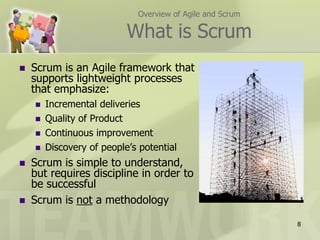
                           What is Scrum
   Scrum is an Agile framework that
    supports lightweight processes
    that emphasize:
       Incremental deliveries
       Quality of Product
       Continuous improvement
       Discovery of people’s potential
   Scrum is simple to understand,
    but requires discipline in order to
    be successful
   Scrum is not a methodology

                                                           8
Overview of Agile and Scrum


                       Foundations of Scrum
   Empiricism
       Detailed up-front planning and defined processes are replaced
        by just-in-time Inspect and Adapt cycles
   Self-Organization
       Small teams manage their own workload and organize
        themselves around clear goals and constraints
   Prioritization
       Do the next right thing
   Rhythm
       Allows teams to avoid daily noise and focus on delivery
   Collaboration
       Leaders and customers work with the Team, rather than
        directing them


                                                                        9
Overview of Agile and Scrum


                                Core Values
   Transparency
      Everything about a project is visible to everyone
   Commitment
      Be willing to commit to a goal
   Courage
      Have the courage to commit, to act, to be open and to expect
       respect
   Focus
      Focus all of your efforts and skills on doing the work that you
       have committed to doing
   Respect
      Respect and trust the different people who comprise a team

                                                                    10
Scrum: Vision and Product
Please dial in to (218) 895-4640   PIN: 3289145
Scrum: Vision and Product

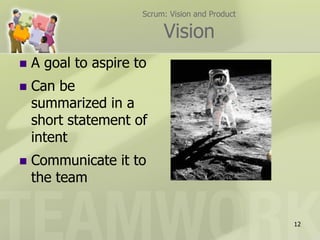
                           Vision
   A goal to aspire to
   Can be
    summarized in a
    short statement of
    intent
   Communicate it to
    the team


                                                  12
Scrum: Vision and Product

                 Role: Product Owner
   Thought Leader and Visionary
   Drives the Product Vision (for example, with
    Story Mapping)
   Prioritizes the Goals - User Stories
   Maintains the Product Backlog with the team
   Accepts the Working Product (on behalf of
    the customer)
                                                    13
Scrum: Sprint
Scrum: Sprint

                    Role: ScrumMaster
   Servant Leader
   Facilitates the Process
   Supports the Team
   Removes Organizational Impediments
   Socializes Scrum to Management
   Enable close collaboration across all roles and
    functions

                                                      15
Scrum: Sprint

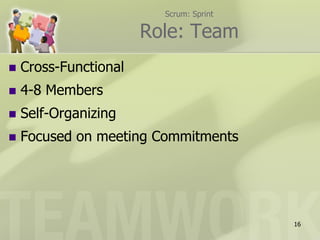
                       Role: Team
   Cross-Functional
   4-8 Members
   Self-Organizing
   Focused on meeting Commitments


                                         16
Scrum: Sprint

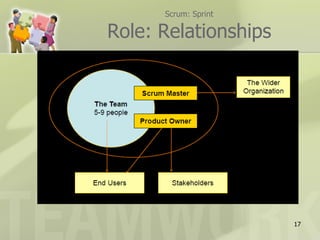
Role: Relationships


                      17
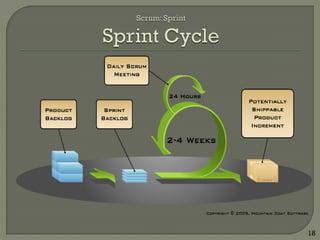
18
Scrum: Sprint

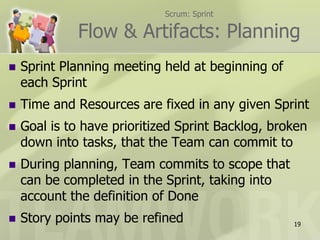
              Flow & Artifacts: Planning
   Sprint Planning meeting held at beginning of
    each Sprint
   Time and Resources are fixed in any given Sprint
   Goal is to have prioritized Sprint Backlog, broken
    down into tasks, that the Team can commit to
   During planning, Team commits to scope that
    can be completed in the Sprint, taking into
    account the definition of Done
   Story points may be refined                    19
Scrum: Sprint

           Flow & Artifacts: Daily Standup
 Meetings held in same location, same time,
  every day
 Timeboxed at 15 minutes
 Encourages self-organization, rhythm, and
  collaboration
 Not a status meeting
 Each Team member speaks to:
     What did I accomplish in the last 24 hours
     What do I plan to accomplish in the next 24 hours
                                                    20
Scrum: Sprint

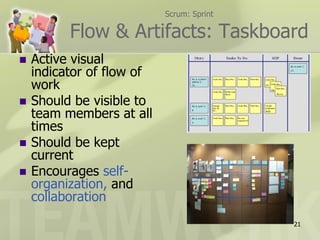
          Flow & Artifacts: Taskboard
   Active visual
    indicator of flow of
    work
   Should be visible to
    team members at all
    times
   Should be kept
    current
   Encourages self-
    organization, and
    collaboration
                                           21
Scrum: Sprint

           Flow & Artifacts: Sprint Review
   Occurs at the end of each Sprint
   Inspect and Adapt the product (Empiricism)
   The team meets with the Product Owner (and
    Stakeholders) to demonstrate the working
    software from the Sprint
   This is a hands-on software demo (not a
    PowerPoint) that usually requires some prep
    beforehand
                                              22
Scrum: Sprint

           Flow & Artifacts: Retrospective
   Occurs at the end of each Sprint
   Inspect and Adapt the process (Empiricism)
   Team and ScrumMaster meet to reflect on
    what went well and what can be improved
   Tone of the meeting is that everyone did their
    best and now look to how can we improve
   Retrospectives must conclude with team
    commitments to action
                                               23
What is in it for me? (Customer)

   As a customer , I want to be able to
     Have   Opportunity to provide feedback
      early
     Go to market faster with Quality
     Faster return on investment


                                              24
What is in it for me?
           (Leadership)
   As a Leader , I want
     To understand progress in terms of
      real progress made on product .
     Better engaged & accountable team


                                           25
What is in it for me? ( Team Member)

 Who is a typical team member?
 As a team member, I want

    A  sustainable pace
     Satisfaction of quality product
      delivered
     Clear Priority and less interruption
      during development
                                             26
How do you learn Scrum – By Doing?


 Apply few practices at a time
 Understand the values and
  foundations
 Inspect and Adapt
 Experience the Joy of Doing Scrum


                                          27
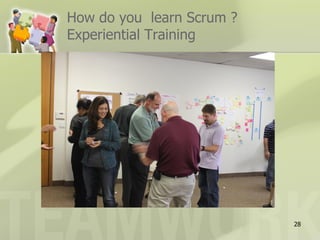
How do you learn Scrum ?
Experiential Training


                           28
Pay-it-forward / Donation
        only trainings
1 day Agile & Scrum Training
- July 15th – Irvine
- July 18th – Seattle
- July 27th – Boston
- July 29th – New York
- July 30th – Denver/Boulder


                                    29
User groups /Communities
 APLN – Agile Project Leadership Network
 Scrum Alliance – Scrum User Groups

 Online    User Groups
    Scrum Alliance


                                            30
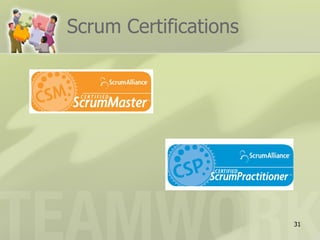
Scrum Certifications


                       31
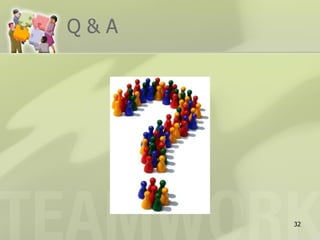
Q&A


      32
   Scrum is a lightweight framework with
    a simple set of rules, built on
    foundations and values

   Scrum enables teams to discover their
    true potential and deliver quality
    software that adds business value

                                            33
Donation only 1 day Trainings

   Irvine – July 15th
       http://agile.conscires.com/1-day-agile-scrum-training-irvine-05/
   Seattle – July 18th
       http://agile.conscires.com/agile-scrum-training-seattle-03/
   Boston – July 27th
       http://agile.conscires.com/1-day-agile-scrum-training-boston-
        03/
   New York– July 29th
       http://agile.conscires.com/1-day-agile-scrum-training-newjersy-
        01/
   Denver – July 30th
       http://agile.conscires.com/scrum-1-day-training-denver-03/

                                                                   34
Thank you !
   More Resources at
       http://agile.conscires.com/suggested-reading-list-
        and-resources/

    Contact Info
         Bachan Anand
         Bachan.anand@conscires.com
         949-232-8900
         http://www.linkedin.com/in/bachan

                                                       35

Introduction to Scrum

  • 1.
    Scrum Intro What’s in it for me? Prepared by Bachan Anand Please dial in to (218) 895-4640 PIN: 3289145 Or use VOIP from your computer
  • 2.
    Agenda  Overview of Agile and Scrum  Scrum: Vision and Product  Scrum: Sprint  What’s in it for me Please dial in to (218) 895-4640 PIN: 3289145 2
  • 3.
    Overview of Agileand Scrum Please dial in to (218) 895-4640 PIN: 3289145
  • 4.
    Overview of Agileand Scrum Agile Manifesto  Agile is a set of values:  Individuals and interactions over processes and tools  Working software (Products) over comprehensive documentation  Customer collaboration over contract negotiation  Responding to change over following a plan Please dial in to (218) 895-4640 PIN: 3289145 4
  • 5.
    Overview of Agileand Scrum Agile Principles  Highest priority is to satisfy the customer through early and continuous delivery of valuable software/products  Welcome changing requirements  Deliver working software (product) frequently  Business people and developers must work together daily throughout the project Please dial in to (218) 895-4640 PIN: 3289145 5
  • 6.
    Overview of Agileand Scrum Agile Principles  Build projects around motivated individuals  Most efficient and effective method of conveying information is face-to-face conversation  Working software (product) is the primary measure of progress  Agile processes promote sustainable development (maintain a constant pace indefinitely) 6 Please dial in to (218) 895-4640 PIN: 3289145
  • 7.
    Overview of Agileand Scrum Agile Principles …cont’d  Continuous attention to technical excellence and good design enhances agility  Simplicity (art of maximizing amount of work not done) is essential  Best architectures, requirements, and designs emerge from self-organizing teams  At regular intervals, team reflects on how to become more effective, then tunes and adjusts http://agilemanifesto.org/principles.html Please dial in to (218) 895-4640 PIN: 3289145 7
  • 8.
    Overview of Agileand Scrum What is Scrum  Scrum is an Agile framework that supports lightweight processes that emphasize:  Incremental deliveries  Quality of Product  Continuous improvement  Discovery of people’s potential  Scrum is simple to understand, but requires discipline in order to be successful  Scrum is not a methodology 8
  • 9.
    Overview of Agileand Scrum Foundations of Scrum  Empiricism  Detailed up-front planning and defined processes are replaced by just-in-time Inspect and Adapt cycles  Self-Organization  Small teams manage their own workload and organize themselves around clear goals and constraints  Prioritization  Do the next right thing  Rhythm  Allows teams to avoid daily noise and focus on delivery  Collaboration  Leaders and customers work with the Team, rather than directing them 9
  • 10.
    Overview of Agileand Scrum Core Values  Transparency  Everything about a project is visible to everyone  Commitment  Be willing to commit to a goal  Courage  Have the courage to commit, to act, to be open and to expect respect  Focus  Focus all of your efforts and skills on doing the work that you have committed to doing  Respect  Respect and trust the different people who comprise a team 10
  • 11.
    Scrum: Vision andProduct Please dial in to (218) 895-4640 PIN: 3289145
  • 12.
    Scrum: Vision andProduct Vision  A goal to aspire to  Can be summarized in a short statement of intent  Communicate it to the team 12
  • 13.
    Scrum: Vision andProduct Role: Product Owner  Thought Leader and Visionary  Drives the Product Vision (for example, with Story Mapping)  Prioritizes the Goals - User Stories  Maintains the Product Backlog with the team  Accepts the Working Product (on behalf of the customer) 13
  • 14.
  • 15.
    Scrum: Sprint Role: ScrumMaster  Servant Leader  Facilitates the Process  Supports the Team  Removes Organizational Impediments  Socializes Scrum to Management  Enable close collaboration across all roles and functions 15
  • 16.
    Scrum: Sprint Role: Team  Cross-Functional  4-8 Members  Self-Organizing  Focused on meeting Commitments 16
  • 17.
  • 18.
  • 19.
    Scrum: Sprint Flow & Artifacts: Planning  Sprint Planning meeting held at beginning of each Sprint  Time and Resources are fixed in any given Sprint  Goal is to have prioritized Sprint Backlog, broken down into tasks, that the Team can commit to  During planning, Team commits to scope that can be completed in the Sprint, taking into account the definition of Done  Story points may be refined 19
  • 20.
    Scrum: Sprint Flow & Artifacts: Daily Standup  Meetings held in same location, same time, every day  Timeboxed at 15 minutes  Encourages self-organization, rhythm, and collaboration  Not a status meeting  Each Team member speaks to:  What did I accomplish in the last 24 hours  What do I plan to accomplish in the next 24 hours 20
  • 21.
    Scrum: Sprint Flow & Artifacts: Taskboard  Active visual indicator of flow of work  Should be visible to team members at all times  Should be kept current  Encourages self- organization, and collaboration 21
  • 22.
    Scrum: Sprint Flow & Artifacts: Sprint Review  Occurs at the end of each Sprint  Inspect and Adapt the product (Empiricism)  The team meets with the Product Owner (and Stakeholders) to demonstrate the working software from the Sprint  This is a hands-on software demo (not a PowerPoint) that usually requires some prep beforehand 22
  • 23.
    Scrum: Sprint Flow & Artifacts: Retrospective  Occurs at the end of each Sprint  Inspect and Adapt the process (Empiricism)  Team and ScrumMaster meet to reflect on what went well and what can be improved  Tone of the meeting is that everyone did their best and now look to how can we improve  Retrospectives must conclude with team commitments to action 23
  • 24.
    What is init for me? (Customer)  As a customer , I want to be able to  Have Opportunity to provide feedback early  Go to market faster with Quality  Faster return on investment 24
  • 25.
    What is init for me? (Leadership)  As a Leader , I want  To understand progress in terms of real progress made on product .  Better engaged & accountable team 25
  • 26.
    What is init for me? ( Team Member)  Who is a typical team member?  As a team member, I want A sustainable pace  Satisfaction of quality product delivered  Clear Priority and less interruption during development 26
  • 27.
    How do youlearn Scrum – By Doing?  Apply few practices at a time  Understand the values and foundations  Inspect and Adapt  Experience the Joy of Doing Scrum 27
  • 28.
    How do youlearn Scrum ? Experiential Training 28
  • 29.
    Pay-it-forward / Donation only trainings 1 day Agile & Scrum Training - July 15th – Irvine - July 18th – Seattle - July 27th – Boston - July 29th – New York - July 30th – Denver/Boulder 29
  • 30.
    User groups /Communities APLN – Agile Project Leadership Network  Scrum Alliance – Scrum User Groups  Online User Groups Scrum Alliance 30
  • 31.
  • 32.
    Q&A 32
  • 33.
    Scrum is a lightweight framework with a simple set of rules, built on foundations and values  Scrum enables teams to discover their true potential and deliver quality software that adds business value 33
  • 34.
    Donation only 1day Trainings  Irvine – July 15th  http://agile.conscires.com/1-day-agile-scrum-training-irvine-05/  Seattle – July 18th  http://agile.conscires.com/agile-scrum-training-seattle-03/  Boston – July 27th  http://agile.conscires.com/1-day-agile-scrum-training-boston- 03/  New York– July 29th  http://agile.conscires.com/1-day-agile-scrum-training-newjersy- 01/  Denver – July 30th  http://agile.conscires.com/scrum-1-day-training-denver-03/ 34
  • 35.
    Thank you !  More Resources at  http://agile.conscires.com/suggested-reading-list- and-resources/ Contact Info Bachan Anand Bachan.anand@conscires.com 949-232-8900 http://www.linkedin.com/in/bachan 35