


I’ve been an entrepreneur since the day I was born. I was selling lemonade from the
end of my driveway at 8 years old. I spent my summers cutting my neighbor's grass
and my winters shoveling their snow. At sleep away camp, when we took trips to
Hershey Park, I went to the store and bought chocolate bars at a discount which I
later resold to my bunk at a premium, while my friends focused on winning the big
elephant at the water gun game. By the time I got to college, I realized that I didn’t
have to be the only one doing the work. I could get my friends to work for me and
make a cut of the profit. So, I started a tutoring company and hired my smartest
friends. I got them tutoring gigs, billed them out at $20 and paid them $15. Over
time, I scaled the business and brought it online. I built a reverse auction system
which allowed my clients to submit their tutoring request’s through a cloud based
platform. Next, all the tutors or as I called them ‘nerds’ would bid on the help
request’s allowing students’ to get tutoring at the cheapest price. I thought I was
running an education company but what I learned was that I was running a talent
acquisition company. I got tutors jobs. While running the tutoring marketplace I
became excited by the opportunities and fascinated by the inefficiencies in talent
acquisition.
In 2012, after selling my business I joined the CEO of Mitchell Martin, Gene Holtzman
to help him build Talent Tech Labs. For those of you who don’t know Gene, he is a
forward thinking and dynamic man. To say he is progressive is an understatement.
Gene has been in the talent acquisition space for over 30 years and has always been
an early adopter of technology. As technology started to penetrate the talent space in
a big way, Gene saw a problem and a huge opportunity. The space was disorganized.
The problem: The technologies all claimed to solve hiring problems but they didn’t
identify which ones. The marketing looked like this.
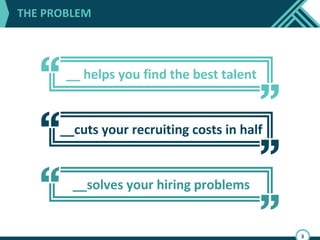
“__ helps you find the best talent”
“__cuts your recruiting costs in half”
“__solves your hiring problems”
Frankly, anybody would be confused. If you call
the companies and ask them what problem
they solve most of them still over generalize
and tell you they “solve all your hiring
problems”.
The solution: We decided to identify all of the
technologies innovating in talent acquisition,
and create a taxonomy that allowed us to
figure out exactly what these companies
solved. This way, when we needed a solution,
we’d go to the map, identify the best product
and solve the problem.
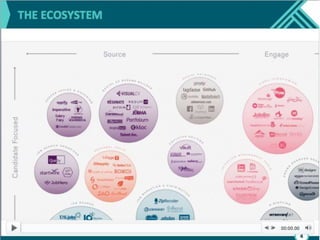
Two years later here is our ecosystem
infographic. I know it’s a bit blurry but as you
can see the space is crowded! Today, we track
over 1200 talent acquisition technology
companies. This infographic shows 250 of the
most innovative and influential companies we
track. We define innovative as those which
have a unique feature-set compared to others
within each distinct bubble and influential as
those which have some traction in market
which would include the number of customers
and amount invested. We’re handing out
copies of our ecosystem at our booth so make
sure you stop by, say hello, and pick up your
own copy after this talk.
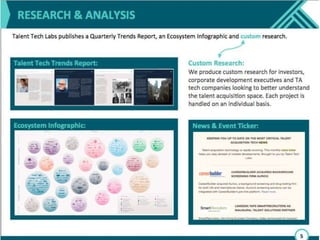
Our ecosystem infographic is only one product
of the research we do at Talent Tech Labs.
Talent Tech Labs is research driven, and we
issue a significant amount of free content. The
first is a trend report issued quarterly, the
second our ecosystem infographic, the third, a
monthly news-ticker which gives you short,
relevant updates on partnerships, mergers and
acquisitions, and investments. The fourth is an
event ticker which lets you know about
relevant events. We also do some custom
research for corporate development
departments and investors looking to learn
about the talent acquisition space.
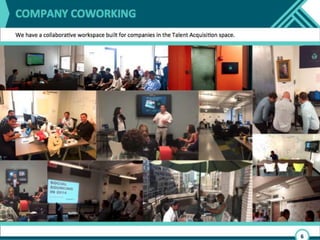
We have a beautiful collaborative workspace.
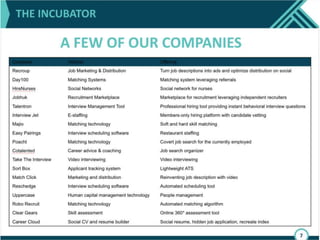
And we run an incubator where we help
companies find product market fit.
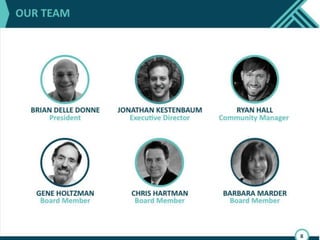
Over the last year our team has grown, we
brought on industry leader Brian Delle Donne
as our President who helped us recapitalize
the company and bring in Mercer and Allegis
Group as partners as well as our head of
community Ryan Hall who is leading our
community engagement initiatives.
Over the last two years I have personally
demoed over 1,200 technology products which
has given me insight into future trends.
I’m amazed by the level of change we are all
living through. And, I’m excited to share the
biggest trends I’ve identified in talent
acquisition for 2016.
Matching is not a new concept. In fact, it has
been around for decades. What’s new is that
the way people look for jobs, and what they
expect when they apply is changing and the
technologies being used, deployed and built
are much more sophisticated.
Let’s start with the obvious. I’m sure you’ve all heard the term ‘Mobile
First’. Well there are 5.2 billion mobile devices and 1.6b of them are
smartphones. To put that into perspective there are only 789m
laptops and 743m desktops. These devices are easy to use, small, and
interactive. Bottom line: Candidate’s are embracing mobile. Recently,
Dice.com reported that at least 35% of candidates who interact with
the site use it on their mobile device. Even dice needs to innovate.
How many of you have tried Tinder? Users no longer want to click and
type. It’s all about tap and swipe.
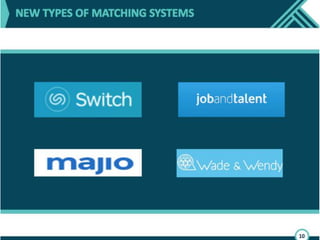
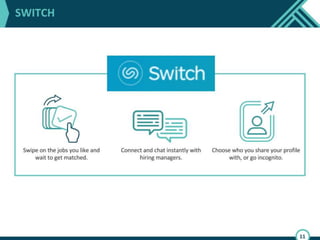
Switch is tinder for jobs. They have a mobile app which allows
candidates to search for jobs like they search for dates. Once a match
is made candidates can chat with the employer in real time. Employers
love the tool because they can post the job in minutes and chat with
the candidate by lunchtime. Candidates love the app for the same
reason.
We’ve moved from an on demand economy to
a convenience economy. It used to be fine to
go to the store and pick something up but then
Amazon came around and shoppers got used
to getting things on demand; instant
satisfaction. I am a culprit, I rarely shop at
retail stores anymore. Uber took things to the
next level -- not only could people get things
now but they could get them instantly right to
their exact address. Today candidates want
jobs to come to them rather than to have to go
look for jobs.
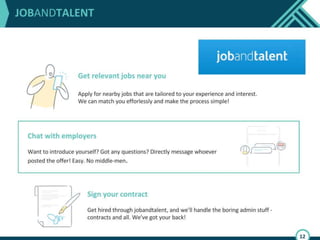
Look at Job & Talent. Job & Talent has a mobile
app which allows candidates to get alerts
when available jobs nearby fit their
qualifications. You fill out an application once
and then jobs get delivered in real time right to
your mobile device.
Candidates are demanding transparency - they
want to know if this job is a good fit before
they apply. Job applications are like black holes
you never know if you are going to hear back
and if you do it could be months later.
Majio’s matching technology sits between your
job application and your ATS. A job seeker can
apply with one click and then Majio shows the
candidate how good of a fit they are for the
job they applied to right away. The power of 1-
click apply and the gratification of instant
feedback increases the number of candidates
at the beginning of your talent acquisition
funnel and speeds up the conversion.
Additionally, the recruiter can immediately
engage the top candidates without waiting or
screening tons of resumes.
Lastly, and something I find very exciting, as AI
enters the field, I believe we will truly see
matching happen at scale.
Look at Wade&Wendy. Wade is a chatbot that
lives inside all of your messaging apps. Wade
grows with you throughout your career--your
always-present adviser--opening your eyes to
new professional opportunities. Wade will ask
you questions each day, about your weekend,
your day at work, your colleagues and over
time wade will get to know you better than
any online profile or resume could. Wendy is
the hiring manager's best friend. She lives
inside a company, personifies its essence, and
intelligently vets and delivers candidates which
uniquely complement its mission and culture.
How cool is that!?
Companies have to carefully evaluate talent.
There have long been tools for testing skills,
and complex tests to render psychometric
assessments. The problem is that highly skilled
talent is often not inclined to complete lengthy
questionnaires or assessment tests.
Through the creation of simulation games,
applicants can play engaging games on mobile
devices, have fun, and not feel like they are
being tested. In turn, companies can generate
truly remarkable assessment findings.
Organizations everywhere are turning to freelancers and temporary
workers. Studies suggest that 40 percent of the U.S. workforce will be
freelancers by 2020. So it’s no surprise that we've seen an endless
arrival of more and more temporary labor marketplaces and it’s full
impact is only starting to be felt by staffing firms.
Traditionally these temporary marketplaces focused on low-end
outsourced talent but they have been moving up the funnel focusing
on more educated hyper-local talent.
In the last 2 years conventional staffing firms, large and small, have
gradually started to pay attention to these innovations. Kelly’s
partnership with Upwork is an example, as is Adecco’s purchase of
Onforce, and Randstad’s investment in Gigwalk.
Kelly’s purchase is the first instance of a traditional staffing firm
partnering with a large online free marketplace. In this model the
Upwork marketplace essentially becomes the supplier or sourcing pool
of online talent which can be consumed by enterprises and “managed
by Kelly.” This could completely disintermediate the recruiter.
Additionally, I believe we will begin to see staffing firms start to
leverage their temporary labor marketplace to showcase their excess
capacity to employers directly, completely disintermediating their sales
people.
Look at TalentSwype. Staffing firms can
automatically share their excess inventory
(candidates coming off billing) into a private
marketplace which can be used by salespeople
as a tool to engage new clients or existing
ones. Eventually the sales person can be
disintermediated completely. The old models
are too restrictive, business economics are
driving the need for change in work
arrangements, and these technologies will
enable that change.
Recruiting is a specialized version of sales and
marketing. So why has our candidate
relationship management function lagged so
far behind in comparison? Hard to say why, but
we see that about to change.
Recruitment organizations must begin to
masterfully manage all of their interactions
with potential candidates just like customers.
The newest CRM systems help people track
interactions, and measure them. They identify
why the top recruiters are successful, allowing
companies to share and institutionalize that
knowledge.
Look for real breakthroughs as CRM systems
start behaving like platforms and become
adept at running inbound marketing
campaigns.
How many platforms does your company rely
on? Likely more than you realize. Organizations
want to stay flexible and maintain efficiencies
so they end up utilizing the best component
solutions even if found in separate apps.
Truly efficient talent tech solutions need to
integrate with other platforms. Cutting edge
tools need to fit into your ATS, email marketing
system, performance management, and every
other people-component within the company.
Expect the next generation of systems to be
built with more open architectures allowing
the easy use of web services and APIs to
communicate between apps. Proprietary or
closed platforms are a thing of the past.
As these open systems enter the market I
believe we are about to see a ton of AaaS, yes
you heard me right, analytics-as-a-service.
Analytics-as-a-Service will connect the data
from all of the point solutions and will allow
recruitment managers to track success.
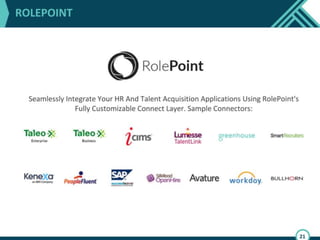
We love what RolePoint is doing with their
connect product. RolePoint Connect is a fully
functioning integration platform as a service,
forming a middleware layer between any ATS,
CRM or job board. Companies no longer need
to connect to multiple API’s they just need to
connect to one and they have access to all
these other systems.
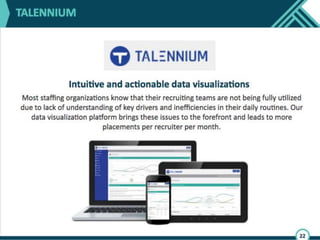
Talennium is another great company. Staffing
companies and in-house corporate recruiting
teams struggle to understand what drives
performance. This is due to their poor
adherence to processes and lack of data
quality. Talennium is a data dashboard which
aggregates data from the different point
solutions within the talent acquisition
technology stack.
We have some awesome companies with us
today. Coworks (a Freelance Management
System), Rolepoint (a Referral Tool and API
connector), Day100 (a matching system which
leverages references), TalentBrew/TMP
workdwide (a job marketing and distribution
platform), and Clinch (a Candidate Relationship
Management tool), all innovating in different
parts of the talent acquisition field. I highly
suggest you take some time to demo their
products sometime over the next two days.
If you are seeing additional trends taking shape
in 2016, please share these so we can keep
sight on what’s emerging in the talent
acquisition technology space.
Thanks. Contact us. www.talenttechlabs.com

#HRTF16 Talent Tech Labs Presentation

  • 2.
    I’ve been anentrepreneur since the day I was born. I was selling lemonade from the end of my driveway at 8 years old. I spent my summers cutting my neighbor's grass and my winters shoveling their snow. At sleep away camp, when we took trips to Hershey Park, I went to the store and bought chocolate bars at a discount which I later resold to my bunk at a premium, while my friends focused on winning the big elephant at the water gun game. By the time I got to college, I realized that I didn’t have to be the only one doing the work. I could get my friends to work for me and make a cut of the profit. So, I started a tutoring company and hired my smartest friends. I got them tutoring gigs, billed them out at $20 and paid them $15. Over time, I scaled the business and brought it online. I built a reverse auction system which allowed my clients to submit their tutoring request’s through a cloud based platform. Next, all the tutors or as I called them ‘nerds’ would bid on the help request’s allowing students’ to get tutoring at the cheapest price. I thought I was running an education company but what I learned was that I was running a talent acquisition company. I got tutors jobs. While running the tutoring marketplace I became excited by the opportunities and fascinated by the inefficiencies in talent acquisition. In 2012, after selling my business I joined the CEO of Mitchell Martin, Gene Holtzman to help him build Talent Tech Labs. For those of you who don’t know Gene, he is a forward thinking and dynamic man. To say he is progressive is an understatement. Gene has been in the talent acquisition space for over 30 years and has always been an early adopter of technology. As technology started to penetrate the talent space in a big way, Gene saw a problem and a huge opportunity. The space was disorganized. The problem: The technologies all claimed to solve hiring problems but they didn’t identify which ones. The marketing looked like this.
  • 3.
    “__ helps youfind the best talent” “__cuts your recruiting costs in half” “__solves your hiring problems” Frankly, anybody would be confused. If you call the companies and ask them what problem they solve most of them still over generalize and tell you they “solve all your hiring problems”. The solution: We decided to identify all of the technologies innovating in talent acquisition, and create a taxonomy that allowed us to figure out exactly what these companies solved. This way, when we needed a solution, we’d go to the map, identify the best product and solve the problem.
  • 4.
    Two years laterhere is our ecosystem infographic. I know it’s a bit blurry but as you can see the space is crowded! Today, we track over 1200 talent acquisition technology companies. This infographic shows 250 of the most innovative and influential companies we track. We define innovative as those which have a unique feature-set compared to others within each distinct bubble and influential as those which have some traction in market which would include the number of customers and amount invested. We’re handing out copies of our ecosystem at our booth so make sure you stop by, say hello, and pick up your own copy after this talk.
  • 5.
    Our ecosystem infographicis only one product of the research we do at Talent Tech Labs. Talent Tech Labs is research driven, and we issue a significant amount of free content. The first is a trend report issued quarterly, the second our ecosystem infographic, the third, a monthly news-ticker which gives you short, relevant updates on partnerships, mergers and acquisitions, and investments. The fourth is an event ticker which lets you know about relevant events. We also do some custom research for corporate development departments and investors looking to learn about the talent acquisition space.
  • 6.
    We have abeautiful collaborative workspace.
  • 7.
    And we runan incubator where we help companies find product market fit.
  • 8.
    Over the lastyear our team has grown, we brought on industry leader Brian Delle Donne as our President who helped us recapitalize the company and bring in Mercer and Allegis Group as partners as well as our head of community Ryan Hall who is leading our community engagement initiatives.
  • 9.
    Over the lasttwo years I have personally demoed over 1,200 technology products which has given me insight into future trends. I’m amazed by the level of change we are all living through. And, I’m excited to share the biggest trends I’ve identified in talent acquisition for 2016.
  • 10.
    Matching is nota new concept. In fact, it has been around for decades. What’s new is that the way people look for jobs, and what they expect when they apply is changing and the technologies being used, deployed and built are much more sophisticated.
  • 11.
    Let’s start withthe obvious. I’m sure you’ve all heard the term ‘Mobile First’. Well there are 5.2 billion mobile devices and 1.6b of them are smartphones. To put that into perspective there are only 789m laptops and 743m desktops. These devices are easy to use, small, and interactive. Bottom line: Candidate’s are embracing mobile. Recently, Dice.com reported that at least 35% of candidates who interact with the site use it on their mobile device. Even dice needs to innovate. How many of you have tried Tinder? Users no longer want to click and type. It’s all about tap and swipe. Switch is tinder for jobs. They have a mobile app which allows candidates to search for jobs like they search for dates. Once a match is made candidates can chat with the employer in real time. Employers love the tool because they can post the job in minutes and chat with the candidate by lunchtime. Candidates love the app for the same reason.
  • 12.
    We’ve moved froman on demand economy to a convenience economy. It used to be fine to go to the store and pick something up but then Amazon came around and shoppers got used to getting things on demand; instant satisfaction. I am a culprit, I rarely shop at retail stores anymore. Uber took things to the next level -- not only could people get things now but they could get them instantly right to their exact address. Today candidates want jobs to come to them rather than to have to go look for jobs. Look at Job & Talent. Job & Talent has a mobile app which allows candidates to get alerts when available jobs nearby fit their qualifications. You fill out an application once and then jobs get delivered in real time right to your mobile device.
  • 13.
    Candidates are demandingtransparency - they want to know if this job is a good fit before they apply. Job applications are like black holes you never know if you are going to hear back and if you do it could be months later. Majio’s matching technology sits between your job application and your ATS. A job seeker can apply with one click and then Majio shows the candidate how good of a fit they are for the job they applied to right away. The power of 1- click apply and the gratification of instant feedback increases the number of candidates at the beginning of your talent acquisition funnel and speeds up the conversion. Additionally, the recruiter can immediately engage the top candidates without waiting or screening tons of resumes.
  • 14.
    Lastly, and somethingI find very exciting, as AI enters the field, I believe we will truly see matching happen at scale. Look at Wade&Wendy. Wade is a chatbot that lives inside all of your messaging apps. Wade grows with you throughout your career--your always-present adviser--opening your eyes to new professional opportunities. Wade will ask you questions each day, about your weekend, your day at work, your colleagues and over time wade will get to know you better than any online profile or resume could. Wendy is the hiring manager's best friend. She lives inside a company, personifies its essence, and intelligently vets and delivers candidates which uniquely complement its mission and culture. How cool is that!?
  • 15.
    Companies have tocarefully evaluate talent. There have long been tools for testing skills, and complex tests to render psychometric assessments. The problem is that highly skilled talent is often not inclined to complete lengthy questionnaires or assessment tests.
  • 16.
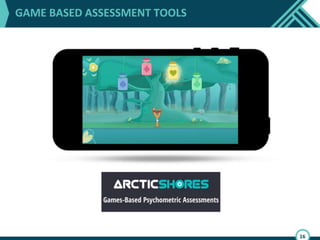
    Through the creationof simulation games, applicants can play engaging games on mobile devices, have fun, and not feel like they are being tested. In turn, companies can generate truly remarkable assessment findings.
  • 17.
    Organizations everywhere areturning to freelancers and temporary workers. Studies suggest that 40 percent of the U.S. workforce will be freelancers by 2020. So it’s no surprise that we've seen an endless arrival of more and more temporary labor marketplaces and it’s full impact is only starting to be felt by staffing firms. Traditionally these temporary marketplaces focused on low-end outsourced talent but they have been moving up the funnel focusing on more educated hyper-local talent. In the last 2 years conventional staffing firms, large and small, have gradually started to pay attention to these innovations. Kelly’s partnership with Upwork is an example, as is Adecco’s purchase of Onforce, and Randstad’s investment in Gigwalk. Kelly’s purchase is the first instance of a traditional staffing firm partnering with a large online free marketplace. In this model the Upwork marketplace essentially becomes the supplier or sourcing pool of online talent which can be consumed by enterprises and “managed by Kelly.” This could completely disintermediate the recruiter. Additionally, I believe we will begin to see staffing firms start to leverage their temporary labor marketplace to showcase their excess capacity to employers directly, completely disintermediating their sales people.
  • 18.
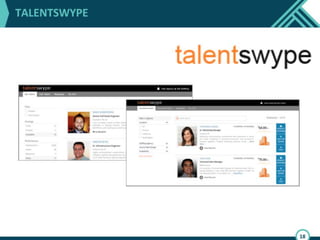
    Look at TalentSwype.Staffing firms can automatically share their excess inventory (candidates coming off billing) into a private marketplace which can be used by salespeople as a tool to engage new clients or existing ones. Eventually the sales person can be disintermediated completely. The old models are too restrictive, business economics are driving the need for change in work arrangements, and these technologies will enable that change.
  • 19.
    Recruiting is aspecialized version of sales and marketing. So why has our candidate relationship management function lagged so far behind in comparison? Hard to say why, but we see that about to change. Recruitment organizations must begin to masterfully manage all of their interactions with potential candidates just like customers. The newest CRM systems help people track interactions, and measure them. They identify why the top recruiters are successful, allowing companies to share and institutionalize that knowledge. Look for real breakthroughs as CRM systems start behaving like platforms and become adept at running inbound marketing campaigns.
  • 20.
    How many platformsdoes your company rely on? Likely more than you realize. Organizations want to stay flexible and maintain efficiencies so they end up utilizing the best component solutions even if found in separate apps. Truly efficient talent tech solutions need to integrate with other platforms. Cutting edge tools need to fit into your ATS, email marketing system, performance management, and every other people-component within the company. Expect the next generation of systems to be built with more open architectures allowing the easy use of web services and APIs to communicate between apps. Proprietary or closed platforms are a thing of the past. As these open systems enter the market I believe we are about to see a ton of AaaS, yes you heard me right, analytics-as-a-service.
  • 21.
    Analytics-as-a-Service will connectthe data from all of the point solutions and will allow recruitment managers to track success.
  • 22.
    We love whatRolePoint is doing with their connect product. RolePoint Connect is a fully functioning integration platform as a service, forming a middleware layer between any ATS, CRM or job board. Companies no longer need to connect to multiple API’s they just need to connect to one and they have access to all these other systems.
  • 23.
    Talennium is anothergreat company. Staffing companies and in-house corporate recruiting teams struggle to understand what drives performance. This is due to their poor adherence to processes and lack of data quality. Talennium is a data dashboard which aggregates data from the different point solutions within the talent acquisition technology stack.
  • 24.
    We have someawesome companies with us today. Coworks (a Freelance Management System), Rolepoint (a Referral Tool and API connector), Day100 (a matching system which leverages references), TalentBrew/TMP workdwide (a job marketing and distribution platform), and Clinch (a Candidate Relationship Management tool), all innovating in different parts of the talent acquisition field. I highly suggest you take some time to demo their products sometime over the next two days.
  • 25.
    If you areseeing additional trends taking shape in 2016, please share these so we can keep sight on what’s emerging in the talent acquisition technology space. Thanks. Contact us. www.talenttechlabs.com