
Agile project
managementIntroduction to Scrum
Ing. Jan Verner
@janverner
cz.linkedin.com/in/janverner
14.4.2016 - Site 2/28
About me
16.4.2015 - Site 3/28Introduction Theory Examples Summary
What should you learn?
This presentation brings
• Theoretical basis
• Demonstration on practical examples
• Real world experience
16.4.2015 - Site 4/28Introduction Theory Examples Summary
Theory
• What is scrum?
• When should we use scrum?
• Scrum in detail
• Artifacts
• Roles
• Processes
16.4.2015 - Site 5/28Introduction Theory Examples Summary
What is scrum?
• Framework for project organization
• No specific engineering practices prescribed
• Focused on cooperation with customer
• Product progresses in iterations called “sprints”
• Requirements are captured as items in so called “product
backlog”
• Self-organizing teams
• Opened to change – may vary and be adapted
• Based on Agile manifesto
16.4.2015 - Site 6/28Introduction Theory Examples Summary
Agile manifesto
• Individuals and interactions
over processes and tools
• Working software
over comprehensive documentation
• Customer collaboration
over contract negotiation
• Responding to change
over following a plan
16.4.2015 - Site 7/28Introduction Theory Examples Summary
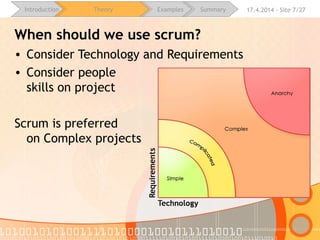
When should we use scrum?
• Consider Technology and Requirements
• Consider people
skills on project
Scrum is preferred
on Complex projects
16.4.2015 - Site 8/28Introduction Theory Examples Summary
Scrum in detail
• Roles
• Product owner
• Scrum master
• Team
• Artifacts
• Product backlog
• Sprint backlog
• Processes
• Sprint planning
• Daily meeting
• Sprint review
• Sprint retrospective
16.4.2015 - Site 9/28Introduction Theory Examples Summary
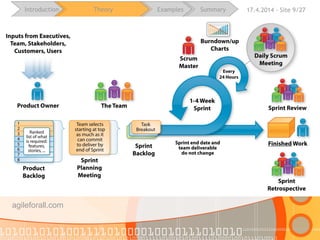
agileforall.com
16.4.2015 - Site 10/28Introduction Theory Examples Summary
Roles – Product owner
• Represents customer
• Defines features of the product
• Adjusts priority of features
• Accepts/rejects sprint results
• Should be available for the Team
during sprint execution to clarify questions
16.4.2015 - Site 11/28Introduction Theory Examples Summary
Roles – Scrum master
• Introduces and supervises scrum
practices and processes
• Enables cooperation across all roles
• Removes sprint impediments
• Shields team from external influences
• Organizes daily meetings
16.4.2015 - Site 12/28Introduction Theory Examples Summary
Roles – Development Team
• Typical size 5-9 members
• Multi-functional (roles sharing)
• Analytics
• Developers
• Testers
• Specialists (e.g. usability)
• Should be collocated
• Full time members
• Improves during sprint retrospective
16.4.2015 - Site 13/28Introduction Theory Examples Summary
Artifacts – Product backlog
• List of product requirements
• Visible and maintained by Product owner
• Communication and information exchange
• Each requirements represented as
Product Backlog Item (PBI)
• Description and acceptance criteria
• Priority (set by the Product owner)
• Effort estimation (set by the Team)
• Each PBI’s size should be smaller than one sprint
• Refining of PBIs (top-down)
16.4.2015 - Site 14/28Introduction Theory Examples Summary
Artifacts – Sprint backlog
• Created at the beginning of each sprint
• Used to document and track planned work
• Contains set of Tasks for each PBI
• Status [To do, In progress, Done]
• Assigned Team member
• Remaining effort [hours]
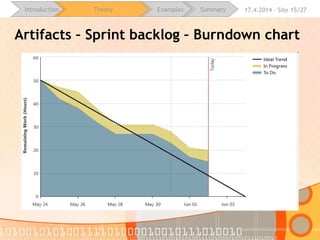
• Contains “burndown” chart
• Visualizes remaining effort in each day of sprint
• Used to track Team progress during sprint
• Used in daily meeting
16.4.2015 - Site 15/28Introduction Theory Examples Summary
Artifacts – Sprint backlog – Burndown chart
16.4.2015 - Site 16/28Introduction Theory Examples Summary
Processes – Sprint planning
• Executed at the beginning of each sprint
• Length approximately 1 day
• Team calculates availability
• Team selects PBIs with highest priority to ongoing sprint
• Team breaks down selected PBIs to Tasks
• Documents all Tasks in Sprint Backlog
• Team commits to selected PBIs
16.4.2015 - Site 17/28Introduction Theory Examples Summary
Processes – Daily meeting
• Used to synchronize Team progress
• Organized every day during sprint execution
• Should be short and effective
• Standup meeting (maximum 15 minutes)
• Every Team member answers
• What has he finished
• What is he going to work on
• Does he have any problems (impediments)
• Review sprint burndown chart
16.4.2015 - Site 18/28Introduction Theory Examples Summary
Processes – Sprint review
• Done at the end of each sprint
• Approximately 3 hours
• Product owner decides on acceptance/rejection
of realized PBIs
• Accepted PBIs are Closed
16.4.2015 - Site 19/28Introduction Theory Examples Summary
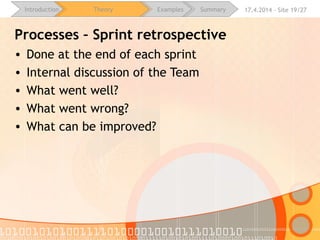
Processes – Sprint retrospective
• Done at the end of each sprint
• Internal discussion of the Team
• What went well?
• What went wrong?
• What can be improved?
16.4.2015 - Site 20/28Introduction Theory Examples Summary
agileforall.com
16.4.2015 - Site 21/28Introduction Theory Examples Summary
Examples
From theory to praxis
• Benefits of agile development
• What is not visible at first glance
• Barriers to Scrum Adoption
• Tooling support
• Demos using Team Foundation Server
16.4.2015 - Site 22/28Introduction Theory Examples Summary
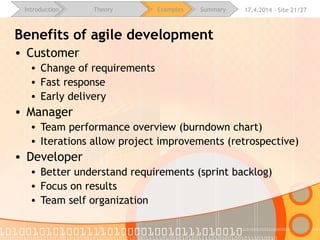
Benefits of agile development
• Customer
• Change of requirements
• Fast response
• Early delivery
• Manager
• Team performance overview (burndown chart)
• Iterations allow project improvements (retrospective)
• Developer
• Better understand requirements (sprint backlog)
• Focus on results
• Team self organization
16.4.2015 - Site 23/28Introduction Theory Examples Summary
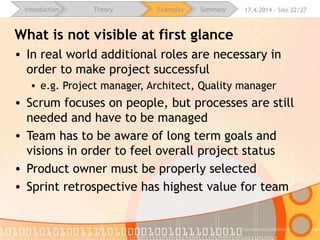
What is not visible at first glance
• In real world additional roles are necessary in order to
make project successful
• e.g. Project manager, Architect, Quality manager
• Scrum focuses on people, but processes are still needed
and have to be managed
• Team has to be aware of long term goals and visions in
order to feel overall project status
• Product owner must be properly selected
• Sprint retrospective has highest value for team
16.4.2015 - Site 24/28Introduction Theory Examples Summary
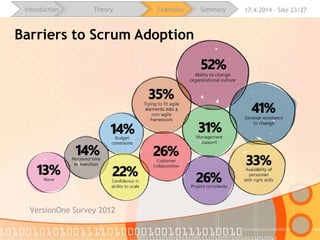
Barriers to Scrum Adoption
VersionOne Survey 2012
16.4.2015 - Site 25/28Introduction Theory Examples Summary
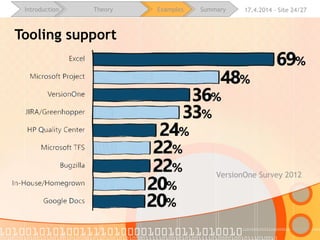
Tooling support
VersionOne Survey 2012
16.4.2015 - Site 26/28Introduction Theory Examples Summary
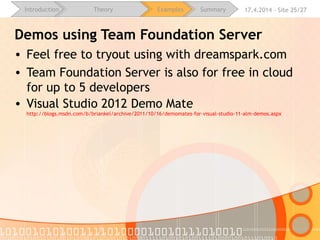
Demos using Team Foundation Server
• Feel free to tryout using with dreamspark.com
• Team Foundation Server is also for free in cloud
for up to 5 developers
• Visual Studio 2012 Demo Mate
http://blogs.msdn.com/b/briankel/archive/2011/10/16/demomates-for-visual-studio-11-alm-demos.aspx
16.4.2015 - Site 27/28Introduction Theory Examples Summary
Summary
• Scrum is about response to change
• Suitable for complex projects
• Product owner is key to success
• Early product delivery helps to optimize project performance
• Sprint backlog contains list of requirements
• Sprint burndown chart tracks Team progress
• Sprint retrospective helps to improve Team
• Proper tooling supports development
14.4.2016 - Site 28/28
Question and Answers…
Respond to survey to get bonus
surveymonkey.com/r/QYVK92K
slideshare.net/janverner
@janverner
cz.linkedin.com/in/janverner

Agile project management

  • 1.
    Agile project managementIntroduction toScrum Ing. Jan Verner @janverner cz.linkedin.com/in/janverner
  • 2.
    14.4.2016 - Site2/28 About me
  • 3.
    16.4.2015 - Site3/28Introduction Theory Examples Summary What should you learn? This presentation brings • Theoretical basis • Demonstration on practical examples • Real world experience
  • 4.
    16.4.2015 - Site4/28Introduction Theory Examples Summary Theory • What is scrum? • When should we use scrum? • Scrum in detail • Artifacts • Roles • Processes
  • 5.
    16.4.2015 - Site5/28Introduction Theory Examples Summary What is scrum? • Framework for project organization • No specific engineering practices prescribed • Focused on cooperation with customer • Product progresses in iterations called “sprints” • Requirements are captured as items in so called “product backlog” • Self-organizing teams • Opened to change – may vary and be adapted • Based on Agile manifesto
  • 6.
    16.4.2015 - Site6/28Introduction Theory Examples Summary Agile manifesto • Individuals and interactions over processes and tools • Working software over comprehensive documentation • Customer collaboration over contract negotiation • Responding to change over following a plan
  • 7.
    16.4.2015 - Site7/28Introduction Theory Examples Summary When should we use scrum? • Consider Technology and Requirements • Consider people skills on project Scrum is preferred on Complex projects
  • 8.
    16.4.2015 - Site8/28Introduction Theory Examples Summary Scrum in detail • Roles • Product owner • Scrum master • Team • Artifacts • Product backlog • Sprint backlog • Processes • Sprint planning • Daily meeting • Sprint review • Sprint retrospective
  • 9.
    16.4.2015 - Site9/28Introduction Theory Examples Summary agileforall.com
  • 10.
    16.4.2015 - Site10/28Introduction Theory Examples Summary Roles – Product owner • Represents customer • Defines features of the product • Adjusts priority of features • Accepts/rejects sprint results • Should be available for the Team during sprint execution to clarify questions
  • 11.
    16.4.2015 - Site11/28Introduction Theory Examples Summary Roles – Scrum master • Introduces and supervises scrum practices and processes • Enables cooperation across all roles • Removes sprint impediments • Shields team from external influences • Organizes daily meetings
  • 12.
    16.4.2015 - Site12/28Introduction Theory Examples Summary Roles – Development Team • Typical size 5-9 members • Multi-functional (roles sharing) • Analytics • Developers • Testers • Specialists (e.g. usability) • Should be collocated • Full time members • Improves during sprint retrospective
  • 13.
    16.4.2015 - Site13/28Introduction Theory Examples Summary Artifacts – Product backlog • List of product requirements • Visible and maintained by Product owner • Communication and information exchange • Each requirements represented as Product Backlog Item (PBI) • Description and acceptance criteria • Priority (set by the Product owner) • Effort estimation (set by the Team) • Each PBI’s size should be smaller than one sprint • Refining of PBIs (top-down)
  • 14.
    16.4.2015 - Site14/28Introduction Theory Examples Summary Artifacts – Sprint backlog • Created at the beginning of each sprint • Used to document and track planned work • Contains set of Tasks for each PBI • Status [To do, In progress, Done] • Assigned Team member • Remaining effort [hours] • Contains “burndown” chart • Visualizes remaining effort in each day of sprint • Used to track Team progress during sprint • Used in daily meeting
  • 15.
    16.4.2015 - Site15/28Introduction Theory Examples Summary Artifacts – Sprint backlog – Burndown chart
  • 16.
    16.4.2015 - Site16/28Introduction Theory Examples Summary Processes – Sprint planning • Executed at the beginning of each sprint • Length approximately 1 day • Team calculates availability • Team selects PBIs with highest priority to ongoing sprint • Team breaks down selected PBIs to Tasks • Documents all Tasks in Sprint Backlog • Team commits to selected PBIs
  • 17.
    16.4.2015 - Site17/28Introduction Theory Examples Summary Processes – Daily meeting • Used to synchronize Team progress • Organized every day during sprint execution • Should be short and effective • Standup meeting (maximum 15 minutes) • Every Team member answers • What has he finished • What is he going to work on • Does he have any problems (impediments) • Review sprint burndown chart
  • 18.
    16.4.2015 - Site18/28Introduction Theory Examples Summary Processes – Sprint review • Done at the end of each sprint • Approximately 3 hours • Product owner decides on acceptance/rejection of realized PBIs • Accepted PBIs are Closed
  • 19.
    16.4.2015 - Site19/28Introduction Theory Examples Summary Processes – Sprint retrospective • Done at the end of each sprint • Internal discussion of the Team • What went well? • What went wrong? • What can be improved?
  • 20.
    16.4.2015 - Site20/28Introduction Theory Examples Summary agileforall.com
  • 21.
    16.4.2015 - Site21/28Introduction Theory Examples Summary Examples From theory to praxis • Benefits of agile development • What is not visible at first glance • Barriers to Scrum Adoption • Tooling support • Demos using Team Foundation Server
  • 22.
    16.4.2015 - Site22/28Introduction Theory Examples Summary Benefits of agile development • Customer • Change of requirements • Fast response • Early delivery • Manager • Team performance overview (burndown chart) • Iterations allow project improvements (retrospective) • Developer • Better understand requirements (sprint backlog) • Focus on results • Team self organization
  • 23.
    16.4.2015 - Site23/28Introduction Theory Examples Summary What is not visible at first glance • In real world additional roles are necessary in order to make project successful • e.g. Project manager, Architect, Quality manager • Scrum focuses on people, but processes are still needed and have to be managed • Team has to be aware of long term goals and visions in order to feel overall project status • Product owner must be properly selected • Sprint retrospective has highest value for team
  • 24.
    16.4.2015 - Site24/28Introduction Theory Examples Summary Barriers to Scrum Adoption VersionOne Survey 2012
  • 25.
    16.4.2015 - Site25/28Introduction Theory Examples Summary Tooling support VersionOne Survey 2012
  • 26.
    16.4.2015 - Site26/28Introduction Theory Examples Summary Demos using Team Foundation Server • Feel free to tryout using with dreamspark.com • Team Foundation Server is also for free in cloud for up to 5 developers • Visual Studio 2012 Demo Mate http://blogs.msdn.com/b/briankel/archive/2011/10/16/demomates-for-visual-studio-11-alm-demos.aspx
  • 27.
    16.4.2015 - Site27/28Introduction Theory Examples Summary Summary • Scrum is about response to change • Suitable for complex projects • Product owner is key to success • Early product delivery helps to optimize project performance • Sprint backlog contains list of requirements • Sprint burndown chart tracks Team progress • Sprint retrospective helps to improve Team • Proper tooling supports development
  • 28.
    14.4.2016 - Site28/28 Question and Answers… Respond to survey to get bonus surveymonkey.com/r/QYVK92K slideshare.net/janverner @janverner cz.linkedin.com/in/janverner

Editor's Notes

  • #3 At the university I’ve missed real world experience… That’s why I’m here
  • #6 XP – Scrum – Agile – Lean explain differences Consider Scrum == Agile Sprints 1-4 weeks Self-organizing – subordinate, boss – adaptability of Team members
  • #7 Ex 1 – CMMI, good cooperation Ex 2 – documentation is necessary Ex 3 – periodical feedback, customer should participate Ex 4 – add new and remove obsolete requirements as a reaction on market changes
  • #10 Iterations Sprint 1-4 weeks Sprint retrospective without PO
  • #14 Product requirements that are known in given time. Effort estimation is used for feedback communication with the Product Owner. Negotiation of size is not common.
  • #18 Informal – at the kitchen after the lunch. Avoid boring meetings
  • #21 Iterations Sprint 1-4 weeks Sprint retrospective without PO
  • #26 Do not use Excel