



The Agile Mindset
Linda Rising
linda@lindarising.org
www.lindarising.org
Disclaimer: This provocative presentation is ideally the
beginning of a conversation. It won't take long for me
to tell you everything I know about cognitive
psychology, although I have been reading in the area
for several years now. I'm an amateur who has
sufficient interest in weird topics and a strange way of
connecting ideas that might or might not be of interestconnecting ideas that might or might not be of interest
to you. Thank you for your tolerance and understanding
of my meanderings and I hope you learn a little that
might help you in your life.
This is not an “academic” presentation, but those
interested in more information are invited to ask me for
references for any part of this talk and I will be happy
to make them available.
Do you mostly agree or mostly
disagree with the following
Intelligence is something very basic that you really
can't change much. You’re born with it or not.
Yes, you can learn new things, but you can'tYes, you can learn new things, but you can't
really change how intelligent you are.
o matter how intelligent you are, you can always
get better, sometimes you can improve a lot.
You can substitute any ability or talent for
“intelligence.”
Interesting experiments
Phase I:
Students were given a very easy set of
questionsquestions
Then they were categorized into “effort” or
“smart” groups (about 50-50)
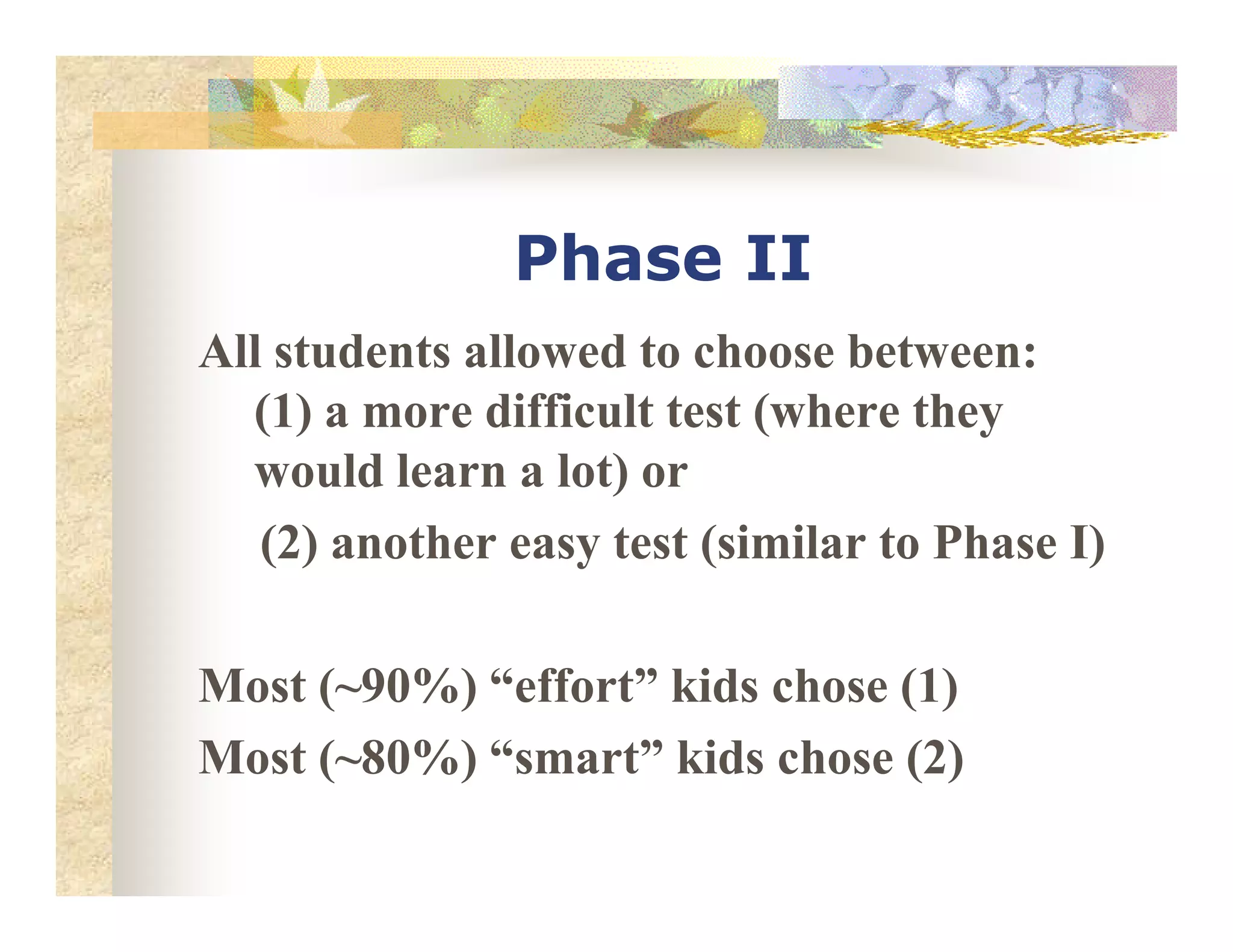
Phase II
All students allowed to choose between:
(1) a more difficult test (where they
would learn a lot) orwould learn a lot) or
(2) another easy test (similar to Phase I)
Most (~90%) “effort” kids chose (1)
Most (~80%) “smart” kids chose (2)
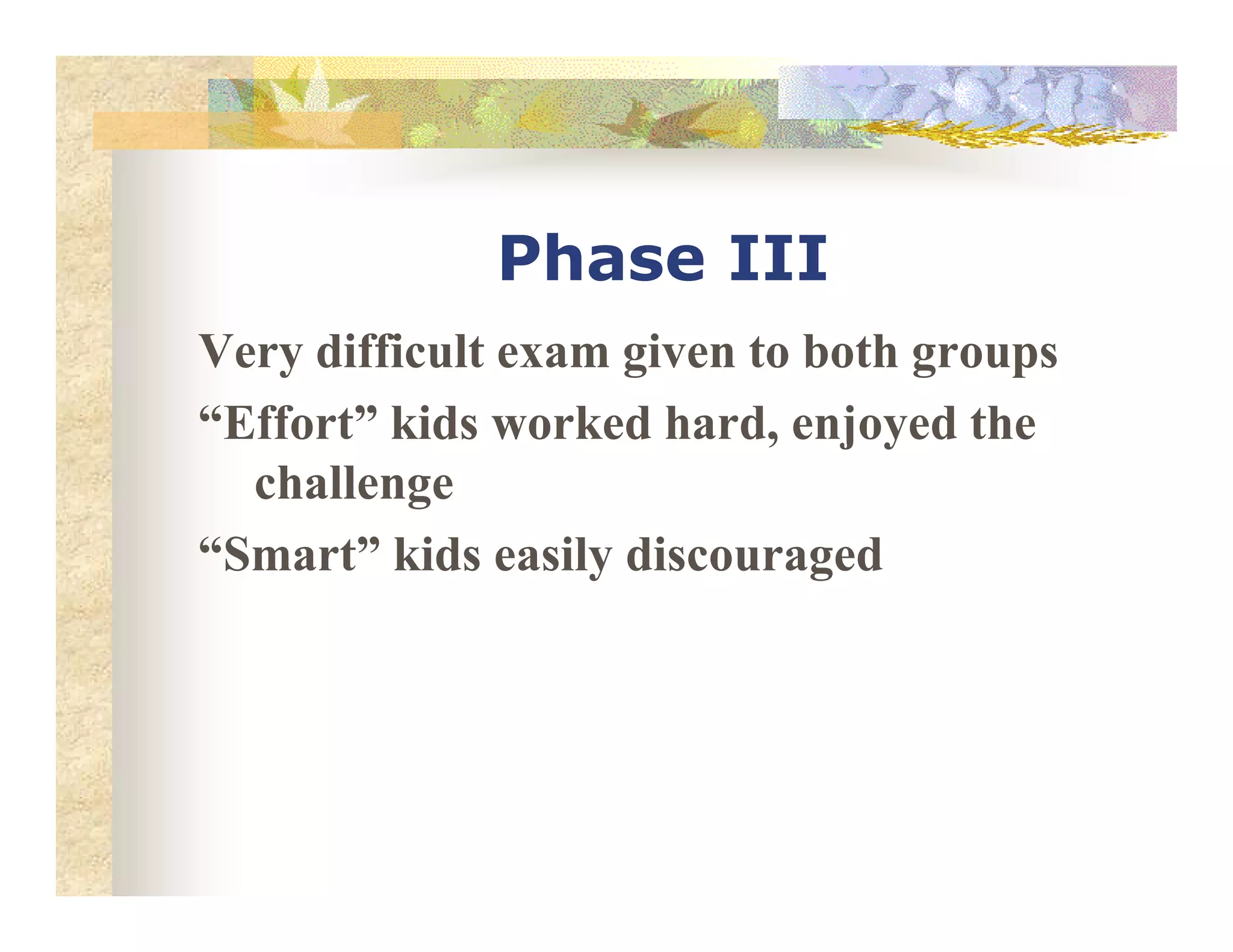
Phase III
Very difficult exam given to both groups
“Effort” kids worked hard, enjoyed the
challengechallenge
“Smart” kids easily discouraged
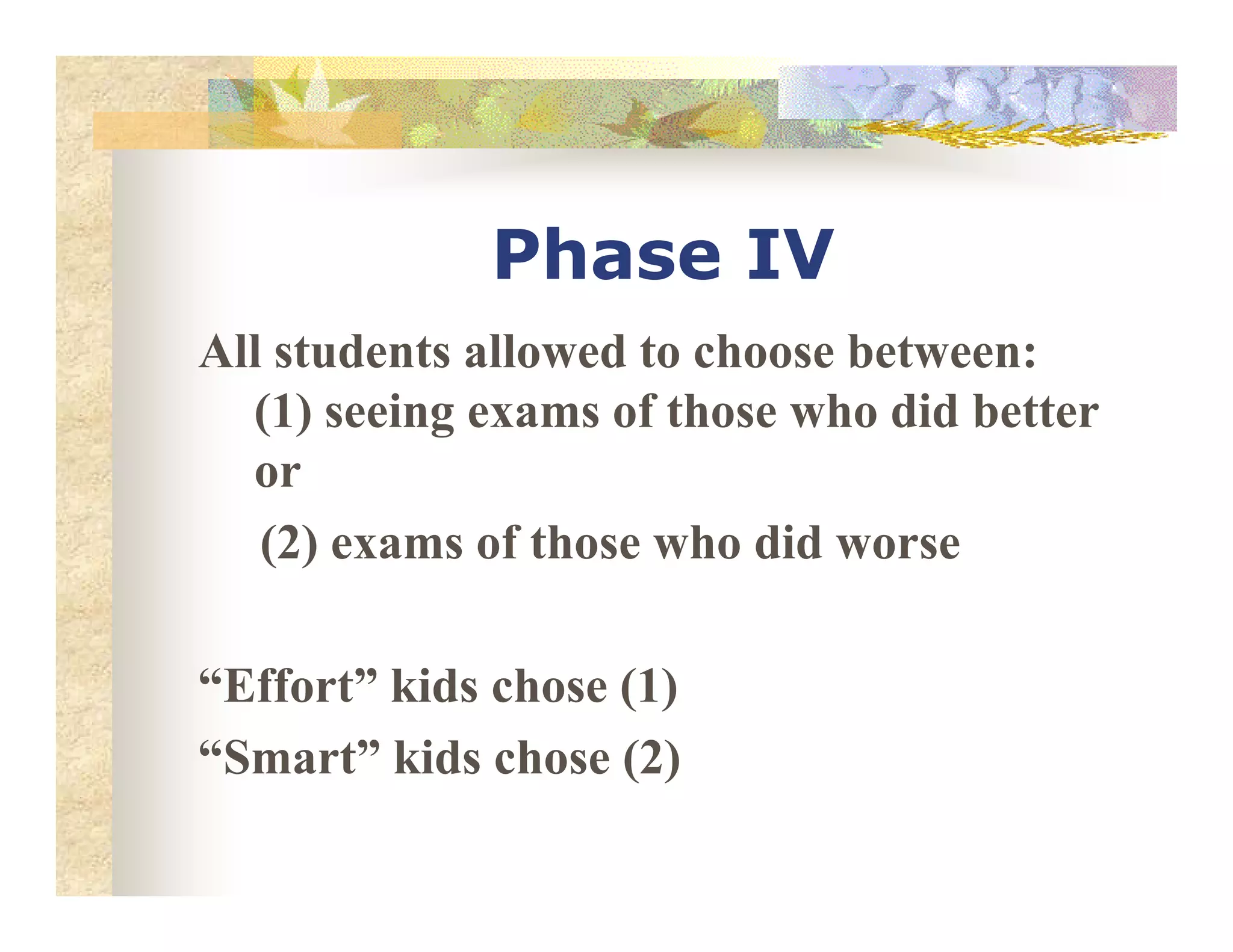
Phase IV
All students allowed to choose between:
(1) seeing exams of those who did better
oror
(2) exams of those who did worse
“Effort” kids chose (1)
“Smart” kids chose (2)
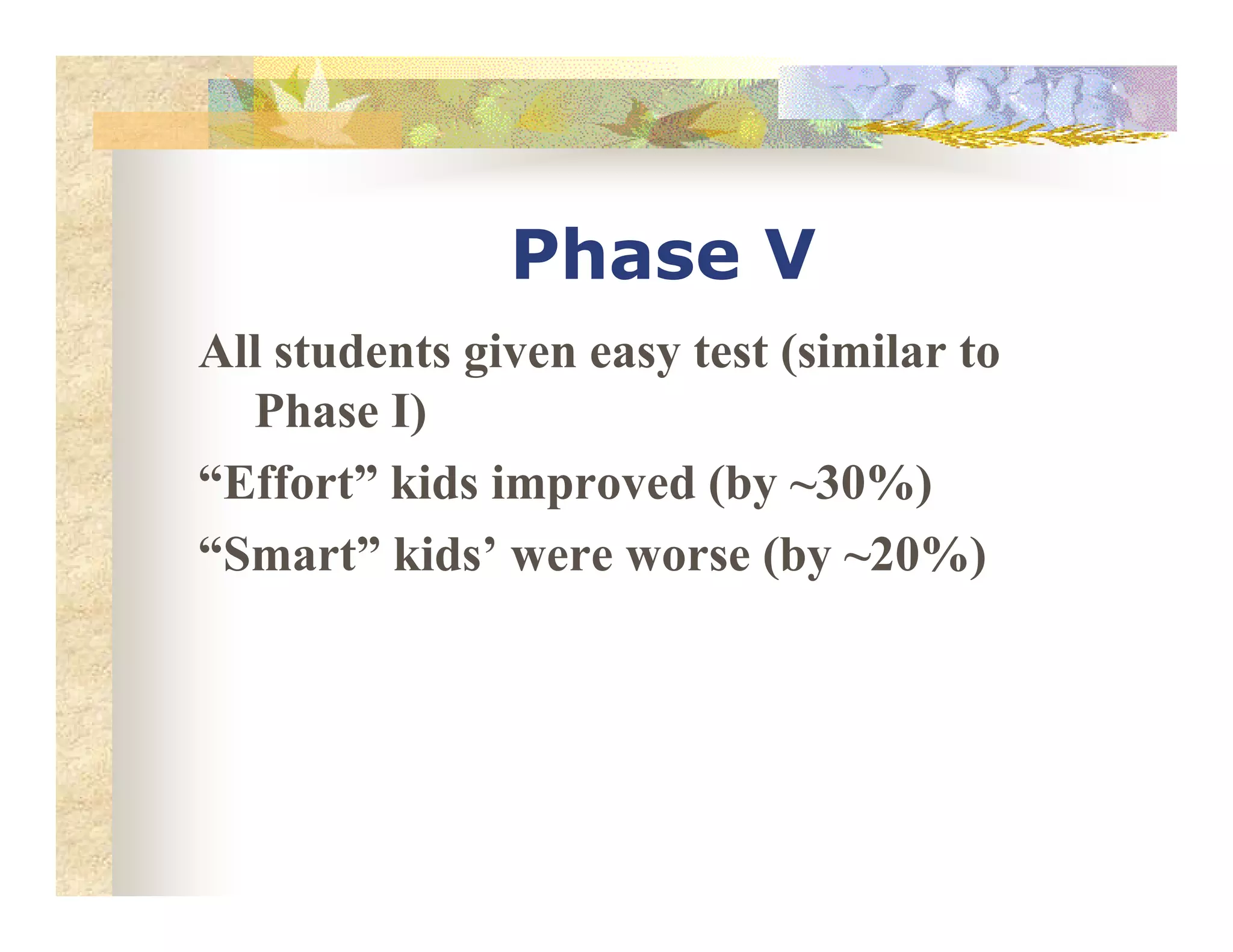
Phase V
All students given easy test (similar to
Phase I)
“Effort” kids improved (by ~30%)“Effort” kids improved (by ~30%)
“Smart” kids’ were worse (by ~20%)
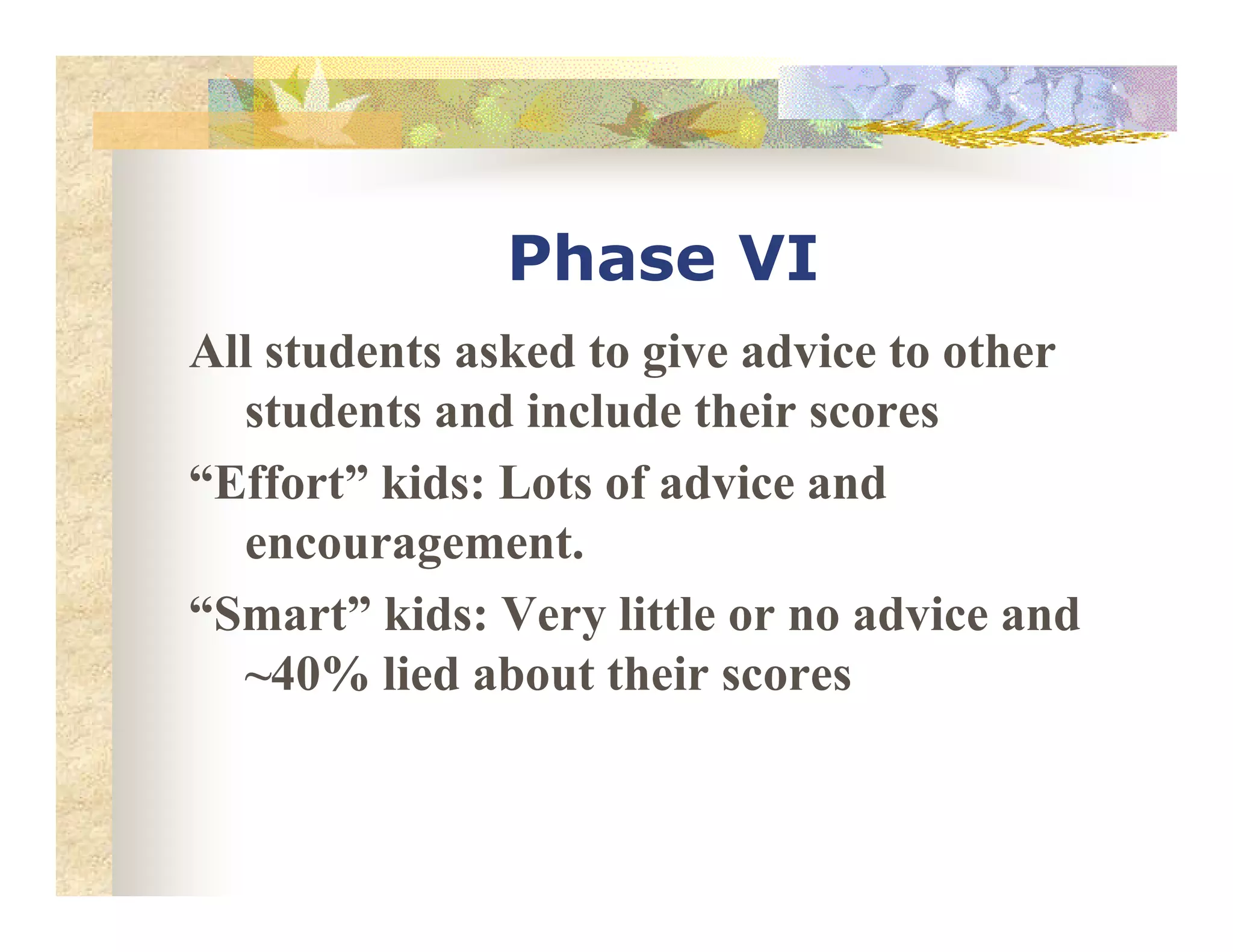
Phase VI
All students asked to give advice to other
students and include their scores
“Effort” kids: Lots of advice and“Effort” kids: Lots of advice and
encouragement.
“Smart” kids: Very little or no advice and
~40% lied about their scores
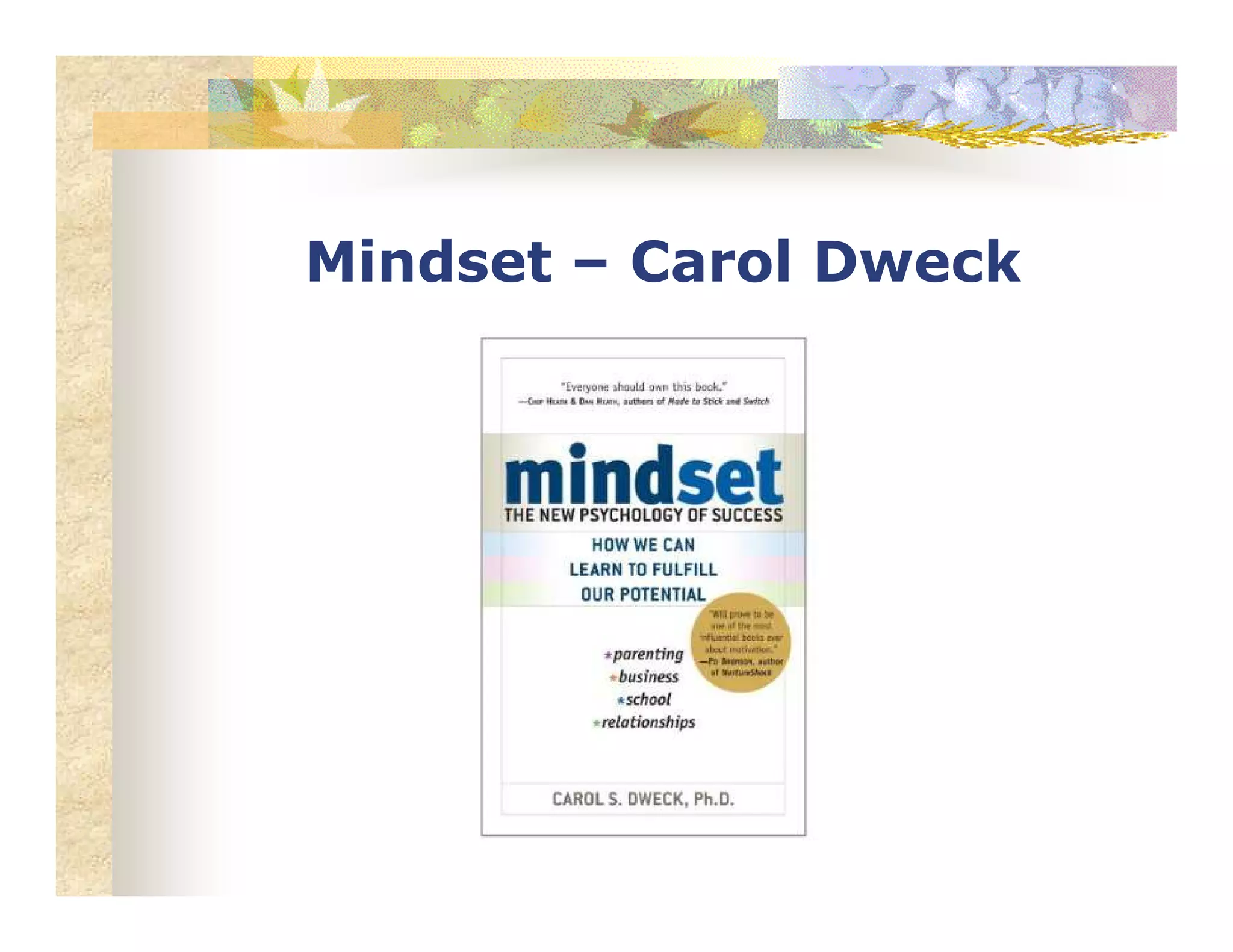
Mindset – Carol Dweck
Self-Theories – Carol Dweck
PR on the web
ew Yorker – “The Talent Myth,”
gladwell.com
ew York Magazine – “How not to talk toew York Magazine – “How not to talk to
your kids,” Po Bronson
TIME magazine – “How to help them
succeed”
Two mindsets: Fixed & Agile
Research shows that mindset:
Determines goals
Reactions to failureReactions to failure
Belief about effort and strategies
Attitudes toward others’ successes
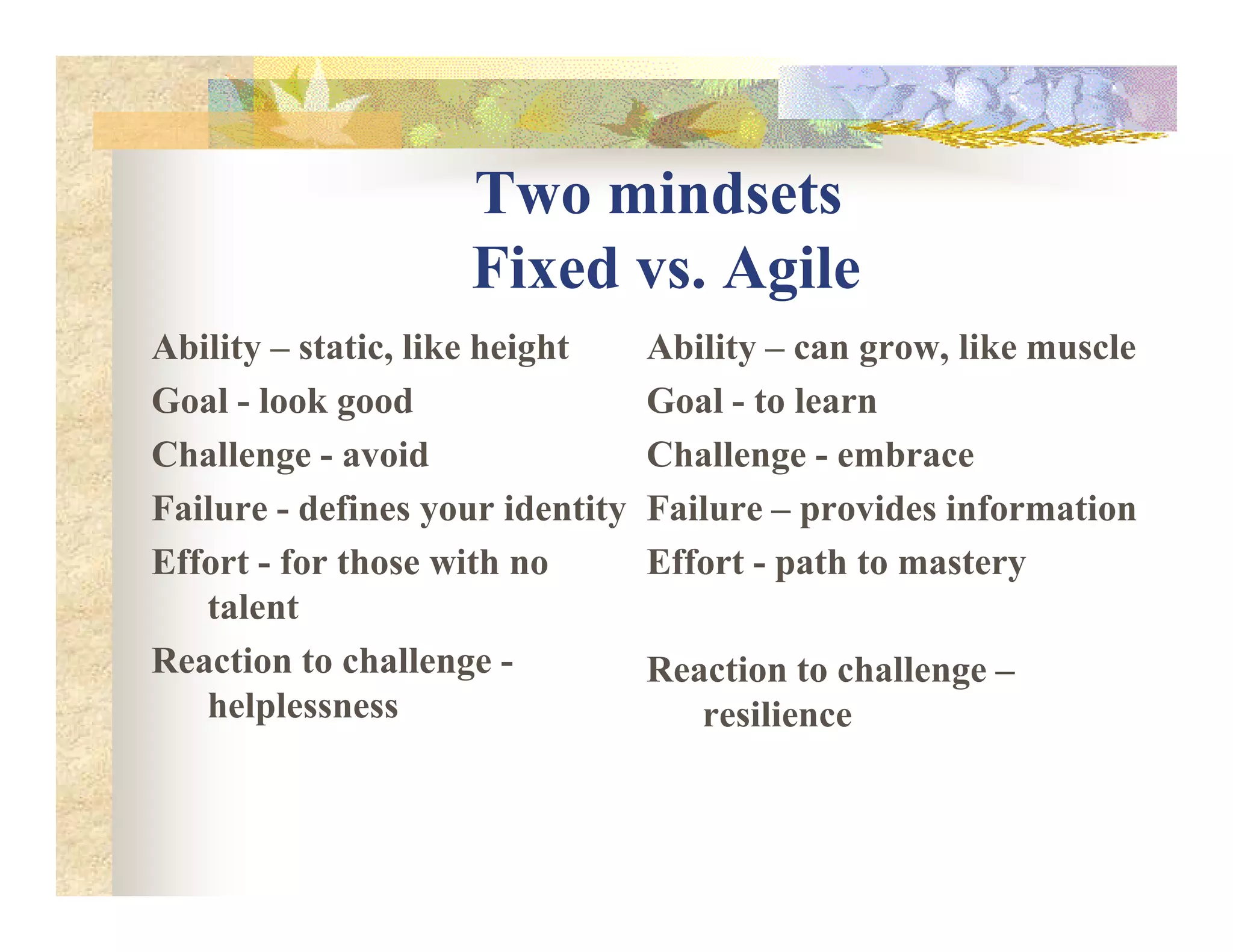
Two mindsets
Fixed vs. Agile
Ability – static, like height
Goal - look good
Challenge - avoid
Ability – can grow, like muscle
Goal - to learn
Challenge - embrace
Failure - defines your identity
Effort - for those with no
talent
Reaction to challenge -
helplessness
Failure – provides information
Effort - path to mastery
Reaction to challenge –
resilience
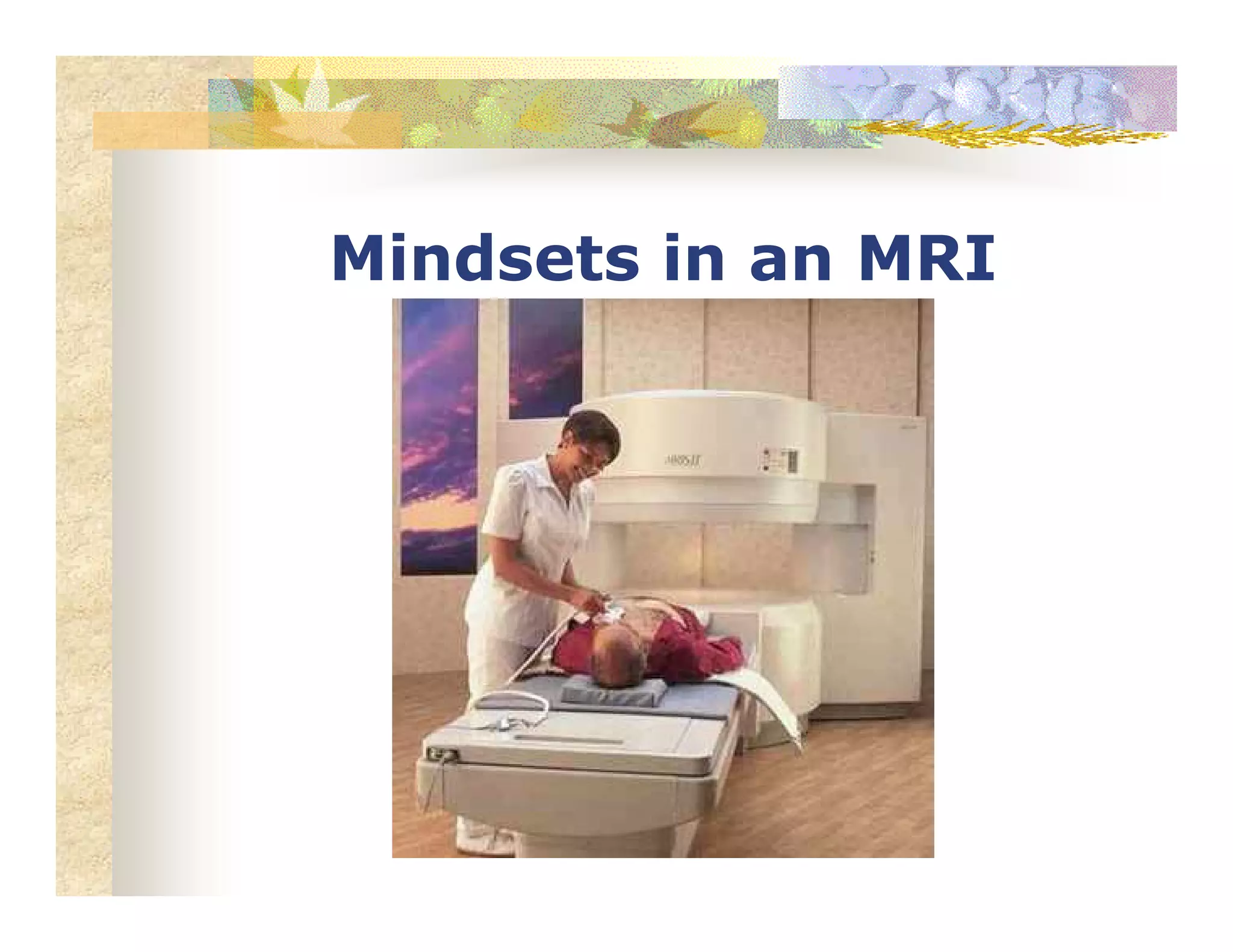
Mindsets in an MRI
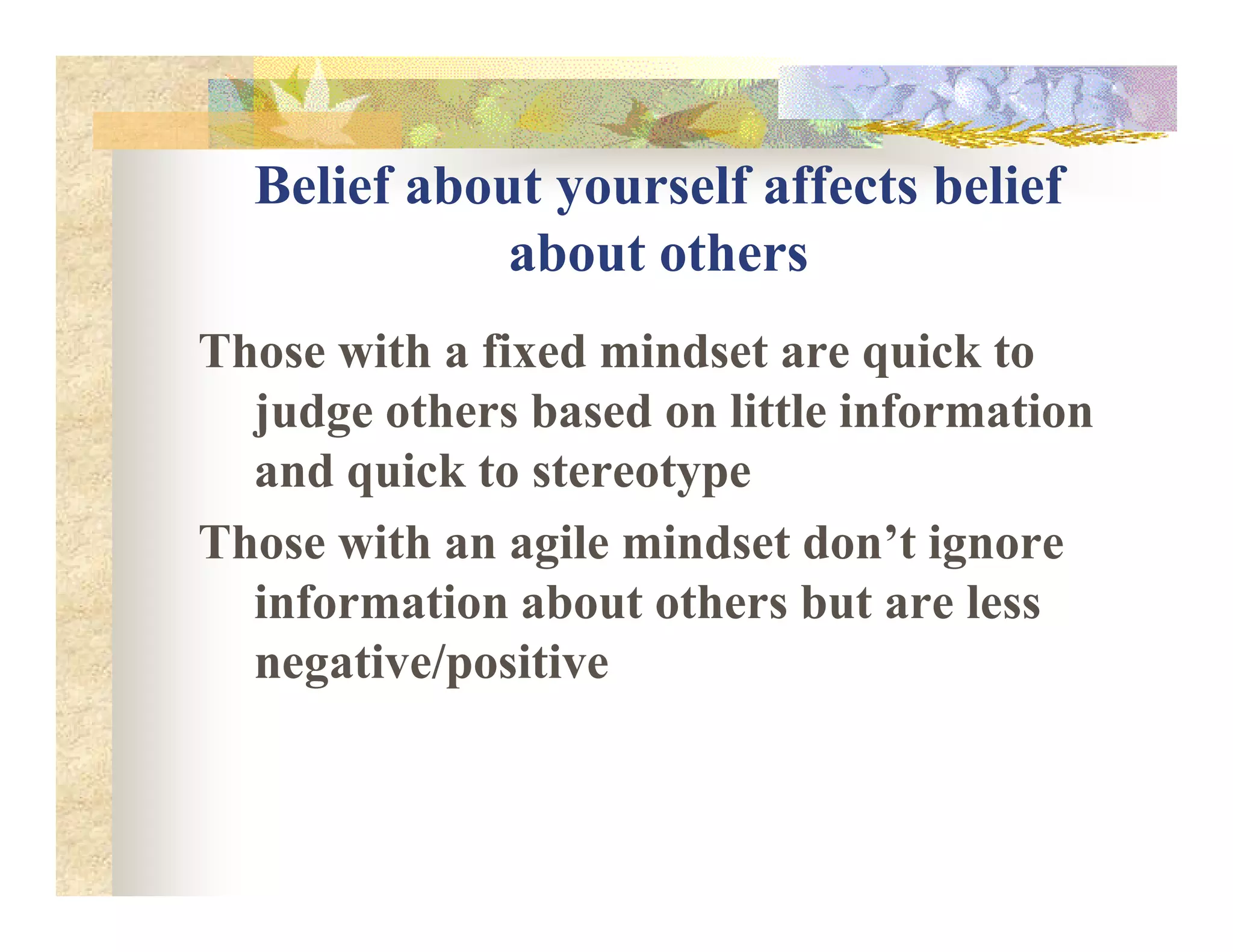
Belief about yourself affects belief
about others
Those with a fixed mindset are quick to
judge others based on little information
and quick to stereotypeand quick to stereotype
Those with an agile mindset don’t ignore
information about others but are less
negative/positive
Bright little girls
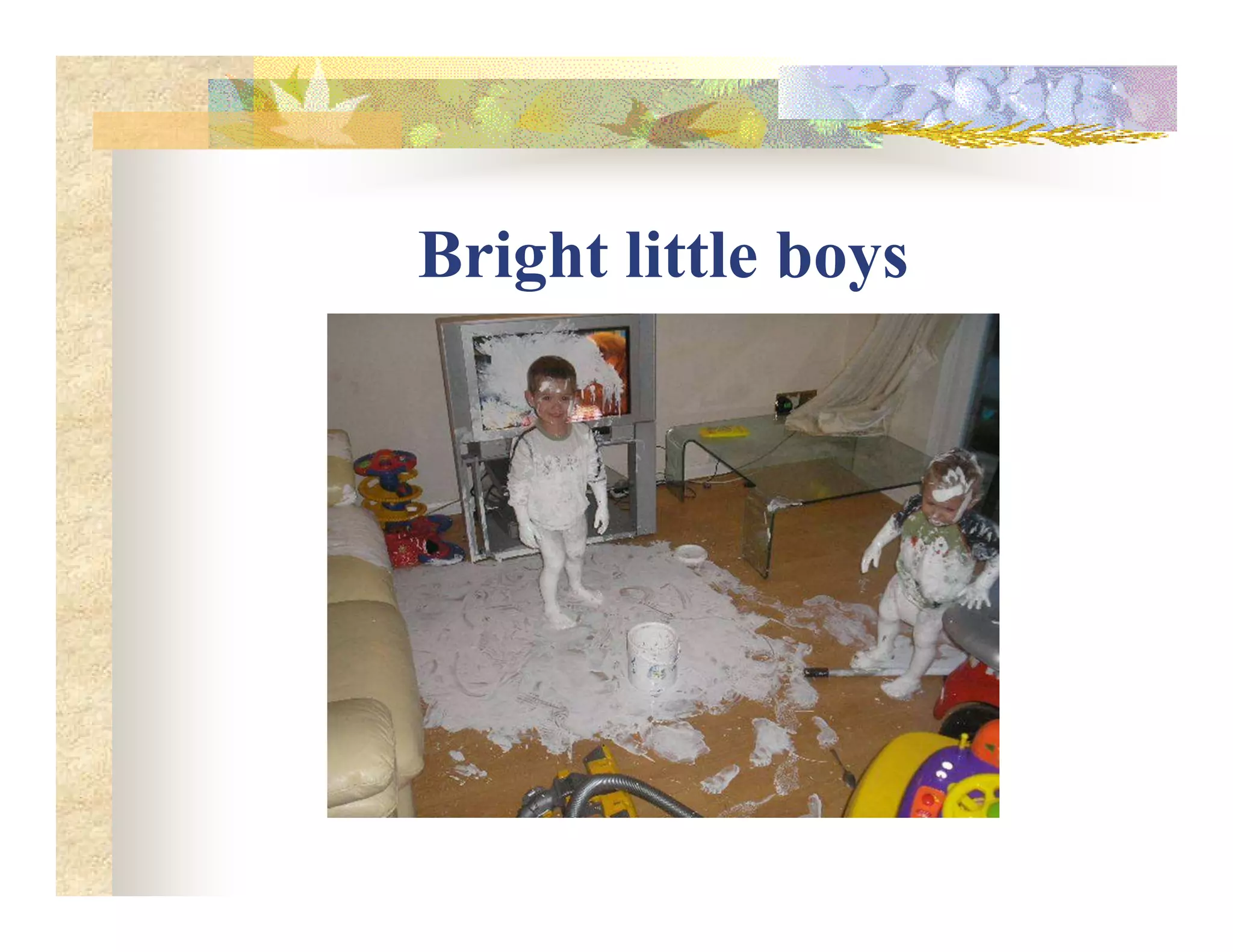
Bright little boys
Organizations have a mindset
Amy Edmondson, Harvard Business School, studied how
hospitals implemented a new technique for open-heart
surgery.
Those who were successful saw a steep learning curve andThose who were successful saw a steep learning curve and
realized it would be challenging, but worth it for
quicker, easier patient.
Those who were not successful saw the change as “cool”
new technology, a marketing opportunity, a way to
show other hospitals that they “had it.”
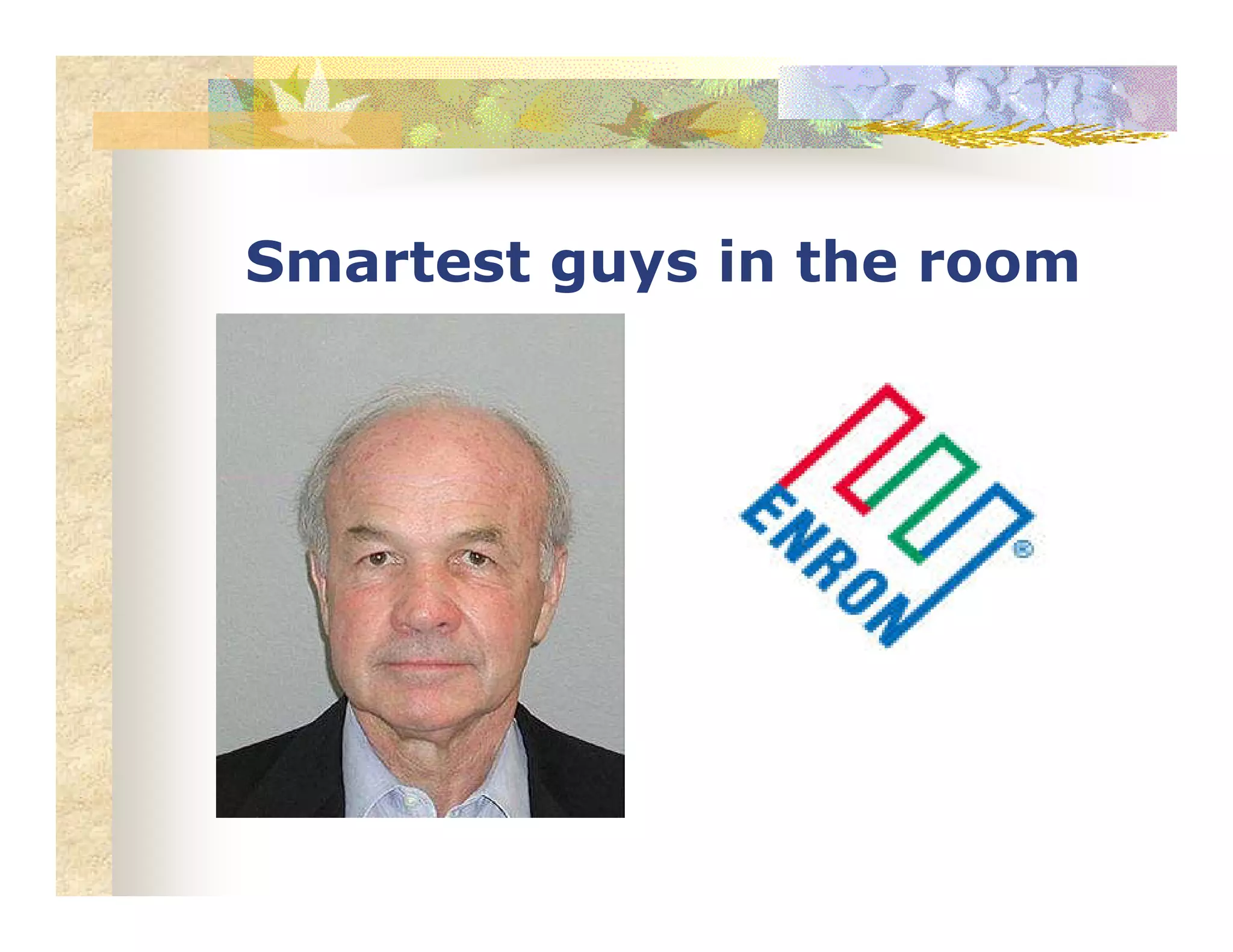
Smartest guys in the room
Enron’s fixed mindset
Identify and hire “the best talent”
Then continuously and ruthlessly grade,
sort, fire, and promote – a process calledsort, fire, and promote – a process called
“rank and yank”
We are a company of people, not
planes. That is what distinguishes us
from other airlines.
The Southwest Culture
Hire for attitude
Establish a culture of community, trust, and
the “Southwest spirit”the “Southwest spirit”
Then provide learning opportunities and
continually grow people
Southwest seems to have an “agile” mindset
Managers have a mindset
“Keen to Help? Managers’ implicit person
theories and their subsequent employee
coaching,” Peter Heslin, Don Vandewalle,coaching,” Peter Heslin, Don Vandewalle,
Gary Latham, Personnel Psych., 2006.
“Pygmalion in Management,” J. Sterling
Livingston, Sept/Oct 1988 Harvard
Business Review.
Hard Facts – Pfeffer & Sutton
http://www.evidence-basedmanagement.com/books/
Agile organizations
Scott Forstall, senior vice president of Apple in charge of
iPhone software – “to make mistakes and struggle, but
eventually we may do something that we’ll remember the
rest of our lives.”rest of our lives.”
David Kelley, IDEO’s founder and chairman: We like our
people to fail early and fail often.
Amazon’s Jeff Bezos says his company’s strategy is like
planting seeds, or going down blind alleys.
The good news is…
Mindset is not “fixed”
We encourage one or the other in each
otherother
We develop one or the other in our children
Research has shown that small
experimental manipulations, e.g.
feedback or reading an article can
produce one or the other
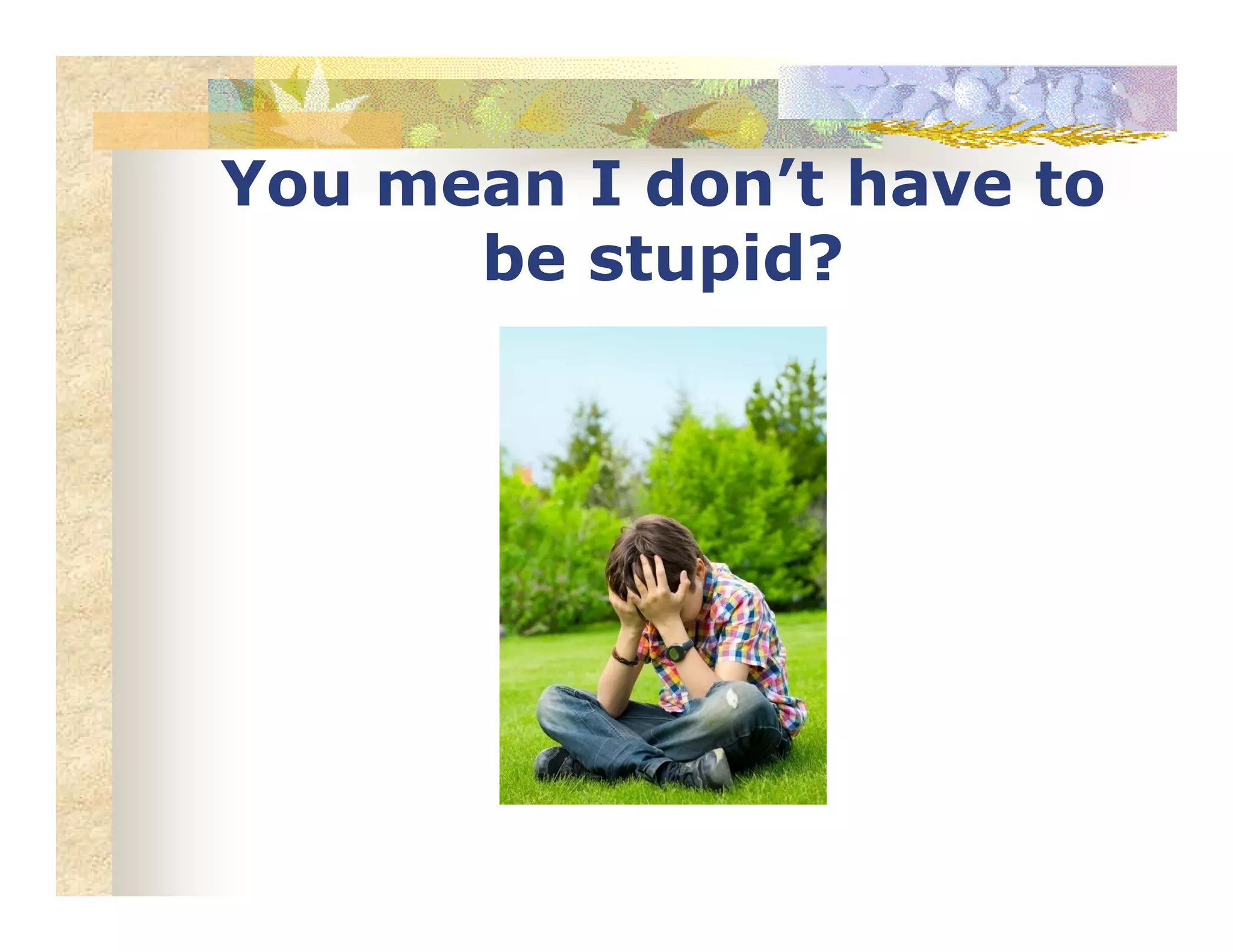
You mean I don’t have to
be stupid?
Effort is good!
Praise effort, strategies, process
Ask about the work
Instead of ignoring failure, teach othersInstead of ignoring failure, teach others
that it’s a way to learn and improve
Agile software development
Fail early, fail often.
Fail fast, learn constantly.
Failure *IS* an option.Failure *IS* an option.
Without failure how can learning happen?
Perfect is a verb.
Better estimations!
Typically we tend to overestimate our
performance, even in the face of data
from previous deliveries. Researchfrom previous deliveries. Research
shows that those with a fixed mindset are
more prone to this tendency than agile
thinkers.
Agile is agile
The agile mindset believes that we are *ALL* a work in
progress.
The agile software development process isn’t fixed. It
continues to change and grow as we learn more aboutcontinues to change and grow as we learn more about
it. If we are lucky, this will never end because it will
never be perfect.
We will continue to improve as we age—just like me ☺☺☺☺!
Try again. Fail again. Fail better.
Samuel Beckett, Irish poet (1906-1989)
Thanks for listening!

Agile mindset BY Linda Rising

  • 1.
    The Agile Mindset LindaRising linda@lindarising.org www.lindarising.org
  • 2.
    Disclaimer: This provocativepresentation is ideally the beginning of a conversation. It won't take long for me to tell you everything I know about cognitive psychology, although I have been reading in the area for several years now. I'm an amateur who has sufficient interest in weird topics and a strange way of connecting ideas that might or might not be of interestconnecting ideas that might or might not be of interest to you. Thank you for your tolerance and understanding of my meanderings and I hope you learn a little that might help you in your life. This is not an “academic” presentation, but those interested in more information are invited to ask me for references for any part of this talk and I will be happy to make them available.
  • 3.
    Do you mostlyagree or mostly disagree with the following Intelligence is something very basic that you really can't change much. You’re born with it or not. Yes, you can learn new things, but you can'tYes, you can learn new things, but you can't really change how intelligent you are. o matter how intelligent you are, you can always get better, sometimes you can improve a lot. You can substitute any ability or talent for “intelligence.”
  • 4.
    Interesting experiments Phase I: Studentswere given a very easy set of questionsquestions Then they were categorized into “effort” or “smart” groups (about 50-50)
  • 5.
    Phase II All studentsallowed to choose between: (1) a more difficult test (where they would learn a lot) orwould learn a lot) or (2) another easy test (similar to Phase I) Most (~90%) “effort” kids chose (1) Most (~80%) “smart” kids chose (2)
  • 6.
    Phase III Very difficultexam given to both groups “Effort” kids worked hard, enjoyed the challengechallenge “Smart” kids easily discouraged
  • 7.
    Phase IV All studentsallowed to choose between: (1) seeing exams of those who did better oror (2) exams of those who did worse “Effort” kids chose (1) “Smart” kids chose (2)
  • 8.
    Phase V All studentsgiven easy test (similar to Phase I) “Effort” kids improved (by ~30%)“Effort” kids improved (by ~30%) “Smart” kids’ were worse (by ~20%)
  • 9.
    Phase VI All studentsasked to give advice to other students and include their scores “Effort” kids: Lots of advice and“Effort” kids: Lots of advice and encouragement. “Smart” kids: Very little or no advice and ~40% lied about their scores
  • 10.
  • 11.
  • 12.
    PR on theweb ew Yorker – “The Talent Myth,” gladwell.com ew York Magazine – “How not to talk toew York Magazine – “How not to talk to your kids,” Po Bronson TIME magazine – “How to help them succeed”
  • 13.
    Two mindsets: Fixed& Agile Research shows that mindset: Determines goals Reactions to failureReactions to failure Belief about effort and strategies Attitudes toward others’ successes
  • 14.
    Two mindsets Fixed vs.Agile Ability – static, like height Goal - look good Challenge - avoid Ability – can grow, like muscle Goal - to learn Challenge - embrace Failure - defines your identity Effort - for those with no talent Reaction to challenge - helplessness Failure – provides information Effort - path to mastery Reaction to challenge – resilience
  • 15.
  • 16.
    Belief about yourselfaffects belief about others Those with a fixed mindset are quick to judge others based on little information and quick to stereotypeand quick to stereotype Those with an agile mindset don’t ignore information about others but are less negative/positive
  • 17.
  • 18.
  • 19.
    Organizations have amindset Amy Edmondson, Harvard Business School, studied how hospitals implemented a new technique for open-heart surgery. Those who were successful saw a steep learning curve andThose who were successful saw a steep learning curve and realized it would be challenging, but worth it for quicker, easier patient. Those who were not successful saw the change as “cool” new technology, a marketing opportunity, a way to show other hospitals that they “had it.”
  • 20.
  • 21.
    Enron’s fixed mindset Identifyand hire “the best talent” Then continuously and ruthlessly grade, sort, fire, and promote – a process calledsort, fire, and promote – a process called “rank and yank”
  • 22.
    We are acompany of people, not planes. That is what distinguishes us from other airlines.
  • 23.
    The Southwest Culture Hirefor attitude Establish a culture of community, trust, and the “Southwest spirit”the “Southwest spirit” Then provide learning opportunities and continually grow people Southwest seems to have an “agile” mindset
  • 24.
    Managers have amindset “Keen to Help? Managers’ implicit person theories and their subsequent employee coaching,” Peter Heslin, Don Vandewalle,coaching,” Peter Heslin, Don Vandewalle, Gary Latham, Personnel Psych., 2006. “Pygmalion in Management,” J. Sterling Livingston, Sept/Oct 1988 Harvard Business Review.
  • 25.
    Hard Facts –Pfeffer & Sutton http://www.evidence-basedmanagement.com/books/
  • 26.
    Agile organizations Scott Forstall,senior vice president of Apple in charge of iPhone software – “to make mistakes and struggle, but eventually we may do something that we’ll remember the rest of our lives.”rest of our lives.” David Kelley, IDEO’s founder and chairman: We like our people to fail early and fail often. Amazon’s Jeff Bezos says his company’s strategy is like planting seeds, or going down blind alleys.
  • 27.
    The good newsis… Mindset is not “fixed” We encourage one or the other in each otherother We develop one or the other in our children Research has shown that small experimental manipulations, e.g. feedback or reading an article can produce one or the other
  • 28.
    You mean Idon’t have to be stupid?
  • 29.
    Effort is good! Praiseeffort, strategies, process Ask about the work Instead of ignoring failure, teach othersInstead of ignoring failure, teach others that it’s a way to learn and improve
  • 30.
    Agile software development Failearly, fail often. Fail fast, learn constantly. Failure *IS* an option.Failure *IS* an option. Without failure how can learning happen? Perfect is a verb.
  • 31.
    Better estimations! Typically wetend to overestimate our performance, even in the face of data from previous deliveries. Researchfrom previous deliveries. Research shows that those with a fixed mindset are more prone to this tendency than agile thinkers.
  • 32.
    Agile is agile Theagile mindset believes that we are *ALL* a work in progress. The agile software development process isn’t fixed. It continues to change and grow as we learn more aboutcontinues to change and grow as we learn more about it. If we are lucky, this will never end because it will never be perfect. We will continue to improve as we age—just like me ☺☺☺☺! Try again. Fail again. Fail better. Samuel Beckett, Irish poet (1906-1989) Thanks for listening!