Agile Software Development Methods
These are some of agile methods used in agile software development.
1. Extreme Programming
Extreme Programming (XP) has evolved from the problems caused by the long development
cycles of traditional development models (Beck 1999a). It first started as 'simply an opportunity
to get the job done' (Haungs 2001) with practices that had been found effective in software
development processes during the preceding decades (Beck 2000). After a number of successful
trials in practice (Anderson et al. 1998), the XP methodology was "theorized" on the key
principles and practices used (Beck 2000). Even though the individual practices of XP are not
new as such, in XP they have been collected and lined up to function with each other in a novel
way thus forming a new methodology for software development. The term 'extreme' comes from
taking these commonsense principles and practices to extreme levels (Beck 2000).
Process
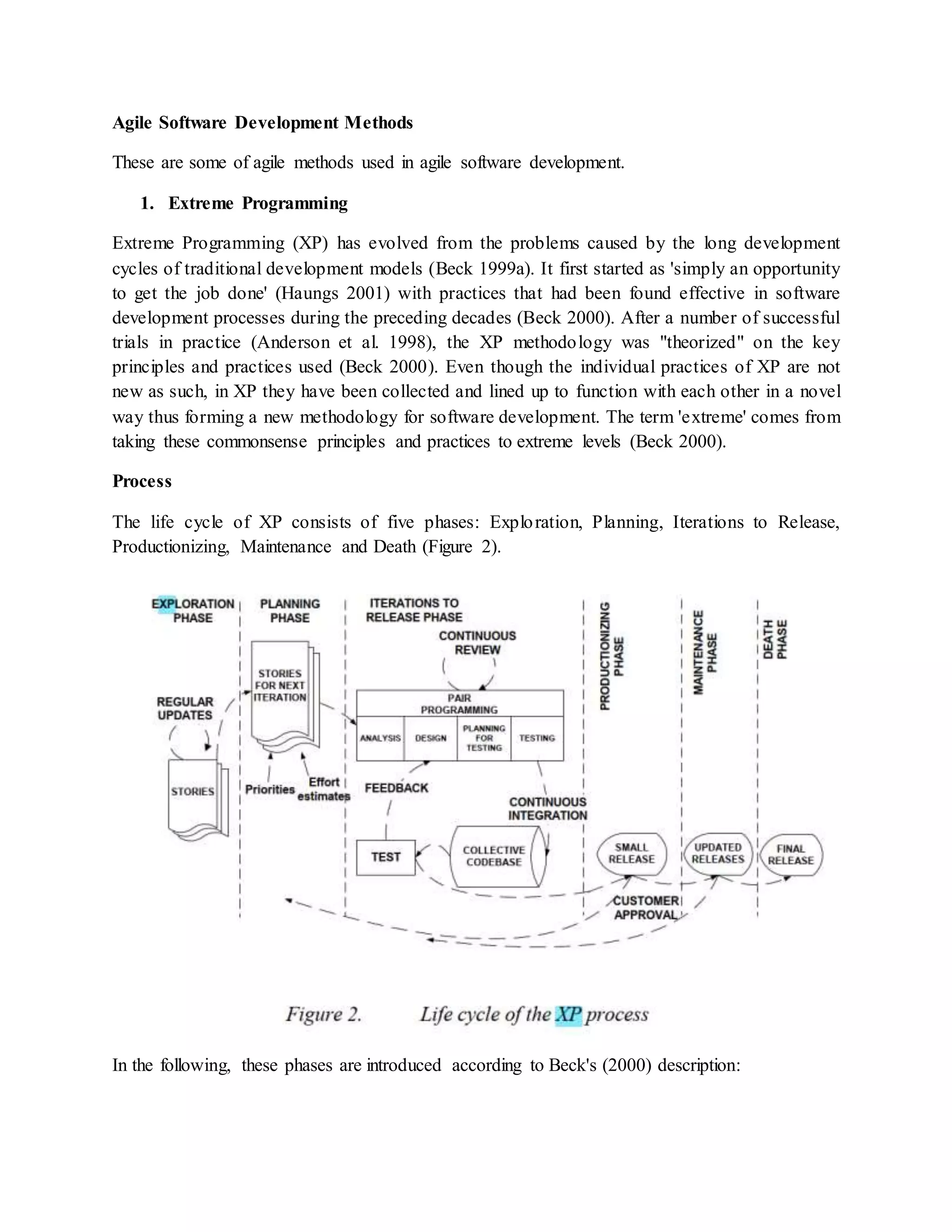
The life cycle of XP consists of five phases: Exploration, Planning, Iterations to Release,
Productionizing, Maintenance and Death (Figure 2).
In the following, these phases are introduced according to Beck's (2000) description:
In the Exploration phase, the customers write out the story cards that they wish to be included
in the first release. Each story card describes a feature to be added into the program. At the same
time the project team familiarize themselves with the tools, technology and practices they will be
using in the project. The technology to be used will be tested and the architecture possibilities for
the system are explored by building a prototype of the system. The exploration phase takes
between a few weeks to a few months, depending largely on how familiar the technology is to
the programmers.
The Planning phase sets the priority order for the stories and an agreement of the contents of the
first small release is made. The programmers first estimate how much effort each story requires
and the schedule is the agreed upon. The time span of the schedule of the first release does not
normally exceed two months. The planning phase itself takes a couple of days.
The Iterations to release phase includes several iterations of the systems before the first release.
The schedule set in the planning stage is broken down to a number of iterations that will each
take one to four weeks to implement. The first iteration creates a system with the architecture of
the whole system. This is achieved by selecting the stories that will enforce building the structure
for the whole system. The customer decides the stories to be selected for each iteration. The
functional tests created by the customer are run at the end of every iteration. At the end of the
last iteration the system is ready for production.
The Productionizing phase requires extra testing and checking of the performance of the system
before the system can be released to the customer. At this phase, new changes may still be found
and the decision has to be made if they are included in the current release. During this phase, the
iterations may need to be quickened from three weeks to one week. The postponed ideas and
suggestions are documented for later implementation during, e.g., the maintenance phase. After
the first release is productionized for customer use, the XP project must both keep the system in
the production running while also producing new iterations. In order to do this, the Maintenance
phase requires an effort also for customer support tasks. Thus, the development velocity may
decelerate after the system is in production. The maintenance phase may require incorporating
new people into the team and changing the team structure.
The Death phase is near when the customer does no longer have any stories to be implemented.
This requires that the system satisfies customer needs also in other respects (e.g., concerning
performance and reliability). This is the time in the XP process when the necessary
documentation of the system is finally written as no more changes to the architecture, design or
code are made. Death may also occur if the system is not delivering the desired outcomes, or if it
becomes too expensive for further development.
Roles and responsibilities
There are different roles in XP for different tasks and purposes during the process and its
practices. In the following, these roles are presented according to Beck (2000).
Programmer
Programmers write tests and keep the program code as simple and definite as possible. The first
issue making XP successful is to communicate and coordinate with other programmers and team
members.
Customer
The customer writes the stories and functional tests, and decides when each requirement is
satisfied. The customer sets the implementation priority for the requirements.
Tester
Testers help the customer write functional tests. They run functional tests regularly, broadcast
test results and maintain testing tools.
Tracker
Tracker gives feedback in XP. He traces the estimates made by the team (e.g. effort estimates)
and gives feedback on how accurate they are in order to improve future estimations. He also
traces the progress of each iteration and evaluates whether the goal is reachable within the given
resource and time constraints or if any changes are needed in the process.
Coach
Coach is the person responsible for the process as a whole. A sound understanding of XP is
important in this role enabling the coach to guide the other team members in following the
process.
Consultant
Consultant is an external member possessing the specific technical knowledge needed. The
consultant guides the team in solving their specific problems.
Manager (Big Boss)
Manager makes the decisions. In order to be able to do this, he communicates with the project
team to determine the current situation, and to distinguish any difficulties or deficiencies in the
process.
Practices
Planning game
Close interaction between the customer and the programmers. The programmers estimate the
effort needed for the implementation of customer stories and the customer then decides about the
scope and timing of releases.
Small/short releases
A simple system is "productionized" (see Figure 2) rapidly - at least once in every 2 to 3 months.
New versions are then released even daily, but at least monthly.
Metaphor
The system is defined by a metaphor/set of metaphors between the customer and the
programmers. This "shared story" guides all development by describing how the system works.
Simple design
The emphasis is on designing the simplest possible solution that is implementable at the moment.
Unnecessary complexity and extra code are removed immediately.
Testing
Software development is test driven. Unit tests are implemented before the code and are run
continuously. Customers write the functional tests.
Refactoring
Restructuring the system by removing duplication, improving communication, simplifying and
adding flexibility.
Pair programming
Two people write the code at one computer.
Collective ownership
Anyone can change any part of the code at any time.
Continuous integration
A new piece of code is integrated into the code-base as soon as it is ready. Thus, the system is
integrated and built many times a day. All tests are run and they have to be passed for the
changes in the code to be accepted.
40-hour week
A maximum of 40-hour working week. No two overtime weeks in a row areallowed. If this
happens, it is treated as a problem to be solved.
On-site customer
Customer has to be present and available full-time for the team.
Coding standards
Coding rules exist and are followed by the programmers. Communication through the code
should be emphasized.
Open workspace
A large room with small cubicles is preferred. Pair programmers should be placed in the center
of the space.
Just rules
Team has its own rules that are followed, but can also be changed at any time. The changes have
to be agreed upon and their impact has to be assessed.
2. Feature Driven Development (FDD)
FDD is suitable for the starting out new projects, enhancing and upgrading existing code, and
those projects tasked with the creation of second version of an existing application.
(Abrahamsson, Salo, Ronkainen, & Warsta, 2002) Feature Driven Development is an agile and
adaptive approach for developing system. This approach does not cover the entire software
development process, but this approach rather focuses on the designing and building phases.
However FDD is been design to work with the other activities of software development project
and does not require any specific process model.
The FDD approach expresses iterative development with the best practices found to be effective
in industry and it also emphases quality aspects throughout the process and include frequent and
tangible deliveries, along with accurate monitoring of the progress of the project. (Abrahamsson,
Salo, Ronkainen, & Warsta, 2002)
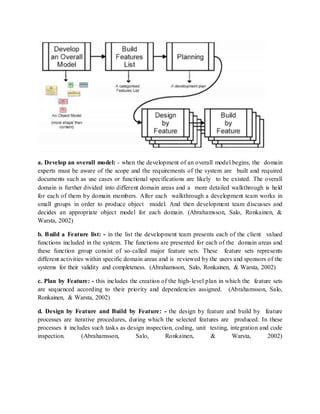
FDD consists of five sequential processes and provides the methods, techniques and guidelines
needed by the project stakeholders to deliver the system.
a. Develop an overall model: - when the development of an overall model begins, the domain
experts must be aware of the scope and the requirements of the system are built and required
documents such as use cases or functional specifications are likely to be existed. The overall
domain is further divided into different domain areas and a more detailed walkthrough is held
for each of them by domain members. After each walkthrough a development team works in
small groups in order to produce object model. And then development team discusses and
decides an appropriate object model for each domain. (Abrahamsson, Salo, Ronkainen, &
Warsta, 2002)
b. Build a Feature list: - in the list the development team presents each of the client valued
functions included in the system. The functions are presented for each of the domain areas and
these function group consist of so-called major feature sets. These feature sets represents
different activities within specific domain areas and is reviewed by the users and sponsors of the
systems for their validity and completeness. (Abrahamsson, Salo, Ronkainen, & Warsta, 2002)
c. Plan by Feature: - this includes the creation of the high-level plan in which the feature sets
are sequenced according to their priority and dependencies assigned. (Abrahamsson, Salo,
Ronkainen, & Warsta, 2002)
d. Design by Feature and Build by Feature: - the design by feature and build by feature
processes are iterative procedures, during which the selected features are produced. In these
processes it includes such tasks as design inspection, coding, unit testing, integration and code
inspection. (Abrahamsson, Salo, Ronkainen, & Warsta, 2002)
3. Scrum
Scrum method is suitable for small teams of less than 10 engineers. And if more people are there
in the group multiple teams should be formed. (Abrahamsson, Salo, Ronkainen, & Warsta, 2002)
The scrum approach has been developed for managing the system development process. This
approach concentrates on how the team members should function in order to produce the system
flexibly in a constantly changing environment. The main idea of scrum is that system
development involves several environmental and technical variables that are likely to change
during the process. (Abrahamsson, Salo, Ronkainen, & Warsta, 2002).
Scrum helps to improve the existing engineering practices in an organization aiming to
identifying any deficiencies or impediments in the developed process and practices used
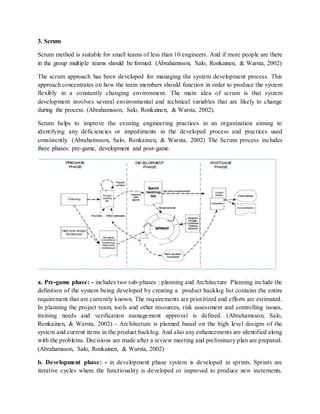
consistently. (Abrahamsson, Salo, Ronkainen, & Warsta, 2002) The Scrum process includes
three phases: pre-game, development and post-game.
a. Pre-game phase: - includes two sub-phases : planning and Architecture Planning include the
definition of the system being developed by creating a product backlog list contains the entire
requirement that are currently known. The requirements are prioritized and efforts are estimated.
In planning the project team, tools and other resources, risk assessment and controlling issues,
training needs and verification management approval is defined. (Abrahamsson, Salo,
Ronkainen, & Warsta, 2002) - Architecture is planned based on the high level designs of the
system and current items in the product backlog. And also any enhancements are identified along
with the problems. Decisions are made after a review meeting and preliminary plan are prepared.
(Abrahamsson, Salo, Ronkainen, & Warsta, 2002)
b. Development phase: - in development phase system is developed in sprints. Sprints are
iterative cycles where the functionality is developed or improved to produce new increments.
Traditional phases of software developments: requirements, analysis, design, evolution and
delivery phases are included in each sprint. In sprint development the architecture and design of
system is developed. (Abrahamsson, Salo, Ronkainen, & Warsta, 2002)
c. Post-game phase: - this is the closure of the release. After completion of environmental
variables such requirements and after making the agreement this phase is entered. In this case, no
more items and issues can be found nor can any new ones be invented. In this case the system is
ready for the release and preparation for this is done such as integration, system testing and
documentation. (Abrahamsson, Salo, Ronkainen, & Warsta, 2002)
3. Adaptive Software Development
Adaptive Software Development, or ASD for short, was developed by James A. Highsmith III,
and published in (Highsmith 2000). Many of ASD’s principles stem from Highsmith’s earlier
research on iterative development methods. The most notable ancestor of ASD, “RADical
Software Development”, was co- authored by Highsmith and S. Bayer, and presented in (Bayer
and Highsmith 1994).
ASD focuses mainly on the problems in developing complex, large systems. The method
strongly encourages incremental, iterative development, with constant prototyping.
Fundamentally, ASD is about “balancing on the edge of chaos” – its aim is to provide a
framework with enough guidance to prevent projects from falling into chaos, but not too much,
which could suppress emergence and creativity.
Process
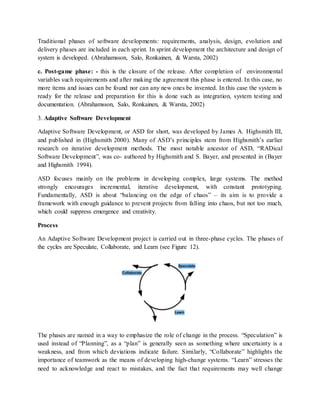
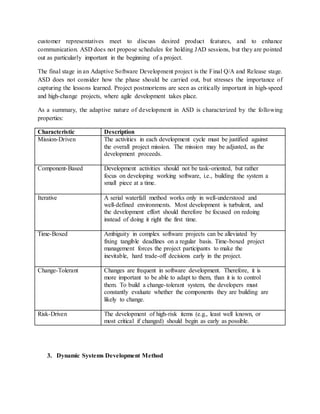
An Adaptive Software Development project is carried out in three-phase cycles. The phases of
the cycles are Speculate, Collaborate, and Learn (see Figure 12).
The phases are named in a way to emphasize the role of change in the process. “Speculation” is
used instead of “Planning”, as a “plan” is generally seen as something where uncertainty is a
weakness, and from which deviations indicate failure. Similarly, “Collaborate” highlights the
importance of teamwork as the means of developing high-change systems. “Learn” stresses the
need to acknowledge and react to mistakes, and the fact that requirements may well change
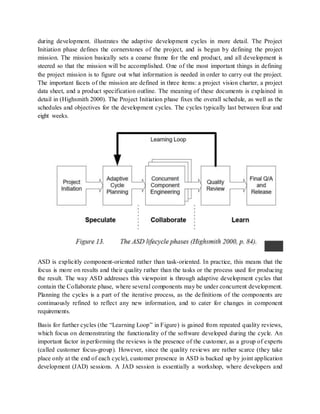
during development. illustrates the adaptive development cycles in more detail. The Project
Initiation phase defines the cornerstones of the project, and is begun by defining the project
mission. The mission basically sets a coarse frame for the end product, and all development is
steered so that the mission will be accomplished. One of the most important things in defining
the project mission is to figure out what information is needed in order to carry out the project.
The important facets of the mission are defined in three items: a project vision charter, a project
data sheet, and a product specification outline. The meaning of these documents is explained in
detail in (Highsmith 2000). The Project Initiation phase fixes the overall schedule, as well as the
schedules and objectives for the development cycles. The cycles typically last between four and
eight weeks.
ASD is explicitly component-oriented rather than task-oriented. In practice, this means that the
focus is more on results and their quality rather than the tasks or the process used for producing
the result. The way ASD addresses this viewpoint is through adaptive development cycles that
contain the Collaborate phase, where several components may be under concurrent development.
Planning the cycles is a part of the iterative process, as the definitions of the components are
continuously refined to reflect any new information, and to cater for changes in component
requirements.
Basis for further cycles (the “Learning Loop” in Figure) is gained from repeated quality reviews,
which focus on demonstrating the functionality of the software developed during the cycle. An
important factor in performing the reviews is the presence of the customer, as a group of experts
(called customer focus-group). However, since the quality reviews are rather scarce (they take
place only at the end of each cycle), customer presence in ASD is backed up by joint application
development (JAD) sessions. A JAD session is essentially a workshop, where developers and
customer representatives meet to discuss desired product features, and to enhance
communication. ASD does not propose schedules for holding JAD sessions, but they are pointed
out as particularly important in the beginning of a project.
The final stage in an Adaptive Software Development project is the Final Q/A and Release stage.
ASD does not consider how the phase should be carried out, but stresses the importance of
capturing the lessons learned. Project postmortems are seen as critically important in high-speed
and high-change projects, where agile development takes place.
As a summary, the adaptive nature of development in ASD is characterized by the following
properties:
Characteristic Description
Mission-Driven The activities in each development cycle must be justified against
the overall project mission. The mission may be adjusted, as the
development proceeds.
Component-Based Development activities should not be task-oriented, but rather
focus on developing working software, i.e., building the system a
small piece at a time.
Iterative A serial waterfall method works only in well-understood and
well-defined environments. Most development is turbulent, and
the development effort should therefore be focused on redoing
instead of doing it right the first time.
Time-Boxed Ambiguity in complex software projects can be alleviated by
fixing tangible deadlines on a regular basis. Time-boxed project
management forces the project participants to make the
inevitable, hard trade-off decisions early in the project.
Change-Tolerant Changes are frequent in software development. Therefore, it is
more important to be able to adapt to them, than it is to control
them. To build a change-tolerant system, the developers must
constantly evaluate whether the components they are building are
likely to change.
Risk-Driven The development of high-risk items (e.g., least well known, or
most critical if changed) should begin as early as possible.
3. Dynamic Systems Development Method
Since its origin in 1994, DSDM, the Dynamic Systems Development Method, has gradually
become the number one framework for rapid application development (RAD) in the UK.
(Stapleton 1997). DSDM is a non-profit and non-proprietary framework for RAD development,
maintained by the DSDM Consortium10. The developers of the method maintain that in addition
to serving as a method in the generally accepted sense DSDM also provides a framework of
controls for RAD, supplemented with guidance on how to efficiently use those controls.
The fundamental idea behind DSDM is that instead of fixing the amount of functionality in a
product, and then adjusting time and resources to reach that functionality, it is preferred to fix
time and resources, and then adjust the amount of functionality accordingly.
Process
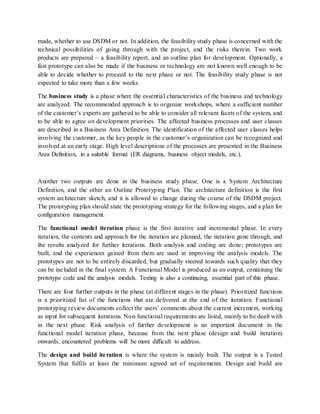
DSDM consists of five phases: feasibility study, business study, functional model iteration,
design and build iteration, and implementation (Figure 11).
The first two phases are sequential, and done only once. The three last phases, during which the
actual development work is done, are iterative and incremental. DSDM approaches iterations as
timeboxes. A timebox lasts for a predefined period of time, and the iteration has to end within
the timebox. The time allowed for each iteration to take is planned beforehand, along with the
results the iteration is guaranteed to produce. In DSDM, a typical timebox duration is from a few
days to a few weeks. In the following, the phases are introduced, with their essential output
documents.
The feasibility study phase is where the suitability of DSDM for the given project is assessed.
Judging by the type of project and, most of all, organizational and people issues, the decision is
made, whether to use DSDM or not. In addition, the feasibility study phase is concerned with the
technical possibilities of going through with the project, and the risks therein. Two work
products are prepared – a feasibility report, and an outline plan for development. Optionally, a
fast prototype can also be made if the business or technology are not known well enough to be
able to decide whether to proceed to the next phase or not. The feasibility study phase is not
expected to take more than a few weeks.
The business study is a phase where the essential characteristics of the business and technology
are analyzed. The recommended approach is to organize workshops, where a sufficient number
of the customer’s experts are gathered to be able to consider all relevant facets of the system, and
to be able to agree on development priorities. The affected business processes and user classes
are described in a Business Area Definition. The identification of the affected user classes helps
involving the customer, as the key people in the customer’s organization can be recognized and
involved at an early stage. High level descriptions of the processes are presented in the Business
Area Definition, in a suitable format (ER diagrams, business object models, etc.).
Another two outputs are done in the business study phase. One is a System Architecture
Definition, and the other an Outline Prototyping Plan. The architecture definition is the first
system architecture sketch, and it is allowed to change during the course of the DSDM project.
The prototyping plan should state the prototyping strategy for the following stages, and a plan for
configuration management.
The functional model iteration phase is the first iterative and incremental phase. In every
iteration, the contents and approach for the iteration are planned, the iteration gone through, and
the results analyzed for further iterations. Both analysis and coding are done; prototypes are
built, and the experiences gained from them are used in improving the analysis models. The
prototypes are not to be entirely discarded, but gradually steered towards such quality that they
can be included in the final system. A Functional Model is produced as an output, containing the
prototype code and the analysis models. Testing is also a continuing, essential part of this phase.
There are four further outputs in the phase (at different stages in the phase). Prioritized functions
is a prioritized list of the functions that are delivered at the end of the iteration. Functional
prototyping review documents collect the users’ comments about the current increment, working
as input for subsequent iterations. Non-functional requirements are listed, mainly to be dealt with
in the next phase. Risk analysis of further development is an important document in the
functional model iteration phase, because from the next phase (design and build iteration)
onwards, encountered problems will be more difficult to address.
The design and build iteration is where the system is mainly built. The output is a Tested
System that fulfils at least the minimum agreed set of requirements. Design and build are
iterative, and the design and functional prototypes are reviewed by the users, and further
development is based on the users’ comments.
The final implementation phase is where the system is transferred from the development
environment into the actual production environment. Training is given to users, and the system
handed over to them. If the roll-out concerns a wide number of users, and done over a period of
time, the implementation phase may also be iterated. Apart from the delivered system, the output
of the implementation phase also includes a User Manual, and a Project Review Report. The
latter summarizes the outcome of the project, and based on the results, the course of further
development is set. DSDM defines four possible courses of development. If the system fulfils all
requirements, no further work is needed. On the other hand, if a substantial amount of
requirements have to be left aside (for example, if they were not discovered until the system was
in development), the process may be run through again, from start to finish. If some less-critical
functionality has to be omitted, the process may be run again from the functional model iteration
phase onwards. Lastly, if some technical issues can not be addressed due to time constraints, they
may be now done by iterating again, starting from the design and build iteration phase.
4. Crystal methodologies:
A family of methods for co-located teams of different sizes and criticality: Clear, Yellow,
Orange, Red, Blue. The most agile method, Crystal Clear, focuses on communication in small
teams Developing software that is not life-critical. Clear development has seven characteristics:
frequent delivery, reflective improvement, osmotic communication, personal safety, focus, easy
access to expert users, and requirements for the technical environment.
5. Lean software development
An adaptation of principles from lean production and, in particular, the Toyota production
system to Software development. Consists of seven principles: eliminate waste, amplify
learning, decide as late as possible, deliver as fast as possible, empower the team, build
integrity, and see the whole

agile methods.docx

  • 1.
    Agile Software DevelopmentMethods These are some of agile methods used in agile software development. 1. Extreme Programming Extreme Programming (XP) has evolved from the problems caused by the long development cycles of traditional development models (Beck 1999a). It first started as 'simply an opportunity to get the job done' (Haungs 2001) with practices that had been found effective in software development processes during the preceding decades (Beck 2000). After a number of successful trials in practice (Anderson et al. 1998), the XP methodology was "theorized" on the key principles and practices used (Beck 2000). Even though the individual practices of XP are not new as such, in XP they have been collected and lined up to function with each other in a novel way thus forming a new methodology for software development. The term 'extreme' comes from taking these commonsense principles and practices to extreme levels (Beck 2000). Process The life cycle of XP consists of five phases: Exploration, Planning, Iterations to Release, Productionizing, Maintenance and Death (Figure 2). In the following, these phases are introduced according to Beck's (2000) description:
  • 2.
    In the Explorationphase, the customers write out the story cards that they wish to be included in the first release. Each story card describes a feature to be added into the program. At the same time the project team familiarize themselves with the tools, technology and practices they will be using in the project. The technology to be used will be tested and the architecture possibilities for the system are explored by building a prototype of the system. The exploration phase takes between a few weeks to a few months, depending largely on how familiar the technology is to the programmers. The Planning phase sets the priority order for the stories and an agreement of the contents of the first small release is made. The programmers first estimate how much effort each story requires and the schedule is the agreed upon. The time span of the schedule of the first release does not normally exceed two months. The planning phase itself takes a couple of days. The Iterations to release phase includes several iterations of the systems before the first release. The schedule set in the planning stage is broken down to a number of iterations that will each take one to four weeks to implement. The first iteration creates a system with the architecture of the whole system. This is achieved by selecting the stories that will enforce building the structure for the whole system. The customer decides the stories to be selected for each iteration. The functional tests created by the customer are run at the end of every iteration. At the end of the last iteration the system is ready for production. The Productionizing phase requires extra testing and checking of the performance of the system before the system can be released to the customer. At this phase, new changes may still be found and the decision has to be made if they are included in the current release. During this phase, the iterations may need to be quickened from three weeks to one week. The postponed ideas and suggestions are documented for later implementation during, e.g., the maintenance phase. After the first release is productionized for customer use, the XP project must both keep the system in the production running while also producing new iterations. In order to do this, the Maintenance phase requires an effort also for customer support tasks. Thus, the development velocity may decelerate after the system is in production. The maintenance phase may require incorporating new people into the team and changing the team structure. The Death phase is near when the customer does no longer have any stories to be implemented. This requires that the system satisfies customer needs also in other respects (e.g., concerning performance and reliability). This is the time in the XP process when the necessary documentation of the system is finally written as no more changes to the architecture, design or code are made. Death may also occur if the system is not delivering the desired outcomes, or if it becomes too expensive for further development. Roles and responsibilities There are different roles in XP for different tasks and purposes during the process and its practices. In the following, these roles are presented according to Beck (2000).
  • 3.
    Programmer Programmers write testsand keep the program code as simple and definite as possible. The first issue making XP successful is to communicate and coordinate with other programmers and team members. Customer The customer writes the stories and functional tests, and decides when each requirement is satisfied. The customer sets the implementation priority for the requirements. Tester Testers help the customer write functional tests. They run functional tests regularly, broadcast test results and maintain testing tools. Tracker Tracker gives feedback in XP. He traces the estimates made by the team (e.g. effort estimates) and gives feedback on how accurate they are in order to improve future estimations. He also traces the progress of each iteration and evaluates whether the goal is reachable within the given resource and time constraints or if any changes are needed in the process. Coach Coach is the person responsible for the process as a whole. A sound understanding of XP is important in this role enabling the coach to guide the other team members in following the process. Consultant Consultant is an external member possessing the specific technical knowledge needed. The consultant guides the team in solving their specific problems. Manager (Big Boss) Manager makes the decisions. In order to be able to do this, he communicates with the project team to determine the current situation, and to distinguish any difficulties or deficiencies in the process. Practices Planning game
  • 4.
    Close interaction betweenthe customer and the programmers. The programmers estimate the effort needed for the implementation of customer stories and the customer then decides about the scope and timing of releases. Small/short releases A simple system is "productionized" (see Figure 2) rapidly - at least once in every 2 to 3 months. New versions are then released even daily, but at least monthly. Metaphor The system is defined by a metaphor/set of metaphors between the customer and the programmers. This "shared story" guides all development by describing how the system works. Simple design The emphasis is on designing the simplest possible solution that is implementable at the moment. Unnecessary complexity and extra code are removed immediately. Testing Software development is test driven. Unit tests are implemented before the code and are run continuously. Customers write the functional tests. Refactoring Restructuring the system by removing duplication, improving communication, simplifying and adding flexibility. Pair programming Two people write the code at one computer. Collective ownership Anyone can change any part of the code at any time. Continuous integration A new piece of code is integrated into the code-base as soon as it is ready. Thus, the system is integrated and built many times a day. All tests are run and they have to be passed for the changes in the code to be accepted. 40-hour week A maximum of 40-hour working week. No two overtime weeks in a row areallowed. If this happens, it is treated as a problem to be solved.
  • 5.
    On-site customer Customer hasto be present and available full-time for the team. Coding standards Coding rules exist and are followed by the programmers. Communication through the code should be emphasized. Open workspace A large room with small cubicles is preferred. Pair programmers should be placed in the center of the space. Just rules Team has its own rules that are followed, but can also be changed at any time. The changes have to be agreed upon and their impact has to be assessed. 2. Feature Driven Development (FDD) FDD is suitable for the starting out new projects, enhancing and upgrading existing code, and those projects tasked with the creation of second version of an existing application. (Abrahamsson, Salo, Ronkainen, & Warsta, 2002) Feature Driven Development is an agile and adaptive approach for developing system. This approach does not cover the entire software development process, but this approach rather focuses on the designing and building phases. However FDD is been design to work with the other activities of software development project and does not require any specific process model. The FDD approach expresses iterative development with the best practices found to be effective in industry and it also emphases quality aspects throughout the process and include frequent and tangible deliveries, along with accurate monitoring of the progress of the project. (Abrahamsson, Salo, Ronkainen, & Warsta, 2002) FDD consists of five sequential processes and provides the methods, techniques and guidelines needed by the project stakeholders to deliver the system.
  • 6.
    a. Develop anoverall model: - when the development of an overall model begins, the domain experts must be aware of the scope and the requirements of the system are built and required documents such as use cases or functional specifications are likely to be existed. The overall domain is further divided into different domain areas and a more detailed walkthrough is held for each of them by domain members. After each walkthrough a development team works in small groups in order to produce object model. And then development team discusses and decides an appropriate object model for each domain. (Abrahamsson, Salo, Ronkainen, & Warsta, 2002) b. Build a Feature list: - in the list the development team presents each of the client valued functions included in the system. The functions are presented for each of the domain areas and these function group consist of so-called major feature sets. These feature sets represents different activities within specific domain areas and is reviewed by the users and sponsors of the systems for their validity and completeness. (Abrahamsson, Salo, Ronkainen, & Warsta, 2002) c. Plan by Feature: - this includes the creation of the high-level plan in which the feature sets are sequenced according to their priority and dependencies assigned. (Abrahamsson, Salo, Ronkainen, & Warsta, 2002) d. Design by Feature and Build by Feature: - the design by feature and build by feature processes are iterative procedures, during which the selected features are produced. In these processes it includes such tasks as design inspection, coding, unit testing, integration and code inspection. (Abrahamsson, Salo, Ronkainen, & Warsta, 2002)
  • 7.
    3. Scrum Scrum methodis suitable for small teams of less than 10 engineers. And if more people are there in the group multiple teams should be formed. (Abrahamsson, Salo, Ronkainen, & Warsta, 2002) The scrum approach has been developed for managing the system development process. This approach concentrates on how the team members should function in order to produce the system flexibly in a constantly changing environment. The main idea of scrum is that system development involves several environmental and technical variables that are likely to change during the process. (Abrahamsson, Salo, Ronkainen, & Warsta, 2002). Scrum helps to improve the existing engineering practices in an organization aiming to identifying any deficiencies or impediments in the developed process and practices used consistently. (Abrahamsson, Salo, Ronkainen, & Warsta, 2002) The Scrum process includes three phases: pre-game, development and post-game. a. Pre-game phase: - includes two sub-phases : planning and Architecture Planning include the definition of the system being developed by creating a product backlog list contains the entire requirement that are currently known. The requirements are prioritized and efforts are estimated. In planning the project team, tools and other resources, risk assessment and controlling issues, training needs and verification management approval is defined. (Abrahamsson, Salo, Ronkainen, & Warsta, 2002) - Architecture is planned based on the high level designs of the system and current items in the product backlog. And also any enhancements are identified along with the problems. Decisions are made after a review meeting and preliminary plan are prepared. (Abrahamsson, Salo, Ronkainen, & Warsta, 2002) b. Development phase: - in development phase system is developed in sprints. Sprints are iterative cycles where the functionality is developed or improved to produce new increments.
  • 8.
    Traditional phases ofsoftware developments: requirements, analysis, design, evolution and delivery phases are included in each sprint. In sprint development the architecture and design of system is developed. (Abrahamsson, Salo, Ronkainen, & Warsta, 2002) c. Post-game phase: - this is the closure of the release. After completion of environmental variables such requirements and after making the agreement this phase is entered. In this case, no more items and issues can be found nor can any new ones be invented. In this case the system is ready for the release and preparation for this is done such as integration, system testing and documentation. (Abrahamsson, Salo, Ronkainen, & Warsta, 2002) 3. Adaptive Software Development Adaptive Software Development, or ASD for short, was developed by James A. Highsmith III, and published in (Highsmith 2000). Many of ASD’s principles stem from Highsmith’s earlier research on iterative development methods. The most notable ancestor of ASD, “RADical Software Development”, was co- authored by Highsmith and S. Bayer, and presented in (Bayer and Highsmith 1994). ASD focuses mainly on the problems in developing complex, large systems. The method strongly encourages incremental, iterative development, with constant prototyping. Fundamentally, ASD is about “balancing on the edge of chaos” – its aim is to provide a framework with enough guidance to prevent projects from falling into chaos, but not too much, which could suppress emergence and creativity. Process An Adaptive Software Development project is carried out in three-phase cycles. The phases of the cycles are Speculate, Collaborate, and Learn (see Figure 12). The phases are named in a way to emphasize the role of change in the process. “Speculation” is used instead of “Planning”, as a “plan” is generally seen as something where uncertainty is a weakness, and from which deviations indicate failure. Similarly, “Collaborate” highlights the importance of teamwork as the means of developing high-change systems. “Learn” stresses the need to acknowledge and react to mistakes, and the fact that requirements may well change
  • 9.
    during development. illustratesthe adaptive development cycles in more detail. The Project Initiation phase defines the cornerstones of the project, and is begun by defining the project mission. The mission basically sets a coarse frame for the end product, and all development is steered so that the mission will be accomplished. One of the most important things in defining the project mission is to figure out what information is needed in order to carry out the project. The important facets of the mission are defined in three items: a project vision charter, a project data sheet, and a product specification outline. The meaning of these documents is explained in detail in (Highsmith 2000). The Project Initiation phase fixes the overall schedule, as well as the schedules and objectives for the development cycles. The cycles typically last between four and eight weeks. ASD is explicitly component-oriented rather than task-oriented. In practice, this means that the focus is more on results and their quality rather than the tasks or the process used for producing the result. The way ASD addresses this viewpoint is through adaptive development cycles that contain the Collaborate phase, where several components may be under concurrent development. Planning the cycles is a part of the iterative process, as the definitions of the components are continuously refined to reflect any new information, and to cater for changes in component requirements. Basis for further cycles (the “Learning Loop” in Figure) is gained from repeated quality reviews, which focus on demonstrating the functionality of the software developed during the cycle. An important factor in performing the reviews is the presence of the customer, as a group of experts (called customer focus-group). However, since the quality reviews are rather scarce (they take place only at the end of each cycle), customer presence in ASD is backed up by joint application development (JAD) sessions. A JAD session is essentially a workshop, where developers and
  • 10.
    customer representatives meetto discuss desired product features, and to enhance communication. ASD does not propose schedules for holding JAD sessions, but they are pointed out as particularly important in the beginning of a project. The final stage in an Adaptive Software Development project is the Final Q/A and Release stage. ASD does not consider how the phase should be carried out, but stresses the importance of capturing the lessons learned. Project postmortems are seen as critically important in high-speed and high-change projects, where agile development takes place. As a summary, the adaptive nature of development in ASD is characterized by the following properties: Characteristic Description Mission-Driven The activities in each development cycle must be justified against the overall project mission. The mission may be adjusted, as the development proceeds. Component-Based Development activities should not be task-oriented, but rather focus on developing working software, i.e., building the system a small piece at a time. Iterative A serial waterfall method works only in well-understood and well-defined environments. Most development is turbulent, and the development effort should therefore be focused on redoing instead of doing it right the first time. Time-Boxed Ambiguity in complex software projects can be alleviated by fixing tangible deadlines on a regular basis. Time-boxed project management forces the project participants to make the inevitable, hard trade-off decisions early in the project. Change-Tolerant Changes are frequent in software development. Therefore, it is more important to be able to adapt to them, than it is to control them. To build a change-tolerant system, the developers must constantly evaluate whether the components they are building are likely to change. Risk-Driven The development of high-risk items (e.g., least well known, or most critical if changed) should begin as early as possible. 3. Dynamic Systems Development Method
  • 11.
    Since its originin 1994, DSDM, the Dynamic Systems Development Method, has gradually become the number one framework for rapid application development (RAD) in the UK. (Stapleton 1997). DSDM is a non-profit and non-proprietary framework for RAD development, maintained by the DSDM Consortium10. The developers of the method maintain that in addition to serving as a method in the generally accepted sense DSDM also provides a framework of controls for RAD, supplemented with guidance on how to efficiently use those controls. The fundamental idea behind DSDM is that instead of fixing the amount of functionality in a product, and then adjusting time and resources to reach that functionality, it is preferred to fix time and resources, and then adjust the amount of functionality accordingly. Process DSDM consists of five phases: feasibility study, business study, functional model iteration, design and build iteration, and implementation (Figure 11). The first two phases are sequential, and done only once. The three last phases, during which the actual development work is done, are iterative and incremental. DSDM approaches iterations as timeboxes. A timebox lasts for a predefined period of time, and the iteration has to end within the timebox. The time allowed for each iteration to take is planned beforehand, along with the results the iteration is guaranteed to produce. In DSDM, a typical timebox duration is from a few days to a few weeks. In the following, the phases are introduced, with their essential output documents. The feasibility study phase is where the suitability of DSDM for the given project is assessed. Judging by the type of project and, most of all, organizational and people issues, the decision is
  • 12.
    made, whether touse DSDM or not. In addition, the feasibility study phase is concerned with the technical possibilities of going through with the project, and the risks therein. Two work products are prepared – a feasibility report, and an outline plan for development. Optionally, a fast prototype can also be made if the business or technology are not known well enough to be able to decide whether to proceed to the next phase or not. The feasibility study phase is not expected to take more than a few weeks. The business study is a phase where the essential characteristics of the business and technology are analyzed. The recommended approach is to organize workshops, where a sufficient number of the customer’s experts are gathered to be able to consider all relevant facets of the system, and to be able to agree on development priorities. The affected business processes and user classes are described in a Business Area Definition. The identification of the affected user classes helps involving the customer, as the key people in the customer’s organization can be recognized and involved at an early stage. High level descriptions of the processes are presented in the Business Area Definition, in a suitable format (ER diagrams, business object models, etc.). Another two outputs are done in the business study phase. One is a System Architecture Definition, and the other an Outline Prototyping Plan. The architecture definition is the first system architecture sketch, and it is allowed to change during the course of the DSDM project. The prototyping plan should state the prototyping strategy for the following stages, and a plan for configuration management. The functional model iteration phase is the first iterative and incremental phase. In every iteration, the contents and approach for the iteration are planned, the iteration gone through, and the results analyzed for further iterations. Both analysis and coding are done; prototypes are built, and the experiences gained from them are used in improving the analysis models. The prototypes are not to be entirely discarded, but gradually steered towards such quality that they can be included in the final system. A Functional Model is produced as an output, containing the prototype code and the analysis models. Testing is also a continuing, essential part of this phase. There are four further outputs in the phase (at different stages in the phase). Prioritized functions is a prioritized list of the functions that are delivered at the end of the iteration. Functional prototyping review documents collect the users’ comments about the current increment, working as input for subsequent iterations. Non-functional requirements are listed, mainly to be dealt with in the next phase. Risk analysis of further development is an important document in the functional model iteration phase, because from the next phase (design and build iteration) onwards, encountered problems will be more difficult to address. The design and build iteration is where the system is mainly built. The output is a Tested System that fulfils at least the minimum agreed set of requirements. Design and build are
  • 13.
    iterative, and thedesign and functional prototypes are reviewed by the users, and further development is based on the users’ comments. The final implementation phase is where the system is transferred from the development environment into the actual production environment. Training is given to users, and the system handed over to them. If the roll-out concerns a wide number of users, and done over a period of time, the implementation phase may also be iterated. Apart from the delivered system, the output of the implementation phase also includes a User Manual, and a Project Review Report. The latter summarizes the outcome of the project, and based on the results, the course of further development is set. DSDM defines four possible courses of development. If the system fulfils all requirements, no further work is needed. On the other hand, if a substantial amount of requirements have to be left aside (for example, if they were not discovered until the system was in development), the process may be run through again, from start to finish. If some less-critical functionality has to be omitted, the process may be run again from the functional model iteration phase onwards. Lastly, if some technical issues can not be addressed due to time constraints, they may be now done by iterating again, starting from the design and build iteration phase. 4. Crystal methodologies: A family of methods for co-located teams of different sizes and criticality: Clear, Yellow, Orange, Red, Blue. The most agile method, Crystal Clear, focuses on communication in small teams Developing software that is not life-critical. Clear development has seven characteristics: frequent delivery, reflective improvement, osmotic communication, personal safety, focus, easy access to expert users, and requirements for the technical environment. 5. Lean software development An adaptation of principles from lean production and, in particular, the Toyota production system to Software development. Consists of seven principles: eliminate waste, amplify learning, decide as late as possible, deliver as fast as possible, empower the team, build integrity, and see the whole