“ The Pursuit  of Perfection” in  Antebellum  America 1820 to 1860
The Age of Reform Reasons: The Great Awakening sparked interest that the individual could control their destiny and that “good deeds” will make the nation a better place  The middle-class feel that they should be models of behavior for the “unmannered and ill-behaved” Finally, women are driving forces for reform because they are no longer kept at home and now have a voice (predominantly in the church)
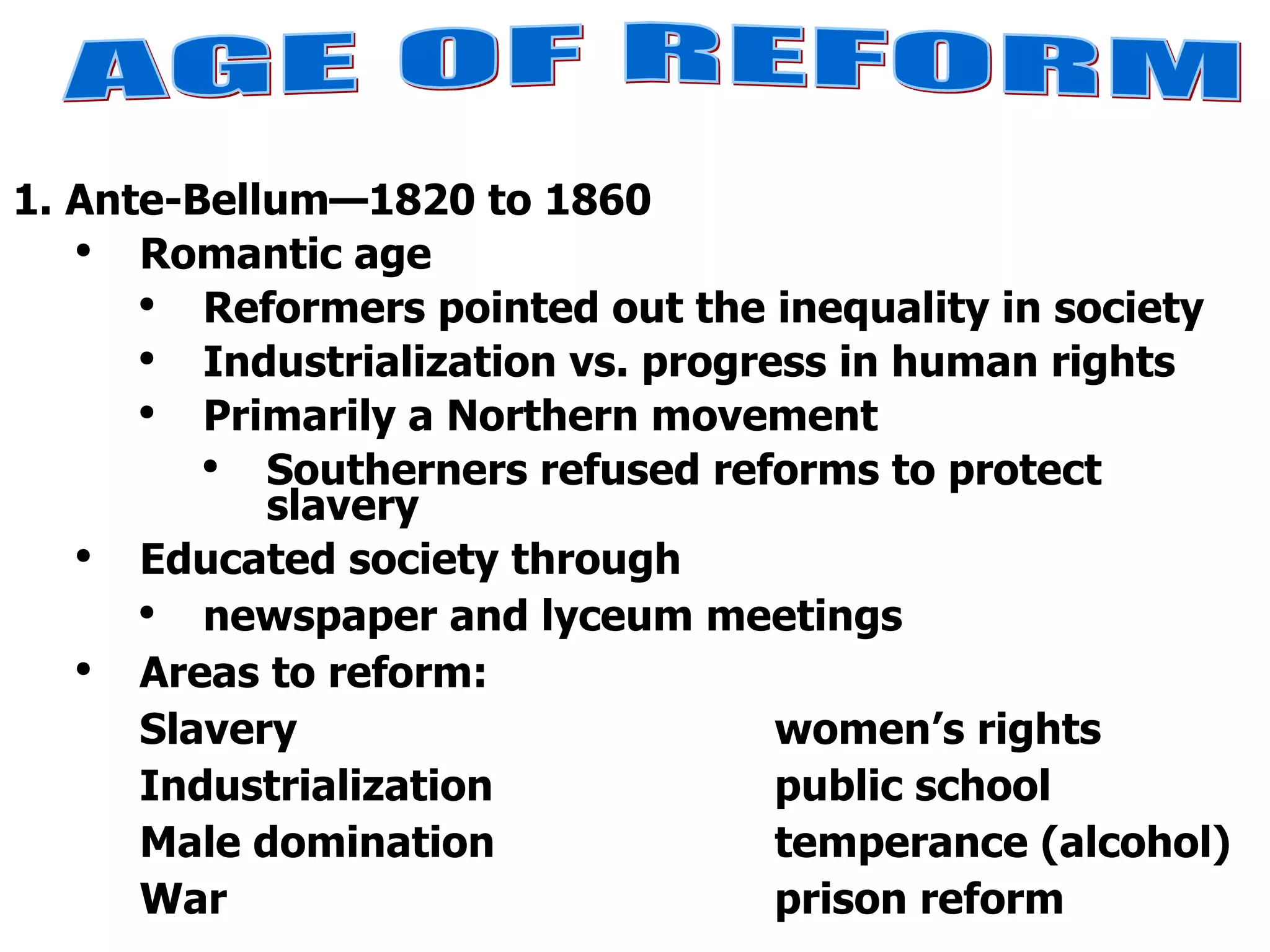
1. Ante-Bellum—1820 to 1860 Romantic age  Reformers pointed out the inequality in society Industrialization vs. progress in human rights Primarily a Northern movement Southerners refused reforms to protect slavery Educated society through  newspaper and lyceum meetings Areas to reform: Slavery women’s rights Industrialization public school Male domination temperance (alcohol) War prison reform AGE OF REFORM
2. 2 nd  Great Awakening---1820’s to 1840’s religious revival vs. deists  Rise of Unitarians---believed in a God of love  Denied the trinity  heaven through good works and helping others social conscience = social gospel  apply Christ’s teachings to bettering society Contrasted with salvation by grace and getting to heaven through Christ Baptists, Methodists, etc. 3. Formed utopian societies = collective ownership
The Second Great Awakening “ Spiritual Reform From Within” [Religious Revivalism] Social Reforms & Redefining the Ideal of Equality Temperance Asylum & Penal Reform Education Women’s Rights Abolitionism
In France, I had almost always seen the spirit of religion and the spirit of freedom pursuing courses diametrically opposed to each other; but in America, I found that they were intimately united, and that they reigned in common over the same country… Religion was the foremost of the political institutions of the United States. -- Alexis de Tocqueville, 1832 The Rise of Popular Religion
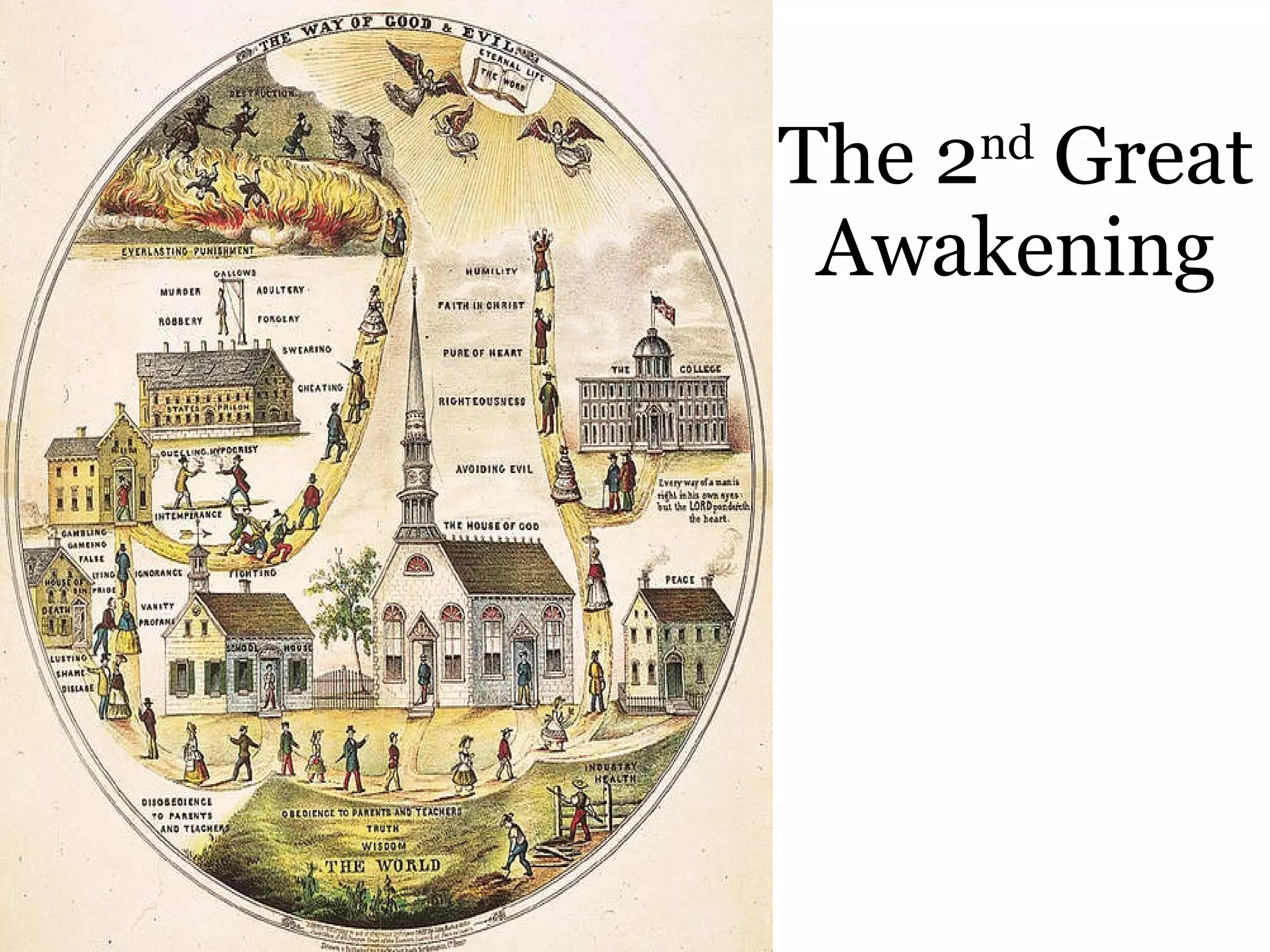
The 2 nd  Great Awakening
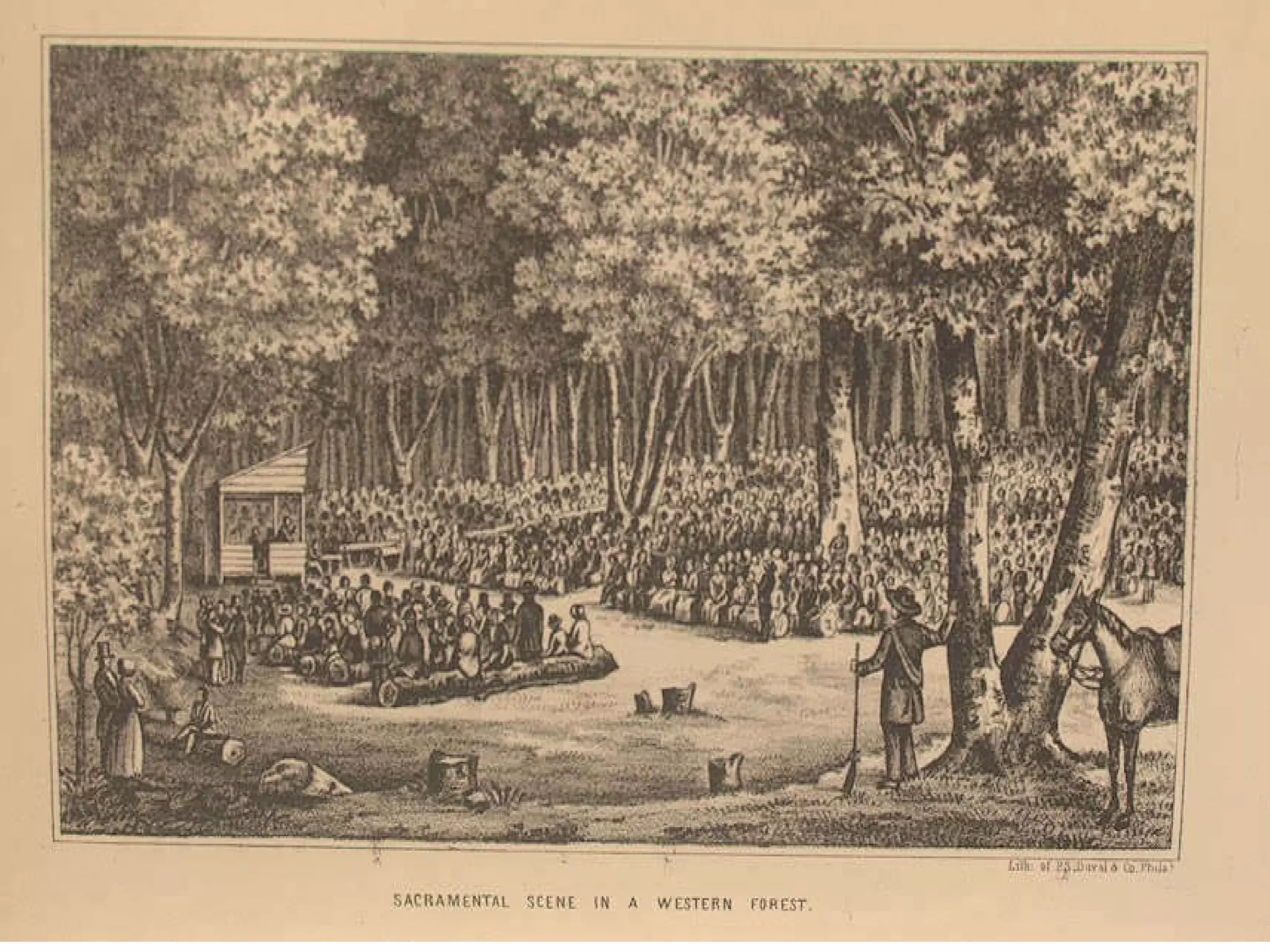
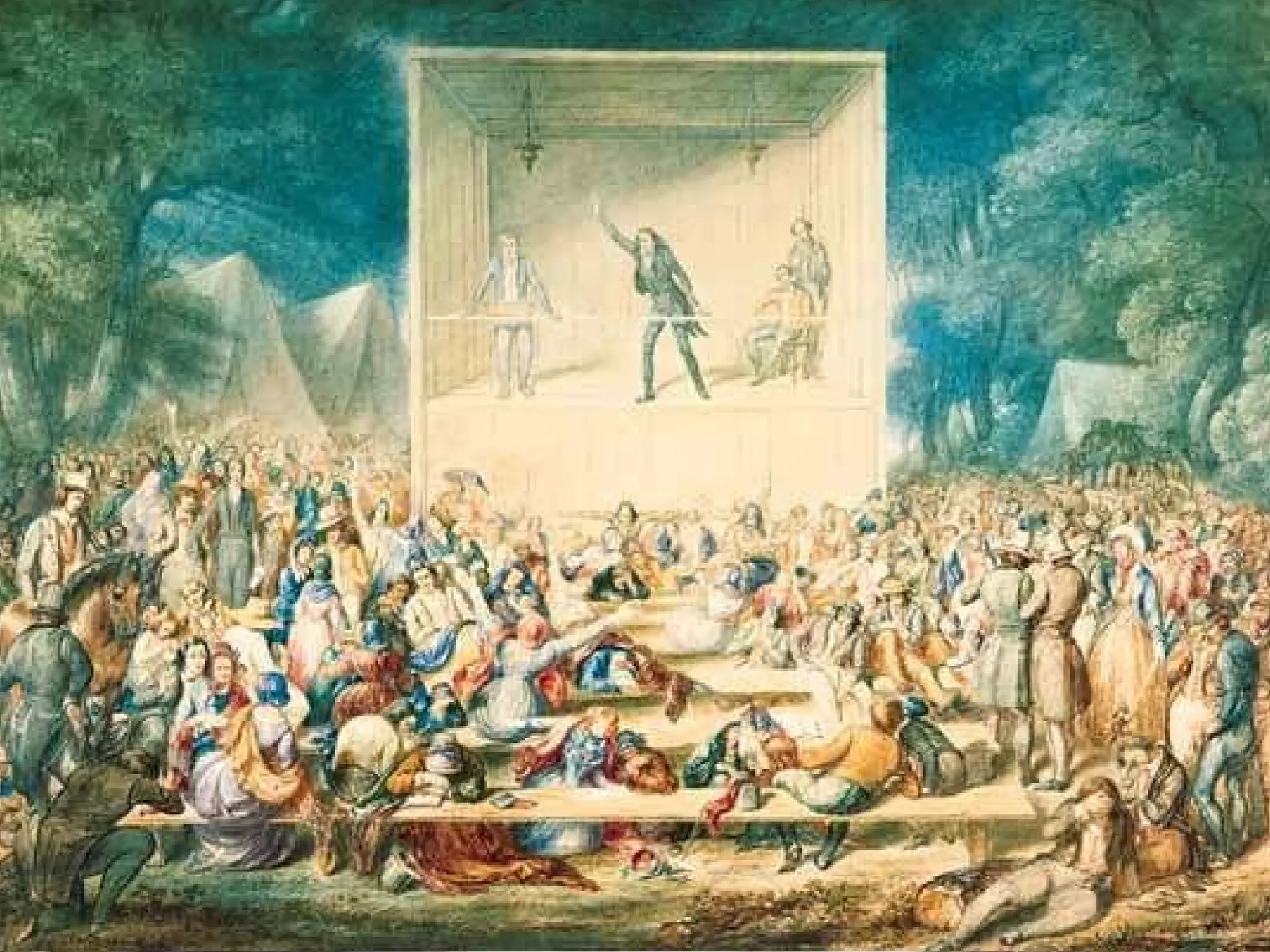
Second Great Awakening   As a result of the Second Great Awakening (a series of revivals in the 1790s-early 1800s), the dominant form of Christianity in America became evangelical Protestantism Membership in the major Protestant churches—Congregational, Presbyterian, Baptist, and Methodist—soared By 1840 an estimated half of the adult population was connected to some church, with the Methodists emerging as the largest denomination in both the North and the South
Revivalism and the Social Order Society during the Jacksonian era was undergoing deep and rapid change The revolution in markets brought both economic expansion and periodic depressions.  To combat this uncertainty reformers sought stability and order in religion Religion provided a means of social control in a disordered society Church-goers embraced the values of hard work, punctuality, and sobriety Revivals brought unity and strength  and a sense of peace
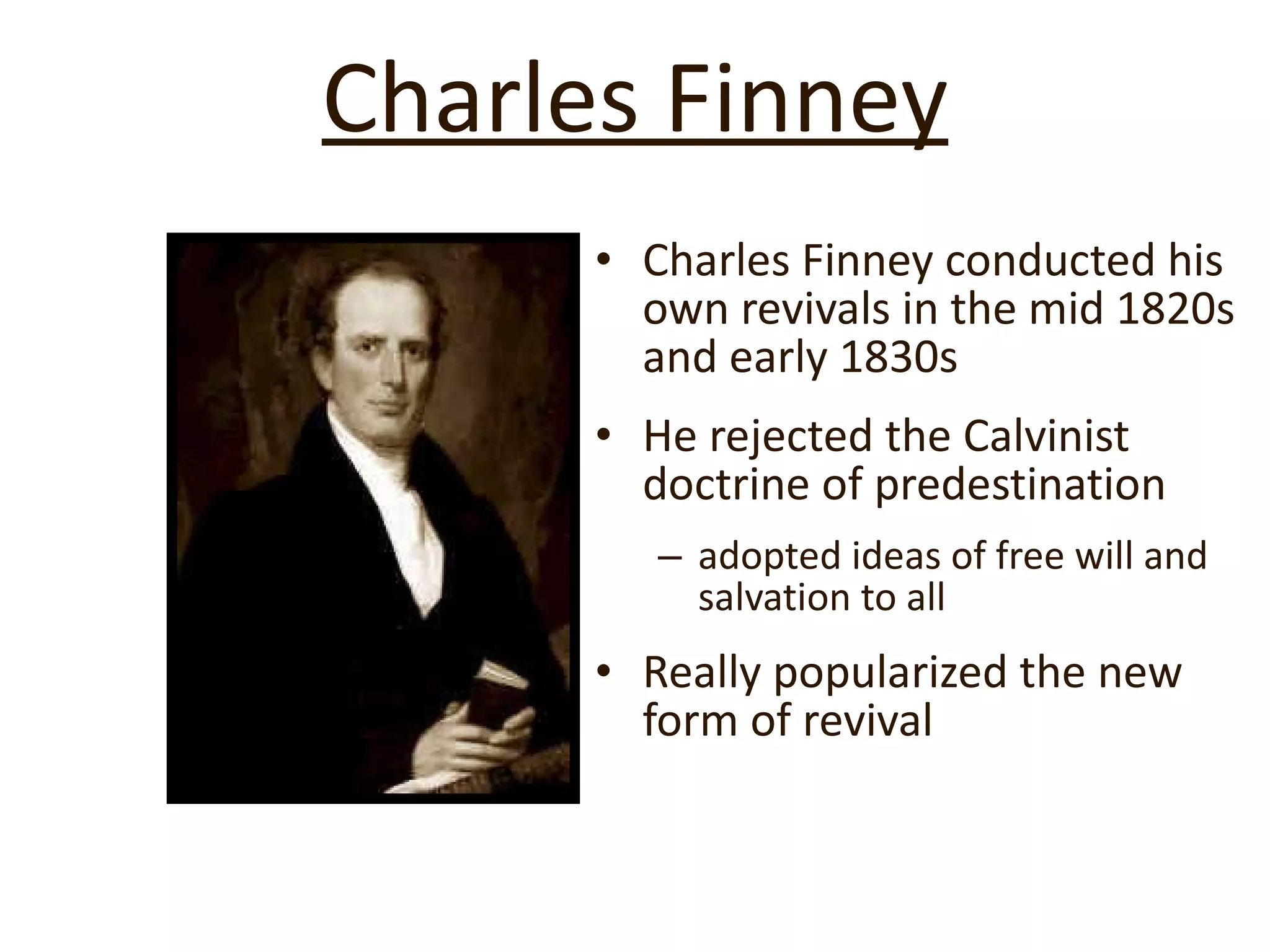
Charles Finney Charles Finney conducted his own revivals in the mid 1820s and early 1830s He rejected the Calvinist doctrine of predestination  adopted ideas of free will and salvation to all Really popularized the new form of revival
Charles Finney and the  Conversion Experience New form of revival Meeting night after night to build excitement Speaking bluntly Praying for sinners by name Encouraging women to testify in public Placing those struggling with conversion on the “anxious bench” at the front of the church
 
 
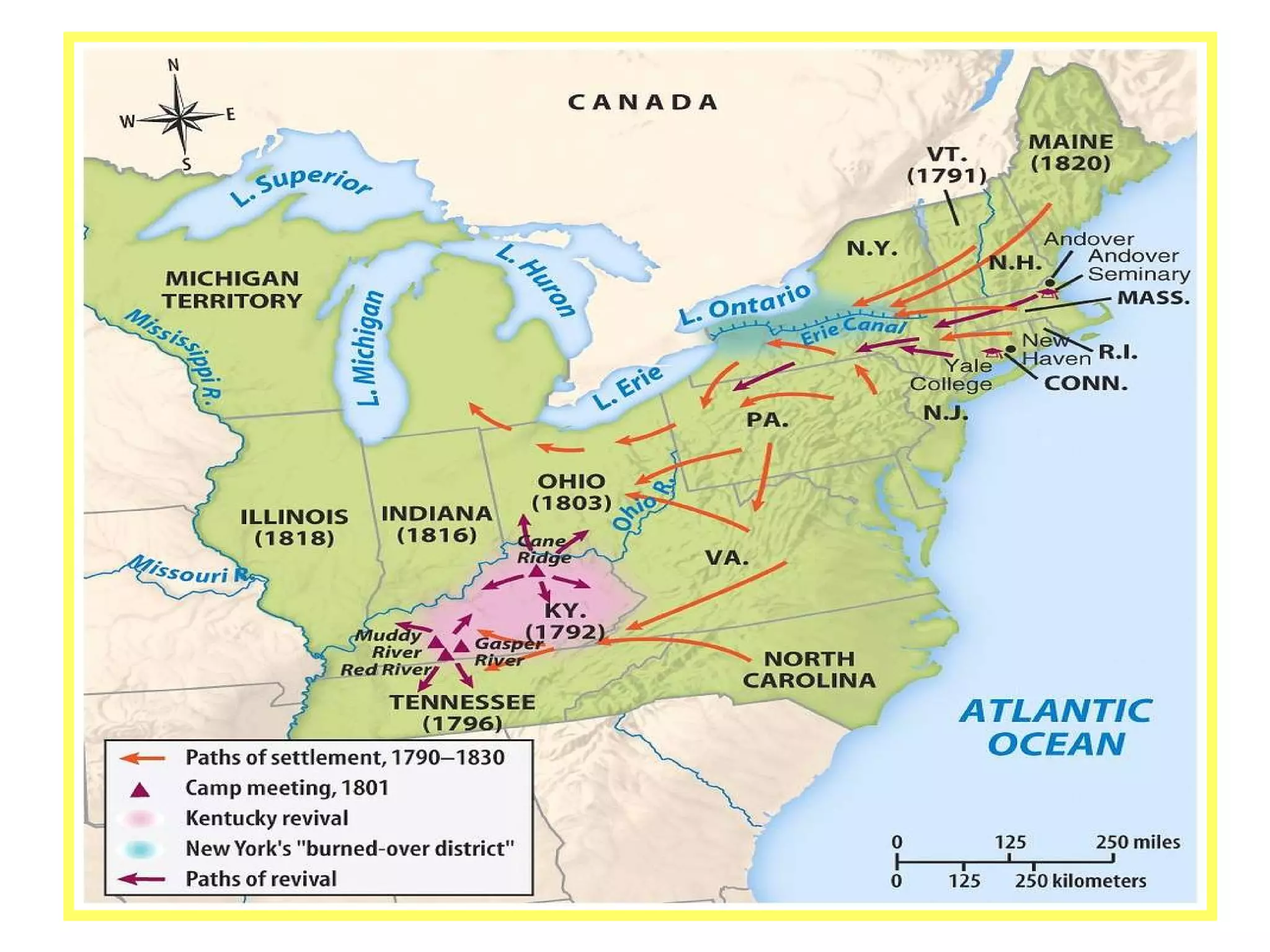
Burned Over District Burned over district in Western NY got its name from a “wild fire of new religions” Gave birth to Seventh Day Adventists The Millerites believed the 2 nd  coming of Christ would occur on October 22, 1843 Members sold belongings, bought white robes for the ascension into heaven Believers formed new church on October 23 rd   Like the 1 st , 2 nd  Awakening widened gaps between classes and religions
 

Age of reform part 1

  • 1.
    “ The Pursuit of Perfection” in Antebellum America 1820 to 1860
  • 2.
    The Age ofReform Reasons: The Great Awakening sparked interest that the individual could control their destiny and that “good deeds” will make the nation a better place The middle-class feel that they should be models of behavior for the “unmannered and ill-behaved” Finally, women are driving forces for reform because they are no longer kept at home and now have a voice (predominantly in the church)
  • 3.
    1. Ante-Bellum—1820 to1860 Romantic age Reformers pointed out the inequality in society Industrialization vs. progress in human rights Primarily a Northern movement Southerners refused reforms to protect slavery Educated society through newspaper and lyceum meetings Areas to reform: Slavery women’s rights Industrialization public school Male domination temperance (alcohol) War prison reform AGE OF REFORM
  • 4.
    2. 2 nd Great Awakening---1820’s to 1840’s religious revival vs. deists Rise of Unitarians---believed in a God of love Denied the trinity heaven through good works and helping others social conscience = social gospel apply Christ’s teachings to bettering society Contrasted with salvation by grace and getting to heaven through Christ Baptists, Methodists, etc. 3. Formed utopian societies = collective ownership
  • 5.
    The Second GreatAwakening “ Spiritual Reform From Within” [Religious Revivalism] Social Reforms & Redefining the Ideal of Equality Temperance Asylum & Penal Reform Education Women’s Rights Abolitionism
  • 6.
    In France, Ihad almost always seen the spirit of religion and the spirit of freedom pursuing courses diametrically opposed to each other; but in America, I found that they were intimately united, and that they reigned in common over the same country… Religion was the foremost of the political institutions of the United States. -- Alexis de Tocqueville, 1832 The Rise of Popular Religion
  • 7.
    The 2 nd Great Awakening
  • 8.
    Second Great Awakening As a result of the Second Great Awakening (a series of revivals in the 1790s-early 1800s), the dominant form of Christianity in America became evangelical Protestantism Membership in the major Protestant churches—Congregational, Presbyterian, Baptist, and Methodist—soared By 1840 an estimated half of the adult population was connected to some church, with the Methodists emerging as the largest denomination in both the North and the South
  • 9.
    Revivalism and theSocial Order Society during the Jacksonian era was undergoing deep and rapid change The revolution in markets brought both economic expansion and periodic depressions. To combat this uncertainty reformers sought stability and order in religion Religion provided a means of social control in a disordered society Church-goers embraced the values of hard work, punctuality, and sobriety Revivals brought unity and strength and a sense of peace
  • 10.
    Charles Finney CharlesFinney conducted his own revivals in the mid 1820s and early 1830s He rejected the Calvinist doctrine of predestination adopted ideas of free will and salvation to all Really popularized the new form of revival
  • 11.
    Charles Finney andthe Conversion Experience New form of revival Meeting night after night to build excitement Speaking bluntly Praying for sinners by name Encouraging women to testify in public Placing those struggling with conversion on the “anxious bench” at the front of the church
  • 12.
  • 13.
  • 14.
    Burned Over DistrictBurned over district in Western NY got its name from a “wild fire of new religions” Gave birth to Seventh Day Adventists The Millerites believed the 2 nd coming of Christ would occur on October 22, 1843 Members sold belongings, bought white robes for the ascension into heaven Believers formed new church on October 23 rd Like the 1 st , 2 nd Awakening widened gaps between classes and religions
  • 15.

Editor's Notes

  • #9 Evangelical Protestantism was in line with the values of the early 1800s because it stressed the ability of everyone to bring about his or her salvation. It upheld the American belief in individualism. It also catered to a mass audience without social distinctions. The revivals reinforced the American belief in democracy and equality.
  • #12 Such techniques all heightened the emotions of the conversion process (born again)
  • #15 The Millerites believed the Second Coming of Christ would occur on October 22, 1843. Members of the church sold all of their belongings and bought white robes for the ascension into heaven. Needless to say on October 23, 1843 the religion fell apart. A small group stayed on and today they are the Seventh Day Adventist