AGE ESTIMATION FROM
BLOODSTAIN
- DIKSHA MEHRA
MEMBER AFRS
CONTENTS
• Blood
• Blood Stain Detection
• Different Bloodstains
• Age Estimation
• RAMAN Spectroscopy
• Dating with Flourescence
• References
Fig. 1 Bloodstain
Blood
• A bodily fluid. Connective
tissue made up of different
types of cells carrying
nutrition and blood gases.
Fig.2 Blood Composition
BLOODSTAIN DETECTION
Preliminary Test For Blood
• TMB or Benzidine Test
• Phenolphthalein Test
• Luminol test
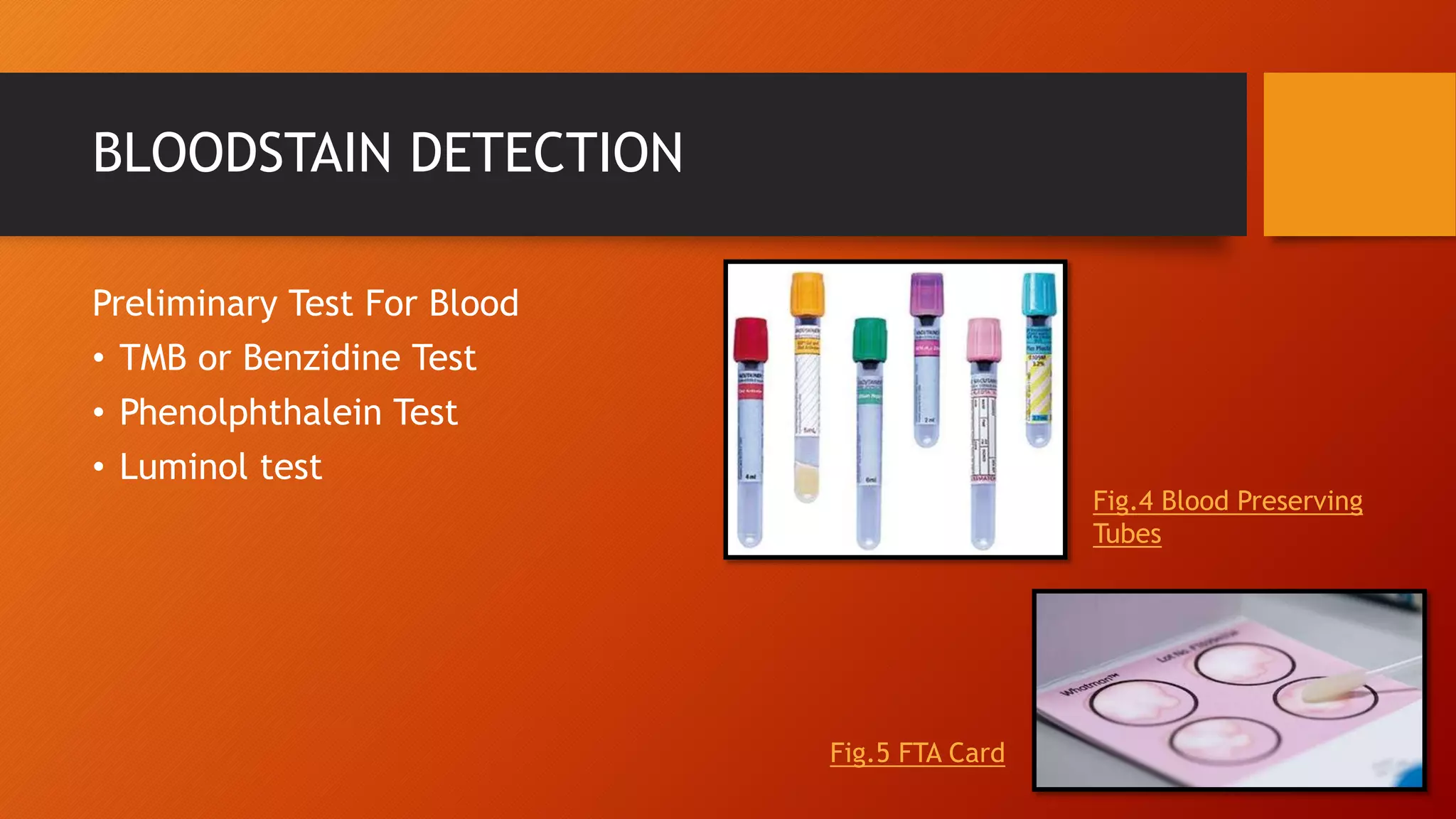
Fig.4 Blood Preserving
Tubes
Fig.5 FTA Card
Different Bloodstains
Fig.6
Different
Types of
Bloodstains
AGE ESTIMATION
• Bloodstains have a significant role to play as these can determine
the exact duration from the time of occurrence till the found
time.
• Methods :
- RAMAN Spectroscopy
- Dating Bloodstains with Fluorescence Lifetime
measurements
AGE ESTIMATION – RAMAN SPECTROSCOPY
• Raman spectroscopy and
advanced statistics allow to date
a blood stain accurately, provided
said blood stain is less than two
years old.
• Raman spectroscopy involves
shining a laser on a sample and
measuring the intensity of
scattered light.
• No two substances give the exact
same Raman spectrum and so the
spectrum is essentially a unique
fingerprint for a given material.
• Importantly, from the criminal
evidence point of view, the
process is non-destructive.
• Thus, it can be repeated at any
time, and also allows other tests,
such as DNA sequencing, to be
carried out.
DATING BLOODSTAINS WITH FLUORESCENCE
LIFETIME MEASUREMENTS
• The method is fast, reproducible,
concentration independent, and
requires a miniscule amount of
the bloodstain with minimal
sample preparation.
• The approach is based on the fact
that the fluorescence lifetime of
tryptophan the major endogenous
fluorophore in blood proteins is
highly sensitive to the protein
conformation.
• In the process of blood aging, the
major tryptophan-containing
proteins, such as albumin and γ-
globulins, undergo structural
changes.
• Therefore, the time-related
degradation of proteins in blood
reflects the blood age.
• This approach minimizes
problems with sampling and
provides more accurate results.
REFERENCES
• https://pubs.acs.org/doi/10.1021/acs.analchem.8b01367#:~:text
=In%20addition%2C%20the%20age%20of,analyzing%20the%20color%2
0of%20bloodstain.&text=There%20is%20a%20technique%20to,%2C24
)%20and%20decomposition%20degree.
• https://www.chemistryviews.org/details/ezine/1435459/CSI_The_
Age_of_the_Bloodstain.html
• https://chemistry-
europe.onlinelibrary.wiley.com/doi/abs/10.1002/chem.201102935

Age Estimation From Bloodstain.pptx