Attachment
Theory
John Bowlly
• John Bowlly (the first attachment theorist) : "To
say of a child (or older person) that he is attached
to, or has an attachment to, someone means that
he is strongly disposed to scck proximity to and
contact with the that individual and to do so
especially in certain specified conditions.
Theory Origin John Bowlby
first formulated the
attachment theory after he
wrote a pamphlet on the
homeless and orphaned
children of WW2.
•During the 1970's,
Mary Ainsworth
expanded greatly
upon Bowlby's
work.
History of Attachment
Theory
• Ideas now guiding
attachment theory joint
work of Bowlby and
Ainsworth (Ainsworth and
Bowlby, 1991)
• Both (directly or
indirectly) were
influenced by Freud and
other psychoanalytic
thinkers.
History of Attachment
Theory
3
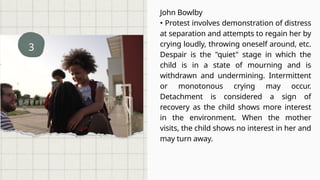
John Bowlby
• Protest involves demonstration of distress
at separation and attempts to regain her by
crying loudly, throwing oneself around, etc.
Despair is the "quiet" stage in which the
child is in a state of mourning and is
withdrawn and undermining. Intermittent
or monotonous crying may occur.
Detachment is considered a sign of
recovery as the child shows more interest
in the environment. When the mother
visits, the child shows no interest in her and
may turn away.
Attachment Theory
-Child's first relationship is a love relationship
that will have profound long-lasting effects on
an individual's subsequent development. •
Mothers(Caregivers) who are available and
responsive to their infant's needs establish a
sense of security in their children. Infant
knows that the caregiver is dependable,
which creates a secure base for the child to
then explore the world. •Attachments should
lay a good foundation for being able to form
other secure relationships
• Safe Haven: When the child feels threatened or
afraid, he or she can return to the caregiver for
comfort and soothing.
• Secure Base: The caregiver provides a secure
and dependable base for the child to explore the
world.
•Proximity Maintenance: 'The child strives to stay
near the caregiver, thus keeping the child safe.
• Separation Distress: When separated from the
caregiver, the child will become upset and
distressed.
Components of Attachment
Mary Ainsworth described three
major styles of attachment in
children:
Secure Attachment: Exhibit distress when separated from
caregivers. Feel secure and able to depend on their adult
caregivers. When frightened, securely attached children
will seek comfort from caregivers.
Ambivalent Attachment: Usually become very distressed
when a parent leaves. Relatively uncommon style. Cannot
depend on their mother (or caregiver) to be there when
in need.
Avoidant Attachment: 'Tend to avoid parents or
caregivers. When offered a choice, will show no
preference between a caregiver and a complete stranger.
Attachment theory was extended to
adult relationships in the late 1980s by
Cindy Hazan and Phillip Shaver
Roughly correspond to infant
classifications:
- Secure
- Insecure Avoidant
- Insecure Ambivalent
Attachment in Adults
Survey Secure:
1 find it relatively easy to get close
to others and am comfortable
depending on them and having
them depend on me. I don't often
worry about being abandoned or
about someone getting too friendly
to me.
Insecure
Ambivalent:
I find that others are reluctant to
get as close as I would like. I want
to get involved completely with
another person, and this thought
sometimes scares people away.
Insecure Avoidant:
I am somewhat uncomfortable
being close to others; I find it
difficult to trust them, difficult to
allow myself to depend on them. I
am nervous when anyone gets too
close.
Paper: A cross-cultural comparison of parental and peer
attachment styles among adult children from the United
States, Puerto Rico, and India (Pearson and Child, 2007).
- Investigates parental and peer attachment among
people from the USA, Puerto Rico and India 50
participants from the USA(avg. age-23), 36 from Puerto
Rico(avg, age-29.7) and 96 from India(avg. age-20.3)
Inventory of Parent and Peer Attachment(IPPA)
(Armsden and Greenberg, 1987) is used to measure
mother, father, and peer attachment.
Parental and Peer Attachment Study
Study Results
• Puerto Rican participants reflected a significantly weaker overall
attachment to their mothers in comparison to both US and Indian
participants
• Participants from India reflected a significantly stronger attachment to
their fathers in comparison to Puerto Rican and US participants.
• US participants maintained a stronger attachment to their peers in
comparison to participants from India.
Study Analysis
• Investigation suggests tenets of attachment
theory are not culturally universal
• College students revealed different attachment
patterns based on different countries of origin.
• Differences may be linked to cultural divergence
(collectivism versus individualism)
3
Study Analysis
• Less attachment of Puerto Rican participants to
their mothers is ascribed to their macho culture
where men are viewed as superior to women.
Indian participants were more strongly attached to
their fathers because they tended to be
patriarchal. The father is seen as the head of the
family. Moreover, both Hindu and Muslim religions
have strong masculinist leanings Participants from
the United States were more attached to their
peers because of its individualistic culture in which
relationships with peers are favored over family
members as compared to the collectivistic culture
of India.
3
Attachment and Self-Image
• Attachment to parents has a stronger
impact on adolescent's self-esteem
than peer attachment (Armsden and
Greenberg, 1987)
• Hay and Ashman (2003) found the
relationship between parents and
same-sex peer relationships had a
significant influence on the formation
of the self-concept of males but not of
females.
Applications
• Attachment theory has implications and
applications mainly for the welfare and care of
children •
Child Care Policies:
- The driving force of Bowlby's development of
attachment theory: the care of children
- Significant policy implications for hospitalized or
institutionalized children
- Applications when foster parents adopt foster
children
- Can inform decisions made in social work and court
processes about foster care
Applications
• Clinical practice in children:
- Increase the responsiveness and
sensitivity of the caregiver for better
attachment, and if possible change the
caregiver.
- Introduction to affectionate and
sensitive caregivers can be helpful for
an insecurely attached infant in his/
her development.
References
References • Bretherton, 1(1992). The origins of Attachment
Theon: John Bonily and May Ainsworth. • Judy Pearson and
Jeffrey Child(2007). A Cross Cultural Comparison of Parental
and Peer Attachment Styles among Adult Children from the
United Stales, Puerto Rico, and India hutp://
psychologs.abour.com/od/loveandartraction./a/artachment
01
. hum • Rutter M (2008), "Implications of Attachment Theory
and Research for Child Care Policies". In Cassidy J, Shaver
PR. Handbook of Attachment: Theory, Research and Clinical
Applications. New York and London: Guilford Press. pp. 958-
74

Attachment Theory for PRESENTATION .pptx

  • 1.
  • 2.
    John Bowlly • JohnBowlly (the first attachment theorist) : "To say of a child (or older person) that he is attached to, or has an attachment to, someone means that he is strongly disposed to scck proximity to and contact with the that individual and to do so especially in certain specified conditions.
  • 3.
    Theory Origin JohnBowlby first formulated the attachment theory after he wrote a pamphlet on the homeless and orphaned children of WW2. •During the 1970's, Mary Ainsworth expanded greatly upon Bowlby's work. History of Attachment Theory
  • 4.
    • Ideas nowguiding attachment theory joint work of Bowlby and Ainsworth (Ainsworth and Bowlby, 1991) • Both (directly or indirectly) were influenced by Freud and other psychoanalytic thinkers. History of Attachment Theory
  • 5.
    3 John Bowlby • Protestinvolves demonstration of distress at separation and attempts to regain her by crying loudly, throwing oneself around, etc. Despair is the "quiet" stage in which the child is in a state of mourning and is withdrawn and undermining. Intermittent or monotonous crying may occur. Detachment is considered a sign of recovery as the child shows more interest in the environment. When the mother visits, the child shows no interest in her and may turn away.
  • 6.
    Attachment Theory -Child's firstrelationship is a love relationship that will have profound long-lasting effects on an individual's subsequent development. • Mothers(Caregivers) who are available and responsive to their infant's needs establish a sense of security in their children. Infant knows that the caregiver is dependable, which creates a secure base for the child to then explore the world. •Attachments should lay a good foundation for being able to form other secure relationships
  • 7.
    • Safe Haven:When the child feels threatened or afraid, he or she can return to the caregiver for comfort and soothing. • Secure Base: The caregiver provides a secure and dependable base for the child to explore the world. •Proximity Maintenance: 'The child strives to stay near the caregiver, thus keeping the child safe. • Separation Distress: When separated from the caregiver, the child will become upset and distressed. Components of Attachment
  • 8.
    Mary Ainsworth describedthree major styles of attachment in children: Secure Attachment: Exhibit distress when separated from caregivers. Feel secure and able to depend on their adult caregivers. When frightened, securely attached children will seek comfort from caregivers. Ambivalent Attachment: Usually become very distressed when a parent leaves. Relatively uncommon style. Cannot depend on their mother (or caregiver) to be there when in need. Avoidant Attachment: 'Tend to avoid parents or caregivers. When offered a choice, will show no preference between a caregiver and a complete stranger.
  • 9.
    Attachment theory wasextended to adult relationships in the late 1980s by Cindy Hazan and Phillip Shaver Roughly correspond to infant classifications: - Secure - Insecure Avoidant - Insecure Ambivalent Attachment in Adults
  • 10.
    Survey Secure: 1 findit relatively easy to get close to others and am comfortable depending on them and having them depend on me. I don't often worry about being abandoned or about someone getting too friendly to me.
  • 11.
    Insecure Ambivalent: I find thatothers are reluctant to get as close as I would like. I want to get involved completely with another person, and this thought sometimes scares people away.
  • 12.
    Insecure Avoidant: I amsomewhat uncomfortable being close to others; I find it difficult to trust them, difficult to allow myself to depend on them. I am nervous when anyone gets too close.
  • 13.
    Paper: A cross-culturalcomparison of parental and peer attachment styles among adult children from the United States, Puerto Rico, and India (Pearson and Child, 2007). - Investigates parental and peer attachment among people from the USA, Puerto Rico and India 50 participants from the USA(avg. age-23), 36 from Puerto Rico(avg, age-29.7) and 96 from India(avg. age-20.3) Inventory of Parent and Peer Attachment(IPPA) (Armsden and Greenberg, 1987) is used to measure mother, father, and peer attachment. Parental and Peer Attachment Study
  • 14.
    Study Results • PuertoRican participants reflected a significantly weaker overall attachment to their mothers in comparison to both US and Indian participants • Participants from India reflected a significantly stronger attachment to their fathers in comparison to Puerto Rican and US participants. • US participants maintained a stronger attachment to their peers in comparison to participants from India.
  • 15.
    Study Analysis • Investigationsuggests tenets of attachment theory are not culturally universal • College students revealed different attachment patterns based on different countries of origin. • Differences may be linked to cultural divergence (collectivism versus individualism)
  • 16.
    3 Study Analysis • Lessattachment of Puerto Rican participants to their mothers is ascribed to their macho culture where men are viewed as superior to women. Indian participants were more strongly attached to their fathers because they tended to be patriarchal. The father is seen as the head of the family. Moreover, both Hindu and Muslim religions have strong masculinist leanings Participants from the United States were more attached to their peers because of its individualistic culture in which relationships with peers are favored over family members as compared to the collectivistic culture of India.
  • 17.
    3 Attachment and Self-Image •Attachment to parents has a stronger impact on adolescent's self-esteem than peer attachment (Armsden and Greenberg, 1987) • Hay and Ashman (2003) found the relationship between parents and same-sex peer relationships had a significant influence on the formation of the self-concept of males but not of females.
  • 18.
    Applications • Attachment theoryhas implications and applications mainly for the welfare and care of children • Child Care Policies: - The driving force of Bowlby's development of attachment theory: the care of children - Significant policy implications for hospitalized or institutionalized children - Applications when foster parents adopt foster children - Can inform decisions made in social work and court processes about foster care
  • 19.
    Applications • Clinical practicein children: - Increase the responsiveness and sensitivity of the caregiver for better attachment, and if possible change the caregiver. - Introduction to affectionate and sensitive caregivers can be helpful for an insecurely attached infant in his/ her development.
  • 20.
    References References • Bretherton,1(1992). The origins of Attachment Theon: John Bonily and May Ainsworth. • Judy Pearson and Jeffrey Child(2007). A Cross Cultural Comparison of Parental and Peer Attachment Styles among Adult Children from the United Stales, Puerto Rico, and India hutp:// psychologs.abour.com/od/loveandartraction./a/artachment 01 . hum • Rutter M (2008), "Implications of Attachment Theory and Research for Child Care Policies". In Cassidy J, Shaver PR. Handbook of Attachment: Theory, Research and Clinical Applications. New York and London: Guilford Press. pp. 958- 74