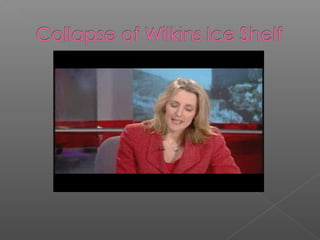
 The End of March             A massive chunk of a
  witnessed a truly             sea shelf, the size of
  spectacular event in          nine Manhattans,
  the West Antarctic            broke off from the
                                Wilkins Peninsula
 Will this event trigger
                               No, because this ice
  sea level rise?               was already floating in
 Why then does this            the ocean
  event so trouble             Feedback loops
  scientists?                   (albedo, water
                                temperature & ocean
                                circulation patterns) &
                                no more buffer
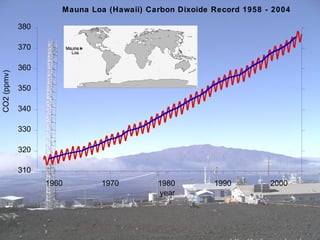
Mauna Loa (Hawaii) Carbon Dixoide Record 1958 - 2004

             380

             370

             360
CO2 (ppmv)


             350

             340

             330

             320

             310
                   1960       1970         1980         1990         2000
                                           year
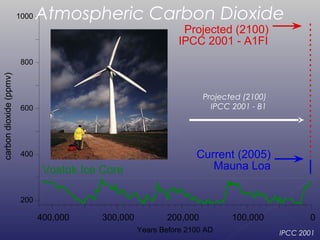
1000   Atmospheric Carbon Dioxide
                                                                Projected (2100)
                                                               IPCC 2001 - A1FI
                         800
carbon dioxide (ppmv)


                                                                      Projected (2100)
                         600                                            IPCC 2001 - B1


                         400                                        Current (2005)
                                Vostok Ice Core                        Mauna Loa

                         200

                               400,000     300,000          200,000          100,000            0
                                                     Years Before 2100 AD                IPCC 2001
 It’s not much different from what the rest
  of us can do
 We all can take action in these areas:
    › Conserve energy
    › Reduce paper consumption & use recycled when
        possible
    ›   Reduce carbon footprints
    ›   Consider where goods come from before buying
    ›   Implement new sustainable methods of operation
    ›   Spread the word
    ›   Invest in environmentally conscious enterprises
   Enlist a volunteer to take charge of all things
    green in your organizations
   This Eco-Point Person should monitor
    compliance with your organization’s plan to
    reduce its carbon footprint
   He or she should also ensure that everyone
    is aware of their own responsibilities
   He or she should also educate new
    employees
   If you rent or lease space in an office
    building, get in touch with the landlord to
    see what more he or she can do
 Turn off lights, computer monitors,
  computers, & printers & anything else
  powered on when you leave the office.
 Better yet, make sure everyone has a
  power strip, and make sure everyone
  switches them off when leaving
    › This saves tons of power because of
      “phantom loads.”
   Install either CFL or LED bulbs everywhere
    › CFL bulbs uses 60% less energy than a
      conventional incandescent bulb & LED bulbs
      can last 60,000 hours while using 2 watts
   The folks at Energy Star have estimated
    that if every American household
    replaces just one incandescent light bulb
    with an Energy Star approved bulb, we
    could save enough energy to light more
    than 3 million homes. We would also
    save more than $600 million in yearly
    energy costs. If everyone accepted this
    challenge, we could prevent GHG
    emissions equal to 800,000 cars.
 Computers, monitors, & etc.: Get
  everyone a power strip – they’re cheap
  and they’re one of the most effective
  steps you can take.
 But . . . it’s only effective in eliminating
  “phantom loads” if everyone switches it
  off when leaving. Hey, at least they can’t
  complain about having to turn off all six
  buttons – all it takes is one switch.
   Computers: Contrary to a lot of popular
    wisdom, screensavers do not save energy,
    and they do not save the screen.
   Instead, the person in charge can ensure
    that monitors & computers go into sleep
    mode after a period of inactivity.
   Additionally, change power management
    settings easily in Control Panel
    Power Options           Power Saver.
    Performance suffers little if at all, and a
    good IT person can modify the settings to
    suit your needs.
   The folks across the river at MIT
    contributed the following statistics:
    Powering down computers and
    monitors can result in significant
    energy savings.
     › Powering down a single desktop
       with a 17” monitor can result in 500
       kWh annual savings. An average
       size Cambridge home uses 700 kWh
       per month.
   If you own it, make the following changes in
    consultation with the property management types
    (if you don’t, try to prevail upon the landlord):
     › Adopt recommendations of the USGBC – even if
        you’re not putting up a new building now, they
        offer helpful guidance about what you can do
        with an older structure.
     › Consult with your utility or power company
        about availability of green power.
     › If none’s available, get a different power
        company (Ha!) or consider carbon offsets.
     › Install a green roof.
   Does everyone need balmy indoor
    temperatures in the winter, or a frosty
    breeze from the air duct in the heat of
    the summer?
    › How about dress codes allowing sweater
      vests? While Fashionistas might look askance
      at the bas couture, turning the heat down a
      few degrees with a building-wide control
      can provide enormous cost & energy
      savings. Aim for 65 degrees in the winter and
      70 in the summer.
 Having your local utility or power
  company perform an energy audit can
  be a good place to start. They can point
  out leaks and recommend cost-saving
  solutions.
 Once you’ve made necessary changes,
  you can keep track of your progress by
  watching your energy bill drop, or by
  bringing back the utility auditor for a
  second look.
   100 % recycled paper or as much post-
    consumer recycled content as possible (see
            www.newleafpaper.com )
   Encourage double-sided copying
   Use the internet and intranets for internal
    paper routing
   Don’t print e-mails, use scanners, and use
    small fonts, reduced spacing, & small
    margins
   Share reference manuals and other huge
    volumes
   Recycle, Reduce, & Reuse
    › Figure out how to dispose of items not
      typically placed in recycle bins, including
      potentially dangerous goods like
      batteries, construction materials, &
      computer, monitor, and printer parts
    › Put recycling bins everywhere around the
      office and encourage their use with
      gentle prodding or outright screaming if
      the prodding doesn’t work
   Start food, clothing, & book drives in your
    publishing houses
    › Unused stuff hanging in someone’s closet,
      languishing on someone’s pantry shelf, or
      collecting dust on someone’s bookshelf
      could be a great find for a neighbor or co-
      worker
   Put the Eco-Point Person in charge of
    establishing relationships with town or
    city officials to expand recycling
    opportunities to small businesses
 More and more car companies are
  offering either low-emissions or zero-
  emissions cars and light trucks. I’ve
  placed my order for a Smart Fortwo – my
  brother-in-law will tell me that it’s not a
  “real” Mercedes, but I’ll spend less for
  gas than him
 Most states have ride-share programs to
  promote car pooling
 Walk, ride a bike, or take a motor
  scooter to work when possible
   How about offering bonuses or other perks
    for employees biking to work – discount
    gym memberships, bike racks, or financial
    incentives?
   Preferred parking spaces for hybrids or other
    low emissions/good gas mileage vehicles
   For employee travel, encourage rental of
    hybrids – many cities now have exclusively
    hybrid car rental companies & most
    traditional companies offer hybrid choices
 Encourage use of public transportation
 Assign your company’s Eco-Point person
  the task of organizing employees to start
  letter writing campaigns to local
  government leaders & state legislators to
  increase availability of public
  transportation
 Encourage live meet-ups on-line & work
  from home options with incentive
  programs
Consider where goods come
               from before buying
   The average American meal travels more than
    1,500 miles – encourage co-workers to buy locally
    grown food where possible
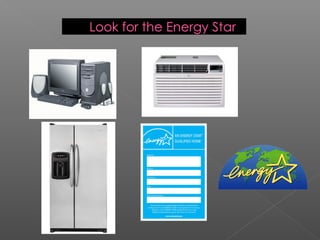
   Buy consumer and other electronic products that
    have the Energy Star label: Go to
    www.EnergyStar.gov.
   Buy fair trade goods, cut back on or eliminate
    purchases of cleaning products containing
    hazardous chemicals
   Give up single servings – buy in bulk – it’s cheaper
    and much more green
 Choose companies that implement
  sustainable business practices, or
  encourage them to change
 Cut down on disposables like styrofoam;
  provide reusable plates and other dining
  items for lunchrooms
 Choose soy-based ink for outsourced
  printing jobs
 Conserve water by choosing flush-free or
  low flush toilets
   Install water filtration systems to cut down
    on bottled water purchases
   Purchase unbleached paper towels &
    napkins; or eliminate their use altogether:
    reuse & wash cloth instead
   Choose cleaners without toxic ingredients
   Get busy with supplies: recycle cartridges &
    toner; reuse old binders, folders & etc; give
    furniture and other supplies to charities
    rather than dumping
Spread the word &
     invest in environmentally conscious enterprises
   Ensure your Eco-Point person has the tools
    necessary to educate employees and
    reward their engagement in the enterprise
   Bring motivational speakers in to increase
    awareness and spur further action
   Encourage donations to environmental
    causes; consider matching gifts
   Check out Travelers: $227 billion market in
    Lifestyles of Health & Sustainability:
    http://www.hybridtravelers.com/newsroom.htm
 Check out this organization which was
  formed by concerned insurance
  companies and others.
 Their mission is to address the problem of
  global climate change before it
  becomes prohibitively expensive to
  insure against foreseeable losses.
396 olson

396 olson

  • 2.
     The Endof March  A massive chunk of a witnessed a truly sea shelf, the size of spectacular event in nine Manhattans, the West Antarctic broke off from the Wilkins Peninsula  Will this event trigger  No, because this ice sea level rise? was already floating in  Why then does this the ocean event so trouble  Feedback loops scientists? (albedo, water temperature & ocean circulation patterns) & no more buffer
  • 4.
    Mauna Loa (Hawaii)Carbon Dixoide Record 1958 - 2004 380 370 360 CO2 (ppmv) 350 340 330 320 310 1960 1970 1980 1990 2000 year
  • 5.
    1000 Atmospheric Carbon Dioxide Projected (2100) IPCC 2001 - A1FI 800 carbon dioxide (ppmv) Projected (2100) 600 IPCC 2001 - B1 400 Current (2005) Vostok Ice Core Mauna Loa 200 400,000 300,000 200,000 100,000 0 Years Before 2100 AD IPCC 2001
  • 6.
     It’s notmuch different from what the rest of us can do  We all can take action in these areas: › Conserve energy › Reduce paper consumption & use recycled when possible › Reduce carbon footprints › Consider where goods come from before buying › Implement new sustainable methods of operation › Spread the word › Invest in environmentally conscious enterprises
  • 7.
    Enlist a volunteer to take charge of all things green in your organizations  This Eco-Point Person should monitor compliance with your organization’s plan to reduce its carbon footprint  He or she should also ensure that everyone is aware of their own responsibilities  He or she should also educate new employees  If you rent or lease space in an office building, get in touch with the landlord to see what more he or she can do
  • 8.
     Turn offlights, computer monitors, computers, & printers & anything else powered on when you leave the office.  Better yet, make sure everyone has a power strip, and make sure everyone switches them off when leaving › This saves tons of power because of “phantom loads.”  Install either CFL or LED bulbs everywhere › CFL bulbs uses 60% less energy than a conventional incandescent bulb & LED bulbs can last 60,000 hours while using 2 watts
  • 9.
    The folks at Energy Star have estimated that if every American household replaces just one incandescent light bulb with an Energy Star approved bulb, we could save enough energy to light more than 3 million homes. We would also save more than $600 million in yearly energy costs. If everyone accepted this challenge, we could prevent GHG emissions equal to 800,000 cars.
  • 10.
     Computers, monitors,& etc.: Get everyone a power strip – they’re cheap and they’re one of the most effective steps you can take.  But . . . it’s only effective in eliminating “phantom loads” if everyone switches it off when leaving. Hey, at least they can’t complain about having to turn off all six buttons – all it takes is one switch.
  • 11.
    Computers: Contrary to a lot of popular wisdom, screensavers do not save energy, and they do not save the screen.  Instead, the person in charge can ensure that monitors & computers go into sleep mode after a period of inactivity.  Additionally, change power management settings easily in Control Panel Power Options Power Saver. Performance suffers little if at all, and a good IT person can modify the settings to suit your needs.
  • 12.
    The folks across the river at MIT contributed the following statistics: Powering down computers and monitors can result in significant energy savings. › Powering down a single desktop with a 17” monitor can result in 500 kWh annual savings. An average size Cambridge home uses 700 kWh per month.
  • 13.
    If you own it, make the following changes in consultation with the property management types (if you don’t, try to prevail upon the landlord): › Adopt recommendations of the USGBC – even if you’re not putting up a new building now, they offer helpful guidance about what you can do with an older structure. › Consult with your utility or power company about availability of green power. › If none’s available, get a different power company (Ha!) or consider carbon offsets. › Install a green roof.
  • 14.
    Does everyone need balmy indoor temperatures in the winter, or a frosty breeze from the air duct in the heat of the summer? › How about dress codes allowing sweater vests? While Fashionistas might look askance at the bas couture, turning the heat down a few degrees with a building-wide control can provide enormous cost & energy savings. Aim for 65 degrees in the winter and 70 in the summer.
  • 15.
     Having yourlocal utility or power company perform an energy audit can be a good place to start. They can point out leaks and recommend cost-saving solutions.  Once you’ve made necessary changes, you can keep track of your progress by watching your energy bill drop, or by bringing back the utility auditor for a second look.
  • 16.
    100 % recycled paper or as much post- consumer recycled content as possible (see www.newleafpaper.com )  Encourage double-sided copying  Use the internet and intranets for internal paper routing  Don’t print e-mails, use scanners, and use small fonts, reduced spacing, & small margins  Share reference manuals and other huge volumes
  • 17.
    Recycle, Reduce, & Reuse › Figure out how to dispose of items not typically placed in recycle bins, including potentially dangerous goods like batteries, construction materials, & computer, monitor, and printer parts › Put recycling bins everywhere around the office and encourage their use with gentle prodding or outright screaming if the prodding doesn’t work
  • 18.
    Start food, clothing, & book drives in your publishing houses › Unused stuff hanging in someone’s closet, languishing on someone’s pantry shelf, or collecting dust on someone’s bookshelf could be a great find for a neighbor or co- worker  Put the Eco-Point Person in charge of establishing relationships with town or city officials to expand recycling opportunities to small businesses
  • 19.
     More andmore car companies are offering either low-emissions or zero- emissions cars and light trucks. I’ve placed my order for a Smart Fortwo – my brother-in-law will tell me that it’s not a “real” Mercedes, but I’ll spend less for gas than him  Most states have ride-share programs to promote car pooling  Walk, ride a bike, or take a motor scooter to work when possible
  • 20.
    How about offering bonuses or other perks for employees biking to work – discount gym memberships, bike racks, or financial incentives?  Preferred parking spaces for hybrids or other low emissions/good gas mileage vehicles  For employee travel, encourage rental of hybrids – many cities now have exclusively hybrid car rental companies & most traditional companies offer hybrid choices
  • 21.
     Encourage useof public transportation  Assign your company’s Eco-Point person the task of organizing employees to start letter writing campaigns to local government leaders & state legislators to increase availability of public transportation  Encourage live meet-ups on-line & work from home options with incentive programs
  • 22.
    Consider where goodscome from before buying  The average American meal travels more than 1,500 miles – encourage co-workers to buy locally grown food where possible  Buy consumer and other electronic products that have the Energy Star label: Go to www.EnergyStar.gov.  Buy fair trade goods, cut back on or eliminate purchases of cleaning products containing hazardous chemicals  Give up single servings – buy in bulk – it’s cheaper and much more green
  • 24.
     Choose companiesthat implement sustainable business practices, or encourage them to change  Cut down on disposables like styrofoam; provide reusable plates and other dining items for lunchrooms  Choose soy-based ink for outsourced printing jobs  Conserve water by choosing flush-free or low flush toilets
  • 25.
    Install water filtration systems to cut down on bottled water purchases  Purchase unbleached paper towels & napkins; or eliminate their use altogether: reuse & wash cloth instead  Choose cleaners without toxic ingredients  Get busy with supplies: recycle cartridges & toner; reuse old binders, folders & etc; give furniture and other supplies to charities rather than dumping
  • 26.
    Spread the word& invest in environmentally conscious enterprises  Ensure your Eco-Point person has the tools necessary to educate employees and reward their engagement in the enterprise  Bring motivational speakers in to increase awareness and spur further action  Encourage donations to environmental causes; consider matching gifts  Check out Travelers: $227 billion market in Lifestyles of Health & Sustainability: http://www.hybridtravelers.com/newsroom.htm
  • 27.
     Check outthis organization which was formed by concerned insurance companies and others.  Their mission is to address the problem of global climate change before it becomes prohibitively expensive to insure against foreseeable losses.