Government of India
               Ministry of Housing & Urban Poverty Alleviation
                       (JNNURM Mission Directorate)


    GUIDELINES FOR AFFORDABLE HOUSING IN PARTNERSHIP


1      INTRODUCTION
1.1    The Scheme of Affordable Housing in Partnership aims at operationalising
the strategy envisaged in the National Urban Housing & Habitat Policy (NUHHP)
2007, of promoting various types of public-private partnerships – of the
government sector with the private sector, the cooperative sector, the financial
services sector, the state parastatals, urban local bodies, etc. – for realizing the goal
of affordable housing for all. It intends to provide a major stimulus to economic
activities through affordable housing for the creation of employment, especially for
the construction workers and other urban poor who are likely to be amongst the
most vulnerable groups in recession. It also targets the creation of demand for a
large variety of industrial goods through the multiplier effect of housing on other
economic acitivites.


1.2    This Scheme is a part of the Jawaharlal Nehru National Urban Renewal
Mission (JNNURM) and takes into account the experience of implementing Basic
Services to the Urban Poor (BSUP) and Integrated Housing & Slum Development
Programme (IHSDP) for three years, and the assessment that shortfall in response
from BSUP towns is a factor of the lack of urban land availability for expansion of
cities, and after consultation with States/UTs who have agreed that the
responsibility of making urban land available at affordable rates must rest with
them in order to reduce the acute shortages of housing in urban areas. The scheme
is also an acknowledgement of the strain of BSUP and IHSDP on state budgetary
resources, and the need to draw in institutional finance for construction of
affordable housing on a mass scale.
1.3   The scheme is primarily applicable to the 65 cities covered under the BSUP
programme. Other cities of population above 5 lakhs could be considered during
implementation with approval of the National Steering Group for JNNURM, if
adequate number of projects is not forthcoming from the 65 cities. However,
project proposals from non-BSUP towns could be considered for sanction based
on a review of the implementation of the Scheme by the Ministry of Housing &
Urban Poverty Alleviation after two years.


1.4   The scheme seeks to encourage State Governments to make provision for
land to meet the acute shortage of affordable housing and to work in the
partnership model envisaged in the NUHHP 2007.


1.5   These Guidelines will come into effect from 1st April, 2009 and the scheme
will be a part of JNNURM.


2.    OBJECTIVE
      The basic aim of the Scheme is to provide stimulus to economic activities
through affordable housing programmes in partnership. Its immediate objective is
employment generation to the urban poor, especially construction workers, where
adverse impact of current economic downturn is being experienced. The Scheme
will also strive to ensure equitable supply of land, shelter and services at affordable
prices to all sections of society, and thereby to prevent the growth of slums in
urban areas.


3.    COVERAGE
3.1   The scheme will apply mainly to the 65 BSUP cities, where shortages of land
for housing are driving unplanned growth and raising home prices and rentals to
unsustainable levels.


3.2   The projects which should be eligible under this scheme for assistance
would need to meet the following two criteria:

                                          2
a)     Dwelling units should be a mix of EWS/LIG/MIG categories with the
             maximum size of a dwelling unit being at 1200 square feet super area,
             with at least 25% of them for EWS of about 300 square feet. In terms of
             carpet area, the minimum carpet area for EWS category shall be 25
             square metres and maximum carpet area for MIG category shall be 80
             square metres.
      b)     The sale price of dwelling units should have an upper ceiling in terms of
             Rupees per square metre of carpet area. The price ceiling would be
             settled in consultation with the States/UTs for different classes of cities.


3.3        An indication of allocation of ACA funds for implementation of the
scheme, to be released by way of Central Grant, among State/UTs would be made
as follows:
Categories of Cities       No     of ACA per City               Total ACA Allocation
                           Cities    (Rs. Crore)                (Rs. Crore)
A. Mega Cities/Urban            7          100.00                        700.00
Agglomerations
B. Other Million-plus          28          70.00                         1960.00
Cities/Urban
Agglomerations
C. Other Cities identified     30          50.00                         1500.00
under BSUP
Addition Allocation for                                                  840.00
High          Performing
Cities*/Other Cities**
Total                                                                    5000.00

* Additional projects in the 65 BSUP cities having scope for wider replication
could be considered subject to no city getting more than 50% additional allocation
as compared to the indicative level. The States/UTs will be encouraged to develop
a legal/regulatory framework of provision of land for affordable housing that
promotes innovative partnerships/models for affordable housing.
** Other Cities, under Category C, with more than 500,000 population could be
considered with the approval by the National Steering Group if adequate number
of projects are not forthcoming from the 65 identified cities. This will be based on

                                             3
a review by the Ministry of Housing & Urban Poverty Alleviation after the
implementation of the Scheme for two years.


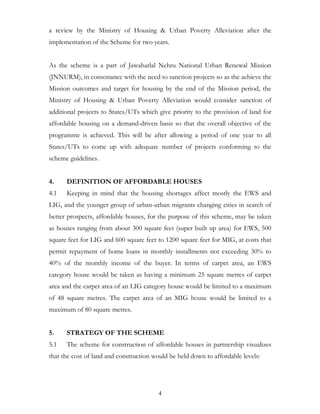
As the scheme is a part of Jawaharlal Nehru National Urban Renewal Mission
(JNNURM), in consonance with the need to sanction projects so as the achieve the
Mission outcomes and target for housing by the end of the Mission period, the
Ministry of Housing & Urban Poverty Alleviation would consider sanction of
additional projects to States/UTs which give priority to the provision of land for
affordable housing on a demand-driven basis so that the overall objective of the
programme is achieved. This will be after allowing a period of one year to all
States/UTs to come up with adequate number of projects conforming to the
scheme guidelines.


4.    DEFINITION OF AFFORDABLE HOUSES
4.1   Keeping in mind that the housing shortages affect mostly the EWS and
LIG, and the younger group of urban-urban migrants changing cities in search of
better prospects, affordable houses, for the purpose of this scheme, may be taken
as houses ranging from about 300 square feet (super built up area) for EWS, 500
square feet for LIG and 600 square feet to 1200 square feet for MIG, at costs that
permit repayment of home loans in monthly installments not exceeding 30% to
40% of the monthly income of the buyer. In terms of carpet area, an EWS
category house would be taken as having a minimum 25 square metres of carpet
area and the carpet area of an LIG category house would be limited to a maximum
of 48 square metres. The carpet area of an MIG house would be limited to a
maximum of 80 square metres.


5.    STRATEGY OF THE SCHEME
5.1   The scheme for construction of affordable houses in partnership visualizes
that the cost of land and construction would be held down to affordable levels:


                                         4
•    Land costs would be intermediated by States/UTs and Development
           Authorities/Urban Local Bodies, by providing land at nominal,
           predetermined or institutional rates (not including more than cost of
           acquisition and development costs of land) for specified housing or
           integrated housing projects. This would be the prerequisite for the scheme.
      •    Costs of land can also be intermediated by attracting private developers to
           build on their land, by granting zoning-related incentives such as land use
           conversion, extra FAR for the construction of affordable houses to be
           allotted by the State/UT government (where ever infrastructure permits
           densification), etc..
      •    Cost of construction can be held down by construction through no profit
           no loss organizations or at reasonable profit; and by beneficiaries directly
           accessing institutional funds for construction, namely the loans offered by
           public sector banks, available at reduced interest rates to individual buyers
           (as announced under the economic stimulus package).
      •    Cost of construction can also be driven down by planning layouts which
           mix EWS/LIG/MIG with HIG houses and commercial layouts, and cross
           subsidizing through the premium earned on the sale of HIG and
           commercial spaces.
      •    States/UTs could reduce costs of housing further by charging a reduced
           stamp duty to a maximum of 2% for affordable houses (LIG) and nil (0%)
           for EWS under this scheme and/or charging reduced tax rates on inputs
           for affordable housing
      •    Cost of construction can also be driven down by adopting appropriate
           construction technologies.


6.        MAIN FEATURES OF THE SCHEME
6.1       The scheme modifies the guidelines of JNNURM (BSUP) for providing
Central Assistance to States to incentivise land assembly for affordable housing to
promote development of projects for a total of 10 lakh affordable housing units by

                                            5
provision of central assistance of 25% for the cost of provision of civic services for
projects for affordable housing at an approximate cost of Rs.5,000 crores to
Central budget.


6.2        The main features of affordable housing in partnership scheme are:


      a.    A project approach would be followed. Projects prepared by urban local
            bodies/urban     development     agencies/housing    boards/improvement
            trusts/other agencies which may be designated as ‘implementing agencies’,
            accompanied by duly approved layout plans and maps to scale would be
            posed for sanction to the State Level Steering Committee and then the
            Central Sanctioning and Monitoring Committee set up for BSUP.
      b.    Land for an affordable housing project could be identified within
            municipal limits, or on the periphery or outskirts of towns and cities
            within jurisdictions of development or planning authorities.
      c.    Projects with a minimum of 200 affordable houses would be entertained.
      d.    Dwelling units built under this scheme would be a mix of
            EWS/LIG/MIG.
      e.    The layout and specifications including design of the affordable houses to
            be built would be approved by the State/UT Government or its
            designated implementing agency.
      f.    The sale price of dwelling units would have an upper ceiling in terms of
            Rupees per square metre of carpet area. This ceiling would be proposed by
            the States/UTs for different classes of cities for approval by the Central
            Sanctioning & Monitoring Committee.
      g.    Beneficiaries would be selected and allotments made on a transparent
            procedure by the State / implementing agency, e.g. draw of lottery, based
            of detailed guidelines approved by the State/UT Government.
      h.    As far as possible, beneficiaries would be selected in advance to beginning
            construction, so that the loan for construction can be availed directly by
            beneficiaries. A tripartite agreement between loanee, bank and

                                             6
development agency should enable facilitation of loan procedures for the
     individual, and release to the development agency as per the progress in
     construction.
i.   EWS/LIG beneficiaries can be enabled to access loans under the Interest
     Subsidy Scheme for Housing the Urban Poor (ISHUP), which provides
     5% interest subsidy on loans up to Rs 1 lakh.
j.   Title to the EWS/LIG houses would be given as far as possible in the
     name of the woman. Where the land is at predetermined rates, title may be
     leasehold, subject to State/UT Government decision, with sufficient
     safeguards to ensure that the beneficiary is not dispossessed and the sale of
     the house to another name is not recognized or registered for a certain
     minimum period; within which transfer of the house should be permissible
     back to the designated (project) agency only, at cost of construction
     adjusted for inflation.
k.   States/UTs/implementing agencies would make effort to ensure that at
     least 25% of the total built up/constructed area of the projects proposed is
     EWS/LIG units.
l.   In order to promote EWS/LIG dwelling units / cross-subsidize the cost
     of land, the project, with approval of the State/UT Governments may also
     offer zoning incentives such as land use conversion, additional FAR/FSI
     for the patch, with or without TDR, based on the prevailing market price
     of land and the cost of construction, provided the civic infrastructure at
     the site or the TDR sites is not put under strain.
m. The State/UT Government may also permit a portion of the identified
     plot of land being used for construction of HIG dwellings or commercial
     purpose, on which the development partner can raise funds to cross-
     subsidize the construction of EWS/LIG dwellings.
n.   In the case of partnership with a private developer on Government land, it
     would be required of the State/UT Government / implementing agency
     to select the private party by a transparent bidding process.


                                       7
o.    If considered appropriate, the States/UTs may consider private lands
            under this scheme. Concessions and FAR, etc. would need to be
            judiciously designed by them to make it attractive on private lands.
            However, the project prerequisites will not be relaxed, and the project
            would not be entertained for sanction except through the State/UT
            Government
      p.    Supervision of quality and timeliness of construction would need to be
            done by quality control mechanisms put in place by States/UTs. A three-
            tier Quality Management System will be mandatory. The first level will be
            developing agency, second by the State level quality monitor and third
            level by a nationally empanelled third party inspection and monitoring
            (TPIM) agency. Involvement of beneficiaries in the project should be
            encouraged.


7          CENTRAL GOVERNMENT ASSISTANCE
7.1        Based on the experience that housing colonies do not get occupied for want
of civic service connectivities, Central Government assistance under this scheme
will flow for the provision of civic services such as water supply including ground
level/overhead service reservoirs, storm water drainage, solid waste management,
sewerage including common sewerage treatment facilities, rain water harvesting,
approach roads, electricity lines including electricity transformers, parks and
playgrounds and other amenities.


7.2        Central Assistance under the scheme will be limited to least of following:
      • Rs. 50,000 per Dwelling Unit for all dwelling units taking EWS, LIG and
           MIG units together which are proposed in the project; and
      • 25% of the cost of all civic services (external and internal) proposed in the
           project


7.3        Subject to the above, Central Assistance would be computed in the
following manner:
                                              8
S.No Built up area for EWS/LIG as a Subsidy Amount*
     percentage of total constructed area
1    25%                                  Rs. 60,000 per EWS/LIG unit
2    >25% and upto 30%                    Rs. 60,000 – 70,000 per
                                          EWS/LIG unit
3    >30% and upto 35%                    Rs. 70,000 - Rs. 80,000 per
                                          EWS/LIG unit
4.   >35% and upto 40%                    Rs. 80,000 – 90,000 per
                                          EWS/LIG unit
5.   >40%                                 Rs. 90,000-Rs. 1,00,000 per
                                          EWS/LIG unit

*An Additionality of 12.5% may be provided for North Eastern States including
Sikkim & Special Category States (Jammu & Kashmir, Himachal Pradesh &
Uttarakhand).


7.4    Release of Central Government share would be in three installments to the
State/UT Government or its designated agency on reimbursement basis (@ 25%.
50%, 25% respectively). The last installment would be released after ascertaining
the completion of construction and selection of beneficiaries.


8.     AGENDA OF REFORM & MEMORANDUM OF AGREEMENT
       Agenda of reform and the Memorandum of Agreement will be same as
applicable to BSUP/IHSDP.


9.     NATIONAL STEERING GROUP
       The National Steering Group of JNNURM, with the following composition,
will steer the scheme to its objectives:-
           1     Minister for Urban Development             Chairman
           2.    Minister of Housing and Urban              Co-Chairperson
                 Poverty Alleviation
           3.    Secretary (HUPA)                           Member
           4.    Secretary, Planning Commission             Member
           5.    Secretary (Expenditure)                    Member
           6.    National Technical Adviser                 Member
           7.    Secretary (Urban Development)              Member-Convener
                                            9
10.   APPRAISAL AND SANCTION OF PROJECTS
      The procedures of BSUP would be applicable.


11.   SANCTION OF PROJECTS
      The Central Sanctioning and Monitoring Committee in the Ministry of
Housing & Urban Poverty Alleviation for sanctioning the projects submitted by
States/UTs under BSUP, with the following composition, would also sanction
projects of affordable housing in partnership
       1.    Secretary (HUPA)                                 Chairman
       2.    Secretary (UD)                                   Member
       3.    Secretary, M/o Finance, Deptt. of Expenditure    Member
       4.    Principal     Adviser     (HUD),     Planning    Member
             Commission
       5.    Secretary, M/o Environment & Forests             Member
       6.    Secretary, M/o Social Justice & Empowerment      Member
       7.    Secretary, M/o Health & Family Welfare           Member
       8.    Secretary, Department of School Education &      Member
             Literacy, Min. of HRD
       9.    Joint Secretary & FA, Ministry of UD &           Member
             HUPA
       10.   Chief Planner, TCPO, Min. of UD                  Member
       11.   Adviser, CPHEEO, Ministry of UD                  Member
       12.   CMD, HUDCO                                       Member
       13.   Joint Secretary (JNNURM) & Mission Director      Member-Secretary

12.   STATE LEVEL STEERING COMMITTEE
      The State level Steering Committee for BSUP, with the following
composition, would decide projects and their priorities for inclusion in the scheme,
and for submission to the Central Sanctioning & Monitoring Committee.
       1.    Chief      Minister/Minister     for  Urban      Chairman
             Development/Minister for Housing of the
             State Govt.
       2.    Minister, Urban Development/ Minister for        Vice-Chairman
             Housing of the State Govt.
       3.    Concerned Mayors/Chairpersons of ULBs            Member
       4.    Concerned MPs/MLAs                               Member
       5.    Secretary, Finance of the State Govt.            Member

                                        10
6.   Secretary (PHE) of the State Govt.               Member
          7.   Secretary (Municipal Administration/ Affairs)    Member
          8.   Secretary (Housing) of the State Govt.           Member
          9.   Secretary (UD)/LSG/Municipal Affairs             Member- Secretary

13.      NODAL AGENCY
         Nodal Agency for BSUP would be the Nodal Agency for this scheme, and
perform the same functions, inter alia:


      a. Appraisal of projects;
      b. Obtaining sanction of State Level Steering Committee for seeking assistance
         from Central Government under the scheme;
      c. Management of grants received from Central Government;
      d. Release of funds;
      e. Monitoring physical and financial progress of sanctioned projects; and
      f. Monitor implementation of reforms as committed in the MoA.


14.      MISSION DIRECTORATE
         The Mission Directorate for BSUP and IHSDP in the Ministry of Housing
& Urban Poverty Alleviation, under the charge of Joint Secretary (JNNURM) &
Mission Director, would ensure effective coordination with State Governments
and other agencies for expeditious processing of the project proposals and
implementation of the scheme.


15.      MONITORING PROGRESS OF PROJECTS
15.1 A provision of 5% of the grant will be earmarked under the Ministry's
Budget for meeting Administration and IEC expenses, including support for
project preparation, appraisal, monitoring, evaluation, and capacity building
activities at various levels.


15.2 The Ministry of Housing & Urban Poverty Alleviation will periodically
monitor the scheme.

                                          11
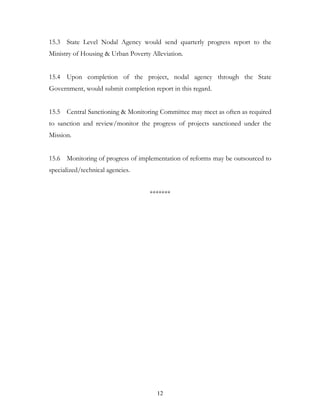
15.3 State Level Nodal Agency would send quarterly progress report to the
Ministry of Housing & Urban Poverty Alleviation.


15.4 Upon completion of the project, nodal agency through the State
Government, would submit completion report in this regard.


15.5 Central Sanctioning & Monitoring Committee may meet as often as required
to sanction and review/monitor the progress of projects sanctioned under the
Mission.


15.6 Monitoring of progress of implementation of reforms may be outsourced to
specialized/technical agencies.


                                    *******


                                      12

Affordable housing

  • 1.
    Government of India Ministry of Housing & Urban Poverty Alleviation (JNNURM Mission Directorate) GUIDELINES FOR AFFORDABLE HOUSING IN PARTNERSHIP 1 INTRODUCTION 1.1 The Scheme of Affordable Housing in Partnership aims at operationalising the strategy envisaged in the National Urban Housing & Habitat Policy (NUHHP) 2007, of promoting various types of public-private partnerships – of the government sector with the private sector, the cooperative sector, the financial services sector, the state parastatals, urban local bodies, etc. – for realizing the goal of affordable housing for all. It intends to provide a major stimulus to economic activities through affordable housing for the creation of employment, especially for the construction workers and other urban poor who are likely to be amongst the most vulnerable groups in recession. It also targets the creation of demand for a large variety of industrial goods through the multiplier effect of housing on other economic acitivites. 1.2 This Scheme is a part of the Jawaharlal Nehru National Urban Renewal Mission (JNNURM) and takes into account the experience of implementing Basic Services to the Urban Poor (BSUP) and Integrated Housing & Slum Development Programme (IHSDP) for three years, and the assessment that shortfall in response from BSUP towns is a factor of the lack of urban land availability for expansion of cities, and after consultation with States/UTs who have agreed that the responsibility of making urban land available at affordable rates must rest with them in order to reduce the acute shortages of housing in urban areas. The scheme is also an acknowledgement of the strain of BSUP and IHSDP on state budgetary resources, and the need to draw in institutional finance for construction of affordable housing on a mass scale.
  • 2.
    1.3 The scheme is primarily applicable to the 65 cities covered under the BSUP programme. Other cities of population above 5 lakhs could be considered during implementation with approval of the National Steering Group for JNNURM, if adequate number of projects is not forthcoming from the 65 cities. However, project proposals from non-BSUP towns could be considered for sanction based on a review of the implementation of the Scheme by the Ministry of Housing & Urban Poverty Alleviation after two years. 1.4 The scheme seeks to encourage State Governments to make provision for land to meet the acute shortage of affordable housing and to work in the partnership model envisaged in the NUHHP 2007. 1.5 These Guidelines will come into effect from 1st April, 2009 and the scheme will be a part of JNNURM. 2. OBJECTIVE The basic aim of the Scheme is to provide stimulus to economic activities through affordable housing programmes in partnership. Its immediate objective is employment generation to the urban poor, especially construction workers, where adverse impact of current economic downturn is being experienced. The Scheme will also strive to ensure equitable supply of land, shelter and services at affordable prices to all sections of society, and thereby to prevent the growth of slums in urban areas. 3. COVERAGE 3.1 The scheme will apply mainly to the 65 BSUP cities, where shortages of land for housing are driving unplanned growth and raising home prices and rentals to unsustainable levels. 3.2 The projects which should be eligible under this scheme for assistance would need to meet the following two criteria: 2
  • 3.
    a) Dwelling units should be a mix of EWS/LIG/MIG categories with the maximum size of a dwelling unit being at 1200 square feet super area, with at least 25% of them for EWS of about 300 square feet. In terms of carpet area, the minimum carpet area for EWS category shall be 25 square metres and maximum carpet area for MIG category shall be 80 square metres. b) The sale price of dwelling units should have an upper ceiling in terms of Rupees per square metre of carpet area. The price ceiling would be settled in consultation with the States/UTs for different classes of cities. 3.3 An indication of allocation of ACA funds for implementation of the scheme, to be released by way of Central Grant, among State/UTs would be made as follows: Categories of Cities No of ACA per City Total ACA Allocation Cities (Rs. Crore) (Rs. Crore) A. Mega Cities/Urban 7 100.00 700.00 Agglomerations B. Other Million-plus 28 70.00 1960.00 Cities/Urban Agglomerations C. Other Cities identified 30 50.00 1500.00 under BSUP Addition Allocation for 840.00 High Performing Cities*/Other Cities** Total 5000.00 * Additional projects in the 65 BSUP cities having scope for wider replication could be considered subject to no city getting more than 50% additional allocation as compared to the indicative level. The States/UTs will be encouraged to develop a legal/regulatory framework of provision of land for affordable housing that promotes innovative partnerships/models for affordable housing. ** Other Cities, under Category C, with more than 500,000 population could be considered with the approval by the National Steering Group if adequate number of projects are not forthcoming from the 65 identified cities. This will be based on 3
  • 4.
    a review bythe Ministry of Housing & Urban Poverty Alleviation after the implementation of the Scheme for two years. As the scheme is a part of Jawaharlal Nehru National Urban Renewal Mission (JNNURM), in consonance with the need to sanction projects so as the achieve the Mission outcomes and target for housing by the end of the Mission period, the Ministry of Housing & Urban Poverty Alleviation would consider sanction of additional projects to States/UTs which give priority to the provision of land for affordable housing on a demand-driven basis so that the overall objective of the programme is achieved. This will be after allowing a period of one year to all States/UTs to come up with adequate number of projects conforming to the scheme guidelines. 4. DEFINITION OF AFFORDABLE HOUSES 4.1 Keeping in mind that the housing shortages affect mostly the EWS and LIG, and the younger group of urban-urban migrants changing cities in search of better prospects, affordable houses, for the purpose of this scheme, may be taken as houses ranging from about 300 square feet (super built up area) for EWS, 500 square feet for LIG and 600 square feet to 1200 square feet for MIG, at costs that permit repayment of home loans in monthly installments not exceeding 30% to 40% of the monthly income of the buyer. In terms of carpet area, an EWS category house would be taken as having a minimum 25 square metres of carpet area and the carpet area of an LIG category house would be limited to a maximum of 48 square metres. The carpet area of an MIG house would be limited to a maximum of 80 square metres. 5. STRATEGY OF THE SCHEME 5.1 The scheme for construction of affordable houses in partnership visualizes that the cost of land and construction would be held down to affordable levels: 4
  • 5.
    Land costs would be intermediated by States/UTs and Development Authorities/Urban Local Bodies, by providing land at nominal, predetermined or institutional rates (not including more than cost of acquisition and development costs of land) for specified housing or integrated housing projects. This would be the prerequisite for the scheme. • Costs of land can also be intermediated by attracting private developers to build on their land, by granting zoning-related incentives such as land use conversion, extra FAR for the construction of affordable houses to be allotted by the State/UT government (where ever infrastructure permits densification), etc.. • Cost of construction can be held down by construction through no profit no loss organizations or at reasonable profit; and by beneficiaries directly accessing institutional funds for construction, namely the loans offered by public sector banks, available at reduced interest rates to individual buyers (as announced under the economic stimulus package). • Cost of construction can also be driven down by planning layouts which mix EWS/LIG/MIG with HIG houses and commercial layouts, and cross subsidizing through the premium earned on the sale of HIG and commercial spaces. • States/UTs could reduce costs of housing further by charging a reduced stamp duty to a maximum of 2% for affordable houses (LIG) and nil (0%) for EWS under this scheme and/or charging reduced tax rates on inputs for affordable housing • Cost of construction can also be driven down by adopting appropriate construction technologies. 6. MAIN FEATURES OF THE SCHEME 6.1 The scheme modifies the guidelines of JNNURM (BSUP) for providing Central Assistance to States to incentivise land assembly for affordable housing to promote development of projects for a total of 10 lakh affordable housing units by 5
  • 6.
    provision of centralassistance of 25% for the cost of provision of civic services for projects for affordable housing at an approximate cost of Rs.5,000 crores to Central budget. 6.2 The main features of affordable housing in partnership scheme are: a. A project approach would be followed. Projects prepared by urban local bodies/urban development agencies/housing boards/improvement trusts/other agencies which may be designated as ‘implementing agencies’, accompanied by duly approved layout plans and maps to scale would be posed for sanction to the State Level Steering Committee and then the Central Sanctioning and Monitoring Committee set up for BSUP. b. Land for an affordable housing project could be identified within municipal limits, or on the periphery or outskirts of towns and cities within jurisdictions of development or planning authorities. c. Projects with a minimum of 200 affordable houses would be entertained. d. Dwelling units built under this scheme would be a mix of EWS/LIG/MIG. e. The layout and specifications including design of the affordable houses to be built would be approved by the State/UT Government or its designated implementing agency. f. The sale price of dwelling units would have an upper ceiling in terms of Rupees per square metre of carpet area. This ceiling would be proposed by the States/UTs for different classes of cities for approval by the Central Sanctioning & Monitoring Committee. g. Beneficiaries would be selected and allotments made on a transparent procedure by the State / implementing agency, e.g. draw of lottery, based of detailed guidelines approved by the State/UT Government. h. As far as possible, beneficiaries would be selected in advance to beginning construction, so that the loan for construction can be availed directly by beneficiaries. A tripartite agreement between loanee, bank and 6
  • 7.
    development agency shouldenable facilitation of loan procedures for the individual, and release to the development agency as per the progress in construction. i. EWS/LIG beneficiaries can be enabled to access loans under the Interest Subsidy Scheme for Housing the Urban Poor (ISHUP), which provides 5% interest subsidy on loans up to Rs 1 lakh. j. Title to the EWS/LIG houses would be given as far as possible in the name of the woman. Where the land is at predetermined rates, title may be leasehold, subject to State/UT Government decision, with sufficient safeguards to ensure that the beneficiary is not dispossessed and the sale of the house to another name is not recognized or registered for a certain minimum period; within which transfer of the house should be permissible back to the designated (project) agency only, at cost of construction adjusted for inflation. k. States/UTs/implementing agencies would make effort to ensure that at least 25% of the total built up/constructed area of the projects proposed is EWS/LIG units. l. In order to promote EWS/LIG dwelling units / cross-subsidize the cost of land, the project, with approval of the State/UT Governments may also offer zoning incentives such as land use conversion, additional FAR/FSI for the patch, with or without TDR, based on the prevailing market price of land and the cost of construction, provided the civic infrastructure at the site or the TDR sites is not put under strain. m. The State/UT Government may also permit a portion of the identified plot of land being used for construction of HIG dwellings or commercial purpose, on which the development partner can raise funds to cross- subsidize the construction of EWS/LIG dwellings. n. In the case of partnership with a private developer on Government land, it would be required of the State/UT Government / implementing agency to select the private party by a transparent bidding process. 7
  • 8.
    o. If considered appropriate, the States/UTs may consider private lands under this scheme. Concessions and FAR, etc. would need to be judiciously designed by them to make it attractive on private lands. However, the project prerequisites will not be relaxed, and the project would not be entertained for sanction except through the State/UT Government p. Supervision of quality and timeliness of construction would need to be done by quality control mechanisms put in place by States/UTs. A three- tier Quality Management System will be mandatory. The first level will be developing agency, second by the State level quality monitor and third level by a nationally empanelled third party inspection and monitoring (TPIM) agency. Involvement of beneficiaries in the project should be encouraged. 7 CENTRAL GOVERNMENT ASSISTANCE 7.1 Based on the experience that housing colonies do not get occupied for want of civic service connectivities, Central Government assistance under this scheme will flow for the provision of civic services such as water supply including ground level/overhead service reservoirs, storm water drainage, solid waste management, sewerage including common sewerage treatment facilities, rain water harvesting, approach roads, electricity lines including electricity transformers, parks and playgrounds and other amenities. 7.2 Central Assistance under the scheme will be limited to least of following: • Rs. 50,000 per Dwelling Unit for all dwelling units taking EWS, LIG and MIG units together which are proposed in the project; and • 25% of the cost of all civic services (external and internal) proposed in the project 7.3 Subject to the above, Central Assistance would be computed in the following manner: 8
  • 9.
    S.No Built uparea for EWS/LIG as a Subsidy Amount* percentage of total constructed area 1 25% Rs. 60,000 per EWS/LIG unit 2 >25% and upto 30% Rs. 60,000 – 70,000 per EWS/LIG unit 3 >30% and upto 35% Rs. 70,000 - Rs. 80,000 per EWS/LIG unit 4. >35% and upto 40% Rs. 80,000 – 90,000 per EWS/LIG unit 5. >40% Rs. 90,000-Rs. 1,00,000 per EWS/LIG unit *An Additionality of 12.5% may be provided for North Eastern States including Sikkim & Special Category States (Jammu & Kashmir, Himachal Pradesh & Uttarakhand). 7.4 Release of Central Government share would be in three installments to the State/UT Government or its designated agency on reimbursement basis (@ 25%. 50%, 25% respectively). The last installment would be released after ascertaining the completion of construction and selection of beneficiaries. 8. AGENDA OF REFORM & MEMORANDUM OF AGREEMENT Agenda of reform and the Memorandum of Agreement will be same as applicable to BSUP/IHSDP. 9. NATIONAL STEERING GROUP The National Steering Group of JNNURM, with the following composition, will steer the scheme to its objectives:- 1 Minister for Urban Development Chairman 2. Minister of Housing and Urban Co-Chairperson Poverty Alleviation 3. Secretary (HUPA) Member 4. Secretary, Planning Commission Member 5. Secretary (Expenditure) Member 6. National Technical Adviser Member 7. Secretary (Urban Development) Member-Convener 9
  • 10.
    10. APPRAISAL AND SANCTION OF PROJECTS The procedures of BSUP would be applicable. 11. SANCTION OF PROJECTS The Central Sanctioning and Monitoring Committee in the Ministry of Housing & Urban Poverty Alleviation for sanctioning the projects submitted by States/UTs under BSUP, with the following composition, would also sanction projects of affordable housing in partnership 1. Secretary (HUPA) Chairman 2. Secretary (UD) Member 3. Secretary, M/o Finance, Deptt. of Expenditure Member 4. Principal Adviser (HUD), Planning Member Commission 5. Secretary, M/o Environment & Forests Member 6. Secretary, M/o Social Justice & Empowerment Member 7. Secretary, M/o Health & Family Welfare Member 8. Secretary, Department of School Education & Member Literacy, Min. of HRD 9. Joint Secretary & FA, Ministry of UD & Member HUPA 10. Chief Planner, TCPO, Min. of UD Member 11. Adviser, CPHEEO, Ministry of UD Member 12. CMD, HUDCO Member 13. Joint Secretary (JNNURM) & Mission Director Member-Secretary 12. STATE LEVEL STEERING COMMITTEE The State level Steering Committee for BSUP, with the following composition, would decide projects and their priorities for inclusion in the scheme, and for submission to the Central Sanctioning & Monitoring Committee. 1. Chief Minister/Minister for Urban Chairman Development/Minister for Housing of the State Govt. 2. Minister, Urban Development/ Minister for Vice-Chairman Housing of the State Govt. 3. Concerned Mayors/Chairpersons of ULBs Member 4. Concerned MPs/MLAs Member 5. Secretary, Finance of the State Govt. Member 10
  • 11.
    6. Secretary (PHE) of the State Govt. Member 7. Secretary (Municipal Administration/ Affairs) Member 8. Secretary (Housing) of the State Govt. Member 9. Secretary (UD)/LSG/Municipal Affairs Member- Secretary 13. NODAL AGENCY Nodal Agency for BSUP would be the Nodal Agency for this scheme, and perform the same functions, inter alia: a. Appraisal of projects; b. Obtaining sanction of State Level Steering Committee for seeking assistance from Central Government under the scheme; c. Management of grants received from Central Government; d. Release of funds; e. Monitoring physical and financial progress of sanctioned projects; and f. Monitor implementation of reforms as committed in the MoA. 14. MISSION DIRECTORATE The Mission Directorate for BSUP and IHSDP in the Ministry of Housing & Urban Poverty Alleviation, under the charge of Joint Secretary (JNNURM) & Mission Director, would ensure effective coordination with State Governments and other agencies for expeditious processing of the project proposals and implementation of the scheme. 15. MONITORING PROGRESS OF PROJECTS 15.1 A provision of 5% of the grant will be earmarked under the Ministry's Budget for meeting Administration and IEC expenses, including support for project preparation, appraisal, monitoring, evaluation, and capacity building activities at various levels. 15.2 The Ministry of Housing & Urban Poverty Alleviation will periodically monitor the scheme. 11
  • 12.
    15.3 State LevelNodal Agency would send quarterly progress report to the Ministry of Housing & Urban Poverty Alleviation. 15.4 Upon completion of the project, nodal agency through the State Government, would submit completion report in this regard. 15.5 Central Sanctioning & Monitoring Committee may meet as often as required to sanction and review/monitor the progress of projects sanctioned under the Mission. 15.6 Monitoring of progress of implementation of reforms may be outsourced to specialized/technical agencies. ******* 12