
HOUSING SECTOR IN INDIA
MITTAL NEERAJ SHAMAN
Demand Drivers
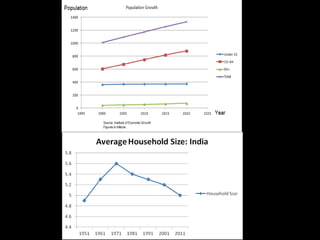
• Population growth
• Increase in proportion of working population
• Economic growth
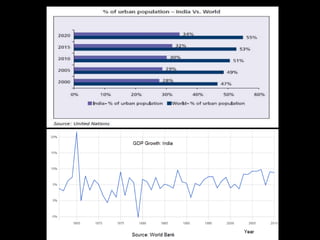
• Urbanization
• Nuclear families
• Easier financing
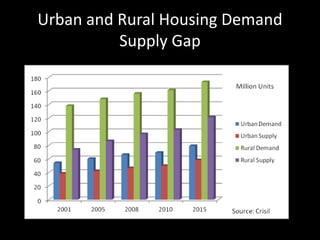
Urban and Rural Housing Demand
Supply Gap
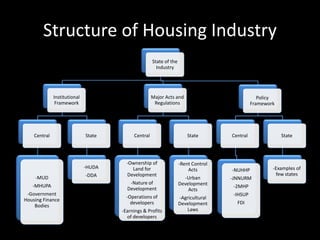
Structure of Housing Industry
State of the
Industry
Institutional
Framework
Central
-MUD
-MHUPA
-Government
Housing Finance
Bodies
State
-HUDA
-DDA
Major Acts and
Regulations
Central
-Ownership of
Land for
Development
-Nature of
Development
-Operations of
developers
-Earnings & Profits
of developers
State
-Rent Control
Acts
-Urban
Development
Acts
-Agricultural
Development
Laws
Policy
Framework
Central
-NUHHP
-JNNURM
-2MHP
-IHSUP
FDI
State
-Examples of
few states
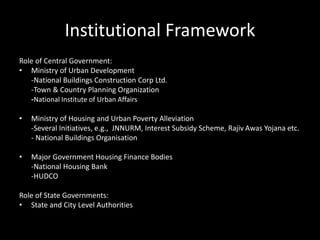
Institutional Framework
Role of Central Government:
• Ministry of Urban Development
-National Buildings Construction Corp Ltd.
-Town & Country Planning Organization
-National Institute of Urban Affairs
• Ministry of Housing and Urban Poverty Alleviation
-Several Initiatives, e.g., JNNURM, Interest Subsidy Scheme, Rajiv Awas Yojana etc.
- National Buildings Organisation
• Major Government Housing Finance Bodies
-National Housing Bank
-HUDCO
Role of State Governments:
• State and City Level Authorities
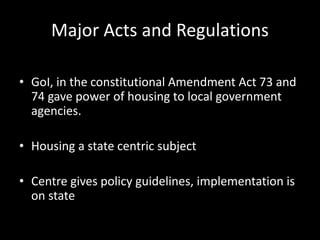
Major Acts and Regulations
• GoI, in the constitutional Amendment Act 73 and
74 gave power of housing to local government
agencies.
• Housing a state centric subject
• Centre gives policy guidelines, implementation is
on state
National Level acts and regulations
(A)Laws relating to ownership of land for
development.
1. Urban Land Ceiling and Regulation Act, 1976
• Implemented in 1976
• Implemented to facilitate availability of urban land for
MIG and LIG
• Ceiling on ownership & possession of vacant land
• Acquisition of excess land for common good
• Payment of compensation for acquire land
Contd..
ULCRA failed to achieve its objectives
• Instead of facilitating it lead to artificial scarcity
• High Land prices
• Central Govt. Repeal the Act by Passing UL (C&R)
Repeal Act,1999
Contd..
2 Registration Act, 1908
 Purpose is to conserver evidence, assurance of title,
publication of documents and prevention of fraud
3 Stamp Act
• Stamp Duty needs to be paid on all documents
• Rate of duty varies from state to state
• High stamp duties are cited as a key reason for
avoidance of registration
• Calculated on the basis of the market value of property
as quoted in the agreement
Contd..
4 Transfer of Property Act, 1872
5 Indian Contract Act, 1972
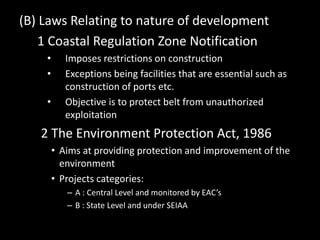
(B) Laws Relating to nature of development
1 Coastal Regulation Zone Notification
• Imposes restrictions on construction
• Exceptions being facilities that are essential such as
construction of ports etc.
• Objective is to protect belt from unauthorized
exploitation
2 The Environment Protection Act, 1986
• Aims at providing protection and improvement of the
environment
• Projects categories:
– A : Central Level and monitored by EAC’s
– B : State Level and under SEIAA
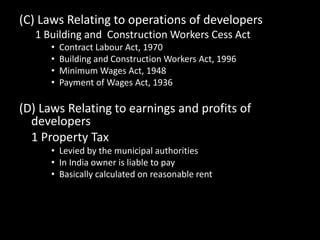
(C) Laws Relating to operations of developers
1 Building and Construction Workers Cess Act
• Contract Labour Act, 1970
• Building and Construction Workers Act, 1996
• Minimum Wages Act, 1948
• Payment of Wages Act, 1936
(D) Laws Relating to earnings and profits of
developers
1 Property Tax
• Levied by the municipal authorities
• In India owner is liable to pay
• Basically calculated on reasonable rent
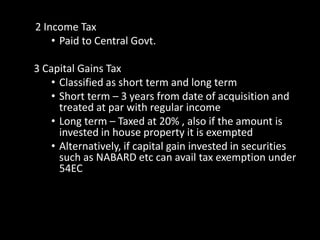
2 Income Tax
• Paid to Central Govt.
3 Capital Gains Tax
• Classified as short term and long term
• Short term – 3 years from date of acquisition and
treated at par with regular income
• Long term – Taxed at 20% , also if the amount is
invested in house property it is exempted
• Alternatively, if capital gain invested in securities
such as NABARD etc can avail tax exemption under
54EC
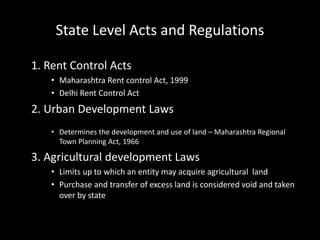
State Level Acts and Regulations
1. Rent Control Acts
• Maharashtra Rent control Act, 1999
• Delhi Rent Control Act
2. Urban Development Laws
• Determines the development and use of land – Maharashtra Regional
Town Planning Act, 1966
3. Agricultural development Laws
• Limits up to which an entity may acquire agricultural land
• Purchase and transfer of excess land is considered void and taken
over by state
Policy Framework
Central Policies
1 National Urban Housing & Habitat Policy,
2007
– Provides Guidance to state governments to meet
growing housing shortage
– “Housing for all” ,focus on “affordable housing”
Contd..
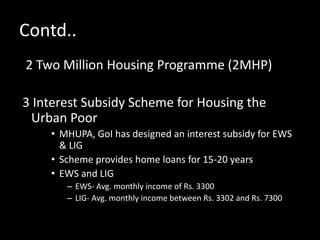
2 Two Million Housing Programme (2MHP)
3 Interest Subsidy Scheme for Housing the
Urban Poor
• MHUPA, GoI has designed an interest subsidy for EWS
& LIG
• Scheme provides home loans for 15-20 years
• EWS and LIG
– EWS- Avg. monthly income of Rs. 3300
– LIG- Avg. monthly income between Rs. 3302 and Rs. 7300
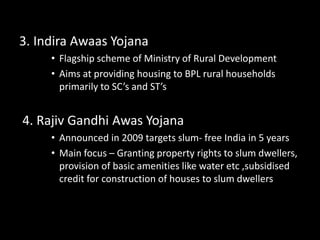
3. Indira Awaas Yojana
• Flagship scheme of Ministry of Rural Development
• Aims at providing housing to BPL rural households
primarily to SC’s and ST’s
4. Rajiv Gandhi Awas Yojana
• Announced in 2009 targets slum- free India in 5 years
• Main focus – Granting property rights to slum dwellers,
provision of basic amenities like water etc ,subsidised
credit for construction of houses to slum dwellers
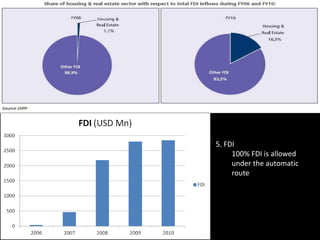
5. FDI
100% FDI is allowed
under the automatic
route
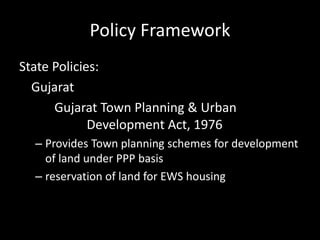
Policy Framework
State Policies:
Gujarat
Gujarat Town Planning & Urban
Development Act, 1976
– Provides Town planning schemes for development
of land under PPP basis
– reservation of land for EWS housing
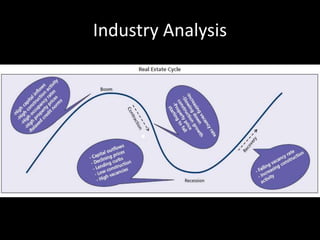
Industry Analysis
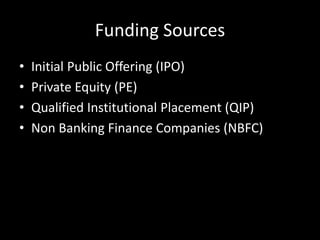
Funding Sources
• Initial Public Offering (IPO)
• Private Equity (PE)
• Qualified Institutional Placement (QIP)
• Non Banking Finance Companies (NBFC)
Challenges
• Land Acquisition
• Lack of Transparency
• Stamp Duty
• Raw Material Prices
• No Centralized Regulatory Authority
• Constraints on bank Credit
Top Players : DLF
• Founded in 1946
• DLF Group is one of the biggest real estate giants
• Built many high-quality buildings across the country,
specifically in Gurgaon
• Tied up with Hilton Group to build whopping 100 hotels
in India over the next few years.
• In current expansion plans, DLF has over 425 million sq.
ft. of development across its businesses, including
developed, on-going and planned projects.
• Spread over 32 cities, mostly in metros and key urban
areas across India
Parsvnath Developers
• It was incorporated on July 24, 1990 under the
Companies Act, 1956.
• With more than two decades of experience in its
repertoire, the group has already stamped its
presence already in seventeen states and going
Pan – India.
• It has made various developments in areas like
GURGAON, Noida, South Delhi.
Unitech
• Plans to invest US$ 720 million in building hotels
in the country
• Its partner for this venture is Marriott
International.
• Carved a niche for itself in India with its
sprawling properties and projects in Bangalore,
Gurgaon, Noida, Greater Noida and Kolkata
• Unitech Group took over projects in International
areas as well.
• Actively involved in construction projects of
power plants, expressways, highways,
transmission lines, classrooms, amusement parks.
Ansals
• Founded by Lala Chiranji Lal Ansal
• By far most dominant activity of Ansals has been
Real Estate Promotion & Development
• Company has several landmark high-rise
commercial building like Statesman House,
Ambadeep, Antriksh Bhawan, Tolstoy House,
Indra Prakash, Navrang House and Ansal Bhawan
• Ansals have also completed several residential
buildings like Gauri Sadan, Upasana at Hailey
Road & Dhawan Deep at Jantar Mantar road, all
in the heart of New Delhi at Connaught Place.
Top Players : Salient Features
• DLF leverage (D/E) down from 10 to 1.09
• Other players  Leverage close to 0.5
• Unitech :
– Low Liquidity Ratios
– Net Profit > Gross Profit
Impact of Budget 2012
• Affordable Housing
– ECB
– Withholding Tax
– Interest Rate Subsidy Continued
• Capital Gains Tax Exemption
– Equity
– SME Equipment
– Property / Tax Saving Bonds
• Boost to Infrastructure and Construction
• Service Tax Increase
THANK YOU

Housing Sector In India

  • 1.
    HOUSING SECTOR ININDIA MITTAL NEERAJ SHAMAN
  • 2.
    Demand Drivers • Populationgrowth • Increase in proportion of working population • Economic growth • Urbanization • Nuclear families • Easier financing
  • 5.
    Urban and RuralHousing Demand Supply Gap
  • 6.
    Structure of HousingIndustry State of the Industry Institutional Framework Central -MUD -MHUPA -Government Housing Finance Bodies State -HUDA -DDA Major Acts and Regulations Central -Ownership of Land for Development -Nature of Development -Operations of developers -Earnings & Profits of developers State -Rent Control Acts -Urban Development Acts -Agricultural Development Laws Policy Framework Central -NUHHP -JNNURM -2MHP -IHSUP FDI State -Examples of few states
  • 7.
    Institutional Framework Role ofCentral Government: • Ministry of Urban Development -National Buildings Construction Corp Ltd. -Town & Country Planning Organization -National Institute of Urban Affairs • Ministry of Housing and Urban Poverty Alleviation -Several Initiatives, e.g., JNNURM, Interest Subsidy Scheme, Rajiv Awas Yojana etc. - National Buildings Organisation • Major Government Housing Finance Bodies -National Housing Bank -HUDCO Role of State Governments: • State and City Level Authorities
  • 8.
    Major Acts andRegulations • GoI, in the constitutional Amendment Act 73 and 74 gave power of housing to local government agencies. • Housing a state centric subject • Centre gives policy guidelines, implementation is on state
  • 9.
    National Level actsand regulations (A)Laws relating to ownership of land for development. 1. Urban Land Ceiling and Regulation Act, 1976 • Implemented in 1976 • Implemented to facilitate availability of urban land for MIG and LIG • Ceiling on ownership & possession of vacant land • Acquisition of excess land for common good • Payment of compensation for acquire land
  • 10.
    Contd.. ULCRA failed toachieve its objectives • Instead of facilitating it lead to artificial scarcity • High Land prices • Central Govt. Repeal the Act by Passing UL (C&R) Repeal Act,1999
  • 11.
    Contd.. 2 Registration Act,1908  Purpose is to conserver evidence, assurance of title, publication of documents and prevention of fraud 3 Stamp Act • Stamp Duty needs to be paid on all documents • Rate of duty varies from state to state • High stamp duties are cited as a key reason for avoidance of registration • Calculated on the basis of the market value of property as quoted in the agreement
  • 12.
    Contd.. 4 Transfer ofProperty Act, 1872 5 Indian Contract Act, 1972
  • 13.
    (B) Laws Relatingto nature of development 1 Coastal Regulation Zone Notification • Imposes restrictions on construction • Exceptions being facilities that are essential such as construction of ports etc. • Objective is to protect belt from unauthorized exploitation 2 The Environment Protection Act, 1986 • Aims at providing protection and improvement of the environment • Projects categories: – A : Central Level and monitored by EAC’s – B : State Level and under SEIAA
  • 14.
    (C) Laws Relatingto operations of developers 1 Building and Construction Workers Cess Act • Contract Labour Act, 1970 • Building and Construction Workers Act, 1996 • Minimum Wages Act, 1948 • Payment of Wages Act, 1936 (D) Laws Relating to earnings and profits of developers 1 Property Tax • Levied by the municipal authorities • In India owner is liable to pay • Basically calculated on reasonable rent
  • 15.
    2 Income Tax •Paid to Central Govt. 3 Capital Gains Tax • Classified as short term and long term • Short term – 3 years from date of acquisition and treated at par with regular income • Long term – Taxed at 20% , also if the amount is invested in house property it is exempted • Alternatively, if capital gain invested in securities such as NABARD etc can avail tax exemption under 54EC
  • 16.
    State Level Actsand Regulations 1. Rent Control Acts • Maharashtra Rent control Act, 1999 • Delhi Rent Control Act 2. Urban Development Laws • Determines the development and use of land – Maharashtra Regional Town Planning Act, 1966 3. Agricultural development Laws • Limits up to which an entity may acquire agricultural land • Purchase and transfer of excess land is considered void and taken over by state
  • 17.
    Policy Framework Central Policies 1National Urban Housing & Habitat Policy, 2007 – Provides Guidance to state governments to meet growing housing shortage – “Housing for all” ,focus on “affordable housing”
  • 18.
    Contd.. 2 Two MillionHousing Programme (2MHP) 3 Interest Subsidy Scheme for Housing the Urban Poor • MHUPA, GoI has designed an interest subsidy for EWS & LIG • Scheme provides home loans for 15-20 years • EWS and LIG – EWS- Avg. monthly income of Rs. 3300 – LIG- Avg. monthly income between Rs. 3302 and Rs. 7300
  • 19.
    3. Indira AwaasYojana • Flagship scheme of Ministry of Rural Development • Aims at providing housing to BPL rural households primarily to SC’s and ST’s 4. Rajiv Gandhi Awas Yojana • Announced in 2009 targets slum- free India in 5 years • Main focus – Granting property rights to slum dwellers, provision of basic amenities like water etc ,subsidised credit for construction of houses to slum dwellers
  • 20.
    5. FDI 100% FDIis allowed under the automatic route
  • 21.
    Policy Framework State Policies: Gujarat GujaratTown Planning & Urban Development Act, 1976 – Provides Town planning schemes for development of land under PPP basis – reservation of land for EWS housing
  • 22.
  • 24.
    Funding Sources • InitialPublic Offering (IPO) • Private Equity (PE) • Qualified Institutional Placement (QIP) • Non Banking Finance Companies (NBFC)
  • 25.
    Challenges • Land Acquisition •Lack of Transparency • Stamp Duty • Raw Material Prices • No Centralized Regulatory Authority • Constraints on bank Credit
  • 26.
    Top Players :DLF • Founded in 1946 • DLF Group is one of the biggest real estate giants • Built many high-quality buildings across the country, specifically in Gurgaon • Tied up with Hilton Group to build whopping 100 hotels in India over the next few years. • In current expansion plans, DLF has over 425 million sq. ft. of development across its businesses, including developed, on-going and planned projects. • Spread over 32 cities, mostly in metros and key urban areas across India
  • 27.
    Parsvnath Developers • Itwas incorporated on July 24, 1990 under the Companies Act, 1956. • With more than two decades of experience in its repertoire, the group has already stamped its presence already in seventeen states and going Pan – India. • It has made various developments in areas like GURGAON, Noida, South Delhi.
  • 28.
    Unitech • Plans toinvest US$ 720 million in building hotels in the country • Its partner for this venture is Marriott International. • Carved a niche for itself in India with its sprawling properties and projects in Bangalore, Gurgaon, Noida, Greater Noida and Kolkata • Unitech Group took over projects in International areas as well. • Actively involved in construction projects of power plants, expressways, highways, transmission lines, classrooms, amusement parks.
  • 29.
    Ansals • Founded byLala Chiranji Lal Ansal • By far most dominant activity of Ansals has been Real Estate Promotion & Development • Company has several landmark high-rise commercial building like Statesman House, Ambadeep, Antriksh Bhawan, Tolstoy House, Indra Prakash, Navrang House and Ansal Bhawan • Ansals have also completed several residential buildings like Gauri Sadan, Upasana at Hailey Road & Dhawan Deep at Jantar Mantar road, all in the heart of New Delhi at Connaught Place.
  • 30.
    Top Players :Salient Features • DLF leverage (D/E) down from 10 to 1.09 • Other players  Leverage close to 0.5 • Unitech : – Low Liquidity Ratios – Net Profit > Gross Profit
  • 31.
    Impact of Budget2012 • Affordable Housing – ECB – Withholding Tax – Interest Rate Subsidy Continued • Capital Gains Tax Exemption – Equity – SME Equipment – Property / Tax Saving Bonds • Boost to Infrastructure and Construction • Service Tax Increase
  • 32.