Pediatric Epilepsy Slide Deck
American Epilepsy Society
Created by the Pediatric Workgroup of the Student & Resident Education Committee
American Epilepsy Society 2015 PC Slide-1
Outline
• Section 1: Seizures and Epilepsy Syndromes
Presenting in Neonates and Early Infancy
• Section 2: Epilepsy Syndromes Presenting in
Early Childhood and Adolescence
• Section 3: Unique Etiologies of Epilepsy Often
Presenting with Pediatric Onset
• Section 4: Surgical Evaluation of Intractable
Pediatric Epilepsy
American Epilepsy Society 2015 PC Slide-2
Section 1: Seizures and
Epilepsy Syndromes Presenting
in Neonates and Early Infancy
American Epilepsy Society 2015 PC Slide-3
Neonatal Epilepsy
Introduction
American Epilepsy Society 2015 PC Slide-4
Neonatal Epilepsy
• Seizures can present at anytime in the lifespan and are increased in
the neonatal period
• The incidence ranges from 1-3.5/1000 live births*
• Increased risk
• preterm infants
• Neurologic comorbidities (intraventricular hemorrhage, stroke, CNS infection)
• *(Glass et al 2009, Lanska et al 2005)
American Epilepsy Society 2015 PC Slide-5
Seizure Types
• “Neonatal seizures are no longer regarded as a
separate entity. Seizures in neonates can be
classified within the proposed scheme”
• -Berg et al Epilepsia. Revised terminology and
concepts for organization of seizures and
epilepsies: Report of the ILAE Commission on
Classification and Terminology. April 2010; 51:4
676-685.
American Epilepsy Society 2015 PC Slide-6
Seizure Types and Caveats
• Neonates and infants are at greater risk for electroclinical
disassociation
• Seizures may only be present electrographically
• Generalized seizures (rare) usually present as multifocal or
migrating
• Tonic–clonic (in any combination)
• Absence (Typical or Atypical) - rarely seen in in neonatal
period
• Myoclonic
• Myoclonic atonic
• Myoclonic tonic
• Atonic – rare in neonatal period
• Focal seizures – more common
• Unknown
• Epileptic spasms
American Epilepsy Society 2015 PC Slide-7
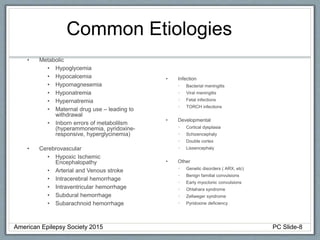
Common Etiologies
• Metabolic
• Hypoglycemia
• Hypocalcemia
• Hypomagnesemia
• Hyponatremia
• Hypernatremia
• Maternal drug use – leading to
withdrawal
• Inborn errors of metabolilsm
(hyperammonemia, pyridoxine-
responsive, hyperglycinemia)
• Cerebrovascular
• Hypoxic Ischemic
Encephalopathy
• Arterial and Venous stroke
• Intracerebral hemorrhage
• Intraventricular hemorrhage
• Subdural hemorrhage
• Subarachnoid hemorrhage
• Infection
• Bacterial meningitis
• Viral meningitis
• Fetal infections
• TORCH infections
• Developmental
• Cortical dysplasia
• Schizencephaly
• Double cortex
• Lissencephaly
• Other
• Genetic disorders ( ARX, etc)
• Benign familial convulsions
• Early myoclonic convulsions
• Ohtahara syndrome
• Zellweger syndrome
• Pyridoxine deficiency
American Epilepsy Society 2015 PC Slide-8
Evaluation
• Physical Exam (including wood’s lamp exam): Looking for both
neurologic and systemic abnormalities
• History
• Imaging
• Evaluation focused on looking for treatable causes, may be
directed by history and exam
• Consider metabolic evaluation including:
• Serology
• Urine testing
• Genetic testing
• CSF testing
American Epilepsy Society 2015 PC Slide-9
Neonatal Epilepsy
Seizure Syndromes presenting in neonates
American Epilepsy Society 2015 PC Slide-10
Ohtahara Syndrome
• Age of onset - birth
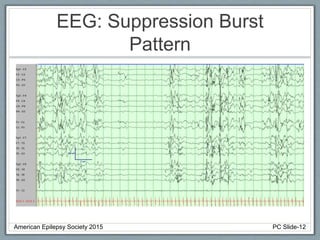
• Seizure types – brief tonic seizures, myoclonic seizures,
infantile spasms
• Associated EEG patterns – suppression burst pattern that can
have evolution into hypsarrhythmia pattern
• Common etiologies – structural abnormalities (cortical
dysplasia), gene mutations: ARX, STXBP1, CDKL5, SCN2A,
SPTAN1
• Treatment – pyridoxine, zonisamide, ACTH, prednisolone,
ketogenic diet
• Prognosis – poorly controlled seizures, severe developmental
delay, shortened life span
American Epilepsy Society 2015 PC Slide-11
EEG: Suppression Burst
Pattern
American Epilepsy Society 2015 PC Slide-12
Early Myoclonic Encephalopathy
• Age of onset – first 2 weeks of life
• Seizure types – generalized myoclonus, focal myoclonus,
massive myoclonus, focal seizures
• Associated EEG patterns – suppression burst, but may
initially only be present during sleep
• Common etiologies – non-ketotic hyperglycinemia,
pyridoxine deficiency, Menkes, Zellweger, less likely
structural
• Treatment – poorly responsive to therapy
• Prognosis – severe intellectual impairment, shortened life
expectancy
American Epilepsy Society 2015 PC Slide-13
Benign Familial Neonatal
Epilepsy
• Age of onset - birth
• Seizure types – focal seizures with multifocal onset,
multifocal migrating, generalized tonic clonic
• Associated EEG patterns – non specific, majority normal
• Common etiologies – KCNQ2, KCNQ3 mutations
• Treatment – Seizures remit in most. Benzodiazepines or
other conventional AEDs are typically used
• Prognosis –seizures resolve in most by 6 months of age,
there may be an increased risk for febrile seizures, most
have normal development, 15% develop epilepsy
American Epilepsy Society 2015 PC Slide-14
EPILEPSY of Infancy with
Migrating Focal Features
• Age of onset – 3 months (avg age) can be within 1st month
• Seizure types – focal seizures occurring in clusters with
frequent episodes of status epilepticus, seizures may
improve between 1-5 years of age but development does
not
• Associated EEG patterns – multifocal epileptiform
discharges, multifocal onset to seizures often with ictal
pattern which evolves between hemispheres during seizure
• Common etiologies – not known
• Treatment – poorly responsive to conventional therapy
• Prognosis – poor with regression associated with seizures
American Epilepsy Society 2015 PC Slide-15
KCNQ2 Encephalopathy
• Age of onset – first 2 weeks of life, some reports of intrauterine
seizures
• Seizure types – tonic seizures, focal tonic seizures, infantile spasms
• Associated EEG patterns – burst suppression pattern,
hypsarrhythmia
• Imaging – T1/T2 hyperintensities in the basal ganglia and thalamus,
myelination abnormalities
• Common etiologies – heterozygous mutations of KCNQ2 (majority
are missense mutations)
• Treatment – poorly responsive, perhaps improved with voltage gated
sodium channel blockers
• Prognosis – seizures typically remit between 3-5 years of age, varying
degrees of intellectual impairment
American Epilepsy Society 2015 PC Slide-16
CDKL5 Associated Epilepsy
• Age of onset - seizures present by 3 months in 90% of
infants
• Seizure types – early onset epileptic spasms, tonic-tonic
vibratory, myoclonus, hypermotor tonic spasm sequence,
and generalized tonic clonic
• Associated EEG patterns – diffuse slowing, multifocal
abnormalities, often with pattern of hypsarhythmia
• Common etiologies – CDKL5 missense mutations
• Treatment – poorly responsive to medication
• Prognosis – severe gross motor delay, speech delay, 90 %
with sleep disturbance, severe intellectual delay
American Epilepsy Society 2015 PC Slide-17
Pyridoxine Dependent Epilepsy
• Age of onset – usually first day of life, but can be delayed
• Seizure types – myoclonic, clonic, generalized tonic clonic
• Associated EEG patterns – burst suppression or multifocal
spike waves with diffuse slowing prior to treatment
• Common Etiologies - heterozygous and homozygous
mutations in ALDH7A1
• Treatment – treatment with pyridoxine or pyridoxal-5-
phospate, poorly responsive to other antiepileptic
medications
• Prognosis – mild to severe intellectual impairment
American Epilepsy Society 2015 PC Slide-18
Seizures of infancy/Early
Childhood
Febrile Seizures
American Epilepsy Society 2015 PC Slide-19
Definition of Febrile Seizure
• Febrile seizures are convulsions brought on by a
fever in infants or small children. Most febrile
seizures last a minute or two, although some can
be as brief as a few seconds while others last for
more than 15 minutes.
• The majority of children with febrile seizures have
rectal temperatures greater than 102 degrees
Fahrenheit (38.9 C). Most febrile seizures occur
during the first day of a child's fever.
American Epilepsy Society 2015 PC Slide-20
Definition of Febrile Seizure
• A seizure occurring in childhood after age 1 month, associated with a
febrile illness not caused by an infection of the CNS, without previous
neonatal seizures or a previous unprovoked seizure, and not meeting
criteria for other acute symptomatic seizures.*
• Fever is usually defined as greater than 100.4 F (38C)
• Febrile seizure is divided into simple and complex. Complex febrile
seizures encompass seizures that are prolonged in nature (greater
than 15 minutes), have any focal features or reoccur with more than 1
in a 24 hour period
*ILAE 2012
American Epilepsy Society 2015 PC Slide-21
Age of Occurrence
• Most common childhood seizure
• Incidence 2-5 % (US)
• Average age 6 months to 3 years
• Almost all first febrile seizures occur by age 3y
• Median age 18-22 months
American Epilepsy Society 2015 PC Slide-22
Risk Factors For Developing
Epilepsy After Febrile
Seizures
• Epilepsy in a first degree relative
• Complex febrile seizure
• Baseline neurodevelopment abnormalities
• Risk of unprovoked seizure 2-4% after febrile seizures
• Risk of 7% when children followed to age 25y
American Epilepsy Society 2015 PC Slide-23
Red Flags in Febrile Seizures
• Hemiconvulsive seizures and or frequent episodes of status epilepticus under
one year of age suggest an SCN1a channelopathy (Dravet syndrome)
• Febrile seizure associated with meningeal signs are not considered febrile
seizures – must consider an infectious process
• Family history of febrile seizures at older ages and epilepsy suggestive of
Genetic Epilepsy with Febrile Seizures Plus (GEFS+)
• 1/3 will have additional febrile seizures; young age, day care and family history
are risk factors for this to occur
American Epilepsy Society 2015 PC Slide-24
Workup for Febrile Seizure
• History and exam (primary goal is to determine source of fever)
• CBC
• Chemistries including Na, Mg, Phos, and Ca
• Appropriate fever evaluation (blood culture, stool culture, LP)
• (many children may have HHV6, but not clinically indicated to test)
• Imaging only indicated if :
• History of head trauma
• Abnormal exam
• Evidence of increased ICP
• EEG is not helpful unless it is unclear if event was seizure or
not, then should be done in first 7 days, if abnormal repeat to
see if abnormalities resolve
American Epilepsy Society 2015 PC Slide-25
Epilepsy syndromes of infancy/early childhood
SEIZURES OF INFANCY/EARLY
CHILDHOOD
American Epilepsy Society 2015 PC Slide-26
West Syndrome
• Age of onset – 4-9 months of age
• Seizure types – epileptic spasms
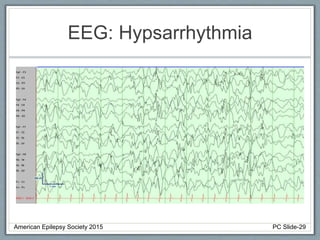
• Associated EEG patterns – hypsarrhythmia (see
figure)
• Common etiologies – various etiologies (see next
slide)
• Treatment – ACTH, vigabatrin, prednisolone, ketogenic
diet, surgical resection (if focal etiology)
• Prognosis – developmental delay, many will have
seizures later in life, can evolve to Lennox Gastaut
Syndrome
American Epilepsy Society 2015 PC Slide-27
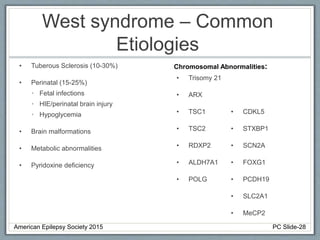
West syndrome – Common
Etiologies
• Tuberous Sclerosis (10-30%)
• Perinatal (15-25%)
• Fetal infections
• HIE/perinatal brain injury
• Hypoglycemia
• Brain malformations
• Metabolic abnormalities
• Pyridoxine deficiency
• Trisomy 21
• ARX
• TSC1
• TSC2
• RDXP2
• ALDH7A1
• POLG
• CDKL5
• STXBP1
• SCN2A
• FOXG1
• PCDH19
• SLC2A1
• MeCP2
Chromosomal Abnormalities:
American Epilepsy Society 2015 PC Slide-28
EEG: Hypsarrhythmia
American Epilepsy Society 2015 PC Slide-29
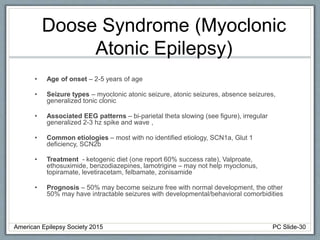
Doose Syndrome (Myoclonic
Atonic Epilepsy)
• Age of onset – 2-5 years of age
• Seizure types – myoclonic atonic seizure, atonic seizures, absence seizures,
generalized tonic clonic
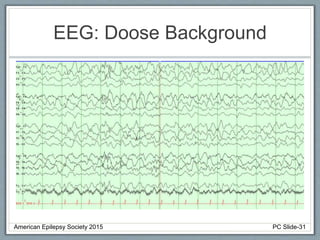
• Associated EEG patterns – bi-parietal theta slowing (see figure), irregular
generalized 2-3 hz spike and wave ,
• Common etiologies – most with no identified etiology, SCN1a, Glut 1
deficiency, SCN2b
• Treatment - ketogenic diet (one report 60% success rate), Valproate,
ethosuximide, benzodiazepines, lamotrigine – may not help myoclonus,
topiramate, levetiracetam, felbamate, zonisamide
• Prognosis – 50% may become seizure free with normal development, the other
50% may have intractable seizures with developmental/behavioral comorbidities
American Epilepsy Society 2015 PC Slide-30
EEG: Doose Background
American Epilepsy Society 2015 PC Slide-31
Lennox Gastaut Syndrome
• Age of onset – 1-7 years of age
• Seizure types – tonic (mostly nocturnal), atonic, myoclonic, atypical absence,
generalized tonic clonic, focal
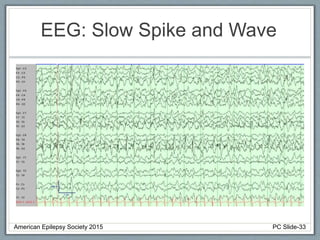
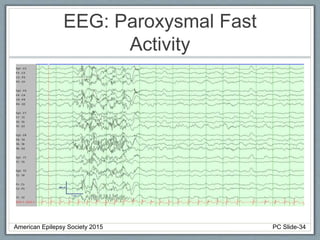
• Associated EEG patterns – generalized 1-2hz slow spike and wave (see
figure), generalized slowing, paroxysmal fast activity (recruiting rhythm) during
sleep (see figure)
• Common etiologies – variety of etiologies, proceeded by infantile spasms in 9-
40% of cases
• Treatment – felbamate, clobazam, rufinamide, topiramate, zonisamide,
ketogenic diet, valproate, levetiracetam, VNS, corpus callosotomy, focal cortical
resection (if there is a focus)
• Prognosis – moderate to severe intellectual impairment, usually correlates with
etiology and seizure control
American Epilepsy Society 2015 PC Slide-32
EEG: Slow Spike and Wave
American Epilepsy Society 2015 PC Slide-33
EEG: Paroxysmal Fast
Activity
American Epilepsy Society 2015 PC Slide-34
Section 1: selected
References
• Berg AT et al. Revised terminology and concepts for organization of
seizures and epilepsies: Report of the ILAE Commission on
Classification and Terminology. Epilepsia. April 2010; 51:4, 676-685.
• Stocker, S et al. Pyridoxine dependent epilepsy and antiquitin
deficiency clinical and molecular characteristics and recommendation
for diagnosis, treatment and follow up. Molecular Genetic and
metabolism, 2011; 104, 48-60.
• Fehr S et al. the CDKL5 disorder is an independent clinical entity
associated with early-onset encephalopathy. EJHG 2013; 21, 266-273.
• Beals JC, Cherian K, Moshe SL. Early-onset epileptic
encephalopathies: Ohtahara syndrome and early myoclonic
encephalopathy. Pediatric Neurology 2012 47 312-323.
• Coppola G et al. Migrating Partial Seizures in Infancy: A Malignant
Disorder with Developmental Arrest. Epilepsia 1995, 36 (10) 1017-
1024.
American Epilepsy Society 2015 PC Slide-35
Section 2: Epilepsy syndromes of
childhood and adolescence
American Epilepsy Society 2015 PC Slide-36
Childhood Epilepsy
Syndromes
American Epilepsy Society 2015 PC Slide-37
Benign Rolandic Epilepsy
• Etiology: Unknown, although a family history of
epilepsy is common
• Age of onset: 4-10 years
• Seizures
• Type: focal seizures, typically out of sleep
• Semiology: drooling, dysarthria, speech arrest, tingling or
clonic activity of unilateral face with spread to arm, may
progress to hemiclonic or generalized convulsive
• Duration: self-limited, status epilepticus is uncommon
• Frequency: typically low
American Epilepsy Society 2015 PC Slide-38
Benign Rolandic Epilepsy
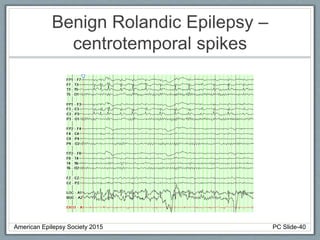
• Interictal EEG: High amplitude centrotemporal spikes and
sharp waves with dramatic activation during sleep (see
figure). Serial EEGs may show shifting asymmetry of spike
wave discharges
• Imaging: normal
• Treatment: pharmacoresponsive, may not require
preventative medications if seizures are infrequent.
• Clinical course: self limited epilepsy with spontaneous
remission, usually by age 15-17 years
• Comorbidities: Normal cognition, although learning and
behavioral disorders can occur
American Epilepsy Society 2015 PC Slide-39
Benign Rolandic Epilepsy –
centrotemporal spikes
American Epilepsy Society 2015 PC Slide-40
Panayiotopoulos syndrome
• Etiology: unknown
• Age of onset: 1-14 years, most often preschool age
• Seizures:
• Type: focal seizures, 2/3 out of sleep
• Semiology: autonomic symptoms: ictus emeticus (nausea
and retching), pallor, urinary incontinence, hypersalivation,
tachycardia, often with preserved consciousness. Evolves
to gaze deviation with decreased awareness, followed by
hemiconvulsion or bilateral convulsive seizure.
• Duration: often prolonged, autonomic status epilepticus
• Frequency: typically low
American Epilepsy Society 2015 PC Slide-41
Panayiotopoulos syndrome
• Interictal EEG: multifocal, high-amplitude epileptiform
discharges with increased activation during drowsiness and
sleep. Occipital discharges may be present and are
suppressed with eye opening.
• Imaging: normal
• Treatment: pharmacoresponsive, may not require preventative
medications if seizures are infrequent, but do need abortive
agents for prolonged seizures. 25% will have more frequent
seizures that can be resistant to treatment.
• Clinical course: self limited epilepsy with spontaneous
resolution within 1-2 years in 90% of children, all remit by
adolescence
• Comorbidities: normal cognition, excellent cognitive outcome
American Epilepsy Society 2015 PC Slide-42
Childhood absence epilepsy
• Etiology: presumed genetic
• Age of onset: 3-10 years, peak at 6-7 years; onset
before age 3 years likely represents different epilepsy
syndrome
• Seizures:
• Type: generalized absence seizures, can be provoked by
hyperventilation in up to 90%; 3% will also have
generalized convulsive seizures
• Semiology: staring, behavioral arrest, unresponsiveness.
Infrequent associated automatisms, clonic jerks, loss of
postural tone.
• Duration: brief, approximately 10 seconds
• Frequency: high, hundreds per day if untreated
American Epilepsy Society 2015 PC Slide-43
Childhood absence epilepsy
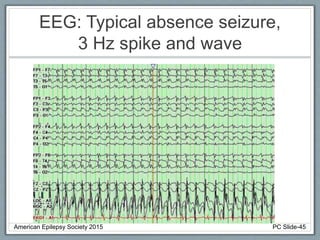
• Interictal EEG: generalized symmetric 3 Hz spike and wave
discharges with increased activation of discharges during
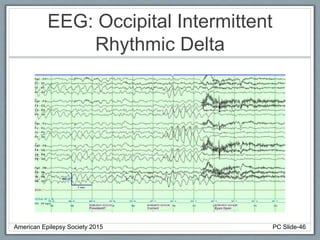
hyperventilation; a posterior delta rhythm that attenuates
with eye opening is seen in a minority of children (see figure)
• Imaging: normal
• Treatment: pharmacoresponsive in 60-70%; ethosuximide
and valproic acid are most effective, valproic acid has more
reported side effects. Carbamazepine and oxcarbazepine
can precipitate absence status epilepticus.
• Clinical course: self-limited in 70-90%. If seizures continue
in adolescence, 40% will have convulsive seizures. Some
may evolve to juvenile myoclonic epilepsy (JME)
• Comorbidities: normal cognition, excellent cognitive
outcome, executive dysfunction is reported
American Epilepsy Society 2015 PC Slide-44
EEG: Typical absence seizure,
3 Hz spike and wave
American Epilepsy Society 2015 PC Slide-45
EEG: Occipital Intermittent
Rhythmic Delta
American Epilepsy Society 2015 PC Slide-46
Atypical absence epilepsies
• Etiology: presumed genetic
• Age of onset: variable
• Seizures:
• Type: absence seizures with additional features
• Semiology: staring, behavioral arrest, unresponsiveness like typical
absence seizures, but also have some of the following:
• Rhythmic myoclonic jerking of the limbs or head with absence seizure
(myoclonic-absence seizure)
• Non-suppressible eyelid myoclonia with or without absence seizure
• Perioral myoclonia
• Duration: typically brief, but absence status epilepticus can occur
• Frequency: high, hundreds of seizures per day
American Epilepsy Society 2015 PC Slide-47
Atypical absence epilepsies
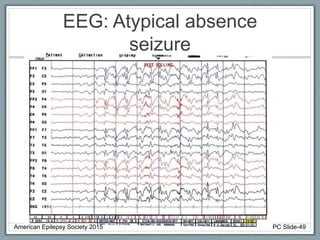
• EEG: generalized 3 Hz spike and wave discharges,
generalized atypical spike and polyspike and wave
discharges
• Imaging: normal
• Treatment: often pharmacoresistent. Treatment includes
broad spectrum AEDs and dietary therapy (ketogenic diet,
modified adkins diet, low glycemic index diet)
• Clinical course: Seizures are unlikely to spontaneously remit
• Comorbidities: Learning disorders and mild to moderate
intellectual disability are common, although some have
normal cognition.
American Epilepsy Society 2015 PC Slide-48
EEG: Atypical absence
seizure
American Epilepsy Society 2015 PC Slide-49
Late childhood onset epilepsy
syndromes
American Epilepsy Society 2015 PC Slide-50
Juvenile absence epilepsy
• Etiology: presumed genetic
• Age of onset: 10-16 years
• Seizures:
• Type: absence seizures, 80% will also have
generalized convulsive seizures
• Semiology: staring, behavioral arrest,
unresponsiveness
• Duration: approximately 10 seconds
• Frequency: 2-3 per day
American Epilepsy Society 2015 PC Slide-51
Juvenile absence epilepsy
• Interictal EEG: generalized 3.5-4 Hz spike and wave,
generalized atypical spike and polyspike and wave
• Imaging: normal
• Treatment: usually pharmacoresponsive. Treatment
includes broad spectrum AEDs to treat both absence
and convulsive seizures. Low carbohydrate diets can
also be considered.
• Clinical course: spontaneous remission is rare
• Comorbidities: normal cognition, although executive
dysfunction is common
American Epilepsy Society 2015 PC Slide-52
Juvenile myoclonic epilepsy
• Etiology: presumed genetic
• Age of onset: 12-18 years
• Seizures:
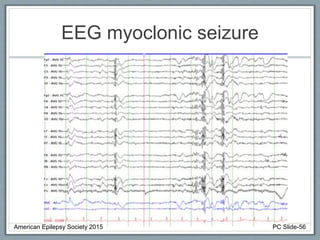
• Myoclonic: sudden jerk, lasting <1 second, no clear associated loss of
awareness, can happen multiple times per day, especially in the morning or
with strobe lights. Occur in all JME patients, but may not be recognized
initially as seizures. A history of sudden jerks, clumsiness, or jitteriness,
especially in the morning should be questioned.
• Generalized tonic clonic: often begin a repetitive myoclonic seizures that
culminate in a generalized bilateral convulsion. Typically self-limited and
infrequent, although nearly all JME patients will have at least one. Often the
first seizure recognized.
• Absence: staring, behavioral arrest, unresponsiveness. May not be
previously recognized and a history of staring spells should be questioned.
Occur in approximately 20% of patients with JME.
American Epilepsy Society 2015 PC Slide-53
Juvenile myoclonic epilepsy
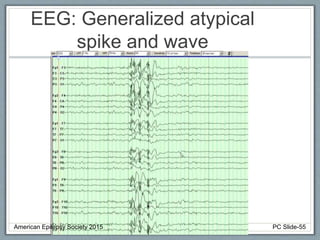
• Interictal EEG: generalized 4-6 Hz atypical spike and polyspike
and wave discharges (see figure), with photoparoxysmal
response that may precipitate myoclonic seizures in 30-90%
• Imaging: normal
• Treatment: 80-90% are pharmacoresponsive. The traditional
treatment is valproic acid, but side effects may limit its use,
especially in women of reproductive age, and other broad
spectrum AEDs are used. Carbamazepine, oxcarbazepine,
and phenytoin can exacerbate seizures.
• Clinical course: spontaneous remission is rare
• Comorbidities: normal cognition, although executive
dysfunction is common
American Epilepsy Society 2015 PC Slide-54
EEG: Generalized atypical
spike and wave
American Epilepsy Society 2015 PC Slide-55
EEG myoclonic seizure
American Epilepsy Society 2015 PC Slide-56
Gastaut type occipital
epilepsy
• Late-onset childhood epilepsy with occipital paroxysms
• Etiology: unknown
• Age of onset: 3-15 years, typically school age
• Seizures
• Focal seizures
• Semiology: Elementary visual hallucinations that may progress to
more complex visual hallucinations, then gaze deviation ipsilateral
head deviation with loss of awareness, that may progress to
generalized convulsive seizure. Severe ictal and postictal
headache.
• Duration: self limited, status epilepticus is uncommon
• Frequency: variable
American Epilepsy Society 2015 PC Slide-57
Gastaut type occipital
epilepsy
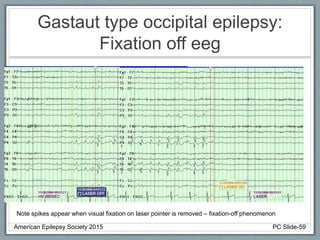
• Interictal EEG: multifocal, high-amplitude epileptiform
discharges with increased activation during drowsiness and
sleep. Occipital discharges may be present and are
suppressed with eye opening (fixation-off phenomenon, see
figure).
• Imaging: normal. Imaging is recommended to exclude a
potential structural etiology for occipital epilepsy
• Treatment: typically pharmacoresponsive
• Clinical course: spontaneously resolves within 2-4 years in
50-60%, may continue in others.
• Comorbidities: normal cognition
American Epilepsy Society 2015 PC Slide-58
Gastaut type occipital epilepsy:
Fixation off eeg
Note spikes appear when visual fixation on laser pointer is removed – fixation-off phenomenon
American Epilepsy Society 2015 PC Slide-59
Other epileptic
encephalopathies
American Epilepsy Society 2015 PC Slide-60
ESES
• Electrical status epilepticus in slow wave sleep (ESES)
• EEG finding characterized by nearly continuous
activation of spike wave discharges in slow wave sleep
• Awake EEG may be normal or may demonstrate focal,
multifocal, or diffuse spikes and slow waves,
predominantly in the frontocentral, centrotemporal, or
frontotemporal regions
• EEG in non-REM sleep shows diffuse discharges that
typically occupy 85% or more of the slow sleep record
• Discharges resolve upon awakening and have no clinical
accompaniment
• Normal sleep architecture is still seen
American Epilepsy Society 2015 PC Slide-61
Continuous spike wave
syndrome
• Etiology: Genetic, metabolic, structural, or unknown
• Age of onset: 1-14 years, peak age 4-8 years
• Seizures: present in 80%
• Type: generalized convulsive, typical absence, atypical
absence, focal, atonic. Tonic seizures do not occur.
• Duration: variable
• Frequency: variable, although up to 93% have multiple
seizures per day
• Interictal EEG: Slowing of the background with or without
epileptiform discharges during wakefulness, ESES during
sleep with discharges often maximal over the frontocentral
regions
American Epilepsy Society 2015 PC Slide-62
Continuous spike wave
syndrome
• Imaging: can be normal, can show structural abnormalities including
remote insult and malformations of cortical development
• Treatment: Seizures and EEG need to be treated. Diazepam and
corticosteroids in 3-4 week cycles are often used to treat the EEG.
Multiple other treatments have been tried including valproic acid,
benzodiazepines, ethosuximide, levetiracetam, IVIG, sulthiame (not
FDA approved in US), ketogenic diet, multiple subpial transection.
Carbamazepine, oxcarbazepine, and phenytoin can worsen the
syndrome. Seizures can be pharmacoresistent.
• Clinical course: Relapsing remitting course that spontaneously
resolves in adolescence, but neuropsychological sequelae of the
recurrent relapses are often permanent
• Comorbidities: Regression of skills, often global, is necessary for
diagnosis.
American Epilepsy Society 2015 PC Slide-63
Landau-Kleffner syndrome
• Etiology: unknown
• Age of onset: 3-8 years, peak 4-5 years
• Seizures: present in 70-80% of children
• Types: generalized convulsive, focal, atypical absence. Atonic
seizures usually not seen. Seizures often arise from sleep, but are
also present during wakefulness.
• Duration: variable
• Frequency: variable
• EEG: Interictal EEG: Slowing of the background, or normal
background, with or without epileptiform discharges during
wakefulness, ESES during sleep with discharges often maximal
over the frontotemporal and centrotemporal regions
American Epilepsy Society 2015 PC Slide-64
Landau-Kleffner syndrome
• Imaging: normal
• Treatment: Seizures and EEG need to be treated. Multiple treatments
have been tried including valproic acid, benzodiazepines,
ethosuximide, levetiracetam, IVIG, sulthiame (not FDA approved in
US), ketogenic diet, multiple subpial transection. Carbamazepine,
oxcarbazepine, and phenytoin can worsen the syndrome. Seizures
usually pharmacoresponsive. Diazepam and corticosteroids in 3-4
week cycles are often used to treat the EEG.
• Clinical course: Relapsing remitting course that spontaneously
resolves in adolescence, but neuropsychological sequelae of the
recurrent relapses are often permanent
• Comorbidities: Regression of language is necessary for diagnosis.
Receptive language usually affected more than expressive (acquired
auditory agnosia). Behavioral and attentional abnormalities coinciding
with language regression are common.
American Epilepsy Society 2015 PC Slide-65
Atypical benign partial epilepsy
• Etiology: unknown, although a family history of epilepsy is
common
• Age of onset: 2.5-6 years
• Seizures
• Type: multiple, including focal motor, atypical absence,
atonic, often leading to potential diagnosis of Lennox Gastaut
syndrome or Myoclonic-Atonic epilepsy. However, epileptic
negative myoclonus is a unique seizure type and myoclonic
or myoclonic-atonic seizures are unlikely.
• Semiology: Focal motor seizures often present at onset with
twitching of unilateral face and arm with or without evolution
to generalized convulsive seizures. Epileptic negative
myoclonus has sudden interruptions in EMG, often focal.
• Duration: typically brief
• Frequency: hundreds per day, although this may wax and
wane
American Epilepsy Society 2015 PC Slide-66
Atypical benign partial epilepsy
• Interictal EEG: Variable initially. May be multifocal, may be a
variant of centrotemporal spikes. Over time discharges
become more widespread and there is significant activation of
generalized slow spike and wave discharges in sleep, but spike
wave index typically <85%.
• Imaging: Usually normal
• Treatment: Often pharmacoresistent, but may respond to
corticosteroids, ketogenic diet, and ethosuximide.
• Clinical course: All children have essentially normal
development at onset, but may show regression in the setting
of frequent seizures. Seizures typically last 2-3 years and
spontaneously resolve by age 12 years.
• Comorbidities: Learning disorders, including language delay
and hyperactivity are common
American Epilepsy Society 2015 PC Slide-67
Tay-Sachs
• Etiology: hexosaminidase A deficiency due to
autosomal recessive mutations in alpha subunit of
hexosaminidase A gene
• Age at onset: usually infancy
• Clinical characteristics: exaggerated startle reflex
to sound, developmental regression, blindness,
“cherry red spot” on funduscopic exam
• Multiple seizure types, including epileptic spasms
and focal seizures, as well as myoclonus
American Epilepsy Society 2015 PC Slide-68
Tay-Sachs
• EEG: variable. Generalized background slowing
with generalized EEG correlate to myoclonus.
There can be fast spikes present over the central
head region.
• Imaging: progressive diffuse white matter and
basal ganglia changes and atrophy
• Clinical course: progressive decline with death
usually in the 2-3rd decade
American Epilepsy Society 2015 PC Slide-69
Alper’s hepatopathic
poliodystrophy
• Etiology: Autosomal recessive, deficiency in mtDNA
polymerase gamma activity due to mutations in
POLG1
• Age at onset: usually infancy, but can present into
early adulthood
• Clinical characteristics: normal at birth, then recurrent
status epilepticus, hepatic failure with micronodular
cirrhosis, and episodic neurologic deterioration.
• Hepatic failure worsened by valproic acid. Valproic acid
must be avoided.
American Epilepsy Society 2015 PC Slide-70
Alper’s hepatopathic
poliodystrophy
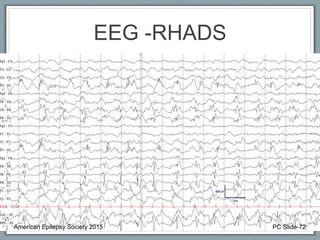
• EEG: Slow or absent posterior dominant rhythm with
multifocal and generalized epileptiform activity.
Rhythmic High Amplitude Delta with Superimposed
Spikes [RHADS] common associated EEG pattern.
(see figure)
• Imaging: Variable, including migratory cortical and
subcortical hyperintensities, basal ganglia and thalami
changes, diffuse white matter changes, cerebellar
atrophy
• Clinical course: progressively worsening epilepsy and
hepatic failure. Death within months to 12 years of
onset.
American Epilepsy Society 2015 PC Slide-71
EEG -RHADS
American Epilepsy Society 2015 PC Slide-72
Progressive myoclonic
epilepsies
• Multiple seizure types, worsening myoclonus, cerebellar
dysfunction, and developmental regression
• Age of onset, EEG patterns, and comorbidities variable,
depending on etiology
• Etiology typically metabolic or genetic
• Progressive course with pharmacoresistent epilepsy
• Treatment is usually symptomatic
American Epilepsy Society 2015 PC Slide-73
Neuronal ceroid
lipofuscinosis
• Etiology: genetically heterogeneous, multiple neuronal
ceroid lipofuscinosis (CLN) genes exist
• Age of onset: infantile, juvenile, and adult forms exist
• Clinical characteristics: progressive seizures,
cerebellar ataxia, extrapyramidal signs, myoclonus,
dementia, behavioral changes, visual loss, auditory
and visual hallucinations
• Granular osmophilic deposits in cells, causing fingerprint,
curvilinear, or rectilinear bodies on skin biopsy
American Epilepsy Society 2015 PC Slide-74
Neuronal ceroid
lipofuscinosis
• EEG: progressive slowing of the background, with loss
or “vanishing” of the EEG activity. Photosensitivity with
a photoparoxysmal response at slow frequencies.
• Imaging: Abnormalities are variable depending on
specific mutation, often precede clinical symptoms,
and include cerebral and cerebellar atrophy,
decreased signal intensity of the thalami and
hyperintense periventricular white matter
• Clinical course: gradual progression to death
American Epilepsy Society 2015 PC Slide-75
Unverricht-Lundborg disease
• Etiology: autosomal recessive inheritance of mutations
in cystatin B gene (CSTB)
• Age of onset: 6-15 years
• Clinical characteristics: Present with myoclonus that
can be triggered by sensory stimuli and are worse
upon awakening. Convulsive seizures and absence
also occur. Initially no neurologic deficit, then
progressive ataxia, tremor, dysarthria, and myoclonus
during adolescence.
American Epilepsy Society 2015 PC Slide-76
Unverricht-Lundborg disease
• EEG: Wakefulness: generalized slowing, epileptiform
discharges, photoparoxysmal response. Sleep:
remains essentially normal
• Imaging: Typically normal at onset with subsequent
development of diffuse atrophy
• Clinical course: Progressive symptoms in
adolescence, but minimal or no cognitive decline.
Stabilization and possibly some improvement in ataxia
and myoclonus in adulthood. Seizures are
pharmacoresponsive, but myoclonus is not. Possibly
normal lifespan.
American Epilepsy Society 2015 PC Slide-77
Lafora disease
• Etiology: Autosomal recessive mutation in EPM2A or
EPM2B genes
• Age of onset: 8-18 years
• Clinical characteristics: Cognitive regression,
headaches, myoclonic jerks, generalized seizures,
visual hallucinations that are epileptic (occipital
seizures) and non-epileptic, that all occur at
approximately the same time. Ataxia, dysarthria, and
mood disorders occur early.
• Lafora bodies, cells with dense accumulations of
polyglucosans, seen in the majority of neurons as well as
heart, skeletal muscle, liver, and sebaceous gland ducts
American Epilepsy Society 2015 PC Slide-78
Lafora disease
• EEG: Early there are generalized epileptiform
discharges that occur at approximately 3 Hz. Over
time there is slowing of the background and the
discharge frequency increases from 3 Hz to 6-12 Hz
• Imaging: Typically no significant change in MRI, but
MR spectroscopy shows decreased NAA/creatine ratio
• Clinical course: Progresses over years. After 10 years
of disease, there is nearly continuous myoclonus with
and without absence, frequent convulsive seizures,
and vegetative state followed by death.
American Epilepsy Society 2015 PC Slide-79
Myoclonic epilepsy with
ragged red fibers
• Etiology: Mitochondrial DNA mutations in mitochondrial
tRNA gene for lysine, MTTK, is found in 80-90%, features
also seen with mutation in MTND5 gene and other mtDNA
mutations
• Age of onset: variable
• Clinical characteristics: Variable, depending on the relative
amount of mutant mtDNA. All experience progressive
myoclonus that may have EEG correlate and can be
worsened by action. Other seizures can also occur.
Cerebellar ataxia, myopathy, neuropathy, optic atrophy,
deafness, short stature, dementia, and stroke like episodes
can also occur.
• Muscle biopsy shows proliferation of mitochondria, which
look like ragged red fibers
American Epilepsy Society 2015 PC Slide-80
Myoclonic epilepsy with
ragged red fibers
• EEG: Slowing of the background with focal and
generalized epileptiform discharges
• Imaging: atrophy with basal ganglia calcifications
• Clinical course: Variable, depending on severity.
Myoclonus is usually pharmacoresistent, although
other seizures may respond to medications.
Valproic acid should be avoided.
American Epilepsy Society 2015 PC Slide-81
Immune-mediated epilepsy
• Multifocal neurologic signs and symptoms including:
• Intractable epilepsy
• Psychiatric disorder
• Cognitive dysfunction
• Movement disorders
• Sleep dysfunction
• Autonomic dysfunction
• Acute or subacute onset and progressive course
American Epilepsy Society 2015 PC Slide-82
Rasmussen encephalitis
• Etiology: presumed autoimmune
• Age of onset: Variable, usually young children
• Clinical characteristics: Intractable focal epilepsy, often
with epilepsia partialis continua (EPC), and
progressive hemiparesis followed by progressive
intellectual decline.
• EEG: Slowing ipsilateral to hemiatrophy. EPC may not
have EEG correlate.
American Epilepsy Society 2015 PC Slide-83
Rasmussen encephalitis
• Imaging: Progressive atrophy of affective
hemisphere
• Treatment and clinical course: Functional
hemispherotomy is usually treatment of choice for
those with unilateral involvement. Hemiparesis
follows, but seizure and cognitive outcome is
significantly improved. Immunomodulatory
therapies, such as IVIG, corticosteroids, and other
steroid-sparing agents can be tried.
American Epilepsy Society 2015 PC Slide-84
Voltage gated potassium channel
complex/LGI1 antibodies
• Age of onset: Variable
• Clinical characteristics: Developmental regression,
faciobrachial dystonic seizures (brief unilateral grimace
with ipsilateral arm dystonia) are common and occur
frequently, other seizures also occur, movement
disorder, ataxia, insomnia, autonomic instability
• EEG: Nonspecific slowing of the background and
multifocal or generalized epileptiform discharges.
American Epilepsy Society 2015 PC Slide-85
Voltage gated potassium
channel complex/LGI1
antibodies
• Imaging: May be normal in children, may show
increased signal mesial temporal lobes, consistent
with limbic encephalitis
• Treatment and clinical course: Up to 10% with
limbic encephalitis may have underlying
malignancy, which must be evaluated. Also,
prompt treatment with corticosteroids, IVIG,
plasma exchange, or other immunomodulatory
therapy leads to a favorable response in most
patients
American Epilepsy Society 2015 PC Slide-86
NMDA receptor antibodies
• Age of onset: Variable
• Clinical characteristics: Possible preceding viral-like
symptoms, then psychiatric and behavioral changes,
followed by insomnia then decreased level of
awareness, seizures, dyskinesias, choreoathetosis,
and autonomic instability
• EEG: Diffuse nonspecific slowing, with or without
epileptiform discharges. Nearly continuous 1-3 Hz
delta with superimposed bursts of fast activity,
“extreme delta brush,” highly suggestive of NMDAR
antibodies
American Epilepsy Society 2015 PC Slide-87
NMDA receptor antibodies
• Imaging: May be normal, may show cortical and
subcortical T2 FLAIR signal abnormalities and
transient cortico-meningeal enhancement
• Treatment and clinical course: NMDA detection in CSF
or serum makes the diagnosis. In children, <10% are
associated with underlying tumor (teratoma).
Treatment includes IVIG, plasma exchange,
corticosteroids, rituximab, and cyclophosphamide. If
treated early, 80% have significant improvement and
may have full recovery.
American Epilepsy Society 2015 PC Slide-88
Section 2: selected
References
• Dhamija, et al. “Neuronal Voltage-Gated Potassium Channel Complex Autoimmunity in
Children.” Pediatr Neurol 2011; 44:275-281
• Santavouri, et al. “Clinical and neuroradiological diagnostic aspects of neuronal ceroid
lipofuscinoses disorders.” European Journal of Pediatric Neurology 2001; 5(Suppl. A): 157-
161
• Wong-Kisiel, et al. “Autoimmune Encephalopathies and Epilepsies in Children and
Teenagers.” Can J Neurol Sci. 2012; 39: 134-144
• Armangue, et al. “Autoimmune Encephalitis in Children.” J Child Neurol. 2012; 27(11):
1460-1469
• Bindoff and Engelsen. “Mitochondrial Diseases and Epilepsy.” Epilepsia 2012; 53(Suppl. 4):
92-97
• Ramachandran, et al. “The Autosomal Recessively Inherited Progressive Myoclonus
Epilepsies and Their Genes.” Epilepsia 2009; 50(Suppl. 5): 29-36
• Mondonca de Siqueira. “Progressive Myoclonic Epilepsies: Review of Clinical, Molecular,
and Therapeutic Aspects.” J Neurol. 2010; 257: 1612-1619
American Epilepsy Society 2015 PC Slide-89
Section 2: selected
References
• Fujii, et al. “Atypical Benign Partial Epilepsy: Recognition Can Prevent
Pseudocatastrophe.” Pediatr Neurol 2010: 43: 411-419
• Nickels and Wirrell. “Electrical Status Epilepticus in Sleep.” Semin Pediatr Neurol
2008; 15:50-60
• Glauser, et al. “Ethosuximide, Valproic Acid, and Lamotrigine in Childhood Absence
Epilepsy: Initial Monotherapy Outcomes at 12 Months.” Epilepsia 2013; 54(10): 141-
155
• Glauser, et al. “Updated ILAE Evidence Review of Antiepileptic Drug Efficacy and
Effectiveness as Initial Monotherapy for Epileptic Seizures and Syndromes.” Epilepsia
2013
• Wirrell and Nickels. “Pediatric Epilepsy Syndromes.” Continuum 2010; 16(3): 57-85
• Wong-Kisiel and Nickels. “Electroencephalogram of Age-Dependent Epileptic
Encephalopathies in Infancy and Early Childhood.” Epilepsy Res Treat. 2013; 743203
American Epilepsy Society 2015 PC Slide-90
Section 3: Unique Etiologies of
Epilepsy Often Presenting with
Pediatric Onset
American Epilepsy Society 2015 PC Slide-91
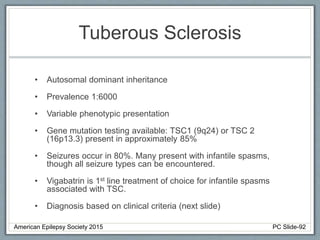
Tuberous Sclerosis
• Autosomal dominant inheritance
• Prevalence 1:6000
• Variable phenotypic presentation
• Gene mutation testing available: TSC1 (9q24) or TSC 2
(16p13.3) present in approximately 85%
• Seizures occur in 80%. Many present with infantile spasms,
though all seizure types can be encountered.
• Vigabatrin is 1st line treatment of choice for infantile spasms
associated with TSC.
• Diagnosis based on clinical criteria (next slide)
American Epilepsy Society 2015 PC Slide-92
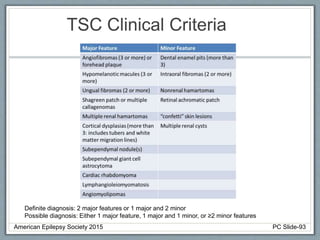
TSC Clinical Criteria
Definite diagnosis: 2 major features or 1 major and 2 minor
Possible diagnosis: Either 1 major feature, 1 major and 1 minor, or ≥2 minor features
American Epilepsy Society 2015 PC Slide-93
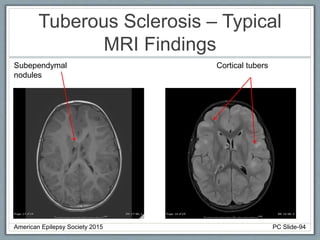
Tuberous Sclerosis – Typical
MRI Findings
Subependymal
nodules
Cortical tubers
American Epilepsy Society 2015 PC Slide-94
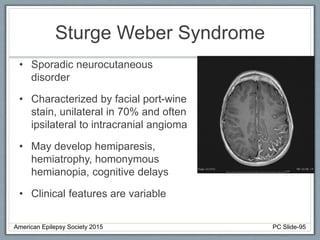
Sturge Weber Syndrome
• Sporadic neurocutaneous
disorder
• Characterized by facial port-wine
stain, unilateral in 70% and often
ipsilateral to intracranial angioma
• May develop hemiparesis,
hemiatrophy, homonymous
hemianopia, cognitive delays
• Clinical features are variable
American Epilepsy Society 2015 PC Slide-95
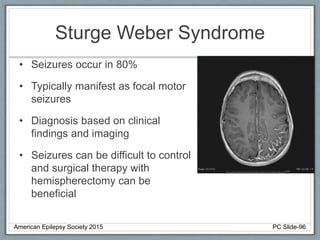
Sturge Weber Syndrome
• Seizures occur in 80%
• Typically manifest as focal motor
seizures
• Diagnosis based on clinical
findings and imaging
• Seizures can be difficult to control
and surgical therapy with
hemispherectomy can be
beneficial
American Epilepsy Society 2015 PC Slide-96
Developmental Tumors
• Account for approximately 1/3 cases of intractable
epilepsy
• Gangliogliomas and Dysembryoplastic neuroepithelial
tumors account for 50-70% of tumors associated with
epilepsy
• Tumors are often associated with surrounding cortical
dysplasia
• Seizures are typically focal
• Complete resection often results in seizure freedom
American Epilepsy Society 2015 PC Slide-97
Cortical Dysplasia
• Focal regions of abnormal cortical organization with or
without the presence of large abnormal cells
• Most common cause of intractable pediatric epilepsy
• Focal onset seizures most often encountered
• EEG features: often frequent focal interictal discharges
American Epilepsy Society 2015 PC Slide-98
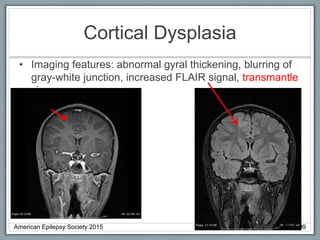
Cortical Dysplasia
• Imaging features: abnormal gyral thickening, blurring of
gray-white junction, increased FLAIR signal, transmantle
sign
American Epilepsy Society 2015 PC Slide-99
Gelastic Epilepsy Related to
Hypothalamic Hamartoma
• Presentation: Neonates to early childhood
• Seizure types: Unprovoked laughter is defining. Atonic, tonic,
GTC, and focal onset seizures may also occur
• EEG: interictal EEG often normal or may demonstrate focal
findings. An ictal pattern of background suppression followed by
fast activity (often focal) is commonly encountered. However,
EEG (both ictal and interictal) can be pseudolateralizing
• Behavioral dyscontrol and precocious puberty are commonly
encountered comorbidities
American Epilepsy Society 2015 PC Slide-100
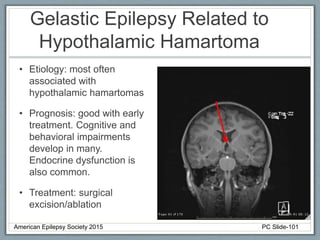
Gelastic Epilepsy Related to
Hypothalamic Hamartoma
• Etiology: most often
associated with
hypothalamic hamartomas
• Prognosis: good with early
treatment. Cognitive and
behavioral impairments
develop in many.
Endocrine dysfunction is
also common.
• Treatment: surgical
excision/ablation
American Epilepsy Society 2015 PC Slide-101
Selected Childhood
Epilepsies of Genetic Origin
*The evolution of genetic epilepsies in childhood is rapidly evolving with new syndromes and genes discovered frequently.
This section is not meant as an exhaustive review, but instead serves as an introduction to some of the more common
and well described childhood epilepsies with known genetic cause.
American Epilepsy Society 2015 PC Slide-102
Dravet Syndrome
Evolution of symptoms
• Initial presentation: Febrile seizures in 1st year of life
• Often prolonged febrile seizures/febrile status
• Evolve to Hemiclonic (alternating) or generalized tonic-clonic seizures
• Seizures provoked by modest hyperthermia (e.g. hot bath)
• Rarely have fever without seizure
• Development usually normal at time of onset
• By age 2y, unprovoked seizures may begin including Myoclonic, GTC,
Complex partial, absence, atonic
• Patients experience frequent admissions with status epilepticus initially,
both convulsive and nonconvulsive
• EEG may be normal initially, but progressively worsens to generalized
slowing, generalized spike/polyspike wave, multifocal independent spike
wave
• Development plateaus then progressively declines around 1 year of age
or with the appearance of other seizure types
American Epilepsy Society 2015 PC Slide-103
Dravet Gait
Some children with Dravet Syndrome will develop a
characteristic apraxic gait demonstrated below
• Will insert movie for final version.
American Epilepsy Society 2015 PC Slide-104
Evaluation: Dravet Syndrome
• EEG: may be normal at initial presentation, but typically shows
generalized slowing, generalized and multifocal spike wave
discharges by the time unprovoked seizures begin
• MRI: often normal, but may show some cerebral atrophy or
hippocampal sclerosis
• Genetic testing: SCN1A- at least 70% of patients have mutation in
SCN1A, the vast majority are de novo
• Other mutations are also rarely reported to be associated with
Dravet phenotype including:
• SCN2A, SCN1B, SCN8A, SCN9A, GABRG2, STXBP1
American Epilepsy Society 2015 PC Slide-105
SCN1A
• Location: 2q21-34
• Function: voltage gated Na channel (NaV1.1) – mutations may lead to increased Na influx, thus
excitation
• Most mutations are frameshift, nonsense, or splice-site mutations which produce nonfunctional
protein
• Missense mutations are also found
• Testing strategies: DNA sequencing or Deletion Testing
• 73-92% of mutations are detectable by DNA sequencing
• 8-27% have large scale or whole gene deletions
• Microdeletions within SCN1A present in 2-3%
• Rare reports of duplication or amplification
• Location of mutation within the gene is important
• Approximately 15% of Dravet syndrome have no mutation identified
American Epilepsy Society 2015 PC Slide-106
Treatment Strategies-
SCN disorders
• Abnormal SCN1A channels disproportionately affect GABA
neurons (Yu, et al 2006)
• Benzodiazepines
• Clobazam –dosed 0.2-1mg/kg/d divided bid/tid
• Valproic acid
• Stiripentol – not FDA approved in US
• Topiramate
• Phenobarbital – not as well tolerated secondary to cognition
• DRUGS TO AVOID: carbamazepine, lamotrigine,
oxcarbazepine may worsen seizures – specifically,
myoclonus
American Epilepsy Society 2015 PC Slide-107
Associated SCN1A Conditions:
Genetic Epilepsy with Febrile Seizures
Plus
• Age of onset: 6m-6y
• Seizure types: classic febrile seizures which persist beyond
6 years, often with afebrile GTC, absence, myoclonic and
focal seizures of variable frequency.
• EEG: variable findings. May be normal or often have
generalized spike wave
• Key features: febrile seizures beyond 6 years and strong
family history of similar febrile and afebrile seizures
• Prognosis: varies, though often the phenotypes of family
members is similar
• Treatment: varies. Decision to start treatment rests on the
need based on frequency of seizures.
American Epilepsy Society 2015 PC Slide-108
PCDH19 Female Limited
Epilepsy
• Age of onset: 6-36 months
• Seizure types: seizures with fever initially, then generalized seizures more so
than focal. Often presenting with seizure clusters.
• EEG: varies with both focal and generalized abnormalities
• Key features: Occurs only in females, febrile seizures, clusters of seizure,
variable developmental status
• Prognosis: appears varied with regards to seizures, but tends to improve with
age. Cognitive deficits are varied, but may become more evident after seizure
onset.
• Treatment: most AEDs, none noted to be superior
• Cause: mutations in PCDH19, X linked inheritance with clinical manifestations
limited to females
American Epilepsy Society 2015 PC Slide-109
PCDH19
• Chrom Xq22 - Protocadherin 19
• Function: transmembrane protein expressed in
the CNS. Possibly a modulator of synaptic
transmission
• Type: various (frameshift/missense)
• Available testing: DNA sequencing
American Epilepsy Society 2015 PC Slide-110
• Other genetic epilepsies discussed elsewhere
(see neonatal epilepsy section)
• Benign Familial Neonatal Seizures
• KCNQ2 Encephalopathy Syndrome
• CDKL5 Associated Epilepsy
American Epilepsy Society 2015 PC Slide-111
Section 4: Surgical
Evaluation of intractable
Pediatric epilepsy
American Epilepsy Society 2015 PC Slide-112
Surgical Evaluation of intractable
pediatric epilepsy
• Defining intractability
-15-20% of patients with epilepsy will be intractable to
medical therapy
-defined as failure of 2 appropriately chosen and
administered AEDs
• Rationale for surgical therapy
• Physical harm posed by seizures
• Effect of epilepsy on early brain development
• Deterioration of brain development both functionally and
structurally
• Impact of chronic disease on QOL
• Life expectancy
American Epilepsy Society 2015 PC Slide-113
Choosing candidates: features of
early intractability
• Early onset seizures
• Frequent seizures (daily/weekly)
• Seizure clustering
• Abnormal neurological examination
• Remote symptomatic etiology
• Infantile spasms
• Multiple seizure types
• Recurrence of seizures in first 6-12 months of treatment
American Epilepsy Society 2015 PC Slide-114
Components of Surgical
Evaluation
• Video EEG
• Interictal and ictal data, including careful video review
for localizing semiology
• Localized onset is most important
• Anatomic Imaging: MRI
• High resolution, thin slice volumetric T1 weighted
gradient recalled-echo, axial/coronal T2, FLAIR, and
high resolution coronal T2 through the hippocampus
American Epilepsy Society 2015 PC Slide-115
Components of Surgical
Evaluation
• Functional Imaging
• PET (positron emission tomography)
• Measures cerebral metabolism using radiolabeled tracer
• Useful in MRI-negative epilepsy or those with apparent generalized
patterns
• SPECT (single-photon emission computer tomography)
• Measures perfusion
• Localizing value improves with ictal/interictal subtraction and statistical
analysis
• Useful in poorly localized ictal onset
• MEG
• Localizes epileptiform generators
• Increasingly used for localization of eloquent cortex
• fMRI
• Reliably localizes eloquent cortex
American Epilepsy Society 2015 PC Slide-116
Phase II monitoring
• Subdural electrodes or depth electrodes placed
for localization of ictal onset or mapping of
eloquent cortex
• Often used in patients with normal/non-localizing
imaging, widespread epileptogenic zones,
multilesional imaging, or onset zones near
eloquent cortex
• May also be required in lesional cases,
especially some neoplasms with associated
cortical dysplasia or low grade cortical dysplasia
American Epilepsy Society 2015 PC Slide-117
Predictors of Favorable
Outcome
• Older age at seizure onset
• Shorter duration of epilepsy
• Lesional MRI
• Unifocal lesions
• IQ > 70
• Absence of psychiatric comorbidities
• Unilobar resections
• Temporal lobe resections
• Pathology
• Tumors fare better than cortical dysplasia
• In dysplasia, high grades tend to have better outcome (likely related to completeness of
resection)
• Completeness of resection (most important predictor of seizure free outcome)
American Epilepsy Society 2015 PC Slide-118

AES Pediatrics Working group Slide Final.pptx

  • 1.
    Pediatric Epilepsy SlideDeck American Epilepsy Society Created by the Pediatric Workgroup of the Student & Resident Education Committee American Epilepsy Society 2015 PC Slide-1
  • 2.
    Outline • Section 1:Seizures and Epilepsy Syndromes Presenting in Neonates and Early Infancy • Section 2: Epilepsy Syndromes Presenting in Early Childhood and Adolescence • Section 3: Unique Etiologies of Epilepsy Often Presenting with Pediatric Onset • Section 4: Surgical Evaluation of Intractable Pediatric Epilepsy American Epilepsy Society 2015 PC Slide-2
  • 3.
    Section 1: Seizuresand Epilepsy Syndromes Presenting in Neonates and Early Infancy American Epilepsy Society 2015 PC Slide-3
  • 4.
  • 5.
    Neonatal Epilepsy • Seizurescan present at anytime in the lifespan and are increased in the neonatal period • The incidence ranges from 1-3.5/1000 live births* • Increased risk • preterm infants • Neurologic comorbidities (intraventricular hemorrhage, stroke, CNS infection) • *(Glass et al 2009, Lanska et al 2005) American Epilepsy Society 2015 PC Slide-5
  • 6.
    Seizure Types • “Neonatalseizures are no longer regarded as a separate entity. Seizures in neonates can be classified within the proposed scheme” • -Berg et al Epilepsia. Revised terminology and concepts for organization of seizures and epilepsies: Report of the ILAE Commission on Classification and Terminology. April 2010; 51:4 676-685. American Epilepsy Society 2015 PC Slide-6
  • 7.
    Seizure Types andCaveats • Neonates and infants are at greater risk for electroclinical disassociation • Seizures may only be present electrographically • Generalized seizures (rare) usually present as multifocal or migrating • Tonic–clonic (in any combination) • Absence (Typical or Atypical) - rarely seen in in neonatal period • Myoclonic • Myoclonic atonic • Myoclonic tonic • Atonic – rare in neonatal period • Focal seizures – more common • Unknown • Epileptic spasms American Epilepsy Society 2015 PC Slide-7
  • 8.
    Common Etiologies • Metabolic •Hypoglycemia • Hypocalcemia • Hypomagnesemia • Hyponatremia • Hypernatremia • Maternal drug use – leading to withdrawal • Inborn errors of metabolilsm (hyperammonemia, pyridoxine- responsive, hyperglycinemia) • Cerebrovascular • Hypoxic Ischemic Encephalopathy • Arterial and Venous stroke • Intracerebral hemorrhage • Intraventricular hemorrhage • Subdural hemorrhage • Subarachnoid hemorrhage • Infection • Bacterial meningitis • Viral meningitis • Fetal infections • TORCH infections • Developmental • Cortical dysplasia • Schizencephaly • Double cortex • Lissencephaly • Other • Genetic disorders ( ARX, etc) • Benign familial convulsions • Early myoclonic convulsions • Ohtahara syndrome • Zellweger syndrome • Pyridoxine deficiency American Epilepsy Society 2015 PC Slide-8
  • 9.
    Evaluation • Physical Exam(including wood’s lamp exam): Looking for both neurologic and systemic abnormalities • History • Imaging • Evaluation focused on looking for treatable causes, may be directed by history and exam • Consider metabolic evaluation including: • Serology • Urine testing • Genetic testing • CSF testing American Epilepsy Society 2015 PC Slide-9
  • 10.
    Neonatal Epilepsy Seizure Syndromespresenting in neonates American Epilepsy Society 2015 PC Slide-10
  • 11.
    Ohtahara Syndrome • Ageof onset - birth • Seizure types – brief tonic seizures, myoclonic seizures, infantile spasms • Associated EEG patterns – suppression burst pattern that can have evolution into hypsarrhythmia pattern • Common etiologies – structural abnormalities (cortical dysplasia), gene mutations: ARX, STXBP1, CDKL5, SCN2A, SPTAN1 • Treatment – pyridoxine, zonisamide, ACTH, prednisolone, ketogenic diet • Prognosis – poorly controlled seizures, severe developmental delay, shortened life span American Epilepsy Society 2015 PC Slide-11
  • 12.
    EEG: Suppression Burst Pattern AmericanEpilepsy Society 2015 PC Slide-12
  • 13.
    Early Myoclonic Encephalopathy •Age of onset – first 2 weeks of life • Seizure types – generalized myoclonus, focal myoclonus, massive myoclonus, focal seizures • Associated EEG patterns – suppression burst, but may initially only be present during sleep • Common etiologies – non-ketotic hyperglycinemia, pyridoxine deficiency, Menkes, Zellweger, less likely structural • Treatment – poorly responsive to therapy • Prognosis – severe intellectual impairment, shortened life expectancy American Epilepsy Society 2015 PC Slide-13
  • 14.
    Benign Familial Neonatal Epilepsy •Age of onset - birth • Seizure types – focal seizures with multifocal onset, multifocal migrating, generalized tonic clonic • Associated EEG patterns – non specific, majority normal • Common etiologies – KCNQ2, KCNQ3 mutations • Treatment – Seizures remit in most. Benzodiazepines or other conventional AEDs are typically used • Prognosis –seizures resolve in most by 6 months of age, there may be an increased risk for febrile seizures, most have normal development, 15% develop epilepsy American Epilepsy Society 2015 PC Slide-14
  • 15.
    EPILEPSY of Infancywith Migrating Focal Features • Age of onset – 3 months (avg age) can be within 1st month • Seizure types – focal seizures occurring in clusters with frequent episodes of status epilepticus, seizures may improve between 1-5 years of age but development does not • Associated EEG patterns – multifocal epileptiform discharges, multifocal onset to seizures often with ictal pattern which evolves between hemispheres during seizure • Common etiologies – not known • Treatment – poorly responsive to conventional therapy • Prognosis – poor with regression associated with seizures American Epilepsy Society 2015 PC Slide-15
  • 16.
    KCNQ2 Encephalopathy • Ageof onset – first 2 weeks of life, some reports of intrauterine seizures • Seizure types – tonic seizures, focal tonic seizures, infantile spasms • Associated EEG patterns – burst suppression pattern, hypsarrhythmia • Imaging – T1/T2 hyperintensities in the basal ganglia and thalamus, myelination abnormalities • Common etiologies – heterozygous mutations of KCNQ2 (majority are missense mutations) • Treatment – poorly responsive, perhaps improved with voltage gated sodium channel blockers • Prognosis – seizures typically remit between 3-5 years of age, varying degrees of intellectual impairment American Epilepsy Society 2015 PC Slide-16
  • 17.
    CDKL5 Associated Epilepsy •Age of onset - seizures present by 3 months in 90% of infants • Seizure types – early onset epileptic spasms, tonic-tonic vibratory, myoclonus, hypermotor tonic spasm sequence, and generalized tonic clonic • Associated EEG patterns – diffuse slowing, multifocal abnormalities, often with pattern of hypsarhythmia • Common etiologies – CDKL5 missense mutations • Treatment – poorly responsive to medication • Prognosis – severe gross motor delay, speech delay, 90 % with sleep disturbance, severe intellectual delay American Epilepsy Society 2015 PC Slide-17
  • 18.
    Pyridoxine Dependent Epilepsy •Age of onset – usually first day of life, but can be delayed • Seizure types – myoclonic, clonic, generalized tonic clonic • Associated EEG patterns – burst suppression or multifocal spike waves with diffuse slowing prior to treatment • Common Etiologies - heterozygous and homozygous mutations in ALDH7A1 • Treatment – treatment with pyridoxine or pyridoxal-5- phospate, poorly responsive to other antiepileptic medications • Prognosis – mild to severe intellectual impairment American Epilepsy Society 2015 PC Slide-18
  • 19.
    Seizures of infancy/Early Childhood FebrileSeizures American Epilepsy Society 2015 PC Slide-19
  • 20.
    Definition of FebrileSeizure • Febrile seizures are convulsions brought on by a fever in infants or small children. Most febrile seizures last a minute or two, although some can be as brief as a few seconds while others last for more than 15 minutes. • The majority of children with febrile seizures have rectal temperatures greater than 102 degrees Fahrenheit (38.9 C). Most febrile seizures occur during the first day of a child's fever. American Epilepsy Society 2015 PC Slide-20
  • 21.
    Definition of FebrileSeizure • A seizure occurring in childhood after age 1 month, associated with a febrile illness not caused by an infection of the CNS, without previous neonatal seizures or a previous unprovoked seizure, and not meeting criteria for other acute symptomatic seizures.* • Fever is usually defined as greater than 100.4 F (38C) • Febrile seizure is divided into simple and complex. Complex febrile seizures encompass seizures that are prolonged in nature (greater than 15 minutes), have any focal features or reoccur with more than 1 in a 24 hour period *ILAE 2012 American Epilepsy Society 2015 PC Slide-21
  • 22.
    Age of Occurrence •Most common childhood seizure • Incidence 2-5 % (US) • Average age 6 months to 3 years • Almost all first febrile seizures occur by age 3y • Median age 18-22 months American Epilepsy Society 2015 PC Slide-22
  • 23.
    Risk Factors ForDeveloping Epilepsy After Febrile Seizures • Epilepsy in a first degree relative • Complex febrile seizure • Baseline neurodevelopment abnormalities • Risk of unprovoked seizure 2-4% after febrile seizures • Risk of 7% when children followed to age 25y American Epilepsy Society 2015 PC Slide-23
  • 24.
    Red Flags inFebrile Seizures • Hemiconvulsive seizures and or frequent episodes of status epilepticus under one year of age suggest an SCN1a channelopathy (Dravet syndrome) • Febrile seizure associated with meningeal signs are not considered febrile seizures – must consider an infectious process • Family history of febrile seizures at older ages and epilepsy suggestive of Genetic Epilepsy with Febrile Seizures Plus (GEFS+) • 1/3 will have additional febrile seizures; young age, day care and family history are risk factors for this to occur American Epilepsy Society 2015 PC Slide-24
  • 25.
    Workup for FebrileSeizure • History and exam (primary goal is to determine source of fever) • CBC • Chemistries including Na, Mg, Phos, and Ca • Appropriate fever evaluation (blood culture, stool culture, LP) • (many children may have HHV6, but not clinically indicated to test) • Imaging only indicated if : • History of head trauma • Abnormal exam • Evidence of increased ICP • EEG is not helpful unless it is unclear if event was seizure or not, then should be done in first 7 days, if abnormal repeat to see if abnormalities resolve American Epilepsy Society 2015 PC Slide-25
  • 26.
    Epilepsy syndromes ofinfancy/early childhood SEIZURES OF INFANCY/EARLY CHILDHOOD American Epilepsy Society 2015 PC Slide-26
  • 27.
    West Syndrome • Ageof onset – 4-9 months of age • Seizure types – epileptic spasms • Associated EEG patterns – hypsarrhythmia (see figure) • Common etiologies – various etiologies (see next slide) • Treatment – ACTH, vigabatrin, prednisolone, ketogenic diet, surgical resection (if focal etiology) • Prognosis – developmental delay, many will have seizures later in life, can evolve to Lennox Gastaut Syndrome American Epilepsy Society 2015 PC Slide-27
  • 28.
    West syndrome –Common Etiologies • Tuberous Sclerosis (10-30%) • Perinatal (15-25%) • Fetal infections • HIE/perinatal brain injury • Hypoglycemia • Brain malformations • Metabolic abnormalities • Pyridoxine deficiency • Trisomy 21 • ARX • TSC1 • TSC2 • RDXP2 • ALDH7A1 • POLG • CDKL5 • STXBP1 • SCN2A • FOXG1 • PCDH19 • SLC2A1 • MeCP2 Chromosomal Abnormalities: American Epilepsy Society 2015 PC Slide-28
  • 29.
    EEG: Hypsarrhythmia American EpilepsySociety 2015 PC Slide-29
  • 30.
    Doose Syndrome (Myoclonic AtonicEpilepsy) • Age of onset – 2-5 years of age • Seizure types – myoclonic atonic seizure, atonic seizures, absence seizures, generalized tonic clonic • Associated EEG patterns – bi-parietal theta slowing (see figure), irregular generalized 2-3 hz spike and wave , • Common etiologies – most with no identified etiology, SCN1a, Glut 1 deficiency, SCN2b • Treatment - ketogenic diet (one report 60% success rate), Valproate, ethosuximide, benzodiazepines, lamotrigine – may not help myoclonus, topiramate, levetiracetam, felbamate, zonisamide • Prognosis – 50% may become seizure free with normal development, the other 50% may have intractable seizures with developmental/behavioral comorbidities American Epilepsy Society 2015 PC Slide-30
  • 31.
    EEG: Doose Background AmericanEpilepsy Society 2015 PC Slide-31
  • 32.
    Lennox Gastaut Syndrome •Age of onset – 1-7 years of age • Seizure types – tonic (mostly nocturnal), atonic, myoclonic, atypical absence, generalized tonic clonic, focal • Associated EEG patterns – generalized 1-2hz slow spike and wave (see figure), generalized slowing, paroxysmal fast activity (recruiting rhythm) during sleep (see figure) • Common etiologies – variety of etiologies, proceeded by infantile spasms in 9- 40% of cases • Treatment – felbamate, clobazam, rufinamide, topiramate, zonisamide, ketogenic diet, valproate, levetiracetam, VNS, corpus callosotomy, focal cortical resection (if there is a focus) • Prognosis – moderate to severe intellectual impairment, usually correlates with etiology and seizure control American Epilepsy Society 2015 PC Slide-32
  • 33.
    EEG: Slow Spikeand Wave American Epilepsy Society 2015 PC Slide-33
  • 34.
    EEG: Paroxysmal Fast Activity AmericanEpilepsy Society 2015 PC Slide-34
  • 35.
    Section 1: selected References •Berg AT et al. Revised terminology and concepts for organization of seizures and epilepsies: Report of the ILAE Commission on Classification and Terminology. Epilepsia. April 2010; 51:4, 676-685. • Stocker, S et al. Pyridoxine dependent epilepsy and antiquitin deficiency clinical and molecular characteristics and recommendation for diagnosis, treatment and follow up. Molecular Genetic and metabolism, 2011; 104, 48-60. • Fehr S et al. the CDKL5 disorder is an independent clinical entity associated with early-onset encephalopathy. EJHG 2013; 21, 266-273. • Beals JC, Cherian K, Moshe SL. Early-onset epileptic encephalopathies: Ohtahara syndrome and early myoclonic encephalopathy. Pediatric Neurology 2012 47 312-323. • Coppola G et al. Migrating Partial Seizures in Infancy: A Malignant Disorder with Developmental Arrest. Epilepsia 1995, 36 (10) 1017- 1024. American Epilepsy Society 2015 PC Slide-35
  • 36.
    Section 2: Epilepsysyndromes of childhood and adolescence American Epilepsy Society 2015 PC Slide-36
  • 37.
  • 38.
    Benign Rolandic Epilepsy •Etiology: Unknown, although a family history of epilepsy is common • Age of onset: 4-10 years • Seizures • Type: focal seizures, typically out of sleep • Semiology: drooling, dysarthria, speech arrest, tingling or clonic activity of unilateral face with spread to arm, may progress to hemiclonic or generalized convulsive • Duration: self-limited, status epilepticus is uncommon • Frequency: typically low American Epilepsy Society 2015 PC Slide-38
  • 39.
    Benign Rolandic Epilepsy •Interictal EEG: High amplitude centrotemporal spikes and sharp waves with dramatic activation during sleep (see figure). Serial EEGs may show shifting asymmetry of spike wave discharges • Imaging: normal • Treatment: pharmacoresponsive, may not require preventative medications if seizures are infrequent. • Clinical course: self limited epilepsy with spontaneous remission, usually by age 15-17 years • Comorbidities: Normal cognition, although learning and behavioral disorders can occur American Epilepsy Society 2015 PC Slide-39
  • 40.
    Benign Rolandic Epilepsy– centrotemporal spikes American Epilepsy Society 2015 PC Slide-40
  • 41.
    Panayiotopoulos syndrome • Etiology:unknown • Age of onset: 1-14 years, most often preschool age • Seizures: • Type: focal seizures, 2/3 out of sleep • Semiology: autonomic symptoms: ictus emeticus (nausea and retching), pallor, urinary incontinence, hypersalivation, tachycardia, often with preserved consciousness. Evolves to gaze deviation with decreased awareness, followed by hemiconvulsion or bilateral convulsive seizure. • Duration: often prolonged, autonomic status epilepticus • Frequency: typically low American Epilepsy Society 2015 PC Slide-41
  • 42.
    Panayiotopoulos syndrome • InterictalEEG: multifocal, high-amplitude epileptiform discharges with increased activation during drowsiness and sleep. Occipital discharges may be present and are suppressed with eye opening. • Imaging: normal • Treatment: pharmacoresponsive, may not require preventative medications if seizures are infrequent, but do need abortive agents for prolonged seizures. 25% will have more frequent seizures that can be resistant to treatment. • Clinical course: self limited epilepsy with spontaneous resolution within 1-2 years in 90% of children, all remit by adolescence • Comorbidities: normal cognition, excellent cognitive outcome American Epilepsy Society 2015 PC Slide-42
  • 43.
    Childhood absence epilepsy •Etiology: presumed genetic • Age of onset: 3-10 years, peak at 6-7 years; onset before age 3 years likely represents different epilepsy syndrome • Seizures: • Type: generalized absence seizures, can be provoked by hyperventilation in up to 90%; 3% will also have generalized convulsive seizures • Semiology: staring, behavioral arrest, unresponsiveness. Infrequent associated automatisms, clonic jerks, loss of postural tone. • Duration: brief, approximately 10 seconds • Frequency: high, hundreds per day if untreated American Epilepsy Society 2015 PC Slide-43
  • 44.
    Childhood absence epilepsy •Interictal EEG: generalized symmetric 3 Hz spike and wave discharges with increased activation of discharges during hyperventilation; a posterior delta rhythm that attenuates with eye opening is seen in a minority of children (see figure) • Imaging: normal • Treatment: pharmacoresponsive in 60-70%; ethosuximide and valproic acid are most effective, valproic acid has more reported side effects. Carbamazepine and oxcarbazepine can precipitate absence status epilepticus. • Clinical course: self-limited in 70-90%. If seizures continue in adolescence, 40% will have convulsive seizures. Some may evolve to juvenile myoclonic epilepsy (JME) • Comorbidities: normal cognition, excellent cognitive outcome, executive dysfunction is reported American Epilepsy Society 2015 PC Slide-44
  • 45.
    EEG: Typical absenceseizure, 3 Hz spike and wave American Epilepsy Society 2015 PC Slide-45
  • 46.
    EEG: Occipital Intermittent RhythmicDelta American Epilepsy Society 2015 PC Slide-46
  • 47.
    Atypical absence epilepsies •Etiology: presumed genetic • Age of onset: variable • Seizures: • Type: absence seizures with additional features • Semiology: staring, behavioral arrest, unresponsiveness like typical absence seizures, but also have some of the following: • Rhythmic myoclonic jerking of the limbs or head with absence seizure (myoclonic-absence seizure) • Non-suppressible eyelid myoclonia with or without absence seizure • Perioral myoclonia • Duration: typically brief, but absence status epilepticus can occur • Frequency: high, hundreds of seizures per day American Epilepsy Society 2015 PC Slide-47
  • 48.
    Atypical absence epilepsies •EEG: generalized 3 Hz spike and wave discharges, generalized atypical spike and polyspike and wave discharges • Imaging: normal • Treatment: often pharmacoresistent. Treatment includes broad spectrum AEDs and dietary therapy (ketogenic diet, modified adkins diet, low glycemic index diet) • Clinical course: Seizures are unlikely to spontaneously remit • Comorbidities: Learning disorders and mild to moderate intellectual disability are common, although some have normal cognition. American Epilepsy Society 2015 PC Slide-48
  • 49.
    EEG: Atypical absence seizure AmericanEpilepsy Society 2015 PC Slide-49
  • 50.
    Late childhood onsetepilepsy syndromes American Epilepsy Society 2015 PC Slide-50
  • 51.
    Juvenile absence epilepsy •Etiology: presumed genetic • Age of onset: 10-16 years • Seizures: • Type: absence seizures, 80% will also have generalized convulsive seizures • Semiology: staring, behavioral arrest, unresponsiveness • Duration: approximately 10 seconds • Frequency: 2-3 per day American Epilepsy Society 2015 PC Slide-51
  • 52.
    Juvenile absence epilepsy •Interictal EEG: generalized 3.5-4 Hz spike and wave, generalized atypical spike and polyspike and wave • Imaging: normal • Treatment: usually pharmacoresponsive. Treatment includes broad spectrum AEDs to treat both absence and convulsive seizures. Low carbohydrate diets can also be considered. • Clinical course: spontaneous remission is rare • Comorbidities: normal cognition, although executive dysfunction is common American Epilepsy Society 2015 PC Slide-52
  • 53.
    Juvenile myoclonic epilepsy •Etiology: presumed genetic • Age of onset: 12-18 years • Seizures: • Myoclonic: sudden jerk, lasting <1 second, no clear associated loss of awareness, can happen multiple times per day, especially in the morning or with strobe lights. Occur in all JME patients, but may not be recognized initially as seizures. A history of sudden jerks, clumsiness, or jitteriness, especially in the morning should be questioned. • Generalized tonic clonic: often begin a repetitive myoclonic seizures that culminate in a generalized bilateral convulsion. Typically self-limited and infrequent, although nearly all JME patients will have at least one. Often the first seizure recognized. • Absence: staring, behavioral arrest, unresponsiveness. May not be previously recognized and a history of staring spells should be questioned. Occur in approximately 20% of patients with JME. American Epilepsy Society 2015 PC Slide-53
  • 54.
    Juvenile myoclonic epilepsy •Interictal EEG: generalized 4-6 Hz atypical spike and polyspike and wave discharges (see figure), with photoparoxysmal response that may precipitate myoclonic seizures in 30-90% • Imaging: normal • Treatment: 80-90% are pharmacoresponsive. The traditional treatment is valproic acid, but side effects may limit its use, especially in women of reproductive age, and other broad spectrum AEDs are used. Carbamazepine, oxcarbazepine, and phenytoin can exacerbate seizures. • Clinical course: spontaneous remission is rare • Comorbidities: normal cognition, although executive dysfunction is common American Epilepsy Society 2015 PC Slide-54
  • 55.
    EEG: Generalized atypical spikeand wave American Epilepsy Society 2015 PC Slide-55
  • 56.
    EEG myoclonic seizure AmericanEpilepsy Society 2015 PC Slide-56
  • 57.
    Gastaut type occipital epilepsy •Late-onset childhood epilepsy with occipital paroxysms • Etiology: unknown • Age of onset: 3-15 years, typically school age • Seizures • Focal seizures • Semiology: Elementary visual hallucinations that may progress to more complex visual hallucinations, then gaze deviation ipsilateral head deviation with loss of awareness, that may progress to generalized convulsive seizure. Severe ictal and postictal headache. • Duration: self limited, status epilepticus is uncommon • Frequency: variable American Epilepsy Society 2015 PC Slide-57
  • 58.
    Gastaut type occipital epilepsy •Interictal EEG: multifocal, high-amplitude epileptiform discharges with increased activation during drowsiness and sleep. Occipital discharges may be present and are suppressed with eye opening (fixation-off phenomenon, see figure). • Imaging: normal. Imaging is recommended to exclude a potential structural etiology for occipital epilepsy • Treatment: typically pharmacoresponsive • Clinical course: spontaneously resolves within 2-4 years in 50-60%, may continue in others. • Comorbidities: normal cognition American Epilepsy Society 2015 PC Slide-58
  • 59.
    Gastaut type occipitalepilepsy: Fixation off eeg Note spikes appear when visual fixation on laser pointer is removed – fixation-off phenomenon American Epilepsy Society 2015 PC Slide-59
  • 60.
  • 61.
    ESES • Electrical statusepilepticus in slow wave sleep (ESES) • EEG finding characterized by nearly continuous activation of spike wave discharges in slow wave sleep • Awake EEG may be normal or may demonstrate focal, multifocal, or diffuse spikes and slow waves, predominantly in the frontocentral, centrotemporal, or frontotemporal regions • EEG in non-REM sleep shows diffuse discharges that typically occupy 85% or more of the slow sleep record • Discharges resolve upon awakening and have no clinical accompaniment • Normal sleep architecture is still seen American Epilepsy Society 2015 PC Slide-61
  • 62.
    Continuous spike wave syndrome •Etiology: Genetic, metabolic, structural, or unknown • Age of onset: 1-14 years, peak age 4-8 years • Seizures: present in 80% • Type: generalized convulsive, typical absence, atypical absence, focal, atonic. Tonic seizures do not occur. • Duration: variable • Frequency: variable, although up to 93% have multiple seizures per day • Interictal EEG: Slowing of the background with or without epileptiform discharges during wakefulness, ESES during sleep with discharges often maximal over the frontocentral regions American Epilepsy Society 2015 PC Slide-62
  • 63.
    Continuous spike wave syndrome •Imaging: can be normal, can show structural abnormalities including remote insult and malformations of cortical development • Treatment: Seizures and EEG need to be treated. Diazepam and corticosteroids in 3-4 week cycles are often used to treat the EEG. Multiple other treatments have been tried including valproic acid, benzodiazepines, ethosuximide, levetiracetam, IVIG, sulthiame (not FDA approved in US), ketogenic diet, multiple subpial transection. Carbamazepine, oxcarbazepine, and phenytoin can worsen the syndrome. Seizures can be pharmacoresistent. • Clinical course: Relapsing remitting course that spontaneously resolves in adolescence, but neuropsychological sequelae of the recurrent relapses are often permanent • Comorbidities: Regression of skills, often global, is necessary for diagnosis. American Epilepsy Society 2015 PC Slide-63
  • 64.
    Landau-Kleffner syndrome • Etiology:unknown • Age of onset: 3-8 years, peak 4-5 years • Seizures: present in 70-80% of children • Types: generalized convulsive, focal, atypical absence. Atonic seizures usually not seen. Seizures often arise from sleep, but are also present during wakefulness. • Duration: variable • Frequency: variable • EEG: Interictal EEG: Slowing of the background, or normal background, with or without epileptiform discharges during wakefulness, ESES during sleep with discharges often maximal over the frontotemporal and centrotemporal regions American Epilepsy Society 2015 PC Slide-64
  • 65.
    Landau-Kleffner syndrome • Imaging:normal • Treatment: Seizures and EEG need to be treated. Multiple treatments have been tried including valproic acid, benzodiazepines, ethosuximide, levetiracetam, IVIG, sulthiame (not FDA approved in US), ketogenic diet, multiple subpial transection. Carbamazepine, oxcarbazepine, and phenytoin can worsen the syndrome. Seizures usually pharmacoresponsive. Diazepam and corticosteroids in 3-4 week cycles are often used to treat the EEG. • Clinical course: Relapsing remitting course that spontaneously resolves in adolescence, but neuropsychological sequelae of the recurrent relapses are often permanent • Comorbidities: Regression of language is necessary for diagnosis. Receptive language usually affected more than expressive (acquired auditory agnosia). Behavioral and attentional abnormalities coinciding with language regression are common. American Epilepsy Society 2015 PC Slide-65
  • 66.
    Atypical benign partialepilepsy • Etiology: unknown, although a family history of epilepsy is common • Age of onset: 2.5-6 years • Seizures • Type: multiple, including focal motor, atypical absence, atonic, often leading to potential diagnosis of Lennox Gastaut syndrome or Myoclonic-Atonic epilepsy. However, epileptic negative myoclonus is a unique seizure type and myoclonic or myoclonic-atonic seizures are unlikely. • Semiology: Focal motor seizures often present at onset with twitching of unilateral face and arm with or without evolution to generalized convulsive seizures. Epileptic negative myoclonus has sudden interruptions in EMG, often focal. • Duration: typically brief • Frequency: hundreds per day, although this may wax and wane American Epilepsy Society 2015 PC Slide-66
  • 67.
    Atypical benign partialepilepsy • Interictal EEG: Variable initially. May be multifocal, may be a variant of centrotemporal spikes. Over time discharges become more widespread and there is significant activation of generalized slow spike and wave discharges in sleep, but spike wave index typically <85%. • Imaging: Usually normal • Treatment: Often pharmacoresistent, but may respond to corticosteroids, ketogenic diet, and ethosuximide. • Clinical course: All children have essentially normal development at onset, but may show regression in the setting of frequent seizures. Seizures typically last 2-3 years and spontaneously resolve by age 12 years. • Comorbidities: Learning disorders, including language delay and hyperactivity are common American Epilepsy Society 2015 PC Slide-67
  • 68.
    Tay-Sachs • Etiology: hexosaminidaseA deficiency due to autosomal recessive mutations in alpha subunit of hexosaminidase A gene • Age at onset: usually infancy • Clinical characteristics: exaggerated startle reflex to sound, developmental regression, blindness, “cherry red spot” on funduscopic exam • Multiple seizure types, including epileptic spasms and focal seizures, as well as myoclonus American Epilepsy Society 2015 PC Slide-68
  • 69.
    Tay-Sachs • EEG: variable.Generalized background slowing with generalized EEG correlate to myoclonus. There can be fast spikes present over the central head region. • Imaging: progressive diffuse white matter and basal ganglia changes and atrophy • Clinical course: progressive decline with death usually in the 2-3rd decade American Epilepsy Society 2015 PC Slide-69
  • 70.
    Alper’s hepatopathic poliodystrophy • Etiology:Autosomal recessive, deficiency in mtDNA polymerase gamma activity due to mutations in POLG1 • Age at onset: usually infancy, but can present into early adulthood • Clinical characteristics: normal at birth, then recurrent status epilepticus, hepatic failure with micronodular cirrhosis, and episodic neurologic deterioration. • Hepatic failure worsened by valproic acid. Valproic acid must be avoided. American Epilepsy Society 2015 PC Slide-70
  • 71.
    Alper’s hepatopathic poliodystrophy • EEG:Slow or absent posterior dominant rhythm with multifocal and generalized epileptiform activity. Rhythmic High Amplitude Delta with Superimposed Spikes [RHADS] common associated EEG pattern. (see figure) • Imaging: Variable, including migratory cortical and subcortical hyperintensities, basal ganglia and thalami changes, diffuse white matter changes, cerebellar atrophy • Clinical course: progressively worsening epilepsy and hepatic failure. Death within months to 12 years of onset. American Epilepsy Society 2015 PC Slide-71
  • 72.
    EEG -RHADS American EpilepsySociety 2015 PC Slide-72
  • 73.
    Progressive myoclonic epilepsies • Multipleseizure types, worsening myoclonus, cerebellar dysfunction, and developmental regression • Age of onset, EEG patterns, and comorbidities variable, depending on etiology • Etiology typically metabolic or genetic • Progressive course with pharmacoresistent epilepsy • Treatment is usually symptomatic American Epilepsy Society 2015 PC Slide-73
  • 74.
    Neuronal ceroid lipofuscinosis • Etiology:genetically heterogeneous, multiple neuronal ceroid lipofuscinosis (CLN) genes exist • Age of onset: infantile, juvenile, and adult forms exist • Clinical characteristics: progressive seizures, cerebellar ataxia, extrapyramidal signs, myoclonus, dementia, behavioral changes, visual loss, auditory and visual hallucinations • Granular osmophilic deposits in cells, causing fingerprint, curvilinear, or rectilinear bodies on skin biopsy American Epilepsy Society 2015 PC Slide-74
  • 75.
    Neuronal ceroid lipofuscinosis • EEG:progressive slowing of the background, with loss or “vanishing” of the EEG activity. Photosensitivity with a photoparoxysmal response at slow frequencies. • Imaging: Abnormalities are variable depending on specific mutation, often precede clinical symptoms, and include cerebral and cerebellar atrophy, decreased signal intensity of the thalami and hyperintense periventricular white matter • Clinical course: gradual progression to death American Epilepsy Society 2015 PC Slide-75
  • 76.
    Unverricht-Lundborg disease • Etiology:autosomal recessive inheritance of mutations in cystatin B gene (CSTB) • Age of onset: 6-15 years • Clinical characteristics: Present with myoclonus that can be triggered by sensory stimuli and are worse upon awakening. Convulsive seizures and absence also occur. Initially no neurologic deficit, then progressive ataxia, tremor, dysarthria, and myoclonus during adolescence. American Epilepsy Society 2015 PC Slide-76
  • 77.
    Unverricht-Lundborg disease • EEG:Wakefulness: generalized slowing, epileptiform discharges, photoparoxysmal response. Sleep: remains essentially normal • Imaging: Typically normal at onset with subsequent development of diffuse atrophy • Clinical course: Progressive symptoms in adolescence, but minimal or no cognitive decline. Stabilization and possibly some improvement in ataxia and myoclonus in adulthood. Seizures are pharmacoresponsive, but myoclonus is not. Possibly normal lifespan. American Epilepsy Society 2015 PC Slide-77
  • 78.
    Lafora disease • Etiology:Autosomal recessive mutation in EPM2A or EPM2B genes • Age of onset: 8-18 years • Clinical characteristics: Cognitive regression, headaches, myoclonic jerks, generalized seizures, visual hallucinations that are epileptic (occipital seizures) and non-epileptic, that all occur at approximately the same time. Ataxia, dysarthria, and mood disorders occur early. • Lafora bodies, cells with dense accumulations of polyglucosans, seen in the majority of neurons as well as heart, skeletal muscle, liver, and sebaceous gland ducts American Epilepsy Society 2015 PC Slide-78
  • 79.
    Lafora disease • EEG:Early there are generalized epileptiform discharges that occur at approximately 3 Hz. Over time there is slowing of the background and the discharge frequency increases from 3 Hz to 6-12 Hz • Imaging: Typically no significant change in MRI, but MR spectroscopy shows decreased NAA/creatine ratio • Clinical course: Progresses over years. After 10 years of disease, there is nearly continuous myoclonus with and without absence, frequent convulsive seizures, and vegetative state followed by death. American Epilepsy Society 2015 PC Slide-79
  • 80.
    Myoclonic epilepsy with raggedred fibers • Etiology: Mitochondrial DNA mutations in mitochondrial tRNA gene for lysine, MTTK, is found in 80-90%, features also seen with mutation in MTND5 gene and other mtDNA mutations • Age of onset: variable • Clinical characteristics: Variable, depending on the relative amount of mutant mtDNA. All experience progressive myoclonus that may have EEG correlate and can be worsened by action. Other seizures can also occur. Cerebellar ataxia, myopathy, neuropathy, optic atrophy, deafness, short stature, dementia, and stroke like episodes can also occur. • Muscle biopsy shows proliferation of mitochondria, which look like ragged red fibers American Epilepsy Society 2015 PC Slide-80
  • 81.
    Myoclonic epilepsy with raggedred fibers • EEG: Slowing of the background with focal and generalized epileptiform discharges • Imaging: atrophy with basal ganglia calcifications • Clinical course: Variable, depending on severity. Myoclonus is usually pharmacoresistent, although other seizures may respond to medications. Valproic acid should be avoided. American Epilepsy Society 2015 PC Slide-81
  • 82.
    Immune-mediated epilepsy • Multifocalneurologic signs and symptoms including: • Intractable epilepsy • Psychiatric disorder • Cognitive dysfunction • Movement disorders • Sleep dysfunction • Autonomic dysfunction • Acute or subacute onset and progressive course American Epilepsy Society 2015 PC Slide-82
  • 83.
    Rasmussen encephalitis • Etiology:presumed autoimmune • Age of onset: Variable, usually young children • Clinical characteristics: Intractable focal epilepsy, often with epilepsia partialis continua (EPC), and progressive hemiparesis followed by progressive intellectual decline. • EEG: Slowing ipsilateral to hemiatrophy. EPC may not have EEG correlate. American Epilepsy Society 2015 PC Slide-83
  • 84.
    Rasmussen encephalitis • Imaging:Progressive atrophy of affective hemisphere • Treatment and clinical course: Functional hemispherotomy is usually treatment of choice for those with unilateral involvement. Hemiparesis follows, but seizure and cognitive outcome is significantly improved. Immunomodulatory therapies, such as IVIG, corticosteroids, and other steroid-sparing agents can be tried. American Epilepsy Society 2015 PC Slide-84
  • 85.
    Voltage gated potassiumchannel complex/LGI1 antibodies • Age of onset: Variable • Clinical characteristics: Developmental regression, faciobrachial dystonic seizures (brief unilateral grimace with ipsilateral arm dystonia) are common and occur frequently, other seizures also occur, movement disorder, ataxia, insomnia, autonomic instability • EEG: Nonspecific slowing of the background and multifocal or generalized epileptiform discharges. American Epilepsy Society 2015 PC Slide-85
  • 86.
    Voltage gated potassium channelcomplex/LGI1 antibodies • Imaging: May be normal in children, may show increased signal mesial temporal lobes, consistent with limbic encephalitis • Treatment and clinical course: Up to 10% with limbic encephalitis may have underlying malignancy, which must be evaluated. Also, prompt treatment with corticosteroids, IVIG, plasma exchange, or other immunomodulatory therapy leads to a favorable response in most patients American Epilepsy Society 2015 PC Slide-86
  • 87.
    NMDA receptor antibodies •Age of onset: Variable • Clinical characteristics: Possible preceding viral-like symptoms, then psychiatric and behavioral changes, followed by insomnia then decreased level of awareness, seizures, dyskinesias, choreoathetosis, and autonomic instability • EEG: Diffuse nonspecific slowing, with or without epileptiform discharges. Nearly continuous 1-3 Hz delta with superimposed bursts of fast activity, “extreme delta brush,” highly suggestive of NMDAR antibodies American Epilepsy Society 2015 PC Slide-87
  • 88.
    NMDA receptor antibodies •Imaging: May be normal, may show cortical and subcortical T2 FLAIR signal abnormalities and transient cortico-meningeal enhancement • Treatment and clinical course: NMDA detection in CSF or serum makes the diagnosis. In children, <10% are associated with underlying tumor (teratoma). Treatment includes IVIG, plasma exchange, corticosteroids, rituximab, and cyclophosphamide. If treated early, 80% have significant improvement and may have full recovery. American Epilepsy Society 2015 PC Slide-88
  • 89.
    Section 2: selected References •Dhamija, et al. “Neuronal Voltage-Gated Potassium Channel Complex Autoimmunity in Children.” Pediatr Neurol 2011; 44:275-281 • Santavouri, et al. “Clinical and neuroradiological diagnostic aspects of neuronal ceroid lipofuscinoses disorders.” European Journal of Pediatric Neurology 2001; 5(Suppl. A): 157- 161 • Wong-Kisiel, et al. “Autoimmune Encephalopathies and Epilepsies in Children and Teenagers.” Can J Neurol Sci. 2012; 39: 134-144 • Armangue, et al. “Autoimmune Encephalitis in Children.” J Child Neurol. 2012; 27(11): 1460-1469 • Bindoff and Engelsen. “Mitochondrial Diseases and Epilepsy.” Epilepsia 2012; 53(Suppl. 4): 92-97 • Ramachandran, et al. “The Autosomal Recessively Inherited Progressive Myoclonus Epilepsies and Their Genes.” Epilepsia 2009; 50(Suppl. 5): 29-36 • Mondonca de Siqueira. “Progressive Myoclonic Epilepsies: Review of Clinical, Molecular, and Therapeutic Aspects.” J Neurol. 2010; 257: 1612-1619 American Epilepsy Society 2015 PC Slide-89
  • 90.
    Section 2: selected References •Fujii, et al. “Atypical Benign Partial Epilepsy: Recognition Can Prevent Pseudocatastrophe.” Pediatr Neurol 2010: 43: 411-419 • Nickels and Wirrell. “Electrical Status Epilepticus in Sleep.” Semin Pediatr Neurol 2008; 15:50-60 • Glauser, et al. “Ethosuximide, Valproic Acid, and Lamotrigine in Childhood Absence Epilepsy: Initial Monotherapy Outcomes at 12 Months.” Epilepsia 2013; 54(10): 141- 155 • Glauser, et al. “Updated ILAE Evidence Review of Antiepileptic Drug Efficacy and Effectiveness as Initial Monotherapy for Epileptic Seizures and Syndromes.” Epilepsia 2013 • Wirrell and Nickels. “Pediatric Epilepsy Syndromes.” Continuum 2010; 16(3): 57-85 • Wong-Kisiel and Nickels. “Electroencephalogram of Age-Dependent Epileptic Encephalopathies in Infancy and Early Childhood.” Epilepsy Res Treat. 2013; 743203 American Epilepsy Society 2015 PC Slide-90
  • 91.
    Section 3: UniqueEtiologies of Epilepsy Often Presenting with Pediatric Onset American Epilepsy Society 2015 PC Slide-91
  • 92.
    Tuberous Sclerosis • Autosomaldominant inheritance • Prevalence 1:6000 • Variable phenotypic presentation • Gene mutation testing available: TSC1 (9q24) or TSC 2 (16p13.3) present in approximately 85% • Seizures occur in 80%. Many present with infantile spasms, though all seizure types can be encountered. • Vigabatrin is 1st line treatment of choice for infantile spasms associated with TSC. • Diagnosis based on clinical criteria (next slide) American Epilepsy Society 2015 PC Slide-92
  • 93.
    TSC Clinical Criteria Definitediagnosis: 2 major features or 1 major and 2 minor Possible diagnosis: Either 1 major feature, 1 major and 1 minor, or ≥2 minor features American Epilepsy Society 2015 PC Slide-93
  • 94.
    Tuberous Sclerosis –Typical MRI Findings Subependymal nodules Cortical tubers American Epilepsy Society 2015 PC Slide-94
  • 95.
    Sturge Weber Syndrome •Sporadic neurocutaneous disorder • Characterized by facial port-wine stain, unilateral in 70% and often ipsilateral to intracranial angioma • May develop hemiparesis, hemiatrophy, homonymous hemianopia, cognitive delays • Clinical features are variable American Epilepsy Society 2015 PC Slide-95
  • 96.
    Sturge Weber Syndrome •Seizures occur in 80% • Typically manifest as focal motor seizures • Diagnosis based on clinical findings and imaging • Seizures can be difficult to control and surgical therapy with hemispherectomy can be beneficial American Epilepsy Society 2015 PC Slide-96
  • 97.
    Developmental Tumors • Accountfor approximately 1/3 cases of intractable epilepsy • Gangliogliomas and Dysembryoplastic neuroepithelial tumors account for 50-70% of tumors associated with epilepsy • Tumors are often associated with surrounding cortical dysplasia • Seizures are typically focal • Complete resection often results in seizure freedom American Epilepsy Society 2015 PC Slide-97
  • 98.
    Cortical Dysplasia • Focalregions of abnormal cortical organization with or without the presence of large abnormal cells • Most common cause of intractable pediatric epilepsy • Focal onset seizures most often encountered • EEG features: often frequent focal interictal discharges American Epilepsy Society 2015 PC Slide-98
  • 99.
    Cortical Dysplasia • Imagingfeatures: abnormal gyral thickening, blurring of gray-white junction, increased FLAIR signal, transmantle sign American Epilepsy Society 2015 PC Slide-99
  • 100.
    Gelastic Epilepsy Relatedto Hypothalamic Hamartoma • Presentation: Neonates to early childhood • Seizure types: Unprovoked laughter is defining. Atonic, tonic, GTC, and focal onset seizures may also occur • EEG: interictal EEG often normal or may demonstrate focal findings. An ictal pattern of background suppression followed by fast activity (often focal) is commonly encountered. However, EEG (both ictal and interictal) can be pseudolateralizing • Behavioral dyscontrol and precocious puberty are commonly encountered comorbidities American Epilepsy Society 2015 PC Slide-100
  • 101.
    Gelastic Epilepsy Relatedto Hypothalamic Hamartoma • Etiology: most often associated with hypothalamic hamartomas • Prognosis: good with early treatment. Cognitive and behavioral impairments develop in many. Endocrine dysfunction is also common. • Treatment: surgical excision/ablation American Epilepsy Society 2015 PC Slide-101
  • 102.
    Selected Childhood Epilepsies ofGenetic Origin *The evolution of genetic epilepsies in childhood is rapidly evolving with new syndromes and genes discovered frequently. This section is not meant as an exhaustive review, but instead serves as an introduction to some of the more common and well described childhood epilepsies with known genetic cause. American Epilepsy Society 2015 PC Slide-102
  • 103.
    Dravet Syndrome Evolution ofsymptoms • Initial presentation: Febrile seizures in 1st year of life • Often prolonged febrile seizures/febrile status • Evolve to Hemiclonic (alternating) or generalized tonic-clonic seizures • Seizures provoked by modest hyperthermia (e.g. hot bath) • Rarely have fever without seizure • Development usually normal at time of onset • By age 2y, unprovoked seizures may begin including Myoclonic, GTC, Complex partial, absence, atonic • Patients experience frequent admissions with status epilepticus initially, both convulsive and nonconvulsive • EEG may be normal initially, but progressively worsens to generalized slowing, generalized spike/polyspike wave, multifocal independent spike wave • Development plateaus then progressively declines around 1 year of age or with the appearance of other seizure types American Epilepsy Society 2015 PC Slide-103
  • 104.
    Dravet Gait Some childrenwith Dravet Syndrome will develop a characteristic apraxic gait demonstrated below • Will insert movie for final version. American Epilepsy Society 2015 PC Slide-104
  • 105.
    Evaluation: Dravet Syndrome •EEG: may be normal at initial presentation, but typically shows generalized slowing, generalized and multifocal spike wave discharges by the time unprovoked seizures begin • MRI: often normal, but may show some cerebral atrophy or hippocampal sclerosis • Genetic testing: SCN1A- at least 70% of patients have mutation in SCN1A, the vast majority are de novo • Other mutations are also rarely reported to be associated with Dravet phenotype including: • SCN2A, SCN1B, SCN8A, SCN9A, GABRG2, STXBP1 American Epilepsy Society 2015 PC Slide-105
  • 106.
    SCN1A • Location: 2q21-34 •Function: voltage gated Na channel (NaV1.1) – mutations may lead to increased Na influx, thus excitation • Most mutations are frameshift, nonsense, or splice-site mutations which produce nonfunctional protein • Missense mutations are also found • Testing strategies: DNA sequencing or Deletion Testing • 73-92% of mutations are detectable by DNA sequencing • 8-27% have large scale or whole gene deletions • Microdeletions within SCN1A present in 2-3% • Rare reports of duplication or amplification • Location of mutation within the gene is important • Approximately 15% of Dravet syndrome have no mutation identified American Epilepsy Society 2015 PC Slide-106
  • 107.
    Treatment Strategies- SCN disorders •Abnormal SCN1A channels disproportionately affect GABA neurons (Yu, et al 2006) • Benzodiazepines • Clobazam –dosed 0.2-1mg/kg/d divided bid/tid • Valproic acid • Stiripentol – not FDA approved in US • Topiramate • Phenobarbital – not as well tolerated secondary to cognition • DRUGS TO AVOID: carbamazepine, lamotrigine, oxcarbazepine may worsen seizures – specifically, myoclonus American Epilepsy Society 2015 PC Slide-107
  • 108.
    Associated SCN1A Conditions: GeneticEpilepsy with Febrile Seizures Plus • Age of onset: 6m-6y • Seizure types: classic febrile seizures which persist beyond 6 years, often with afebrile GTC, absence, myoclonic and focal seizures of variable frequency. • EEG: variable findings. May be normal or often have generalized spike wave • Key features: febrile seizures beyond 6 years and strong family history of similar febrile and afebrile seizures • Prognosis: varies, though often the phenotypes of family members is similar • Treatment: varies. Decision to start treatment rests on the need based on frequency of seizures. American Epilepsy Society 2015 PC Slide-108
  • 109.
    PCDH19 Female Limited Epilepsy •Age of onset: 6-36 months • Seizure types: seizures with fever initially, then generalized seizures more so than focal. Often presenting with seizure clusters. • EEG: varies with both focal and generalized abnormalities • Key features: Occurs only in females, febrile seizures, clusters of seizure, variable developmental status • Prognosis: appears varied with regards to seizures, but tends to improve with age. Cognitive deficits are varied, but may become more evident after seizure onset. • Treatment: most AEDs, none noted to be superior • Cause: mutations in PCDH19, X linked inheritance with clinical manifestations limited to females American Epilepsy Society 2015 PC Slide-109
  • 110.
    PCDH19 • Chrom Xq22- Protocadherin 19 • Function: transmembrane protein expressed in the CNS. Possibly a modulator of synaptic transmission • Type: various (frameshift/missense) • Available testing: DNA sequencing American Epilepsy Society 2015 PC Slide-110
  • 111.
    • Other geneticepilepsies discussed elsewhere (see neonatal epilepsy section) • Benign Familial Neonatal Seizures • KCNQ2 Encephalopathy Syndrome • CDKL5 Associated Epilepsy American Epilepsy Society 2015 PC Slide-111
  • 112.
    Section 4: Surgical Evaluationof intractable Pediatric epilepsy American Epilepsy Society 2015 PC Slide-112
  • 113.
    Surgical Evaluation ofintractable pediatric epilepsy • Defining intractability -15-20% of patients with epilepsy will be intractable to medical therapy -defined as failure of 2 appropriately chosen and administered AEDs • Rationale for surgical therapy • Physical harm posed by seizures • Effect of epilepsy on early brain development • Deterioration of brain development both functionally and structurally • Impact of chronic disease on QOL • Life expectancy American Epilepsy Society 2015 PC Slide-113
  • 114.
    Choosing candidates: featuresof early intractability • Early onset seizures • Frequent seizures (daily/weekly) • Seizure clustering • Abnormal neurological examination • Remote symptomatic etiology • Infantile spasms • Multiple seizure types • Recurrence of seizures in first 6-12 months of treatment American Epilepsy Society 2015 PC Slide-114
  • 115.
    Components of Surgical Evaluation •Video EEG • Interictal and ictal data, including careful video review for localizing semiology • Localized onset is most important • Anatomic Imaging: MRI • High resolution, thin slice volumetric T1 weighted gradient recalled-echo, axial/coronal T2, FLAIR, and high resolution coronal T2 through the hippocampus American Epilepsy Society 2015 PC Slide-115
  • 116.
    Components of Surgical Evaluation •Functional Imaging • PET (positron emission tomography) • Measures cerebral metabolism using radiolabeled tracer • Useful in MRI-negative epilepsy or those with apparent generalized patterns • SPECT (single-photon emission computer tomography) • Measures perfusion • Localizing value improves with ictal/interictal subtraction and statistical analysis • Useful in poorly localized ictal onset • MEG • Localizes epileptiform generators • Increasingly used for localization of eloquent cortex • fMRI • Reliably localizes eloquent cortex American Epilepsy Society 2015 PC Slide-116
  • 117.
    Phase II monitoring •Subdural electrodes or depth electrodes placed for localization of ictal onset or mapping of eloquent cortex • Often used in patients with normal/non-localizing imaging, widespread epileptogenic zones, multilesional imaging, or onset zones near eloquent cortex • May also be required in lesional cases, especially some neoplasms with associated cortical dysplasia or low grade cortical dysplasia American Epilepsy Society 2015 PC Slide-117
  • 118.
    Predictors of Favorable Outcome •Older age at seizure onset • Shorter duration of epilepsy • Lesional MRI • Unifocal lesions • IQ > 70 • Absence of psychiatric comorbidities • Unilobar resections • Temporal lobe resections • Pathology • Tumors fare better than cortical dysplasia • In dysplasia, high grades tend to have better outcome (likely related to completeness of resection) • Completeness of resection (most important predictor of seizure free outcome) American Epilepsy Society 2015 PC Slide-118