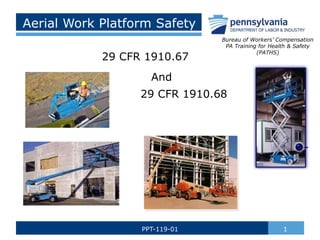
Aerial Work Platform Safety
1
PPT-119-01
Bureau of Workers’ Compensation
PA Training for Health & Safety
(PATHS)
29 CFR 1910.67
29 CFR 1910.68
And
Objectives
 Operator Training Requirements
 Before Operation Inspection
 Safety Operations of a Lift
 Aerial Lift Requirements
 Scissors Lift Requirements
 Maintenance Requirements
2
PPT-119-01
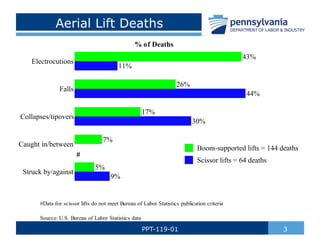
Aerial Lift Deaths
3
PPT-119-01
Struck by/against
Caught in/between
Collapses/tipovers
Falls
Electrocutions
9%
5%
7%
30%
17%
44%
26%
11%
43%
Scissor lifts = 64 deaths
Boom-supported lifts = 144 deaths
#Data for scissor lifts do not meet Bureau of Labor Statistics publication criteria
Source: U.S. Bureau of Labor Statistics data
% of Deaths
#
Aerial Lifts
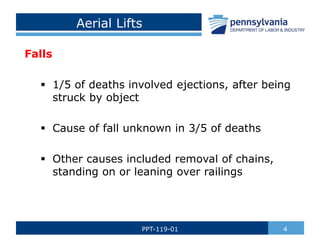
Falls
 1/5 of deaths involved ejections, after being
struck by object
 Cause of fall unknown in 3/5 of deaths
 Other causes included removal of chains,
standing on or leaning over railings
4
PPT-119-01
Aerial Lifts
Tip-overs
 Caused almost 1/3 of scissor lift deaths
 Mostly while elevated over 15 feet
 1/4 of tip-overs occurred where lift hit a hole
or curb while moving
Electrocutions
 1/2 involved overhead power lines
5
PPT-119-01
Operator Training
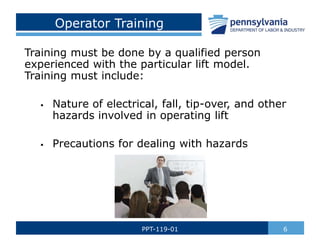
Training must be done by a qualified person
experienced with the particular lift model.
Training must include:
 Nature of electrical, fall, tip-over, and other
hazards involved in operating lift
 Precautions for dealing with hazards
6
PPT-119-01
Operator Training
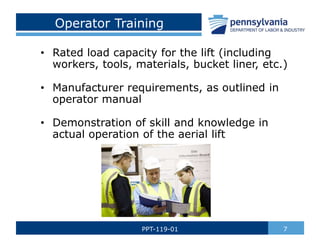
• Rated load capacity for the lift (including
workers, tools, materials, bucket liner, etc.)
• Manufacturer requirements, as outlined in
operator manual
• Demonstration of skill and knowledge in
actual operation of the aerial lift
7
PPT-119-01
Qualified Person
OSHA 1926.450(b)
A qualified person .…by extensive
knowledge, training, and experience
can….solve….problems related to the subject
matter….
8
PPT-119-01
Before Operating a Lift
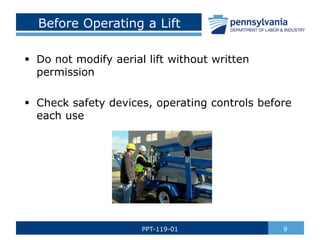
 Do not modify aerial lift without written
permission
 Check safety devices, operating controls before
each use
9
PPT-119-01
Before Operating a Lift
Check area in which aerial lift will be used for:
 Level surface (Do not exceed manufacturer
slope recommendations)
 Holes, drop-offs, bumps, debris, etc.
 Overhead obstructions and overhead power
lines
 Stable surface
 Other hazards
Set outriggers, brakes, wheel chocks
10
PPT-119-01
Aerial Lifts
 Do not raise platform on uneven or soft
surfaces
 Do not raise platform in windy or gusty
conditions
 Do not travel to job location with lift in elevated
position
 Do not use lift with railing removed
11
PPT-119-01
Aerial Lifts
 Do not stand on railing to reach work area
rather than repositioning the lift
 Do not use near power lines, junction boxes,
etc.
 Do not overload
 Do not use near moving vehicles
 Do not override safety devices
12
PPT-119-01
Aerial Lifts
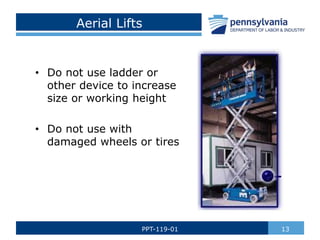
• Do not use ladder or
other device to increase
size or working height
• Do not use with
damaged wheels or tires
13
PPT-119-01
Aerial Lifts
Do List
 Read and understand ALL caution and danger
warnings and operating manuals
 Perform daily maintenance inspection
 Replace all worn or damaged parts
 Fasten entry gate/chin/bar
 Use work platform only on hard level surfaces
14
PPT-119-01
Aerial Lifts
Inspect the following daily:
 Operating and emergency controls
 Safety devices
 Personal protective devices
 Tires and wheels
 Air, hydraulic and fuel system for leaks
 Look for loose or missing parts
15
PPT-119-01
Aerial Lifts
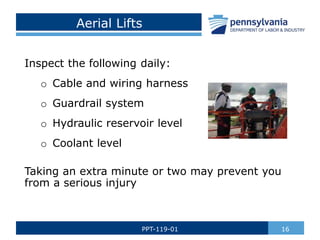
Inspect the following daily:
o Cable and wiring harness
o Guardrail system
o Hydraulic reservoir level
o Coolant level
Taking an extra minute or two may prevent you
from a serious injury
16
PPT-119-01
Fall Protection
 Scissors Lifts (Fall Protection)
Fall protection is not necessary or required
unless the railing has been removed.
 Articulating & telescoping boom lift.
Fall protection is required due to potential for
being bounced out of lift or from climbing out
basket.
17
PPT-119-01
Preventing Tip-Over
 Do not exceed manufacturer rated load
capacity limits
 Do not travel to job location with lift in elevated
position.
 Set up proper work zone protection when
working near traffic
 Avoid excessive horizontal
forces when working on
elevated scissor lifts
18
PPT-119-01
Preventing Tip-Over
Positioning of lifts
 Do not drive near drop-offs or holes.
 Do not raise platform on uneven or soft
surfaces.
 Do not drive onto uneven or soft surfaces
when elevated.
 Do not raise platform on slope or drive onto
slope when elevated.
 Do not raise platform in windy or gusty
conditions.
19
PPT-119-01
Aerial Baskets
Safe Setup
• Solid footing for wheels and outriggers is
crucial
• Wheels and outriggers blocked and/or cribbed
as necessary
• Awareness of and clearance from overhead
electrical hazards
• Warm-up period followed by safe test of
hydraulic system
20
PPT-119-01
Aerial Baskets
Safe Setup
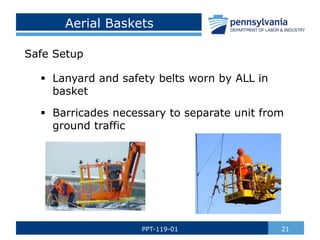
 Lanyard and safety belts worn by ALL in
basket
 Barricades necessary to separate unit from
ground traffic
21
PPT-119-01
Aerial Baskets
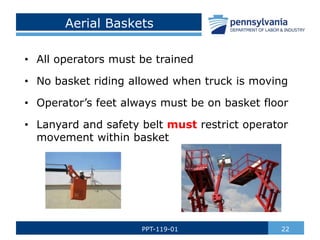
• All operators must be trained
• No basket riding allowed when truck is moving
• Operator’s feet always must be on basket floor
• Lanyard and safety belt must restrict operator
movement within basket
22
PPT-119-01
Aerial Baskets
• Load limits of boom & basket posted and never
exceeded
• Boom lowered and basket cradled before truck
movement
• No overreaching from basket
23
PPT-119-01
Fall Protection
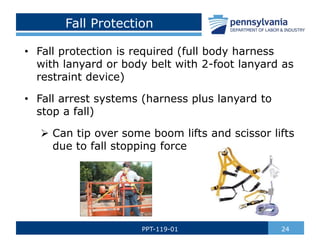
• Fall protection is required (full body harness
with lanyard or body belt with 2-foot lanyard as
restraint device)
• Fall arrest systems (harness plus lanyard to
stop a fall)
 Can tip over some boom lifts and scissor lifts
due to fall stopping force
24
PPT-119-01
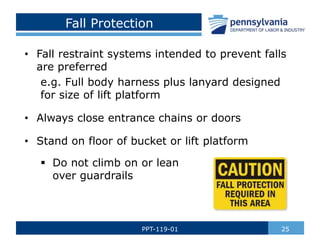
Fall Protection
• Fall restraint systems intended to prevent falls
are preferred
e.g. Full body harness plus lanyard designed
for size of lift platform
• Always close entrance chains or doors
• Stand on floor of bucket or lift platform
 Do not climb on or lean
over guardrails
25
PPT-119-01
Preventing Electrocutions
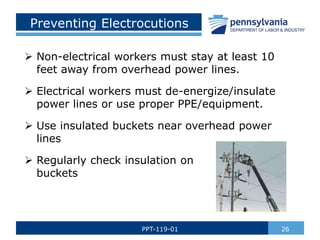
 Non-electrical workers must stay at least 10
feet away from overhead power lines.
 Electrical workers must de-energize/insulate
power lines or use proper PPE/equipment.
 Use insulated buckets near overhead power
lines
 Regularly check insulation on
buckets
26
PPT-119-01
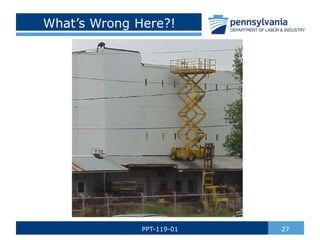
What’s Wrong Here?!
27
PPT-119-01
Contact Information
Health & Safety Training Specialists
1171 South Cameron Street, Room 324
Harrisburg, PA 17104-2501
(717) 772-1635
RA-LI-BWC-PATHS@pa.gov
28
PPT-119-01
Like us on Facebook! -
https://www.facebook.com/BWCPATHS
Questions
29
PPT-119-01

Aerial Work Platform Safety.pptx

  • 1.
    Aerial Work PlatformSafety 1 PPT-119-01 Bureau of Workers’ Compensation PA Training for Health & Safety (PATHS) 29 CFR 1910.67 29 CFR 1910.68 And
  • 2.
    Objectives  Operator TrainingRequirements  Before Operation Inspection  Safety Operations of a Lift  Aerial Lift Requirements  Scissors Lift Requirements  Maintenance Requirements 2 PPT-119-01
  • 3.
    Aerial Lift Deaths 3 PPT-119-01 Struckby/against Caught in/between Collapses/tipovers Falls Electrocutions 9% 5% 7% 30% 17% 44% 26% 11% 43% Scissor lifts = 64 deaths Boom-supported lifts = 144 deaths #Data for scissor lifts do not meet Bureau of Labor Statistics publication criteria Source: U.S. Bureau of Labor Statistics data % of Deaths #
  • 4.
    Aerial Lifts Falls  1/5of deaths involved ejections, after being struck by object  Cause of fall unknown in 3/5 of deaths  Other causes included removal of chains, standing on or leaning over railings 4 PPT-119-01
  • 5.
    Aerial Lifts Tip-overs  Causedalmost 1/3 of scissor lift deaths  Mostly while elevated over 15 feet  1/4 of tip-overs occurred where lift hit a hole or curb while moving Electrocutions  1/2 involved overhead power lines 5 PPT-119-01
  • 6.
    Operator Training Training mustbe done by a qualified person experienced with the particular lift model. Training must include:  Nature of electrical, fall, tip-over, and other hazards involved in operating lift  Precautions for dealing with hazards 6 PPT-119-01
  • 7.
    Operator Training • Ratedload capacity for the lift (including workers, tools, materials, bucket liner, etc.) • Manufacturer requirements, as outlined in operator manual • Demonstration of skill and knowledge in actual operation of the aerial lift 7 PPT-119-01
  • 8.
    Qualified Person OSHA 1926.450(b) Aqualified person .…by extensive knowledge, training, and experience can….solve….problems related to the subject matter…. 8 PPT-119-01
  • 9.
    Before Operating aLift  Do not modify aerial lift without written permission  Check safety devices, operating controls before each use 9 PPT-119-01
  • 10.
    Before Operating aLift Check area in which aerial lift will be used for:  Level surface (Do not exceed manufacturer slope recommendations)  Holes, drop-offs, bumps, debris, etc.  Overhead obstructions and overhead power lines  Stable surface  Other hazards Set outriggers, brakes, wheel chocks 10 PPT-119-01
  • 11.
    Aerial Lifts  Donot raise platform on uneven or soft surfaces  Do not raise platform in windy or gusty conditions  Do not travel to job location with lift in elevated position  Do not use lift with railing removed 11 PPT-119-01
  • 12.
    Aerial Lifts  Donot stand on railing to reach work area rather than repositioning the lift  Do not use near power lines, junction boxes, etc.  Do not overload  Do not use near moving vehicles  Do not override safety devices 12 PPT-119-01
  • 13.
    Aerial Lifts • Donot use ladder or other device to increase size or working height • Do not use with damaged wheels or tires 13 PPT-119-01
  • 14.
    Aerial Lifts Do List Read and understand ALL caution and danger warnings and operating manuals  Perform daily maintenance inspection  Replace all worn or damaged parts  Fasten entry gate/chin/bar  Use work platform only on hard level surfaces 14 PPT-119-01
  • 15.
    Aerial Lifts Inspect thefollowing daily:  Operating and emergency controls  Safety devices  Personal protective devices  Tires and wheels  Air, hydraulic and fuel system for leaks  Look for loose or missing parts 15 PPT-119-01
  • 16.
    Aerial Lifts Inspect thefollowing daily: o Cable and wiring harness o Guardrail system o Hydraulic reservoir level o Coolant level Taking an extra minute or two may prevent you from a serious injury 16 PPT-119-01
  • 17.
    Fall Protection  ScissorsLifts (Fall Protection) Fall protection is not necessary or required unless the railing has been removed.  Articulating & telescoping boom lift. Fall protection is required due to potential for being bounced out of lift or from climbing out basket. 17 PPT-119-01
  • 18.
    Preventing Tip-Over  Donot exceed manufacturer rated load capacity limits  Do not travel to job location with lift in elevated position.  Set up proper work zone protection when working near traffic  Avoid excessive horizontal forces when working on elevated scissor lifts 18 PPT-119-01
  • 19.
    Preventing Tip-Over Positioning oflifts  Do not drive near drop-offs or holes.  Do not raise platform on uneven or soft surfaces.  Do not drive onto uneven or soft surfaces when elevated.  Do not raise platform on slope or drive onto slope when elevated.  Do not raise platform in windy or gusty conditions. 19 PPT-119-01
  • 20.
    Aerial Baskets Safe Setup •Solid footing for wheels and outriggers is crucial • Wheels and outriggers blocked and/or cribbed as necessary • Awareness of and clearance from overhead electrical hazards • Warm-up period followed by safe test of hydraulic system 20 PPT-119-01
  • 21.
    Aerial Baskets Safe Setup Lanyard and safety belts worn by ALL in basket  Barricades necessary to separate unit from ground traffic 21 PPT-119-01
  • 22.
    Aerial Baskets • Alloperators must be trained • No basket riding allowed when truck is moving • Operator’s feet always must be on basket floor • Lanyard and safety belt must restrict operator movement within basket 22 PPT-119-01
  • 23.
    Aerial Baskets • Loadlimits of boom & basket posted and never exceeded • Boom lowered and basket cradled before truck movement • No overreaching from basket 23 PPT-119-01
  • 24.
    Fall Protection • Fallprotection is required (full body harness with lanyard or body belt with 2-foot lanyard as restraint device) • Fall arrest systems (harness plus lanyard to stop a fall)  Can tip over some boom lifts and scissor lifts due to fall stopping force 24 PPT-119-01
  • 25.
    Fall Protection • Fallrestraint systems intended to prevent falls are preferred e.g. Full body harness plus lanyard designed for size of lift platform • Always close entrance chains or doors • Stand on floor of bucket or lift platform  Do not climb on or lean over guardrails 25 PPT-119-01
  • 26.
    Preventing Electrocutions  Non-electricalworkers must stay at least 10 feet away from overhead power lines.  Electrical workers must de-energize/insulate power lines or use proper PPE/equipment.  Use insulated buckets near overhead power lines  Regularly check insulation on buckets 26 PPT-119-01
  • 27.
  • 28.
    Contact Information Health &Safety Training Specialists 1171 South Cameron Street, Room 324 Harrisburg, PA 17104-2501 (717) 772-1635 RA-LI-BWC-PATHS@pa.gov 28 PPT-119-01 Like us on Facebook! - https://www.facebook.com/BWCPATHS
  • 29.

Editor's Notes

  • #2 When work requires a person to ascend to heights, safety factors must be incorporated into the effort. The following OSHA regulations apply to this program: 29 CFR 1910.67, Vehicle-mounted elevating and rotating work platforms; 29 CFR 1910.68, Man lifts
  • #3 This program will address the following topics toward achieving safety during operations: Operator Training Requirements Before Operation Inspection Safety Operations of a Lift Aerial Lift Requirements Scissors Lift Requirements Maintenance Requirements
  • #4 This slide shows the fatality statistics for 1992 through 1999 compiled by the US Bureau of Labor Statistics.
  • #5 Falls 1/5 (20%) of deaths involved ejections after being struck by object Cause of fall unknown in 3/5 (60%) of deaths Other causes included removal of chains, standing on or leaning over railings
  • #6 Tip-overs Caused almost 1/3 of scissor lift deaths Mostly while elevated over 15 feet 1/4 (25%) of tip-overs occurred where the lift hit a hole or curb while moving Electrocutions 1/2 (50%) involved overhead power lines
  • #7 Training must be done by a qualified person experienced with the particular lift model. Training must include: Nature of electrical, fall, tip-over, and other hazards involved in operating a lift Precautions for dealing with hazards
  • #8 Operator training will also include: Rated load capacity for the lift (including workers, tools, materials, bucket liner, etc.) Manufacturer requirements, as outlined in the operator manual Demonstration of skill and knowledge in actual operation of the aerial lift
  • #9 OSHA discusses a “Qualified Person” and the requisite abilities. According to OSHA 1926.450(b) Qualified, “means one who, by possession of a recognized degree, certificate, or professional standing, or who by extensive knowledge, training, and experience, has successfully demonstrated his/her ability to solve or resolve problems related to the subject matter, the work, or the project.”
  • #10 Before operating a lift: Do not modify the aerial lift without written permission Check safety devices and operating controls before each use
  • #11 Before operation, Check area in which aerial lift will be used for: Level surface (Do not exceed manufacturer slope recommendations) Holes, drop-offs, bumps, debris, etc. Overhead obstructions and overhead power lines Stable surface Other hazards Set outriggers, brakes, wheel chocks
  • #12 Precautions for aerial lift operation also consider, Do not raise platform on uneven or soft surfaces Do not raise platform in windy or gusty conditions Do not travel to job location with lift in elevated position Do not use lift with railing removed
  • #13 Aerial lift safety considerations: Do not stand on railing to reach work area rather than repositioning the lift Do not use near power lines, junction boxes, etc. Do not overload Do not use near moving vehicles Do not override safety devices
  • #14 Additional precautions. Do not use ladder or other device to increase size or working height Do not use with damaged wheels or tires
  • #15 Those things which should be accomplished regarding aerial lifts, Do List Read and understand ALL caution and danger warnings and operating manuals Perform daily maintenance inspection Replace all worn or damaged parts Fasten entry gate/chin/bar Use work platform only on hard level surfaces
  • #16 Aerial lifts require daily inspection for safety and serviceability. Inspect the following daily: Operating and emergency controls Safety devices Personal protective devices Tires and wheels Air, hydraulic and fuel system for leaks Look for loose or missing parts
  • #17 Inspect the following daily: Cable and wiring harness Guardrail system Hydraulic reservoir level Coolant level Taking an extra minute or two may prevent you from a serious injury
  • #18 Due to being at elevated heights, fall protection is required when operating lift equipment. Scissors Lifts (Fall Protection) Fall protection is not necessary or required unless the tailing has been removed. Articulating & telescoping boom lift. Fall protection is required due to potential for being bounced out of lift or from climbing out basket.
  • #19 Tip-overs lead to injuries and death. Preventive measures concerning tip-overs include: Do not exceed manufacturer rated load capacity limits Do not travel to job location with lift in elevated position. Set up proper work zone protection when working near traffic Avoid excessive horizontal forces when working on elevated scissor lifts
  • #20 One method to prevent tip-over is the positioning of the lift. Do not drive near drop-offs or holes. Do not raise platform on uneven or soft surfaces. Do not drive onto uneven or soft surfaces when elevated. Do not raise platform on slope or drive onto slope when elevated. Do not raise platform in windy or gusty conditions.
  • #21 Aerial baskets also require a safe setup. Solid footing for wheels and outriggers is crucial Wheels and outriggers blocked and/or cribbed as necessary Awareness of and clearance from overhead electrical hazards Warm-up period followed by safe test of hydraulic system
  • #22 Also during an aerial basket’s safe setup, Lanyard and safety belts worn by ALL in basket Barricades necessary to separate unit from ground traffic
  • #23 Aerial basket safety also includes provisions for the following: All operators must be trained No basket riding allowed when truck is moving Operator’s feet always must be on basket floor Lanyard and safety belt must restrict operator movement within basket
  • #24 Ensure with aerial baskets, Load limits of boom & basket posted and never exceeded Boom lowered and basket cradled before truck movement No overreaching from basket
  • #25 An indicated, when working at elevated heights, fall protection is a must. Fall protection is required (full body harness with lanyard or body belt with 2-foot lanyard as restraint device) Fall arrest systems (harness plus lanyard to stop a fall) Can tip over some boom lifts and scissor lifts due to fall stopping force
  • #26 Fall restraint systems intended to prevent falls are preferred e.g. Full body harness plus lanyard designed for size of lift platform Always close entrance chains or doors Stand on floor of bucket or lift platform Do not climb on or lean over guardrails
  • #27 Electricity is another hazard commonly encountered by aerial and lift truck operations. Electrocution can be prevented. Non-electrical workers must stay at least 10 feet away from overhead power lines. Electrical workers must de-energize/insulate power lines or use proper PPE/equipment. Use insulated buckets near overhead power lines Regularly check insulation on buckets More information can be found in 29 CFR 1910.333(c)(3)(iii).
  • #28 Misuse, to the extreme, of aerial lift trucks; scissors and forklift.
  • #29 Please contact us for other available free training for your organization.