Faculty and Student Experiences
with Online Mentoring
Swapna Kumar & Catherine Coe
AERA 2015
4/19/15Swapna Kumar
Ed.D. Program Context
4/19/15Swapna Kumar
Dissertation
•  Problem of practice
•  Five chapters
•  Rigor
•  Advances practice, initiates change and impacts
educational environment
Ed.D. Program Context
•  Professionals in K-12 (traditional/virtual), post-
secondary, corporate, and other educational settings.
•  Geographically dispersed
•  Cohort model – Peer Support
•  Inquiry groups
4/19/15Swapna Kumar
Online Mentoring
•  Online Mentoring
•  Medical Education
•  Business
•  Mentoring relationships between student and graduate advisor
(Lee, 2008; Maher, Ford, & Thompson, 2004)
•  Educational development, professional development and
psychosocial development (Hayes & Koro-Ljungberg, 2011)
4/19/15Swapna Kumar
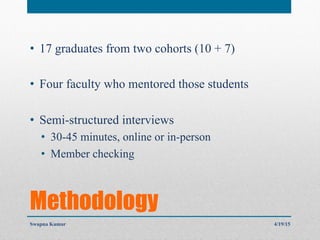
Methodology
•  17 graduates from two cohorts (10 + 7)
•  Four faculty who mentored those students
•  Semi-structured interviews
•  30-45 minutes, online or in-person
•  Member checking
4/19/15Swapna Kumar
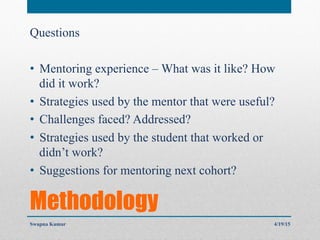
Methodology
Questions
•  Mentoring experience – What was it like? How
did it work?
•  Strategies used by the mentor that were useful?
•  Challenges faced? Addressed?
•  Strategies used by the student that worked or
didn’t work?
•  Suggestions for mentoring next cohort?
4/19/15Swapna Kumar
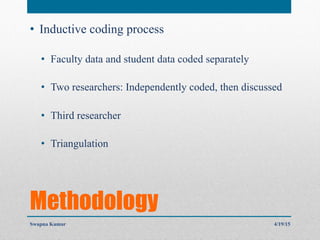
•  Inductive coding process
•  Faculty data and student data coded separately
•  Two researchers: Independently coded, then discussed
•  Third researcher
•  Triangulation
Methodology
4/19/15Swapna Kumar
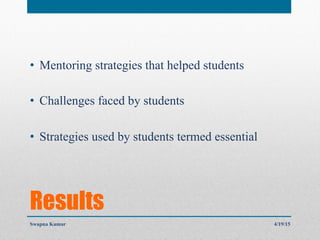
Results
•  Mentoring strategies that helped students
•  Challenges faced by students
•  Strategies used by students termed essential
4/19/15Swapna Kumar
Results
Strategies used by mentors that helped students
•  Choice of communication channels
•  Timely feedback and timelines
•  Types of feedback = specific / candid feedback
4/19/15Swapna Kumar
Results
Strategies used by mentors that helped students
•  Structure
•  Small group mentoring
•  Structured peer interaction
4/19/15Swapna Kumar
Results
Challenges faced by students
•  Time management, work-life balance, motivation
to continue writing
•  Research implementation
•  Handling / acting on feedback
4/19/15Swapna Kumar
Results
Challenges faced by mentors
•  Workload – multiple mentees
•  Giving feedback online
•  PhD vs. EdD dissertations
4/19/15Swapna Kumar
Results
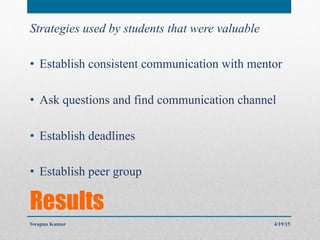
Strategies used by students that were valuable
•  Establish consistent communication with mentor
•  Ask questions and find communication channel
•  Establish deadlines
•  Establish peer group
4/19/15Swapna Kumar
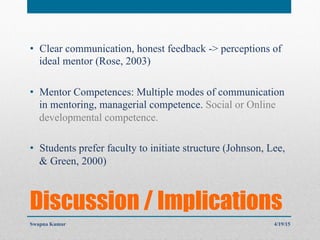
Discussion / Implications
•  Clear communication, honest feedback -> perceptions of
ideal mentor (Rose, 2003)
•  Mentor Competences: Multiple modes of communication
in mentoring, managerial competence. Social or Online
developmental competence.
•  Students prefer faculty to initiate structure (Johnson, Lee,
& Green, 2000)
4/19/15Swapna Kumar
Discussion / Implications
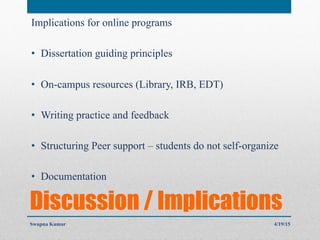
Implications for online programs
•  Dissertation guiding principles
•  On-campus resources (Library, IRB, EDT)
•  Writing practice and feedback
•  Structuring Peer support – students do not self-organize
•  Documentation
4/19/15Swapna Kumar
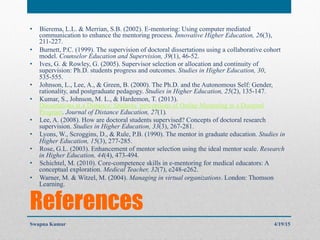
References
•  Bierema, L.L. & Merrian, S.B. (2002). E-mentoring: Using computer mediated
communication to enhance the mentoring process. Innovative Higher Education, 26(3),
211-227.
•  Burnett, P.C. (1999). The supervision of doctoral dissertations using a collaborative cohort
model. Counselor Education and Supervision, 39(1), 46-52.
•  Ives, G. & Rowley, G. (2005). Supervisor selection or allocation and continuity of
supervision: Ph.D. students progress and outcomes. Studies in Higher Education, 30,
535-555.
•  Johnson, L., Lee, A., & Green, B. (2000). The Ph.D. and the Autonomous Self: Gender,
rationality, and postgraduate pedagogy. Studies in Higher Education, 25(2), 135-147.
•  Kumar, S., Johnson, M. L., & Hardemon, T. (2013).
Dissertations at a Distance: Students’ perceptions of Online Mentoring in a Doctoral
Program. Journal of Distance Education, 27(1).
•  Lee, A. (2008). How are doctoral students supervised? Concepts of doctoral research
supervision. Studies in Higher Education, 33(3), 267-281.
•  Lyons, W., Scroggins, D., & Rule, P.B. (1990). The mentor in graduate education. Studies in
Higher Education, 15(3), 277-285.
•  Rose, G.L. (2003). Enhancement of mentor selection using the ideal mentor scale. Research
in Higher Education, 44(4), 473-494.
•  Schichtel, M. (2010). Core-competence skills in e-mentoring for medical educators: A
conceptual exploration. Medical Teacher, 32(7), e248-e262.
•  Warner, M. & Witzel, M. (2004). Managing in virtual organizations. London: Thomson
Learning.
4/19/15Swapna Kumar

Aera online mentorings

  • 1.
    Faculty and StudentExperiences with Online Mentoring Swapna Kumar & Catherine Coe AERA 2015 4/19/15Swapna Kumar
  • 2.
    Ed.D. Program Context 4/19/15SwapnaKumar Dissertation •  Problem of practice •  Five chapters •  Rigor •  Advances practice, initiates change and impacts educational environment
  • 3.
    Ed.D. Program Context • Professionals in K-12 (traditional/virtual), post- secondary, corporate, and other educational settings. •  Geographically dispersed •  Cohort model – Peer Support •  Inquiry groups 4/19/15Swapna Kumar
  • 4.
    Online Mentoring •  OnlineMentoring •  Medical Education •  Business •  Mentoring relationships between student and graduate advisor (Lee, 2008; Maher, Ford, & Thompson, 2004) •  Educational development, professional development and psychosocial development (Hayes & Koro-Ljungberg, 2011) 4/19/15Swapna Kumar
  • 5.
    Methodology •  17 graduatesfrom two cohorts (10 + 7) •  Four faculty who mentored those students •  Semi-structured interviews •  30-45 minutes, online or in-person •  Member checking 4/19/15Swapna Kumar
  • 6.
    Methodology Questions •  Mentoring experience– What was it like? How did it work? •  Strategies used by the mentor that were useful? •  Challenges faced? Addressed? •  Strategies used by the student that worked or didn’t work? •  Suggestions for mentoring next cohort? 4/19/15Swapna Kumar
  • 7.
    •  Inductive codingprocess •  Faculty data and student data coded separately •  Two researchers: Independently coded, then discussed •  Third researcher •  Triangulation Methodology 4/19/15Swapna Kumar
  • 8.
    Results •  Mentoring strategiesthat helped students •  Challenges faced by students •  Strategies used by students termed essential 4/19/15Swapna Kumar
  • 9.
    Results Strategies used bymentors that helped students •  Choice of communication channels •  Timely feedback and timelines •  Types of feedback = specific / candid feedback 4/19/15Swapna Kumar
  • 10.
    Results Strategies used bymentors that helped students •  Structure •  Small group mentoring •  Structured peer interaction 4/19/15Swapna Kumar
  • 11.
    Results Challenges faced bystudents •  Time management, work-life balance, motivation to continue writing •  Research implementation •  Handling / acting on feedback 4/19/15Swapna Kumar
  • 12.
    Results Challenges faced bymentors •  Workload – multiple mentees •  Giving feedback online •  PhD vs. EdD dissertations 4/19/15Swapna Kumar
  • 13.
    Results Strategies used bystudents that were valuable •  Establish consistent communication with mentor •  Ask questions and find communication channel •  Establish deadlines •  Establish peer group 4/19/15Swapna Kumar
  • 14.
    Discussion / Implications • Clear communication, honest feedback -> perceptions of ideal mentor (Rose, 2003) •  Mentor Competences: Multiple modes of communication in mentoring, managerial competence. Social or Online developmental competence. •  Students prefer faculty to initiate structure (Johnson, Lee, & Green, 2000) 4/19/15Swapna Kumar
  • 15.
    Discussion / Implications Implicationsfor online programs •  Dissertation guiding principles •  On-campus resources (Library, IRB, EDT) •  Writing practice and feedback •  Structuring Peer support – students do not self-organize •  Documentation 4/19/15Swapna Kumar
  • 16.
    References •  Bierema, L.L.& Merrian, S.B. (2002). E-mentoring: Using computer mediated communication to enhance the mentoring process. Innovative Higher Education, 26(3), 211-227. •  Burnett, P.C. (1999). The supervision of doctoral dissertations using a collaborative cohort model. Counselor Education and Supervision, 39(1), 46-52. •  Ives, G. & Rowley, G. (2005). Supervisor selection or allocation and continuity of supervision: Ph.D. students progress and outcomes. Studies in Higher Education, 30, 535-555. •  Johnson, L., Lee, A., & Green, B. (2000). The Ph.D. and the Autonomous Self: Gender, rationality, and postgraduate pedagogy. Studies in Higher Education, 25(2), 135-147. •  Kumar, S., Johnson, M. L., & Hardemon, T. (2013). Dissertations at a Distance: Students’ perceptions of Online Mentoring in a Doctoral Program. Journal of Distance Education, 27(1). •  Lee, A. (2008). How are doctoral students supervised? Concepts of doctoral research supervision. Studies in Higher Education, 33(3), 267-281. •  Lyons, W., Scroggins, D., & Rule, P.B. (1990). The mentor in graduate education. Studies in Higher Education, 15(3), 277-285. •  Rose, G.L. (2003). Enhancement of mentor selection using the ideal mentor scale. Research in Higher Education, 44(4), 473-494. •  Schichtel, M. (2010). Core-competence skills in e-mentoring for medical educators: A conceptual exploration. Medical Teacher, 32(7), e248-e262. •  Warner, M. & Witzel, M. (2004). Managing in virtual organizations. London: Thomson Learning. 4/19/15Swapna Kumar