How to develop your own
advocacy strategy
A step by step guide
Four foundations for delivering successful
advocacy
1. Do your research and gather your evidence
2. Understand the agenda from community to
global levels
3. Establish strong partnerships and alliances
4. Set clear timeframes
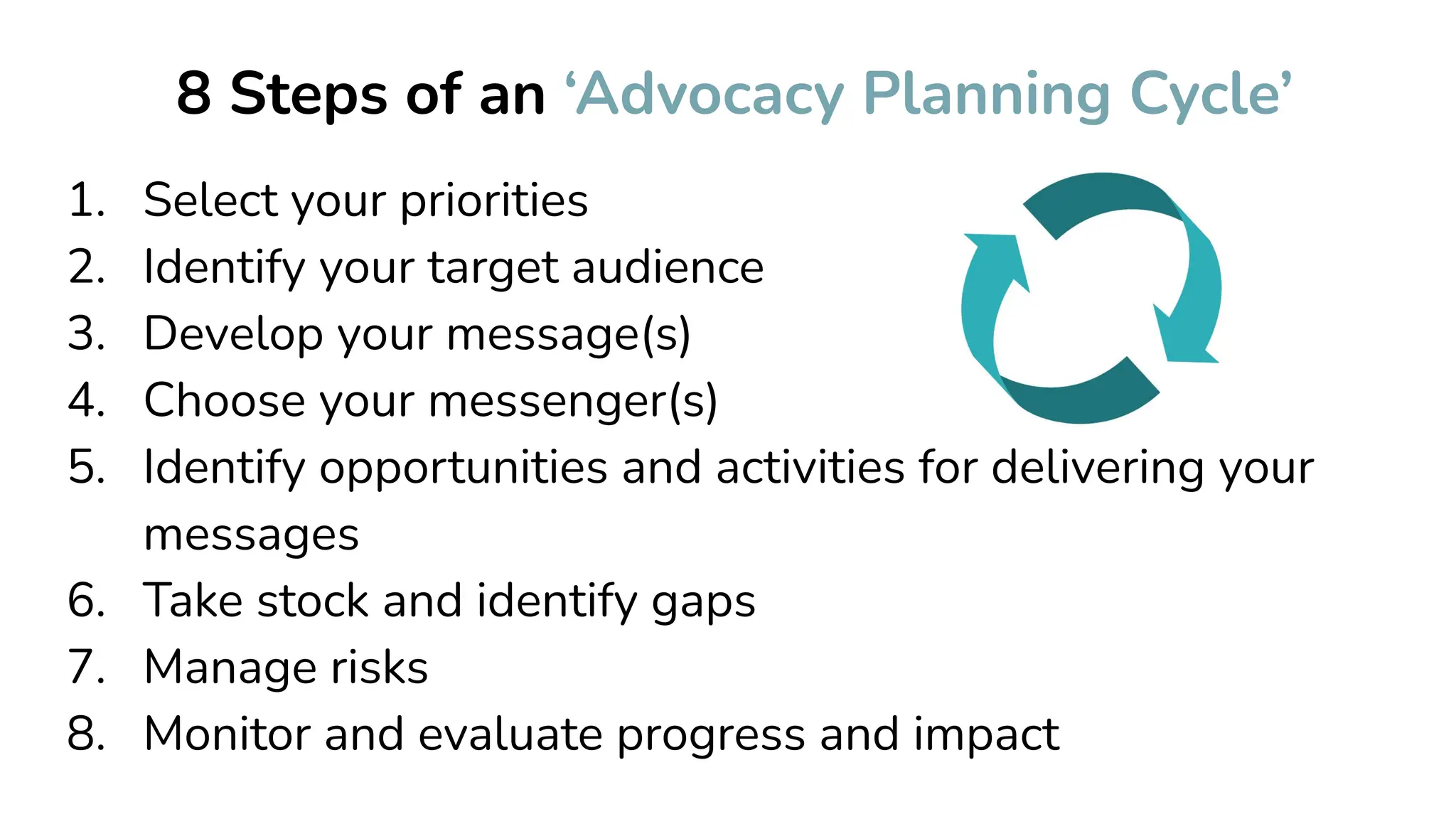
8 Steps of an ‘Advocacy Planning Cycle’
1. Select your priorities
2. Identify your target audience
3. Develop your message(s)
4. Choose your messenger(s)
5. Identify opportunities and activities for delivering your
messages
6. Take stock and identify gaps
7. Manage risks
8. Monitor and evaluate progress and impact
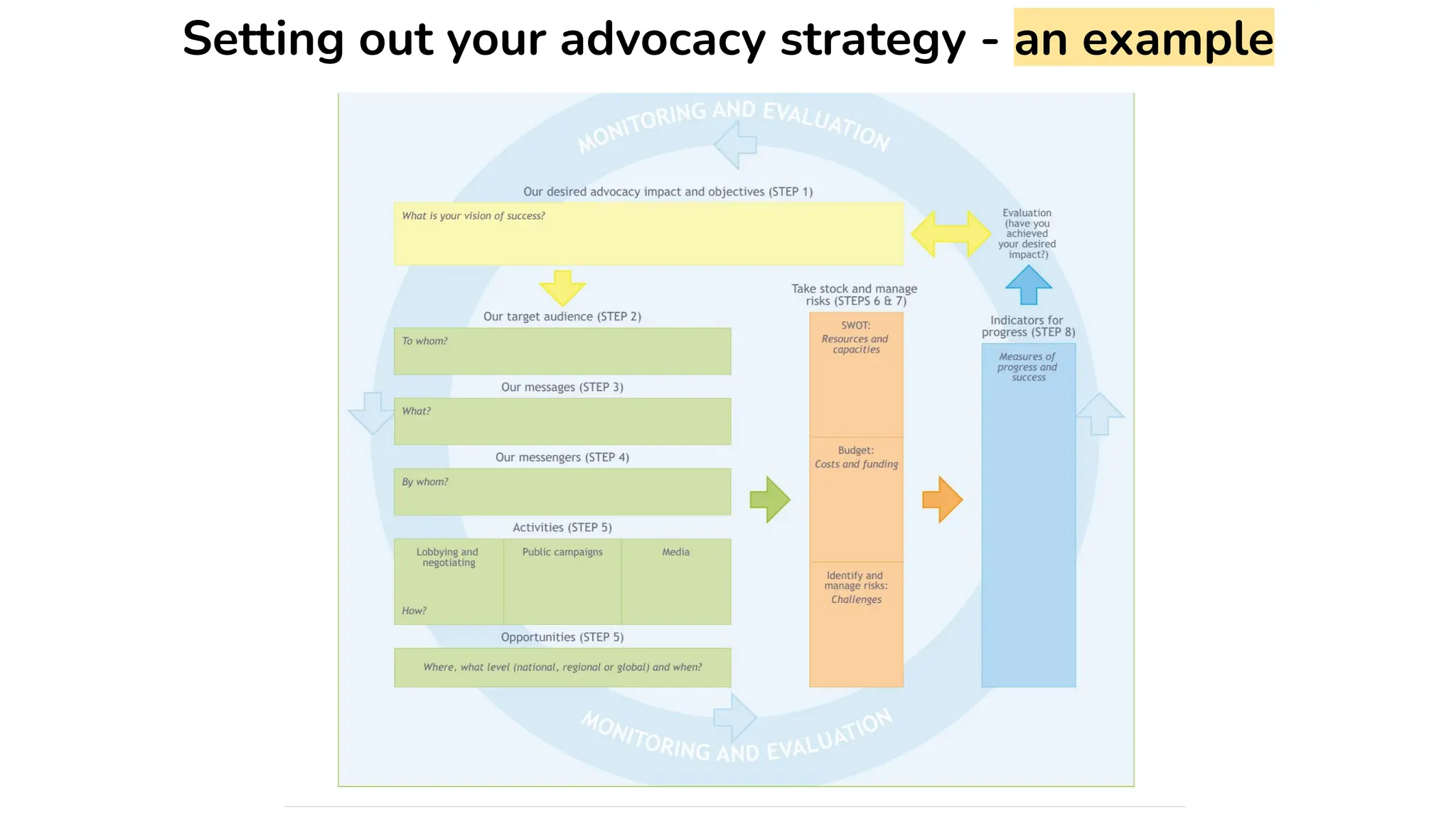
Setting out your advocacy strategy - an example
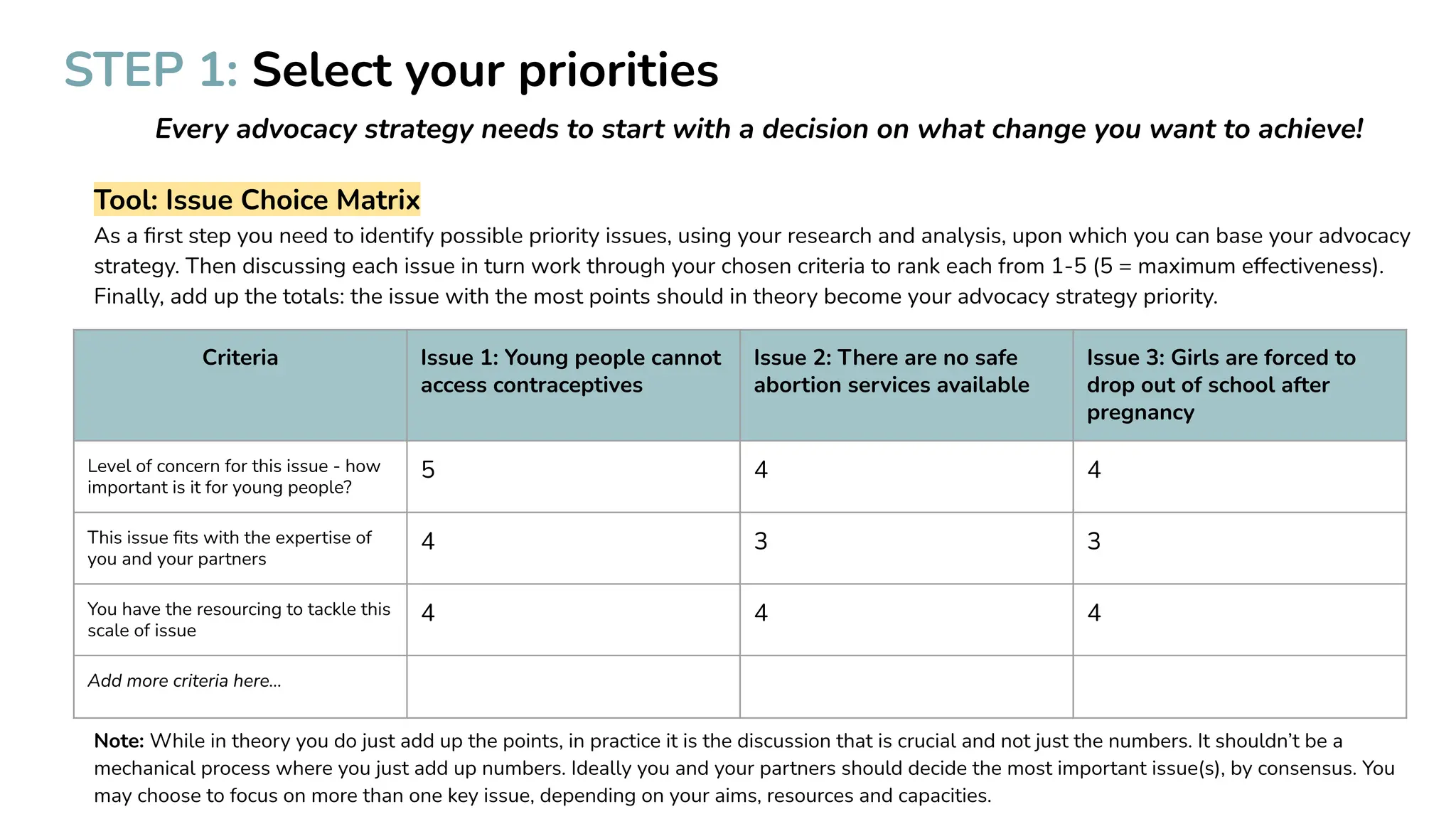
STEP 1: Select your priorities
Every advocacy strategy needs to start with a decision on what change you want to achieve!
Tool: Issue Choice Matrix
As a first step you need to identify possible priority issues, using your research and analysis, upon which you can base your advocacy
strategy. Then discussing each issue in turn work through your chosen criteria to rank each from 1-5 (5 = maximum effectiveness).
Finally, add up the totals: the issue with the most points should in theory become your advocacy strategy priority.
Note: While in theory you do just add up the points, in practice it is the discussion that is crucial and not just the numbers. It shouldn’t be a
mechanical process where you just add up numbers. Ideally you and your partners should decide the most important issue(s), by consensus. You
may choose to focus on more than one key issue, depending on your aims, resources and capacities.
Criteria Issue 1: Young people cannot
access contraceptives
Issue 2: There are no safe
abortion services available
Issue 3: Girls are forced to
drop out of school after
pregnancy
Level of concern for this issue - how
important is it for young people?
5 4 4
This issue fits with the expertise of
you and your partners
4 3 3
You have the resourcing to tackle this
scale of issue
4 4 4
Add more criteria here...
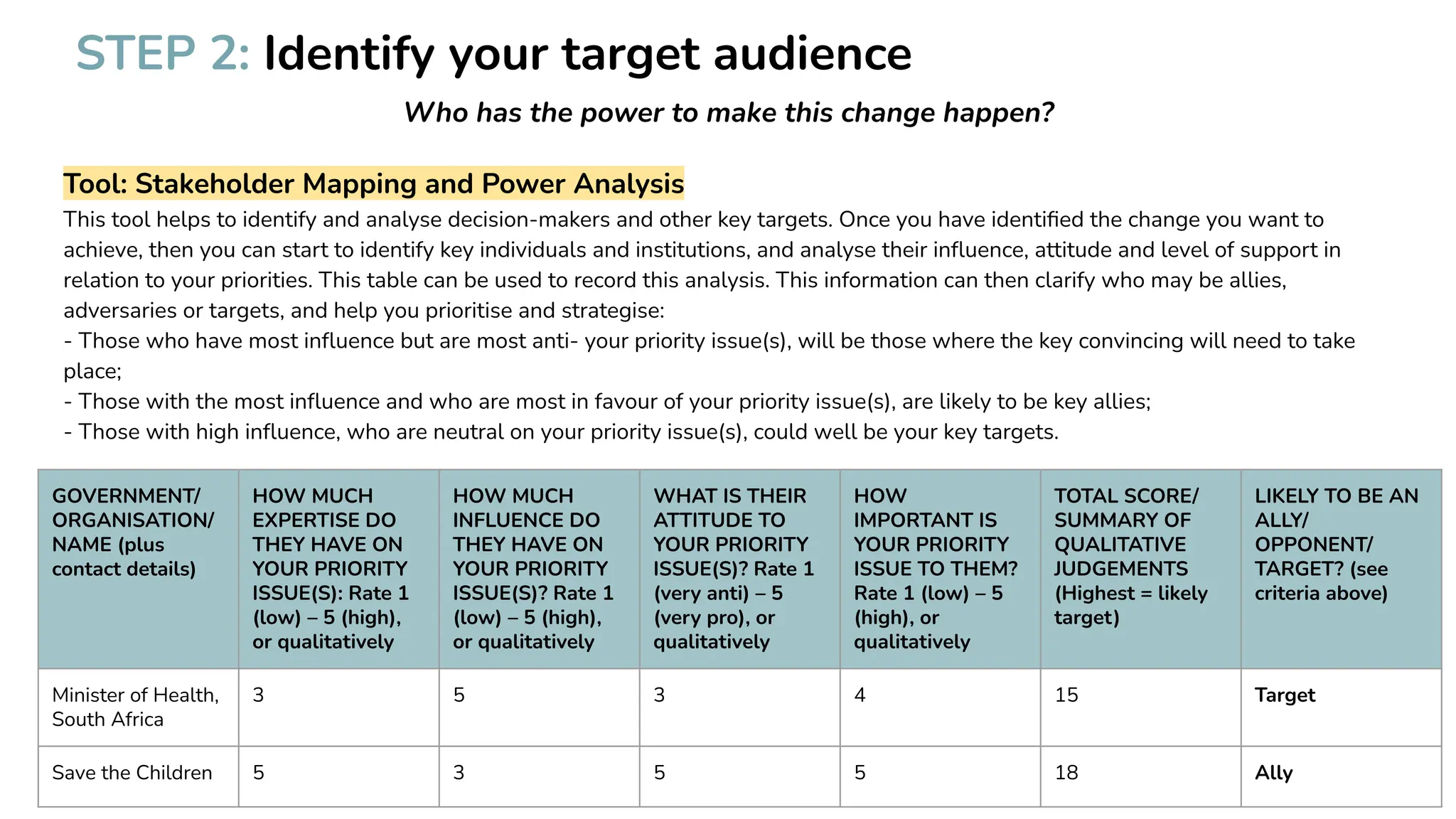
STEP 2: Identify your target audience
Who has the power to make this change happen?
Tool: Stakeholder Mapping and Power Analysis
This tool helps to identify and analyse decision-makers and other key targets. Once you have identified the change you want to
achieve, then you can start to identify key individuals and institutions, and analyse their influence, attitude and level of support in
relation to your priorities. This table can be used to record this analysis. This information can then clarify who may be allies,
adversaries or targets, and help you prioritise and strategise:
- Those who have most influence but are most anti- your priority issue(s), will be those where the key convincing will need to take
place;
- Those with the most influence and who are most in favour of your priority issue(s), are likely to be key allies;
- Those with high influence, who are neutral on your priority issue(s), could well be your key targets.
GOVERNMENT/
ORGANISATION/
NAME (plus
contact details)
HOW MUCH
EXPERTISE DO
THEY HAVE ON
YOUR PRIORITY
ISSUE(S): Rate 1
(low) – 5 (high),
or qualitatively
HOW MUCH
INFLUENCE DO
THEY HAVE ON
YOUR PRIORITY
ISSUE(S)? Rate 1
(low) – 5 (high),
or qualitatively
WHAT IS THEIR
ATTITUDE TO
YOUR PRIORITY
ISSUE(S)? Rate 1
(very anti) – 5
(very pro), or
qualitatively
HOW
IMPORTANT IS
YOUR PRIORITY
ISSUE TO THEM?
Rate 1 (low) – 5
(high), or
qualitatively
TOTAL SCORE/
SUMMARY OF
QUALITATIVE
JUDGEMENTS
(Highest = likely
target)
LIKELY TO BE AN
ALLY/
OPPONENT/
TARGET? (see
criteria above)
Minister of Health,
South Africa
3 5 3 4 15 Target
Save the Children 5 3 5 5 18 Ally
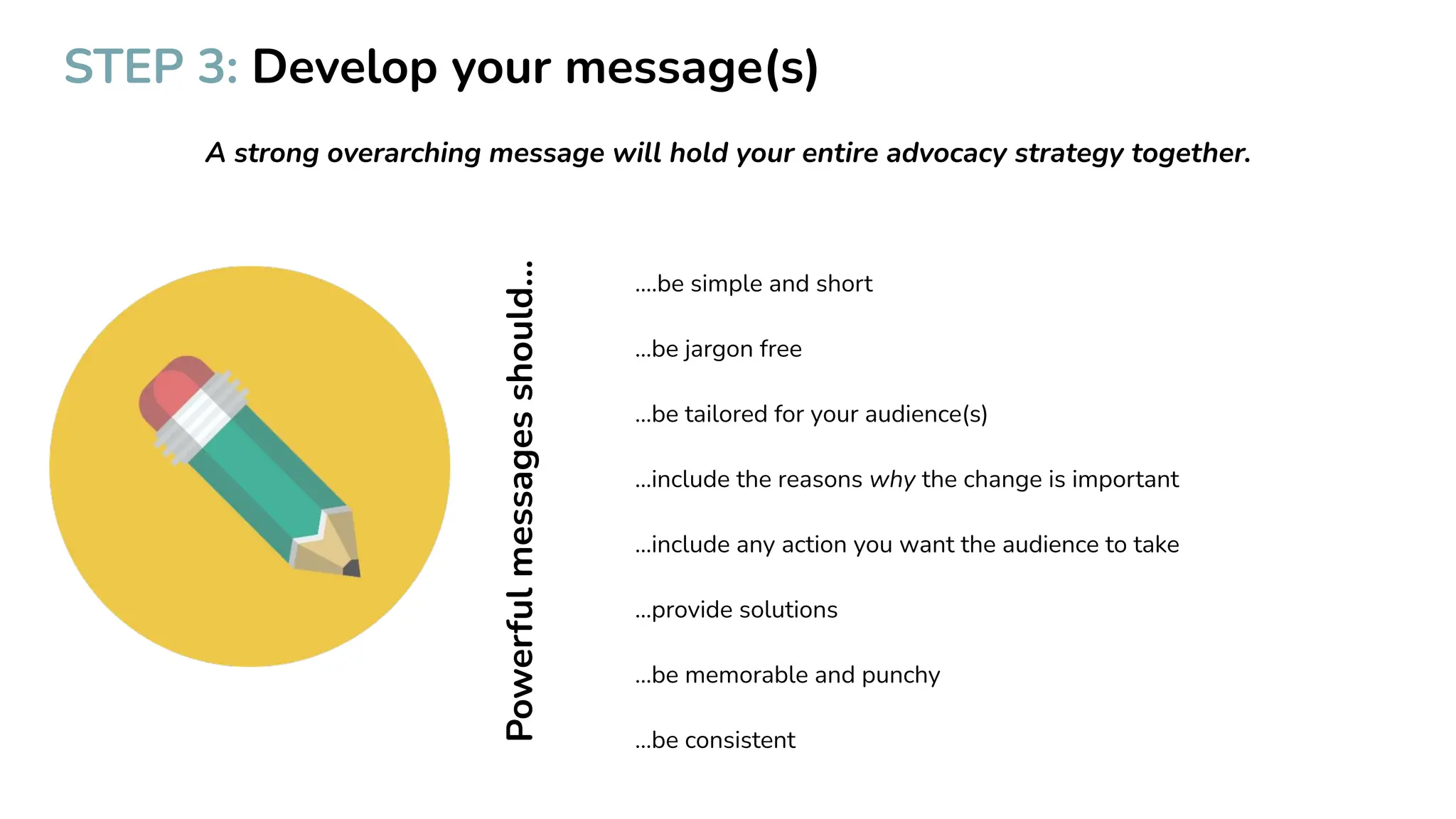
STEP 3: Develop your message(s)
A strong overarching message will hold your entire advocacy strategy together.
....be simple and short
...be jargon free
...be tailored for your audience(s)
...include the reasons why the change is important
...include any action you want the audience to take
...provide solutions
...be memorable and punchy
...be consistent
Powerful
messages
should...
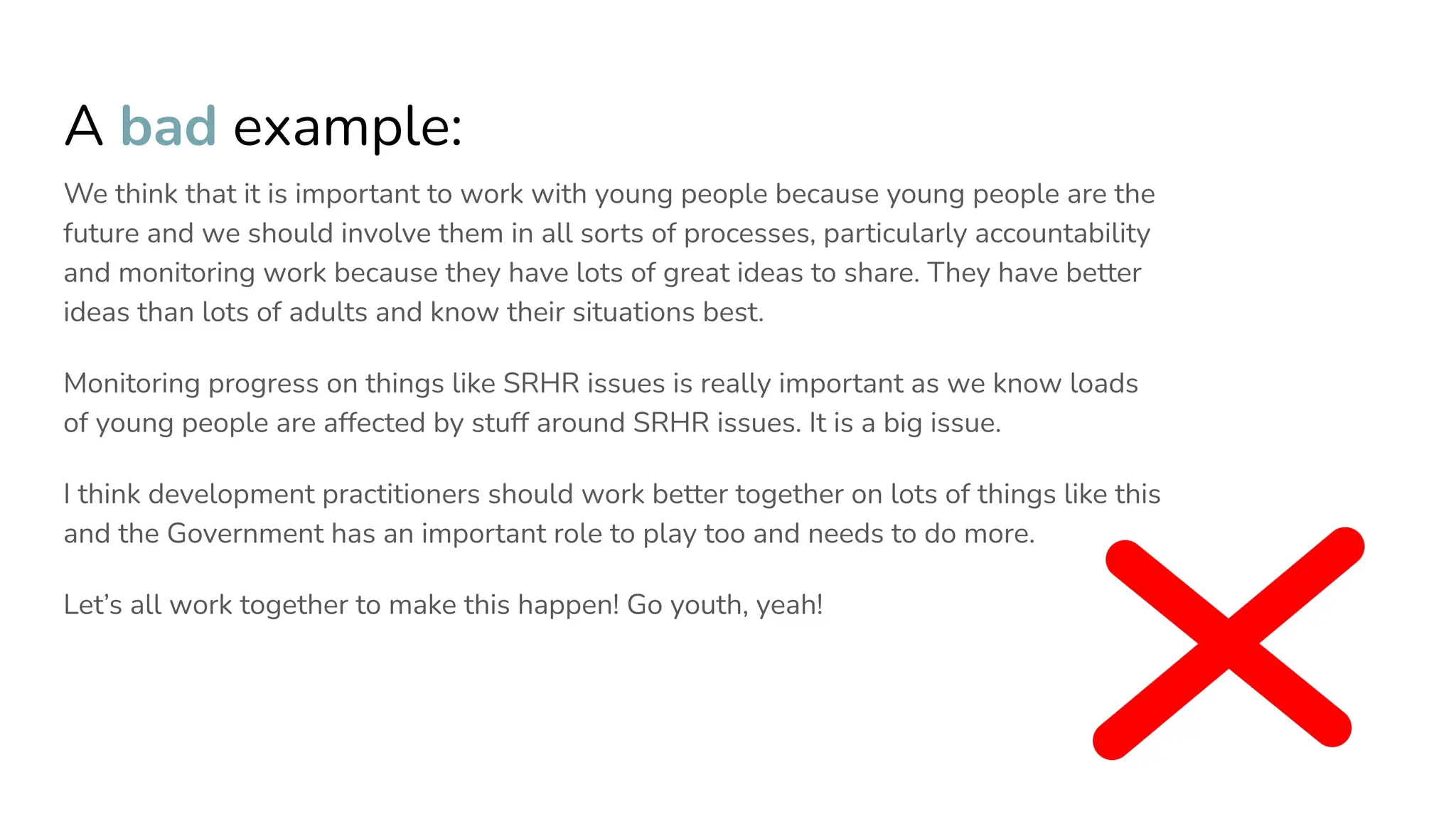
A bad example:
We think that it is important to work with young people because young people are the
future and we should involve them in all sorts of processes, particularly accountability
and monitoring work because they have lots of great ideas to share. They have better
ideas than lots of adults and know their situations best.
Monitoring progress on things like SRHR issues is really important as we know loads
of young people are affected by stuff around SRHR issues. It is a big issue.
I think development practitioners should work better together on lots of things like this
and the Government has an important role to play too and needs to do more.
Let’s all work together to make this happen! Go youth, yeah!
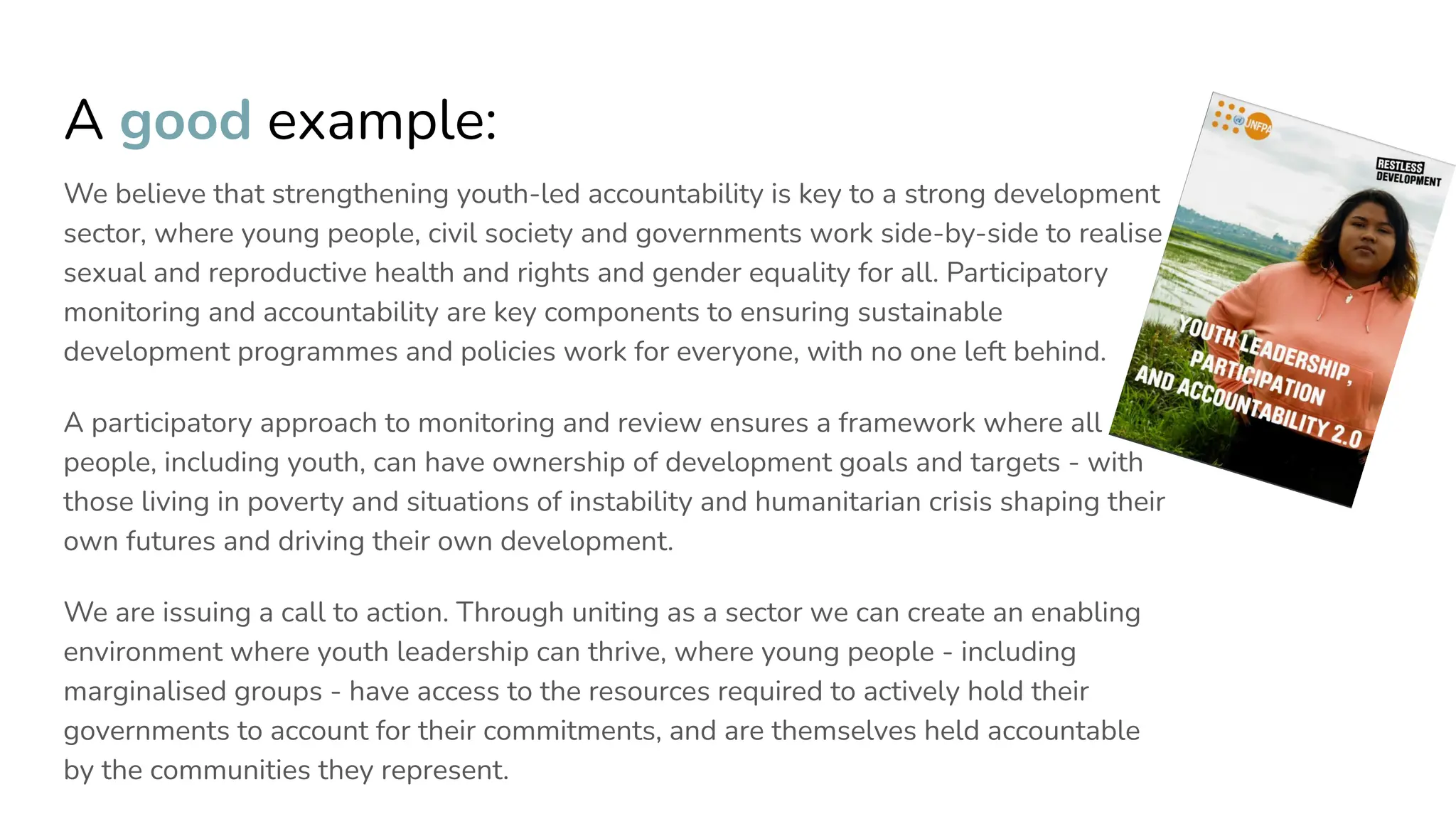
A good example:
We believe that strengthening youth-led accountability is key to a strong development
sector, where young people, civil society and governments work side-by-side to realise
sexual and reproductive health and rights and gender equality for all. Participatory
monitoring and accountability are key components to ensuring sustainable
development programmes and policies work for everyone, with no one left behind.
A participatory approach to monitoring and review ensures a framework where all
people, including youth, can have ownership of development goals and targets - with
those living in poverty and situations of instability and humanitarian crisis shaping their
own futures and driving their own development.
We are issuing a call to action. Through uniting as a sector we can create an enabling
environment where youth leadership can thrive, where young people - including
marginalised groups - have access to the resources required to actively hold their
governments to account for their commitments, and are themselves held accountable
by the communities they represent.
STEP 4: Choose your messenger(s)
Your message can have a very different impact, depending on who is delivering it!
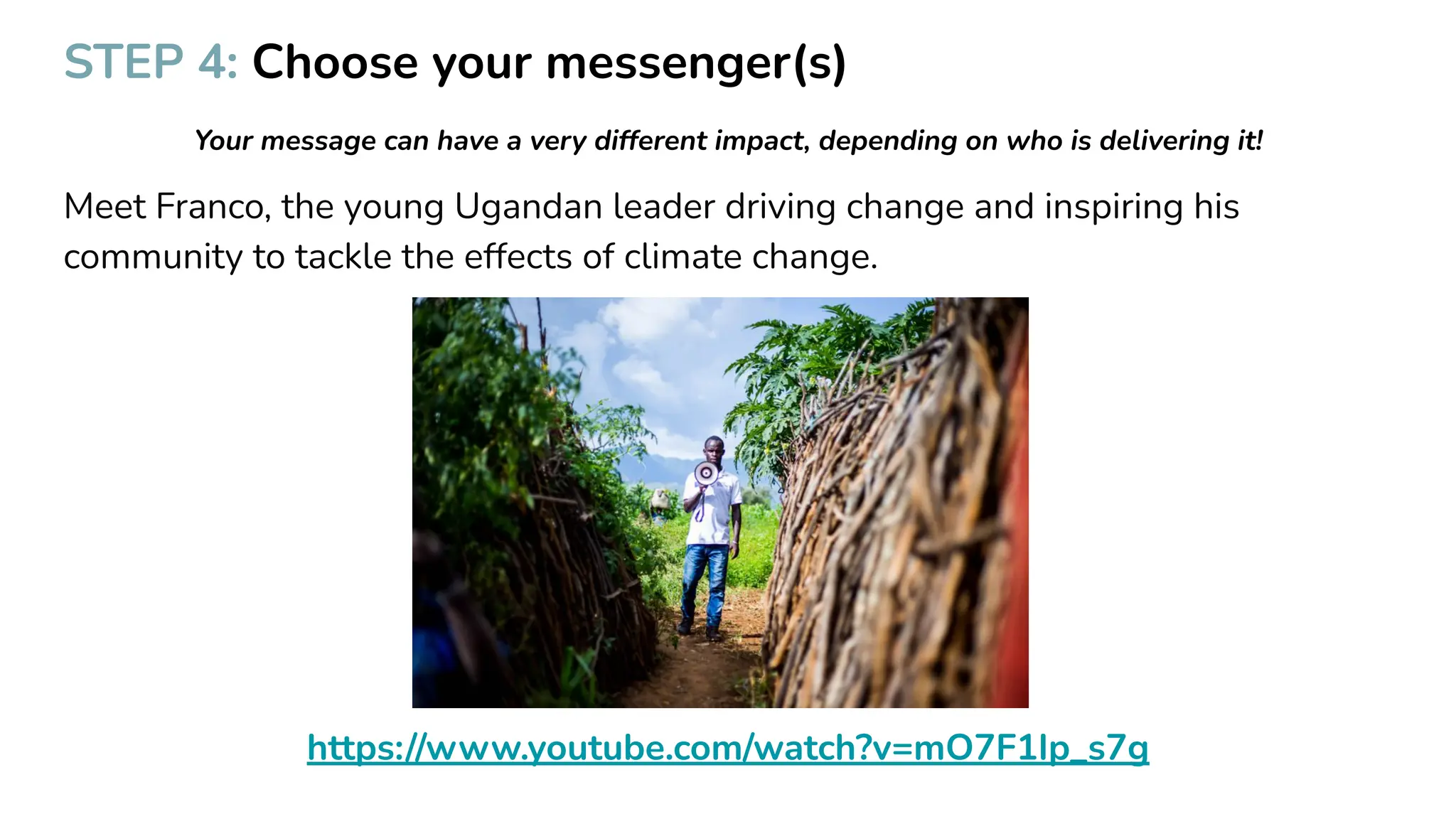
Meet Franco, the young Ugandan leader driving change and inspiring his
community to tackle the effects of climate change.
https://www.youtube.com/watch?v=mO7F1Ip_s7g
STEP 5: Identify opportunities and activities for delivering
your messages
It is important to think about different approaches to your advocacy.
INSIDER Advocacy
+
OUTSIDER Advocacy
Connect influencers
Consider your context and be creative
Ensure representation
Connect recommendations at national,
regional and global levels
Secure support
Report your evidence
Media and social
m
Insider + Outsider tactics and tips for sharing your
messages
Tool: Keep a ‘Lobby Log’
The Lobby Log is a useful tool to help you keep track of who you meet, their contact details, the outcome of the meeting
and any follow up that is needed.
When working in coalition or partnership the Lobby Log can also be used to share information on the advocacy efforts
that have been undertaken by individual members – to ensure that members are updated on the latest developments, that
new contacts are shared, and that members are able to continue/follow up on discussions initiated by others within the
coalition or partnership. The Log should be completed after each meeting and be as comprehensive as possible.
NAME AND POSITION
OF REPRESENTATIVE
PLACE AND DATE OF
MEETING
WHAT WAS DISCUSSED FOLLOW UP/ ACTION POINTS CONTACT
DETAILS
[Name, position]:
Ministry of Health,
[Country]
Wednesday 27 March
at Ministry of Health
Office, Rm 302
• Is supportive of the work of the
coalition and welcomes inputs • Agrees
Govt has committed to meeting key
SRHR policy targets • Would like to
meet more with young people to hear
their perspectives
• Send data report summary of
key SRHR data • Send over
further information about the
members of the coalition •
Arrange a follow up meeting
next month
[Email/phone]
...and remember...
● All stakeholders are human beings.
● Only ask them to do things they can actually deliver.
● Be patient and think about your tone.
● Give them the opportunity to disappoint you.
● Don’t over-do it!
● Say thank you.
STEP 6: Take stock and identify gaps
Sometimes, you can follow all of the planning steps and things just don’t work out.
Some important steps to take when things might not be working as you hoped or
planned:
1. Sit down and analyse why things aren’t working.
2. Be really honest.
3. It is ok for your advocacy strategy to change!
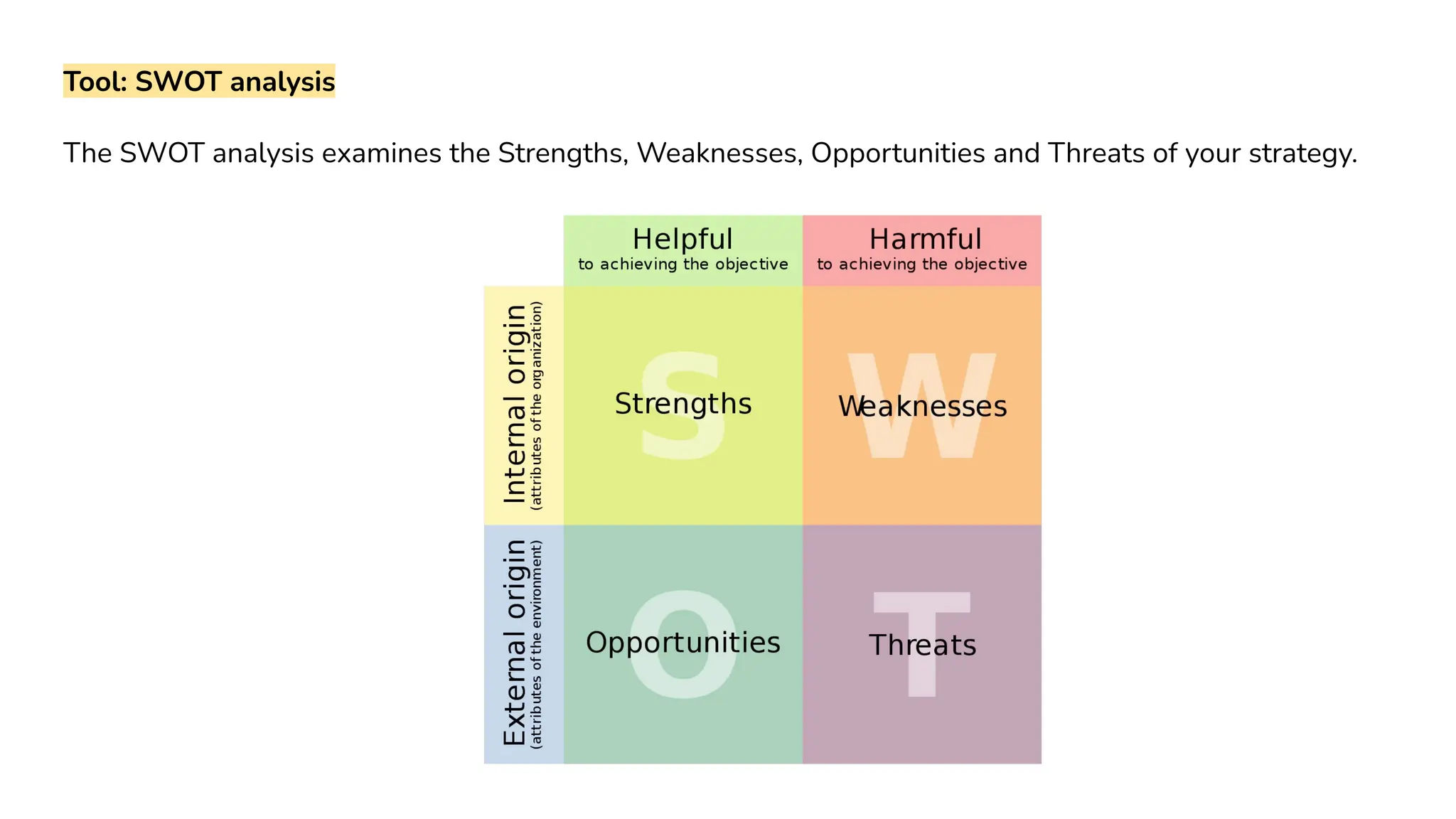
Tool: SWOT analysis
The SWOT analysis examines the Strengths, Weaknesses, Opportunities and Threats of your strategy.
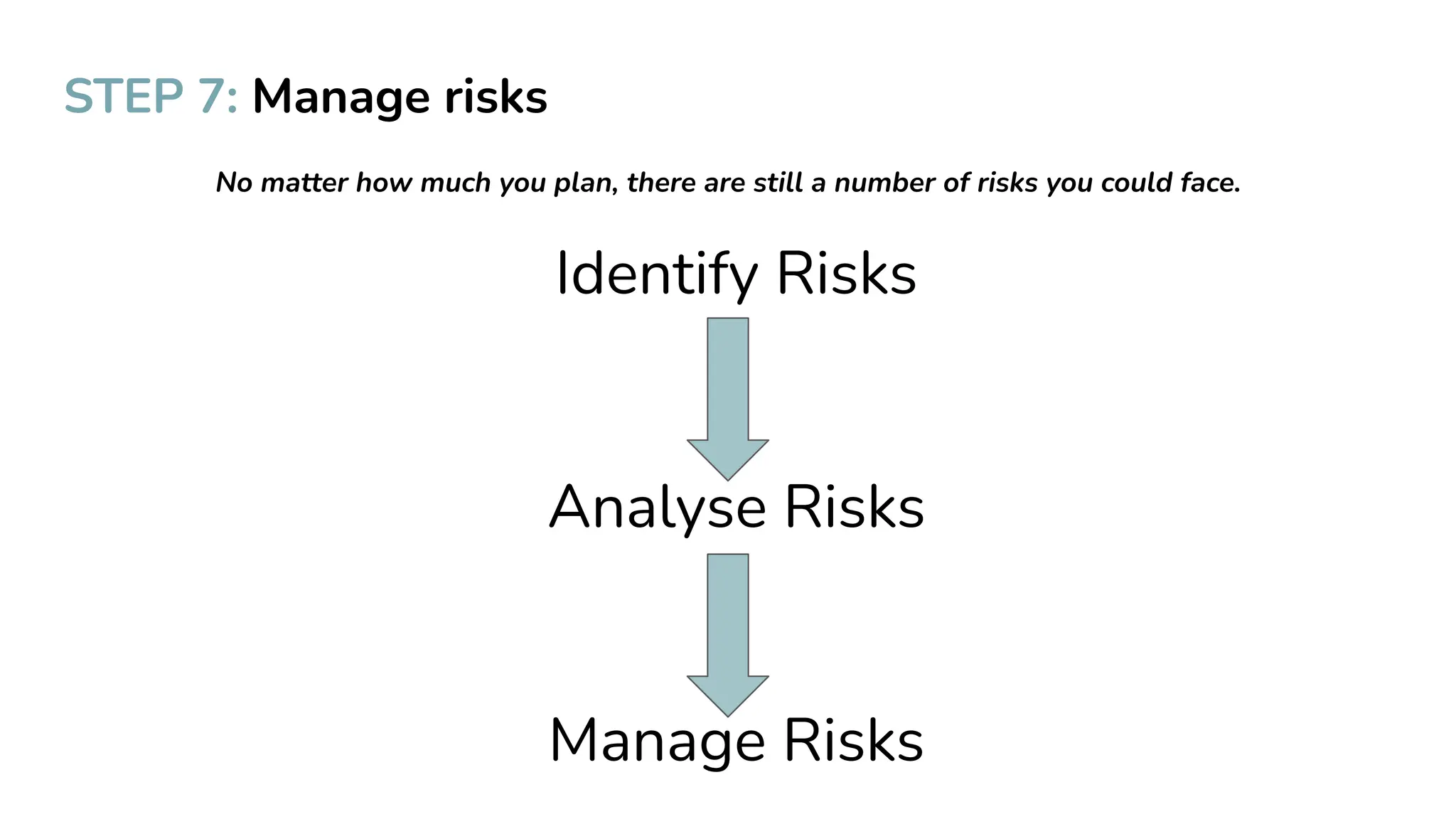
STEP 7: Manage risks
No matter how much you plan, there are still a number of risks you could face.
Identify Risks
Analyse Risks
Manage Risks
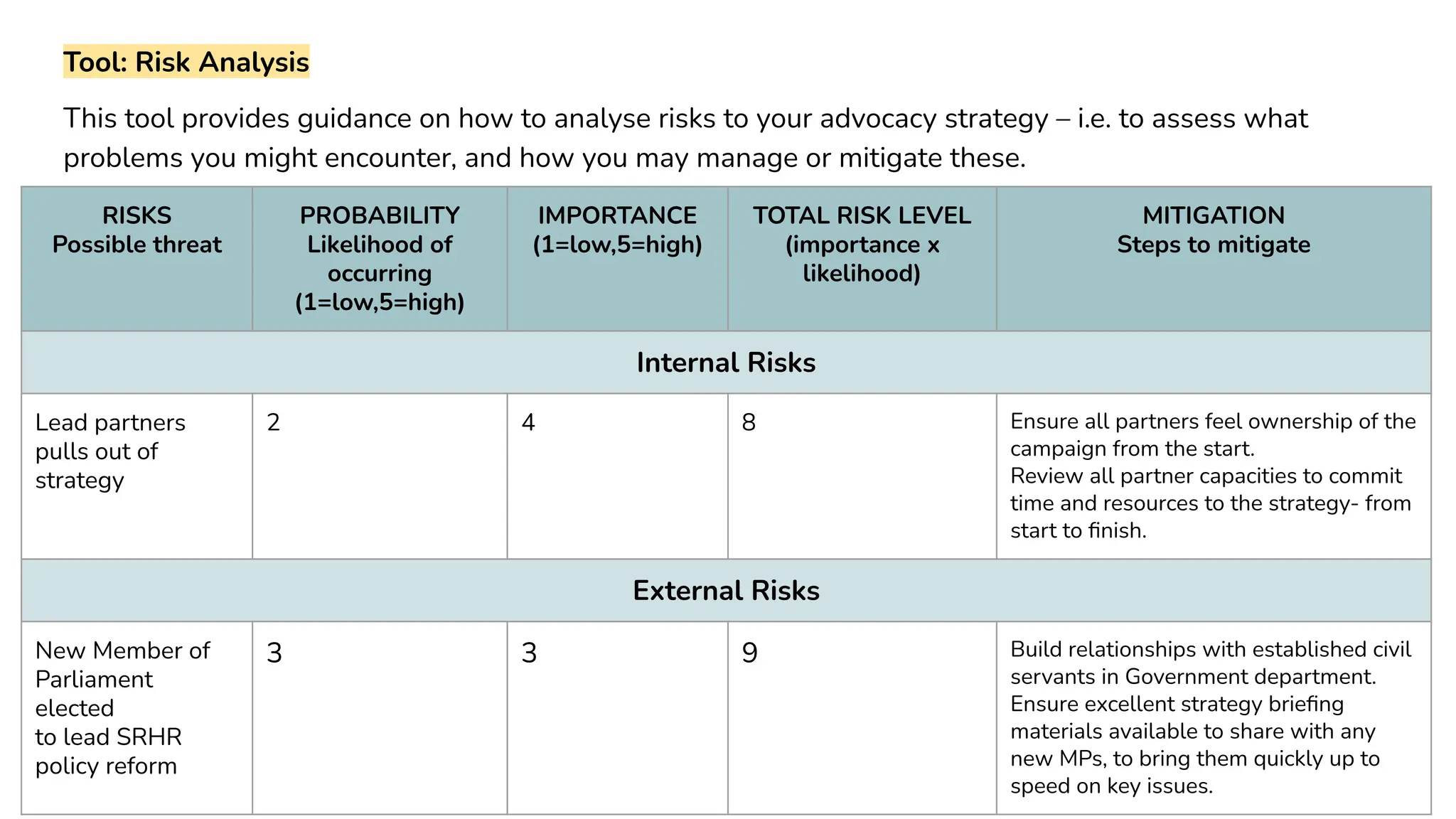
Tool: Risk Analysis
This tool provides guidance on how to analyse risks to your advocacy strategy – i.e. to assess what
problems you might encounter, and how you may manage or mitigate these.
RISKS
Possible threat
PROBABILITY
Likelihood of
occurring
(1=low,5=high)
IMPORTANCE
(1=low,5=high)
TOTAL RISK LEVEL
(importance x
likelihood)
MITIGATION
Steps to mitigate
Internal Risks
Lead partners
pulls out of
strategy
2 4 8 Ensure all partners feel ownership of the
campaign from the start.
Review all partner capacities to commit
time and resources to the strategy- from
start to finish.
External Risks
New Member of
Parliament
elected
to lead SRHR
policy reform
3 3 9 Build relationships with established civil
servants in Government department.
Ensure excellent strategy briefing
materials available to share with any
new MPs, to bring them quickly up to
speed on key issues.
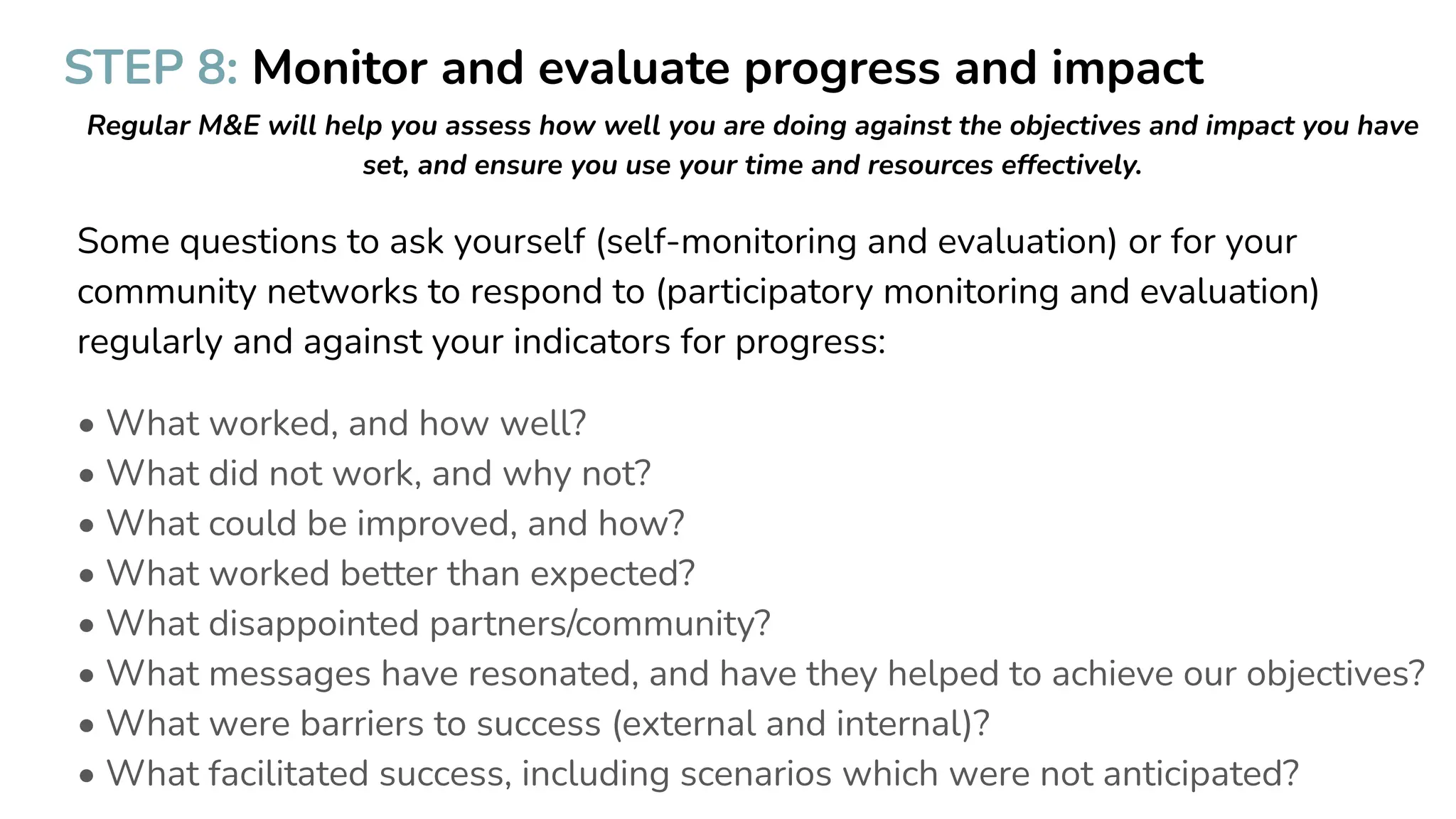
STEP 8: Monitor and evaluate progress and impact
Regular M&E will help you assess how well you are doing against the objectives and impact you have
set, and ensure you use your time and resources effectively.
Some questions to ask yourself (self-monitoring and evaluation) or for your
community networks to respond to (participatory monitoring and evaluation)
regularly and against your indicators for progress:
• What worked, and how well?
• What did not work, and why not?
• What could be improved, and how?
• What worked better than expected?
• What disappointed partners/community?
• What messages have resonated, and have they helped to achieve our objectives?
• What were barriers to success (external and internal)?
• What facilitated success, including scenarios which were not anticipated?
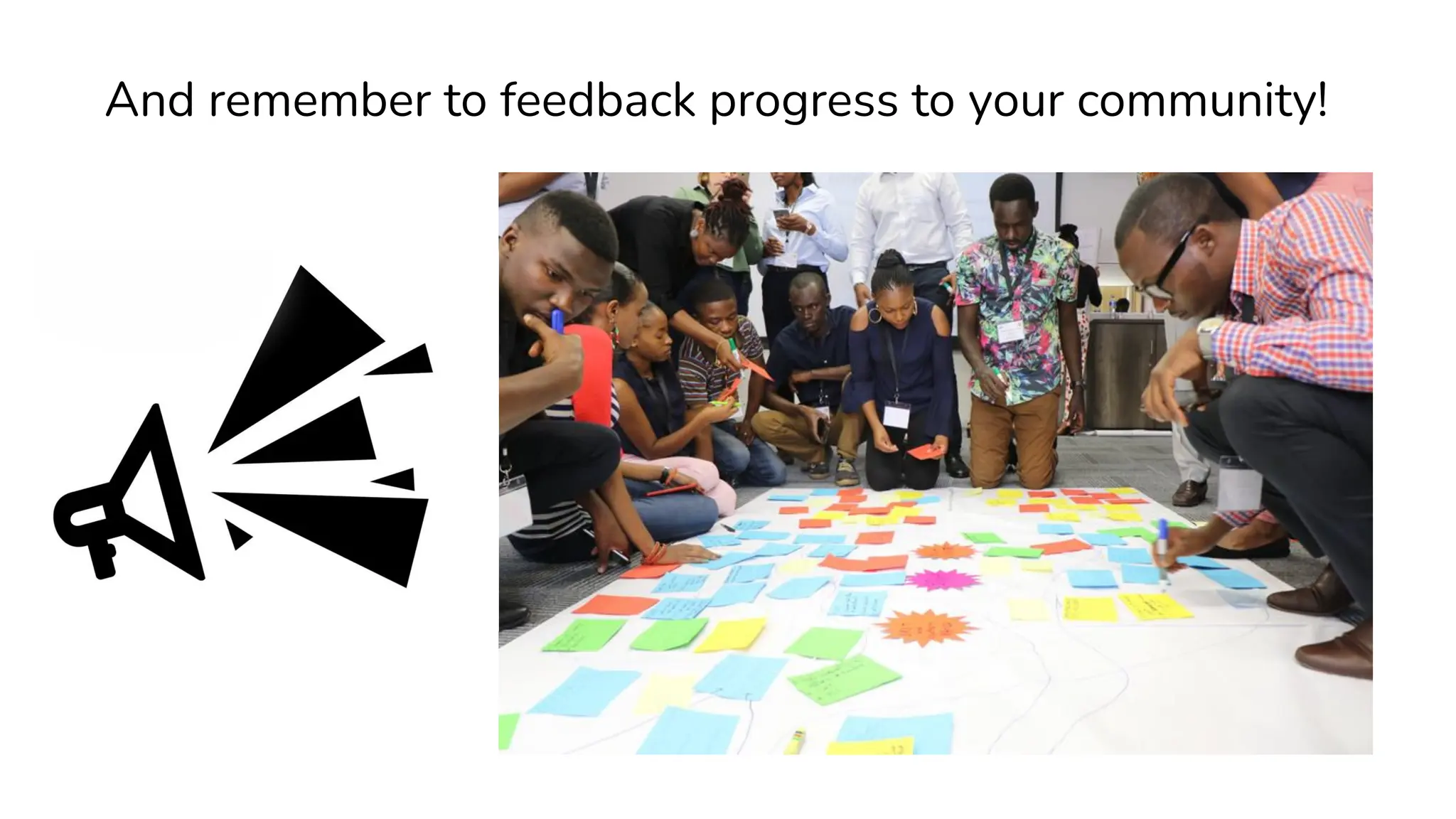
And remember to feedback progress to your community!
And that’s it - you now have all the steps
you need to create your own advocacy
strategy!
CONGRATULATIONS

How to develop your own advocacy strategy: A step by step guide

  • 1.
    How to developyour own advocacy strategy A step by step guide
  • 2.
    Four foundations fordelivering successful advocacy 1. Do your research and gather your evidence 2. Understand the agenda from community to global levels 3. Establish strong partnerships and alliances 4. Set clear timeframes
  • 3.
    8 Steps ofan ‘Advocacy Planning Cycle’ 1. Select your priorities 2. Identify your target audience 3. Develop your message(s) 4. Choose your messenger(s) 5. Identify opportunities and activities for delivering your messages 6. Take stock and identify gaps 7. Manage risks 8. Monitor and evaluate progress and impact
  • 4.
    Setting out youradvocacy strategy - an example
  • 5.
    STEP 1: Selectyour priorities Every advocacy strategy needs to start with a decision on what change you want to achieve! Tool: Issue Choice Matrix As a first step you need to identify possible priority issues, using your research and analysis, upon which you can base your advocacy strategy. Then discussing each issue in turn work through your chosen criteria to rank each from 1-5 (5 = maximum effectiveness). Finally, add up the totals: the issue with the most points should in theory become your advocacy strategy priority. Note: While in theory you do just add up the points, in practice it is the discussion that is crucial and not just the numbers. It shouldn’t be a mechanical process where you just add up numbers. Ideally you and your partners should decide the most important issue(s), by consensus. You may choose to focus on more than one key issue, depending on your aims, resources and capacities. Criteria Issue 1: Young people cannot access contraceptives Issue 2: There are no safe abortion services available Issue 3: Girls are forced to drop out of school after pregnancy Level of concern for this issue - how important is it for young people? 5 4 4 This issue fits with the expertise of you and your partners 4 3 3 You have the resourcing to tackle this scale of issue 4 4 4 Add more criteria here...
  • 6.
    STEP 2: Identifyyour target audience Who has the power to make this change happen? Tool: Stakeholder Mapping and Power Analysis This tool helps to identify and analyse decision-makers and other key targets. Once you have identified the change you want to achieve, then you can start to identify key individuals and institutions, and analyse their influence, attitude and level of support in relation to your priorities. This table can be used to record this analysis. This information can then clarify who may be allies, adversaries or targets, and help you prioritise and strategise: - Those who have most influence but are most anti- your priority issue(s), will be those where the key convincing will need to take place; - Those with the most influence and who are most in favour of your priority issue(s), are likely to be key allies; - Those with high influence, who are neutral on your priority issue(s), could well be your key targets. GOVERNMENT/ ORGANISATION/ NAME (plus contact details) HOW MUCH EXPERTISE DO THEY HAVE ON YOUR PRIORITY ISSUE(S): Rate 1 (low) – 5 (high), or qualitatively HOW MUCH INFLUENCE DO THEY HAVE ON YOUR PRIORITY ISSUE(S)? Rate 1 (low) – 5 (high), or qualitatively WHAT IS THEIR ATTITUDE TO YOUR PRIORITY ISSUE(S)? Rate 1 (very anti) – 5 (very pro), or qualitatively HOW IMPORTANT IS YOUR PRIORITY ISSUE TO THEM? Rate 1 (low) – 5 (high), or qualitatively TOTAL SCORE/ SUMMARY OF QUALITATIVE JUDGEMENTS (Highest = likely target) LIKELY TO BE AN ALLY/ OPPONENT/ TARGET? (see criteria above) Minister of Health, South Africa 3 5 3 4 15 Target Save the Children 5 3 5 5 18 Ally
  • 7.
    STEP 3: Developyour message(s) A strong overarching message will hold your entire advocacy strategy together. ....be simple and short ...be jargon free ...be tailored for your audience(s) ...include the reasons why the change is important ...include any action you want the audience to take ...provide solutions ...be memorable and punchy ...be consistent Powerful messages should...
  • 8.
    A bad example: Wethink that it is important to work with young people because young people are the future and we should involve them in all sorts of processes, particularly accountability and monitoring work because they have lots of great ideas to share. They have better ideas than lots of adults and know their situations best. Monitoring progress on things like SRHR issues is really important as we know loads of young people are affected by stuff around SRHR issues. It is a big issue. I think development practitioners should work better together on lots of things like this and the Government has an important role to play too and needs to do more. Let’s all work together to make this happen! Go youth, yeah!
  • 9.
    A good example: Webelieve that strengthening youth-led accountability is key to a strong development sector, where young people, civil society and governments work side-by-side to realise sexual and reproductive health and rights and gender equality for all. Participatory monitoring and accountability are key components to ensuring sustainable development programmes and policies work for everyone, with no one left behind. A participatory approach to monitoring and review ensures a framework where all people, including youth, can have ownership of development goals and targets - with those living in poverty and situations of instability and humanitarian crisis shaping their own futures and driving their own development. We are issuing a call to action. Through uniting as a sector we can create an enabling environment where youth leadership can thrive, where young people - including marginalised groups - have access to the resources required to actively hold their governments to account for their commitments, and are themselves held accountable by the communities they represent.
  • 10.
    STEP 4: Chooseyour messenger(s) Your message can have a very different impact, depending on who is delivering it! Meet Franco, the young Ugandan leader driving change and inspiring his community to tackle the effects of climate change. https://www.youtube.com/watch?v=mO7F1Ip_s7g
  • 11.
    STEP 5: Identifyopportunities and activities for delivering your messages It is important to think about different approaches to your advocacy. INSIDER Advocacy + OUTSIDER Advocacy
  • 12.
    Connect influencers Consider yourcontext and be creative Ensure representation Connect recommendations at national, regional and global levels Secure support Report your evidence Media and social m Insider + Outsider tactics and tips for sharing your messages
  • 13.
    Tool: Keep a‘Lobby Log’ The Lobby Log is a useful tool to help you keep track of who you meet, their contact details, the outcome of the meeting and any follow up that is needed. When working in coalition or partnership the Lobby Log can also be used to share information on the advocacy efforts that have been undertaken by individual members – to ensure that members are updated on the latest developments, that new contacts are shared, and that members are able to continue/follow up on discussions initiated by others within the coalition or partnership. The Log should be completed after each meeting and be as comprehensive as possible. NAME AND POSITION OF REPRESENTATIVE PLACE AND DATE OF MEETING WHAT WAS DISCUSSED FOLLOW UP/ ACTION POINTS CONTACT DETAILS [Name, position]: Ministry of Health, [Country] Wednesday 27 March at Ministry of Health Office, Rm 302 • Is supportive of the work of the coalition and welcomes inputs • Agrees Govt has committed to meeting key SRHR policy targets • Would like to meet more with young people to hear their perspectives • Send data report summary of key SRHR data • Send over further information about the members of the coalition • Arrange a follow up meeting next month [Email/phone]
  • 14.
    ...and remember... ● Allstakeholders are human beings. ● Only ask them to do things they can actually deliver. ● Be patient and think about your tone. ● Give them the opportunity to disappoint you. ● Don’t over-do it! ● Say thank you.
  • 15.
    STEP 6: Takestock and identify gaps Sometimes, you can follow all of the planning steps and things just don’t work out. Some important steps to take when things might not be working as you hoped or planned: 1. Sit down and analyse why things aren’t working. 2. Be really honest. 3. It is ok for your advocacy strategy to change!
  • 16.
    Tool: SWOT analysis TheSWOT analysis examines the Strengths, Weaknesses, Opportunities and Threats of your strategy.
  • 17.
    STEP 7: Managerisks No matter how much you plan, there are still a number of risks you could face. Identify Risks Analyse Risks Manage Risks
  • 18.
    Tool: Risk Analysis Thistool provides guidance on how to analyse risks to your advocacy strategy – i.e. to assess what problems you might encounter, and how you may manage or mitigate these. RISKS Possible threat PROBABILITY Likelihood of occurring (1=low,5=high) IMPORTANCE (1=low,5=high) TOTAL RISK LEVEL (importance x likelihood) MITIGATION Steps to mitigate Internal Risks Lead partners pulls out of strategy 2 4 8 Ensure all partners feel ownership of the campaign from the start. Review all partner capacities to commit time and resources to the strategy- from start to finish. External Risks New Member of Parliament elected to lead SRHR policy reform 3 3 9 Build relationships with established civil servants in Government department. Ensure excellent strategy briefing materials available to share with any new MPs, to bring them quickly up to speed on key issues.
  • 19.
    STEP 8: Monitorand evaluate progress and impact Regular M&E will help you assess how well you are doing against the objectives and impact you have set, and ensure you use your time and resources effectively. Some questions to ask yourself (self-monitoring and evaluation) or for your community networks to respond to (participatory monitoring and evaluation) regularly and against your indicators for progress: • What worked, and how well? • What did not work, and why not? • What could be improved, and how? • What worked better than expected? • What disappointed partners/community? • What messages have resonated, and have they helped to achieve our objectives? • What were barriers to success (external and internal)? • What facilitated success, including scenarios which were not anticipated?
  • 20.
    And remember tofeedback progress to your community!
  • 21.
    And that’s it- you now have all the steps you need to create your own advocacy strategy! CONGRATULATIONS