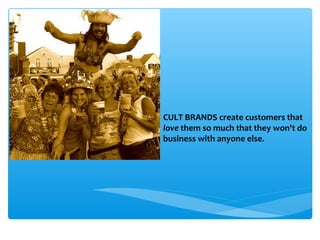
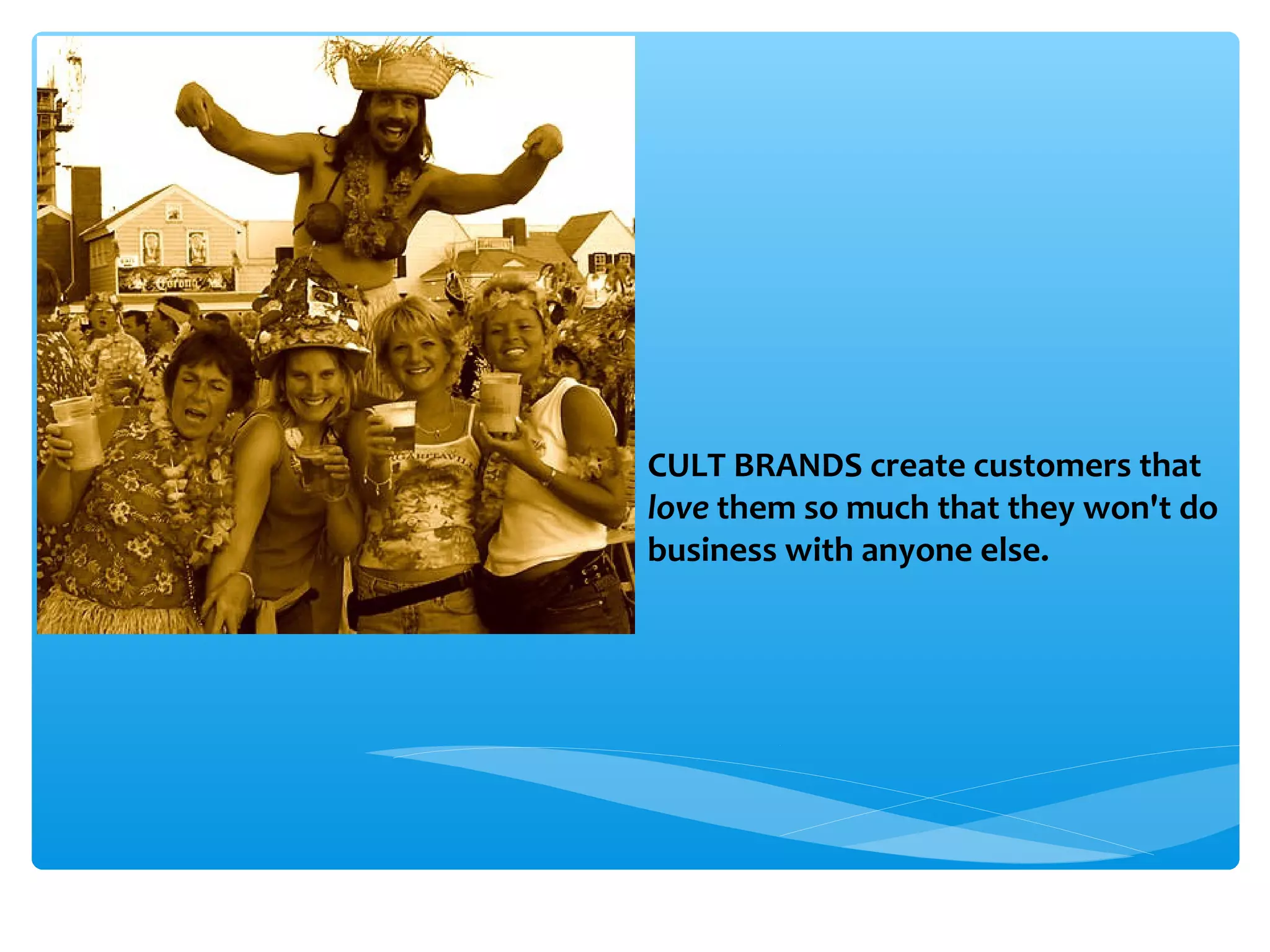




CULT BRANDS create customers that
love them so much that they won't do
business with anyone else.
BRAND : It is an idea or image of a specific product
or service that consumers connect with, by
identifying the name, logo, slogan, or design of
the company.
CULT BRAND : It is defined as a phenomenon where
customers display an usually strong emotional
involvement with a particular brand.
∗ High degree of customer loyalty
∗ Amplified sense of owing the brand
What are Cult Brands?
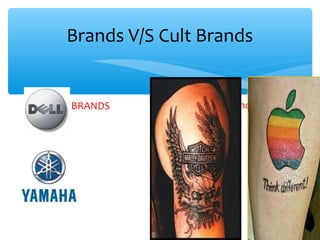
Brands V/S Cult Brands
BRANDS Cult Brands
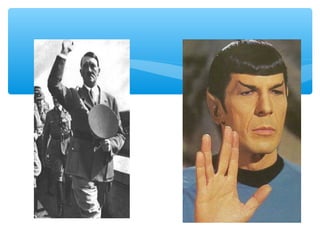
∗ Destructive cults harm, hurt, manipulate, and often
brainwash their members. The leader of a destructive cult
doesn't really care about the well being of the members.
∗ Benign cults help fill the emotional needs and wants of
their followers in a positive way. They and their followers
enjoy a mutually beneficial relationship, with both
receiving a real sense of satisfaction, accomplishment,
belonging and enlightenment from the relationship.
Destructive and Benign Cults
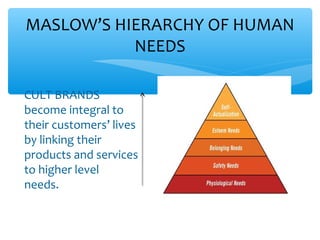
MASLOW’S HIERARCHY OF HUMAN
NEEDS
CULT BRANDS
become integral to
their customers’ lives
by linking their
products and services
to higher level
needs.
Consumers want to be part of a group that’s different.
∗Our society is addicted to communication.
∗We not only enjoy being part of groups made of like-
minded individuals, but we all enjoy being different and
standing out from the rest of the pack.
#1 – The Golden Rule of Social Groups
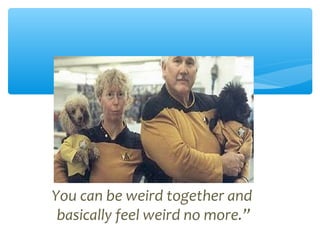
You can be weird together and
basically feel weird no more.”
Cult brand inventors show daring and determination.
∗Consumers are tired of being bombarded with
products and services that all look the same, feel the
same, and act the same.
∗They want surprises.
#2 – The Golden Rule of Courage
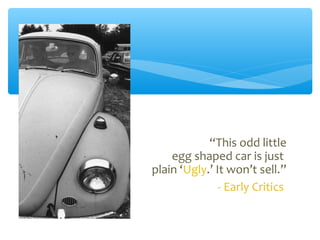
“This odd little
egg shaped car is just
plain ‘Ugly.’ It won’t sell.”
- Early Critics
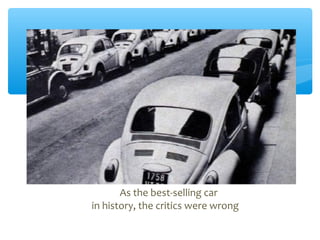
As the best-selling car
in history, the critics were wrong
Cult brands sell lifestyles.
∗ They make us happy. They cheer us up when we're
down; they help us enjoy life.
∗Not only do they provide escape, but the companies
develop and sell tools that allow followers to pursue
their dreams and celebrate new lifestyles.
#3 – The Golden Rule of Fun
Jimmy - The King of FUN
Listen to the choir and create cult brand evangelists
∗Serves the customers they already have. They don't try
to attract hypothetical new customers.
∗They look to the congregation, value their opinions,
and reward them. Do extraordinary things for them.
#4 – The Golden Rule of Human
Needs
Cult brands always create customer communities.
∗Brand companies continually find new ways to give
back to their customers for their passion and devotion.
They remain humble and personable.
∗They develop strong relationships through developing
and supporting customer communities.
#5 – The Golden Rule of Contribution
Weekend Rides
Cult brands are inclusive
∗Cult brand companies don't build imaginary profiles of
ideal customers. They don't' discriminate.
∗Exclusivity doesn't exist.
#6 – The Golden Rule of Openness
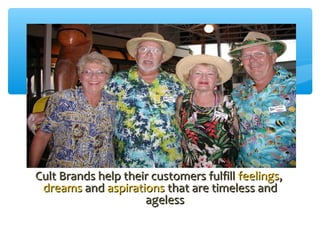
Cult Brands help their customers fulfillCult Brands help their customers fulfill feelingsfeelings,,
dreamsdreams andand aspirationsaspirations that are timeless andthat are timeless and
agelessageless
Cult brands promote personal freedom and draw power
from their enemies
∗Cult brand draw strength and unity from identifying
and targeting an archenemy-a group that conflicts with
the company's values and goals.
#7 – The Golden Rule of Freedom
Vans embraces the “outcasts.” They champion
their lifestyles.
CULT BRANDING IN INDIA
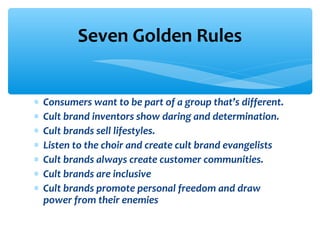
∗ Consumers want to be part of a group that’s different.
∗ Cult brand inventors show daring and determination.
∗ Cult brands sell lifestyles.
∗ Listen to the choir and create cult brand evangelists
∗ Cult brands always create customer communities.
∗ Cult brands are inclusive
∗ Cult brands promote personal freedom and draw
power from their enemies
Seven Golden Rules

Cult branding

  • 1.
    CULT BRANDS createcustomers that love them so much that they won't do business with anyone else.
  • 2.
    BRAND : Itis an idea or image of a specific product or service that consumers connect with, by identifying the name, logo, slogan, or design of the company. CULT BRAND : It is defined as a phenomenon where customers display an usually strong emotional involvement with a particular brand. ∗ High degree of customer loyalty ∗ Amplified sense of owing the brand What are Cult Brands?
  • 3.
    Brands V/S CultBrands BRANDS Cult Brands
  • 4.
    ∗ Destructive cultsharm, hurt, manipulate, and often brainwash their members. The leader of a destructive cult doesn't really care about the well being of the members. ∗ Benign cults help fill the emotional needs and wants of their followers in a positive way. They and their followers enjoy a mutually beneficial relationship, with both receiving a real sense of satisfaction, accomplishment, belonging and enlightenment from the relationship. Destructive and Benign Cults
  • 6.
    MASLOW’S HIERARCHY OFHUMAN NEEDS CULT BRANDS become integral to their customers’ lives by linking their products and services to higher level needs.
  • 7.
    Consumers want tobe part of a group that’s different. ∗Our society is addicted to communication. ∗We not only enjoy being part of groups made of like- minded individuals, but we all enjoy being different and standing out from the rest of the pack. #1 – The Golden Rule of Social Groups
  • 8.
    You can beweird together and basically feel weird no more.”
  • 9.
    Cult brand inventorsshow daring and determination. ∗Consumers are tired of being bombarded with products and services that all look the same, feel the same, and act the same. ∗They want surprises. #2 – The Golden Rule of Courage
  • 10.
    “This odd little eggshaped car is just plain ‘Ugly.’ It won’t sell.” - Early Critics
  • 11.
    As the best-sellingcar in history, the critics were wrong
  • 12.
    Cult brands selllifestyles. ∗ They make us happy. They cheer us up when we're down; they help us enjoy life. ∗Not only do they provide escape, but the companies develop and sell tools that allow followers to pursue their dreams and celebrate new lifestyles. #3 – The Golden Rule of Fun
  • 13.
    Jimmy - TheKing of FUN
  • 14.
    Listen to thechoir and create cult brand evangelists ∗Serves the customers they already have. They don't try to attract hypothetical new customers. ∗They look to the congregation, value their opinions, and reward them. Do extraordinary things for them. #4 – The Golden Rule of Human Needs
  • 16.
    Cult brands alwayscreate customer communities. ∗Brand companies continually find new ways to give back to their customers for their passion and devotion. They remain humble and personable. ∗They develop strong relationships through developing and supporting customer communities. #5 – The Golden Rule of Contribution
  • 17.
  • 18.
    Cult brands areinclusive ∗Cult brand companies don't build imaginary profiles of ideal customers. They don't' discriminate. ∗Exclusivity doesn't exist. #6 – The Golden Rule of Openness
  • 19.
    Cult Brands helptheir customers fulfillCult Brands help their customers fulfill feelingsfeelings,, dreamsdreams andand aspirationsaspirations that are timeless andthat are timeless and agelessageless
  • 20.
    Cult brands promotepersonal freedom and draw power from their enemies ∗Cult brand draw strength and unity from identifying and targeting an archenemy-a group that conflicts with the company's values and goals. #7 – The Golden Rule of Freedom
  • 21.
    Vans embraces the“outcasts.” They champion their lifestyles.
  • 22.
  • 23.
    ∗ Consumers wantto be part of a group that’s different. ∗ Cult brand inventors show daring and determination. ∗ Cult brands sell lifestyles. ∗ Listen to the choir and create cult brand evangelists ∗ Cult brands always create customer communities. ∗ Cult brands are inclusive ∗ Cult brands promote personal freedom and draw power from their enemies Seven Golden Rules