ADVERTISEMENT
STRATEGY
 Komal Dhiman
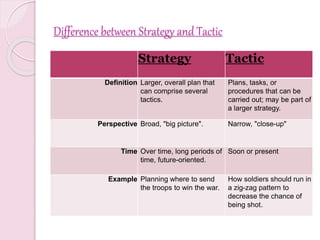
Difference between Strategy and Tactic
Strategy Tactic
Definition Larger, overall plan that
can comprise several
tactics.
Plans, tasks, or
procedures that can be
carried out; may be part of
a larger strategy.
Perspective Broad, "big picture". Narrow, "close-up"
Time Over time, long periods of
time, future-oriented.
Soon or present
Example Planning where to send
the troops to win the war.
How soldiers should run in
a zig-zag pattern to
decrease the chance of
being shot.
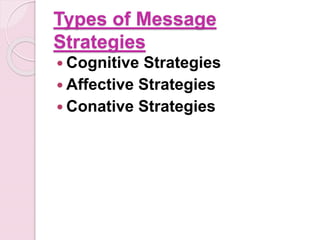
Types of Message
Strategies
 Cognitive Strategies
 Affective Strategies
 Conative Strategies
Cognitive Strategy
It is the presentation of Rational
arguments or pieces of information to
consumer, the product’s attributes or the
benefits.
 Generic messages
 Preemptive messages
 Unique selling Proposition
 Hyperbole
 Comparative Advertisements
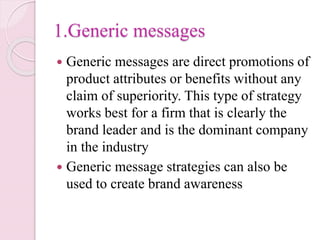
1.Generic messages
 Generic messages are direct promotions of
product attributes or benefits without any
claim of superiority. This type of strategy
works best for a firm that is clearly the
brand leader and is the dominant company
in the industry
 Generic message strategies can also be
used to create brand awareness
2.Preemptive Messages
 Preemptive messages claim superiority
based on a product’s specific attribute or
benefit. The idea is to prevent the
competition from making the same or a
similar statement.
3. Unique selling proposition
 It is an explicit, testable claim of
uniqueness or superiority that can be
supported or substantiated in some
manner.
4. Hyperbole
 It is an approach makes an untestable
claim based upon some attribute or
benefit.
5.Comparative advertisement
 When an advertiser directly or indirectly
compares a good or service to the
competition, it is the comparative method.
The advertisement may or may not
mention the competitor by name
6.Emotional Advertisement
 Emotional advertising attempts to elicit
powerful emotions that eventually lead to
product recall and choice. Many emotions
can be connected to products, including
trust, reliability, friendship, happiness,
security, glamour, luxury, pleasure,
romance, and passion.
Affective Strategies
 Affective strategies are a common
approach to developing a strong brand
name. When an advertisement gets you to
like a brand and have positive feelings for
a brand, then the hope is that you will also
purchase that brand.
Conative Strategies
 Conative Strategies - Conative message
strategies are designed to lead more
directly to some type of consumer
response. They can be used to support
other promotional efforts, such as coupon
redemption programs, Internet “hits” and
orders, and in-store offers such as buy-
one-get-one-free.
 These ads typically encourage quick
action

Advertisement strategy

  • 1.
  • 2.
    Difference between Strategyand Tactic Strategy Tactic Definition Larger, overall plan that can comprise several tactics. Plans, tasks, or procedures that can be carried out; may be part of a larger strategy. Perspective Broad, "big picture". Narrow, "close-up" Time Over time, long periods of time, future-oriented. Soon or present Example Planning where to send the troops to win the war. How soldiers should run in a zig-zag pattern to decrease the chance of being shot.
  • 3.
    Types of Message Strategies Cognitive Strategies  Affective Strategies  Conative Strategies
  • 4.
    Cognitive Strategy It isthe presentation of Rational arguments or pieces of information to consumer, the product’s attributes or the benefits.  Generic messages  Preemptive messages  Unique selling Proposition  Hyperbole  Comparative Advertisements
  • 5.
    1.Generic messages  Genericmessages are direct promotions of product attributes or benefits without any claim of superiority. This type of strategy works best for a firm that is clearly the brand leader and is the dominant company in the industry  Generic message strategies can also be used to create brand awareness
  • 6.
    2.Preemptive Messages  Preemptivemessages claim superiority based on a product’s specific attribute or benefit. The idea is to prevent the competition from making the same or a similar statement.
  • 7.
    3. Unique sellingproposition  It is an explicit, testable claim of uniqueness or superiority that can be supported or substantiated in some manner.
  • 8.
    4. Hyperbole  Itis an approach makes an untestable claim based upon some attribute or benefit.
  • 9.
    5.Comparative advertisement  Whenan advertiser directly or indirectly compares a good or service to the competition, it is the comparative method. The advertisement may or may not mention the competitor by name
  • 10.
    6.Emotional Advertisement  Emotionaladvertising attempts to elicit powerful emotions that eventually lead to product recall and choice. Many emotions can be connected to products, including trust, reliability, friendship, happiness, security, glamour, luxury, pleasure, romance, and passion.
  • 11.
    Affective Strategies  Affectivestrategies are a common approach to developing a strong brand name. When an advertisement gets you to like a brand and have positive feelings for a brand, then the hope is that you will also purchase that brand.
  • 12.
    Conative Strategies  ConativeStrategies - Conative message strategies are designed to lead more directly to some type of consumer response. They can be used to support other promotional efforts, such as coupon redemption programs, Internet “hits” and orders, and in-store offers such as buy- one-get-one-free.  These ads typically encourage quick action