
Adverse Drug
Reactions
For BPH 1st Year
Dr. Pravin Prasad
2nd Year Resident, MD Clinical Pharmacology
Maharajgunj Medical Campus
15th February, 2017 (5th Falgun, 2073),
Thursday
Adverse Drug Effects:
Terminologies
Adverse Effects:
 Any undesirable or unintended
consequence of drug
administration
Adverse Drug Effects:
Terminologies
Adverse Drug Event:
 Any untoward medical
occurrence that may present
during treatment with the
medicine, but which does not
necessarily have a causal
relationship with the treatment
Adverse Drug Effects:
Terminologies
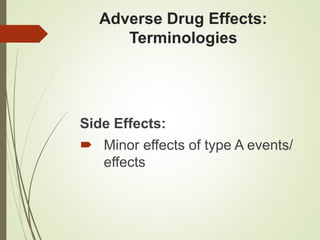
Side Effects:
 Minor effects of type A events/
effects
Adverse Drug Effects:
Terminologies
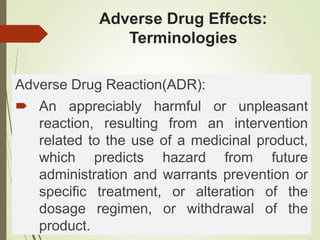
Adverse Drug Reaction(ADR):
 An appreciably harmful or unpleasant
reaction, resulting from an intervention
related to the use of a medicinal product,
which predicts hazard from future
administration and warrants prevention or
specific treatment, or alteration of the
dosage regimen, or withdrawal of the
product.
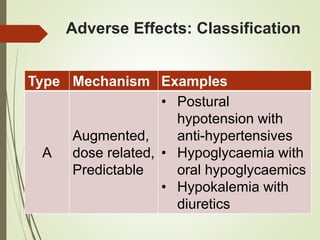
Adverse Effects: Classification
Type Mechanism Examples
A
Augmented,
dose related,
Predictable
• Postural
hypotension with
anti-hypertensives
• Hypoglycaemia with
oral hypoglycaemics
• Hypokalemia with
diuretics
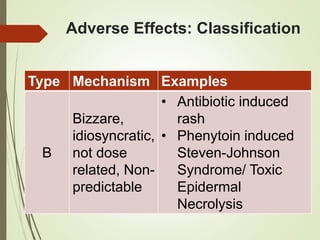
Adverse Effects: Classification
Type Mechanism Examples
B
Bizzare,
idiosyncratic,
not dose
related, Non-
predictable
• Antibiotic induced
rash
• Phenytoin induced
Steven-Johnson
Syndrome/ Toxic
Epidermal
Necrolysis
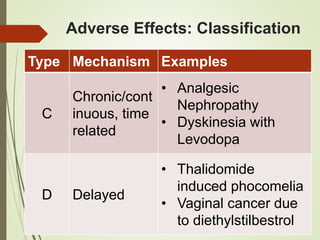
Adverse Effects: Classification
Type Mechanism Examples
C
Chronic/cont
inuous, time
related
• Analgesic
Nephropathy
• Dyskinesia with
Levodopa
D Delayed
• Thalidomide
induced phocomelia
• Vaginal cancer due
to diethylstilbestrol
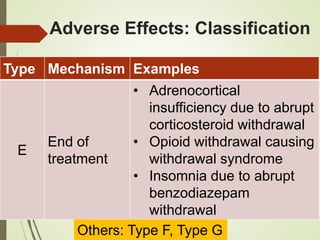
Adverse Effects: Classification
Type Mechanism Examples
E
End of
treatment
• Adrenocortical
insufficiency due to abrupt
corticosteroid withdrawal
• Opioid withdrawal causing
withdrawal syndrome
• Insomnia due to abrupt
benzodiazepam
withdrawal
Others: Type F, Type G
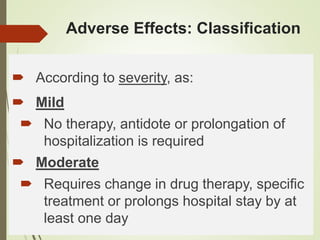
Adverse Effects: Classification
 According to severity, as:
 Mild
 No therapy, antidote or prolongation of
hospitalization is required
 Moderate
 Requires change in drug therapy, specific
treatment or prolongs hospital stay by at
least one day
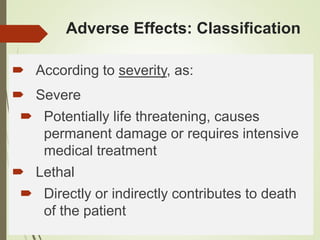
Adverse Effects: Classification
 According to severity, as:
 Severe
 Potentially life threatening, causes
permanent damage or requires intensive
medical treatment
 Lethal
 Directly or indirectly contributes to death
of the patient
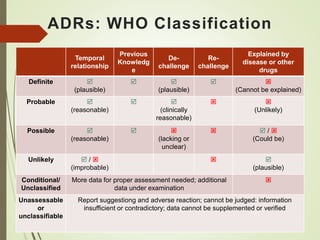
ADRs: WHO Classification
Temporal
relationship
Previous
Knowledg
e
De-
challenge
Re-
challenge
Explained by
disease or other
drugs
Definite 
(plausible)
 
(plausible)
 
(Cannot be explained)
Probable 
(reasonable)
 
(clinically
reasonable)
 
(Unlikely)
Possible 
(reasonable)
 
(lacking or
unclear)
  / 
(Could be)
Unlikely  / 
(improbable)
 
(plausible)
Conditional/
Unclassified
More data for proper assessment needed; additional
data under examination

Unassessable
or
unclassifiable
Report suggestiong and adverse reaction; cannot be judged: information
insufficient or contradictory; data cannot be supplemented or verified
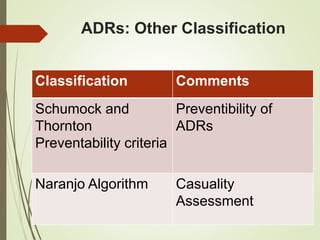
ADRs: Other Classification
Classification Comments
Schumock and
Thornton
Preventability criteria
Preventibility of
ADRs
Naranjo Algorithm Casuality
Assessment
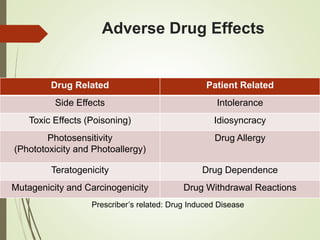
Adverse Drug Effects
Drug Related Patient Related
Side Effects Intolerance
Toxic Effects (Poisoning) Idiosyncracy
Photosensitivity
(Phototoxicity and Photoallergy)
Drug Allergy
Teratogenicity Drug Dependence
Mutagenicity and Carcinogenicity Drug Withdrawal Reactions
Prescriber’s related: Drug Induced Disease
Thank you!

Adverse drug reaction for BPH

  • 1.
    Adverse Drug Reactions For BPH1st Year Dr. Pravin Prasad 2nd Year Resident, MD Clinical Pharmacology Maharajgunj Medical Campus 15th February, 2017 (5th Falgun, 2073), Thursday
  • 2.
    Adverse Drug Effects: Terminologies AdverseEffects:  Any undesirable or unintended consequence of drug administration
  • 3.
    Adverse Drug Effects: Terminologies AdverseDrug Event:  Any untoward medical occurrence that may present during treatment with the medicine, but which does not necessarily have a causal relationship with the treatment
  • 4.
    Adverse Drug Effects: Terminologies SideEffects:  Minor effects of type A events/ effects
  • 5.
    Adverse Drug Effects: Terminologies AdverseDrug Reaction(ADR):  An appreciably harmful or unpleasant reaction, resulting from an intervention related to the use of a medicinal product, which predicts hazard from future administration and warrants prevention or specific treatment, or alteration of the dosage regimen, or withdrawal of the product.
  • 6.
    Adverse Effects: Classification TypeMechanism Examples A Augmented, dose related, Predictable • Postural hypotension with anti-hypertensives • Hypoglycaemia with oral hypoglycaemics • Hypokalemia with diuretics
  • 7.
    Adverse Effects: Classification TypeMechanism Examples B Bizzare, idiosyncratic, not dose related, Non- predictable • Antibiotic induced rash • Phenytoin induced Steven-Johnson Syndrome/ Toxic Epidermal Necrolysis
  • 8.
    Adverse Effects: Classification TypeMechanism Examples C Chronic/cont inuous, time related • Analgesic Nephropathy • Dyskinesia with Levodopa D Delayed • Thalidomide induced phocomelia • Vaginal cancer due to diethylstilbestrol
  • 9.
    Adverse Effects: Classification TypeMechanism Examples E End of treatment • Adrenocortical insufficiency due to abrupt corticosteroid withdrawal • Opioid withdrawal causing withdrawal syndrome • Insomnia due to abrupt benzodiazepam withdrawal Others: Type F, Type G
  • 10.
    Adverse Effects: Classification According to severity, as:  Mild  No therapy, antidote or prolongation of hospitalization is required  Moderate  Requires change in drug therapy, specific treatment or prolongs hospital stay by at least one day
  • 11.
    Adverse Effects: Classification According to severity, as:  Severe  Potentially life threatening, causes permanent damage or requires intensive medical treatment  Lethal  Directly or indirectly contributes to death of the patient
  • 12.
    ADRs: WHO Classification Temporal relationship Previous Knowledg e De- challenge Re- challenge Explainedby disease or other drugs Definite  (plausible)   (plausible)   (Cannot be explained) Probable  (reasonable)   (clinically reasonable)   (Unlikely) Possible  (reasonable)   (lacking or unclear)   /  (Could be) Unlikely  /  (improbable)   (plausible) Conditional/ Unclassified More data for proper assessment needed; additional data under examination  Unassessable or unclassifiable Report suggestiong and adverse reaction; cannot be judged: information insufficient or contradictory; data cannot be supplemented or verified
  • 13.
    ADRs: Other Classification ClassificationComments Schumock and Thornton Preventability criteria Preventibility of ADRs Naranjo Algorithm Casuality Assessment
  • 14.
    Adverse Drug Effects DrugRelated Patient Related Side Effects Intolerance Toxic Effects (Poisoning) Idiosyncracy Photosensitivity (Phototoxicity and Photoallergy) Drug Allergy Teratogenicity Drug Dependence Mutagenicity and Carcinogenicity Drug Withdrawal Reactions Prescriber’s related: Drug Induced Disease
  • 15.

Editor's Notes

  • #5 Adverse Effects: any undesirable or unintended consequence of drug administration Adverse Drug Event: any untoward medical occurance that may present during treatment with the medicine, but which does not necessarily have a causal relationship with the treatment Side Effects: minor effects of type A events/effects Adverse Drug Reaction: any noxious change which is suspected to be due to drug, occurs at doses normally used in man, requires treatment or decrease in dose, or indicates caution in future use of the same drug. Excludes trivial or expected side effects and poisoning or overdose
  • #6 Adverse Effects: any undesirable or unintended consequence of drug administration Adverse Drug Event: any untoward medical occurance that may present during treatment with the medicine, but which does not necessarily have a causal relationship with the treatment Side Effects: minor effects of type A events/effects Adverse Drug Reaction: any noxious change which is suspected to be due to drug, occurs at doses normally used in man, requires treatment or decrease in dose, or indicates caution in future use of the same drug. Excludes trivial or expected side effects and poisoning or overdose
  • #7 Adverse effects: Any un-desireable or unintended consequence of drug administration Type A: based on pharmacological properties of a drug, will occur in everyone if enough of the drug is given because they are due to excess of normal, predictable, dose-related, pharmacodynamic effects. Includes side effects, toxic effects, consequences of drug withdrawal (type E)??, mostly preventable and reversible. Eg
  • #8 Type B: will occur only in some people, patient dependent, includes allergy and idiosyncracy, less common, non dose-related, generally more serious, requires withdrawal of drug, can be predicted and prevented if genetic basis is known and individual phenotype is identified. Accounts for most drug fatalities
  • #9 Type E: ending of use reactions, discontinuation of chromnic therapy is too abrupt: corticosteroids withdrawal leading to rebound adrenocortical insufficiency, opiod causing withsrawal syndrome
  • #16 Maximum score : +13
  • #19 Atropine used as antisecretory for GA producing dryness of mouth, GTN used in Angina producing postural hypotension and throbbing headache Anti-allergic promethazine producing sedation, Anti-ovulatory estrogen producing nausea Constipation by codeine used for cough is m/a in traveller’s diarrhoea, AV conduction depression in AF is S/E when digoxin used in CHF
  • #20 Functional alteration (high dose atropine causing delirium) Drug induced tissue damage (hepatic necrosis form paracetamol overdosage) Extension of therapeutic effects (coma by barbiturates, complete A-V block by digoxin, bleeding due to heparin) Another action (analgesic morphine causing respiratory depression, antidepressant imipramine causing cardiac arrhythmia, antitubercular streptomycin causing vestibular damage)
  • #21 Cutaenous reaction resulting from drug induced sensitization of the skin to ultraviolet (UV) radiation Severe lesion with larger doses of drugs in phototoxicity Phototoxicity: Accumulates in the skin, absorbs light and undergoes a photochemical reaction followed by a photobiological reaction resulting in local tissue damage (erythema, edema, blistering) Photoallergy: Drugs and its metabolites induces a cell mediated immune response, on exposure to light produces a papular or eczematous contact dermatitis like picture
  • #22 Thalidomide disaster (1958-1961) phocomelia (seal like limbs) Capacity of the drug to cause foetal abnormality when administered to the pregnant mother Drug effects on embryo are often irreversible Foetal exposure depends on: Blood level Duration for which drug remains in maternal circulation
  • #25 Direct interaction: modified DNA sequence codes for proto-oncogenes; proteins that inhibit transcription of proto-oncogenes Indirect interaction: genetically damaged cells
  • #27 Example: Single dose of triflupromazine induces muscle dystonias in some individuals, specially children Few doses of carbamazepine causing ataxia Chloroquine causing abdominal pain and vomiting in an occasional patient
  • #28 Example: Barbiturates causing excitement and mental confusion in some individuals Quinine/quinidine causing cramps, diarrhea, purpura, asthma, and vascular collapse in some patients Chloramphenicol non dose related severe aplastic anaemia
  • #29 Immunologically mediated reaction producing stereotype symptoms, unrelated to the pharmacodynamic profile of the drug Smaller dose, different time course of onset and duration Drug or its metabolite acts as antigen or hapten  on combination with endogenous protein induces production of AB/ sensitized lymphocytes Humoral Type I: Anaphylactic reactions, IgE mediated. Body on sensitization produces reaginic antibodies (IgE) that fixes on mast cells Exposure to drug, Ag:Ab reaction – mediators release (histamine, 5-HT, leukotrienes, LT-C4 and D4, PG, PAF Utricaria, itching, angioedema, bronchospasm, rhinitis, anaphylactic shock Paresthesia, flushing, swelling, wheezing, palpitation  anaphylaxis  syncope Stop Drug, Anti-histamines in milder cases, epinephrine and corticosteroids in severe cases Type II: (Cytolytic) Drug + Component of a tissue cell = Antigen Antibodies: IgG, IgM; binds to target cells Re-exposure  Ag:Ab reaction  complement activated  cytolysis (thrombocytopenia, agranulocytosis, aplastic anaemia, hemolysis, organ damage (liver, kidney, muscle), SLE) Type III: (retarded, Arthus) Circulating antibodies (IgG, aka mopping AB) Ag:Ab complexes bind to complement  precipitate on vascular endothelium  destructive imflammatory response Rahses, serum sickness(fever, arthralgia, lymphadenopathy), polyarteritis nodosa, SJS (erythema multiforme, arthritis, nephritis, myocarditis, mental symptoms) Subsides in 1-2 weeks Type IV (delayed hypersensitivity): Mediated through production of sensitized T-lymphocytes carrying receptors for Ag. On binding, releases lymphokines  attracts granulocytes  inflammatory response Contact dermatitis, rashes, fever, photosensitization Generally takes >12 hrs to develop.
  • #30 Drug capable of altering mood and feelings are liable to repetitive use to derive euphoria, recreation, withdrawal from reality, social adjustment Psychological dependence: individual believes that optimal state of well being is achieved only through the actions of the drug; feels emotionally distressed if drug not taken; liking  compulsion; intensity varies from desire  craving Reinforcement: ability of the drug to produce effects that user enjoys and which make him wish to take it again or to induce drug seeking behaviour Faster acting drugs (opiods, cocaine), inhaled/i.v. are strong re-inforcers, Slower acting drugs (BZDs) weak reinforcers are liable to repetitive use to derive euphoria, recreation, withdrawal from reality, social adjustment Drug addiction: Pattern of compulsive drug use characterised by overwhelming involvement with the use of the drug; Procuring and using drug is prime concern; takes precedence over other activities; Tends to relapse after withdrawal; Can be produced by drugs not liable to produce physical dependence (amphetamines, cocaine, cannabis, LSD); Nalorphine: physical dependence without addiction (no drug seeking behaviour) Drug habituation: less intensive involvement with the drug; withdrawal mild discomfort; tea, coffee, tobacco, social drinking; no physical dependence Physical dependence: altered physiological state, which necessitates continued presence of drug to maintain physiological equilibrium; discontinuation withdrawal syndrome; aka neuroadaptation; eg opioids, barbiturates, alcohol, BZDs. Stimulant drugs (amphetamine, cocaine) little or no physical dependence Drug Abuse: Use of a drug by self medication in a manner and amount that deviates from the approved medical and social patterns in a given culture at a given time; 2 patterns: continuous use (opioids, alcohol, sedatives) and occasional use (alcohol, cannabis, amphetamines, binge drinking cannabis, solvents)