Schola de San Jose
Cannery Road, Polomolok, South Cotabato
Structure
of
English
Johnmark Soriano
Jeniffer Porras
By: Kimberly Dawn Roxas
Raffy Usnaine
Jodem Calayon
Sir Niño Jacobe
Teacher
 Defining to understand
what is an Adverbs.
 Examine the different
types of adverbs are
classification according
to their functions.
Introduction
How? How
often?
When? Where?
quickly always after away
happily everyday early home
sadly often today near
slowly once since there
Adverb
• An adverb is a word or an expression
that modifies a verb, adjective,
another adverb, determiner, clause,
preposition, or sentence.
• This means that an adverb shows
how, when and where some action,
event or situation happened.
Examples
She runs quickly.
They were really unhappy.
John plays tennis very well.
verb
adverb
pronoun
He touched it gently
Johnmark Soriano
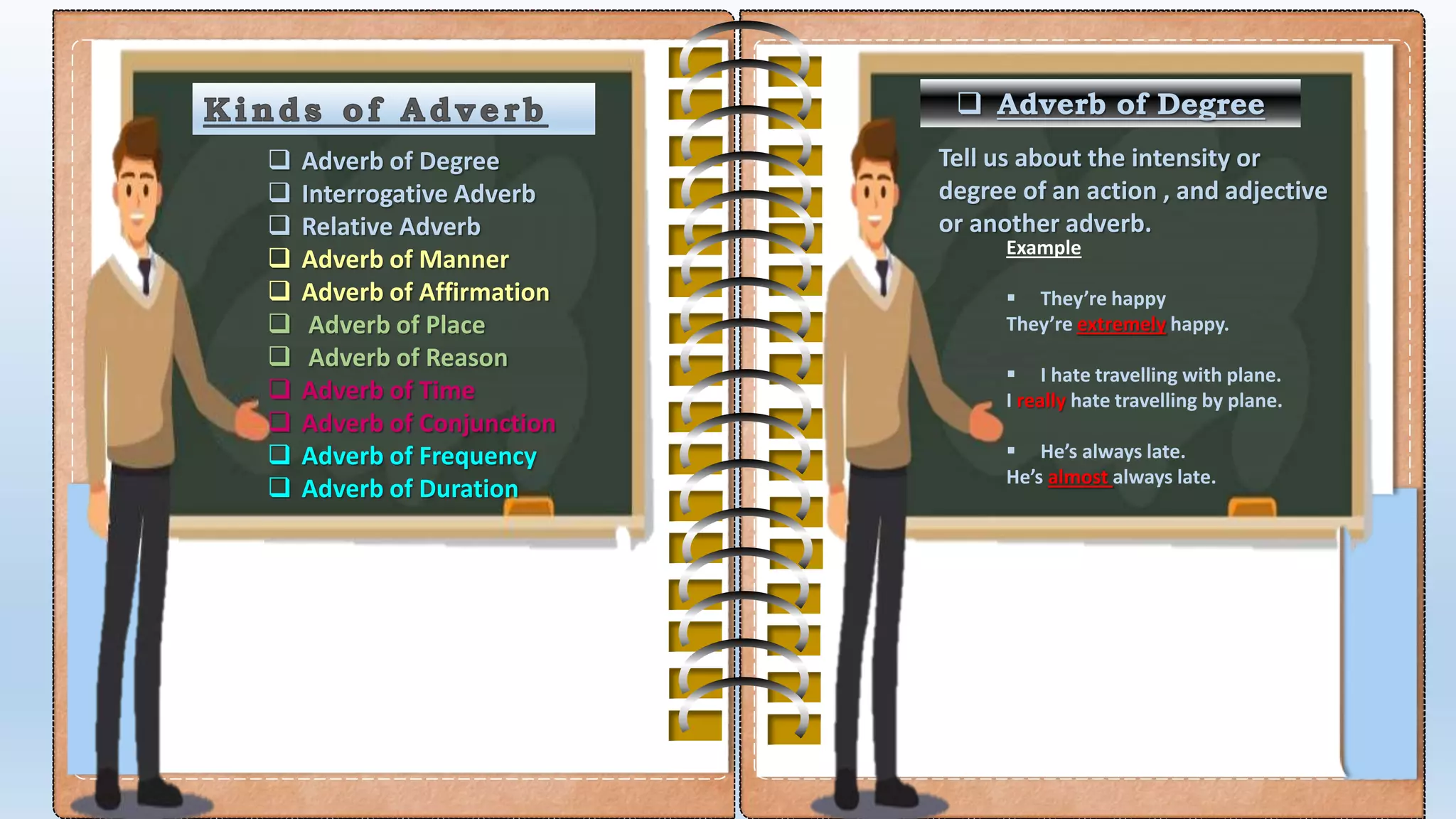
 Adverb of Degree
 Interrogative Adverb
 Relative Adverb
 Adverb of Manner
 Adverb of Affirmation
 Adverb of Place
 Adverb of Reason
 Adverb of Time
 Adverb of Conjunction
 Adverb of Frequency
 Adverb of Duration
 Adverb of Degree
Example
 They’re happy
They’re extremely happy.
 I hate travelling with plane.
I really hate travelling by plane.
 He’s always late.
He’s almost always late.
Tell us about the intensity or
degree of an action , and adjective
or another adverb.
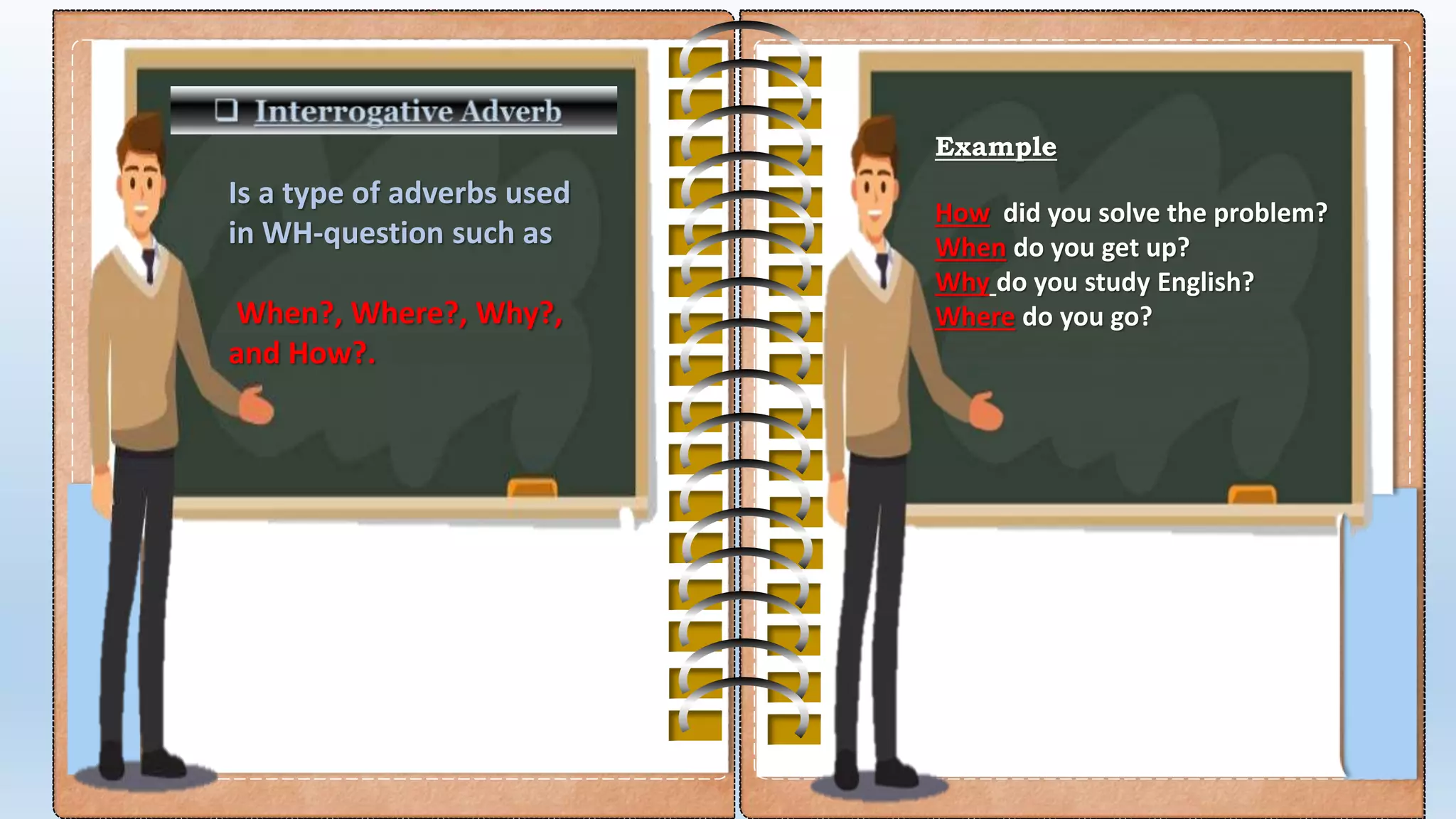
Is a type of adverbs used
in WH-question such as
When?, Where?, Why?,
and How?.
Example
How did you solve the problem?
When do you get up?
Why do you study English?
Where do you go?
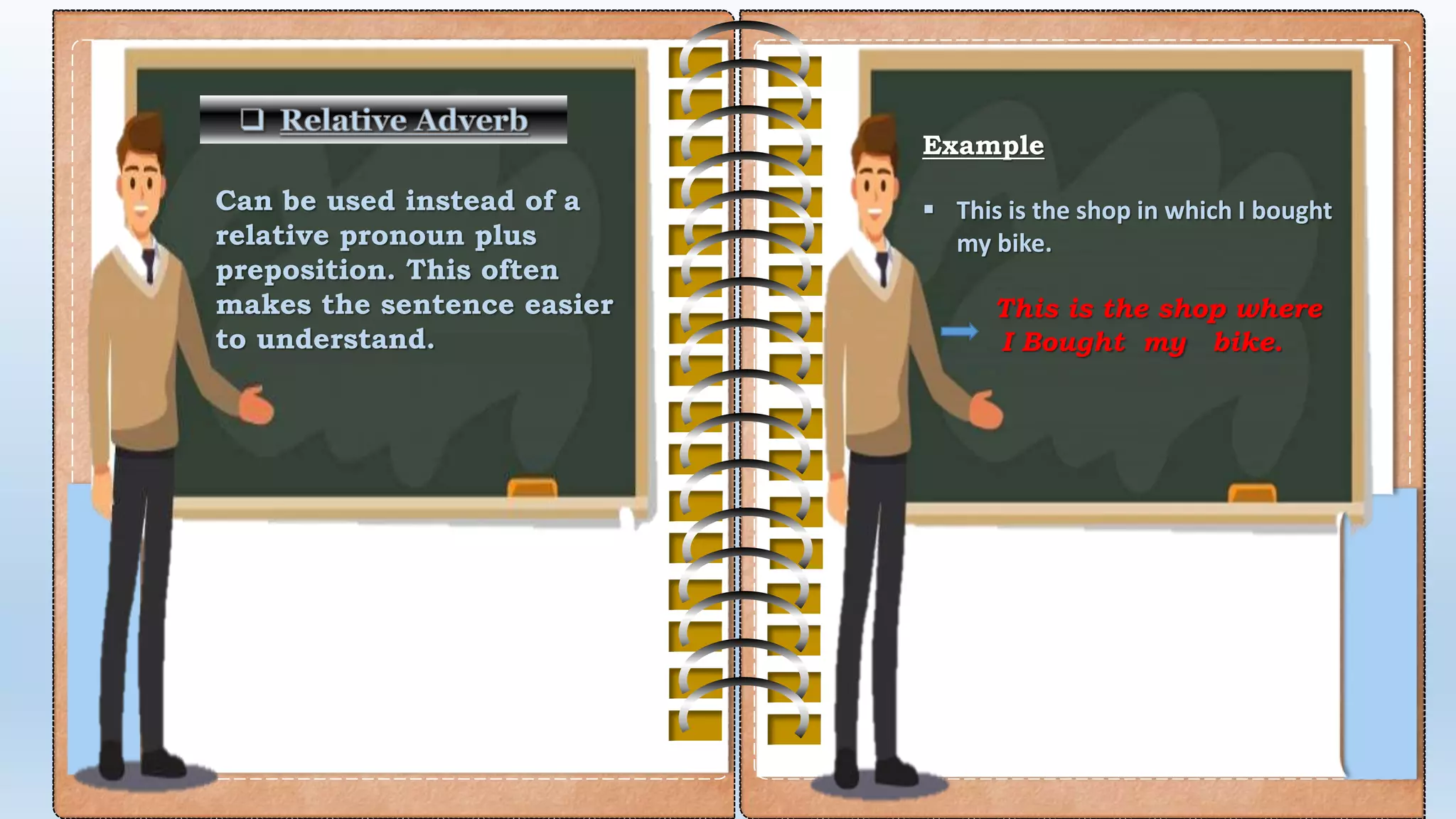
Can be used instead of a
relative pronoun plus
preposition. This often
makes the sentence easier
to understand.
Example
 This is the shop in which I bought
my bike.
This is the shop where
I Bought my bike.
Examples in sentence
The children were playing happily with
their toys.
The police dealt with the incident
very efficiently.
Birds sang cheerfully in the trees.
describe how something happens. (such
as cheerfully, efficiently, painfully, secretly,
quietly, peacefully, carefully, slowly, badly,
closely, easily, well, fast, quickly, etc.)
For example it is possible to walk or run at
different speeds.
The boys ran.
 The boys ran quickly.
 The boys were tired, so they ran
more slowly than before.
Jeniffer Porras Jeniffer Porras
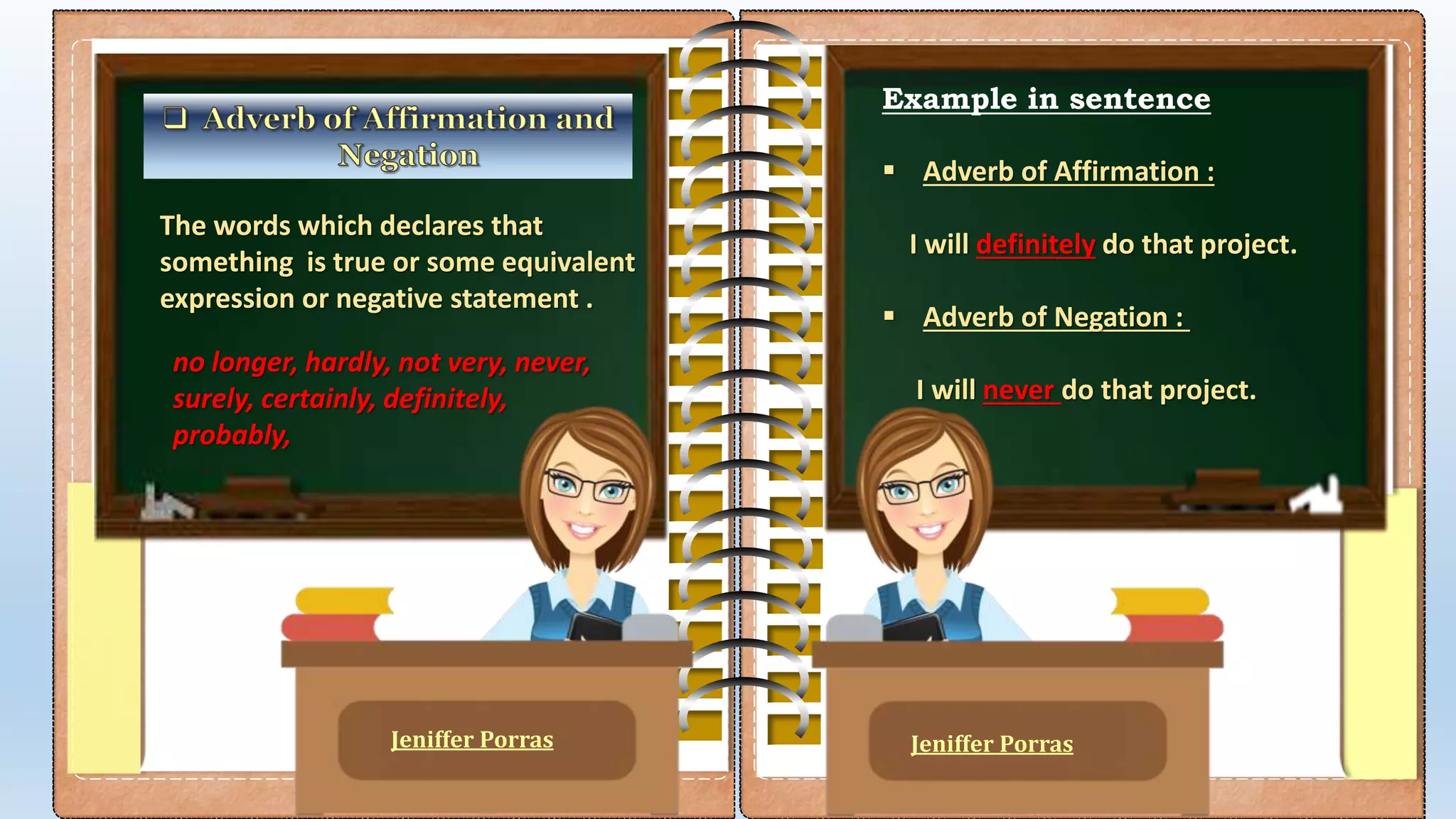
The words which declares that
something is true or some equivalent
expression or negative statement .
no longer, hardly, not very, never,
surely, certainly, definitely,
probably,
Example in sentence
 Adverb of Affirmation :
I will definitely do that project.
 Adverb of Negation :
I will never do that project.
Jeniffer Porras Jeniffer Porras
 Adverb of Place
Adverbs of place tell us where something
happens, and are usually placed after the
main verb or after the clause that they
modify. Adverbs of place do not modify
adjectives or other adverbs.
Some examples of adverbs of place
here, everywhere, outside,
away, around
Examples in sentence
•John looked around but he couldn't see
the monkey.
•I searched everywhere I could think of.
•They built a house nearby.
•She took the child outside.
Kimberly Dawn Roxas
Example in Sentence
Common adverbs of place.
Here and there
They give a location relative to the
speaker. With verbs of
movement, here means "towards
or with the speaker"
and there means "away from, or
not with the speaker".
Sentence Meaning
The table is in
there.
Go in; you can
see it by yourself
Put it there. Put it in a place
away from me.
Come here! Come towards
me.
Kimberly Dawn Roxas Kimberly Dawn Roxas
 Adverb of Purpose or
Reason
Are words those express the
reason, an aim or target behind the
happening of a particular action.
Some examples of adverbs of place
Hence, therefore, so, since,
thus, because, consequently
Example in sentence
1. I was sick, thus didn’t go to
work today.
2. Because I was late, I
jogged a little faster.
3. I started running so that
I didn’t miss the bus.
Kimberly Dawn Roxas Kimberly Dawn Roxas
are words that qualify the meaning
of a sentence by telling us when
things happen, an adverb of time is a
word that describes when, for how
long, or how often a certain action
happened.
 Adverb of time
Examples in sentence
Sometime I cycle to school
We went to the park yesterday.
I well clean my room
tomorrow.
He often swims in the pool
We have to leave now
Sometimes , Yesterday
Tomorrow, Often, Now
Some examples of adverbs of Time
Raffy Usnaine Raffy Usnaine
 Adverb of Conjunction Examples
 I tried my best: however, I
couldn’t make it.
 Hurry up; otherwise, you will
be late for the lacture.
The word which is used
to connect ideas or
clauses.
otherwise, consequently, indeed, still,
therefore, thus, accordingly, besides,
hence, instead, however, nevertheless,
nonetheless, otherwise,
Raffy Usnaine
 Adverb of Frequency
The word which expresses
frequency or how often
something occurs.
Twice , often, hourly, now and
then, again and again, usually
 Definite Frequency.
We get paid hourly
 Indefinite Frequency
I usually get up late in
weekend
Example in sentence
Jodem Calayon
Jodem Calayon
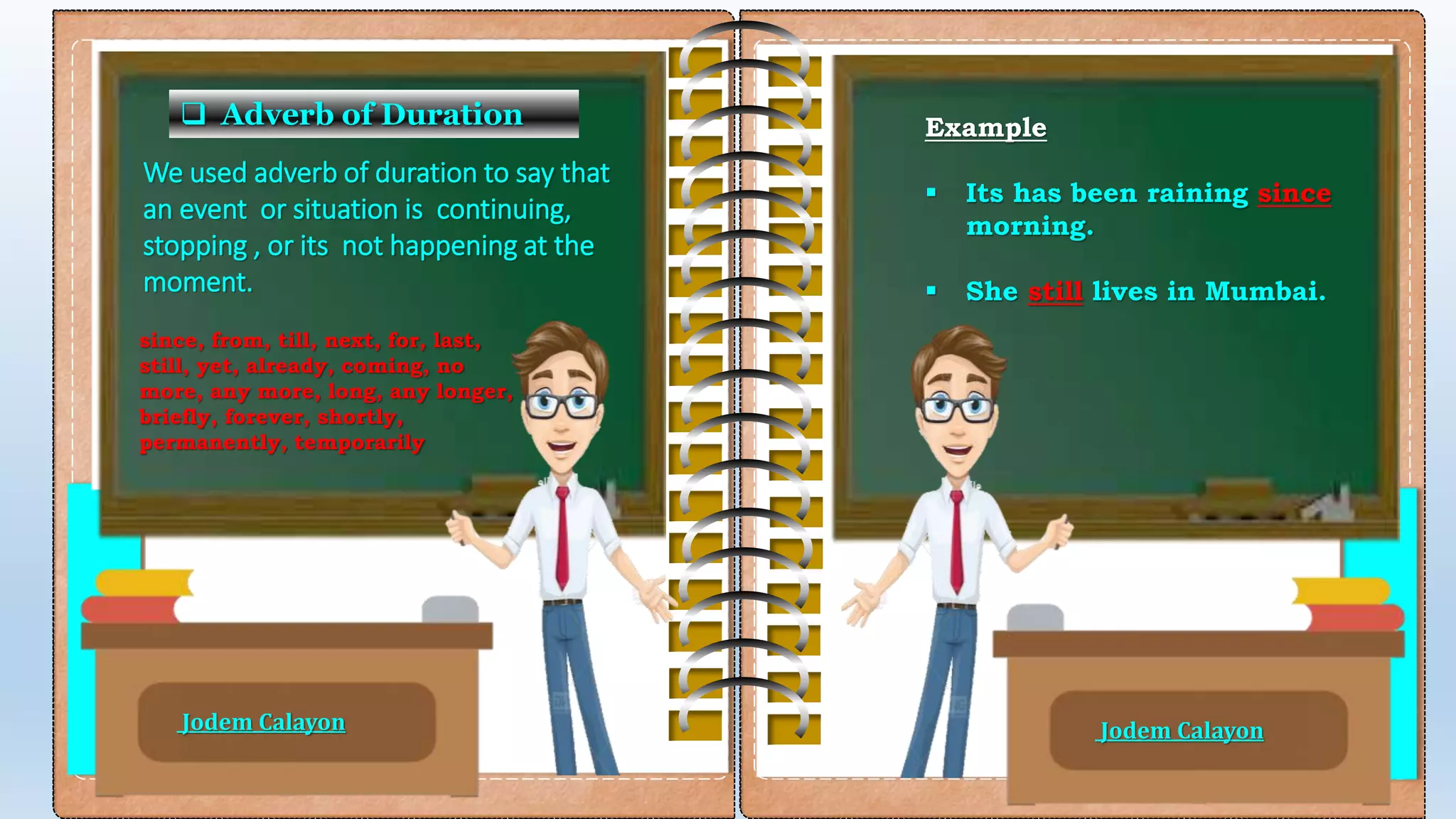
 Adverb of Duration
We used adverb of duration to say that
an event or situation is continuing,
stopping , or its not happening at the
moment.
since, from, till, next, for, last,
still, yet, already, coming, no
more, any more, long, any longer,
briefly, forever, shortly,
permanently, temporarily
Example
 Its has been raining since
morning.
 She still lives in Mumbai.
Jodem Calayon Jodem Calayon
Adverbs  and kinds of adverbs

Adverbs and kinds of adverbs

  • 1.
    Schola de SanJose Cannery Road, Polomolok, South Cotabato Structure of English Johnmark Soriano Jeniffer Porras By: Kimberly Dawn Roxas Raffy Usnaine Jodem Calayon Sir Niño Jacobe Teacher
  • 3.
     Defining tounderstand what is an Adverbs.  Examine the different types of adverbs are classification according to their functions.
  • 4.
    Introduction How? How often? When? Where? quicklyalways after away happily everyday early home sadly often today near slowly once since there Adverb • An adverb is a word or an expression that modifies a verb, adjective, another adverb, determiner, clause, preposition, or sentence. • This means that an adverb shows how, when and where some action, event or situation happened.
  • 5.
    Examples She runs quickly. Theywere really unhappy. John plays tennis very well. verb adverb pronoun He touched it gently Johnmark Soriano
  • 6.
     Adverb ofDegree  Interrogative Adverb  Relative Adverb  Adverb of Manner  Adverb of Affirmation  Adverb of Place  Adverb of Reason  Adverb of Time  Adverb of Conjunction  Adverb of Frequency  Adverb of Duration  Adverb of Degree Example  They’re happy They’re extremely happy.  I hate travelling with plane. I really hate travelling by plane.  He’s always late. He’s almost always late. Tell us about the intensity or degree of an action , and adjective or another adverb.
  • 7.
    Is a typeof adverbs used in WH-question such as When?, Where?, Why?, and How?. Example How did you solve the problem? When do you get up? Why do you study English? Where do you go?
  • 8.
    Can be usedinstead of a relative pronoun plus preposition. This often makes the sentence easier to understand. Example  This is the shop in which I bought my bike. This is the shop where I Bought my bike.
  • 9.
    Examples in sentence Thechildren were playing happily with their toys. The police dealt with the incident very efficiently. Birds sang cheerfully in the trees. describe how something happens. (such as cheerfully, efficiently, painfully, secretly, quietly, peacefully, carefully, slowly, badly, closely, easily, well, fast, quickly, etc.) For example it is possible to walk or run at different speeds. The boys ran.  The boys ran quickly.  The boys were tired, so they ran more slowly than before. Jeniffer Porras Jeniffer Porras
  • 10.
    The words whichdeclares that something is true or some equivalent expression or negative statement . no longer, hardly, not very, never, surely, certainly, definitely, probably, Example in sentence  Adverb of Affirmation : I will definitely do that project.  Adverb of Negation : I will never do that project. Jeniffer Porras Jeniffer Porras
  • 11.
     Adverb ofPlace Adverbs of place tell us where something happens, and are usually placed after the main verb or after the clause that they modify. Adverbs of place do not modify adjectives or other adverbs. Some examples of adverbs of place here, everywhere, outside, away, around Examples in sentence •John looked around but he couldn't see the monkey. •I searched everywhere I could think of. •They built a house nearby. •She took the child outside. Kimberly Dawn Roxas
  • 12.
    Example in Sentence Commonadverbs of place. Here and there They give a location relative to the speaker. With verbs of movement, here means "towards or with the speaker" and there means "away from, or not with the speaker". Sentence Meaning The table is in there. Go in; you can see it by yourself Put it there. Put it in a place away from me. Come here! Come towards me. Kimberly Dawn Roxas Kimberly Dawn Roxas
  • 13.
     Adverb ofPurpose or Reason Are words those express the reason, an aim or target behind the happening of a particular action. Some examples of adverbs of place Hence, therefore, so, since, thus, because, consequently Example in sentence 1. I was sick, thus didn’t go to work today. 2. Because I was late, I jogged a little faster. 3. I started running so that I didn’t miss the bus. Kimberly Dawn Roxas Kimberly Dawn Roxas
  • 14.
    are words thatqualify the meaning of a sentence by telling us when things happen, an adverb of time is a word that describes when, for how long, or how often a certain action happened.  Adverb of time Examples in sentence Sometime I cycle to school We went to the park yesterday. I well clean my room tomorrow. He often swims in the pool We have to leave now Sometimes , Yesterday Tomorrow, Often, Now Some examples of adverbs of Time Raffy Usnaine Raffy Usnaine
  • 15.
     Adverb ofConjunction Examples  I tried my best: however, I couldn’t make it.  Hurry up; otherwise, you will be late for the lacture. The word which is used to connect ideas or clauses. otherwise, consequently, indeed, still, therefore, thus, accordingly, besides, hence, instead, however, nevertheless, nonetheless, otherwise, Raffy Usnaine
  • 16.
     Adverb ofFrequency The word which expresses frequency or how often something occurs. Twice , often, hourly, now and then, again and again, usually  Definite Frequency. We get paid hourly  Indefinite Frequency I usually get up late in weekend Example in sentence Jodem Calayon Jodem Calayon
  • 17.
     Adverb ofDuration We used adverb of duration to say that an event or situation is continuing, stopping , or its not happening at the moment. since, from, till, next, for, last, still, yet, already, coming, no more, any more, long, any longer, briefly, forever, shortly, permanently, temporarily Example  Its has been raining since morning.  She still lives in Mumbai. Jodem Calayon Jodem Calayon