Presented by
Group 10
UM15237 Smarak Pattnaik
UM15238 Somjit Swain
UM15239 Soumya Tayal
UM15240 Sourabh Jain
UM15241 Sudhiranjan Pathy
UM15242 Suprita Padhee
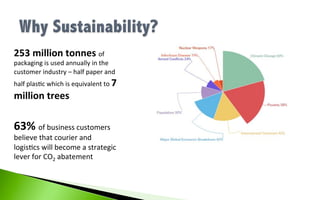
253	million	tonnes	of	
packaging	is	used	annually	in	the	
customer	industry	–	half	paper	and	
half	plas6c	which	is	equivalent	to	7	
million	trees
63%	of	business	customers	
believe	that	courier	and	
logis6cs	will	become	a	strategic	
lever	for	CO2	abatement
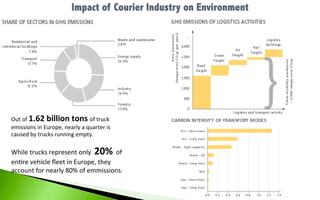
Out	of	1.62	billion	tons	of	truck	
emissions	in	Europe,	nearly	a	quarter	is	
caused	by	trucks	running	empty.
While	trucks	represent	only		20%	of	
en6re	vehicle	fleet	in	Europe,	they	
account	for	nearly	80%	of	emmissions.
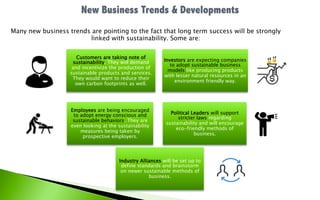
Many new business trends are pointing to the fact that long term success will be strongly
linked with sustainability. Some are:
Customers are taking note of
sustainability. They will demand
and incentivize the production of
sustainable products and services.
They would want to reduce their
own carbon footprints as well.
Investors are expecting companies
to adopt sustainable business
models like producing products
with lesser natural resources in an
environment friendly way.
Employees are being encouraged
to adopt energy conscious and
sustainable behaviors. They are
even looking at the sustainability
measures being taken by
prospective employers.
Political Leaders will support
stricter laws regarding
sustainability and will encourage
eco-friendly methods of
business.
Industry Alliances will be set up to
define standards and brainstorm
on newer sustainable methods of
business.
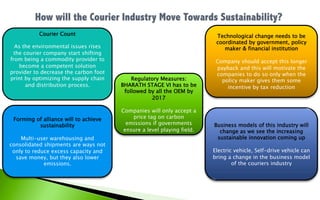
Courier Count
As the environmental issues rises
the courier company start shifting
from being a commodity provider to
become a competent solution
provider to decrease the carbon foot
print by optimizing the supply chain
and distribution process.
Technological change needs to be
coordinated by government, policy
maker & financial institution
Company should accept this longer
payback and this will motivate the
companies to do so only when the
policy maker gives them some
incentive by tax reduction
Forming of alliance will to achieve
sustainability
Multi-user warehousing and
consolidated shipments are ways not
only to reduce excess capacity and
save money, but they also lower
emissions.
Business models of this industry will
change as we see the increasing
sustainable innovation coming up
Electric vehicle, Self-drive vehicle can
bring a change in the business model
of the couriers industry
Regulatory Measures:
BHARATH STAGE VI has to be
followed by all the OEM by
2017
Companies will only accept a
price tag on carbon
emissions if governments
ensure a level playing field.
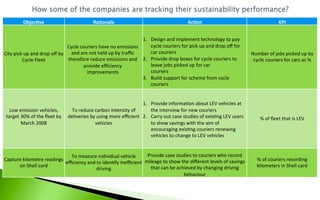
Objec8ve		 Ra8onale	 Ac8on	 KPI	
City	pick	up	and	drop	off	by	
Cycle	Fleet	
1.  Design	and	implement	technology	to	pay	
cycle	couriers	for	pick	up	and	drop	off	for	
car	couriers					
2.  Provide	drop	boxes	for	cycle	couriers	to	
leave	jobs	picked	up	for	car	
couriers		
3.  Build	support	for	scheme	from	cycle	
couriers	
Number	of	jobs	picked	up	by	
cycle	couriers	for	cars	as	%	


Low	emission	vehicles,	
target	30%	of	the	fleet	by	
March	2008	


To	reduce	carbon	intensity	of	
deliveries	by	using	more	efficient	
vehicles	
1.  Provide	informa6on	about	LEV	vehicles	at	
the	interview	for	new	couriers	
2.  Carry	out	case	studies	of	exis6ng	LEV	users	
to	show	savings	with	the	aim	of	
encouraging	exis6ng	couriers	renewing	
vehicles	to	change	to	LEV	vehicles	
%	of	fleet	that	is	LEV	
Capture	kilometre	readings	
on	Shell	card	
To	measure	individual	vehicle	
efficiency	and	to	iden6fy	inefficient	
driving	
Provide	case	studies	to	couriers	who	record	
mileage	to	show	the	different	levels	of	savings	
that	can	be	achieved	by	changing	driving	
behaviour	
%	of	couriers	recording	
kilometers	in	Shell	card	
Cycle	couriers	have	no	emissions	
and	are	not	held	up	by	traffic	
therefore	reduce	emissions	and	
provide	efficiency	
improvements
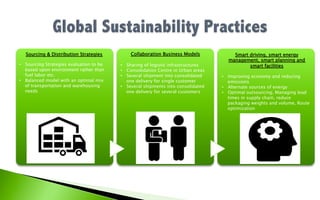
Sourcing & Distribution Strategies
•  Sourcing Strategies evaluation to be
based upon environment rather than
fuel labor etc.
•  Balanced model with an optimal mix
of transportation and warehousing
needs
Collaboration Business Models
•  Sharing of logistic infrastructures
•  Consolidation Centre in Urban areas
•  Several shipment into consolidated
one delivery for single customer
•  Several shipments into consolidated
one delivery for several customers
Smart driving, smart energy
management, smart planning and
smart facilities
•  Improving economy and reducing
emissions
•  Alternate sources of energy
•  Optimal outsourcing, Managing lead
times in supply chain, reduce
packaging weights and volume, Route
optimization
DomesticInternational
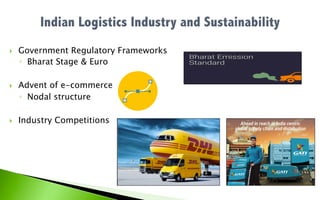
}  Government Regulatory Frameworks
◦  Bharat Stage & Euro
}  Advent of e-commerce
◦  Nodal structure
}  Industry Competitions
FedEx has set the following goals:
•  Reduce aircraft emissions 30% by 2020 on an emissions per available-ton-mile
basis.
•  Increase FedEx Express vehicle efficiency by 30% by 2020.
•  Get 30% of our jet fuel from alternative fuels by 2030.
•  Expand on-site renewable energy generation and procurement of renewable
energy credits.
Some Accomplishments:
•  FedEx currently operates 118 all-electric trucks and 364 commercial hybrid
trucks.
•  The company has begun operating Boeing 777F aircraft, which use 18 % less
fuel than the MD11 freighters and provide greater payload capacity.
•  All FedEx branded envelopes are now carbon neutral.
•  The automation tool FedEx Electronic Trade Documents (ETD) enables
customers to upload their international shipment documentation electronically
•  At its Cologne hub, the company operates a solar power system that has the
capacity to produce more than 800,000 kilowatt hours of electricity each year.
EarthSmart is FedEx commitment to environmental sustainability. The program
bundles initiatives that offer tangible business and environmental benefits. This
initiative covers the span of FedEx impact: business solutions, workplace culture and
community outreach. Projects must meet high, measurable standards to qualify
EarthSmart designation.
Three Pillars of Earth Smart:
•  EarthSmart Innovations – FedEx services and assets, including trucks, services and
facilities which meet strict, quantifiable standards for innovation and
environmental sustainability.
•  EarthSmart Outreach  – Through a variety of global and local philanthropic
endeavours, FedEx advances its commitment to making communities cleaner,
healthier and more efficient by encouraging sustainable transportation, green
urban spaces and resilient ecosystems.
•  EarthSmart@Work – Programs which engage FedEx team members on sustainability
matters and help them to make significant contributions to the environmental
sustainability of its business qualify as EarthSmart@Work initiatives.
DHL has launched the DHL Carbon Calculator. With the introduction of the
Carbon Calculator, DHL now allows its customers to calculate, free of
charge, transport-related emissions for almost all shipment sizes and
modes of transport.
•  The calculation is carried out online based on intelligent algorithms  
using data from the DHL Carbon Accounting and Controlling
department. The computational methodology reflects the recognized
Greenhouse Gas Protocol standards, the European Standard EN 16258
as well as the guidelines of the Global Logistics Emissions Council. 
•  The new Carbon Calculator helps customers understand and reduce the
environmental impact of their supply chains.
•  With its Green Optimization service, DHL also offers customized
logistics solutions to help customers reduce GHG emissions and
minimize the environmental impact of their logistics processes.
Mahindra Logistics actively works to reduce the impact of the Green House Gases
(GHS) on the environment as a part of its sustainability initiatives.
•  Network Optimization: By aggregating the loads across its network, MLL is able
to deploy the right type of vehicle to   meet this aggregated loads without
compromising on the service levels   ensuring no delivery and damage free
deliveries.
•  Load & Vehicle Optimization: Redesigning various fixtures / packing /  carrying
fixture of the transport vehicle also help in optimizing the capacity utilization.
This directly results in lowering of fuel consumption thereby reducing the GHG
emissions.
•  Alternative mode of Transportation: In order to reduce the GHG emissions
further, MLL is also working on alternative modes of transportation with reduced
GHG emissions.
•  Alternative fuel: Wherever possible, MLL deploys vehicles that work on alternate
fuels which are environmentally friendly. As part of this initiative, MLL uses Reva
vehicles (electrically powered) in some of its customer premises.
•  New Fleet Induction: One of the newest initiatives taken up by MLL, this aims at
replacing the older vehicles with higher emissions and lower fuel efficiencies with
newer vehicles that are fuel efficient and low on emissions.
Gati believes that the environment be used in a way that is sustainable. The
company ensures that the use of natural resources will meet the present day needs
for the resource without jeopardizing the supply of the resource for future
generations.
•  Association with the Sunderban Project : To help the Tagore Society for Rural
Development (TSRD) in its mission, GATI has sponsored the publication of study
material (books & journals) which will be distributed to schools, colleges and
self-help groups so that necessary steps can be taken to preserve the eco-
harmony of Sunderban.
•  Gati Goes Green: As a step towards its internal green initiatives, Gati has made it
mandatory for all its Express Distribution Centres and Warehouses across the
country to plant and maintain a green stretch in and around their premises.
•  GPS tracking of Gati Fleet enables saving fuel by better managing time and route.
•  Paper Recycling: 69.60 tonnes of waste paper recycled by Gati as per their
Annual Report 2015-16.
Thank You!

(Ximb) sustainability courier industry

  • 2.
    Presented by Group 10 UM15237Smarak Pattnaik UM15238 Somjit Swain UM15239 Soumya Tayal UM15240 Sourabh Jain UM15241 Sudhiranjan Pathy UM15242 Suprita Padhee
  • 3.
  • 4.
  • 5.
    Many new businesstrends are pointing to the fact that long term success will be strongly linked with sustainability. Some are: Customers are taking note of sustainability. They will demand and incentivize the production of sustainable products and services. They would want to reduce their own carbon footprints as well. Investors are expecting companies to adopt sustainable business models like producing products with lesser natural resources in an environment friendly way. Employees are being encouraged to adopt energy conscious and sustainable behaviors. They are even looking at the sustainability measures being taken by prospective employers. Political Leaders will support stricter laws regarding sustainability and will encourage eco-friendly methods of business. Industry Alliances will be set up to define standards and brainstorm on newer sustainable methods of business.
  • 6.
    Courier Count As theenvironmental issues rises the courier company start shifting from being a commodity provider to become a competent solution provider to decrease the carbon foot print by optimizing the supply chain and distribution process. Technological change needs to be coordinated by government, policy maker & financial institution Company should accept this longer payback and this will motivate the companies to do so only when the policy maker gives them some incentive by tax reduction Forming of alliance will to achieve sustainability Multi-user warehousing and consolidated shipments are ways not only to reduce excess capacity and save money, but they also lower emissions. Business models of this industry will change as we see the increasing sustainable innovation coming up Electric vehicle, Self-drive vehicle can bring a change in the business model of the couriers industry Regulatory Measures: BHARATH STAGE VI has to be followed by all the OEM by 2017 Companies will only accept a price tag on carbon emissions if governments ensure a level playing field.
  • 7.
    Objec8ve Ra8onale Ac8on KPI City pick up and drop off by Cycle Fleet 1.  Design and implement technology to pay cycle couriers for pick up and drop off for car couriers 2.  Provide drop boxes for cycle couriers to leave jobs picked up for car couriers 3.  Build support for scheme from cycle couriers Number of jobs picked up by cycle couriers for cars as % Low emission vehicles, target 30% of the fleet by March 2008 To reduce carbon intensity of deliveries by using more efficient vehicles 1.  Provide informa6on about LEV vehicles at the interview for new couriers 2.  Carry out case studies of exis6ng LEV users to show savings with the aim of encouraging exis6ng couriers renewing vehicles to change to LEV vehicles % of fleet that is LEV Capture kilometre readings on Shell card To measure individual vehicle efficiency and to iden6fy inefficient driving Provide case studies to couriers who record mileage to show the different levels of savings that can be achieved by changing driving behaviour % of couriers recording kilometers in Shell card Cycle couriers have no emissions and are not held up by traffic therefore reduce emissions and provide efficiency improvements
  • 8.
    Sourcing & DistributionStrategies •  Sourcing Strategies evaluation to be based upon environment rather than fuel labor etc. •  Balanced model with an optimal mix of transportation and warehousing needs Collaboration Business Models •  Sharing of logistic infrastructures •  Consolidation Centre in Urban areas •  Several shipment into consolidated one delivery for single customer •  Several shipments into consolidated one delivery for several customers Smart driving, smart energy management, smart planning and smart facilities •  Improving economy and reducing emissions •  Alternate sources of energy •  Optimal outsourcing, Managing lead times in supply chain, reduce packaging weights and volume, Route optimization
  • 9.
  • 10.
    }  Government RegulatoryFrameworks ◦  Bharat Stage & Euro }  Advent of e-commerce ◦  Nodal structure }  Industry Competitions
  • 11.
    FedEx has setthe following goals: •  Reduce aircraft emissions 30% by 2020 on an emissions per available-ton-mile basis. •  Increase FedEx Express vehicle efficiency by 30% by 2020. •  Get 30% of our jet fuel from alternative fuels by 2030. •  Expand on-site renewable energy generation and procurement of renewable energy credits. Some Accomplishments: •  FedEx currently operates 118 all-electric trucks and 364 commercial hybrid trucks. •  The company has begun operating Boeing 777F aircraft, which use 18 % less fuel than the MD11 freighters and provide greater payload capacity. •  All FedEx branded envelopes are now carbon neutral. •  The automation tool FedEx Electronic Trade Documents (ETD) enables customers to upload their international shipment documentation electronically •  At its Cologne hub, the company operates a solar power system that has the capacity to produce more than 800,000 kilowatt hours of electricity each year.
  • 12.
    EarthSmart is FedExcommitment to environmental sustainability. The program bundles initiatives that offer tangible business and environmental benefits. This initiative covers the span of FedEx impact: business solutions, workplace culture and community outreach. Projects must meet high, measurable standards to qualify EarthSmart designation. Three Pillars of Earth Smart: •  EarthSmart Innovations – FedEx services and assets, including trucks, services and facilities which meet strict, quantifiable standards for innovation and environmental sustainability. •  EarthSmart Outreach  – Through a variety of global and local philanthropic endeavours, FedEx advances its commitment to making communities cleaner, healthier and more efficient by encouraging sustainable transportation, green urban spaces and resilient ecosystems. •  EarthSmart@Work – Programs which engage FedEx team members on sustainability matters and help them to make significant contributions to the environmental sustainability of its business qualify as EarthSmart@Work initiatives.
  • 13.
    DHL has launchedthe DHL Carbon Calculator. With the introduction of the Carbon Calculator, DHL now allows its customers to calculate, free of charge, transport-related emissions for almost all shipment sizes and modes of transport. •  The calculation is carried out online based on intelligent algorithms   using data from the DHL Carbon Accounting and Controlling department. The computational methodology reflects the recognized Greenhouse Gas Protocol standards, the European Standard EN 16258 as well as the guidelines of the Global Logistics Emissions Council.  •  The new Carbon Calculator helps customers understand and reduce the environmental impact of their supply chains. •  With its Green Optimization service, DHL also offers customized logistics solutions to help customers reduce GHG emissions and minimize the environmental impact of their logistics processes.
  • 14.
    Mahindra Logistics activelyworks to reduce the impact of the Green House Gases (GHS) on the environment as a part of its sustainability initiatives. •  Network Optimization: By aggregating the loads across its network, MLL is able to deploy the right type of vehicle to   meet this aggregated loads without compromising on the service levels   ensuring no delivery and damage free deliveries. •  Load & Vehicle Optimization: Redesigning various fixtures / packing /  carrying fixture of the transport vehicle also help in optimizing the capacity utilization. This directly results in lowering of fuel consumption thereby reducing the GHG emissions. •  Alternative mode of Transportation: In order to reduce the GHG emissions further, MLL is also working on alternative modes of transportation with reduced GHG emissions. •  Alternative fuel: Wherever possible, MLL deploys vehicles that work on alternate fuels which are environmentally friendly. As part of this initiative, MLL uses Reva vehicles (electrically powered) in some of its customer premises. •  New Fleet Induction: One of the newest initiatives taken up by MLL, this aims at replacing the older vehicles with higher emissions and lower fuel efficiencies with newer vehicles that are fuel efficient and low on emissions.
  • 15.
    Gati believes thatthe environment be used in a way that is sustainable. The company ensures that the use of natural resources will meet the present day needs for the resource without jeopardizing the supply of the resource for future generations. •  Association with the Sunderban Project : To help the Tagore Society for Rural Development (TSRD) in its mission, GATI has sponsored the publication of study material (books & journals) which will be distributed to schools, colleges and self-help groups so that necessary steps can be taken to preserve the eco- harmony of Sunderban. •  Gati Goes Green: As a step towards its internal green initiatives, Gati has made it mandatory for all its Express Distribution Centres and Warehouses across the country to plant and maintain a green stretch in and around their premises. •  GPS tracking of Gati Fleet enables saving fuel by better managing time and route. •  Paper Recycling: 69.60 tonnes of waste paper recycled by Gati as per their Annual Report 2015-16.
  • 16.