Developing a Social Media Plan


 Tirza Hollenhorst       Barrett Michael
 tirzalyn@ifpeople.net   bmichael@ifpeople.net
 678 608 3408            281 844 1184
 www.ifpeople.net        www.ifpeople.net
What’s this whole
social media thing?
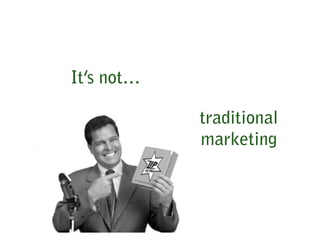
It’s not…

            traditional
            marketing
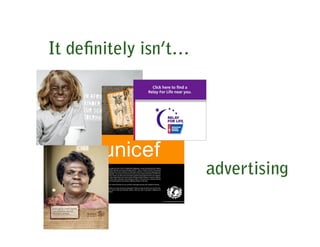
It definitely isn’t…


                      advertising
Social media defines the activities
 that integrate technology, social
  interaction and the sharing of
 words, images, video and audio.
In other words…


        Social media is a
        conversation that
       takes place online.
It’s a conversation
 more people are
joining every day.
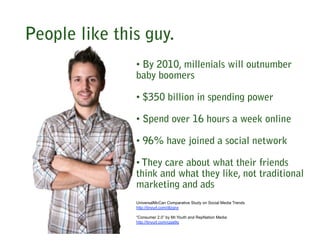
People like this guy.
               • By 2010, millenials will outnumber
               baby boomers

               • $350 billion in spending power

               • Spend over 16 hours a week online

               • 96% have joined a social network

               • They care about what their friends
               think and what they like, not traditional
               marketing and ads
               UniversalMcCan Comparative Study on Social Media Trends
               http://tinyurl.com/dlzqnx

               “Consumer 2.0” by Mr.Youth and RepNation Media
               http://tinyurl.com/cpja9q
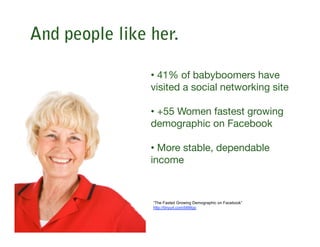
And people like her.

                • 41% of babyboomers have
                visited a social networking site

                • +55 Women fastest growing
                demographic on Facebook

                • More stable, dependable
                income 


                “The Fasted Growing Demographic on Facebook”
                http://tinyurl.com/bl99qo
Social media is...

Consumer-driven
  Transparent
   Engaging
   Inclusive
    Sincere
It isn’t…

Controlled
Impersonal
 Exclusive
  Formal
 One-sided
Conversations are easy.
Why is social media hard?
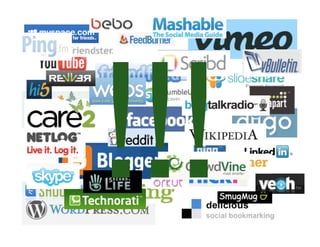
!
!

 !

So many channels.
   So many people
So many conversations.

    So little time.
How do I decide
  what channels to use,
 what people to engage,
what conversations to join?
Strategy
( a really, really good one)
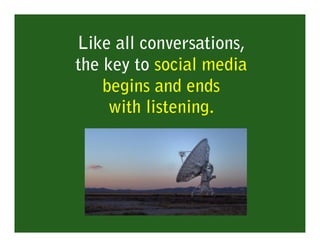
Like all conversations,
the key to social media
    begins and ends
     with listening.
Step 1
Listen to yourself
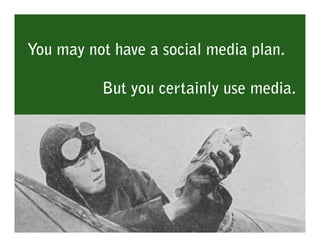
You may not have a social media plan.

          But you certainly use media.
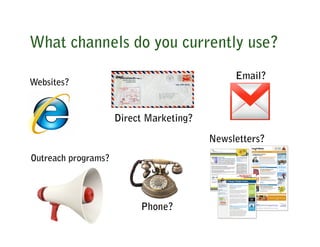
What channels do you currently use?
                                              Email?
Websites?


                     Direct Marketing?

                                         Newsletters?
Outreach programs?


                          Phone?
Ask yourself questions...


   What tone do these channels convey?
       Who are my intended targets?
    Am I reaching my intended targets?
   Do these channels reflect our mission?
   What overall message does my brand
              communicate?
Most importantly…


              What’s missing?
    Where do these channels fall short?
    Are there people we should target
                 but aren’t?
   Online, are we passive participants or
              active engagers?
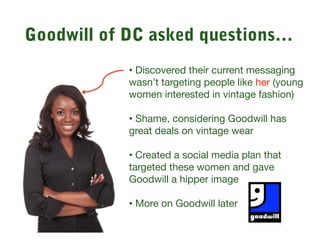
Goodwill of DC asked questions…
            • Discovered their current messaging
            wasn’t targeting people like her (young
            women interested in vintage fashion)

            • Shame, considering Goodwill has
            great deals on vintage wear 

            • Created a social media plan that
            targeted these women and gave
            Goodwill a hipper image

            • More on Goodwill later
Asking questions reminds you who you
are and who you want to be.

It also indicates how social media can be
used to complement your overall
mission.
Step 2
Listen to others
The conversation has already started.

             Research before joining in.
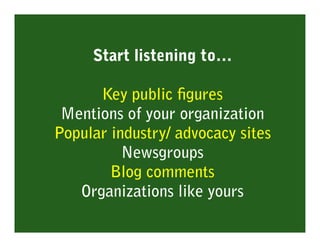
Start listening to…

      Key public figures
 Mentions of your organization
Popular industry/ advocacy sites
          Newsgroups
        Blog comments
   Organizations like yours
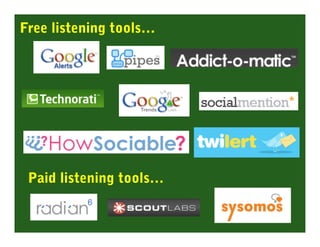
Free listening tools…


Paid listening tools…
Let’s get a closer look…


   http://www.google.com/alerts


                                                               http://pipes.yahoo.com/pipes/


                                  http://www.technorati.com/
Ask yourself…
What attitudes define me and my issues?
What sites have the most activity related
to my organization?
What kind of people do the most posting?
What other organizations and issues are
these people connected to?
What kind of negative comments or
misconceptions exist?
What will you discover?
   Better understanding of your brand
               presence

   Online communities you should join

Targets and influencers you should engage

       Values you should promote

      Attitudes you should change
Step 3
Create personas
Personas are…


         Descriptions of individuals that
         represent your target.

         They’re not real people.

         Just archetypes that represent
         real people.
Personas…

Help you identify potential character
traits, personalities, habits and
attitudes of your target.

This helps you create a social media
plan of ideal scope and size.
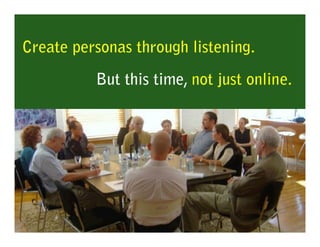
Create personas through listening.
          But this time, not just online.
Interview stakeholders in person...

         Where do you go online?
    How much time do you spend there?
             Do you comment?
    Do you initiate online conversations?
     What social networks do you use?
     Would you feel comfortable if our
      organization joined you online?
Step 4
Map your assets
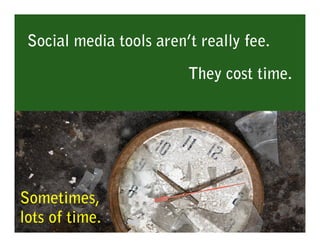
Social media tools aren’t really fee.

                         They cost time.


Sometimes,
lots of time.
How many hours and how many people
   can I devote to implementing
       a social media plan?
Take note of…

  Size and technical experience of staff
Volunteer base (long-term vs short term)
     Time staff members can devote
             to social media
Content already produced that can be used
           on social media sites
This makes your social media plan…

              Realistic
             Managable
             Achievable
              Efficient
         And not the source
        of tears and anguish
Step 5
Define your goals
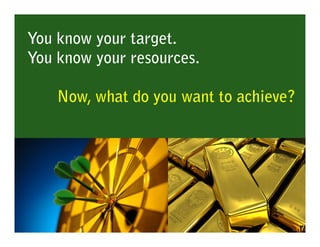
You know your target.
You know your resources.

    Now, what do you want to achieve?
Do you want to…

    Build better relationships?
Raise awareness about your cause?
     Increase website traffic?
       Build up your base?
     Inspire people to action?
       Increase donations?
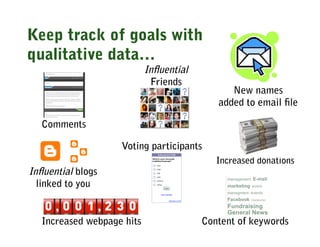
Keep track of goals with
qualitative data…
                           Influential
                            Friends
                                              New names
                                           added to email file

  Comments

                   Voting participants
                                           Increased donations
Influential blogs
  linked to you


  Increased webpage hits                Content of keywords
Set benchmarks based on
         these metrics…

        We want (n) positive
    comments per week on Twitter.
 We want $(n) from our charity mall.
We want (n) pagerank by a certain date.
We want (n) people to sign our petition.
Step 6
Clarify your message
How would I define my organization
    in a single, simple phrase?
We’re the smart fashion choice
    for hip young women.
That’s your message.

Have all your social media content
reflect it.
This will make your message…

        Focused and on point

   Have a cohesive, unifying theme

Easily grasped by short attention spans
Step 7
Select channels
Ask yourself…


     What channel best suits:
           My goals?
        My brand story?
        My resources?
           My target?
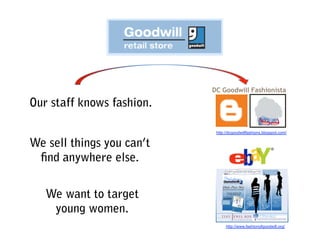
Our staff knows fashion.

                           http://dcgoodwillfashions.blogspot.com/


We sell things you can’t
 find anywhere else.


   We want to target
    young women.
                                http://www.fashionofgoodwill.org/
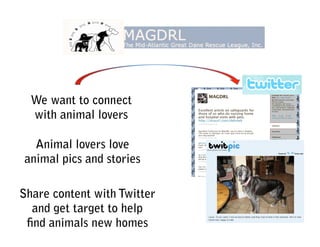
We want to connect
  with animal lovers

  Animal lovers love
animal pics and stories

Share content with Twitter
  and get target to help
 find animals new homes
Step 8
Join the Conversation
The rules of social media
are not defined.

But there are a few tips
to keep in mind.
1. Stay Transparent
• Don’t be evasive

• Always offer your full name,
your title and your organization

• Be the first to admit vested
interests
2. Keep It Conversational
• A blog post isn’t an annual report

• Write like you would write to a friend

                        • Ask questions

                        • Solicit opinions

3. Write What You Know
   • Stick to issues relating to your
   organization

   • Position yourself as an expert in
   your field

   • Add real knowledge to conversations,
   not just another opinion
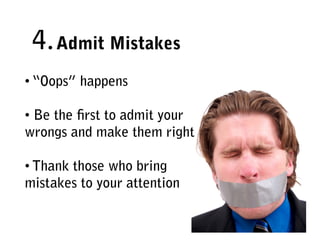
4. Admit Mistakes
• “Oops” happens

• Be the first to admit your
wrongs and make them right

• Thank those who bring
mistakes to your attention
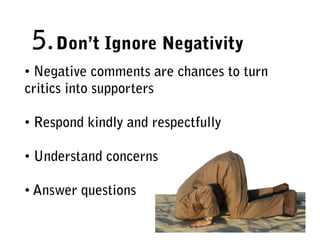
5. Don’t Ignore Negativity
• Negative comments are chances to turn
critics into supporters

• Respond kindly and respectfully

• Understand concerns

• Answer questions
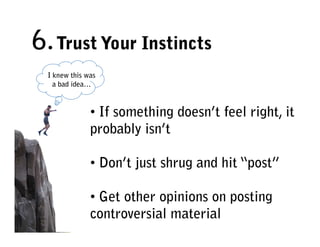
6. Trust Your Instincts
  I knew this was
    a bad idea…


               • If something doesn’t feel right, it
               probably isn’t

               • Don’t just shrug and hit “post”

               • Get other opinions on posting
               controversial material
Step 9
Listen & re-invent
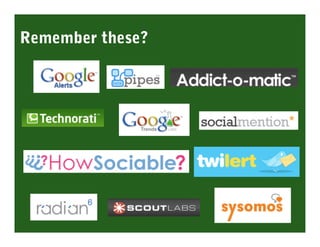
Remember these?
Never stop using them to…

 Find conversations to join
  Track responses to your
   social media activity
 Discover what messaging
    works, what doesn’t
After you listen, re-evaluate your
strategy and focus on what’s
working.

Consider dropping what isn’t.
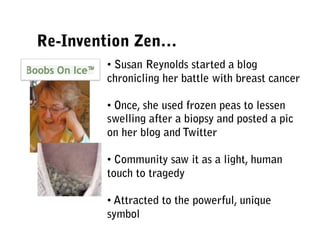
Re-Invention Zen…
        • Susan Reynolds started a blog
        chronicling her battle with breast cancer

        • Once, she used frozen peas to lessen
        swelling after a biopsy and posted a pic
        on her blog and Twitter

        • Community saw it as a light, human
        touch to tragedy

        • Attracted to the powerful, unique
        symbol
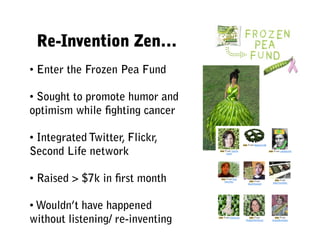
Re-Invention Zen…
• Enter the Frozen Pea Fund

• Sought to promote humor and
optimism while fighting cancer

• Integrated Twitter, Flickr,
Second Life network

• Raised > $7k in first month

• Wouldn’t have happened
without listening/ re-inventing
Social media may be here to stay.

But the tools are temporary.
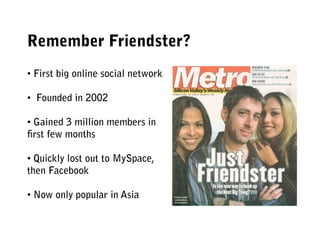
Remember Friendster?
• First big online social network

•  Founded in 2002

• Gained 3 million members in
first few months

• Quickly lost out to MySpace,
then Facebook

• Now only popular in Asia
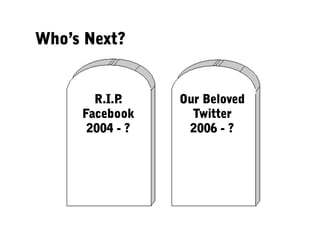
Who’s Next?

 Who’s next?

       R.I.P.    Our Beloved
     Facebook      Twitter
      2004 - ?    2006 - ?
Stay ahead of the curve…

         LISTEN

 for new places where your
  targets are congregating

to murmurs of new technology

    and continue to play
Tirza Hollenhorst       Barrett Michael
tirzalyn@ifpeople.net   bmichael@ifpeople.net
678 608 3408            281 844 1184
www.ifpeople.net        www.ifpeople.net

Advancedsocialmedia

  • 1.
    Developing a SocialMedia Plan
 Tirza Hollenhorst Barrett Michael tirzalyn@ifpeople.net bmichael@ifpeople.net 678 608 3408 281 844 1184 www.ifpeople.net www.ifpeople.net
  • 2.
  • 3.
    It’s not… traditional marketing
  • 4.
  • 5.
    Social media definesthe activities that integrate technology, social interaction and the sharing of words, images, video and audio.
  • 6.
    In other words… Social media is a conversation that takes place online.
  • 7.
    It’s a conversation more people are joining every day.
  • 8.
    People like thisguy. • By 2010, millenials will outnumber baby boomers • $350 billion in spending power • Spend over 16 hours a week online • 96% have joined a social network • They care about what their friends think and what they like, not traditional marketing and ads UniversalMcCan Comparative Study on Social Media Trends http://tinyurl.com/dlzqnx “Consumer 2.0” by Mr.Youth and RepNation Media http://tinyurl.com/cpja9q
  • 9.
    And people likeher. • 41% of babyboomers have visited a social networking site • +55 Women fastest growing demographic on Facebook • More stable, dependable income “The Fasted Growing Demographic on Facebook” http://tinyurl.com/bl99qo
  • 10.
    Social media is... Consumer-driven Transparent Engaging Inclusive Sincere
  • 11.
  • 12.
    Conversations are easy. Whyis social media hard?
  • 13.
  • 14.
    So many channels. So many people So many conversations. So little time.
  • 15.
    How do Idecide what channels to use, what people to engage, what conversations to join?
  • 16.
    Strategy ( a really,really good one)
  • 17.
    Like all conversations, thekey to social media begins and ends with listening.
  • 18.
  • 19.
    You may nothave a social media plan. But you certainly use media.
  • 20.
    What channels doyou currently use? Email? Websites? Direct Marketing? Newsletters? Outreach programs? Phone?
  • 21.
    Ask yourself questions... What tone do these channels convey? Who are my intended targets? Am I reaching my intended targets? Do these channels reflect our mission? What overall message does my brand communicate?
  • 22.
    Most importantly… What’s missing? Where do these channels fall short? Are there people we should target but aren’t? Online, are we passive participants or active engagers?
  • 23.
    Goodwill of DCasked questions… • Discovered their current messaging wasn’t targeting people like her (young women interested in vintage fashion) • Shame, considering Goodwill has great deals on vintage wear • Created a social media plan that targeted these women and gave Goodwill a hipper image • More on Goodwill later
  • 24.
    Asking questions remindsyou who you are and who you want to be. It also indicates how social media can be used to complement your overall mission.
  • 25.
  • 26.
    The conversation hasalready started. Research before joining in.
  • 27.
    Start listening to… Key public figures Mentions of your organization Popular industry/ advocacy sites Newsgroups Blog comments Organizations like yours
  • 28.
  • 29.
    Let’s get acloser look… http://www.google.com/alerts http://pipes.yahoo.com/pipes/ http://www.technorati.com/
  • 30.
    Ask yourself… What attitudesdefine me and my issues? What sites have the most activity related to my organization? What kind of people do the most posting? What other organizations and issues are these people connected to? What kind of negative comments or misconceptions exist?
  • 31.
    What will youdiscover? Better understanding of your brand presence Online communities you should join Targets and influencers you should engage Values you should promote Attitudes you should change
  • 32.
  • 33.
    Personas are… Descriptions of individuals that represent your target. They’re not real people. Just archetypes that represent real people.
  • 34.
    Personas… Help you identifypotential character traits, personalities, habits and attitudes of your target. This helps you create a social media plan of ideal scope and size.
  • 35.
    Create personas throughlistening. But this time, not just online.
  • 36.
    Interview stakeholders inperson... Where do you go online? How much time do you spend there? Do you comment? Do you initiate online conversations? What social networks do you use? Would you feel comfortable if our organization joined you online?
  • 37.
  • 38.
    Social media toolsaren’t really fee. They cost time. Sometimes, lots of time.
  • 39.
    How many hoursand how many people can I devote to implementing a social media plan?
  • 40.
    Take note of… Size and technical experience of staff Volunteer base (long-term vs short term) Time staff members can devote to social media Content already produced that can be used on social media sites
  • 41.
    This makes yoursocial media plan… Realistic Managable Achievable Efficient And not the source of tears and anguish
  • 42.
  • 43.
    You know yourtarget. You know your resources. Now, what do you want to achieve?
  • 44.
    Do you wantto… Build better relationships? Raise awareness about your cause? Increase website traffic? Build up your base? Inspire people to action? Increase donations?
  • 45.
    Keep track ofgoals with qualitative data… Influential Friends New names added to email file Comments Voting participants Increased donations Influential blogs linked to you Increased webpage hits Content of keywords
  • 46.
    Set benchmarks basedon these metrics… We want (n) positive comments per week on Twitter. We want $(n) from our charity mall. We want (n) pagerank by a certain date. We want (n) people to sign our petition.
  • 47.
  • 48.
    How would Idefine my organization in a single, simple phrase?
  • 49.
    We’re the smartfashion choice for hip young women.
  • 50.
    That’s your message. Haveall your social media content reflect it.
  • 51.
    This will makeyour message… Focused and on point Have a cohesive, unifying theme Easily grasped by short attention spans
  • 52.
  • 53.
    Ask yourself… What channel best suits: My goals? My brand story? My resources? My target?
  • 54.
    Our staff knowsfashion. http://dcgoodwillfashions.blogspot.com/ We sell things you can’t find anywhere else. We want to target young women. http://www.fashionofgoodwill.org/
  • 55.
    We want toconnect with animal lovers Animal lovers love animal pics and stories Share content with Twitter and get target to help find animals new homes
  • 56.
    Step 8 Join theConversation
  • 57.
    The rules ofsocial media are not defined. But there are a few tips to keep in mind.
  • 58.
    1. Stay Transparent • Don’tbe evasive • Always offer your full name, your title and your organization • Be the first to admit vested interests
  • 59.
    2. Keep ItConversational • A blog post isn’t an annual report • Write like you would write to a friend • Ask questions • Solicit opinions

  • 60.
    3. Write WhatYou Know • Stick to issues relating to your organization • Position yourself as an expert in your field • Add real knowledge to conversations, not just another opinion
  • 61.
    4. Admit Mistakes • “Oops”happens • Be the first to admit your wrongs and make them right • Thank those who bring mistakes to your attention
  • 62.
    5. Don’t IgnoreNegativity • Negative comments are chances to turn critics into supporters • Respond kindly and respectfully • Understand concerns • Answer questions
  • 63.
    6. Trust YourInstincts I knew this was a bad idea… • If something doesn’t feel right, it probably isn’t • Don’t just shrug and hit “post” • Get other opinions on posting controversial material
  • 64.
    Step 9 Listen &re-invent
  • 65.
  • 66.
    Never stop usingthem to… Find conversations to join Track responses to your social media activity Discover what messaging works, what doesn’t
  • 67.
    After you listen,re-evaluate your strategy and focus on what’s working. Consider dropping what isn’t.
  • 68.
    Re-Invention Zen… • Susan Reynolds started a blog chronicling her battle with breast cancer • Once, she used frozen peas to lessen swelling after a biopsy and posted a pic on her blog and Twitter • Community saw it as a light, human touch to tragedy • Attracted to the powerful, unique symbol
  • 69.
    Re-Invention Zen… • Enter theFrozen Pea Fund • Sought to promote humor and optimism while fighting cancer • Integrated Twitter, Flickr, Second Life network • Raised > $7k in first month • Wouldn’t have happened without listening/ re-inventing
  • 70.
    Social media maybe here to stay. But the tools are temporary.
  • 71.
    Remember Friendster? • First bigonline social network •  Founded in 2002 • Gained 3 million members in first few months • Quickly lost out to MySpace, then Facebook • Now only popular in Asia
  • 72.
    Who’s Next?
 Who’snext? R.I.P. Our Beloved Facebook Twitter 2004 - ? 2006 - ?
  • 73.
    Stay ahead ofthe curve… LISTEN for new places where your targets are congregating to murmurs of new technology and continue to play
  • 74.
    Tirza Hollenhorst Barrett Michael tirzalyn@ifpeople.net bmichael@ifpeople.net 678 608 3408 281 844 1184 www.ifpeople.net www.ifpeople.net