Advanced Security With GeoServer 
Ing. Mauro Bartolomeoli, GeoSolutions 
Ing. Emanuele Tajariol, GeoSolutions 
Ing. Simone Giannecchini, GeoSolutions 
Ing. Alessio Fabiani, GeoSolutions 
FOSS4G 2014, Portland 
10th September 2014
GeoSolutions 
 Founded in Italy in late 2006 
 Expertise 
• Image Processing, GeoSpatial Data Fusion 
• Java, Java Enterprise, C++, Python 
• JPEG2000, JPIP, Advanced 2D visualization 
 Supporting/Developing FOSS4G projects 
 GeoServer, MapStore 
 GeoBatch, GeoNetwork 
 Clients 
 Public Agencies 
 Private Companies 
 http://www.geo-solutions.it 
FOSS4G 2014, Portland 
10th September 2014
GeoServer Security Subsystem Overview 
FOSS4G 2014, Portland 
10th September 2014
GeoServer Security Subsystem Overview 
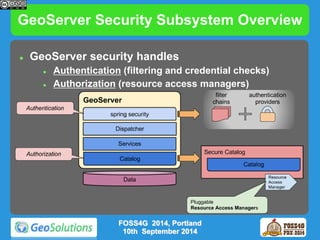
 GeoServer security handles 
 Authentication (filtering and credential checks) 
 Authorization (resource access managers) 
FOSS4G 2014, Portland 
10th September 2014
GeoServer Security Subsystem Overview 
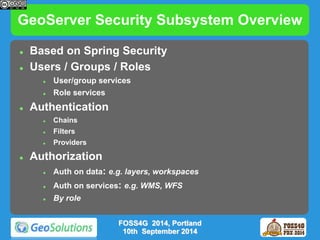
 Based on Spring Security 
 Users / Groups / Roles 
 User/group services 
 Role services 
 Authentication 
 Chains 
 Filters 
 Providers 
 Authorization 
 Auth on data: e.g. layers, workspaces 
 Auth on services: e.g. WMS, WFS 
 By role 
FOSS4G 2014, Portland 
10th September 2014
Users / Groups / Roles Storage 
FOSS4G 2014, Portland 
10th September 2014
Users / Groups / Roles Storage 
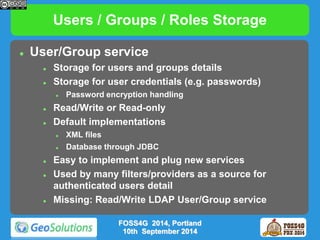
 User/Group service 
 Storage for users and groups details 
 Storage for user credentials (e.g. passwords) 
 Password encryption handling 
 Read/Write or Read-only 
 Default implementations 
 XML files 
 Database through JDBC 
 Easy to implement and plug new services 
 Used by many filters/providers as a source for 
authenticated users detail 
 Missing: Read/Write LDAP User/Group service 
FOSS4G 2014, Portland 
10th September 2014
Users / Groups / Roles Storage 
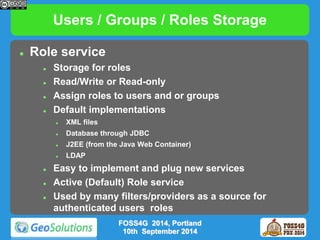
 Role service 
 Storage for roles 
 Read/Write or Read-only 
 Assign roles to users and or groups 
 Default implementations 
 XML files 
 Database through JDBC 
 J2EE (from the Java Web Container) 
 LDAP 
 Easy to implement and plug new services 
 Active (Default) Role service 
 Used by many filters/providers as a source for 
authenticated users roles 
FOSS4G 2014, Portland 
10th September 2014
Authentication 
FOSS4G 2014, Portland 
10th September 2014
Authentication 
 Filter Chains 
 By «request url» pattern matching 
 Web UI 
 OGC Services 
 REST API 
 … 
 By Method: GET, POST, … 
 HTTP Session handling 
 Each chain applies a sequence of configured Filters to 
matching requests 
 Only SSL flag 
FOSS4G 2014, Portland 
10th September 2014
Authentication 
 Filters 
 Gathering user credentials (and eventually invoking 
authentication providers chain) 
 Basic 
 Form 
 Anonymous (always the last) 
 Preauthentication (and eventually load user details from 
user/group and/or role service) 
 HTTP Header 
 Digest 
 X.509 
 Remember Me 
 J2EE 
 Easy to implement and plug new filters 
 Missing: authenticate from environment variables (e.g. Shibboleth SSO) 
FOSS4G 2014, Portland 
10th September 2014
Authentication 
 Authentication Providers 
 Used if filters require further authentication of 
gathered credentials (no preauthentication can be 
applied) 
 Username Password (using user/group service) 
 Database through JDBC (uses credentials to connect to a database, 
very different from the JDBC user/group service) 
 LDAP 
 with ActiveDirectory support 
 Easy to implement and plug new providers 
 Providers chain, to allow for different authentication 
mechanisms (e.g intranet users from LDAP, internet 
users from db) 
FOSS4G 2014, Portland 
10th September 2014
Authentication 
 Extensions 
 CAS (https://www.apereo.org/cas): example of SSO 
integration 
 Community modules 
 Authkey: simple UUID to user mapper 
 Pluggable: possibility to define custom mappers (e.g. webservices) 
 URLMangler to add authkey to OGC request transparently (via 
GetCapabilities) 
 Real World Use Cases 
 Shibboleth SSO (using Headers or CGI environment 
variables) 
 Mixing filters/providers: LDAP/AD for internal users, 
jdbc for external users 
FOSS4G 2014, Portland 
10th September 2014
Authentication 
 Future improvements 
 Clean up and filling holes 
 Increase LDAP support (e.g. LDAP User/Group 
Service for LDAP read-write support) 
 Greater flexibility 
 Improve authkey community module (new webservice 
based mappers) and promote to extension 
 New authentication filters (e.g. reading credentials 
from CGI environment variables) 
FOSS4G 2014, Portland 
10th September 2014
Authorization 
FOSS4G 2014, Portland 
10th September 2014
Authorization 
 Simple default implementation 
 Permissions assigned only by user role(s) 
 Data Access Authorization Rules 
 Workspace 
 Single Layer 
 Access Mode: Read, Write, Admin 
 Services Authorization Rules 
 Service (WMS, WFS, …) 
 Method (GetMap, GetLegendGraphic, …) 
 Pluggable ResourceAccessManager 
 SecureCatalog 
 Security Wrapped Catalog Objects (e.g. ReadOnlyDataStore) 
FOSS4G 2014, Portland 
10th September 2014
Authorization 
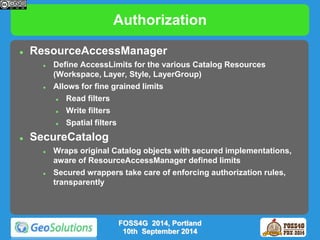
 ResourceAccessManager 
 Define AccessLimits for the various Catalog Resources 
(Workspace, Layer, Style, LayerGroup) 
 Allows for fine grained limits 
 Read filters 
 Write filters 
 Spatial filters 
 SecureCatalog 
 Wraps original Catalog objects with secured implementations, 
aware of ResourceAccessManager defined limits 
 Secured wrappers take care of enforcing authorization rules, 
transparently 
FOSS4G 2014, Portland 
10th September 2014
Meet GeoFence 
FOSS4G 2014, Portland 
10th September 2014
GeoFence 
 Extended A&A for GeoServer 
 Authentication 
 Optional 
 Integrated with GeoServer authorization 
architecture 
 Open Source 
 GPL 
 Code on GitHub 
 Authorization 
 Auth on data: e.g. layers, workspaces 
 Auth on services: e.g. WMS, WFS 
FOSS4G 2014, Portland 
10th September 2014
GeoFence 
 Based on GSIP 57 
 Mixed Interceptor + Probe approach 
 Extended authorization management for GeoServer 
 External Rule-Based System 
 GeoServer Internal Probe 
 On-the-fly manipulation of incoming requests 
 Role Based Access Control 
 Users 
 Groups 
 Rule-based database 
 IPTables-like 
FOSS4G 2014, Portland 
10th September 2014
GeoFence 
 Fine Grain Authorization Control 
 Services 
 Operations 
 Workspaces 
 Layers 
 Attributes (alphanumeric and geospatial) 
 External Web Application 
 REST Interface 
 GUI 
 Scalable 
 1 GeoFence controls N GeoServer cluster 
FOSS4G 2014, Portland 
10th September 2014
GeoFence 
 Java Enterprise infrastructure 
 Spring/Spring-Remoting 
 Hibernate 
 Apache CXF 
 Supports DBMS 
 PostgreSQL/PostGIS 
 Oracle spatial 
 H2 
 Performance ensured thanks to 
a fine-tunable cache 
FOSS4G 2014, Portland 
10th September 2014
GeoServer Security Model 
FOSS4G 2014, Portland 
10th September 2014
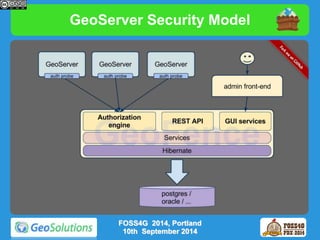
GeoServer Security Model 
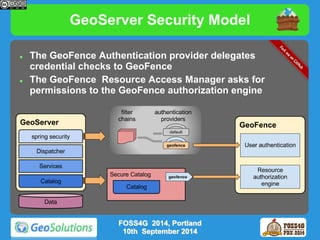
 The GeoFence Authentication provider delegates 
credential checks to GeoFence 
 The GeoFence Resource Access Manager asks for 
permissions to the GeoFence authorization engine 
FOSS4G 2014, Portland 
10th September 2014
GeoServer Security Model 
FOSS4G 2014, Portland 
10th September 2014
Digging GeoFence 
FOSS4G 2014, Portland 
10th September 2014
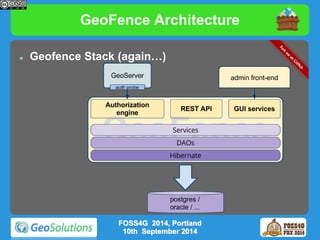
GeoFence Architecture 
 Geofence Stack (again…) 
FOSS4G 2014, Portland 
10th September 2014
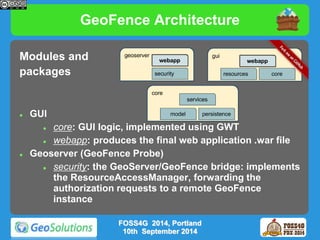
GeoFence Architecture 
Modules and 
packages 
 GUI 
 core: GUI logic, implemented using GWT 
 webapp: produces the final web application .war file 
 Geoserver (GeoFence Probe) 
 security: the GeoServer/GeoFence bridge: implements 
the ResourceAccessManager, forwarding the 
authorization requests to a remote GeoFence 
instance 
FOSS4G 2014, Portland 
10th September 2014
GeoFence Architecture 
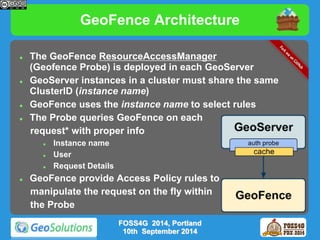
 The GeoFence ResourceAccessManager 
(Geofence Probe) is deployed in each GeoServer 
 GeoServer instances in a cluster must share the same 
ClusterID (instance name) 
 GeoFence uses the instance name to select rules 
 The Probe queries GeoFence on each 
request* with proper info 
 Instance name 
 User 
 Request Details 
 GeoFence provide Access Policy rules to 
manipulate the request on the fly within 
the Probe 
FOSS4G 2014, Portland 
10th September 2014
GeoFence Architecture 
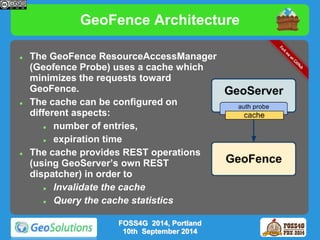
 The GeoFence ResourceAccessManager 
(Geofence Probe) uses a cache which 
minimizes the requests toward 
GeoFence. 
 The cache can be configured on 
different aspects: 
 number of entries, 
 expiration time 
 The cache provides REST operations 
(using GeoServer’s own REST 
dispatcher) in order to 
 Invalidate the cache 
 Query the cache statistics 
FOSS4G 2014, Portland 
10th September 2014
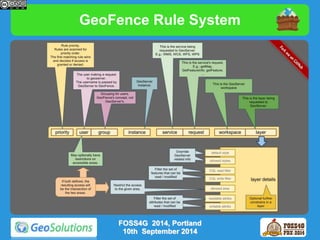
GeoFence Rule System 
 Authorizations are expressed as a 
priority-based rule set 
 Type of Rules are ALLOW/DENY/LIMIT 
 The first matching rule is the one that determines the 
outcome of the auth request 
 Incoming authorization requests are transformed 
in a rule filter 
 Filtering can be performed on one or more of 
these fields: 
 Username 
 Group the provided user belongs to 
FOSS4G 2014, Portland 
10th September 2014
GeoFence Rule System 
 Source geoserver instance 
 We can control multiple GeoServer clusters 
 OGC Service 
 E.g. WMS 
 OGC Service Operation 
 E.g. GetCapabilities 
 Workspace 
 E.g. it.geosolutions 
 Layer name 
 E.g. topp:states 
FOSS4G 2014, Portland 
10th September 2014
GeoFence Rule System 
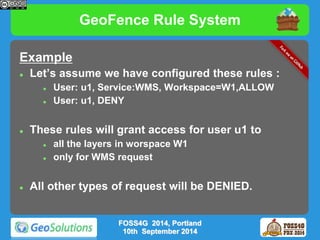
Example 
 Let’s assume we have configured these rules : 
 User: u1, Service:WMS, Workspace=W1,ALLOW 
 User: u1, DENY 
 These rules will grant access for user u1 to 
 all the layers in worspace W1 
 only for WMS request 
 All other types of request will be DENIED. 
FOSS4G 2014, Portland 
10th September 2014
GeoFence Rule System 
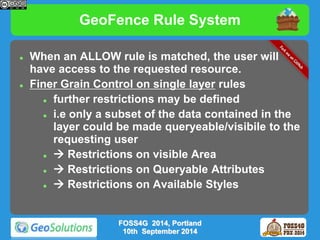
 When an ALLOW rule is matched, the user will 
have access to the requested resource. 
 Finer Grain Control on single layer rules 
 further restrictions may be defined 
 i.e only a subset of the data contained in the 
layer could be made queryeable/visibile to the 
requesting user 
  Restrictions on visible Area 
  Restrictions on Queryable Attributes 
  Restrictions on Available Styles 
FOSS4G 2014, Portland 
10th September 2014
GeoFence Rule System 
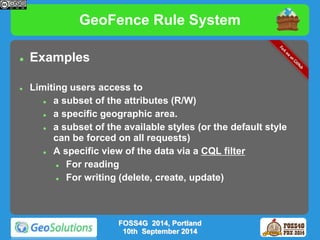
 Examples 
 Limiting users access to 
 a subset of the attributes (R/W) 
 a specific geographic area. 
 a subset of the available styles (or the default style 
can be forced on all requests) 
 A specific view of the data via a CQL filter 
 For reading 
 For writing (delete, create, update) 
FOSS4G 2014, Portland 
10th September 2014
GeoFence Rule System 
FOSS4G 2014, Portland 
10th September 2014
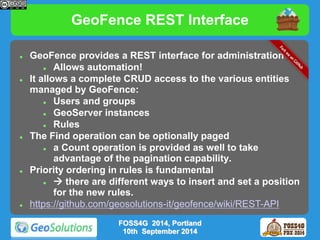
GeoFence REST Interface 
 GeoFence provides a REST interface for administration 
 Allows automation! 
 It allows a complete CRUD access to the various entities 
managed by GeoFence: 
 Users and groups 
 GeoServer instances 
 Rules 
 The Find operation can be optionally paged 
 a Count operation is provided as well to take 
advantage of the pagination capability. 
 Priority ordering in rules is fundamental 
  there are different ways to insert and set a position 
for the new rules. 
 https://github.com/geosolutions-it/geofence/wiki/REST-API 
FOSS4G 2014, Portland 
10th September 2014
GeoFence REST Interface 
 The REST interface also provides a batch mode 
 multiple CRUD commands can be issued at once 
 The commands in the batch are processed in the 
same transaction 
 Extremely important for automation! 
 Backup and restore operations are provided as part of the 
REST interface as well 
 REST API documentation available at 
https://github.com/geosolutions-it/geofence/wiki/REST-API 
FOSS4G 2014, Portland 
10th September 2014
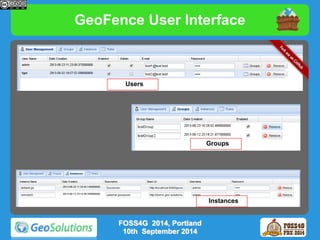
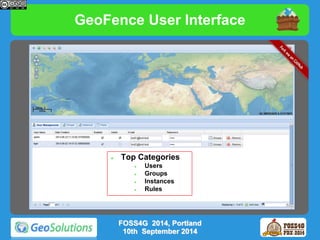
GeoFence User Interface 
 Top Categories 
 Users 
 Groups 
 Instances 
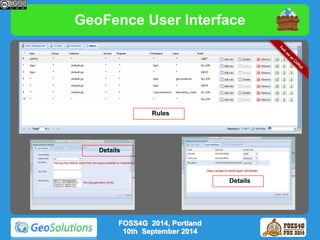
 Rules 
FOSS4G 2014, Portland 
10th September 2014
GeoFence User Interface 
Users 
FOSS4G 2014, Portland 
10th September 2014 
Groups 
Instances
GeoFence User Interface 
Rules 
FOSS4G 2014, Portland 
10th September 2014 
Details 
Details
GeoFence and LDAP 
 An LDAP server can be used as a repository for user and 
groups, including the optional ldap module in the deploy 
 LDAP can be configured through the datasource 
properties file 
 When using LDAP users and groups are not editable from 
the GeoFence interface (they are READ-ONLY) 
 LDAP module documentation at 
https://github.com/geosolutions-it/geofence/wiki/LDAP-module 
FOSS4G 2014, Portland 
10th September 2014
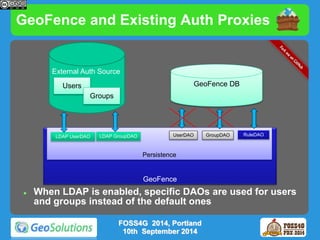
GeoFence and Existing Auth Proxies 
External Auth Source 
LDAP UserDAO LDAP GroupDAO UserDAO GroupDAO RuleDAO 
Persistence 
 When LDAP is enabled, specific DAOs are used for users 
and groups instead of the default ones 
FOSS4G 2014, Portland 
10th September 2014 
Users 
Groups 
GeoFence DB 
GeoFence
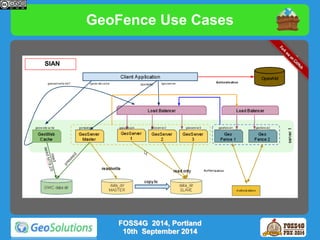
GeoFence Use Cases 
FOSS4G 2014, Portland 
10th September 2014 
SIAN
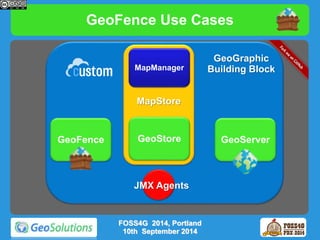
GeoFence Use Cases 
MapManager 
MapStore 
GeoFence 
GeoFence GeoStore GeoServer 
JMX Agents 
FOSS4G 2014, Portland 
10th September 2014 
GeoGraphic 
Building Block
GeoFence Use Cases 
FOSS4G 2014, Portland 
10th September 2014 
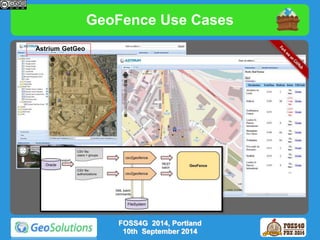
Astrium GetGeo
GeoFence Use Cases 
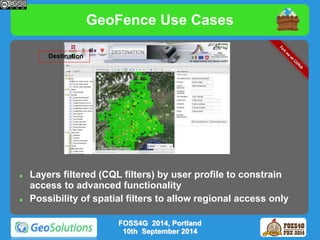
 Layers filtered (CQL filters) by user profile to constrain 
access to advanced functionality 
 Possibility of spatial filters to allow regional access only 
FOSS4G 2014, Portland 
10th September 2014 
Destination
GeoFence Status 
 Project Released as Open Source 
 Continuous Build is in place 
 Dev and Users Mailing Lists are in place 
 Latest Improvements 
 IP based filter rules 
 Catalog Mode support 
 GeoServer community module for the probe 
 Probe Wicket Configuration Page 
 Further Improvements 
FOSS4G 2014, Portland 
10th September 2014 
 Documentation 
 Official Releases 
 UI Refactor (based on REST APIs)
The End 
Thanks for not sleeping 
(loudly) 
alessio.fabiani@geo-solutions.it 
mauro.bartolomeoli@geo-solutions.it 
FOSS4G 2014, Portland 
10th September 2014

Advanced Security With GeoServer

  • 1.
    Advanced Security WithGeoServer Ing. Mauro Bartolomeoli, GeoSolutions Ing. Emanuele Tajariol, GeoSolutions Ing. Simone Giannecchini, GeoSolutions Ing. Alessio Fabiani, GeoSolutions FOSS4G 2014, Portland 10th September 2014
  • 2.
    GeoSolutions  Foundedin Italy in late 2006  Expertise • Image Processing, GeoSpatial Data Fusion • Java, Java Enterprise, C++, Python • JPEG2000, JPIP, Advanced 2D visualization  Supporting/Developing FOSS4G projects  GeoServer, MapStore  GeoBatch, GeoNetwork  Clients  Public Agencies  Private Companies  http://www.geo-solutions.it FOSS4G 2014, Portland 10th September 2014
  • 3.
    GeoServer Security SubsystemOverview FOSS4G 2014, Portland 10th September 2014
  • 4.
    GeoServer Security SubsystemOverview  GeoServer security handles  Authentication (filtering and credential checks)  Authorization (resource access managers) FOSS4G 2014, Portland 10th September 2014
  • 5.
    GeoServer Security SubsystemOverview  Based on Spring Security  Users / Groups / Roles  User/group services  Role services  Authentication  Chains  Filters  Providers  Authorization  Auth on data: e.g. layers, workspaces  Auth on services: e.g. WMS, WFS  By role FOSS4G 2014, Portland 10th September 2014
  • 6.
    Users / Groups/ Roles Storage FOSS4G 2014, Portland 10th September 2014
  • 7.
    Users / Groups/ Roles Storage  User/Group service  Storage for users and groups details  Storage for user credentials (e.g. passwords)  Password encryption handling  Read/Write or Read-only  Default implementations  XML files  Database through JDBC  Easy to implement and plug new services  Used by many filters/providers as a source for authenticated users detail  Missing: Read/Write LDAP User/Group service FOSS4G 2014, Portland 10th September 2014
  • 8.
    Users / Groups/ Roles Storage  Role service  Storage for roles  Read/Write or Read-only  Assign roles to users and or groups  Default implementations  XML files  Database through JDBC  J2EE (from the Java Web Container)  LDAP  Easy to implement and plug new services  Active (Default) Role service  Used by many filters/providers as a source for authenticated users roles FOSS4G 2014, Portland 10th September 2014
  • 9.
    Authentication FOSS4G 2014,Portland 10th September 2014
  • 10.
    Authentication  FilterChains  By «request url» pattern matching  Web UI  OGC Services  REST API  …  By Method: GET, POST, …  HTTP Session handling  Each chain applies a sequence of configured Filters to matching requests  Only SSL flag FOSS4G 2014, Portland 10th September 2014
  • 11.
    Authentication  Filters  Gathering user credentials (and eventually invoking authentication providers chain)  Basic  Form  Anonymous (always the last)  Preauthentication (and eventually load user details from user/group and/or role service)  HTTP Header  Digest  X.509  Remember Me  J2EE  Easy to implement and plug new filters  Missing: authenticate from environment variables (e.g. Shibboleth SSO) FOSS4G 2014, Portland 10th September 2014
  • 12.
    Authentication  AuthenticationProviders  Used if filters require further authentication of gathered credentials (no preauthentication can be applied)  Username Password (using user/group service)  Database through JDBC (uses credentials to connect to a database, very different from the JDBC user/group service)  LDAP  with ActiveDirectory support  Easy to implement and plug new providers  Providers chain, to allow for different authentication mechanisms (e.g intranet users from LDAP, internet users from db) FOSS4G 2014, Portland 10th September 2014
  • 13.
    Authentication  Extensions  CAS (https://www.apereo.org/cas): example of SSO integration  Community modules  Authkey: simple UUID to user mapper  Pluggable: possibility to define custom mappers (e.g. webservices)  URLMangler to add authkey to OGC request transparently (via GetCapabilities)  Real World Use Cases  Shibboleth SSO (using Headers or CGI environment variables)  Mixing filters/providers: LDAP/AD for internal users, jdbc for external users FOSS4G 2014, Portland 10th September 2014
  • 14.
    Authentication  Futureimprovements  Clean up and filling holes  Increase LDAP support (e.g. LDAP User/Group Service for LDAP read-write support)  Greater flexibility  Improve authkey community module (new webservice based mappers) and promote to extension  New authentication filters (e.g. reading credentials from CGI environment variables) FOSS4G 2014, Portland 10th September 2014
  • 15.
    Authorization FOSS4G 2014,Portland 10th September 2014
  • 16.
    Authorization  Simpledefault implementation  Permissions assigned only by user role(s)  Data Access Authorization Rules  Workspace  Single Layer  Access Mode: Read, Write, Admin  Services Authorization Rules  Service (WMS, WFS, …)  Method (GetMap, GetLegendGraphic, …)  Pluggable ResourceAccessManager  SecureCatalog  Security Wrapped Catalog Objects (e.g. ReadOnlyDataStore) FOSS4G 2014, Portland 10th September 2014
  • 17.
    Authorization  ResourceAccessManager  Define AccessLimits for the various Catalog Resources (Workspace, Layer, Style, LayerGroup)  Allows for fine grained limits  Read filters  Write filters  Spatial filters  SecureCatalog  Wraps original Catalog objects with secured implementations, aware of ResourceAccessManager defined limits  Secured wrappers take care of enforcing authorization rules, transparently FOSS4G 2014, Portland 10th September 2014
  • 18.
    Meet GeoFence FOSS4G2014, Portland 10th September 2014
  • 19.
    GeoFence  ExtendedA&A for GeoServer  Authentication  Optional  Integrated with GeoServer authorization architecture  Open Source  GPL  Code on GitHub  Authorization  Auth on data: e.g. layers, workspaces  Auth on services: e.g. WMS, WFS FOSS4G 2014, Portland 10th September 2014
  • 20.
    GeoFence  Basedon GSIP 57  Mixed Interceptor + Probe approach  Extended authorization management for GeoServer  External Rule-Based System  GeoServer Internal Probe  On-the-fly manipulation of incoming requests  Role Based Access Control  Users  Groups  Rule-based database  IPTables-like FOSS4G 2014, Portland 10th September 2014
  • 21.
    GeoFence  FineGrain Authorization Control  Services  Operations  Workspaces  Layers  Attributes (alphanumeric and geospatial)  External Web Application  REST Interface  GUI  Scalable  1 GeoFence controls N GeoServer cluster FOSS4G 2014, Portland 10th September 2014
  • 22.
    GeoFence  JavaEnterprise infrastructure  Spring/Spring-Remoting  Hibernate  Apache CXF  Supports DBMS  PostgreSQL/PostGIS  Oracle spatial  H2  Performance ensured thanks to a fine-tunable cache FOSS4G 2014, Portland 10th September 2014
  • 23.
    GeoServer Security Model FOSS4G 2014, Portland 10th September 2014
  • 24.
    GeoServer Security Model  The GeoFence Authentication provider delegates credential checks to GeoFence  The GeoFence Resource Access Manager asks for permissions to the GeoFence authorization engine FOSS4G 2014, Portland 10th September 2014
  • 25.
    GeoServer Security Model FOSS4G 2014, Portland 10th September 2014
  • 26.
    Digging GeoFence FOSS4G2014, Portland 10th September 2014
  • 27.
    GeoFence Architecture Geofence Stack (again…) FOSS4G 2014, Portland 10th September 2014
  • 28.
    GeoFence Architecture Modulesand packages  GUI  core: GUI logic, implemented using GWT  webapp: produces the final web application .war file  Geoserver (GeoFence Probe)  security: the GeoServer/GeoFence bridge: implements the ResourceAccessManager, forwarding the authorization requests to a remote GeoFence instance FOSS4G 2014, Portland 10th September 2014
  • 29.
    GeoFence Architecture The GeoFence ResourceAccessManager (Geofence Probe) is deployed in each GeoServer  GeoServer instances in a cluster must share the same ClusterID (instance name)  GeoFence uses the instance name to select rules  The Probe queries GeoFence on each request* with proper info  Instance name  User  Request Details  GeoFence provide Access Policy rules to manipulate the request on the fly within the Probe FOSS4G 2014, Portland 10th September 2014
  • 30.
    GeoFence Architecture The GeoFence ResourceAccessManager (Geofence Probe) uses a cache which minimizes the requests toward GeoFence.  The cache can be configured on different aspects:  number of entries,  expiration time  The cache provides REST operations (using GeoServer’s own REST dispatcher) in order to  Invalidate the cache  Query the cache statistics FOSS4G 2014, Portland 10th September 2014
  • 31.
    GeoFence Rule System  Authorizations are expressed as a priority-based rule set  Type of Rules are ALLOW/DENY/LIMIT  The first matching rule is the one that determines the outcome of the auth request  Incoming authorization requests are transformed in a rule filter  Filtering can be performed on one or more of these fields:  Username  Group the provided user belongs to FOSS4G 2014, Portland 10th September 2014
  • 32.
    GeoFence Rule System  Source geoserver instance  We can control multiple GeoServer clusters  OGC Service  E.g. WMS  OGC Service Operation  E.g. GetCapabilities  Workspace  E.g. it.geosolutions  Layer name  E.g. topp:states FOSS4G 2014, Portland 10th September 2014
  • 33.
    GeoFence Rule System Example  Let’s assume we have configured these rules :  User: u1, Service:WMS, Workspace=W1,ALLOW  User: u1, DENY  These rules will grant access for user u1 to  all the layers in worspace W1  only for WMS request  All other types of request will be DENIED. FOSS4G 2014, Portland 10th September 2014
  • 34.
    GeoFence Rule System  When an ALLOW rule is matched, the user will have access to the requested resource.  Finer Grain Control on single layer rules  further restrictions may be defined  i.e only a subset of the data contained in the layer could be made queryeable/visibile to the requesting user   Restrictions on visible Area   Restrictions on Queryable Attributes   Restrictions on Available Styles FOSS4G 2014, Portland 10th September 2014
  • 35.
    GeoFence Rule System  Examples  Limiting users access to  a subset of the attributes (R/W)  a specific geographic area.  a subset of the available styles (or the default style can be forced on all requests)  A specific view of the data via a CQL filter  For reading  For writing (delete, create, update) FOSS4G 2014, Portland 10th September 2014
  • 36.
    GeoFence Rule System FOSS4G 2014, Portland 10th September 2014
  • 37.
    GeoFence REST Interface  GeoFence provides a REST interface for administration  Allows automation!  It allows a complete CRUD access to the various entities managed by GeoFence:  Users and groups  GeoServer instances  Rules  The Find operation can be optionally paged  a Count operation is provided as well to take advantage of the pagination capability.  Priority ordering in rules is fundamental   there are different ways to insert and set a position for the new rules.  https://github.com/geosolutions-it/geofence/wiki/REST-API FOSS4G 2014, Portland 10th September 2014
  • 38.
    GeoFence REST Interface  The REST interface also provides a batch mode  multiple CRUD commands can be issued at once  The commands in the batch are processed in the same transaction  Extremely important for automation!  Backup and restore operations are provided as part of the REST interface as well  REST API documentation available at https://github.com/geosolutions-it/geofence/wiki/REST-API FOSS4G 2014, Portland 10th September 2014
  • 39.
    GeoFence User Interface  Top Categories  Users  Groups  Instances  Rules FOSS4G 2014, Portland 10th September 2014
  • 40.
    GeoFence User Interface Users FOSS4G 2014, Portland 10th September 2014 Groups Instances
  • 41.
    GeoFence User Interface Rules FOSS4G 2014, Portland 10th September 2014 Details Details
  • 42.
    GeoFence and LDAP  An LDAP server can be used as a repository for user and groups, including the optional ldap module in the deploy  LDAP can be configured through the datasource properties file  When using LDAP users and groups are not editable from the GeoFence interface (they are READ-ONLY)  LDAP module documentation at https://github.com/geosolutions-it/geofence/wiki/LDAP-module FOSS4G 2014, Portland 10th September 2014
  • 43.
    GeoFence and ExistingAuth Proxies External Auth Source LDAP UserDAO LDAP GroupDAO UserDAO GroupDAO RuleDAO Persistence  When LDAP is enabled, specific DAOs are used for users and groups instead of the default ones FOSS4G 2014, Portland 10th September 2014 Users Groups GeoFence DB GeoFence
  • 44.
    GeoFence Use Cases FOSS4G 2014, Portland 10th September 2014 SIAN
  • 45.
    GeoFence Use Cases MapManager MapStore GeoFence GeoFence GeoStore GeoServer JMX Agents FOSS4G 2014, Portland 10th September 2014 GeoGraphic Building Block
  • 46.
    GeoFence Use Cases FOSS4G 2014, Portland 10th September 2014 Astrium GetGeo
  • 47.
    GeoFence Use Cases  Layers filtered (CQL filters) by user profile to constrain access to advanced functionality  Possibility of spatial filters to allow regional access only FOSS4G 2014, Portland 10th September 2014 Destination
  • 48.
    GeoFence Status Project Released as Open Source  Continuous Build is in place  Dev and Users Mailing Lists are in place  Latest Improvements  IP based filter rules  Catalog Mode support  GeoServer community module for the probe  Probe Wicket Configuration Page  Further Improvements FOSS4G 2014, Portland 10th September 2014  Documentation  Official Releases  UI Refactor (based on REST APIs)
  • 49.
    The End Thanksfor not sleeping (loudly) alessio.fabiani@geo-solutions.it mauro.bartolomeoli@geo-solutions.it FOSS4G 2014, Portland 10th September 2014