UNIVERSITAS INDONESIA 
FACULTY OF ECONOMICS AND BUSINESS 
International Undergraduate Program 
SYLLABUS 
[ACCT 11301] ADVANCED FINANCIAL ACCOUNTING I 
Odd Semester 2014/2015 
Credit: 3 
Prerequisite: ACCT 11203 Intermediate Financial Accounting II 
Lecturers: 
Indah Melati, M.Sc. [coordinator] 
International Undergraduate Program 
indah.melati@gmail.com 
081804975408 (mobile), (021)7272425 ext.151 (office) 
Tutor: 
Arfah Habib Saragih, MS.Ak. 
arfah.habib.saragih@gmail.com, 085782082758 
Advanced Financial Accounting I_OS 2014-2015 1
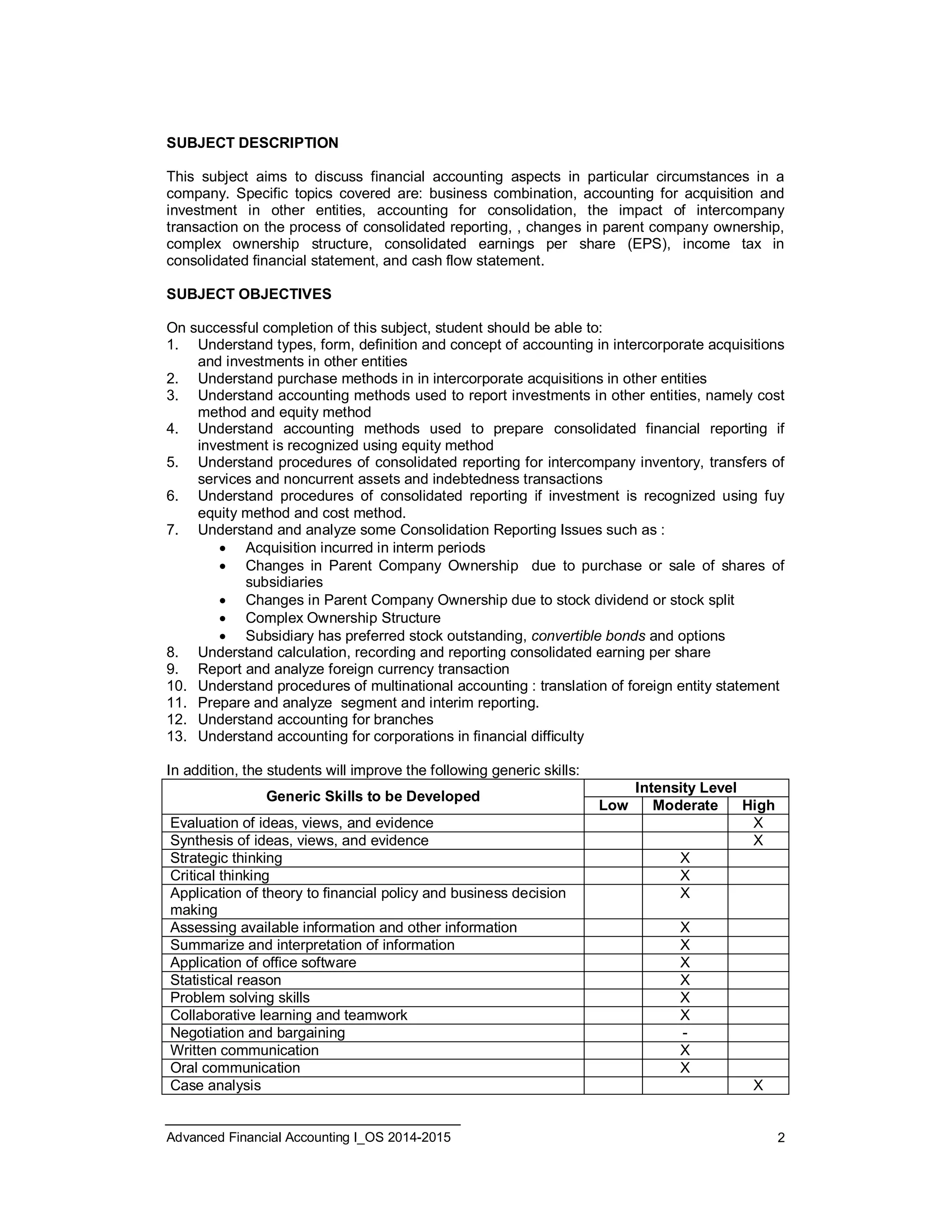
SUBJECT DESCRIPTION 
This subject aims to discuss financial accounting aspects in particular circumstances in a 
company. Specific topics covered are: business combination, accounting for acquisition and 
investment in other entities, accounting for consolidation, the impact of intercompany 
transaction on the process of consolidated reporting, , changes in parent company ownership, 
complex ownership structure, consolidated earnings per share (EPS), income tax in 
consolidated financial statement, and cash flow statement. 
SUBJECT OBJECTIVES 
On successful completion of this subject, student should be able to: 
1. Understand types, form, definition and concept of accounting in intercorporate acquisitions 
and investments in other entities 
2. Understand purchase methods in in intercorporate acquisitions in other entities 
3. Understand accounting methods used to report investments in other entities, namely cost 
method and equity method 
4. Understand accounting methods used to prepare consolidated financial reporting if 
investment is recognized using equity method 
5. Understand procedures of consolidated reporting for intercompany inventory, transfers of 
services and noncurrent assets and indebtedness transactions 
6. Understand procedures of consolidated reporting if investment is recognized using fuy 
equity method and cost method. 
7. Understand and analyze some Consolidation Reporting Issues such as : 
 Acquisition incurred in interm periods 
 Changes in Parent Company Ownership due to purchase or sale of shares of 
subsidiaries 
 Changes in Parent Company Ownership due to stock dividend or stock split 
 Complex Ownership Structure 
 Subsidiary has preferred stock outstanding, convertible bonds and options 
8. Understand calculation, recording and reporting consolidated earning per share 
9. Report and analyze foreign currency transaction 
10. Understand procedures of multinational accounting : translation of foreign entity statement 
11. Prepare and analyze segment and interim reporting. 
12. Understand accounting for branches 
13. Understand accounting for corporations in financial difficulty 
In addition, the students will improve the following generic skills: 
Generic Skills to be Developed Intensity Level 
Low Moderate High 
Evaluation of ideas, views, and evidence X 
Synthesis of ideas, views, and evidence X 
Strategic thinking X 
Critical thinking X 
Application of theory to financial policy and business decision 
X 
making 
Assessing available information and other information X 
Summarize and interpretation of information X 
Application of office software X 
Statistical reason X 
Problem solving skills X 
Collaborative learning and teamwork X 
Negotiation and bargaining - 
Written communication X 
Oral communication X 
Case analysis X 
Advanced Financial Accounting I_OS 2014-2015 2
SUBJECT MATERIALS 
Required readings 
1. Baker, R.E., et.al., Advanced Financial Accounting , 10th ed., McGraw Hill, 2011 
(BAKER) 
2. Baker, R.E., T.E. Christensen, D.M. Cottrell, K.I. Rais, W. Astono & E.R. Wulandari, 
Advanced Financial Accounting (An Indonesian Perspective), 2nd ed., McGraw 
Hill & Salemba Empat , 2012 (BAKER IND) 
3. Tan, Pearl & P. Lee, Advanced Financial Accounting: An IAS and IFRS 
Approach, McGraw Hill, 2009. (TAN & LEE) 
4. Ikatan Akuntan Indonesia, Standar Akuntansi Keuangan, Jakarta: Salemba Empat, 
2009 (PSAK) 
5. International Financial Reporting Standards (IFRS) 
Recommended References 
1. Beams, F.A., Z.A. Brozovsky & C.D. Shoulders, Advanced Accounting, 9th ed., 
New Jersey: Prentice Hall, 2006 (BEAMS) 
2. Mirza, Abbas Ali, Graham J. Holt dan Magnus Orrell, IFRS International Financial 
Reporting Standards, Workbook and Guide, John Wiley, 2006. (MHO) 
3. Undang-undang No. 40/2007 mengenai Perseroan Terbatas (UUPT), terutama 
pasal-pasal tentang modal dan saham dan tentang penggabungan, peleburan dan 
pengambilalihan. 
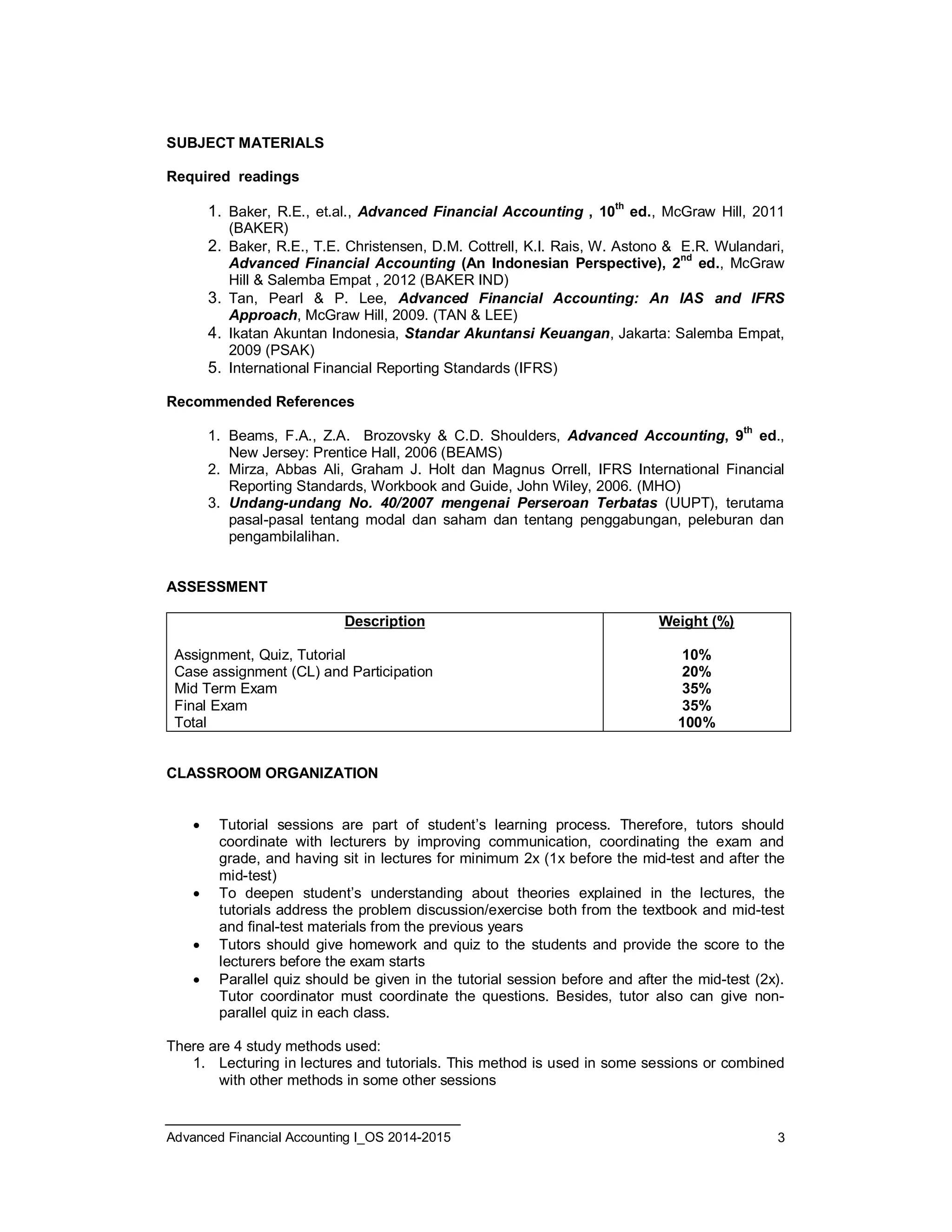
ASSESSMENT 
Description 
Assignment, Quiz, Tutorial 
Case assignment (CL) and Participation 
Mid Term Exam 
Final Exam 
Total 
Weight (%) 
10% 
20% 
35% 
35% 
100% 
CLASSROOM ORGANIZATION 
 Tutorial sessions are part of student’s learning process. Therefore, tutors should 
coordinate with lecturers by improving communication, coordinating the exam and 
grade, and having sit in lectures for minimum 2x (1x before the mid-test and after the 
mid-test) 
 To deepen student’s understanding about theories explained in the lectures, the 
tutorials address the problem discussion/exercise both from the textbook and mid-test 
and final-test materials from the previous years 
 Tutors should give homework and quiz to the students and provide the score to the 
lecturers before the exam starts 
 Parallel quiz should be given in the tutorial session before and after the mid-test (2x). 
Tutor coordinator must coordinate the questions. Besides, tutor also can give non-parallel 
quiz in each class. 
There are 4 study methods used: 
1. Lecturing in lectures and tutorials. This method is used in some sessions or combined 
with other methods in some other sessions 
Advanced Financial Accounting I_OS 2014-2015 3
2. Student-Centered Learning (SCL). This method is applied in most sessions using 
Collaborative Learning 
3. Tutorials 
4. Individual and group assignment 
Lecturing is always combined with discussion, Q&A, and mini case discussion obtained from 
the textbook. In lecturing, lecturers can raise some real cases to provide clearer description to 
students regarding accounting practices in a company. 
Sessions with Student-Centered Learning divide the class into groups consisting of 5 students, 
which will be assigned some cases using the collaborative learning approach-Simple Jigsaw 
(session 4 and 9) 
Tutorials will cover problem discussion which is given as students’ homework in the previous 
session. Problems cover high level of difficulty. 
Students form groups in which individuals should discuss some materials and present them in 
front of the class as individual assignment. Discussion material made by the group is 
considered as group score. 
Teaching Method consists of: 
Lecture yes 
Class discussion yes 
Individual project & paper no 
Group project & paper yes 
Presentation yes 
Case analysis yes 
Tutorial yes 
Laboratory – in class experience exercise no 
Computer lab no 
Cooperative learning yes 
ASSIGNMENT POLICY 
Assignment should be handed-in no later than the due date. Any late work will be assessed a 
penalty of 5 point a day (max 2 days). Work handed-in later than three days will be marked as 0. 
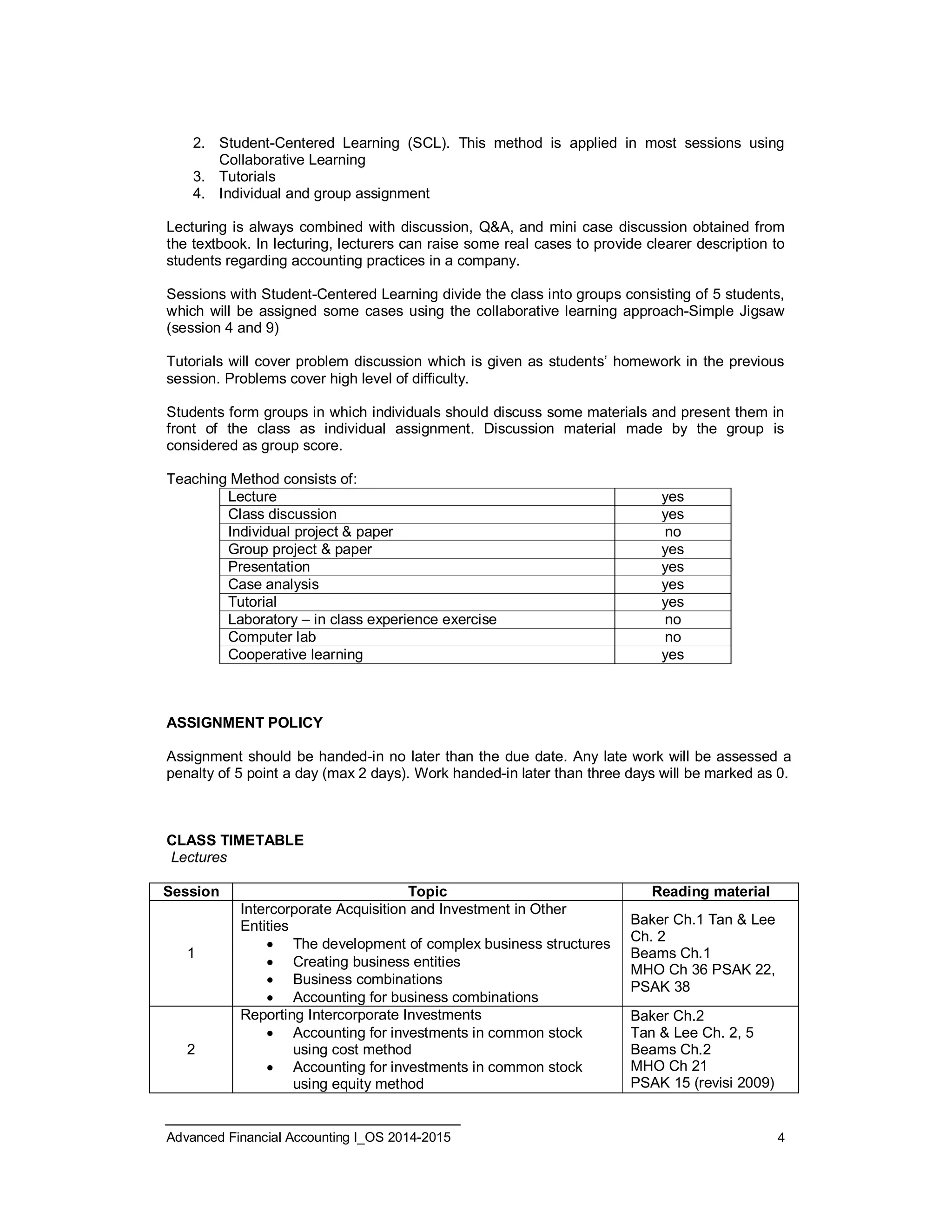
CLASS TIMETABLE 
Lectures 
Session Topic Reading material 
1 
Intercorporate Acquisition and Investment in Other 
Entities 
 The development of complex business structures 
 Creating business entities 
 Business combinations 
 Accounting for business combinations 
Baker Ch.1 Tan & Lee 
Ch. 2 
Beams Ch.1 
MHO Ch 36 PSAK 22, 
PSAK 38 
2 
Reporting Intercorporate Investments 
 Accounting for investments in common stock 
using cost method 
 Accounting for investments in common stock 
using equity method 
Baker Ch.2 
Tan & Lee Ch. 2, 5 
Beams Ch.2 
MHO Ch 21 
PSAK 15 (revisi 2009) 
Advanced Financial Accounting I_OS 2014-2015 4
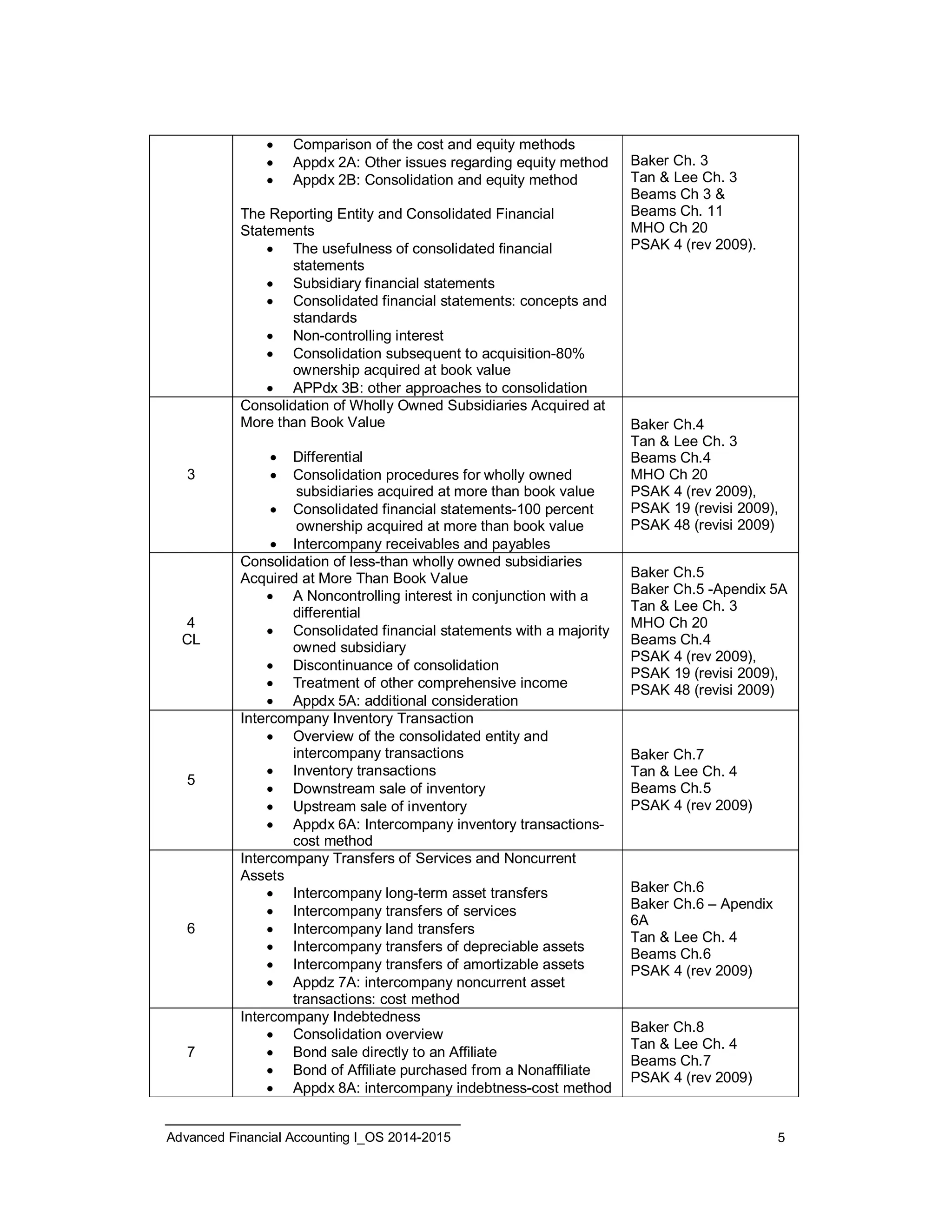
 Comparison of the cost and equity methods 
 Appdx 2A: Other issues regarding equity method 
 Appdx 2B: Consolidation and equity method 
The Reporting Entity and Consolidated Financial 
Statements 
 The usefulness of consolidated financial 
statements 
 Subsidiary financial statements 
 Consolidated financial statements: concepts and 
standards 
 Non-controlling interest 
 Consolidation subsequent to acquisition-80% 
ownership acquired at book value 
 APPdx 3B: other approaches to consolidation 
Baker Ch. 3 
Tan & Lee Ch. 3 
Beams Ch 3 & 
Beams Ch. 11 
MHO Ch 20 
PSAK 4 (rev 2009). 
3 
Consolidation of Wholly Owned Subsidiaries Acquired at 
More than Book Value 
 Differential 
 Consolidation procedures for wholly owned 
subsidiaries acquired at more than book value 
 Consolidated financial statements-100 percent 
ownership acquired at more than book value 
 Intercompany receivables and payables 
Baker Ch.4 
Tan & Lee Ch. 3 
Beams Ch.4 
MHO Ch 20 
PSAK 4 (rev 2009), 
PSAK 19 (revisi 2009), 
PSAK 48 (revisi 2009) 
4 
CL 
Consolidation of less-than wholly owned subsidiaries 
Acquired at More Than Book Value 
 A Noncontrolling interest in conjunction with a 
differential 
 Consolidated financial statements with a majority 
owned subsidiary 
 Discontinuance of consolidation 
 Treatment of other comprehensive income 
 Appdx 5A: additional consideration 
Baker Ch.5 
Baker Ch.5 -Apendix 5A 
Tan & Lee Ch. 3 
MHO Ch 20 
Beams Ch.4 
PSAK 4 (rev 2009), 
PSAK 19 (revisi 2009), 
PSAK 48 (revisi 2009) 
5 
Intercompany Inventory Transaction 
 Overview of the consolidated entity and 
intercompany transactions 
 Inventory transactions 
 Downstream sale of inventory 
 Upstream sale of inventory 
 Appdx 6A: Intercompany inventory transactions-cost 
method 
Baker Ch.7 
Tan & Lee Ch. 4 
Beams Ch.5 
PSAK 4 (rev 2009) 
6 
Intercompany Transfers of Services and Noncurrent 
Assets 
 Intercompany long-term asset transfers 
 Intercompany transfers of services 
 Intercompany land transfers 
 Intercompany transfers of depreciable assets 
 Intercompany transfers of amortizable assets 
 Appdz 7A: intercompany noncurrent asset 
transactions: cost method 
Baker Ch.6 
Baker Ch.6 – Apendix 
6A 
Tan & Lee Ch. 4 
Beams Ch.6 
PSAK 4 (rev 2009) 
7 
Intercompany Indebtedness 
 Consolidation overview 
 Bond sale directly to an Affiliate 
 Bond of Affiliate purchased from a Nonaffiliate 
 Appdx 8A: intercompany indebtness-cost method 
Baker Ch.8 
Tan & Lee Ch. 4 
Beams Ch.7 
PSAK 4 (rev 2009) 
Advanced Financial Accounting I_OS 2014-2015 5
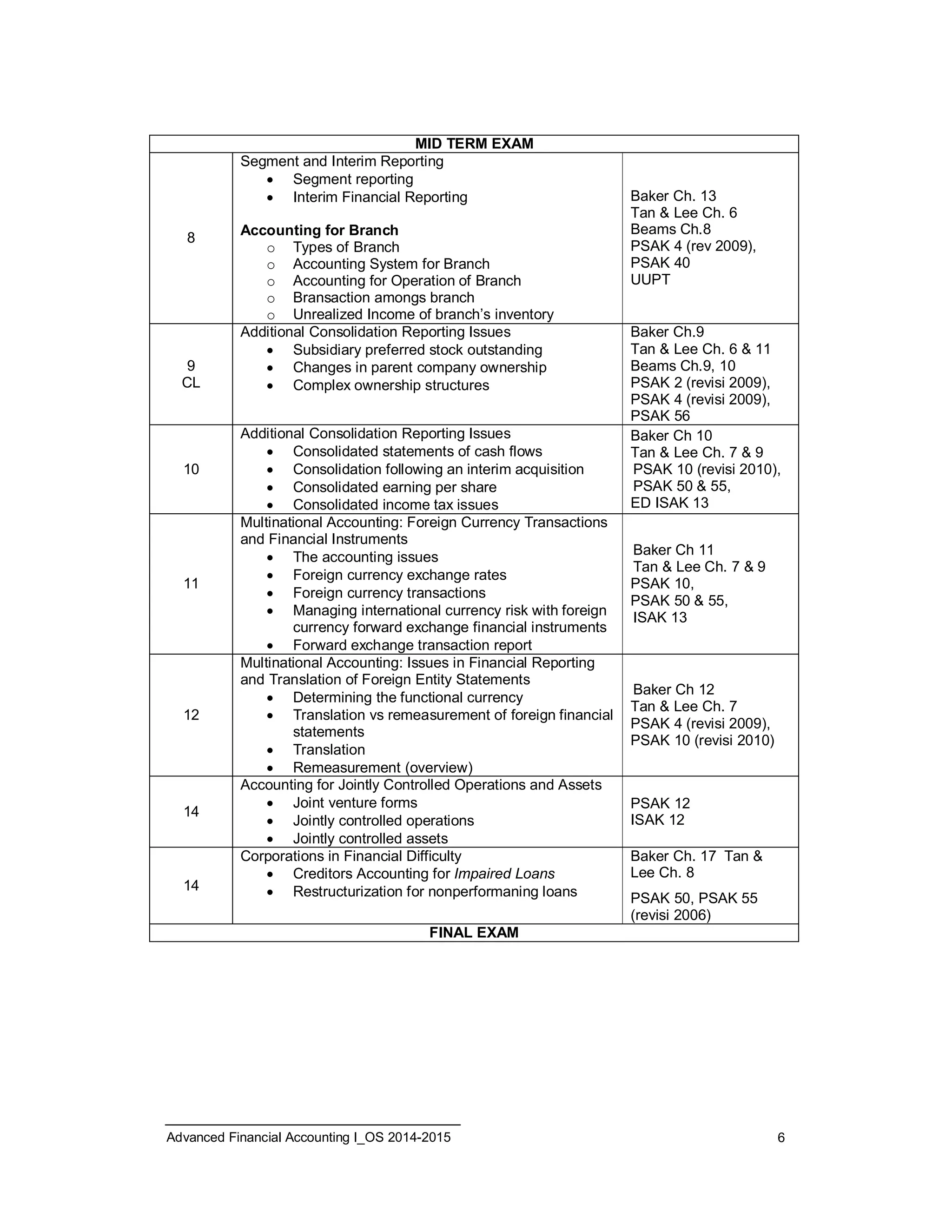
MID TERM EXAM 
8 
Segment and Interim Reporting 
 Segment reporting 
 Interim Financial Reporting 
Accounting for Branch 
o Types of Branch 
o Accounting System for Branch 
o Accounting for Operation of Branch 
o Bransaction amongs branch 
o Unrealized Income of branch’s inventory 
Baker Ch. 13 
Tan & Lee Ch. 6 
Beams Ch.8 
PSAK 4 (rev 2009), 
PSAK 40 
UUPT 
9 
CL 
Additional Consolidation Reporting Issues 
 Subsidiary preferred stock outstanding 
 Changes in parent company ownership 
 Complex ownership structures 
Baker Ch.9 
Tan & Lee Ch. 6 & 11 
Beams Ch.9, 10 
PSAK 2 (revisi 2009), 
PSAK 4 (revisi 2009), 
PSAK 56 
10 
Additional Consolidation Reporting Issues 
 Consolidated statements of cash flows 
 Consolidation following an interim acquisition 
 Consolidated earning per share 
 Consolidated income tax issues 
Baker Ch 10 
Tan & Lee Ch. 7 & 9 
PSAK 10 (revisi 2010), 
PSAK 50 & 55, 
ED ISAK 13 
11 
Multinational Accounting: Foreign Currency Transactions 
and Financial Instruments 
 The accounting issues 
 Foreign currency exchange rates 
 Foreign currency transactions 
 Managing international currency risk with foreign 
currency forward exchange financial instruments 
 Forward exchange transaction report 
Baker Ch 11 
Tan & Lee Ch. 7 & 9 
PSAK 10, 
PSAK 50 & 55, 
ISAK 13 
12 
Multinational Accounting: Issues in Financial Reporting 
and Translation of Foreign Entity Statements 
 Determining the functional currency 
 Translation vs remeasurement of foreign financial 
statements 
 Translation 
 Remeasurement (overview) 
Baker Ch 12 
Tan & Lee Ch. 7 
PSAK 4 (revisi 2009), 
PSAK 10 (revisi 2010) 
14 
Accounting for Jointly Controlled Operations and Assets 
 Joint venture forms 
 Jointly controlled operations 
 Jointly controlled assets 
PSAK 12 
ISAK 12 
14 
Corporations in Financial Difficulty 
 Creditors Accounting for Impaired Loans 
 Restructurization for nonperformaning loans 
Baker Ch. 17 Tan & 
Lee Ch. 8 
PSAK 50, PSAK 55 
(revisi 2006) 
FINAL EXAM 
Advanced Financial Accounting I_OS 2014-2015 6
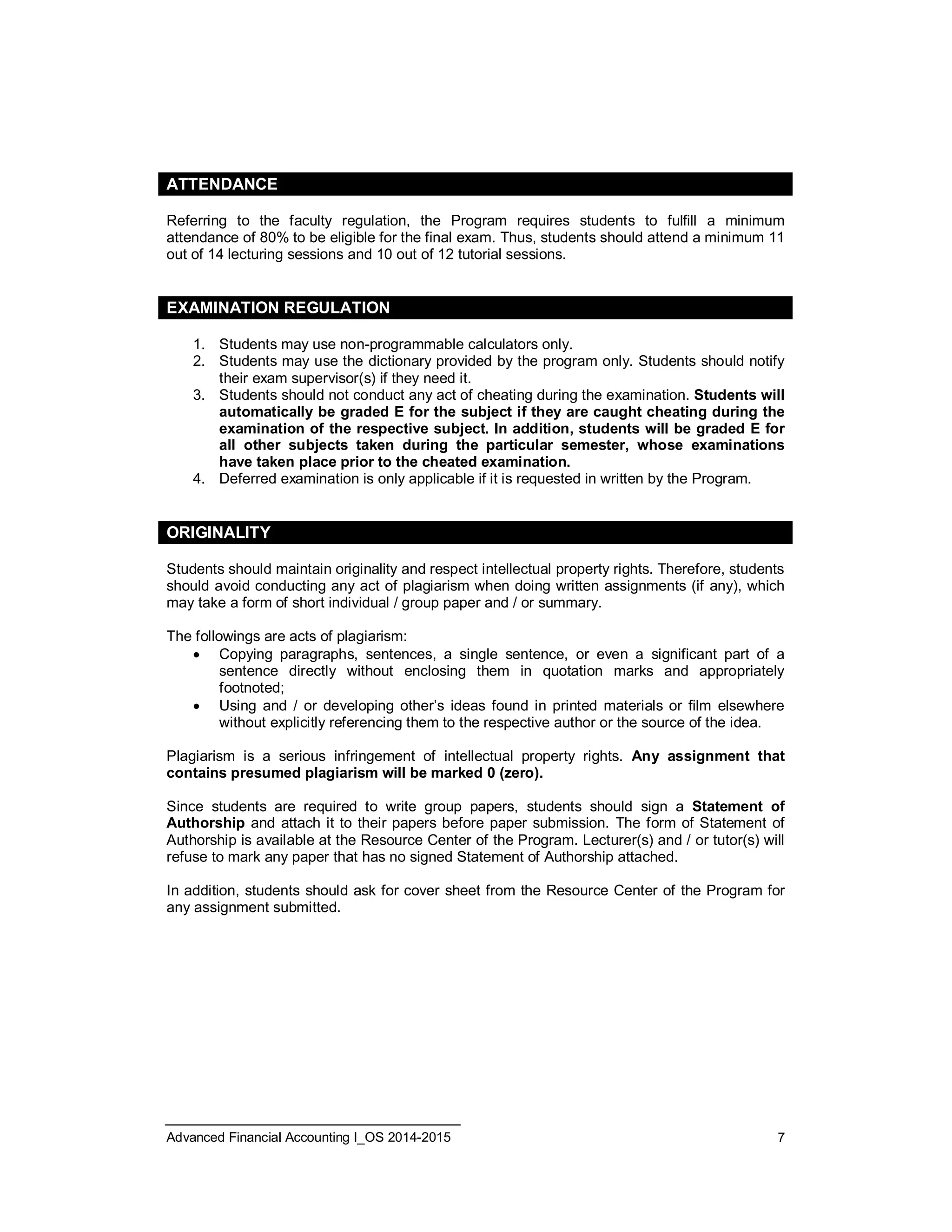
ATTENDANCE 
Referring to the faculty regulation, the Program requires students to fulfill a minimum 
attendance of 80% to be eligible for the final exam. Thus, students should attend a minimum 11 
out of 14 lecturing sessions and 10 out of 12 tutorial sessions. 
EXAMINATION REGULATION 
1. Students may use non-programmable calculators only. 
2. Students may use the dictionary provided by the program only. Students should notify 
their exam supervisor(s) if they need it. 
3. Students should not conduct any act of cheating during the examination. Students will 
automatically be graded E for the subject if they are caught cheating during the 
examination of the respective subject. In addition, students will be graded E for 
all other subjects taken during the particular semester, whose examinations 
have taken place prior to the cheated examination. 
4. Deferred examination is only applicable if it is requested in written by the Program. 
ORIGINALITY 
Students should maintain originality and respect intellectual property rights. Therefore, students 
should avoid conducting any act of plagiarism when doing written assignments (if any), which 
may take a form of short individual / group paper and / or summary. 
The followings are acts of plagiarism: 
 Copying paragraphs, sentences, a single sentence, or even a significant part of a 
sentence directly without enclosing them in quotation marks and appropriately 
footnoted; 
 Using and / or developing other’s ideas found in printed materials or film elsewhere 
without explicitly referencing them to the respective author or the source of the idea. 
Plagiarism is a serious infringement of intellectual property rights. Any assignment that 
contains presumed plagiarism will be marked 0 (zero). 
Since students are required to write group papers, students should sign a Statement of 
Authorship and attach it to their papers before paper submission. The form of Statement of 
Authorship is available at the Resource Center of the Program. Lecturer(s) and / or tutor(s) will 
refuse to mark any paper that has no signed Statement of Authorship attached. 
In addition, students should ask for cover sheet from the Resource Center of the Program for 
any assignment submitted. 
Advanced Financial Accounting I_OS 2014-2015 7

Advanced financial accounting i

  • 1.
    UNIVERSITAS INDONESIA FACULTYOF ECONOMICS AND BUSINESS International Undergraduate Program SYLLABUS [ACCT 11301] ADVANCED FINANCIAL ACCOUNTING I Odd Semester 2014/2015 Credit: 3 Prerequisite: ACCT 11203 Intermediate Financial Accounting II Lecturers: Indah Melati, M.Sc. [coordinator] International Undergraduate Program indah.melati@gmail.com 081804975408 (mobile), (021)7272425 ext.151 (office) Tutor: Arfah Habib Saragih, MS.Ak. arfah.habib.saragih@gmail.com, 085782082758 Advanced Financial Accounting I_OS 2014-2015 1
  • 2.
    SUBJECT DESCRIPTION Thissubject aims to discuss financial accounting aspects in particular circumstances in a company. Specific topics covered are: business combination, accounting for acquisition and investment in other entities, accounting for consolidation, the impact of intercompany transaction on the process of consolidated reporting, , changes in parent company ownership, complex ownership structure, consolidated earnings per share (EPS), income tax in consolidated financial statement, and cash flow statement. SUBJECT OBJECTIVES On successful completion of this subject, student should be able to: 1. Understand types, form, definition and concept of accounting in intercorporate acquisitions and investments in other entities 2. Understand purchase methods in in intercorporate acquisitions in other entities 3. Understand accounting methods used to report investments in other entities, namely cost method and equity method 4. Understand accounting methods used to prepare consolidated financial reporting if investment is recognized using equity method 5. Understand procedures of consolidated reporting for intercompany inventory, transfers of services and noncurrent assets and indebtedness transactions 6. Understand procedures of consolidated reporting if investment is recognized using fuy equity method and cost method. 7. Understand and analyze some Consolidation Reporting Issues such as :  Acquisition incurred in interm periods  Changes in Parent Company Ownership due to purchase or sale of shares of subsidiaries  Changes in Parent Company Ownership due to stock dividend or stock split  Complex Ownership Structure  Subsidiary has preferred stock outstanding, convertible bonds and options 8. Understand calculation, recording and reporting consolidated earning per share 9. Report and analyze foreign currency transaction 10. Understand procedures of multinational accounting : translation of foreign entity statement 11. Prepare and analyze segment and interim reporting. 12. Understand accounting for branches 13. Understand accounting for corporations in financial difficulty In addition, the students will improve the following generic skills: Generic Skills to be Developed Intensity Level Low Moderate High Evaluation of ideas, views, and evidence X Synthesis of ideas, views, and evidence X Strategic thinking X Critical thinking X Application of theory to financial policy and business decision X making Assessing available information and other information X Summarize and interpretation of information X Application of office software X Statistical reason X Problem solving skills X Collaborative learning and teamwork X Negotiation and bargaining - Written communication X Oral communication X Case analysis X Advanced Financial Accounting I_OS 2014-2015 2
  • 3.
    SUBJECT MATERIALS Requiredreadings 1. Baker, R.E., et.al., Advanced Financial Accounting , 10th ed., McGraw Hill, 2011 (BAKER) 2. Baker, R.E., T.E. Christensen, D.M. Cottrell, K.I. Rais, W. Astono & E.R. Wulandari, Advanced Financial Accounting (An Indonesian Perspective), 2nd ed., McGraw Hill & Salemba Empat , 2012 (BAKER IND) 3. Tan, Pearl & P. Lee, Advanced Financial Accounting: An IAS and IFRS Approach, McGraw Hill, 2009. (TAN & LEE) 4. Ikatan Akuntan Indonesia, Standar Akuntansi Keuangan, Jakarta: Salemba Empat, 2009 (PSAK) 5. International Financial Reporting Standards (IFRS) Recommended References 1. Beams, F.A., Z.A. Brozovsky & C.D. Shoulders, Advanced Accounting, 9th ed., New Jersey: Prentice Hall, 2006 (BEAMS) 2. Mirza, Abbas Ali, Graham J. Holt dan Magnus Orrell, IFRS International Financial Reporting Standards, Workbook and Guide, John Wiley, 2006. (MHO) 3. Undang-undang No. 40/2007 mengenai Perseroan Terbatas (UUPT), terutama pasal-pasal tentang modal dan saham dan tentang penggabungan, peleburan dan pengambilalihan. ASSESSMENT Description Assignment, Quiz, Tutorial Case assignment (CL) and Participation Mid Term Exam Final Exam Total Weight (%) 10% 20% 35% 35% 100% CLASSROOM ORGANIZATION  Tutorial sessions are part of student’s learning process. Therefore, tutors should coordinate with lecturers by improving communication, coordinating the exam and grade, and having sit in lectures for minimum 2x (1x before the mid-test and after the mid-test)  To deepen student’s understanding about theories explained in the lectures, the tutorials address the problem discussion/exercise both from the textbook and mid-test and final-test materials from the previous years  Tutors should give homework and quiz to the students and provide the score to the lecturers before the exam starts  Parallel quiz should be given in the tutorial session before and after the mid-test (2x). Tutor coordinator must coordinate the questions. Besides, tutor also can give non-parallel quiz in each class. There are 4 study methods used: 1. Lecturing in lectures and tutorials. This method is used in some sessions or combined with other methods in some other sessions Advanced Financial Accounting I_OS 2014-2015 3
  • 4.
    2. Student-Centered Learning(SCL). This method is applied in most sessions using Collaborative Learning 3. Tutorials 4. Individual and group assignment Lecturing is always combined with discussion, Q&A, and mini case discussion obtained from the textbook. In lecturing, lecturers can raise some real cases to provide clearer description to students regarding accounting practices in a company. Sessions with Student-Centered Learning divide the class into groups consisting of 5 students, which will be assigned some cases using the collaborative learning approach-Simple Jigsaw (session 4 and 9) Tutorials will cover problem discussion which is given as students’ homework in the previous session. Problems cover high level of difficulty. Students form groups in which individuals should discuss some materials and present them in front of the class as individual assignment. Discussion material made by the group is considered as group score. Teaching Method consists of: Lecture yes Class discussion yes Individual project & paper no Group project & paper yes Presentation yes Case analysis yes Tutorial yes Laboratory – in class experience exercise no Computer lab no Cooperative learning yes ASSIGNMENT POLICY Assignment should be handed-in no later than the due date. Any late work will be assessed a penalty of 5 point a day (max 2 days). Work handed-in later than three days will be marked as 0. CLASS TIMETABLE Lectures Session Topic Reading material 1 Intercorporate Acquisition and Investment in Other Entities  The development of complex business structures  Creating business entities  Business combinations  Accounting for business combinations Baker Ch.1 Tan & Lee Ch. 2 Beams Ch.1 MHO Ch 36 PSAK 22, PSAK 38 2 Reporting Intercorporate Investments  Accounting for investments in common stock using cost method  Accounting for investments in common stock using equity method Baker Ch.2 Tan & Lee Ch. 2, 5 Beams Ch.2 MHO Ch 21 PSAK 15 (revisi 2009) Advanced Financial Accounting I_OS 2014-2015 4
  • 5.
     Comparison ofthe cost and equity methods  Appdx 2A: Other issues regarding equity method  Appdx 2B: Consolidation and equity method The Reporting Entity and Consolidated Financial Statements  The usefulness of consolidated financial statements  Subsidiary financial statements  Consolidated financial statements: concepts and standards  Non-controlling interest  Consolidation subsequent to acquisition-80% ownership acquired at book value  APPdx 3B: other approaches to consolidation Baker Ch. 3 Tan & Lee Ch. 3 Beams Ch 3 & Beams Ch. 11 MHO Ch 20 PSAK 4 (rev 2009). 3 Consolidation of Wholly Owned Subsidiaries Acquired at More than Book Value  Differential  Consolidation procedures for wholly owned subsidiaries acquired at more than book value  Consolidated financial statements-100 percent ownership acquired at more than book value  Intercompany receivables and payables Baker Ch.4 Tan & Lee Ch. 3 Beams Ch.4 MHO Ch 20 PSAK 4 (rev 2009), PSAK 19 (revisi 2009), PSAK 48 (revisi 2009) 4 CL Consolidation of less-than wholly owned subsidiaries Acquired at More Than Book Value  A Noncontrolling interest in conjunction with a differential  Consolidated financial statements with a majority owned subsidiary  Discontinuance of consolidation  Treatment of other comprehensive income  Appdx 5A: additional consideration Baker Ch.5 Baker Ch.5 -Apendix 5A Tan & Lee Ch. 3 MHO Ch 20 Beams Ch.4 PSAK 4 (rev 2009), PSAK 19 (revisi 2009), PSAK 48 (revisi 2009) 5 Intercompany Inventory Transaction  Overview of the consolidated entity and intercompany transactions  Inventory transactions  Downstream sale of inventory  Upstream sale of inventory  Appdx 6A: Intercompany inventory transactions-cost method Baker Ch.7 Tan & Lee Ch. 4 Beams Ch.5 PSAK 4 (rev 2009) 6 Intercompany Transfers of Services and Noncurrent Assets  Intercompany long-term asset transfers  Intercompany transfers of services  Intercompany land transfers  Intercompany transfers of depreciable assets  Intercompany transfers of amortizable assets  Appdz 7A: intercompany noncurrent asset transactions: cost method Baker Ch.6 Baker Ch.6 – Apendix 6A Tan & Lee Ch. 4 Beams Ch.6 PSAK 4 (rev 2009) 7 Intercompany Indebtedness  Consolidation overview  Bond sale directly to an Affiliate  Bond of Affiliate purchased from a Nonaffiliate  Appdx 8A: intercompany indebtness-cost method Baker Ch.8 Tan & Lee Ch. 4 Beams Ch.7 PSAK 4 (rev 2009) Advanced Financial Accounting I_OS 2014-2015 5
  • 6.
    MID TERM EXAM 8 Segment and Interim Reporting  Segment reporting  Interim Financial Reporting Accounting for Branch o Types of Branch o Accounting System for Branch o Accounting for Operation of Branch o Bransaction amongs branch o Unrealized Income of branch’s inventory Baker Ch. 13 Tan & Lee Ch. 6 Beams Ch.8 PSAK 4 (rev 2009), PSAK 40 UUPT 9 CL Additional Consolidation Reporting Issues  Subsidiary preferred stock outstanding  Changes in parent company ownership  Complex ownership structures Baker Ch.9 Tan & Lee Ch. 6 & 11 Beams Ch.9, 10 PSAK 2 (revisi 2009), PSAK 4 (revisi 2009), PSAK 56 10 Additional Consolidation Reporting Issues  Consolidated statements of cash flows  Consolidation following an interim acquisition  Consolidated earning per share  Consolidated income tax issues Baker Ch 10 Tan & Lee Ch. 7 & 9 PSAK 10 (revisi 2010), PSAK 50 & 55, ED ISAK 13 11 Multinational Accounting: Foreign Currency Transactions and Financial Instruments  The accounting issues  Foreign currency exchange rates  Foreign currency transactions  Managing international currency risk with foreign currency forward exchange financial instruments  Forward exchange transaction report Baker Ch 11 Tan & Lee Ch. 7 & 9 PSAK 10, PSAK 50 & 55, ISAK 13 12 Multinational Accounting: Issues in Financial Reporting and Translation of Foreign Entity Statements  Determining the functional currency  Translation vs remeasurement of foreign financial statements  Translation  Remeasurement (overview) Baker Ch 12 Tan & Lee Ch. 7 PSAK 4 (revisi 2009), PSAK 10 (revisi 2010) 14 Accounting for Jointly Controlled Operations and Assets  Joint venture forms  Jointly controlled operations  Jointly controlled assets PSAK 12 ISAK 12 14 Corporations in Financial Difficulty  Creditors Accounting for Impaired Loans  Restructurization for nonperformaning loans Baker Ch. 17 Tan & Lee Ch. 8 PSAK 50, PSAK 55 (revisi 2006) FINAL EXAM Advanced Financial Accounting I_OS 2014-2015 6
  • 7.
    ATTENDANCE Referring tothe faculty regulation, the Program requires students to fulfill a minimum attendance of 80% to be eligible for the final exam. Thus, students should attend a minimum 11 out of 14 lecturing sessions and 10 out of 12 tutorial sessions. EXAMINATION REGULATION 1. Students may use non-programmable calculators only. 2. Students may use the dictionary provided by the program only. Students should notify their exam supervisor(s) if they need it. 3. Students should not conduct any act of cheating during the examination. Students will automatically be graded E for the subject if they are caught cheating during the examination of the respective subject. In addition, students will be graded E for all other subjects taken during the particular semester, whose examinations have taken place prior to the cheated examination. 4. Deferred examination is only applicable if it is requested in written by the Program. ORIGINALITY Students should maintain originality and respect intellectual property rights. Therefore, students should avoid conducting any act of plagiarism when doing written assignments (if any), which may take a form of short individual / group paper and / or summary. The followings are acts of plagiarism:  Copying paragraphs, sentences, a single sentence, or even a significant part of a sentence directly without enclosing them in quotation marks and appropriately footnoted;  Using and / or developing other’s ideas found in printed materials or film elsewhere without explicitly referencing them to the respective author or the source of the idea. Plagiarism is a serious infringement of intellectual property rights. Any assignment that contains presumed plagiarism will be marked 0 (zero). Since students are required to write group papers, students should sign a Statement of Authorship and attach it to their papers before paper submission. The form of Statement of Authorship is available at the Resource Center of the Program. Lecturer(s) and / or tutor(s) will refuse to mark any paper that has no signed Statement of Authorship attached. In addition, students should ask for cover sheet from the Resource Center of the Program for any assignment submitted. Advanced Financial Accounting I_OS 2014-2015 7