New Developments In Construction
Technology
Index
A. Construction Planning
B. Building construction
1. Excavation
2. Hybrid Formwork
3. Plastic Formwork
4. Voided Slabs
5. MgO Wall Panels (Dry wall panels)
6. Rice Husk Hulls and Ash – Supplementary
Binder
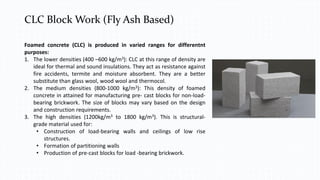
7. CLC Blockwork (Fly Ash Based)
8. Block jointing adhesives
9. Ready Mix Plasters
10. Tile Fixing Adhesives
11. Pre Hung Doors
Creativity is thinking up new things.
Innovation is doing new things.
- Theodore Levitt
Index
A. Construction Planning
B. Building construction
1. Excavation
2. Hybrid Formwork
3. Plastic Formwork
4. Voided Slabs
5. MgO Wall Panels (Dry wall panels)
6. Rice Husk Hulls and Ash – Supplementary
Binder
7. CLC Blockwork (Fly Ash Based)
8. Block jointing adhesives
9. Ready Mix Plasters
10. Tile Fixing Adhesives
11. Pre Hung Doors
C. Safety
Creativity is thinking up new things.
Innovation is doing new things.
- Theodore Levitt
Integrated Scheduling
Integrated Schedule - Design, Procurement and Contract made part of the master
schedules
A. Contract & Procurement schedules are linked to the execution activities, hence it helps to finalize vendors
and contractors timely.
For example
a. Finalization of Plumbing contractor back linked to “internal plumbing works of wet area”
b. Vendor finalization of sanitary wares back linked to execution activity of “fixing of sanitary wares”
So its makes sure that floating of tender or finalization of vendor/contractor are in line with our execution
progress. Its helps to plan for materials before requirement and also to avoid EOT related claims from
contractors
Integrated Scheduling
A. Cost in form of resources (as per BOQ) are loaded in schedule, which help us to get right project cash
flows for Project
B. All client supplied materials are loaded in schedule, which gives us total project as well as yearly
material requirement (with monthly breakup). This helps us for better strategic planning of material
procurement like long term tie ups with A grade suppliers
C. Design/drawings requirement included in the schedule
Advanced Project Management Tools
 RIB – ITWO
 Candy & Build Smart
 ORACLE –Primavera
 Trimble - Tekla
3D To 7D
RIB – ITWO 5D – End to End Approach
Index
A. Construction Planning
B. Building construction
1. Excavation
2. Hybrid Formwork
3. Plastic Formwork
4. Voided Slabs
5. MgO Wall Panels (Dry wall panels)
6. Rice Husk Hulls & Ash – Supplementary Binder
7. CLC Blockwork (Fly Ash Based)
8. Block jointing adhesives
9. Ready Mix Plasters
10. Tile Fixing Adhesives
11. Pre Hung Doors
C. Safety
Creativity is thinking up new things.
Innovation is doing new things.
- Theodore Levitt
Excavation
Conventional – Drill & Blast, Mechanical Excavation
• Conventional methods of rock excavation such as drill & blast, control
blast, mechanical excavation and hydraulic splitter are high impact,
noisy and methods which are regulated by licencing systems. These
methods may impact adjacent buildings / surroundings
New Development – EPI Pulse Plasma Rock Fragmentation
• Electro Power Impulse generator energizes Aluminium & Copper
oxide power to plasma stage. This process generates the heat and
impact wave to crack & break the rock.
• It is a non explosive process requiring no licences. No resonance
generate and hence safe to use near any existing structure.
Conventional
New Development
Excavation
Distance EPI Plasma
Controlled
Blasting
20M 67.6dB 83.2dB
30M 65.3dB 78.9dB
40M 65.8dB 73.3dB
Process:
• Drill holes of 51 mm to a depth of 3 meter
• Insert Plasma cells
• Plug the hole using seal & sand bags
• Energized Electro Power Impactor (EPI) using
30 KVA Generator.
• Provide Pulse to Plasma Cells from EPI
• Remove the Fragmented Rock using normal
Excavator.
Applications:
• Building Foundations, Tunnels.
• Next to the Airport; Rail Lines; Roads; Power
Plants; Dams; Canals; Industrial Plants; Oil &
Gas Pipelines; City Utility Network etc.
• Used for weak to Hard Rock
Note: The difference of 10 dB means about 10 times difference in real sound.
Excavation
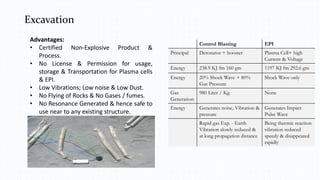
Advantages:
• Certified Non-Explosive Product &
Process.
• No License & Permission for usage,
storage & Transportation for Plasma cells
& EPI.
• Low Vibrations; Low noise & Low Dust.
• No Flying of Rocks & No Gases / fumes.
• No Resonance Generated & hence safe to
use near to any existing structure.
Control Blasting EPI
Principal Detonator + booster Plasma Cell+ high
Current & Voltage
Energy 238.9 KJ fm 160 gm 1197 KJ fm 292.6 gm
Energy 20% Shock Wave + 80%
Gas Pressure
Shock Wave only
Gas
Generation
980 Liter / Kg None
Energy Generates noise, Vibration &
pressure
Generates Impact
Pulse Wave
Rapid gas Exp. - Earth
Vibration slowly reduced &
at long propagation distance
Being thermic reaction
vibration reduced
speedy & disappeared
rapidly
Hybrid Formwork
1. STANDARD FRAME 2. MIVAN SHEAR WALL
3. FULL RCC MIVAN
Plastic Formwork
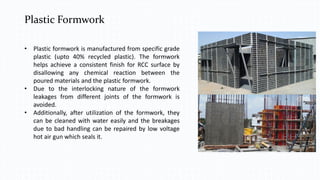
• Plastic formwork is manufactured from specific grade
plastic (upto 40% recycled plastic). The formwork
helps achieve a consistent finish for RCC surface by
disallowing any chemical reaction between the
poured materials and the plastic formwork.
• Due to the interlocking nature of the formwork
leakages from different joints of the formwork is
avoided.
• Additionally, after utilization of the formwork, they
can be cleaned with water easily and the breakages
due to bad handling can be repaired by low voltage
hot air gun which seals it.
Plastic Formwork
Sailent Features of Plastic Formwork
• Light but mechanically resistant (60KN/m2)
• Fast to install and to move
• Reusable upto 100 uses.
• Cost effective in the construction site
• Stable to temperatures (-30 °C / +70 °C)
Weight Kg / M2
Plastic Plywood Aluminum
Plastic Formwork
Items
Plastic
formwork
Traditional
formwork
Steel
formwork
Recycled 40% No 10%
Water resistant Yes No No
Deformation
condition
No Yes Yes
Stripping process Easy Moderate Difficult
Size Custom sizes Restricted Restricted
Corrosion resistant Excellent Bad Bad
Re-Use 100 times 8 times 100 times
Voided Slabs
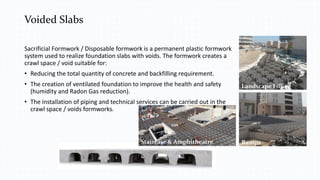
Sacrificial Formwork / Disposable formwork is a permanent plastic formwork
system used to realize foundation slabs with voids. The formwork creates a
crawl space / void suitable for:
• Reducing the total quantity of concrete and backfilling requirement.
• The creation of ventilated foundation to improve the health and safety
(humidity and Radon Gas reduction).
• The installation of piping and technical services can be carried out in the
crawl space / voids formworks.
Landscape Filling
RampsStaircase & Amphitheatre
Voided Slabs – Foundations
Ramps
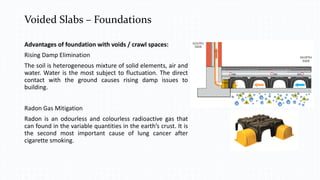
Advantages of foundation with voids / crawl spaces:
Rising Damp Elimination
The soil is heterogeneous mixture of solid elements, air and
water. Water is the most subject to fluctuation. The direct
contact with the ground causes rising damp issues to
building.
Radon Gas Mitigation
Radon is an odourless and colourless radioactive gas that
can found in the variable quantities in the earth’s crust. It is
the second most important cause of lung cancer after
cigarette smoking.
Voided Slabs
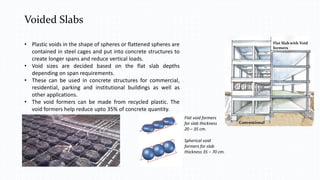
• Plastic voids in the shape of spheres or flattened spheres are
contained in steel cages and put into concrete structures to
create longer spans and reduce vertical loads.
• Void sizes are decided based on the flat slab depths
depending on span requirements.
• These can be used in concrete structures for commercial,
residential, parking and institutional buildings as well as
other applications.
• The void formers can be made from recycled plastic. The
void formers help reduce upto 35% of concrete quantity.
Flat void formers
for slab thickness
20 – 35 cm.
Spherical void
formers for slab
thickness 35 – 70 cm.
Conventional
Flat Slab with Void
formers
MgO Wall Panels (Dry Wall Panel)
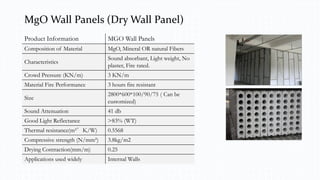
Product Information MGO Wall Panels
Composition of Material MgO, Mineral OR natural Fibers
Characteristics
Sound absorbant, Light weight, No
plaster, Fire rated.
Crowd Pressure (KN/m) 3 KN/m
Material Fire Performance 3 hours fire resistant
Size
2800*600*100/90/75 ( Can be
customized)
Sound Attenuation 41 db
Good Light Reflectance >83% (WT)
Thermal resistance(m² K/W) 0.5568
Compressive strength (N/mm²) 3.8kg/m2
Drying Contraction(mm/m) 0.25
Applications used widely Internal Walls
MgO Wall Panels (Dry Wall Panel)
Weight comparison of Drywall vs. Conventional masonry wall
• Drywall -300–380 kg/m3
• Brick walls - 1800-1900 kg/m3
• Block Walls - 750-850 kg/m3
Flexibility of Redesigning Interiors
• Can be built around the existing slab of a building without
the use of heavy beams as the dry wall systems are light in
weight.
• Open shell / open plan design concept can be adopted in
case of use of dry wall panels.
• Use of dry wall panel helps avoid masonry cracks. Note: The above picture is from the manufacturers factory
location
Rice Husk Hulls / Ash – Supplementary Binder
o The rice husk ash has good reactivity when used as a partial
substitute for cement.
o The main applications of rice husk hulls / ash in the
construction are:
• High-performance Concrete
• Insulator
• Bathroom floors
• Industrial factory floorings
• Foundation
• Swimming pools
• Waterproofing and rehabilitation
o The rice husk itself is rough and abrasive in nature. These are
resistant to natural degradation and result in improper
disposal problems.
Rice Husk Hull Panels
Rice Husk Ash Bricks
CLC Block Work (Fly Ash Based)
Fly ash based cellular light weight concrete block
• It is a version of lightweight concrete that is produced like
normal concrete under ambient conditions. It is produced by
initially making a slurry of Cement +Sand + Fly Ash (constituting
26% – 34 % content) + water
• In cellular lightweight concrete, the density can be controlled by
the introduction of gas or foam by foam generator.
Benefits of using Fly Ash based CLC blocks
• Lightweight
• Fire resistance
• Thermal Insulation
• Sound absorption and acoustical insulation.
• Environmentally Friendly
• Cost efficient
CLC Block Work (Fly Ash Based)
Foamed concrete (CLC) is produced in varied ranges for differentnt
purposes:
1. The lower densities (400 –600 kg/m3): CLC at this range of density are
ideal for thermal and sound insulations. They act as resistance against
fire accidents, termite and moisture absorbent. They are a better
substitute than glass wool, wood wool and thermocol.
2. The medium densities (800-1000 kg/m3): This density of foamed
concrete in attained for manufacturing pre- cast blocks for non-load-
bearing brickwork. The size of blocks may vary based on the design
and construction requirements.
3. The high densities (1200kg/m3 to 1800 kg/m3). This is structural-
grade material used for:
• Construction of load-bearing walls and ceilings of low rise
structures.
• Formation of partitioning walls
• Production of pre-cast blocks for load -bearing brickwork.
Block Jointing Adhesives
Conventional
• Cement mortar, (pre mix or site mix) requiring 1 labour and 1
mason to lay the mortar and blocks. Curing time of 1 day. And
housekeeping of the adjacent areas is to be carried out to remove
spillage of mortar.
New Development
• Block jointing adhesives are nowadays used. No curing required as
it is polymer based. It is done in 2 to 3 mm as thin bed technology.
• One just needs to add water to the mix before using it. Due to
presence of polymers no curing is required after application.
• Block jointing adhesives offer higher bond strength than
conventional block jointing mortar.
Conventional
New Development
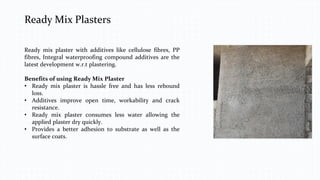
Ready Mix Plasters
Ready mix plaster with additives like cellulose fibres, PP
fibres, Integral waterproofing compound additives are the
latest development w.r.t plastering.
Benefits of using Ready Mix Plaster
• Ready mix plaster is hassle free and has less rebound
loss.
• Additives improve open time, workability and crack
resistance.
• Ready mix plaster consumes less water allowing the
applied plaster dry quickly.
• Provides a better adhesion to substrate as well as the
surface coats.
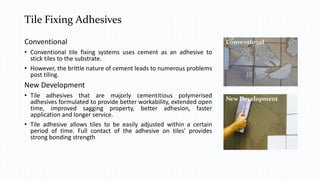
Tile Fixing Adhesives
Conventional
• Conventional tile fixing systems uses cement as an adhesive to
stick tiles to the substrate.
• However, the brittle nature of cement leads to numerous problems
post tiling.
New Development
• Tile adhesives that are majorly cementitious polymerised
adhesives formulated to provide better workability, extended open
time, improved sagging property, better adhesion, faster
application and longer service.
• Tile adhesive allows tiles to be easily adjusted within a certain
period of time. Full contact of the adhesive on tiles' provides
strong bonding strength
Conventional
New Development
Tile Fixing Adhesives
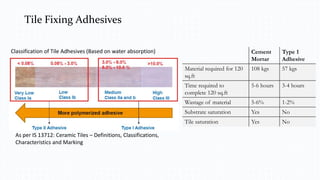
Classification of Tile Adhesives (Based on water absorption)
As per IS 13712: Ceramic Tiles – Definitions, Classifications,
Characteristics and Marking
Cement
Mortar
Type 1
Adhesive
Material required for 120
sq.ft
108 kgs 57 kgs
Time required to
complete 120 sq.ft
5-6 hours 3-4 hours
Wastage of material 5-6% 1-2%
Substrate saturation Yes No
Tile saturation Yes No
Tile Fixing Adhesives
TEST OBSERVATION
PERFORMANCE PROPERTIES CEMENT MORTAR TYPE 1 ADHESIVE (IS
15477)
Pot life of Mix 5-7 mins 30 mins
Open Time 2-3 min 15 mins
1. Tensile Adhesion strength, (N)
a) Dry conditions 167 N, 139 N 1270 N
b) Wet conditions 22 N 1120 N
2. Shear adhesion strength, (KN)
a) Dry conditions, 24 hours 1.98 N 4.04 KN
b) Dry conditions, 14 days 5.2 KN 10.7 KN
c) Heat aging conditions 0.2 KN 8.2 KN
d) Wet conditions 7.4 KN 8.5 KN
Pre Hung Doors
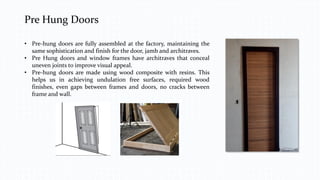
• Pre-hung doors are fully assembled at the factory, maintaining the
same sophistication and finish for the door, jamb and architraves.
• Pre Hung doors and window frames have architraves that conceal
uneven joints to improve visual appeal.
• Pre-hung doors are made using wood composite with resins. This
helps us in achieving undulation free surfaces, required wood
finishes, even gaps between frames and doors, no cracks between
frame and wall.
Pre Hung Doors (Tubular Hollow Core)
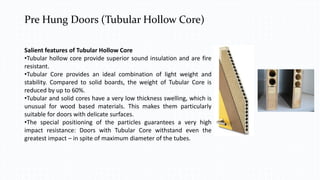
Salient features of Tubular Hollow Core
•Tubular hollow core provide superior sound insulation and are fire
resistant.
•Tubular Core provides an ideal combination of light weight and
stability. Compared to solid boards, the weight of Tubular Core is
reduced by up to 60%.
•Tubular and solid cores have a very low thickness swelling, which is
unusual for wood based materials. This makes them particularly
suitable for doors with delicate surfaces.
•The special positioning of the particles guarantees a very high
impact resistance: Doors with Tubular Core withstand even the
greatest impact – in spite of maximum diameter of the tubes.
Pre Hung Doors (Honeycomb Core)
Salient features of Honeycomb Core Doors
•The basic strength of honeycomb comes from its hexagonal shape.
Its high compressive and tensile strength makes it a unique,
universal and reliable replacement for solid filling materials in the
door making industry. These doors can withstand pressure of up to
8kg/cm².
•Traditional doors are very heavy by weight and after some period
starts leaning and jamming. Hence it requires considerable
maintenance. Whereas, being light weight, ingenious honeycomb
core has an edge over all problems due to deformability.
Quality Checking Tools
Moisture Meter
• Measurement of moisture content of selected materials
can be carried out through Moisture Meters. The
moisture meter can measure moisture content in
Plaster, Concrete, Wood, Aerated Concrete, Wood
(Various types).
Moisture Meter
Leak Detectors
Leak Detectors
• Leak detection tool allows for point-
of-contact, non-destructive checking
of moisture conditions in walls,
roofing and waterproofing
systems up to 4 inches in depth.
Thank You

New developments in construction technology

  • 1.
    New Developments InConstruction Technology
  • 2.
    Index A. Construction Planning B.Building construction 1. Excavation 2. Hybrid Formwork 3. Plastic Formwork 4. Voided Slabs 5. MgO Wall Panels (Dry wall panels) 6. Rice Husk Hulls and Ash – Supplementary Binder 7. CLC Blockwork (Fly Ash Based) 8. Block jointing adhesives 9. Ready Mix Plasters 10. Tile Fixing Adhesives 11. Pre Hung Doors Creativity is thinking up new things. Innovation is doing new things. - Theodore Levitt
  • 3.
    Index A. Construction Planning B.Building construction 1. Excavation 2. Hybrid Formwork 3. Plastic Formwork 4. Voided Slabs 5. MgO Wall Panels (Dry wall panels) 6. Rice Husk Hulls and Ash – Supplementary Binder 7. CLC Blockwork (Fly Ash Based) 8. Block jointing adhesives 9. Ready Mix Plasters 10. Tile Fixing Adhesives 11. Pre Hung Doors C. Safety Creativity is thinking up new things. Innovation is doing new things. - Theodore Levitt
  • 4.
    Integrated Scheduling Integrated Schedule- Design, Procurement and Contract made part of the master schedules A. Contract & Procurement schedules are linked to the execution activities, hence it helps to finalize vendors and contractors timely. For example a. Finalization of Plumbing contractor back linked to “internal plumbing works of wet area” b. Vendor finalization of sanitary wares back linked to execution activity of “fixing of sanitary wares” So its makes sure that floating of tender or finalization of vendor/contractor are in line with our execution progress. Its helps to plan for materials before requirement and also to avoid EOT related claims from contractors
  • 5.
    Integrated Scheduling A. Costin form of resources (as per BOQ) are loaded in schedule, which help us to get right project cash flows for Project B. All client supplied materials are loaded in schedule, which gives us total project as well as yearly material requirement (with monthly breakup). This helps us for better strategic planning of material procurement like long term tie ups with A grade suppliers C. Design/drawings requirement included in the schedule
  • 6.
    Advanced Project ManagementTools  RIB – ITWO  Candy & Build Smart  ORACLE –Primavera  Trimble - Tekla 3D To 7D
  • 7.
    RIB – ITWO5D – End to End Approach
  • 8.
    Index A. Construction Planning B.Building construction 1. Excavation 2. Hybrid Formwork 3. Plastic Formwork 4. Voided Slabs 5. MgO Wall Panels (Dry wall panels) 6. Rice Husk Hulls & Ash – Supplementary Binder 7. CLC Blockwork (Fly Ash Based) 8. Block jointing adhesives 9. Ready Mix Plasters 10. Tile Fixing Adhesives 11. Pre Hung Doors C. Safety Creativity is thinking up new things. Innovation is doing new things. - Theodore Levitt
  • 9.
    Excavation Conventional – Drill& Blast, Mechanical Excavation • Conventional methods of rock excavation such as drill & blast, control blast, mechanical excavation and hydraulic splitter are high impact, noisy and methods which are regulated by licencing systems. These methods may impact adjacent buildings / surroundings New Development – EPI Pulse Plasma Rock Fragmentation • Electro Power Impulse generator energizes Aluminium & Copper oxide power to plasma stage. This process generates the heat and impact wave to crack & break the rock. • It is a non explosive process requiring no licences. No resonance generate and hence safe to use near any existing structure. Conventional New Development
  • 10.
    Excavation Distance EPI Plasma Controlled Blasting 20M67.6dB 83.2dB 30M 65.3dB 78.9dB 40M 65.8dB 73.3dB Process: • Drill holes of 51 mm to a depth of 3 meter • Insert Plasma cells • Plug the hole using seal & sand bags • Energized Electro Power Impactor (EPI) using 30 KVA Generator. • Provide Pulse to Plasma Cells from EPI • Remove the Fragmented Rock using normal Excavator. Applications: • Building Foundations, Tunnels. • Next to the Airport; Rail Lines; Roads; Power Plants; Dams; Canals; Industrial Plants; Oil & Gas Pipelines; City Utility Network etc. • Used for weak to Hard Rock Note: The difference of 10 dB means about 10 times difference in real sound.
  • 11.
    Excavation Advantages: • Certified Non-ExplosiveProduct & Process. • No License & Permission for usage, storage & Transportation for Plasma cells & EPI. • Low Vibrations; Low noise & Low Dust. • No Flying of Rocks & No Gases / fumes. • No Resonance Generated & hence safe to use near to any existing structure. Control Blasting EPI Principal Detonator + booster Plasma Cell+ high Current & Voltage Energy 238.9 KJ fm 160 gm 1197 KJ fm 292.6 gm Energy 20% Shock Wave + 80% Gas Pressure Shock Wave only Gas Generation 980 Liter / Kg None Energy Generates noise, Vibration & pressure Generates Impact Pulse Wave Rapid gas Exp. - Earth Vibration slowly reduced & at long propagation distance Being thermic reaction vibration reduced speedy & disappeared rapidly
  • 12.
    Hybrid Formwork 1. STANDARDFRAME 2. MIVAN SHEAR WALL 3. FULL RCC MIVAN
  • 13.
    Plastic Formwork • Plasticformwork is manufactured from specific grade plastic (upto 40% recycled plastic). The formwork helps achieve a consistent finish for RCC surface by disallowing any chemical reaction between the poured materials and the plastic formwork. • Due to the interlocking nature of the formwork leakages from different joints of the formwork is avoided. • Additionally, after utilization of the formwork, they can be cleaned with water easily and the breakages due to bad handling can be repaired by low voltage hot air gun which seals it.
  • 14.
    Plastic Formwork Sailent Featuresof Plastic Formwork • Light but mechanically resistant (60KN/m2) • Fast to install and to move • Reusable upto 100 uses. • Cost effective in the construction site • Stable to temperatures (-30 °C / +70 °C) Weight Kg / M2 Plastic Plywood Aluminum
  • 15.
    Plastic Formwork Items Plastic formwork Traditional formwork Steel formwork Recycled 40%No 10% Water resistant Yes No No Deformation condition No Yes Yes Stripping process Easy Moderate Difficult Size Custom sizes Restricted Restricted Corrosion resistant Excellent Bad Bad Re-Use 100 times 8 times 100 times
  • 16.
    Voided Slabs Sacrificial Formwork/ Disposable formwork is a permanent plastic formwork system used to realize foundation slabs with voids. The formwork creates a crawl space / void suitable for: • Reducing the total quantity of concrete and backfilling requirement. • The creation of ventilated foundation to improve the health and safety (humidity and Radon Gas reduction). • The installation of piping and technical services can be carried out in the crawl space / voids formworks. Landscape Filling RampsStaircase & Amphitheatre
  • 17.
    Voided Slabs –Foundations Ramps Advantages of foundation with voids / crawl spaces: Rising Damp Elimination The soil is heterogeneous mixture of solid elements, air and water. Water is the most subject to fluctuation. The direct contact with the ground causes rising damp issues to building. Radon Gas Mitigation Radon is an odourless and colourless radioactive gas that can found in the variable quantities in the earth’s crust. It is the second most important cause of lung cancer after cigarette smoking.
  • 18.
    Voided Slabs • Plasticvoids in the shape of spheres or flattened spheres are contained in steel cages and put into concrete structures to create longer spans and reduce vertical loads. • Void sizes are decided based on the flat slab depths depending on span requirements. • These can be used in concrete structures for commercial, residential, parking and institutional buildings as well as other applications. • The void formers can be made from recycled plastic. The void formers help reduce upto 35% of concrete quantity. Flat void formers for slab thickness 20 – 35 cm. Spherical void formers for slab thickness 35 – 70 cm. Conventional Flat Slab with Void formers
  • 19.
    MgO Wall Panels(Dry Wall Panel) Product Information MGO Wall Panels Composition of Material MgO, Mineral OR natural Fibers Characteristics Sound absorbant, Light weight, No plaster, Fire rated. Crowd Pressure (KN/m) 3 KN/m Material Fire Performance 3 hours fire resistant Size 2800*600*100/90/75 ( Can be customized) Sound Attenuation 41 db Good Light Reflectance >83% (WT) Thermal resistance(m² K/W) 0.5568 Compressive strength (N/mm²) 3.8kg/m2 Drying Contraction(mm/m) 0.25 Applications used widely Internal Walls
  • 20.
    MgO Wall Panels(Dry Wall Panel) Weight comparison of Drywall vs. Conventional masonry wall • Drywall -300–380 kg/m3 • Brick walls - 1800-1900 kg/m3 • Block Walls - 750-850 kg/m3 Flexibility of Redesigning Interiors • Can be built around the existing slab of a building without the use of heavy beams as the dry wall systems are light in weight. • Open shell / open plan design concept can be adopted in case of use of dry wall panels. • Use of dry wall panel helps avoid masonry cracks. Note: The above picture is from the manufacturers factory location
  • 21.
    Rice Husk Hulls/ Ash – Supplementary Binder o The rice husk ash has good reactivity when used as a partial substitute for cement. o The main applications of rice husk hulls / ash in the construction are: • High-performance Concrete • Insulator • Bathroom floors • Industrial factory floorings • Foundation • Swimming pools • Waterproofing and rehabilitation o The rice husk itself is rough and abrasive in nature. These are resistant to natural degradation and result in improper disposal problems. Rice Husk Hull Panels Rice Husk Ash Bricks
  • 22.
    CLC Block Work(Fly Ash Based) Fly ash based cellular light weight concrete block • It is a version of lightweight concrete that is produced like normal concrete under ambient conditions. It is produced by initially making a slurry of Cement +Sand + Fly Ash (constituting 26% – 34 % content) + water • In cellular lightweight concrete, the density can be controlled by the introduction of gas or foam by foam generator. Benefits of using Fly Ash based CLC blocks • Lightweight • Fire resistance • Thermal Insulation • Sound absorption and acoustical insulation. • Environmentally Friendly • Cost efficient
  • 23.
    CLC Block Work(Fly Ash Based) Foamed concrete (CLC) is produced in varied ranges for differentnt purposes: 1. The lower densities (400 –600 kg/m3): CLC at this range of density are ideal for thermal and sound insulations. They act as resistance against fire accidents, termite and moisture absorbent. They are a better substitute than glass wool, wood wool and thermocol. 2. The medium densities (800-1000 kg/m3): This density of foamed concrete in attained for manufacturing pre- cast blocks for non-load- bearing brickwork. The size of blocks may vary based on the design and construction requirements. 3. The high densities (1200kg/m3 to 1800 kg/m3). This is structural- grade material used for: • Construction of load-bearing walls and ceilings of low rise structures. • Formation of partitioning walls • Production of pre-cast blocks for load -bearing brickwork.
  • 24.
    Block Jointing Adhesives Conventional •Cement mortar, (pre mix or site mix) requiring 1 labour and 1 mason to lay the mortar and blocks. Curing time of 1 day. And housekeeping of the adjacent areas is to be carried out to remove spillage of mortar. New Development • Block jointing adhesives are nowadays used. No curing required as it is polymer based. It is done in 2 to 3 mm as thin bed technology. • One just needs to add water to the mix before using it. Due to presence of polymers no curing is required after application. • Block jointing adhesives offer higher bond strength than conventional block jointing mortar. Conventional New Development
  • 25.
    Ready Mix Plasters Readymix plaster with additives like cellulose fibres, PP fibres, Integral waterproofing compound additives are the latest development w.r.t plastering. Benefits of using Ready Mix Plaster • Ready mix plaster is hassle free and has less rebound loss. • Additives improve open time, workability and crack resistance. • Ready mix plaster consumes less water allowing the applied plaster dry quickly. • Provides a better adhesion to substrate as well as the surface coats.
  • 26.
    Tile Fixing Adhesives Conventional •Conventional tile fixing systems uses cement as an adhesive to stick tiles to the substrate. • However, the brittle nature of cement leads to numerous problems post tiling. New Development • Tile adhesives that are majorly cementitious polymerised adhesives formulated to provide better workability, extended open time, improved sagging property, better adhesion, faster application and longer service. • Tile adhesive allows tiles to be easily adjusted within a certain period of time. Full contact of the adhesive on tiles' provides strong bonding strength Conventional New Development
  • 27.
    Tile Fixing Adhesives Classificationof Tile Adhesives (Based on water absorption) As per IS 13712: Ceramic Tiles – Definitions, Classifications, Characteristics and Marking Cement Mortar Type 1 Adhesive Material required for 120 sq.ft 108 kgs 57 kgs Time required to complete 120 sq.ft 5-6 hours 3-4 hours Wastage of material 5-6% 1-2% Substrate saturation Yes No Tile saturation Yes No
  • 28.
    Tile Fixing Adhesives TESTOBSERVATION PERFORMANCE PROPERTIES CEMENT MORTAR TYPE 1 ADHESIVE (IS 15477) Pot life of Mix 5-7 mins 30 mins Open Time 2-3 min 15 mins 1. Tensile Adhesion strength, (N) a) Dry conditions 167 N, 139 N 1270 N b) Wet conditions 22 N 1120 N 2. Shear adhesion strength, (KN) a) Dry conditions, 24 hours 1.98 N 4.04 KN b) Dry conditions, 14 days 5.2 KN 10.7 KN c) Heat aging conditions 0.2 KN 8.2 KN d) Wet conditions 7.4 KN 8.5 KN
  • 29.
    Pre Hung Doors •Pre-hung doors are fully assembled at the factory, maintaining the same sophistication and finish for the door, jamb and architraves. • Pre Hung doors and window frames have architraves that conceal uneven joints to improve visual appeal. • Pre-hung doors are made using wood composite with resins. This helps us in achieving undulation free surfaces, required wood finishes, even gaps between frames and doors, no cracks between frame and wall.
  • 30.
    Pre Hung Doors(Tubular Hollow Core) Salient features of Tubular Hollow Core •Tubular hollow core provide superior sound insulation and are fire resistant. •Tubular Core provides an ideal combination of light weight and stability. Compared to solid boards, the weight of Tubular Core is reduced by up to 60%. •Tubular and solid cores have a very low thickness swelling, which is unusual for wood based materials. This makes them particularly suitable for doors with delicate surfaces. •The special positioning of the particles guarantees a very high impact resistance: Doors with Tubular Core withstand even the greatest impact – in spite of maximum diameter of the tubes.
  • 31.
    Pre Hung Doors(Honeycomb Core) Salient features of Honeycomb Core Doors •The basic strength of honeycomb comes from its hexagonal shape. Its high compressive and tensile strength makes it a unique, universal and reliable replacement for solid filling materials in the door making industry. These doors can withstand pressure of up to 8kg/cm². •Traditional doors are very heavy by weight and after some period starts leaning and jamming. Hence it requires considerable maintenance. Whereas, being light weight, ingenious honeycomb core has an edge over all problems due to deformability.
  • 32.
    Quality Checking Tools MoistureMeter • Measurement of moisture content of selected materials can be carried out through Moisture Meters. The moisture meter can measure moisture content in Plaster, Concrete, Wood, Aerated Concrete, Wood (Various types). Moisture Meter Leak Detectors Leak Detectors • Leak detection tool allows for point- of-contact, non-destructive checking of moisture conditions in walls, roofing and waterproofing systems up to 4 inches in depth.
  • 33.