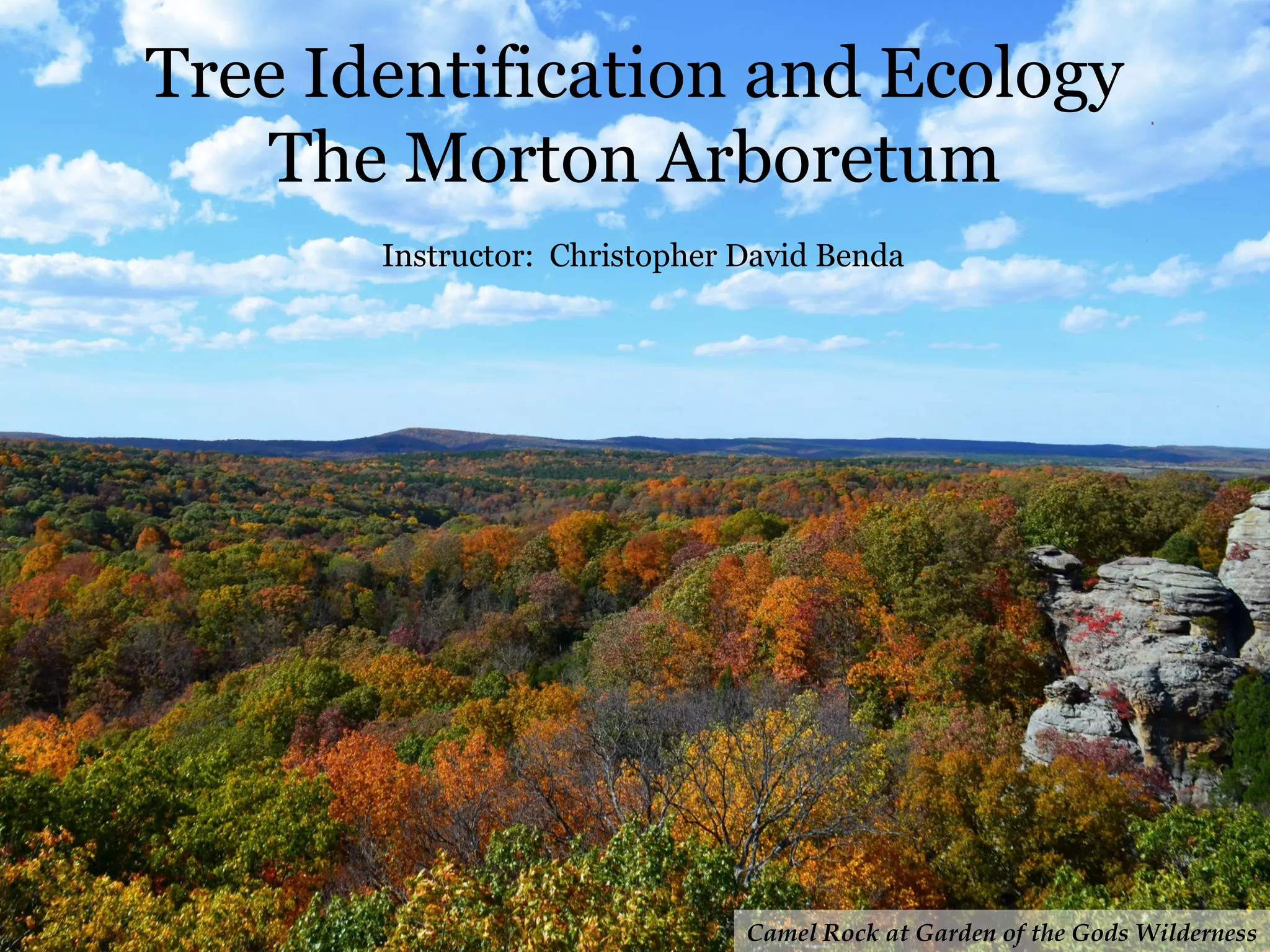




Tree Identification and Ecology
The Morton Arboretum
Instructor: Christopher David Benda
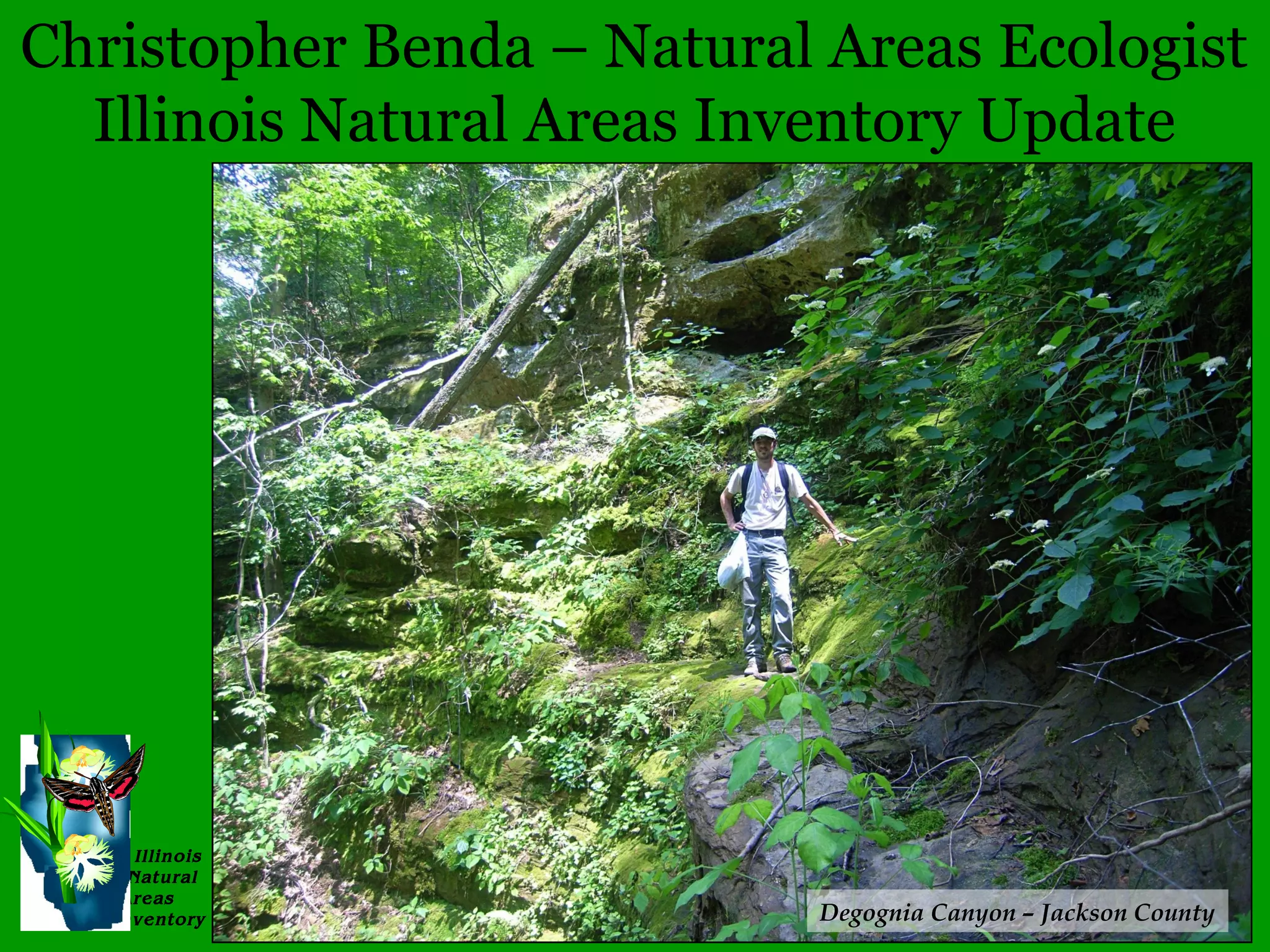
Plant Ecologist
Illinois Natural History Survey
President
Illinois Native Plant Society
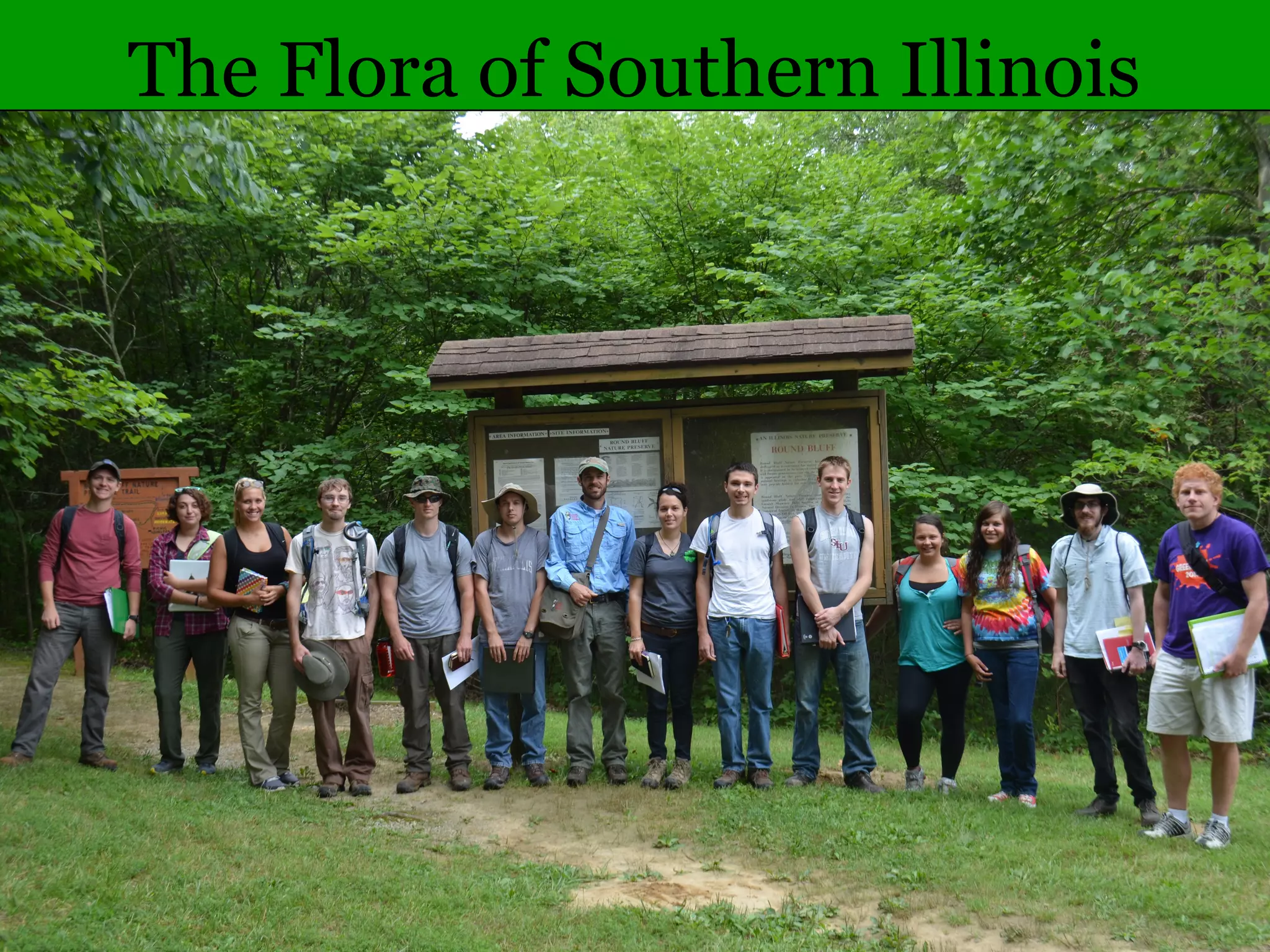
Instructor, Flora of Southern Illinois
Southern Illinois University
Instructor, Tree ID and Ecology
The Morton Arboretum
Technical Expert Consultant
Illinois Endangered Species
Protection Board
CHRISTOPHER DAVID BENDA, M.S.
Illinois Botanizer
Facebook Group
Illinois Botany
Illinois Native
Plant Society
www.ill-inps.org
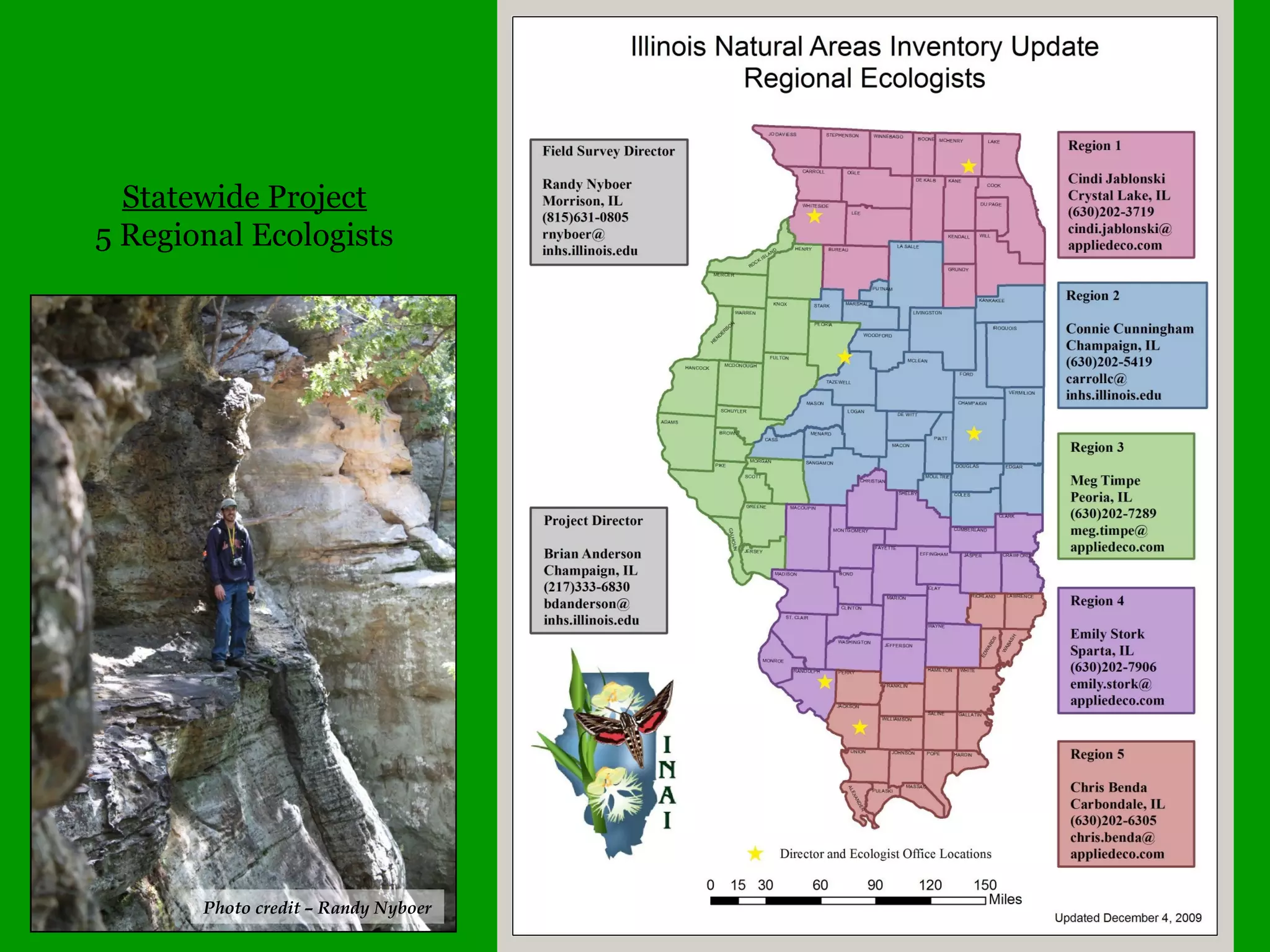
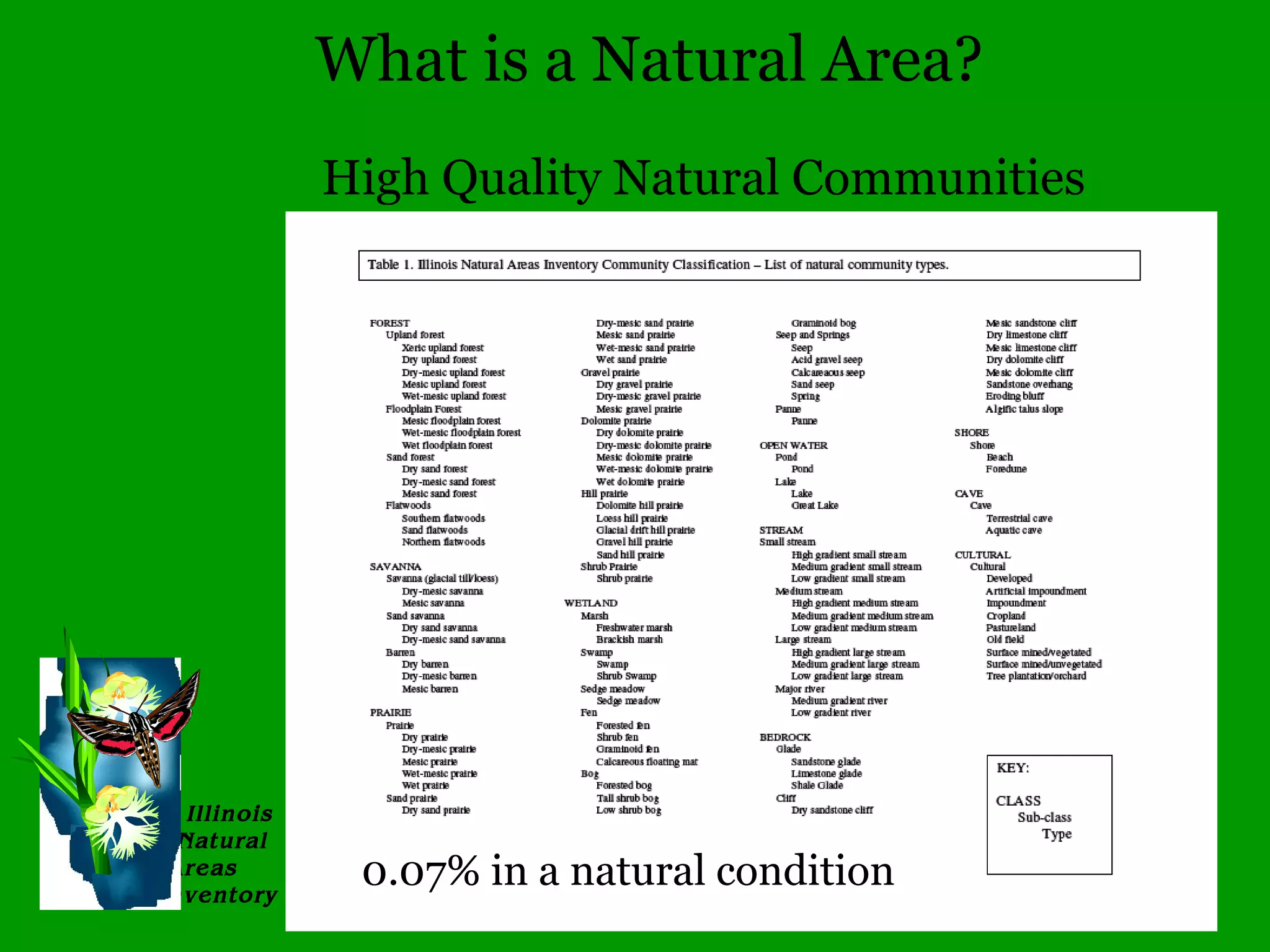
Illinois Natural Areas Inventory
Category I – High Quality Natural Communities
0.07% in a natural condition
Natural Community
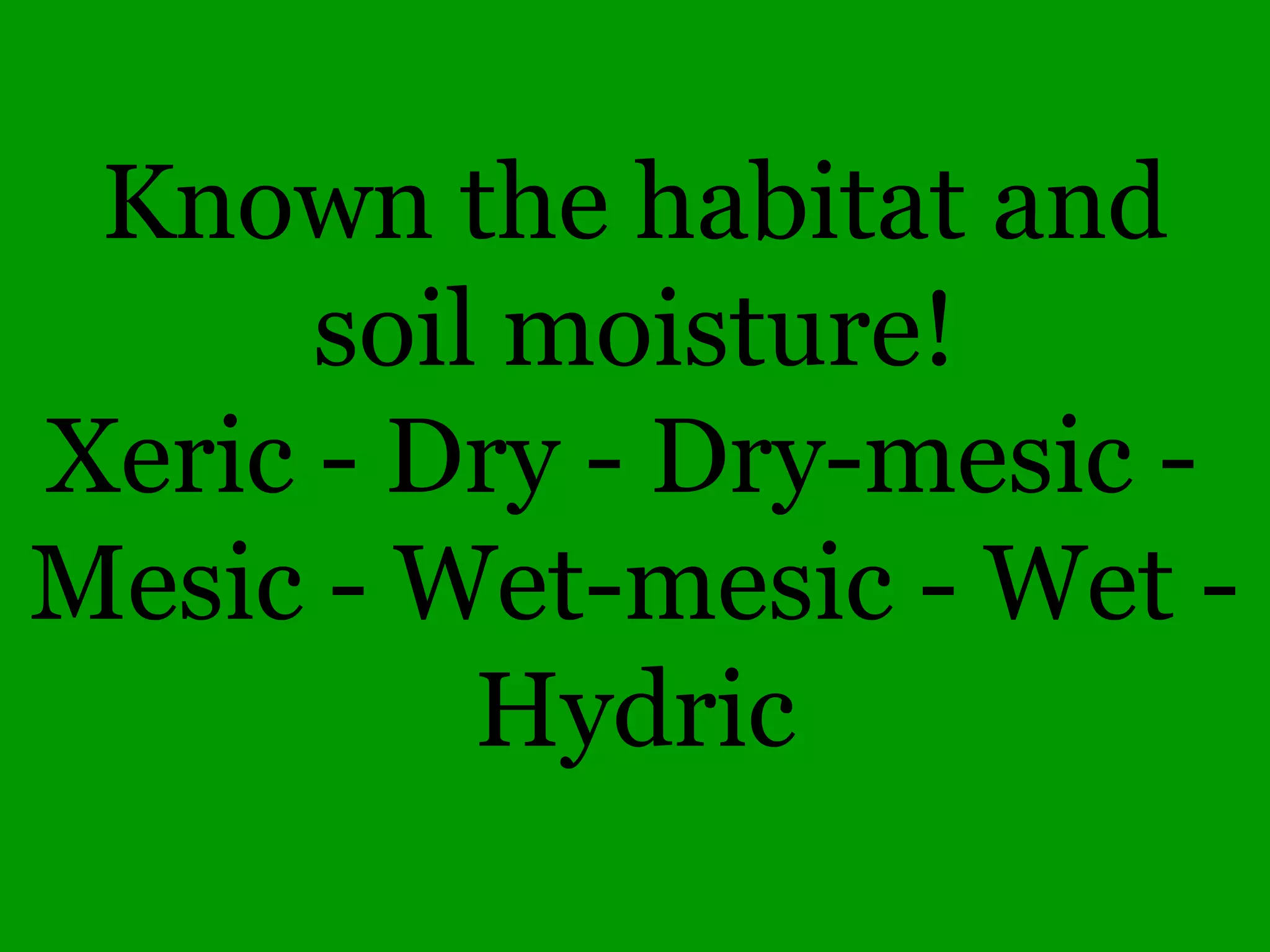
Soil Moisture Gradient
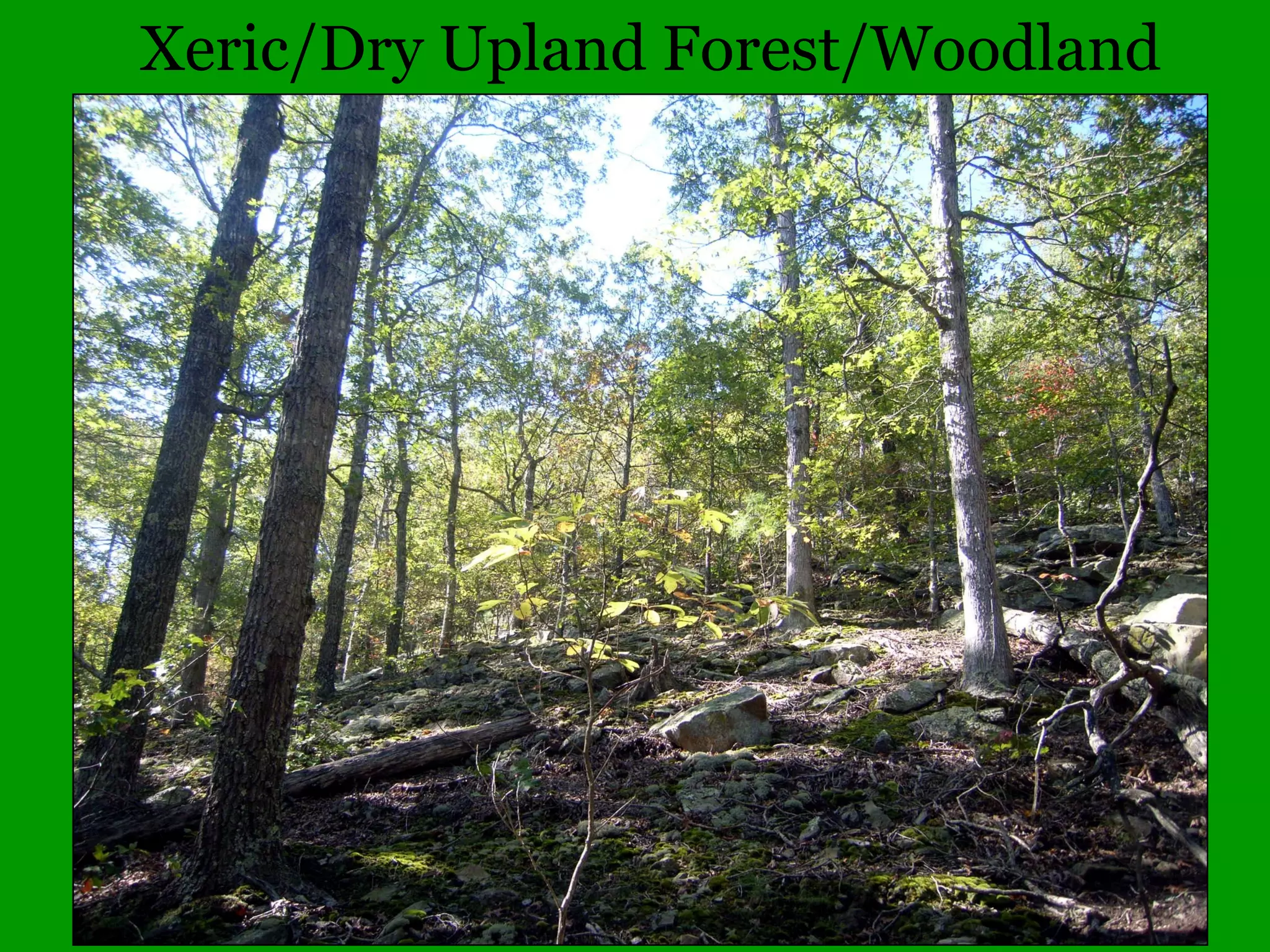
Xeric
Dry
Dry-mesic
Mesic
Wet-mesic
Wet
Hydric
Tree Identification and Ecology
Go over syllabus
Icebreaker Exercise
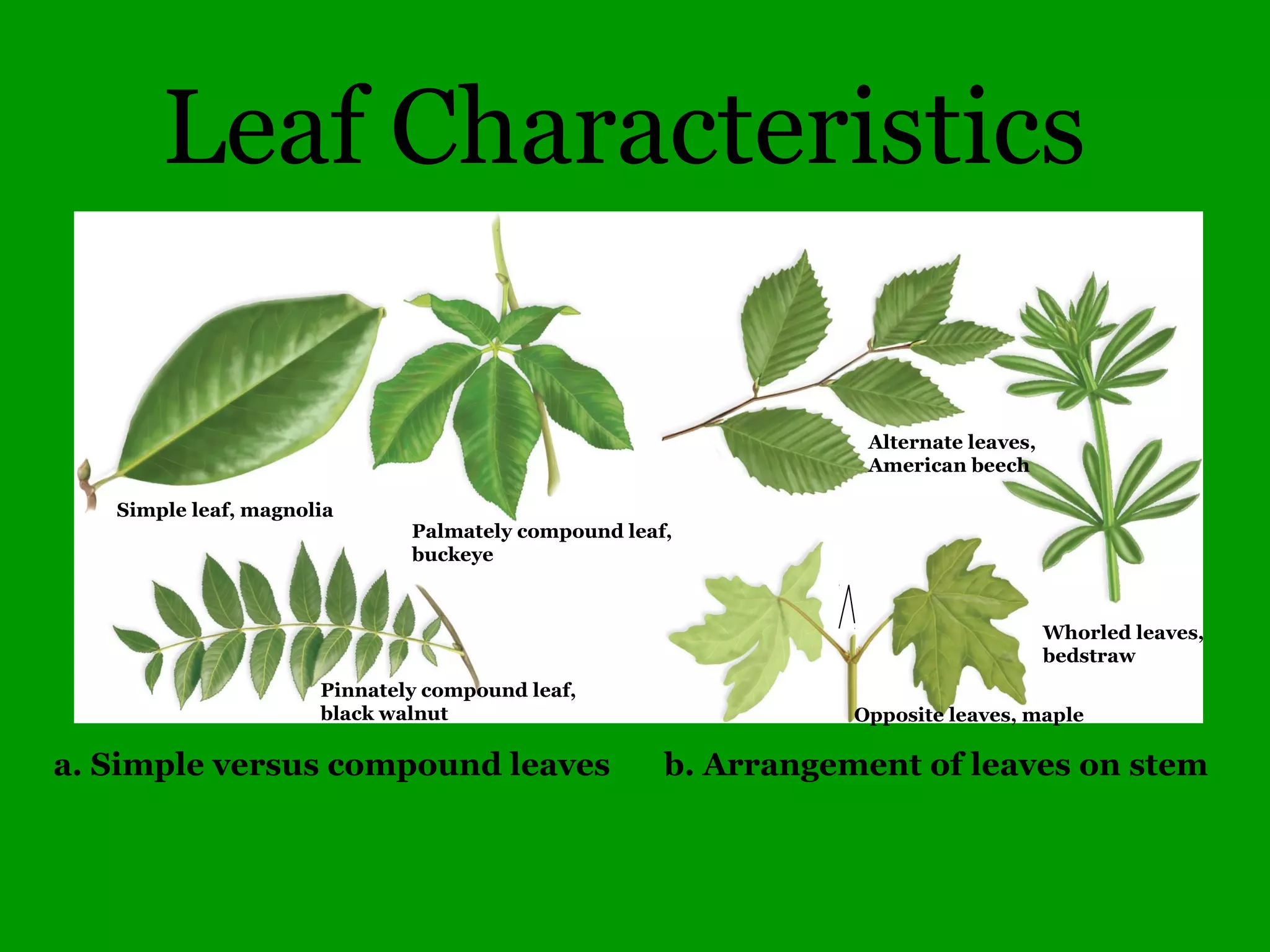
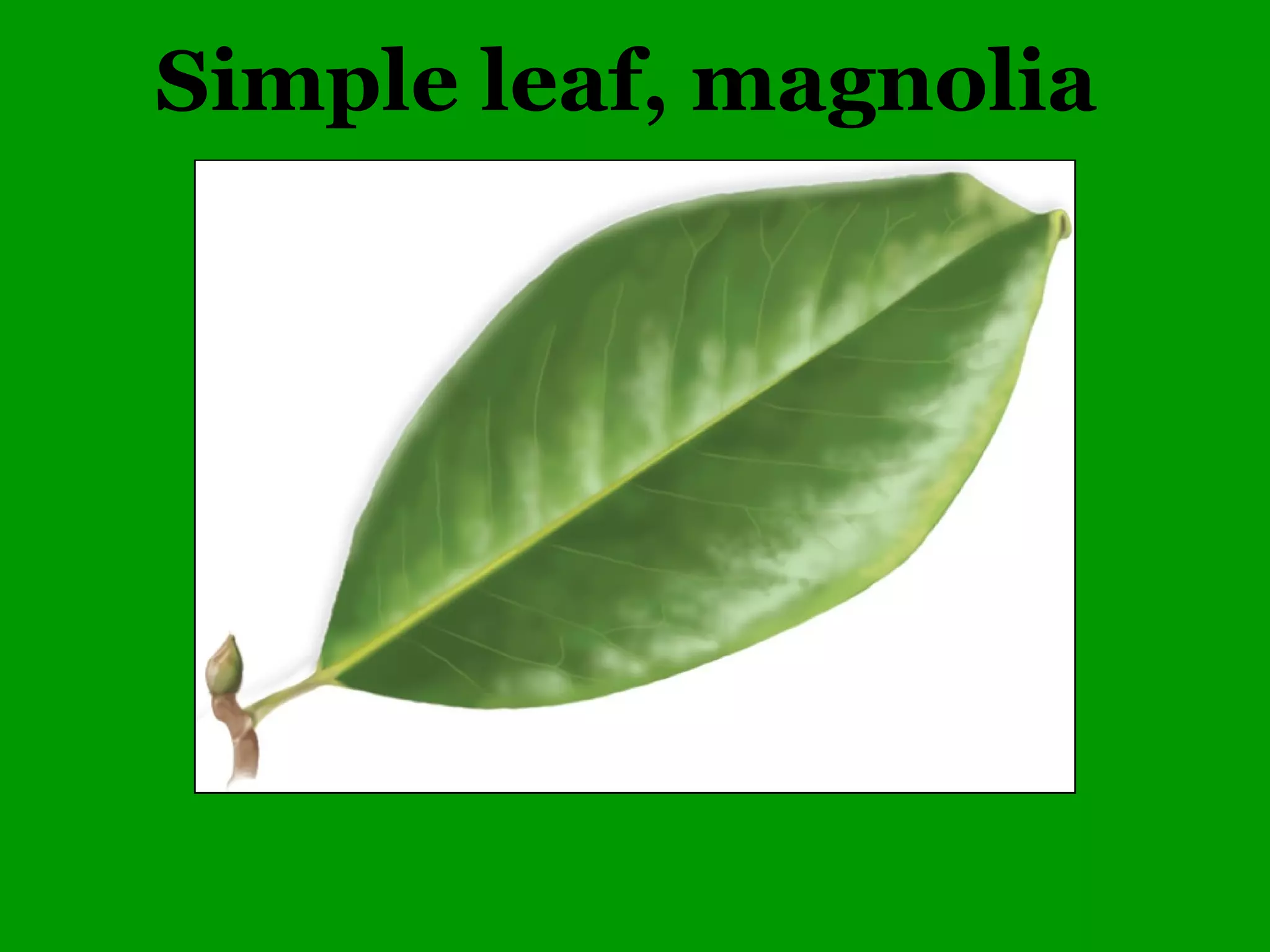
Simple leaf, magnolia
a. Simple versus compound leaves
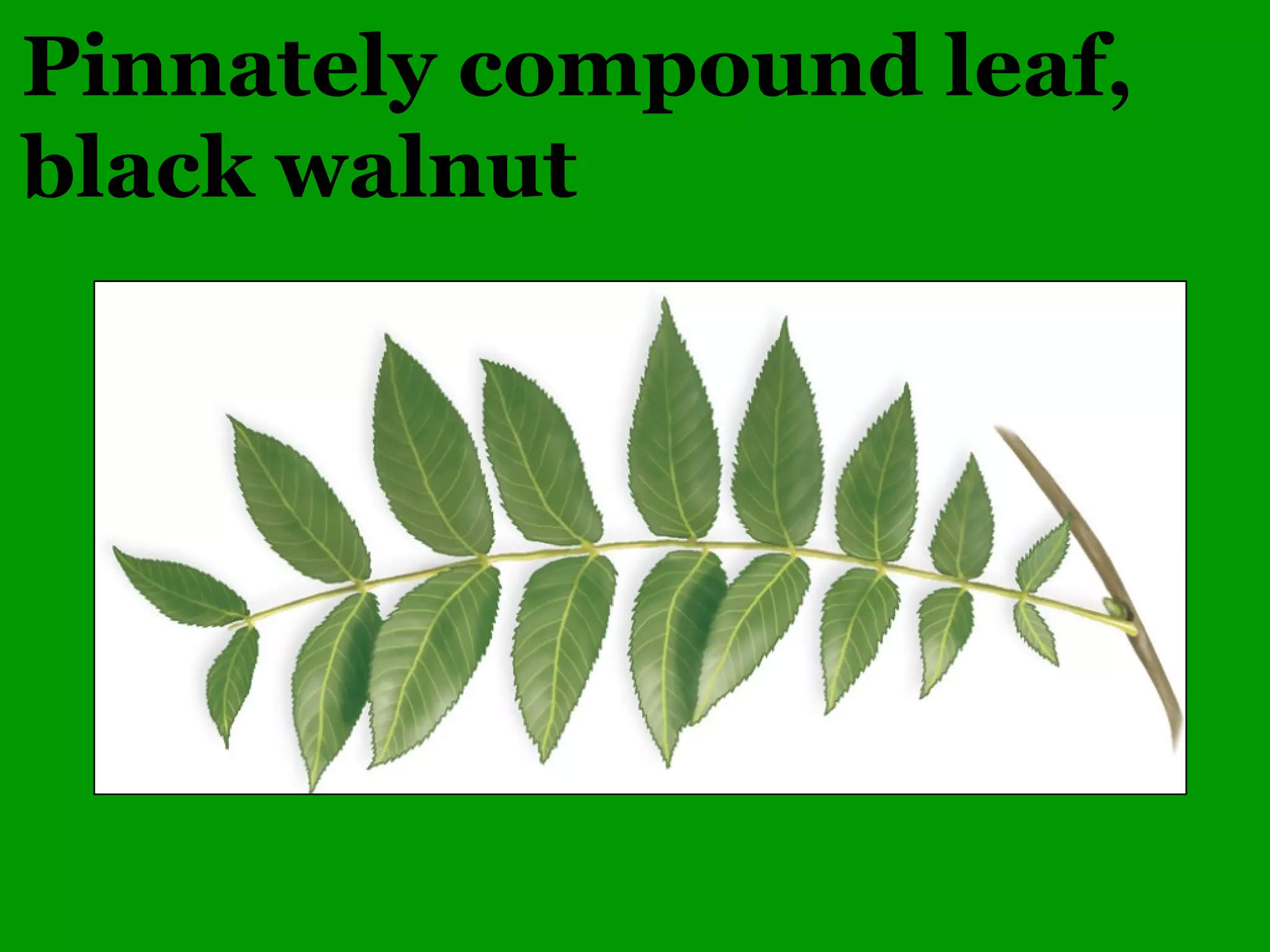
Pinnately compound leaf,
black walnut
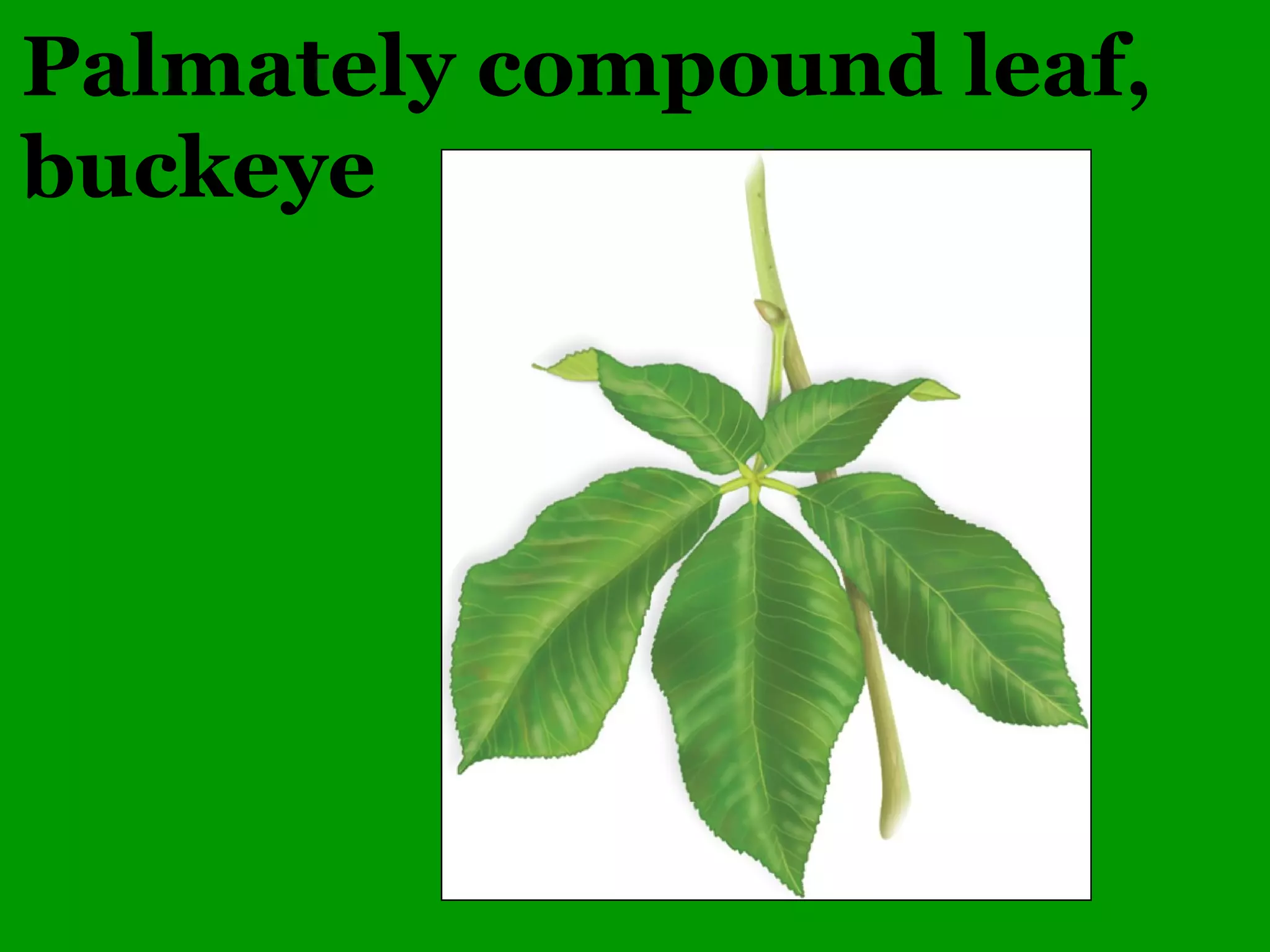
Palmately compound leaf,
buckeye
b. Arrangement of leaves on stem
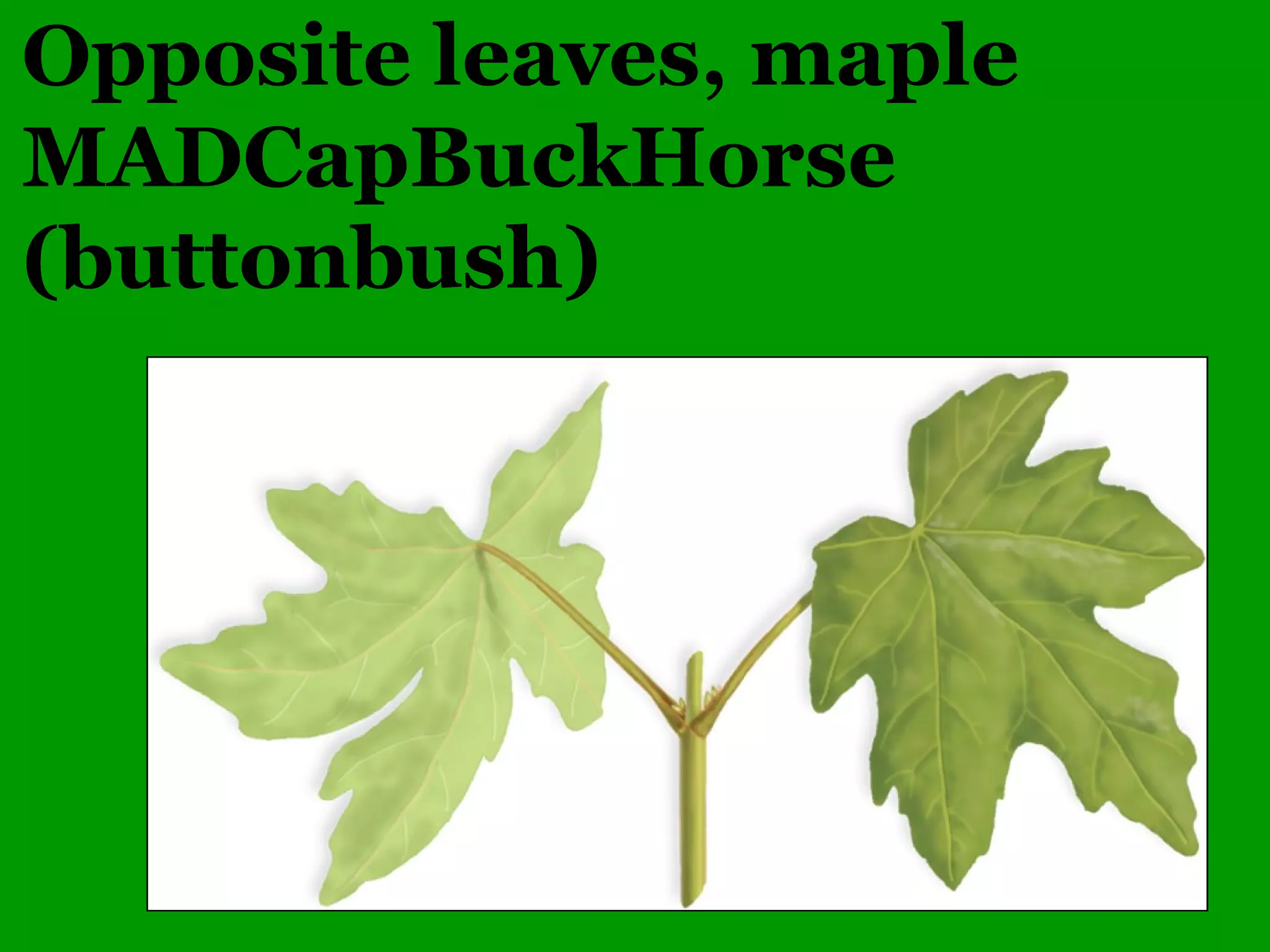
Opposite leaves, maple
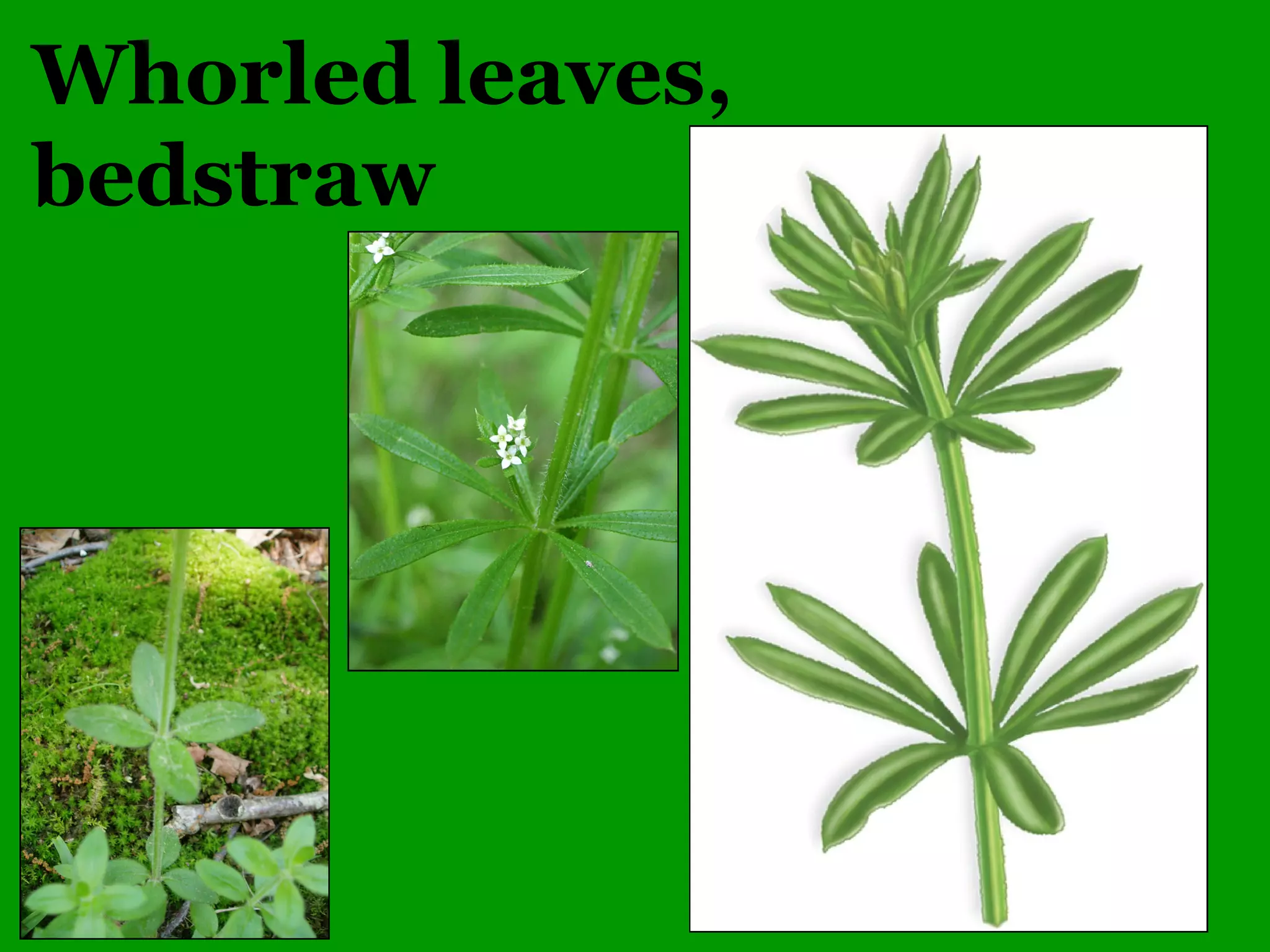
Whorled leaves,
bedstraw
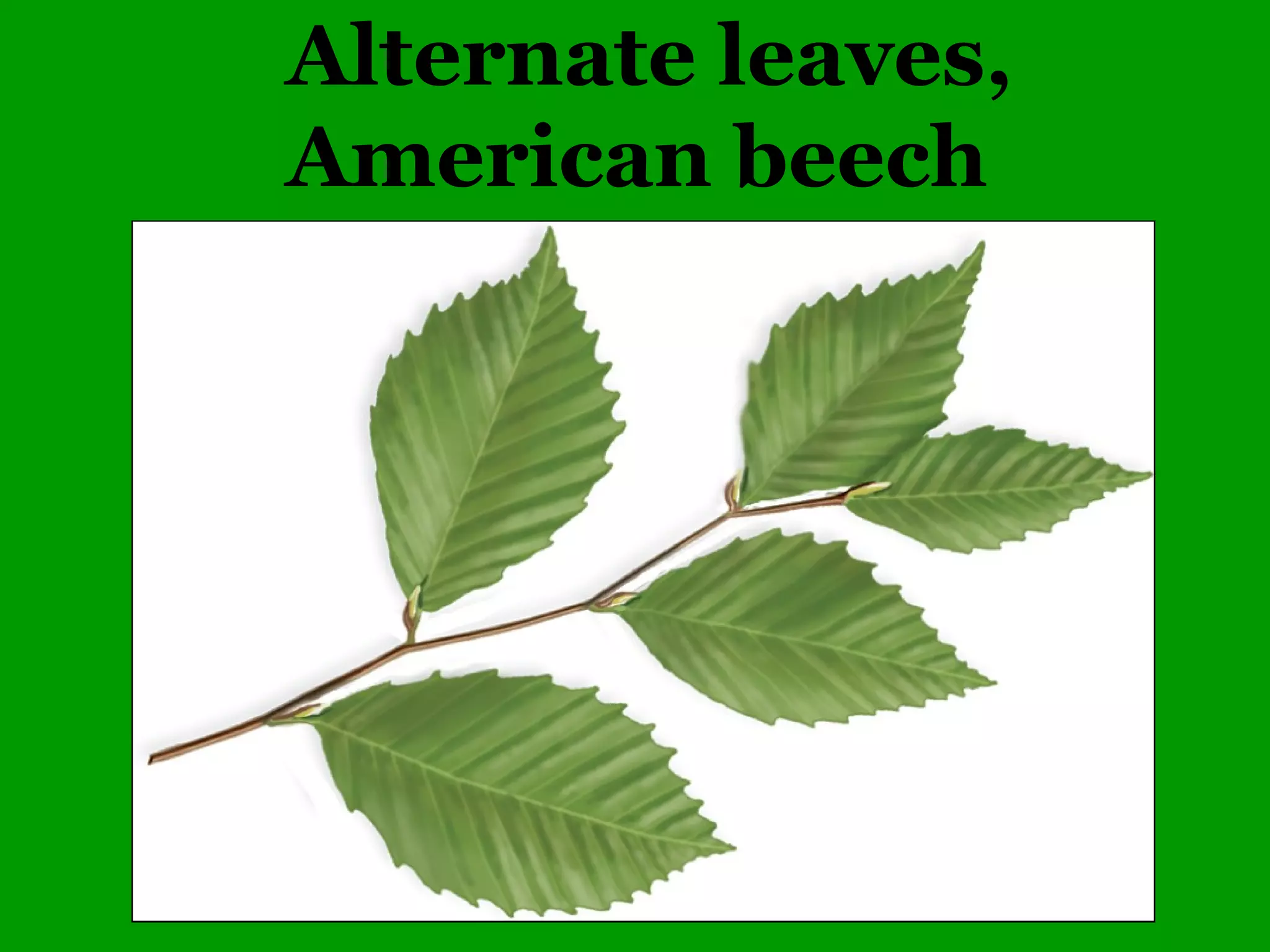
Alternate leaves,
American beech
Leaf Characteristics
Simple leaf
Magnolia
petiole
Palmately compound leaf
Ohio Buckeye
Aesculus glabra
petiole
Pinnately compound leaf
Black Walnut
Alternate leaves
American beech
Whorled leaves
Bedstraw
Galium pilosum
Galium aparine
Opposite leaves
Maples
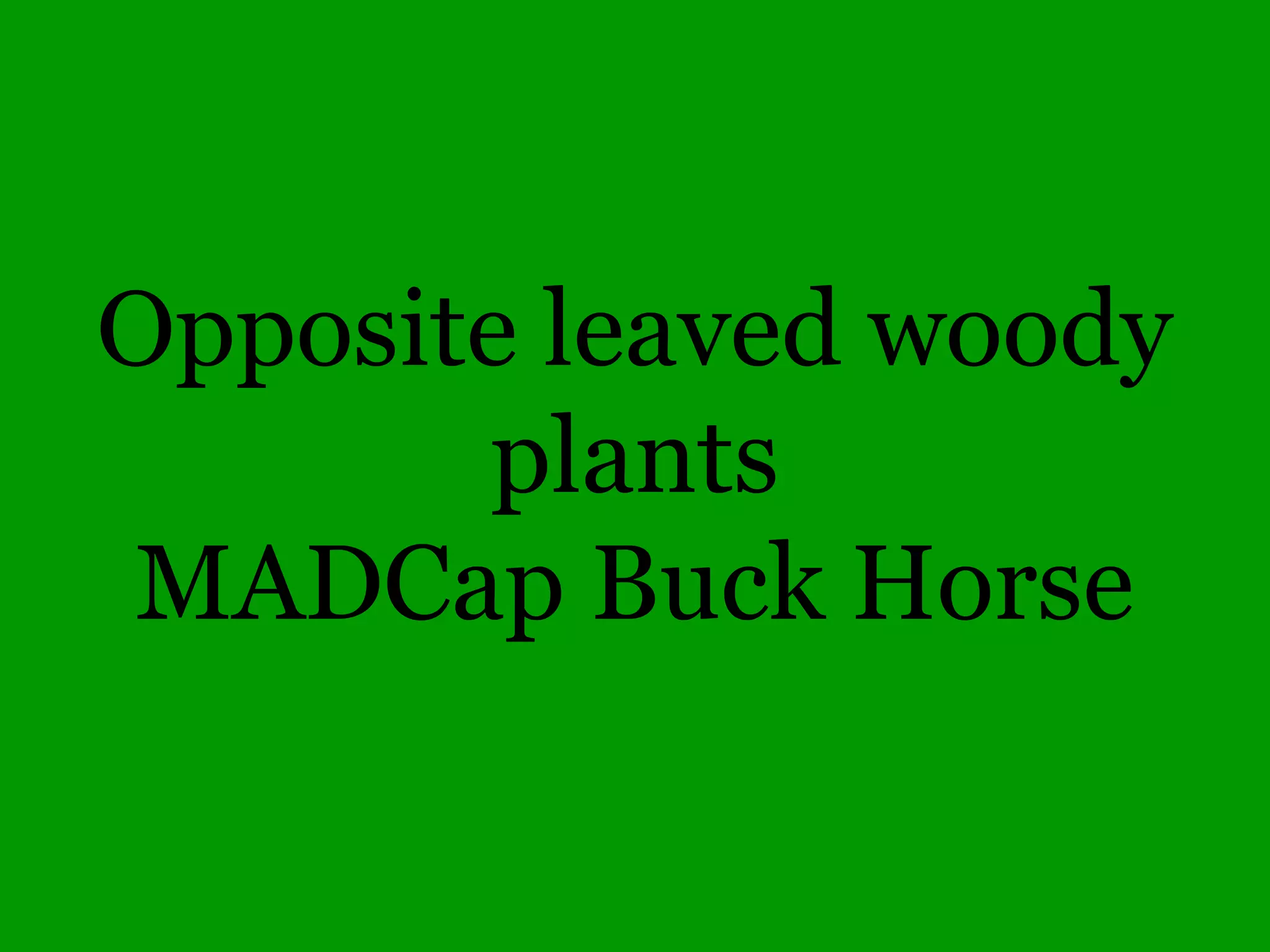
MADCapBuckHorse
Exceptions to the rule:
1. Bladdernut
2. Euonymous (Wahoo)
3. Wild Hydrangea
4. Catalpa
5. Buttonbush
4. Catalpa
5. Buttonbush
petiole
vs.
petiolule
vs.
rachis
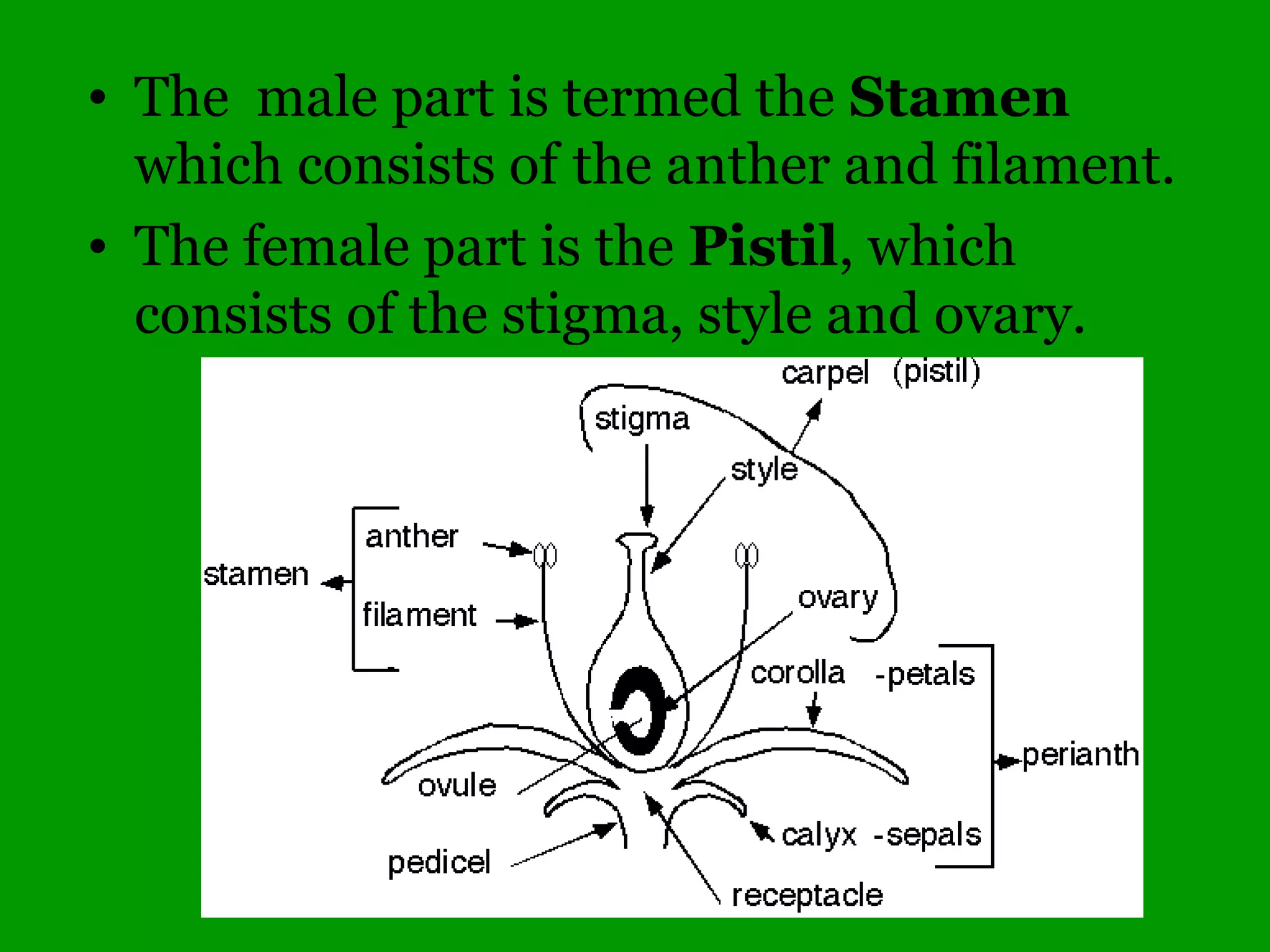
Basic Flower Anatomy
• The male part is termed the Stamen, which consists of the anther
and filament.
• The female part is the Carpel, which consists of the stigma, style
and ovary.
Flower Structure
Perfect
(bisexual flowers)
Vs.
Imperfect
(unisexual flowers)
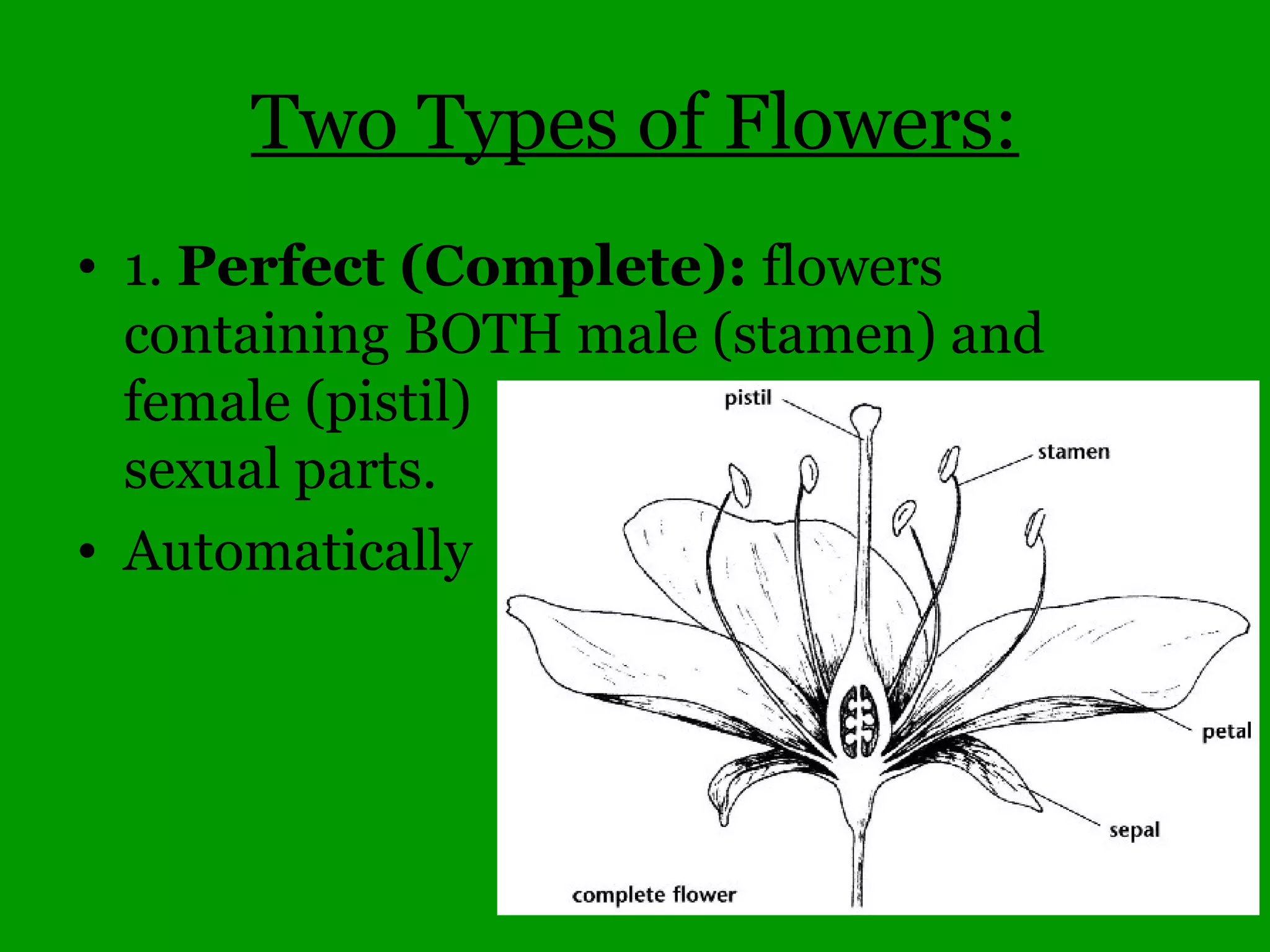
Perfect Flowers
• Flowers containing BOTH male (stamen)
and female (carpel)
sexual parts.
• Automatically
monoecious
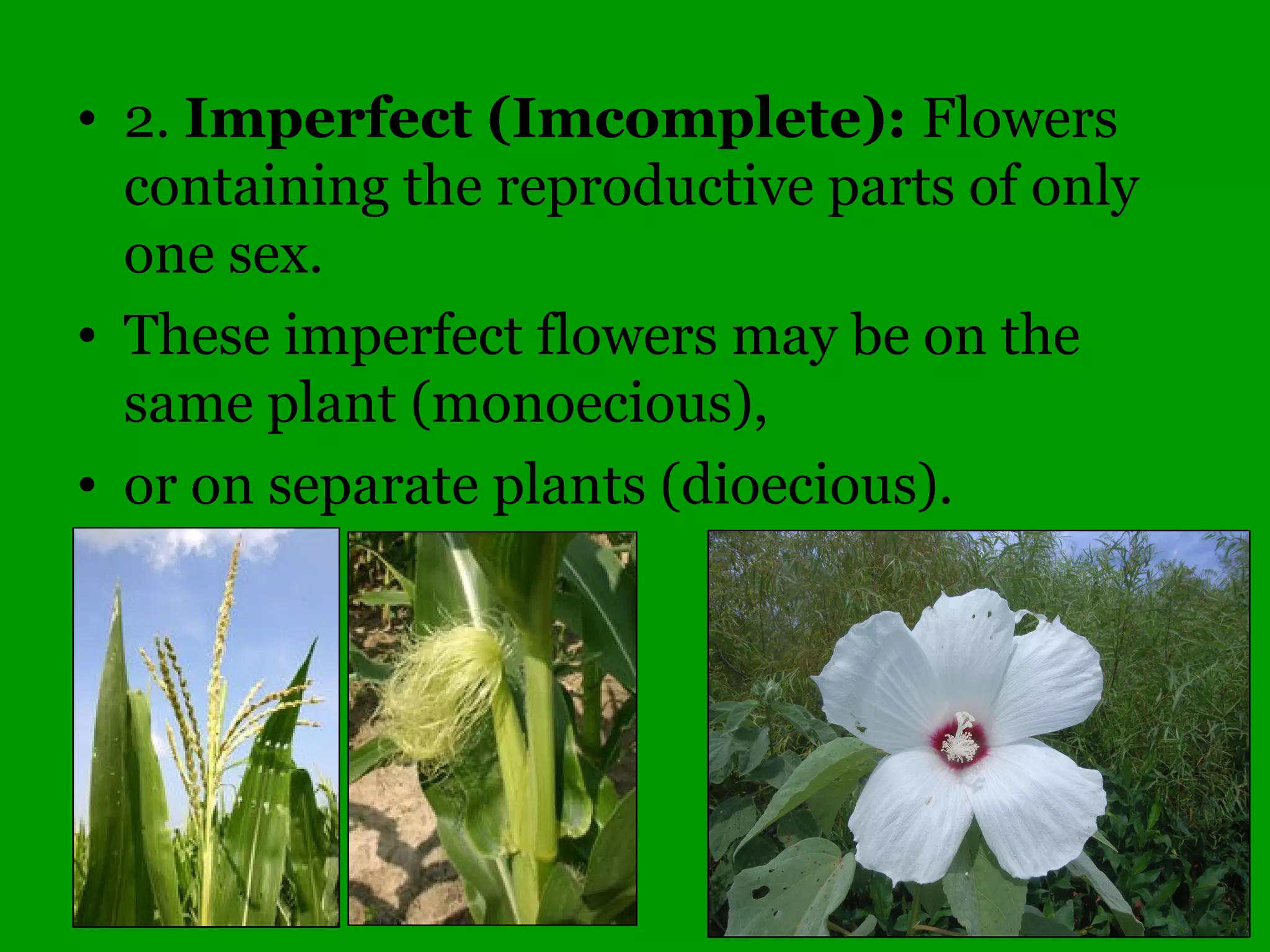
Imperfect Flowers
• Flowers containing the reproductive parts
of only one sex.
• These imperfect flowers may be on the
same plant (monoecious),
• or on separate plants (dioecious)
Sparganium eurycarpum Thalictrum dioicum
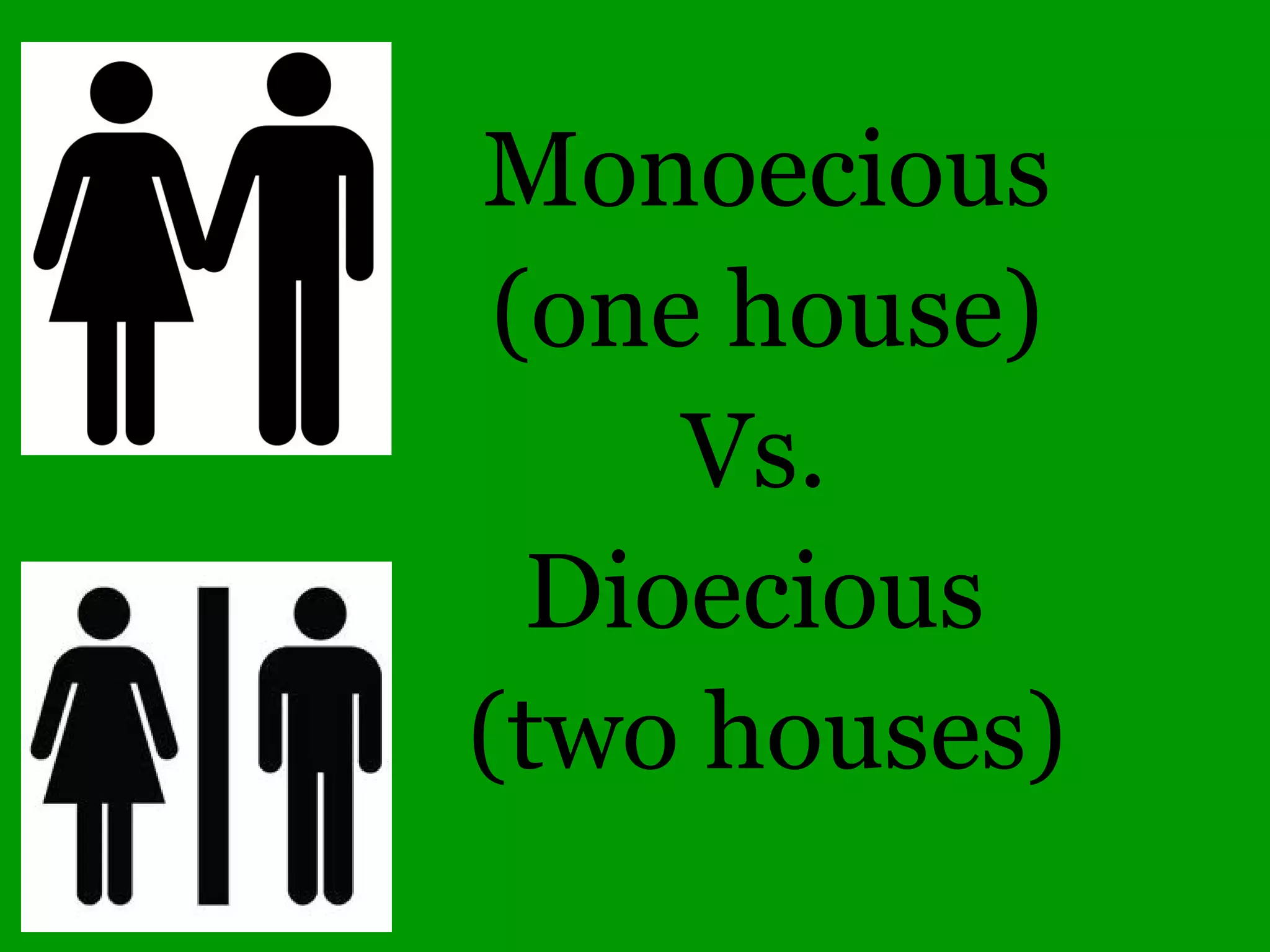
Monoecious
(one house)
Vs.
Dioecious
(two houses)
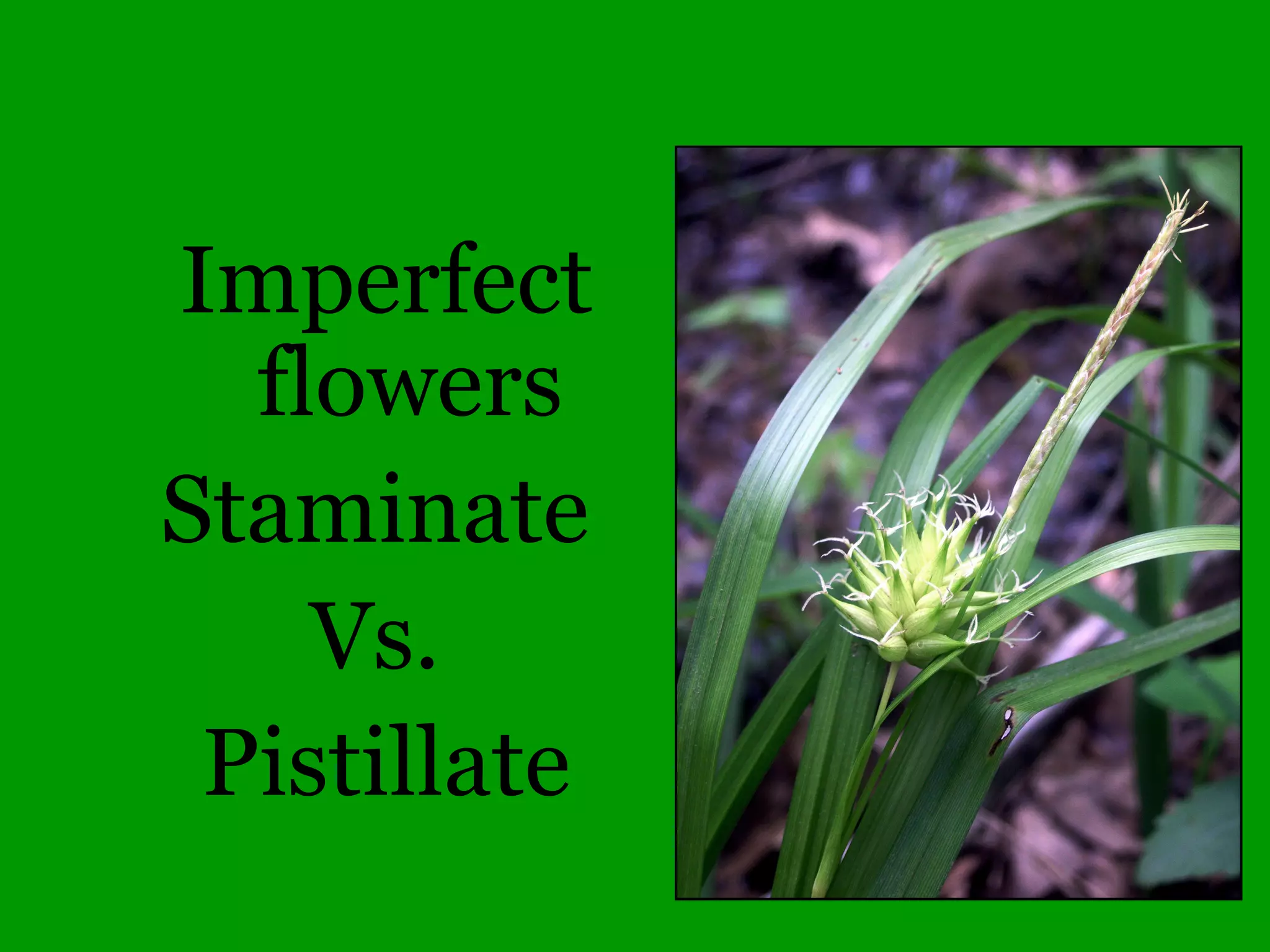
Imperfect
flowers
Staminate
Vs.
Pistillate
Typha angustifolia
staminate
pistillate
Imperfect, monoecious Imperfect, dioecious
Carex grayi Thalictrum dioicum
Obligate
(requires a specific habitat
for survival)
Vs.
Facultative
(requires a general habitat
for survival)
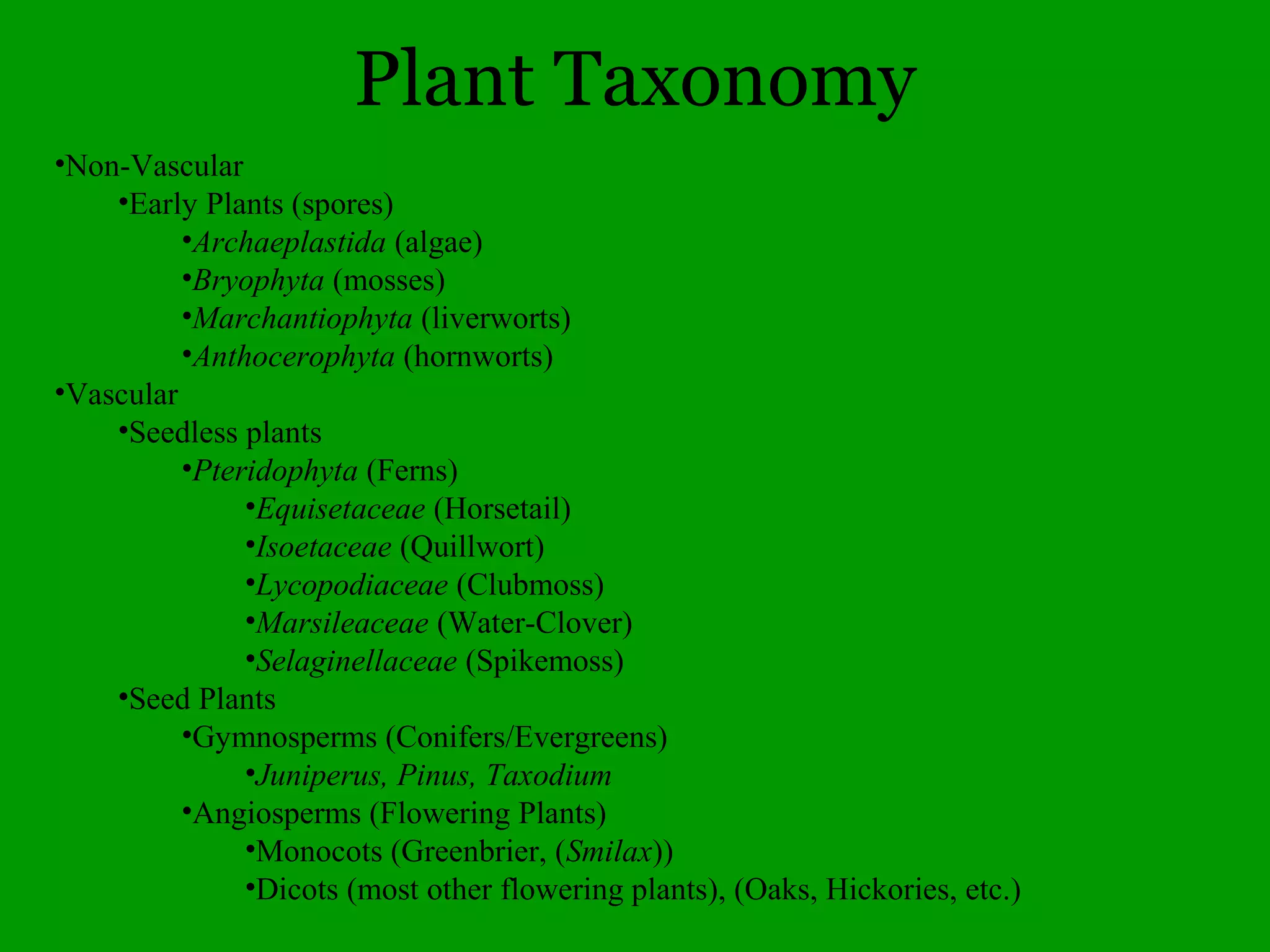
Plant Taxonomy
•Non-Vascular
•Early Plants (spores)
•Archaeplastida (algae)
•Bryophyta (mosses)
•Marchantiophyta (liverworts)
•Anthocerophyta (hornworts)
•Vascular
•Seedless plants
•Pteridophyta (Ferns)
•Fern Allies
•Equisetaceae (Horsetail)
•Isoetaceae (Quillwort)
•Lycopodiaceae (Clubmoss)
•Marsileaceae (Water-Clover)
•Selaginellaceae (Spikemoss)
•Seed Plants
•Gymnosperms (Conifers/Evergreens)
•Juniperus, Pinus, Taxodium
•Angiosperms (Flowering Plants)
•Monocots (Orchids, Lilies, Irises, Grasses, Sedges, Rushes, aquatic plants)
•Dicots (most other flowering plants)
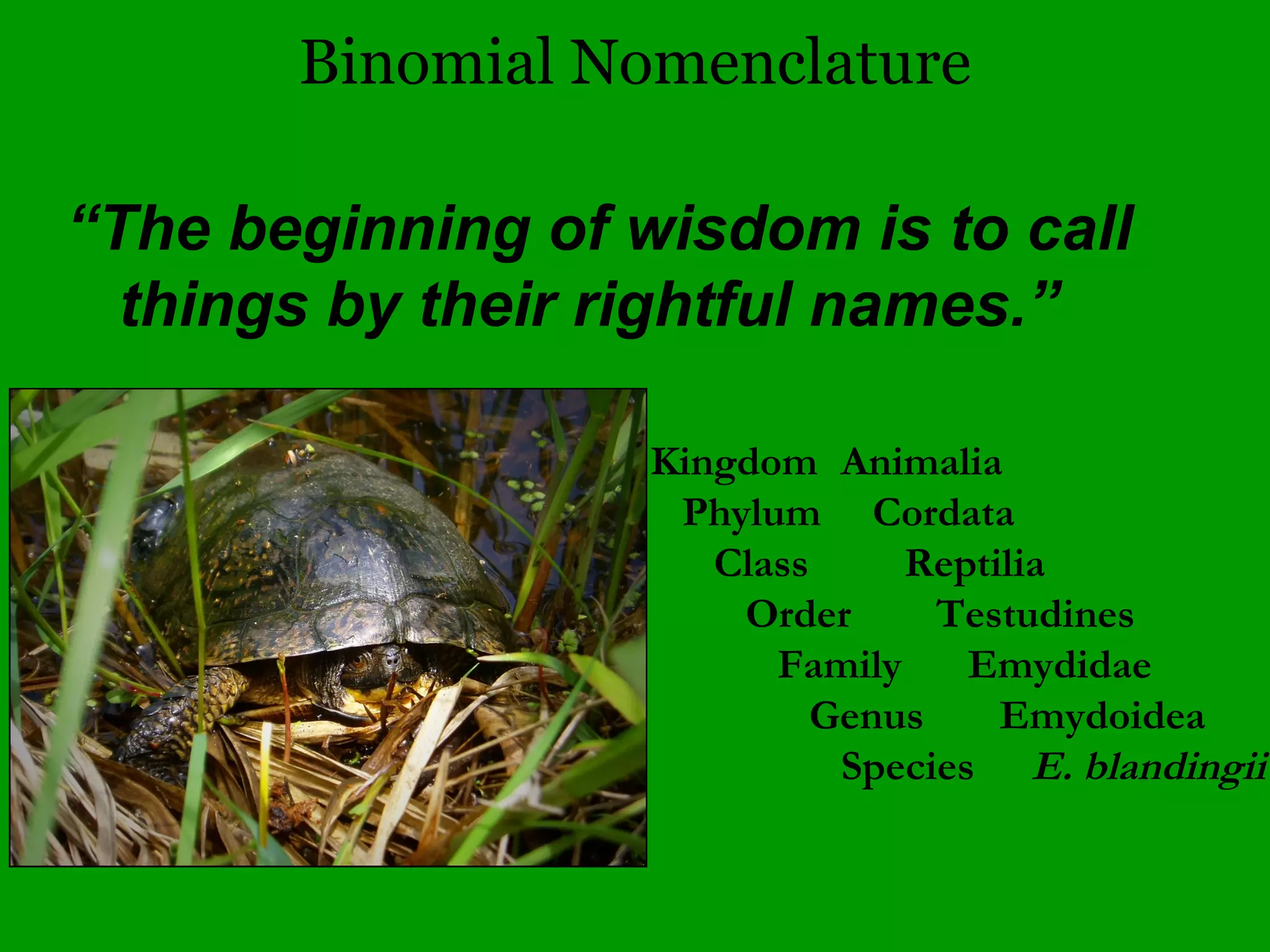
Binomial Nomenclature
“The beginning of wisdom is to call
things by their rightful names.”
Kingdom
Phylum
Class
Order
Family
Genus
Species
Animalia
Cordata
Reptilia
Testudines
Emydidae
Emydoidea
E. blandingii
The Top Ten reasons for
using scientific names
Understand the meaning of the
names!
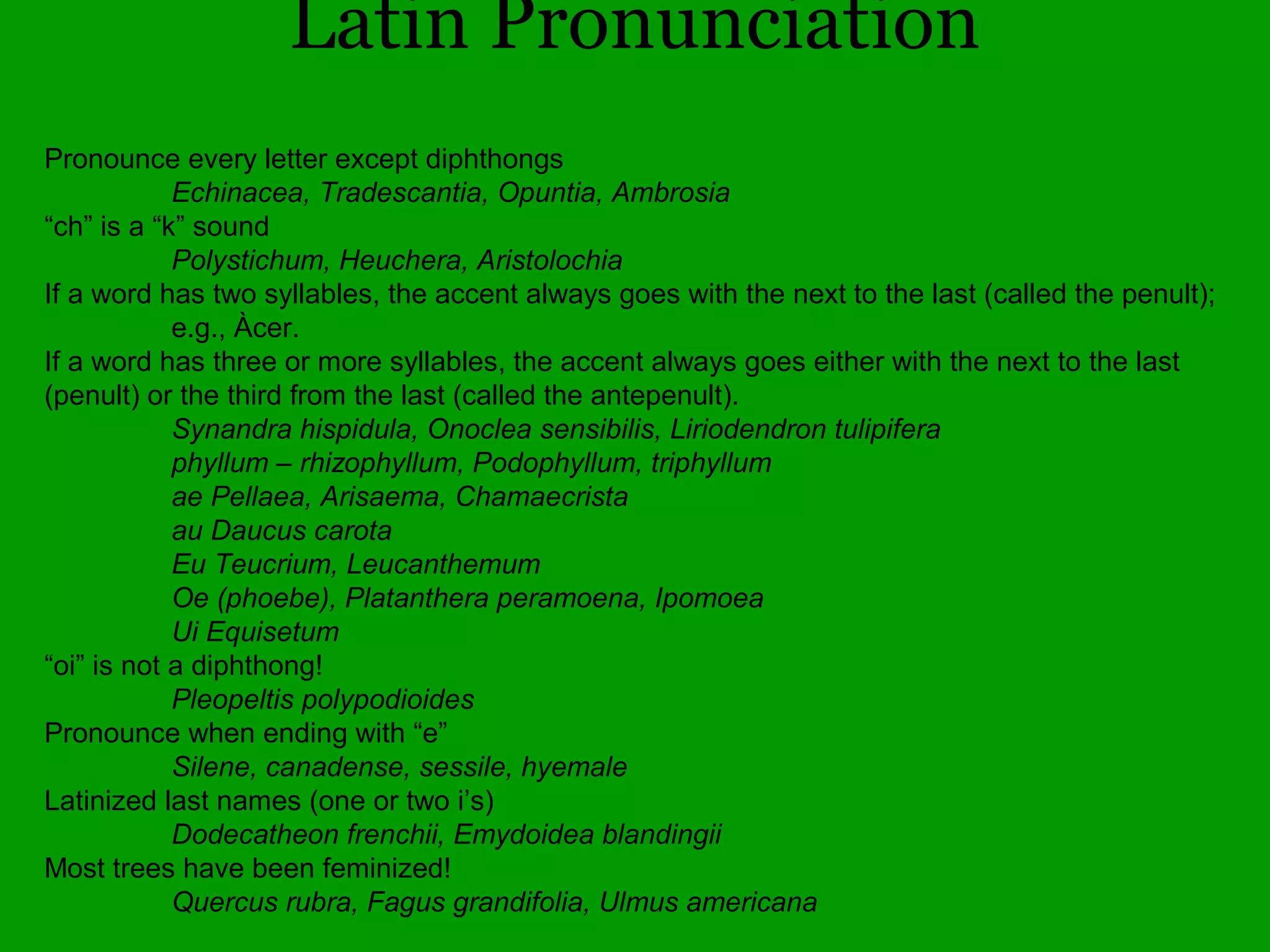
Latin Pronunciation
Pronounce every letter except diphthongs
Echinacea, Tradescantia, Opuntia, Ambrosia
“ch” is a “k” sound
Polystichum, Heuchera, Aristolochia
If a word has two syllables, the accent always goes with the next to the last (called the penult);
e.g., Àcer.
If a word has three or more syllables, the accent always goes either with the next to the last
(penult) or the third from the last (called the antepenult).
Synandra hispidula, Onoclea sensibilis, Liriodendron tulipifera
phyllum – rhizophyllum, Podophyllum, triphyllum
ae Pellaea, Arisaema, Chamaecrista
au Daucus carota
Eu Teucrium, Leucanthemum
Oe (phoebe), Platanthera peramoena, Ipomoea
Ui Equisetum
“oi” is not a diphthong!
Pleopeltis polypodioides
Pronounce when ending with “e”
Silene, canadense, sessile, hyemale
Latinized last names (one or two i’s)
Dodecatheon frenchii, Emydoidea blandingii
Most trees have been feminized!
Quercus rubra, Fagus grandifolia, Ulmus americana
Latin Pronunciation
English pronunciation of vowels
A – E – I – O - U
Latin pronunciation of vowels
Ah – Eh – EE – Oh - OO
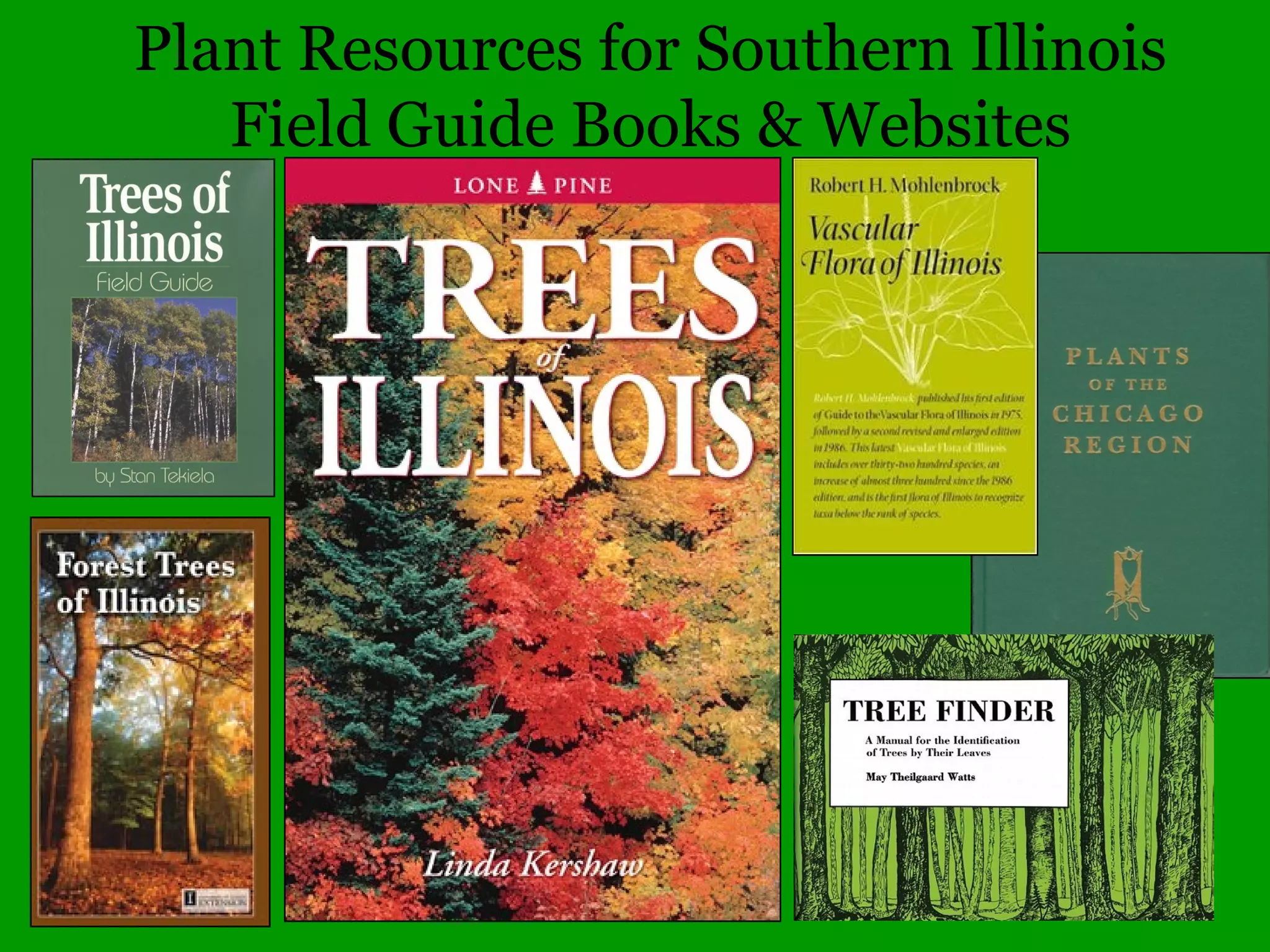
Plant Resources for Southern Illinois
Field Guide Books & Websites
What do you notice
about the arrangement
of the textbook?
Gymnosperms
Vs.
Angiosperms
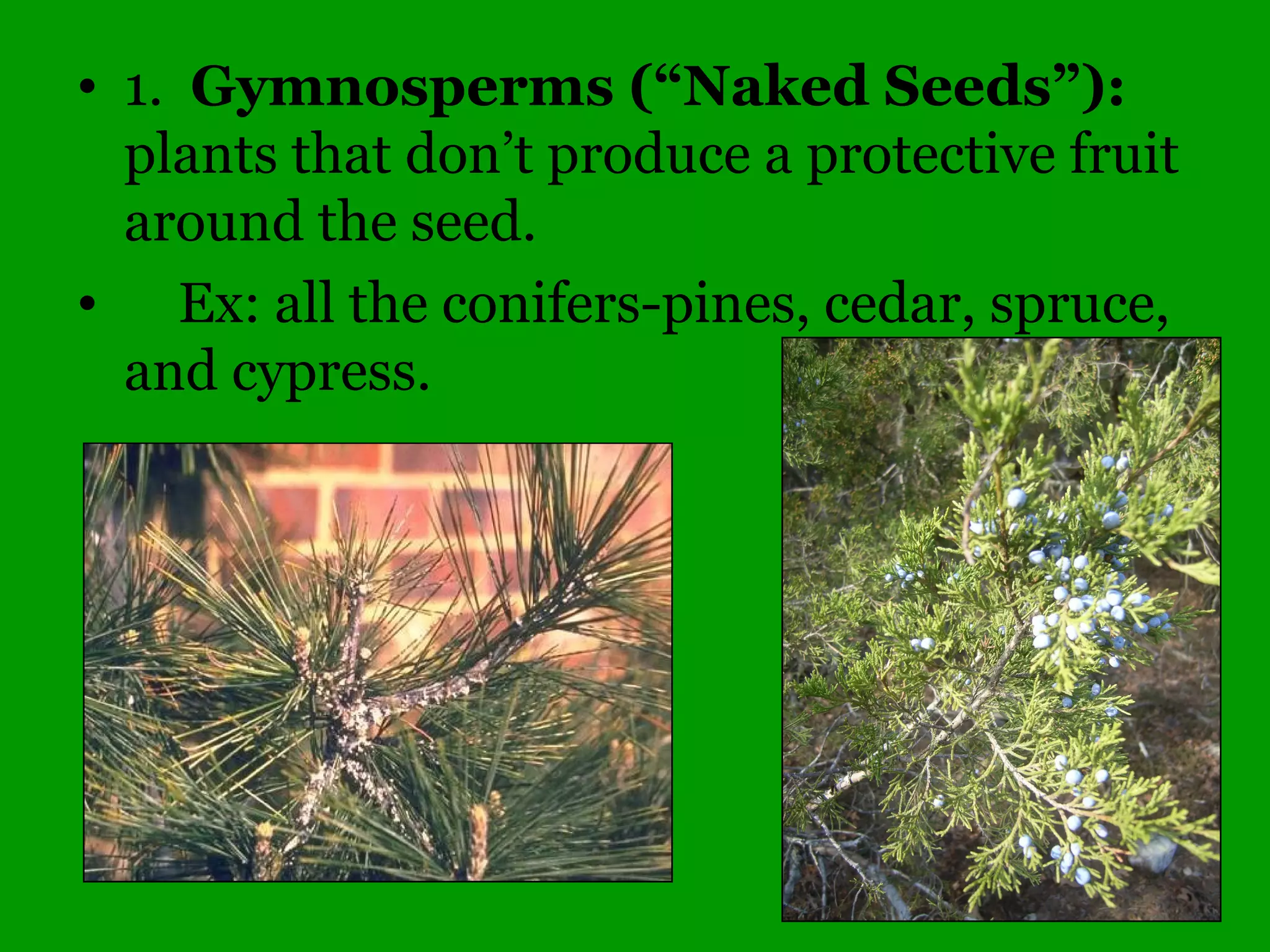
• plants that don’t produce a protective fruit
around the seed.
• all the conifers - pines, cedar, tamarack,
yew, and cypress.
Gymnosperms (“naked seed”)
Pinus echinata Taxodium distichum
Larix laricina
• flowering plants where the seed is encased
in a protective fruit.
• This is the dominant group of plants on
Earth today.
Angiosperms (“hidden seeds”)
Angiosperms
Monocot
Vs.
Dicot
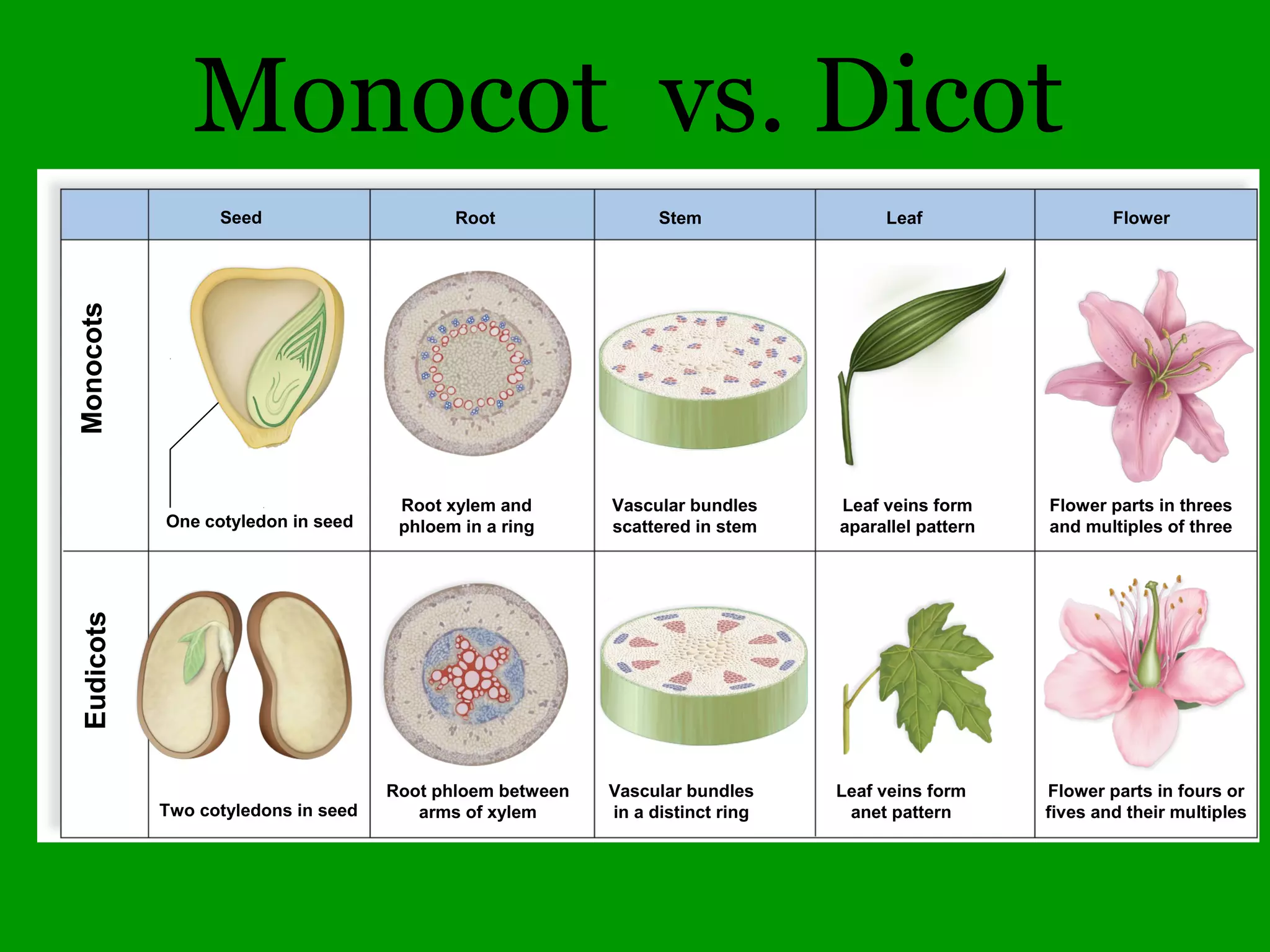
One cotyledon in seed
Leaf veins form a parallel pattern
Flower parts in threes and multiples
of three, irregular (nonsymmetrical)
Two cotyledons in seed
Leaf veins form a net pattern
Flower parts in fours or fives
and their multiples
Dichotomous Keys
and
Plant Collections
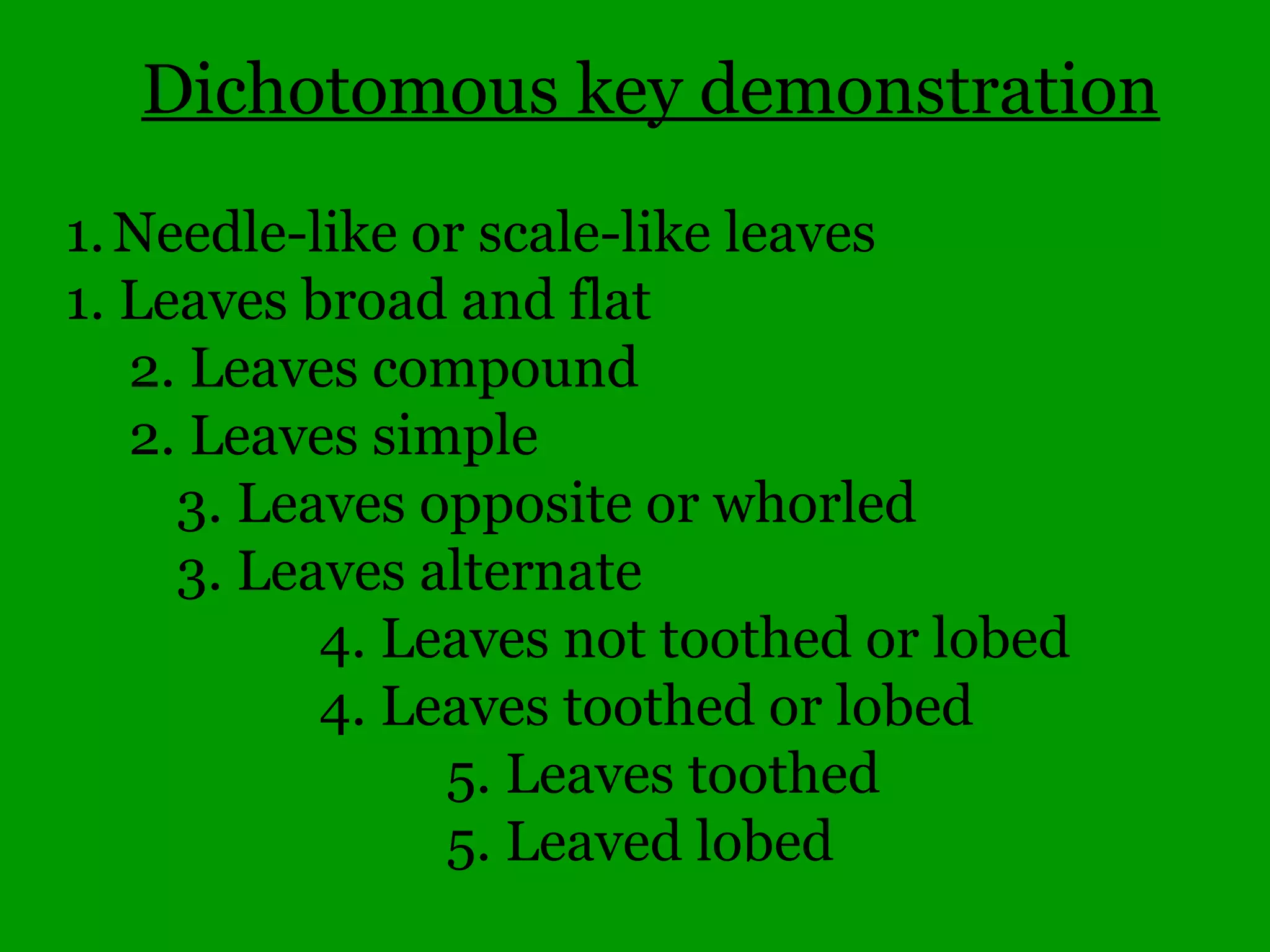
Dichotomous key demonstration
1.Needle-like or scale-like leaves
1. Leaves broad and flat
2. Leaves simple
2. Leaves compound
3. Leaves opposite or whorled
3. Leaves alternate
4. Leaves not toothed or lobed
4. Leaves toothed or lobed
5. Leaves toothed
5. Leaved lobed
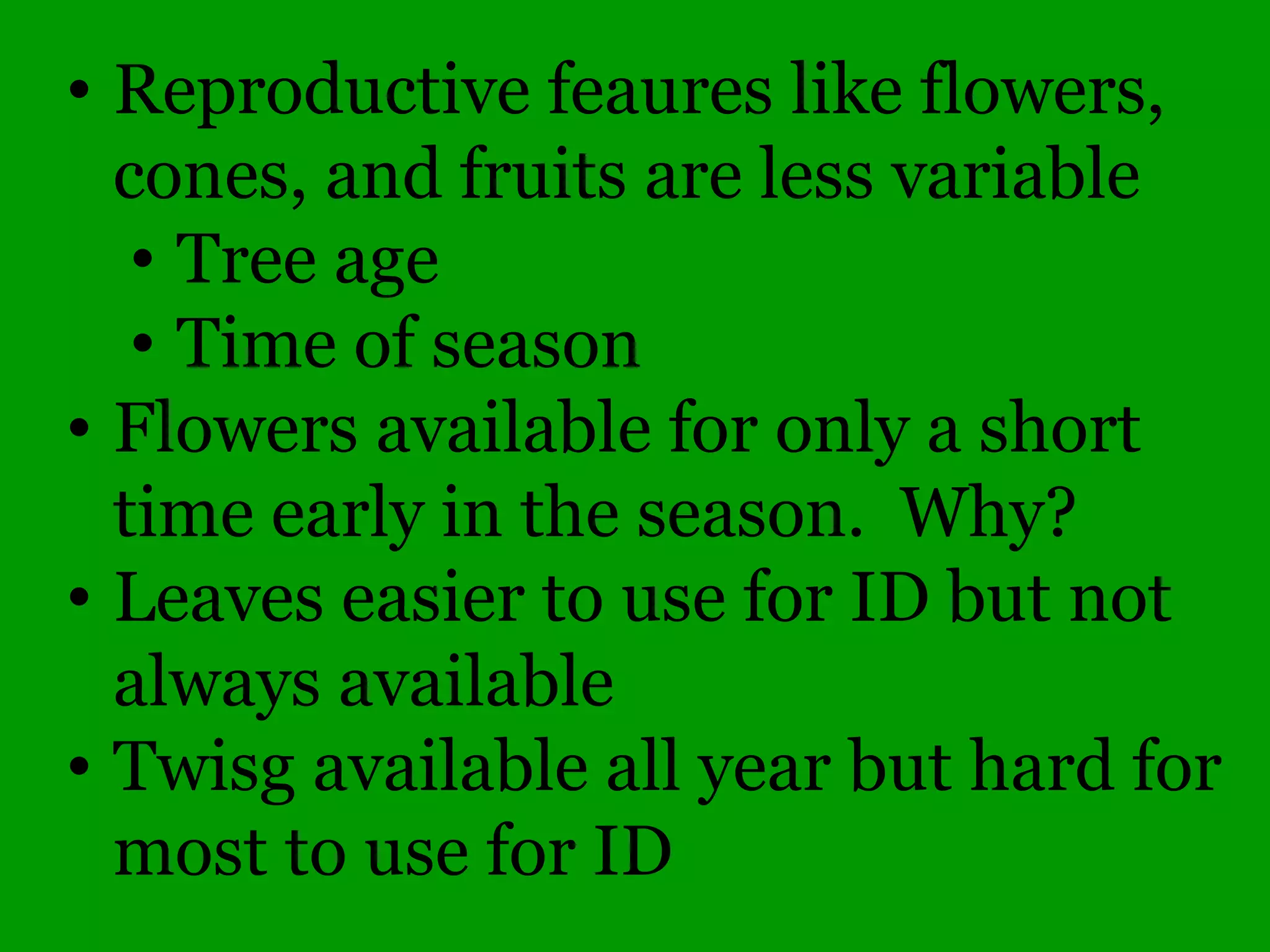
• Reproductive feaures like flowers,
cones, and fruits are less variable
• Tree age
• Time of season
• Flowers available for only a short
time early in the season. Why?
• Leaves easier to use for ID but not
always available
• Twigs available all year but hard for
most to use for ID
Coefficient of Conservatism
The native species most successful in badly
damaged habitats were given C values of 0.
At the other end of the spectrum, species
virtually restricted to natural areas in Illinois
received C values of 10.
(Taft et al. 1997)
Further reading
http://www.conservationresearchinstitute.org/assets/illinoisfqa.pdf
http://www.fws.gov/verobeach/Home/S1029%20Mortellaro%20mo
nograph.pdf
Erigenia link
http://www.ill-inps.org/Erigenia
T & E Species Link
http://www.dnr.illinois.gov/ESPB/Documents/2015_Ch
ecklistFINAL_for_webpage_051915.pdf
Gee whiz?! information
If you can’t tell a joke about it,
explain where the name comes
from, or tell story about the plant
then:
WHO CARES!!!
Plant Humor
How can you ID a dogwood tree?
By its bark!
Break
Illinois Gymnosperms
• Cypressaceae – Cypress family
– Juniperus – 3 species
• communis (Ground Juniper, rare)
• horizontalis (Trailing Juniper, rare)
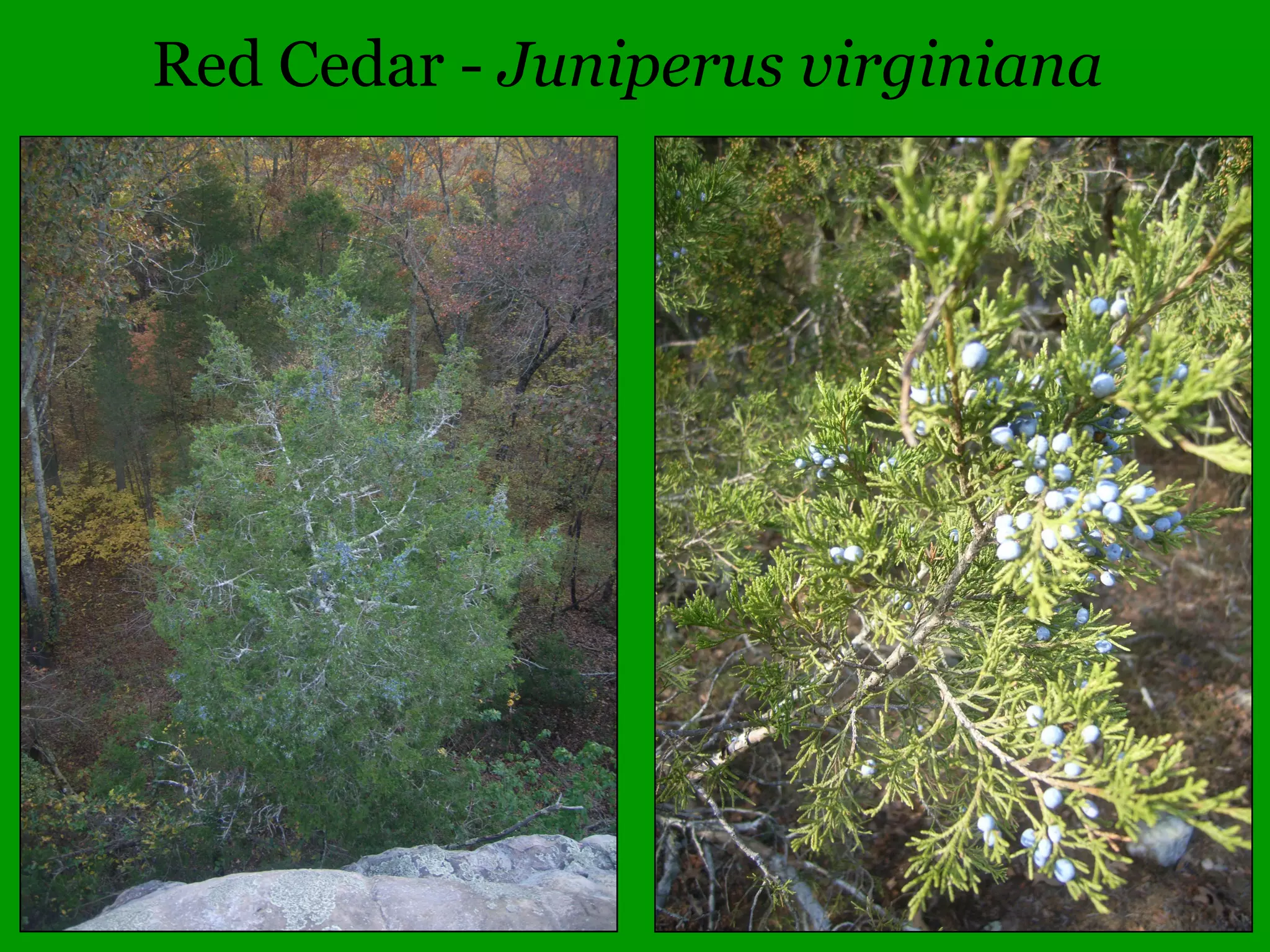
• virginiana (Eastern Red Cedar)
– Thuja – 1 species
• occidentalis (White Cedar, rare)
Illinois Gymnosperms
• Ginkgoaceae – Ginkgo family
– Ginkgo – 1 species
• biloba (Ginkgo)
Illinois Gymnosperms
• Pinaceae – Pine family
– Larix – 2 species
• decidua* (European Larch)
• laricina (Tamarack, rare)
– Picea – 2 species
• abies* (Norway Spruce)
• mariana* (Black Spruce)
Illinois Gymnosperms
• Pinaceae – Pine family
– Pinus – 10 species
• banksiana (Jack Pine)
• echinata (Short-leaf Pine, rare)
• nigra* (Austrian Pine)
• resinosa (Red Pine, rare)
• rigida* (Pitch Pine)
• strobus (White Pine)
• sylvestris* (Scots Pine)
• taeda (Loblolly Pine)
• 2 others
Illinois Gymnosperms
• Taxaceae – Yew family
– Taxus – 1 species
• canadensis (Canada Yew, rare)
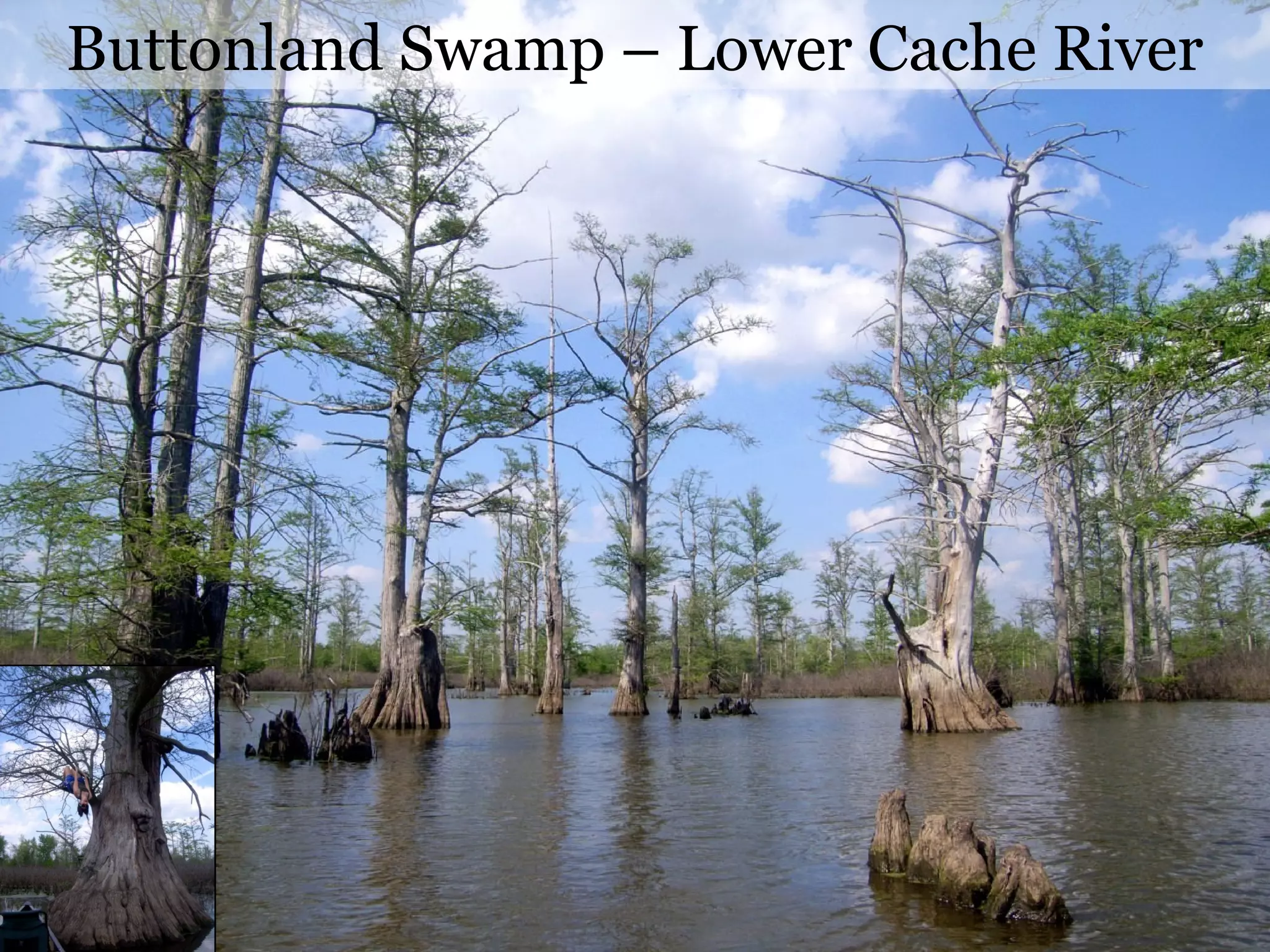
• Taxodiaceae – Bald Cypress family
– Taxodium – 1 species
• distichum (Bald Cypress)
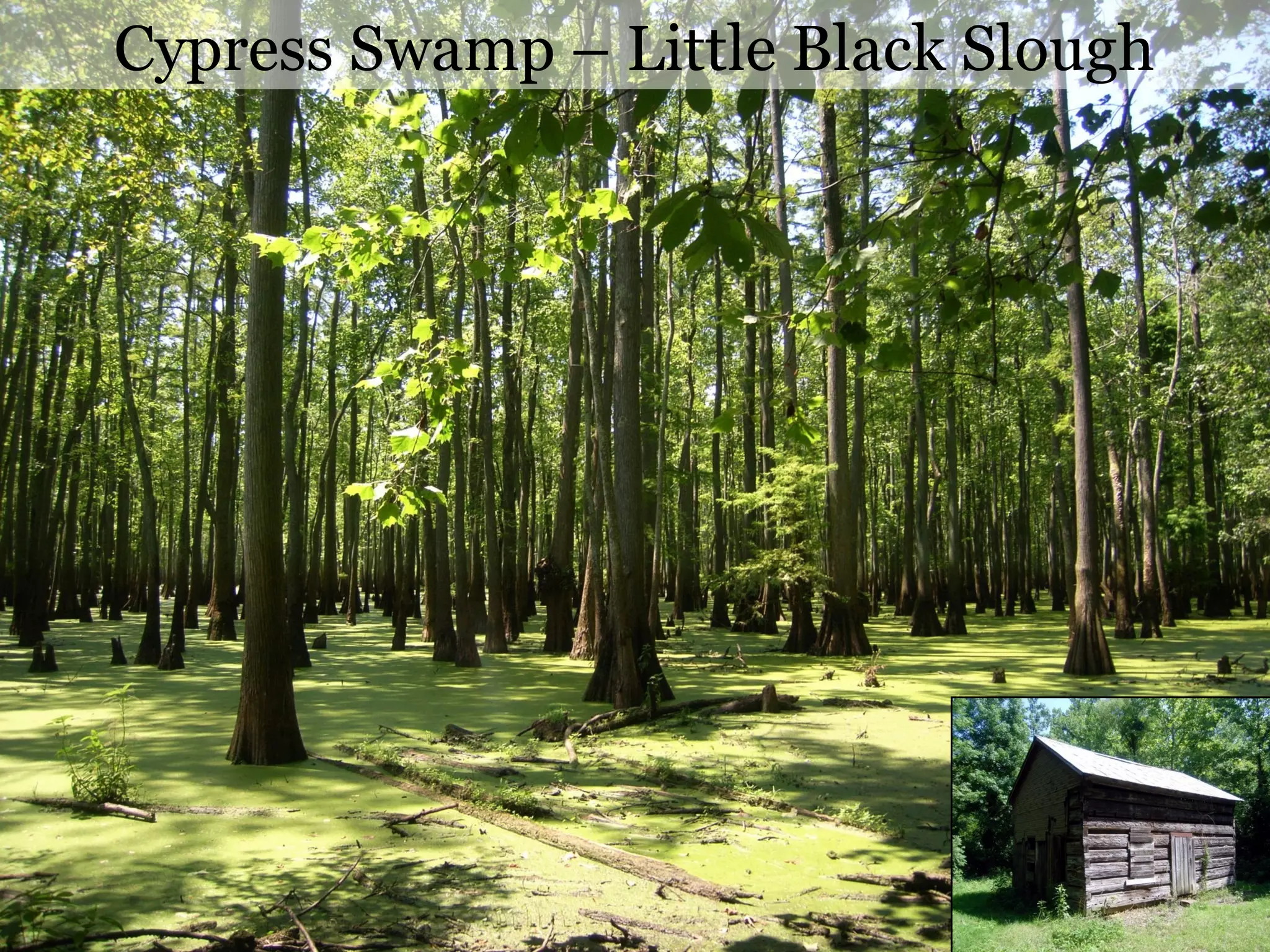
Cypress Swamp – Little Black Slough
Common Woody Angiosperms
• Aceraceae (Maple family)
– Acer - 11 species
• barbatum (Southern Sugar Maple)
• campestre (Hedge Maple)
• ginnala (Amur Maple)
• negundo (Box Elder)
• nigrum (Black Maple)
• palmatum (Japanese Maple)
• platanoides (Norway Maple)
• pseudoplatanus (Sycamore Maple)
• rubrum (Red Maple)
• saccharinum (Silver Maple)
• saccharum (Sugar Maple)
Common Woody Angiosperms
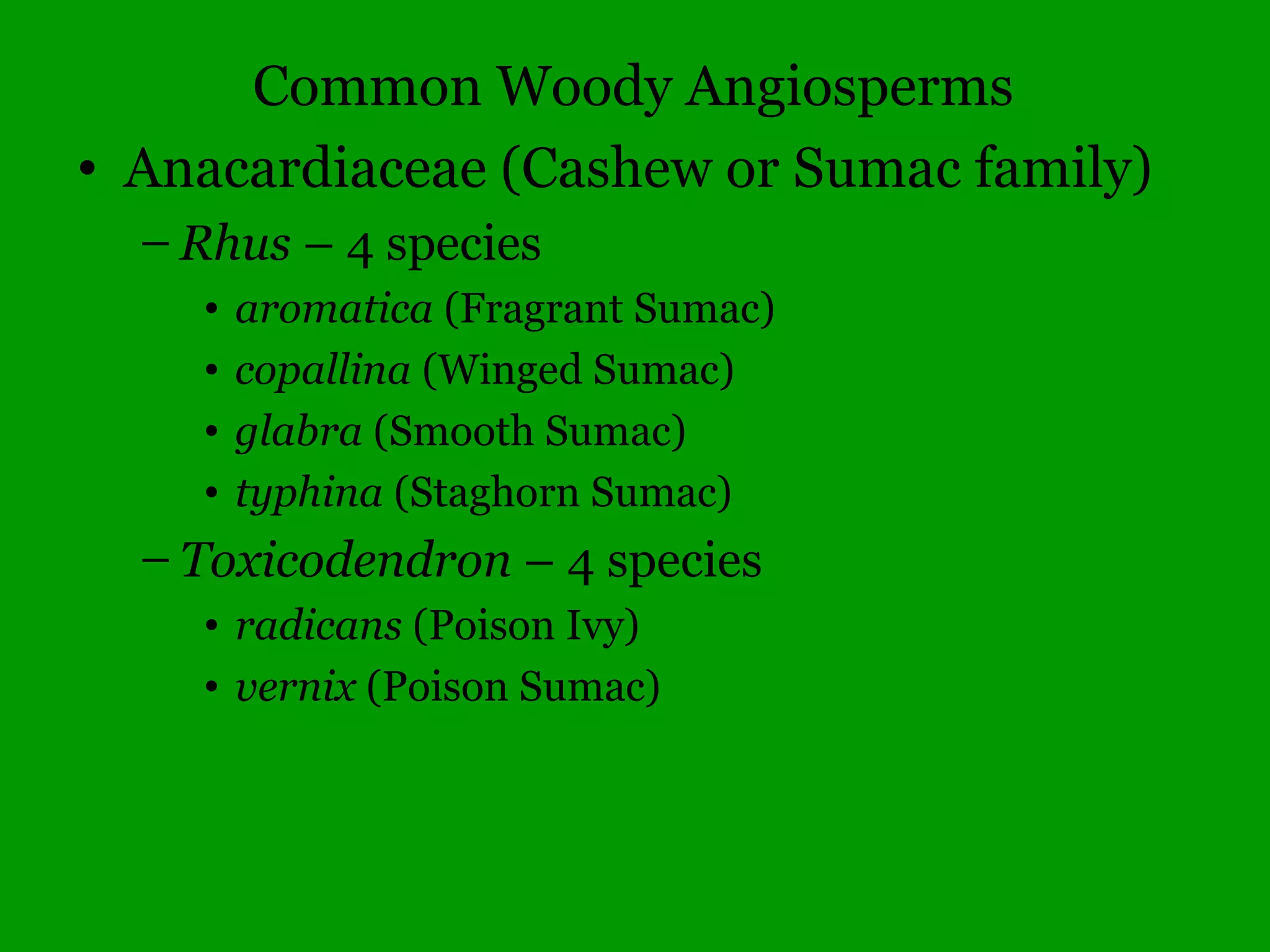
• Anacardiaceae (Cashew or Sumac family)
– Rhus – 4 species
• aromatica (Fragrant Sumac)
• copallina (Winged Sumac)
• glabra (Smooth Sumac)
• typhina (Staghorn Sumac)
– Toxicodendron – 4 species
• radicans (Poison Ivy)
• vernix (Poison Sumac)
Common Woody Angiosperms
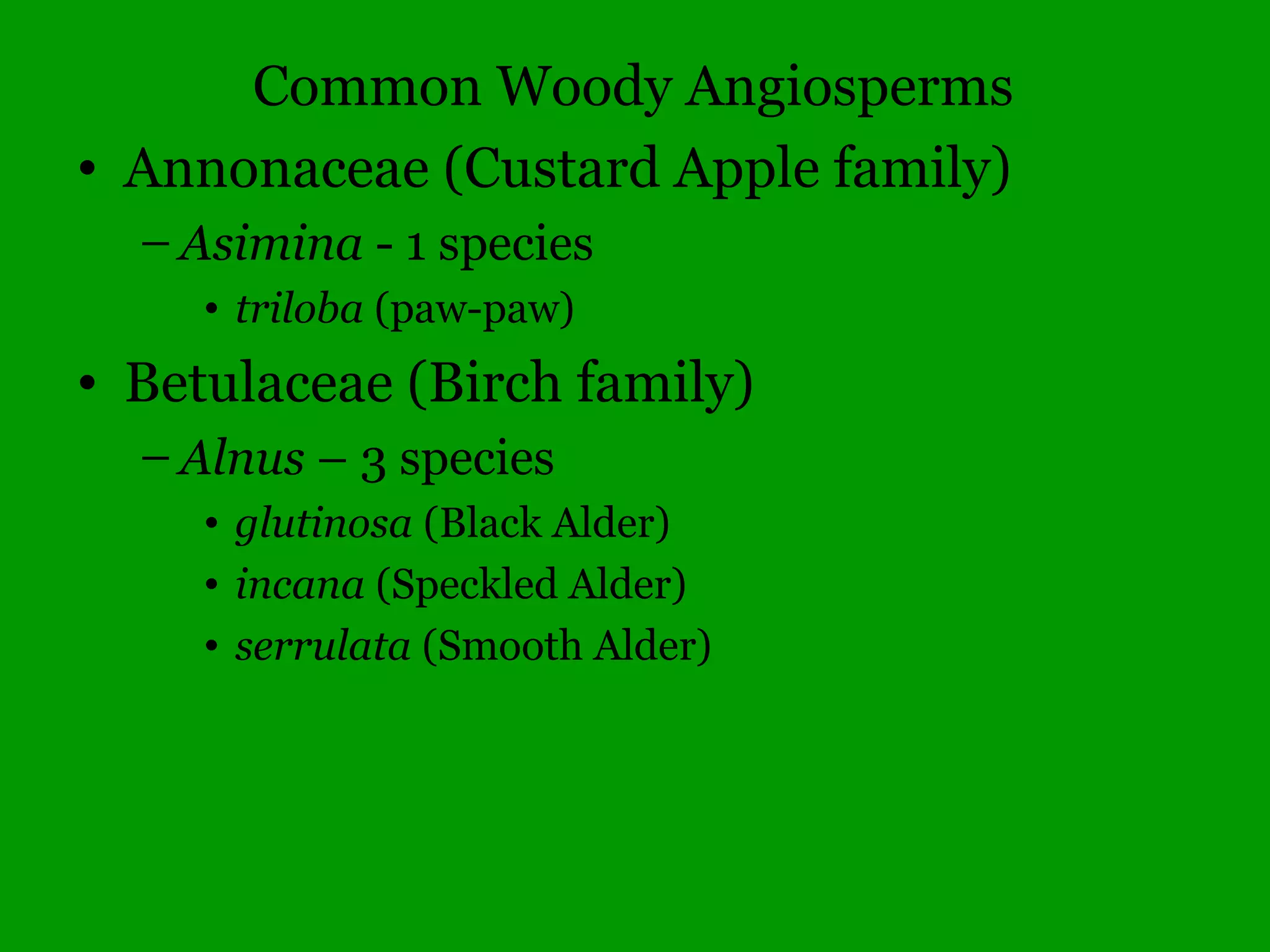
• Annonaceae (Custard Apple family)
– Asimina - 1 species
• triloba (paw-paw)
• Betulaceae (Birch family)
– Alnus – 3 species
• glutinosa (Black Alder)
• incana (Speckled Alder)
• serrulata (Smooth Alder)
Common Woody Angiosperms
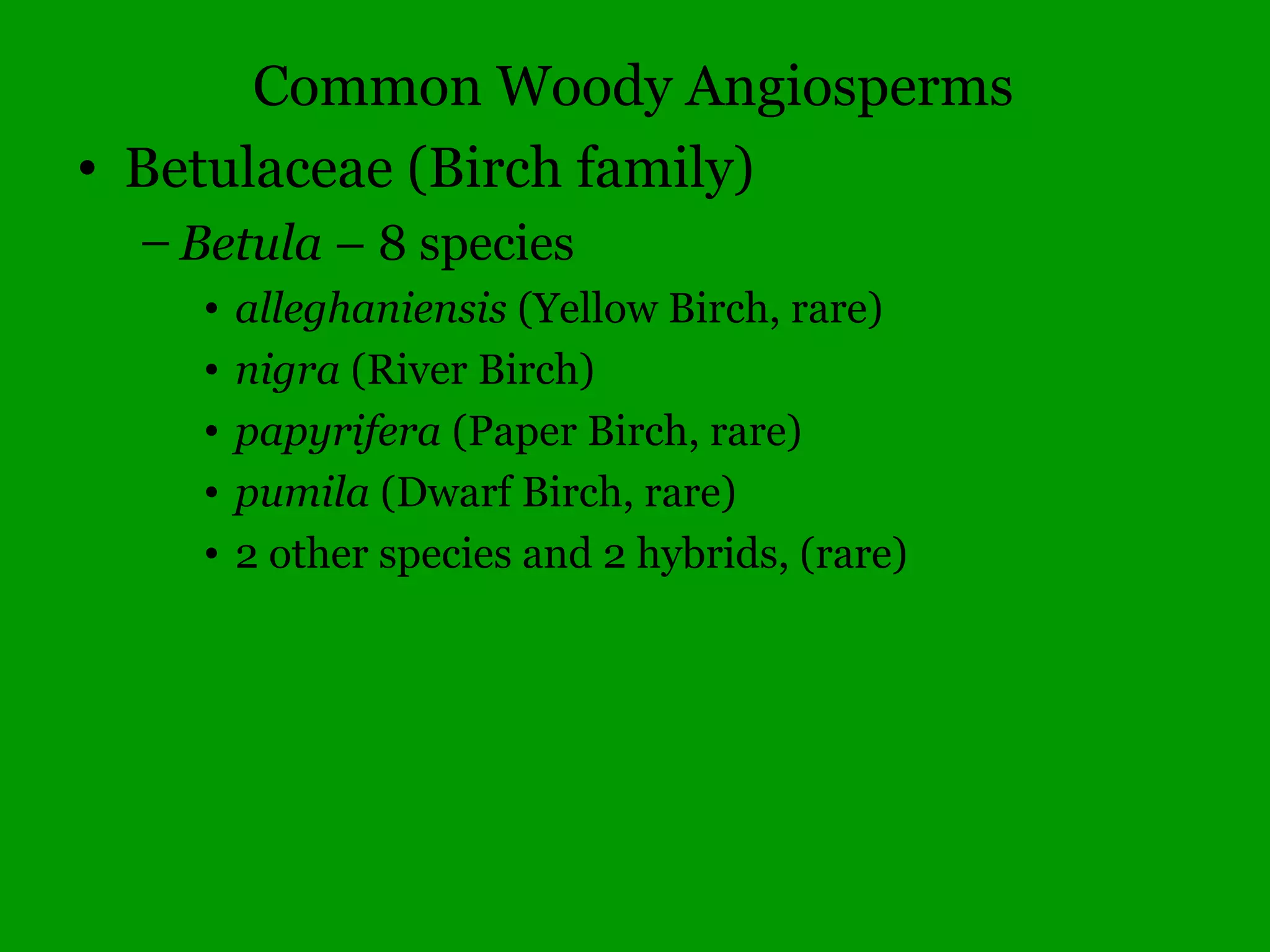
• Betulaceae (Birch family)
– Betula – 8 species
• alleghaniensis (Yellow Birch, rare)
• nigra (River Birch)
• papyrifera (Paper Birch, rare)
• pumila (Dwarf Birch, rare)
• 2 other species and 2 hybrids, (rare)
Common Woody Angiosperms
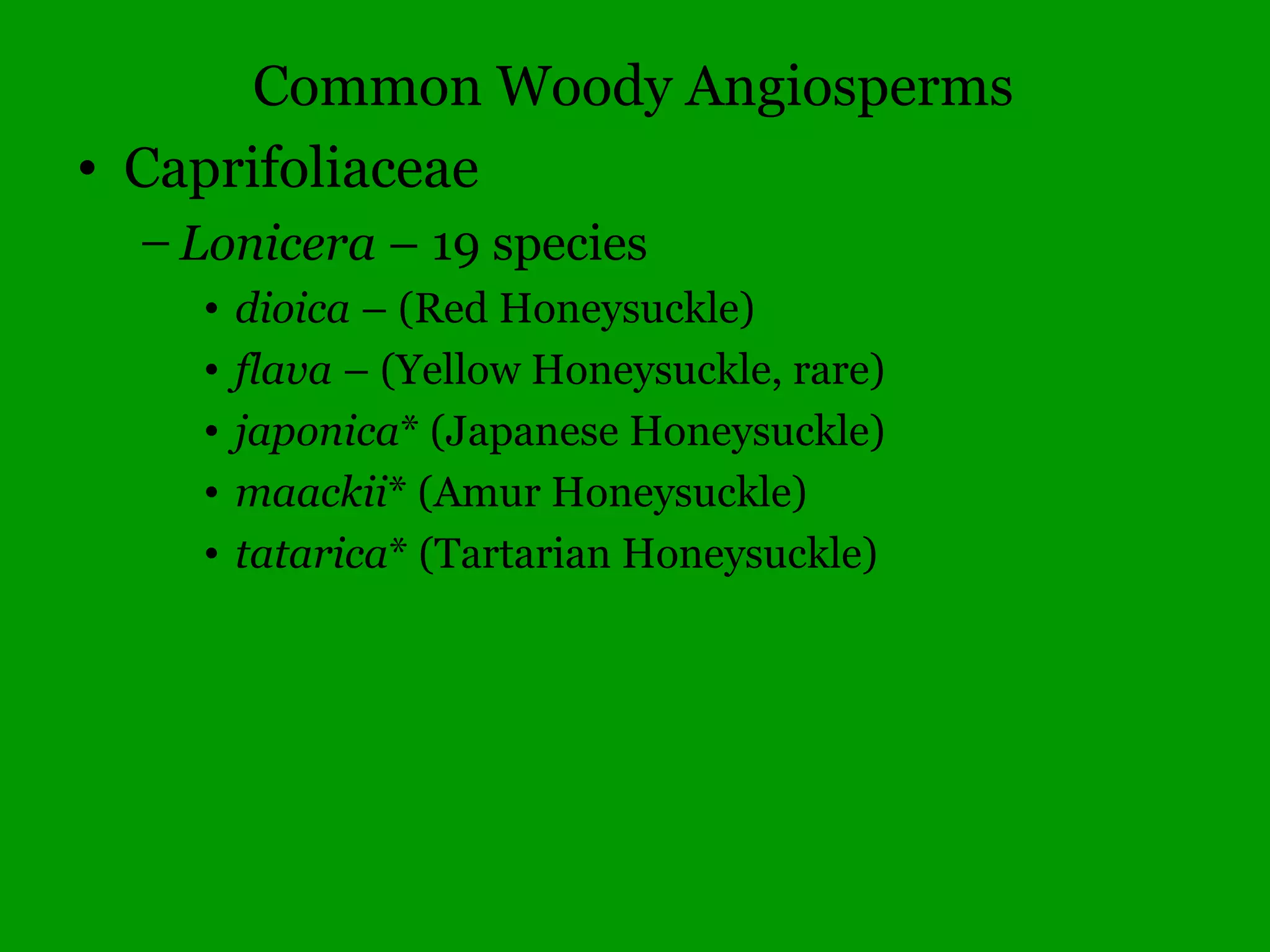
• Caprifoliaceae
– Lonicera – 19 species
• dioica – (Red Honeysuckle)
• flava – (Yellow Honeysuckle, rare)
• japonica* (Japanese Honeysuckle)
• maackii* (Amur Honeysuckle)
• tatarica* (Tartarian Honeysuckle)
Common Woody Angiosperms
• Caprifoliaceae
– Sambucus – 2 species
• canadensis (Elderberry)
• racemosa (Red-berried Elder)
– Symphoricarpos – 1 species
• albus* (Snowberry)
• occidentalis (Wolfberry)
• orbiculatus (Coralberry)
Common Woody Angiosperms
• Caprifoliaceae
– Viburnum – 13 species
• acerifolium (Maple-leaved Arrowwood)
• dentatum* (Arrowwood)
• lentago (Nannyberry)
• prunifolium (Black Haw)
• rafinesquianum (Downy Arrowwood)
• recognitum (Smooth Arrowwood)
• rufidulum (Rusty Black Haw)
• trilobum (High-bush Cranberry, rare)
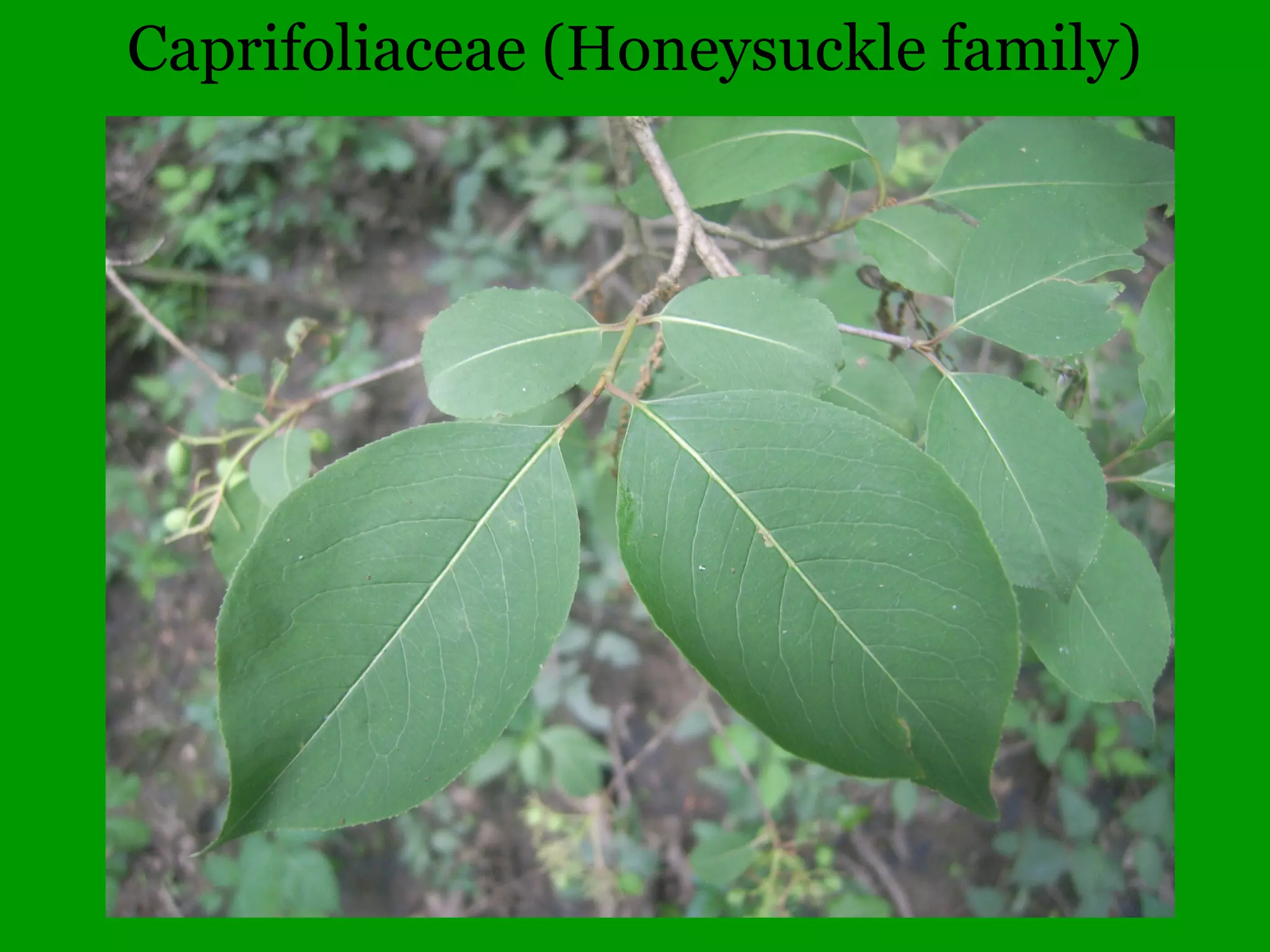
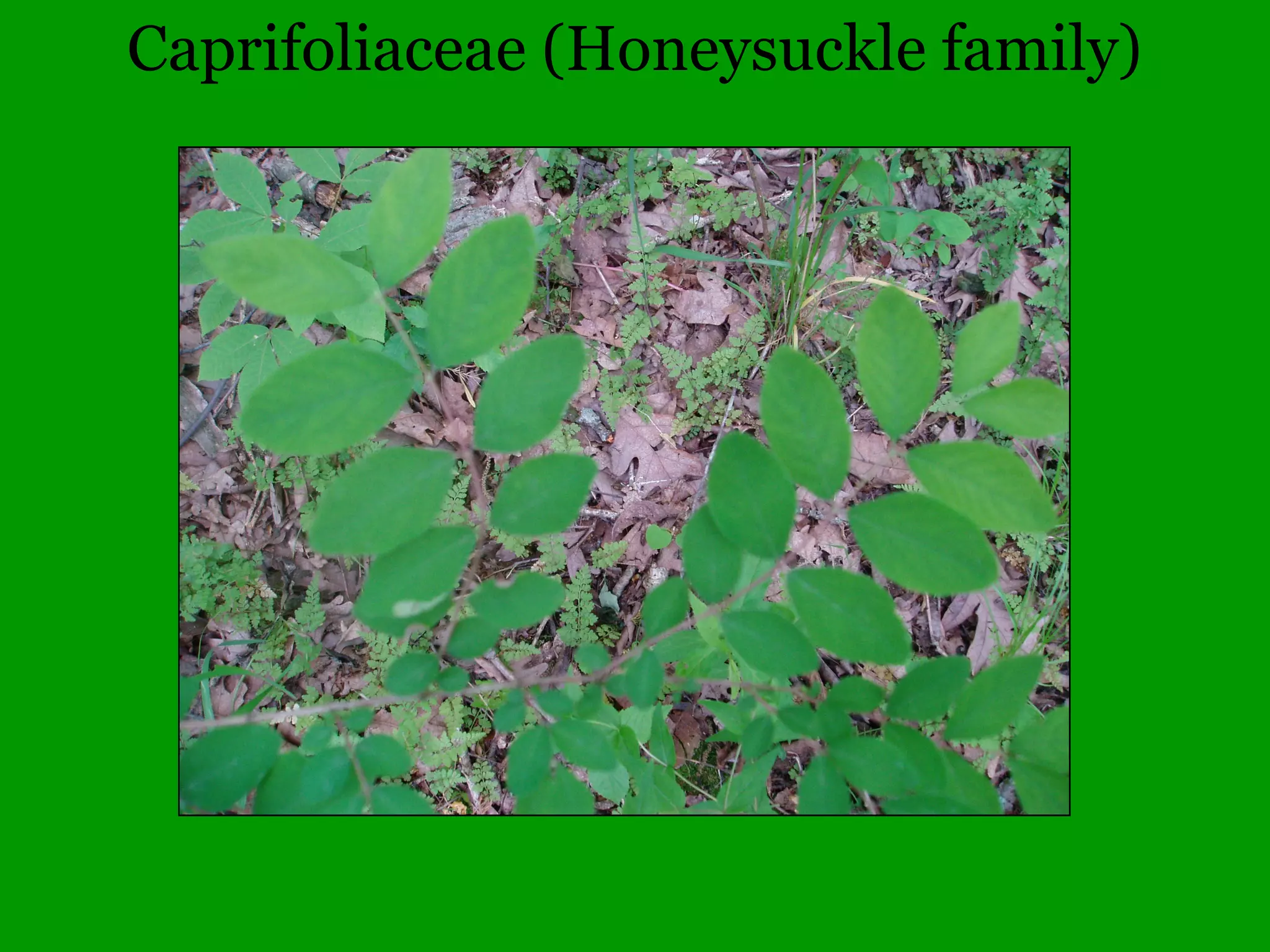
Caprifoliaceae (Honeysuckle family)
Common Woody Angiosperms
• Corylaceae (Hazelnut family)
– Carpinus – 1 species
• caroliniana (Musclewood, Blue Beech)
– Corylus – 1 species
• americana (Hazelnut)
– Ostrya – 1 species
• virginiana (Ironwood, Eastern Hop Hornbeam)
Common Woody Angiosperms
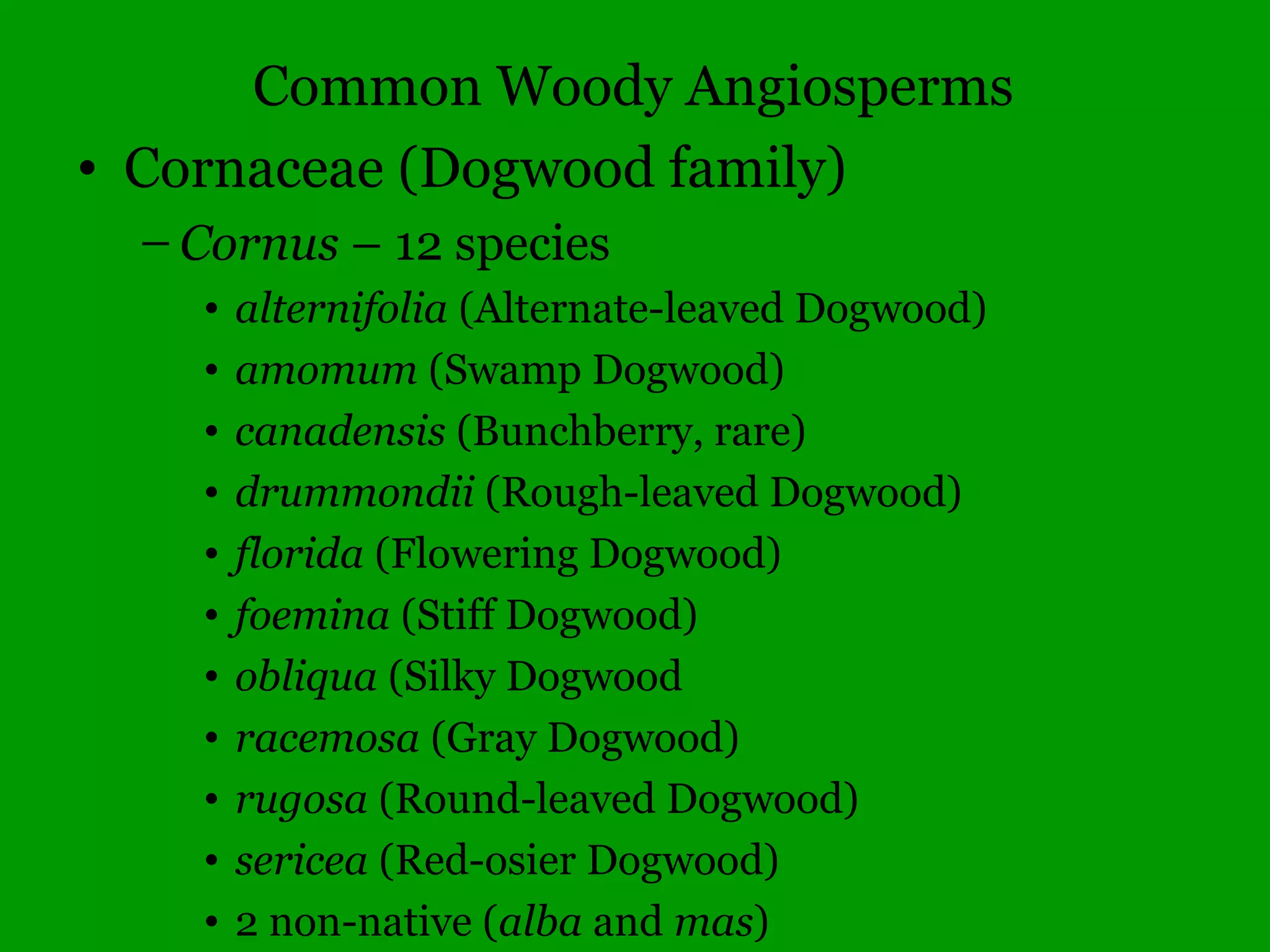
• Cornaceae (Dogwood family)
– Cornus – 12 species
• alternifolia (Alternate-leaved Dogwood)
• amomum (Swamp Dogwood)
• canadensis (Bunchberry, rare)
• drummondii (Rough-leaved Dogwood)
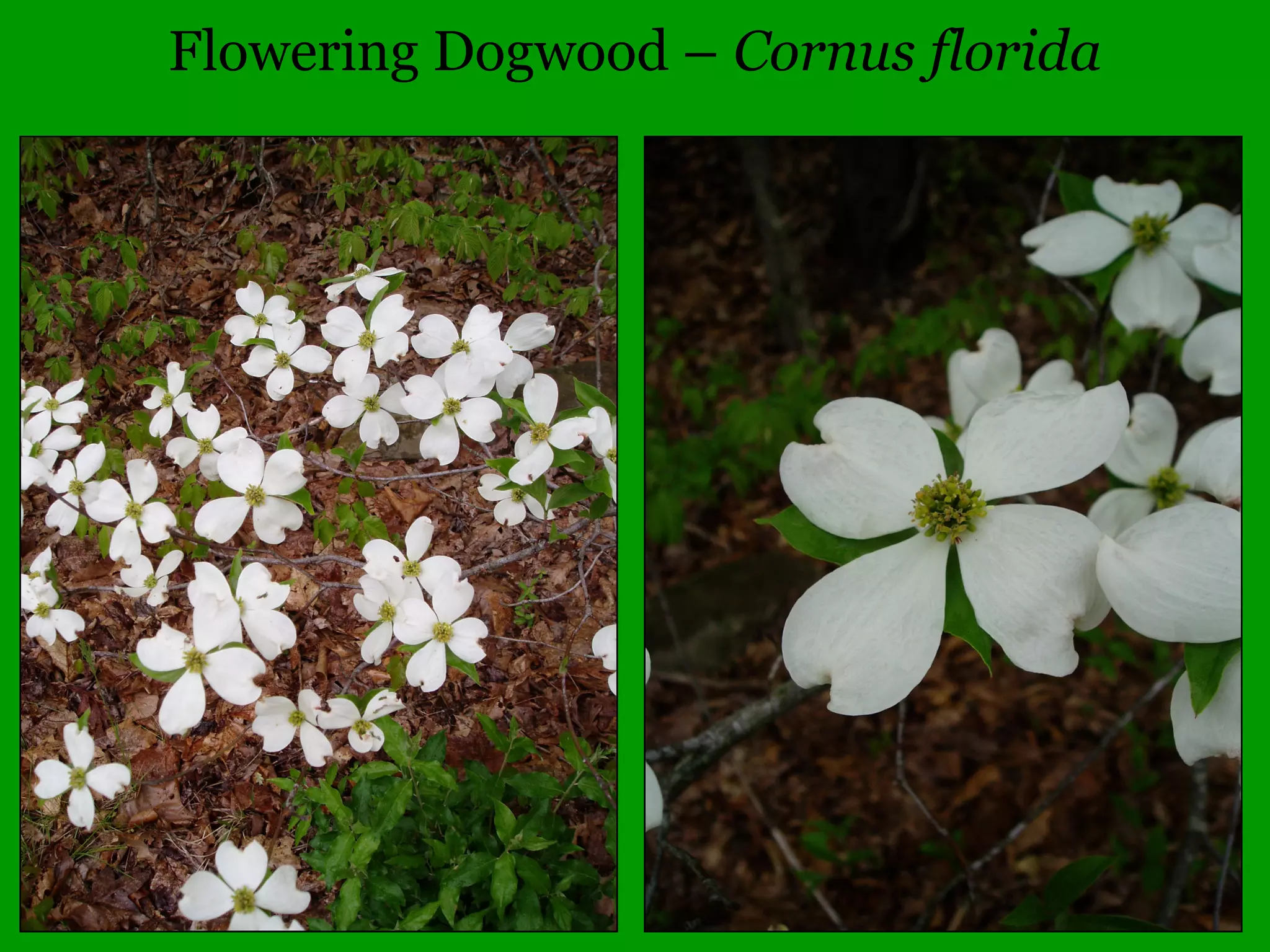
• florida (Flowering Dogwood)
• foemina (Stiff Dogwood)
• obliqua (Silky Dogwood
• racemosa (Gray Dogwood)
• rugosa (Round-leaved Dogwood)
• sericea (Red-osier Dogwood)
• 2 non-native (alba and mas)
Flowering Dogwood – Cornus florida
Common Woody Angiosperms
• Ebenaceae (Ebony family)
– Diospyros – 1 species
• virginiana (Persimmon)
Common Woody Angiosperms
• Ericaceae (Heath family)
– Gaylussacia – 1 species
• baccata (Black Huckleberry)
– Rhododendron – 2 species
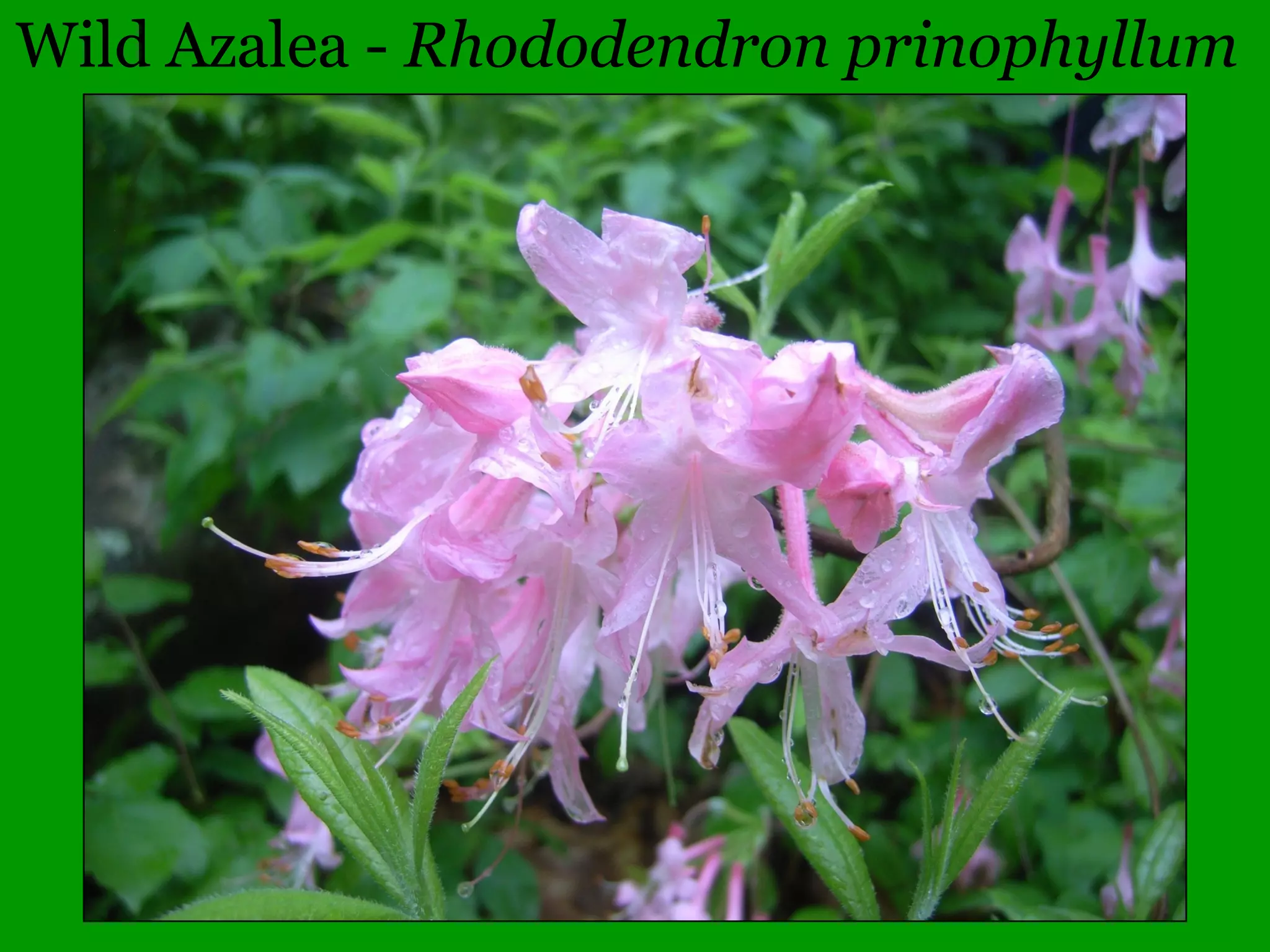
• prinophyllum – (Wild Azalea)
– Vaccinium – 8 species
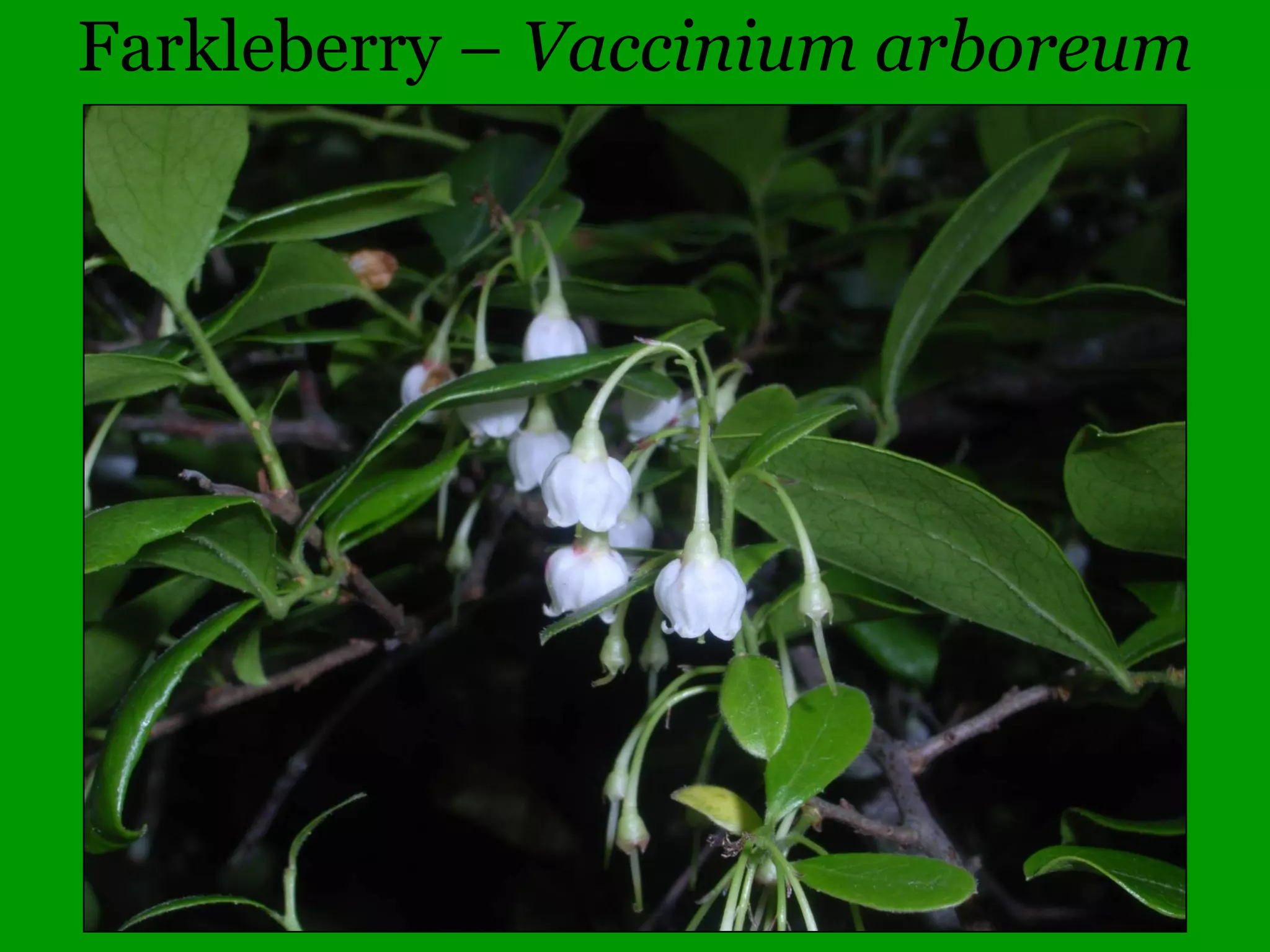
• arboreum (Farkleberry)
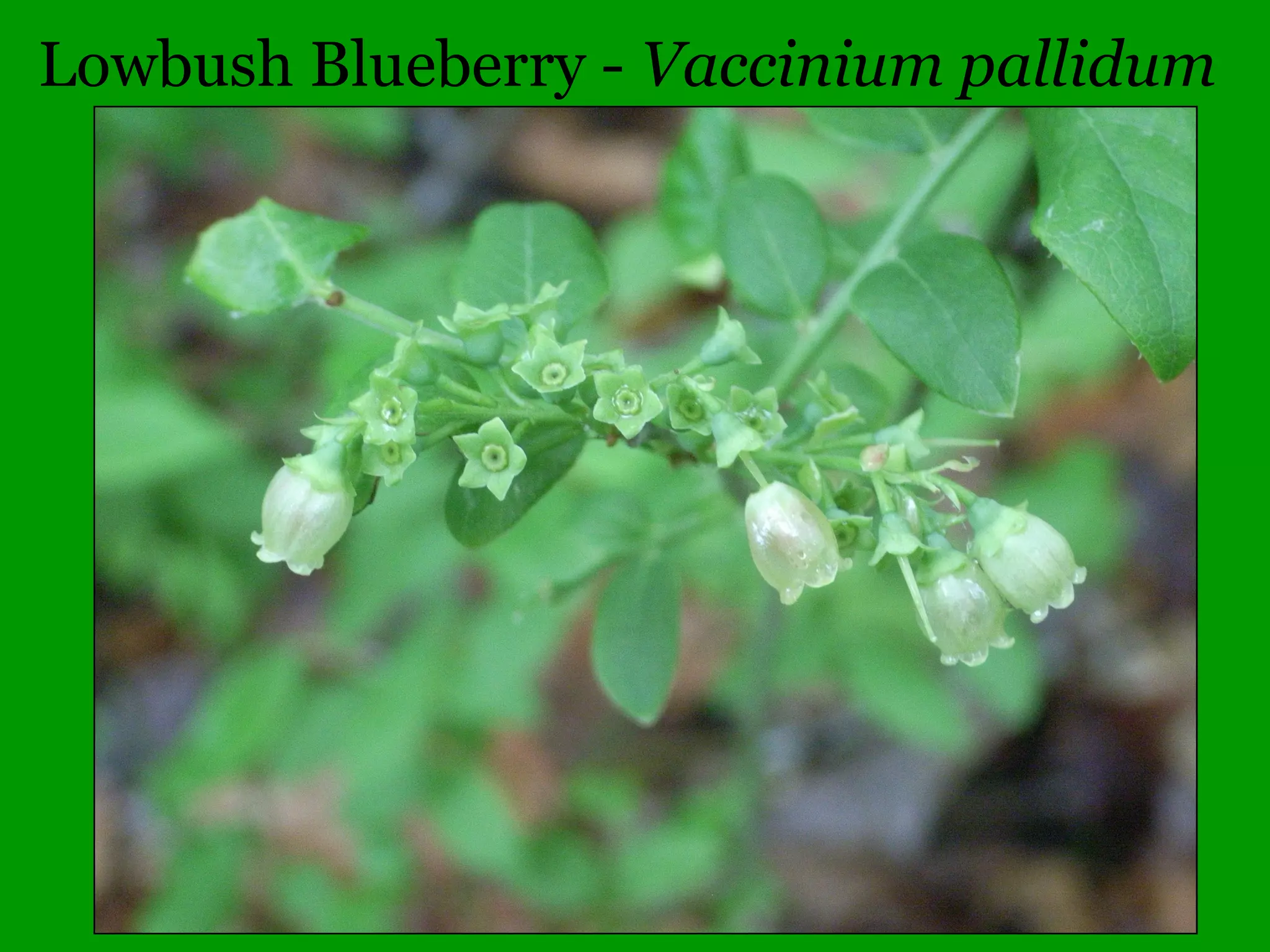
• pallidum (Blueberry)
• stamenium (Deerberry)
Lowbush Blueberry - Vaccinium pallidum
Common Woody Angiosperms
• Caesalpiniaceae (Caesalpinia family)
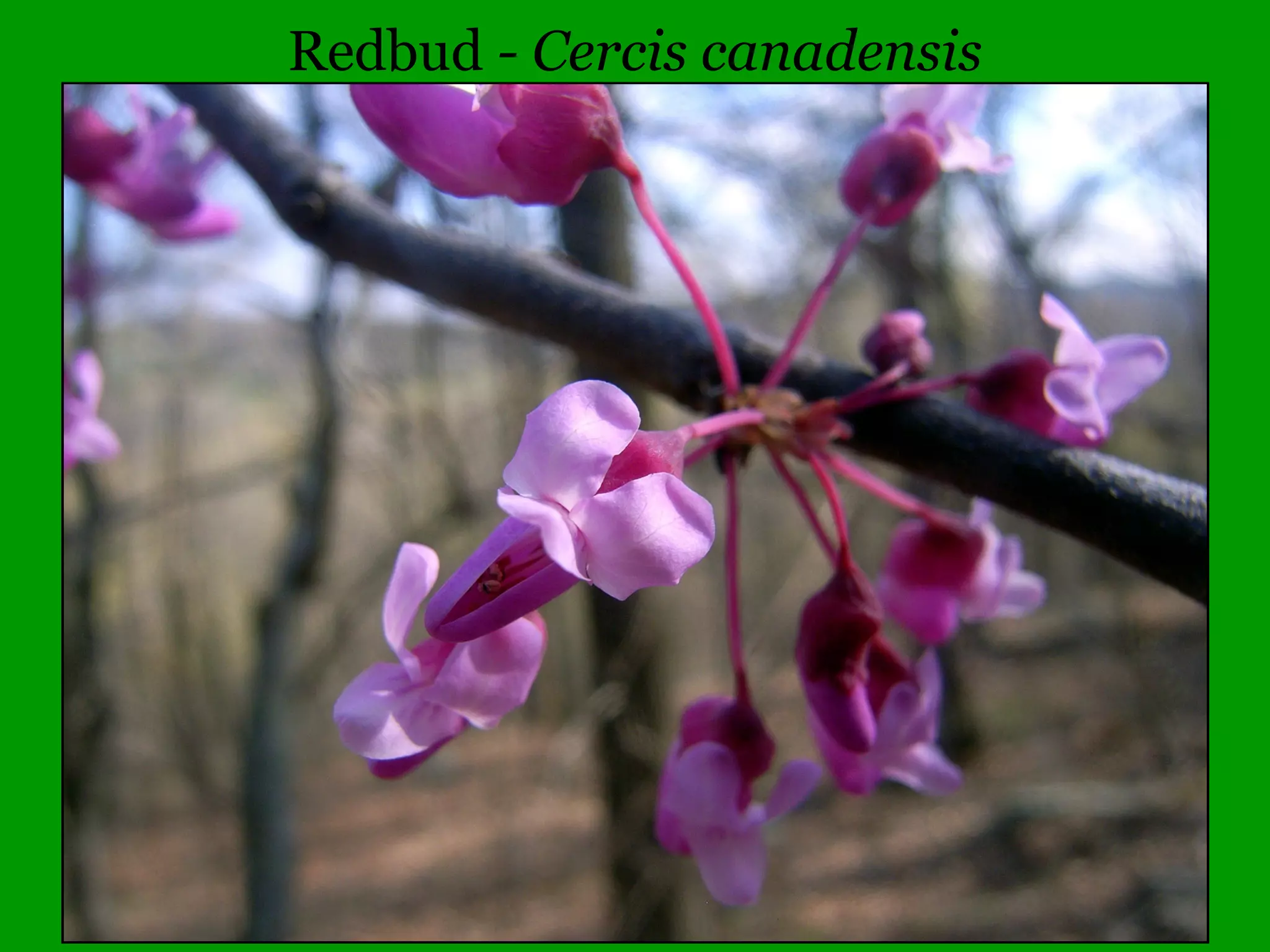
– Cercis – 1 species
• canadensis (Redbud)
– Gleditsia – 2 species
• aquatica – (Water Locust)
• triacanthos (Honey Locust)
– Gymnocladus – 1 species
• dioicus (Kentucky Coffee Tree)
Common Woody Angiosperms
• Fabaceae (Bean/Pea family)
– Amorpha – 3 species
• canescens (Leadplant)
• fruticosa (False Indigo Bush)
• nitens (Smooth False Indigo, rare)
– Cladrastis – 1 species
• kentukea (Yellowwood, rare)
– Robinia – 1 species
• pseudoacacia (Black Locust)
Common Woody Angiosperms
• Fagaceae (Beech family)
– Castanea – 1 species
• dentata (Chestnut)
– Fagus – 1 species
• grandifolia (American Beech)
Common Woody Angiosperms
• Fagaceae (Beech family)
– Quercus – 21 species
• acutissima (Sawtooth Oak)
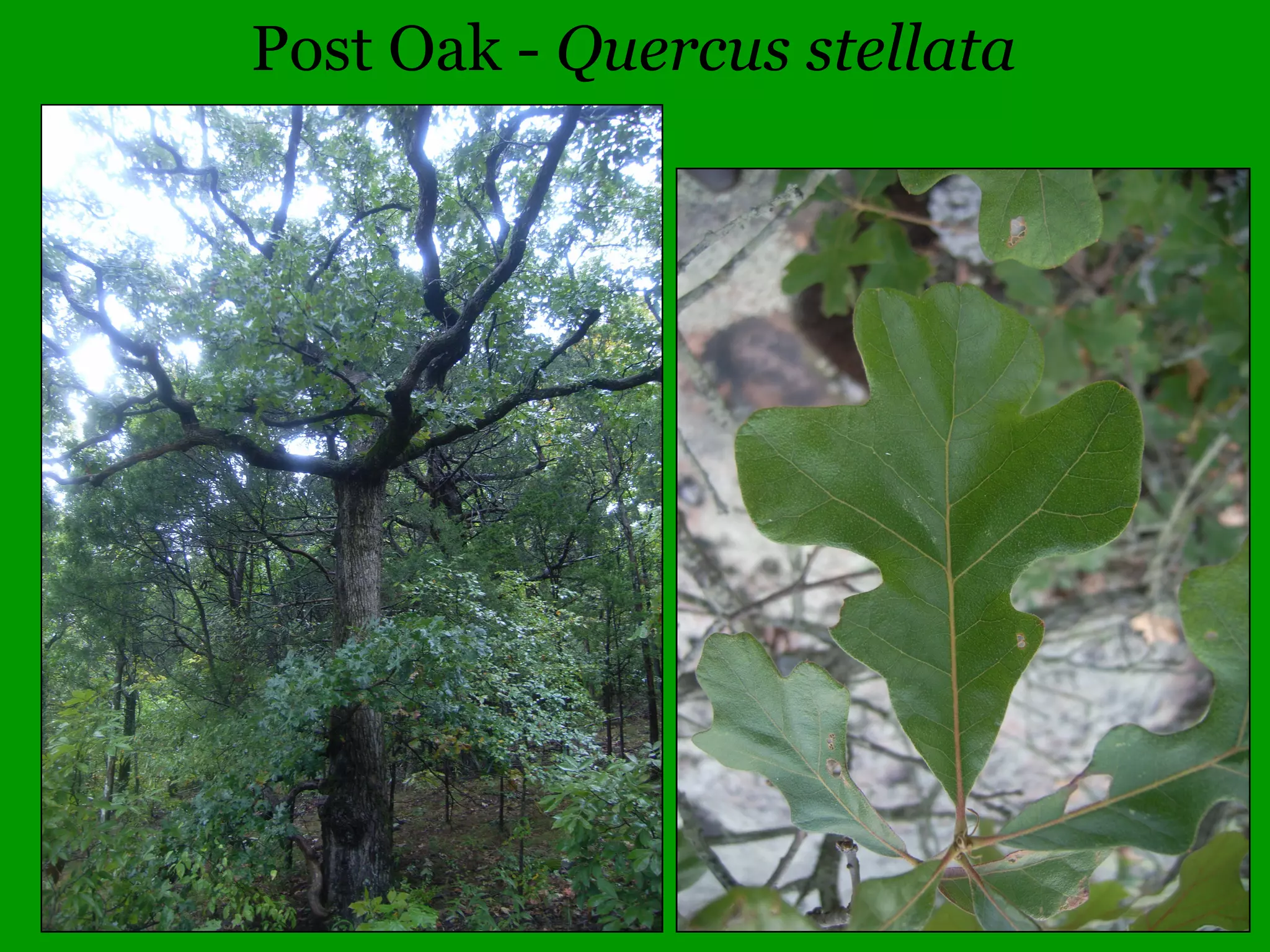
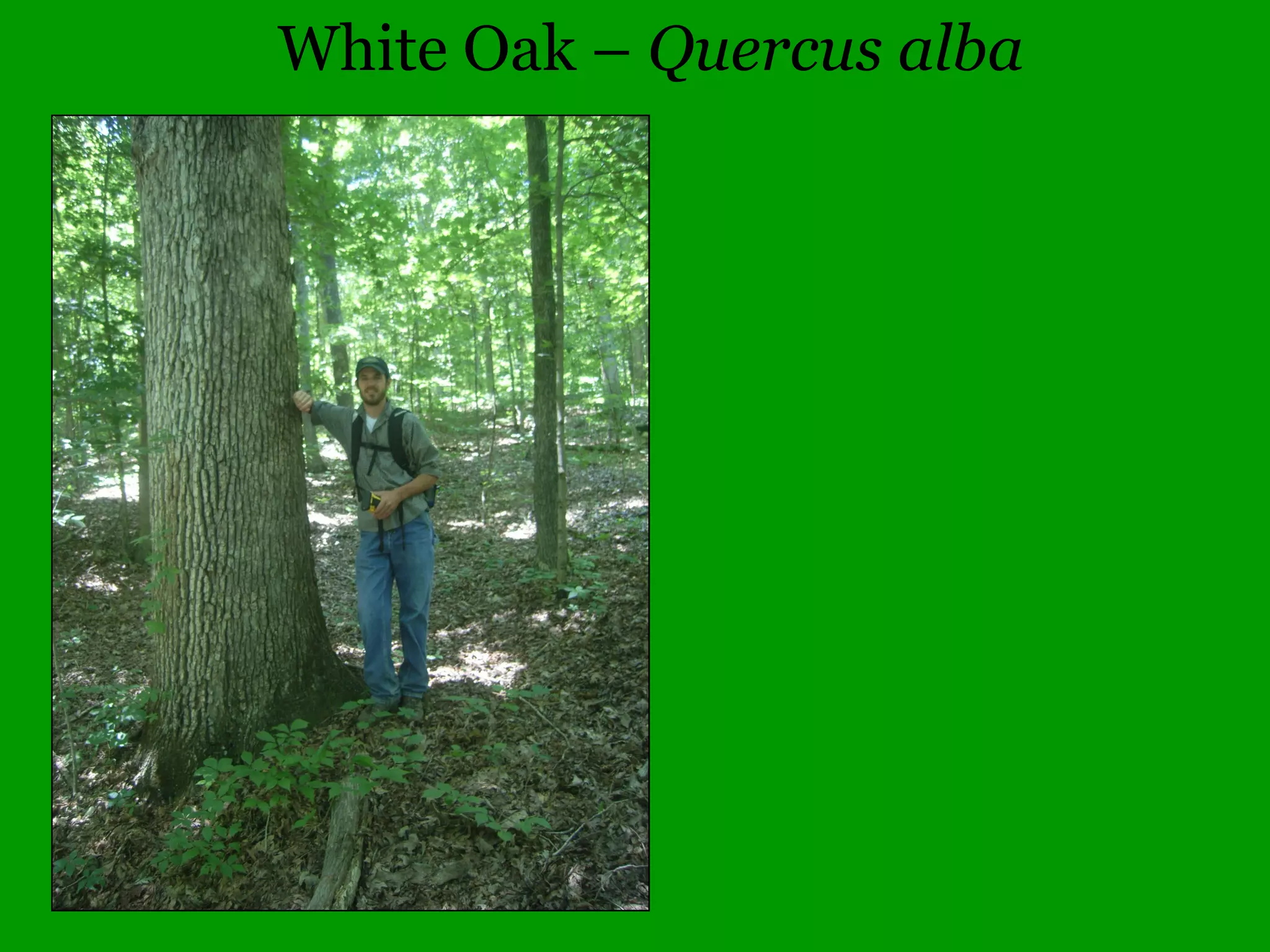
• alba (White Oak)
• bicolor (Swamp White Oak)
• coccinea (Scarlet Oak)
• ellipsoidalis (Northern Pin Oak)
• falcata (Southern Red Oak)
• imbricaria (Shingle Oak)
• lyrata (Overcup Oak)
• macrocarpa (Bur Oak)
• marilandica (Blackjack Oak)
Common Woody Angiosperms
• Fagaceae (Beech family)
– Quercus – 21 species
• michauxii (Swamp Chestnut Oak)
• muhlenbergia (Chinquapin Oak)
• pagoda (Cherrybark Oak)
• palustris (Pin Oak)
• phellos (Willow Oak)
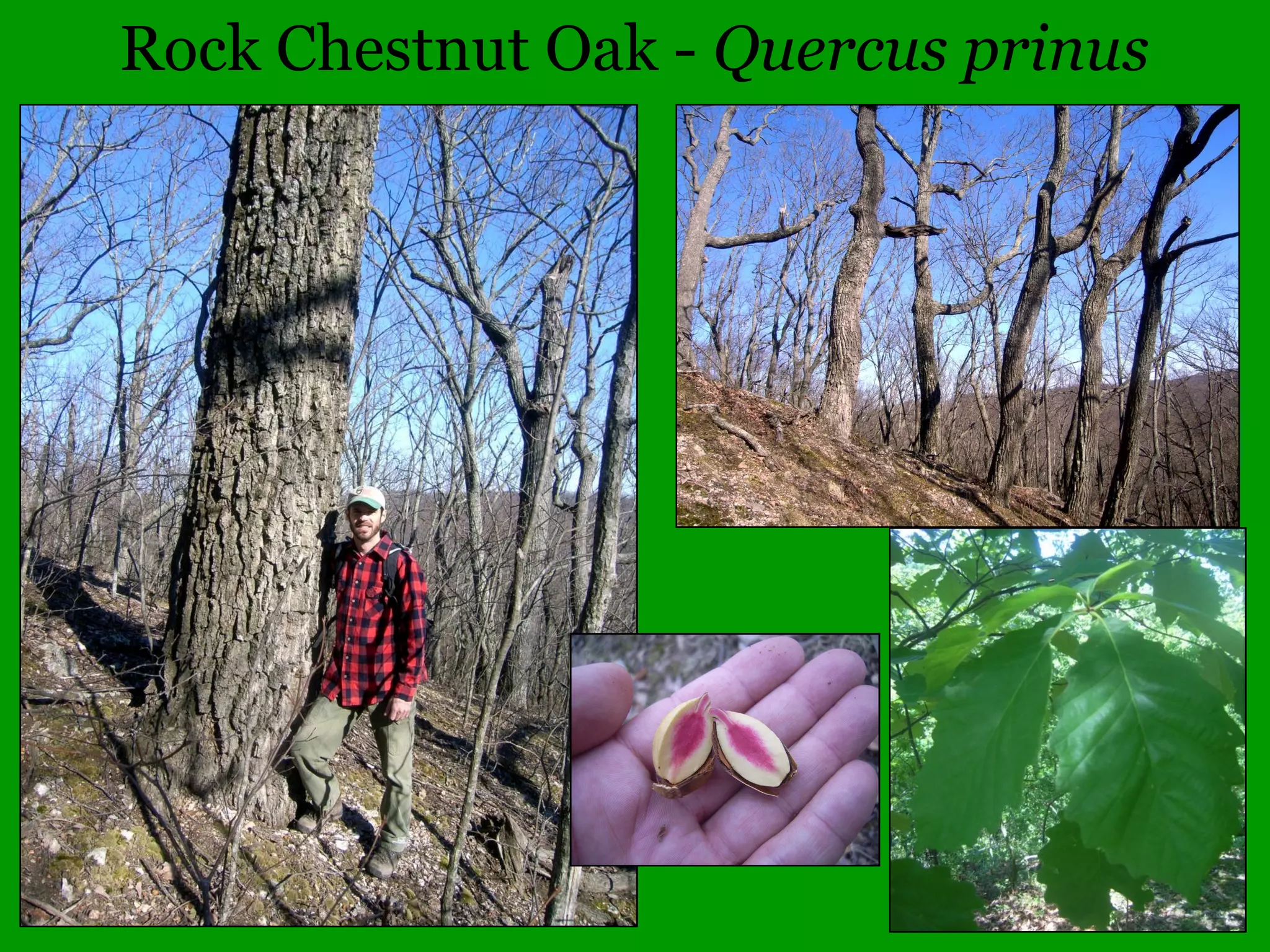
• prinus (Rock Chestnut Oak)
• rubra (Red Oak)
• shumardii (Shumard’s Oak)
• stellata (Post Oak)
• texana (Nuttall’s Oak)
• velutina (Black Oak)
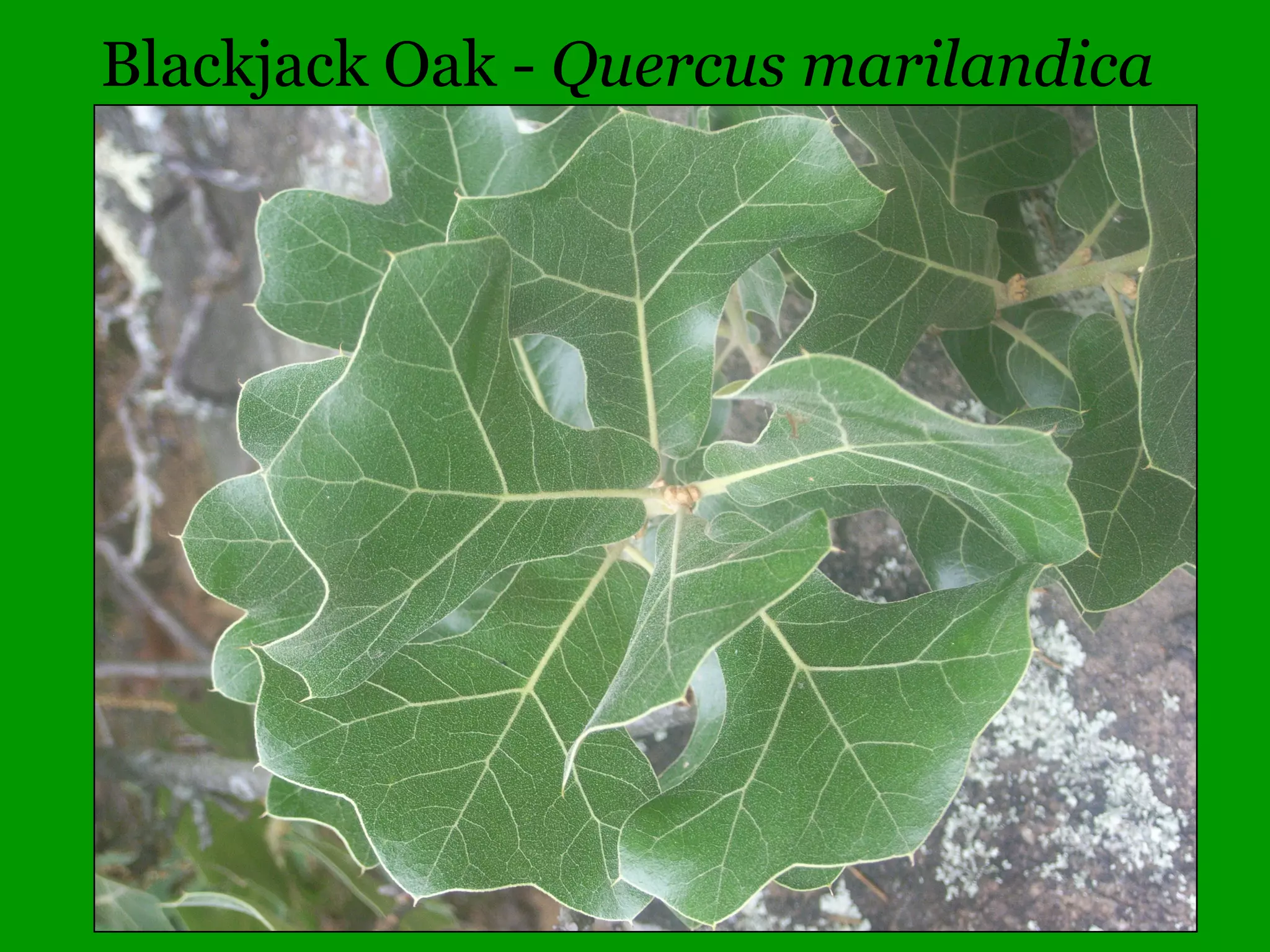
Blackjack Oak - Quercus marilandica
Common Woody Angiosperms
• Hamamelidaceae (Witch Hazel family)
– Hamamelis – 1 species
• virginiana (Witch Hazel)
– Liquidambar – 1 species
• styraciflua (Sweet Gum)
Common Woody Angiosperms
• Hippocastanaceae (Horse Chestnut family)
– Aesculus – 4 species
• flava (Sweet Buckeye, rare)
• glabra (Ohio Buckeye)
• hippocastanum (Horse Chestnut)
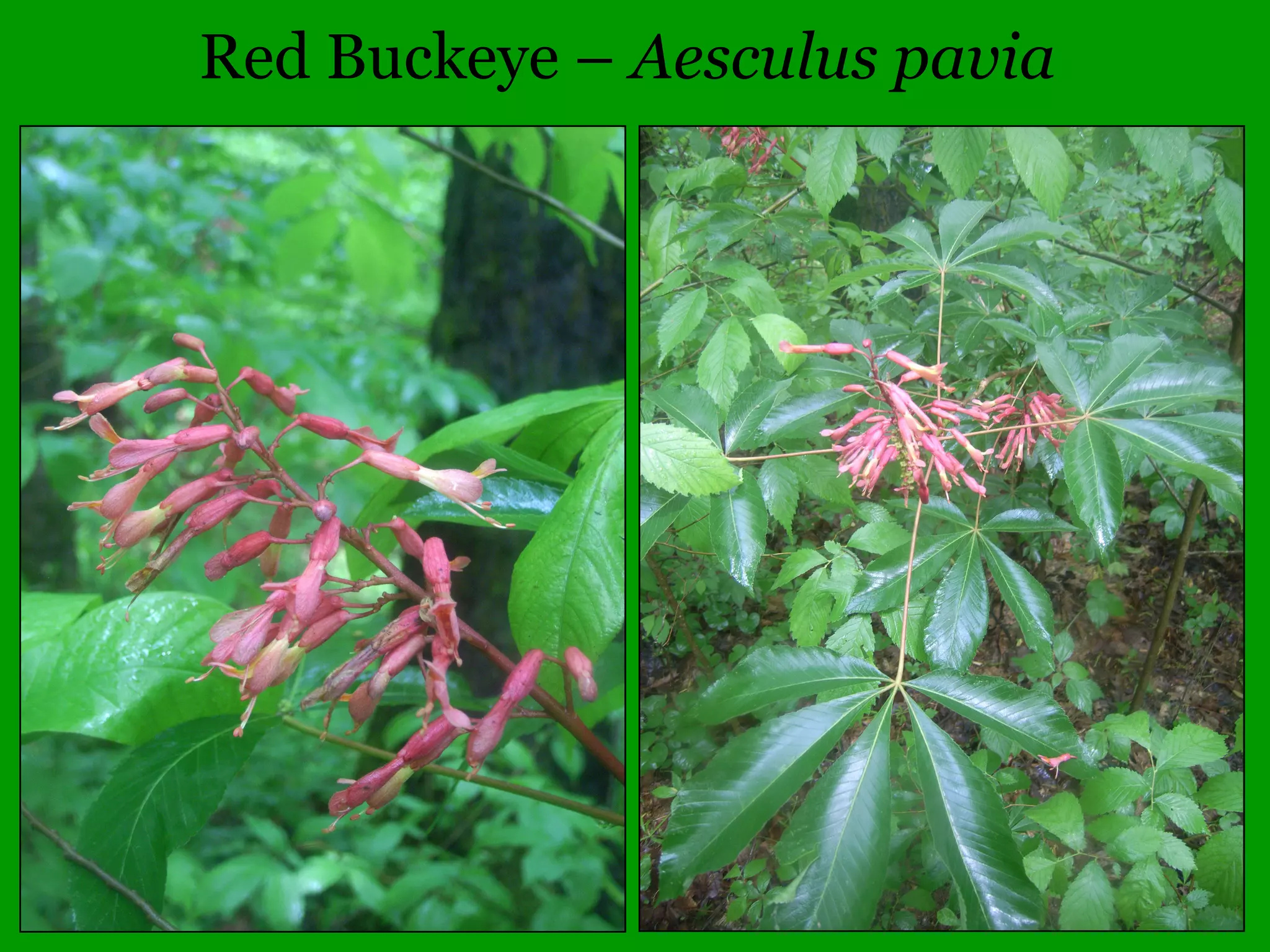
• pavia (Red Buckeye)
Common Woody Angiosperms
• Juglandaceae (Walnut family)
– Carya – 10 species
• aquatica (Water Hickory, rare)
• cordiformis (Bitternut)
• glabra (Pignut Hickory)
• illinoiensis (Pecan)
• laciniosa (Shellbark Hickory)
• ovalis (Sweet Pignut Hickory)
• ovata (Shagbark Hickory)
• pallida (Pale Hickory, rare)
• texana (Black Hickory)
• tomentosa (Mockernut)
Common Woody Angiosperms
• Juglandaceae (Walnut family)
– Juglans – 10 species
• cinerea (Butternut)
• nigra (Black Walnut)
Common Woody Angiosperms
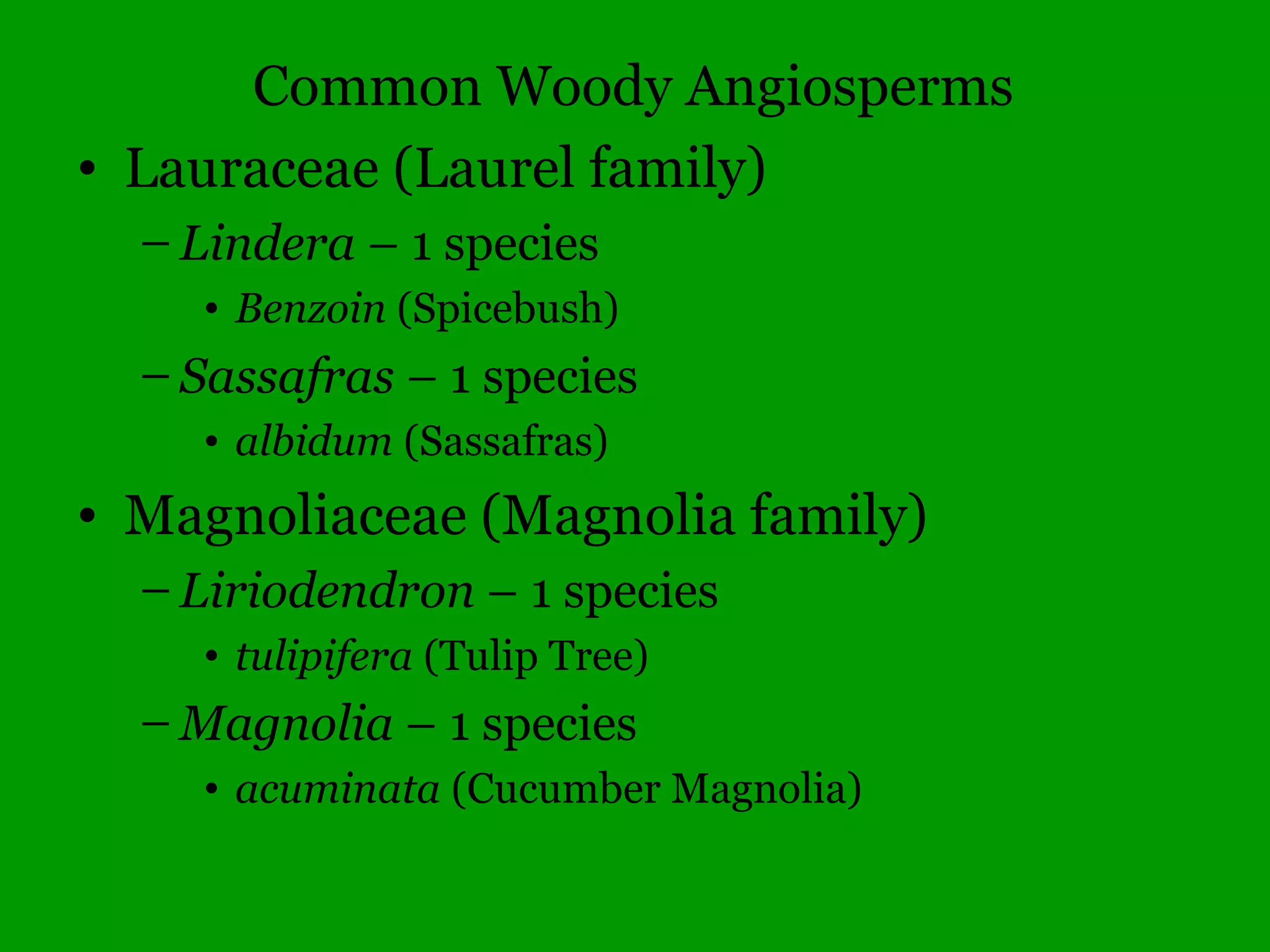
• Lauraceae (Laurel family)
– Lindera – 1 species
• Benzoin (Spicebush)
– Sassafras – 1 species
• albidum (Sassafras)
• Magnoliaceae (Magnolia family)
– Liriodendron – 1 species
• tulipifera (Tulip Tree)
– Magnolia – 1 species
• acuminata (Cucumber Magnolia)
Common Woody Angiosperms
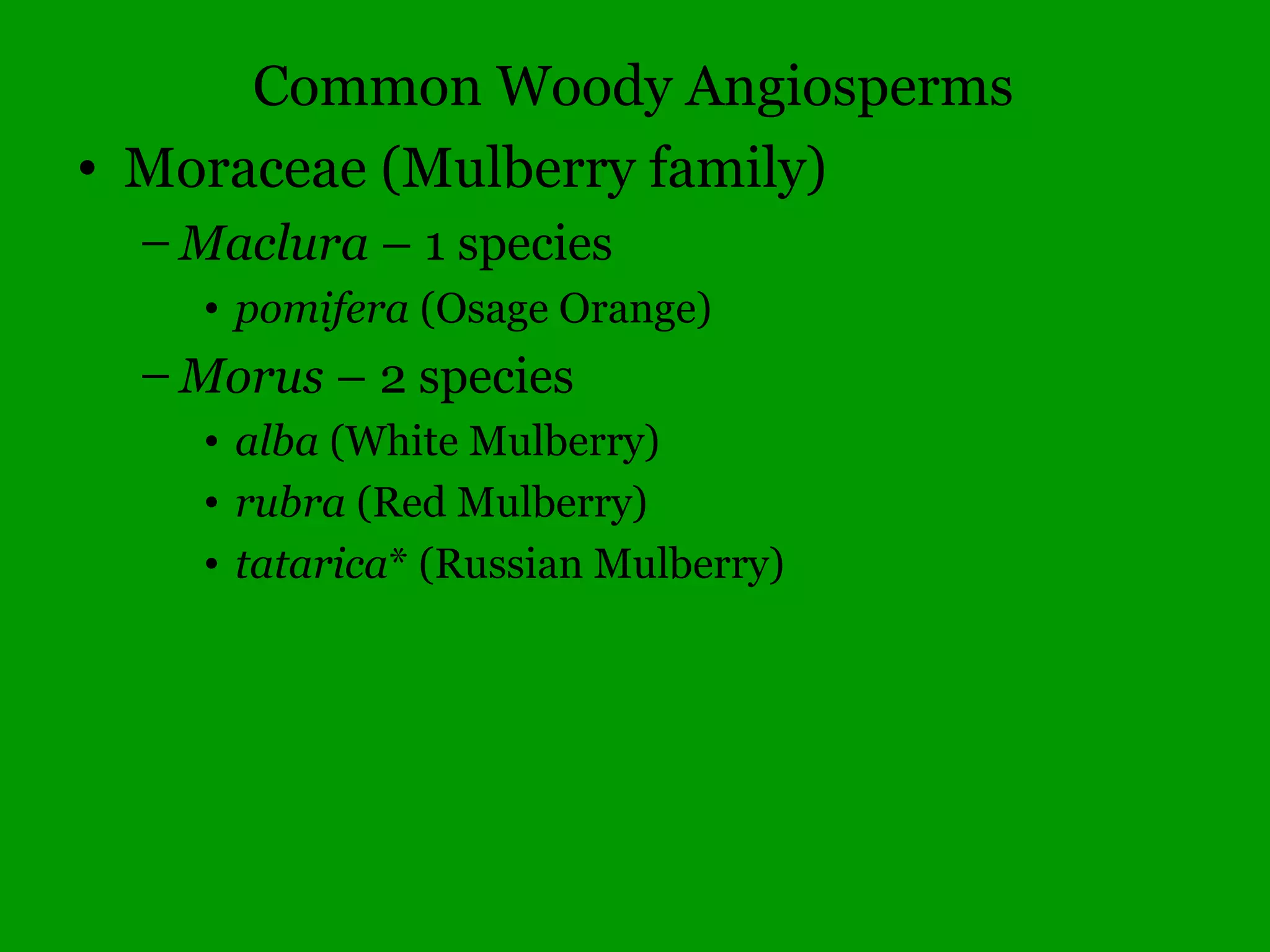
• Moraceae (Mulberry family)
– Maclura – 1 species
• pomifera (Osage Orange)
– Morus – 2 species
• alba (White Mulberry)
• rubra (Red Mulberry)
• tatarica* (Russian Mulberry)
Common Woody Angiosperms
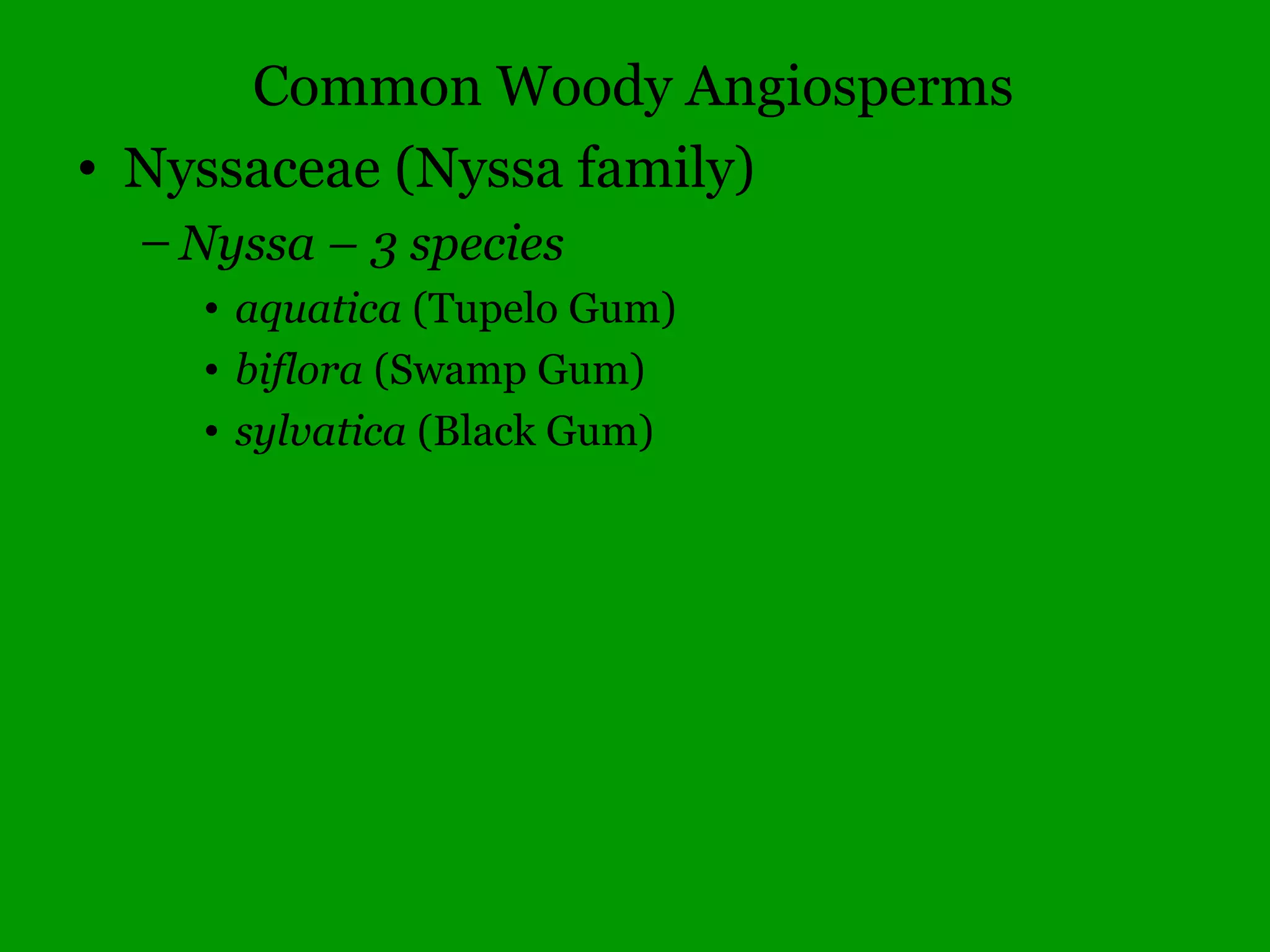
• Nyssaceae (Nyssa family)
– Nyssa – 3 species
• aquatica (Tupelo Gum)
• biflora (Swamp Gum)
• sylvatica (Black Gum)
Common Woody Angiosperms
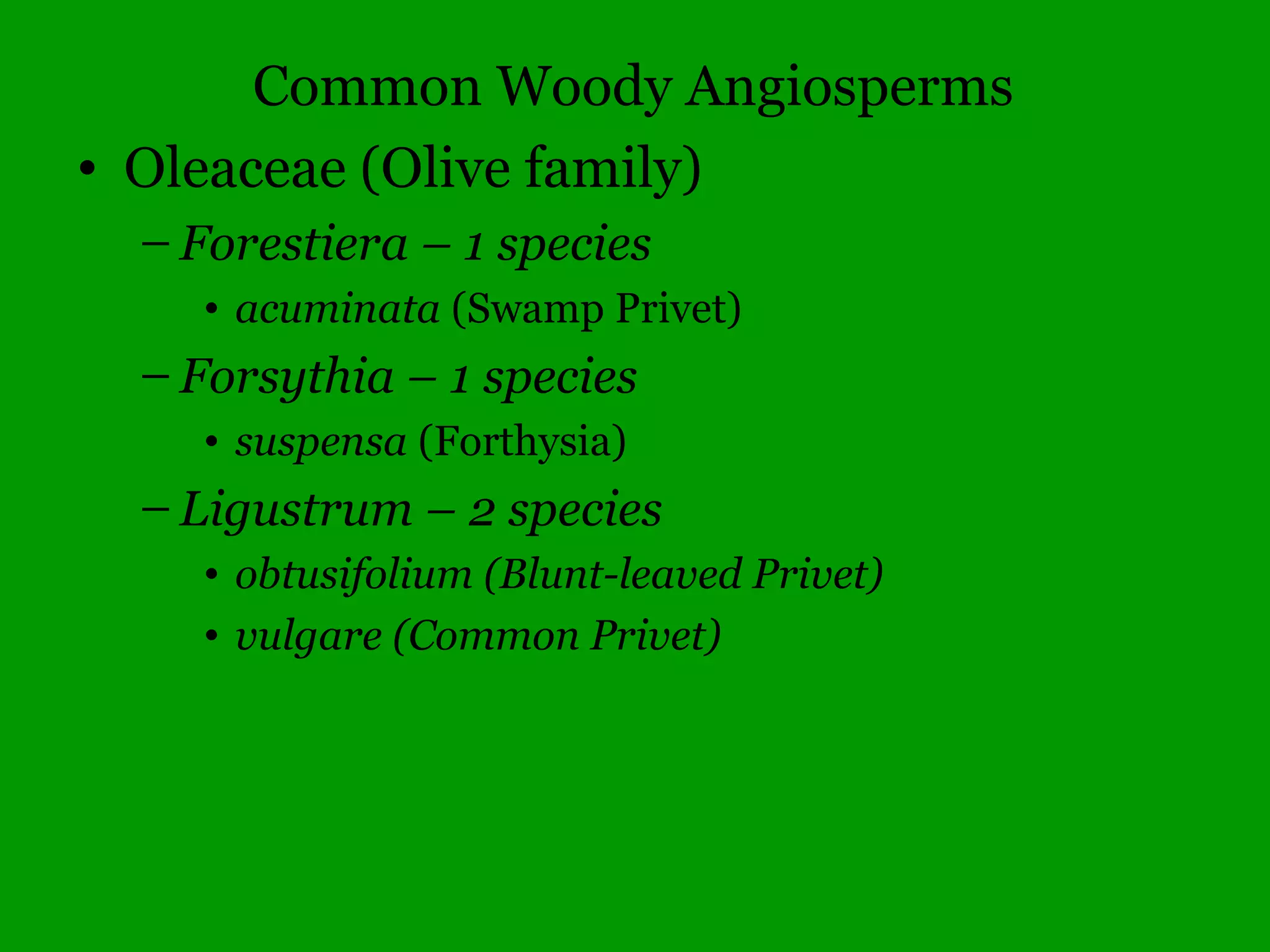
• Oleaceae (Olive family)
– Forestiera – 1 species
• acuminata (Swamp Privet)
– Forsythia – 1 species
• suspensa (Forthysia)
– Ligustrum – 2 species
• obtusifolium (Blunt-leaved Privet)
• vulgare (Common Privet)
Common Woody Angiosperms
• Oleaceae (Olive family)
– Fraxinus – 7 species
• americana (White Ash)
• biltmoreana (Biltmore Ash)
• lanceolata (Green Ash)
• nigra (Black Ash)
• pennsylvanica (Red Ash)
• profunda (Pumpkin Ash)
• quadrangulata (Blue Ash)
Common Woody Angiosperms
• Platanaceae (Sycamore family)
– Platanus – 1 species
• occidentalis (Sycamore)
• Rhamnaceae (Buckthorn family)
– Ceanothus
• americanus (New Jersey Tea)
• herbaceous (Redroot, rare)
– Frangula – 2 species
• alnus (Glossy Buckthorn)
• caroliniana (Carolina Buckthorn)
– Rhamnus – 6 species
• cathartica (Common Buckthorn)
Common Woody Angiosperms
• Rosaceae (Rose family)
– Amelanchier – 5 species
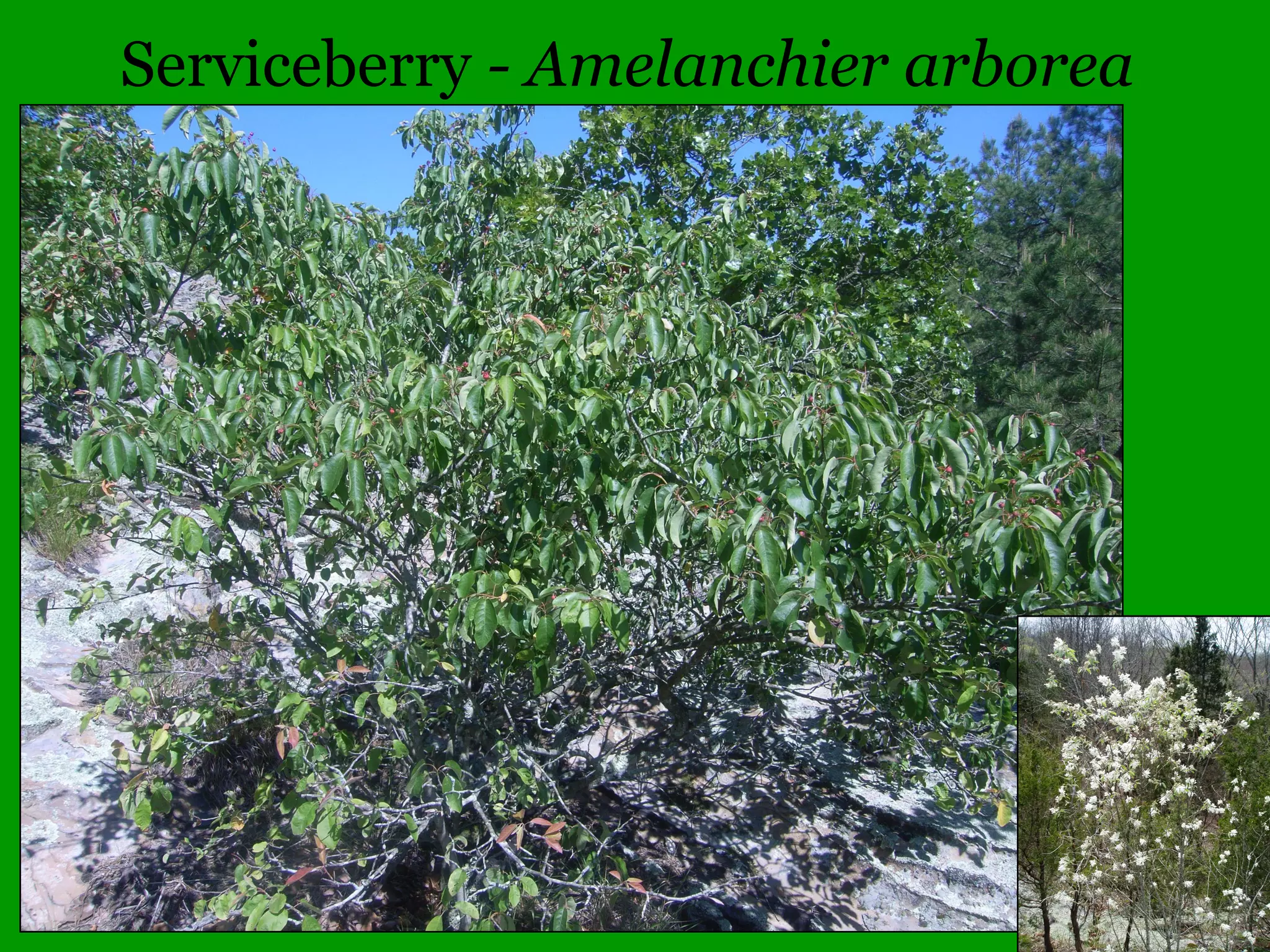
• arborea (Serviceberry)
– Aronia – 2 species
• melanopcarpa (Black Chokeberry)
• prunifolia (Purple Chokeberry)
Common Woody Angiosperms
• Rosaceae (Rose family)
– Crataegus – 44 species
• mollis (Hawthorn)
– Malus – 8 species
• ioensis (Iowa Crab Apple)
– Prunus – 18 species
• americana (Wild Plum)
• mexicana (Big Tree Plum)
• serotina (Black Cherry)
• virginiana (Common Chokecherry)
Common Woody Angiosperms
• Rosaceae (Rose family)
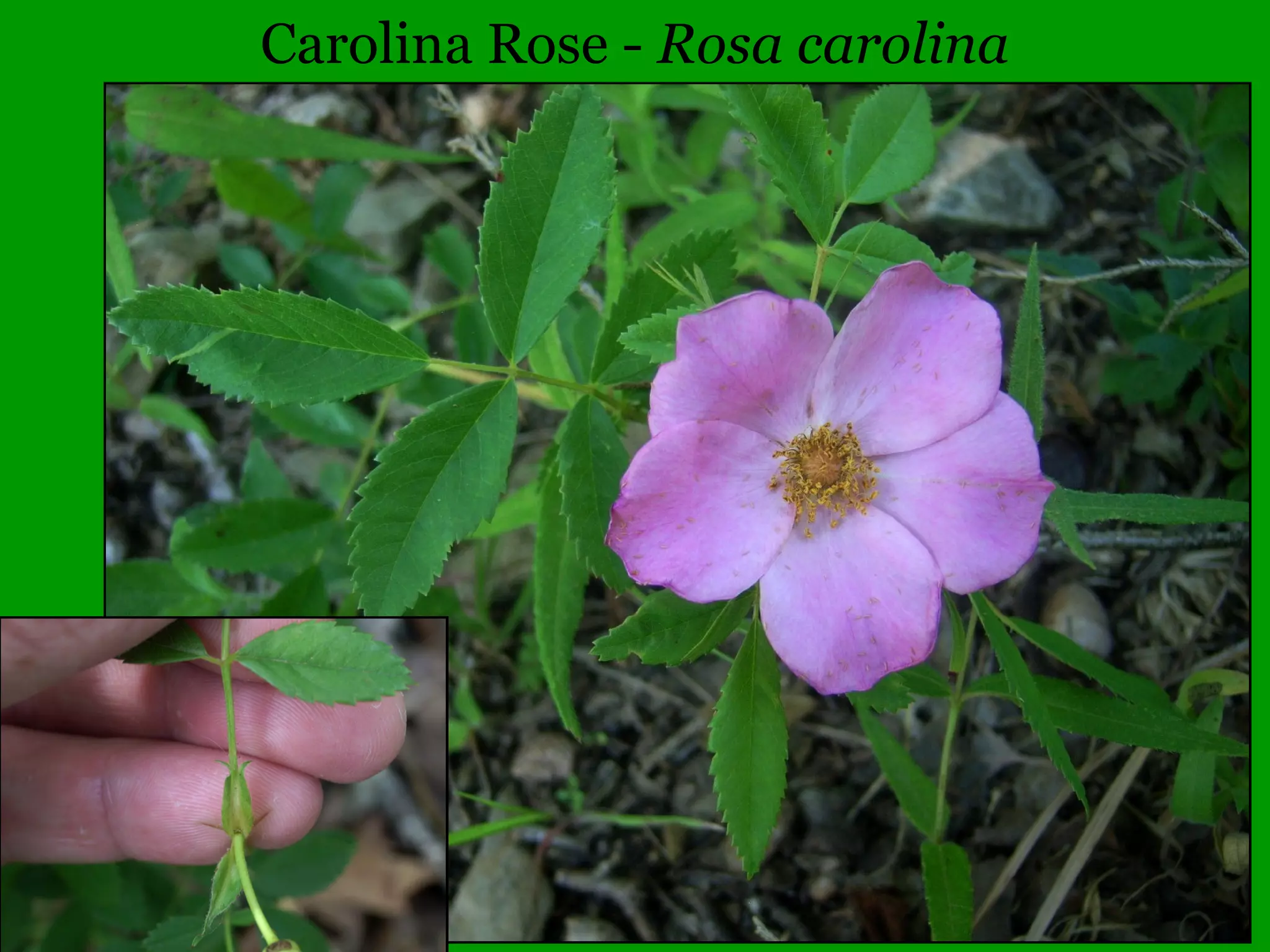
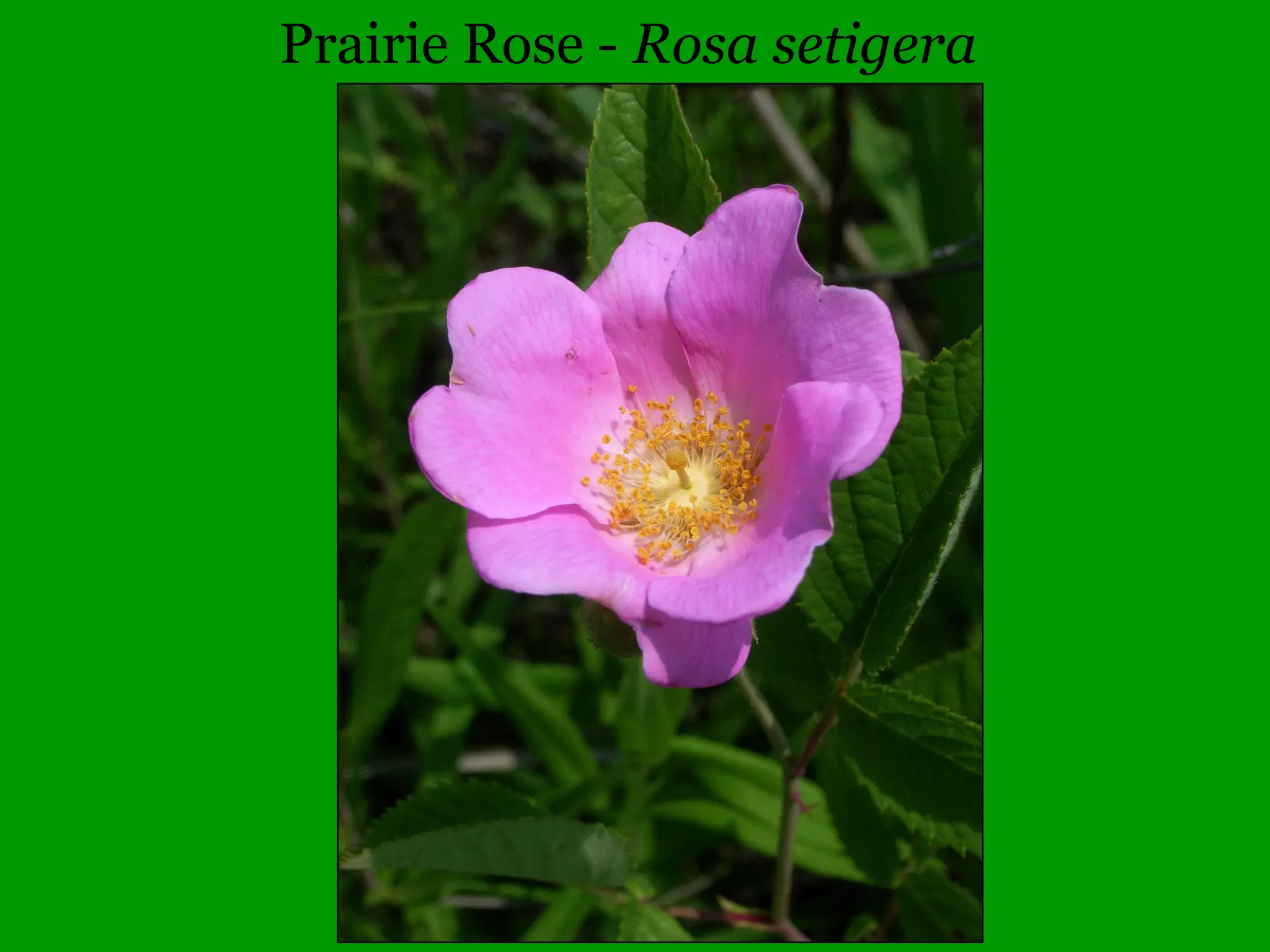
– Rosa (many species)
– Rubus (many species)
Common Woody Angiosperms
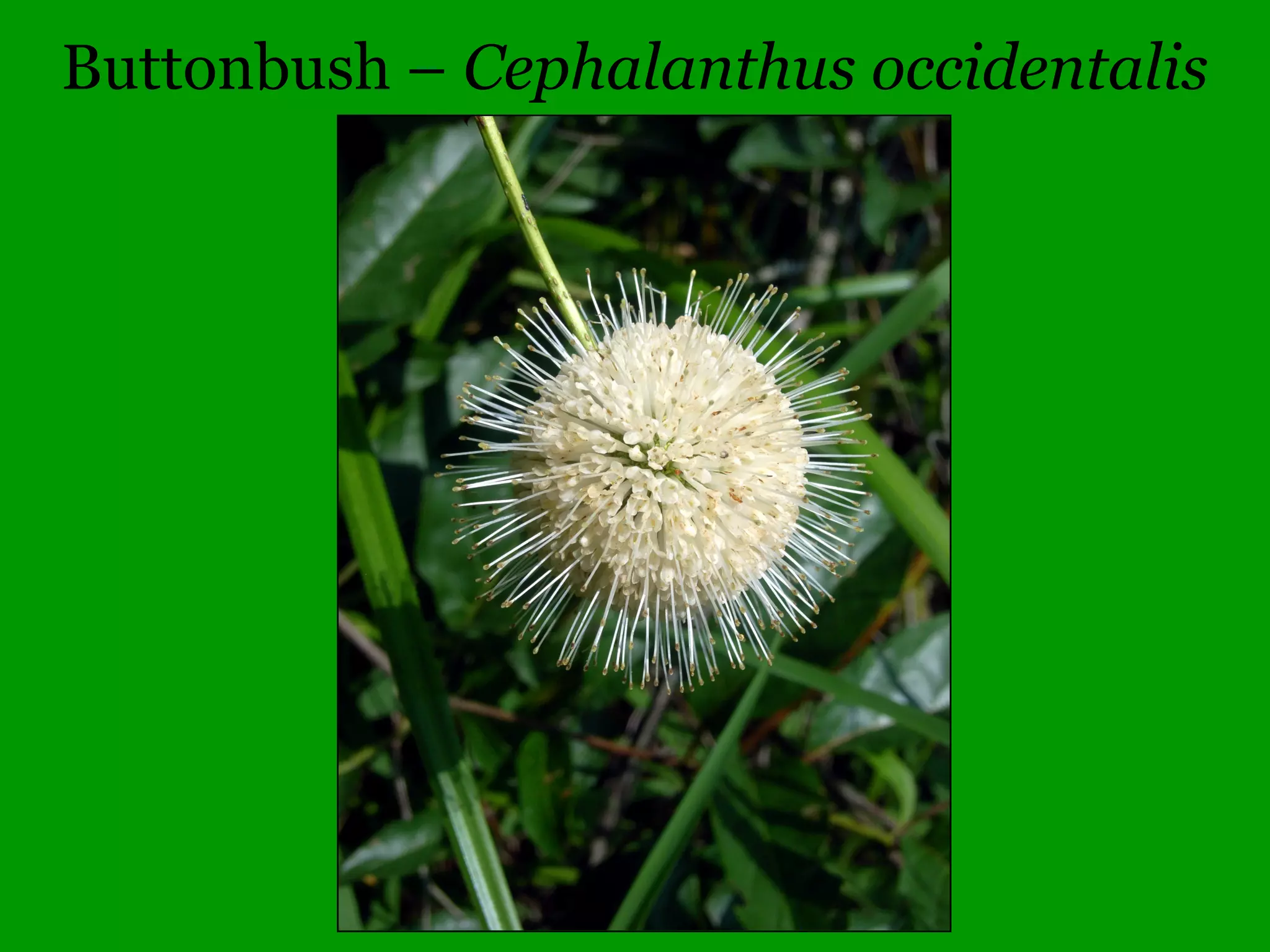
• Rubiaceae (Madder family)
– Cephalanthus – 1 species
• occidentalis (Buttonbush)
Common Woody Angiosperms
• Rutaceae (Citrus family)
– Ptelea – 1 species
• trifoliata (Wafer Ash)
– Zanthoxylum – 1 species
• americanum (Prickly Ash)
Common Woody Angiosperms
• Salicaceae (Willow family)
– Populus – 10 species
• alba (White Poplar)
• deltoides (Cottonwood)
• grandidentata (Large-toothed Aspen)
• heterophylla (Swamp Cottonwood)
• tremuloides (Quaking Aspen)
Common Woody Angiosperms
• Salicaceae (Willow family)
– Salix – 29 species
• babylonica (Weeping Willow)
• discolor (Pussy Willow)
• glaucophylloides (Blue-leaf Willow)
• humilis (Prairie Willow)
• interior (Sandbar Willow)
• nigra (Black Willow)
Common Woody Angiosperms
• Tiliaceae (Basswood family)
– Tilia – 3 species
• americana (American Basswood)
• cordata (Heart-leaved Basswood)
• heterophylla (White Basswood)
Common Woody Angiosperms
• Ulmaceae (Elm family)
– Celtis – 3 species
• laevigata (Sugarberry)
• occidentalis (Common Hackberry)
• tenuifolia (Dwarf Hackberry)
– Planera – 1 species
• americana (Water Elm)
– Ulmus – 5 species
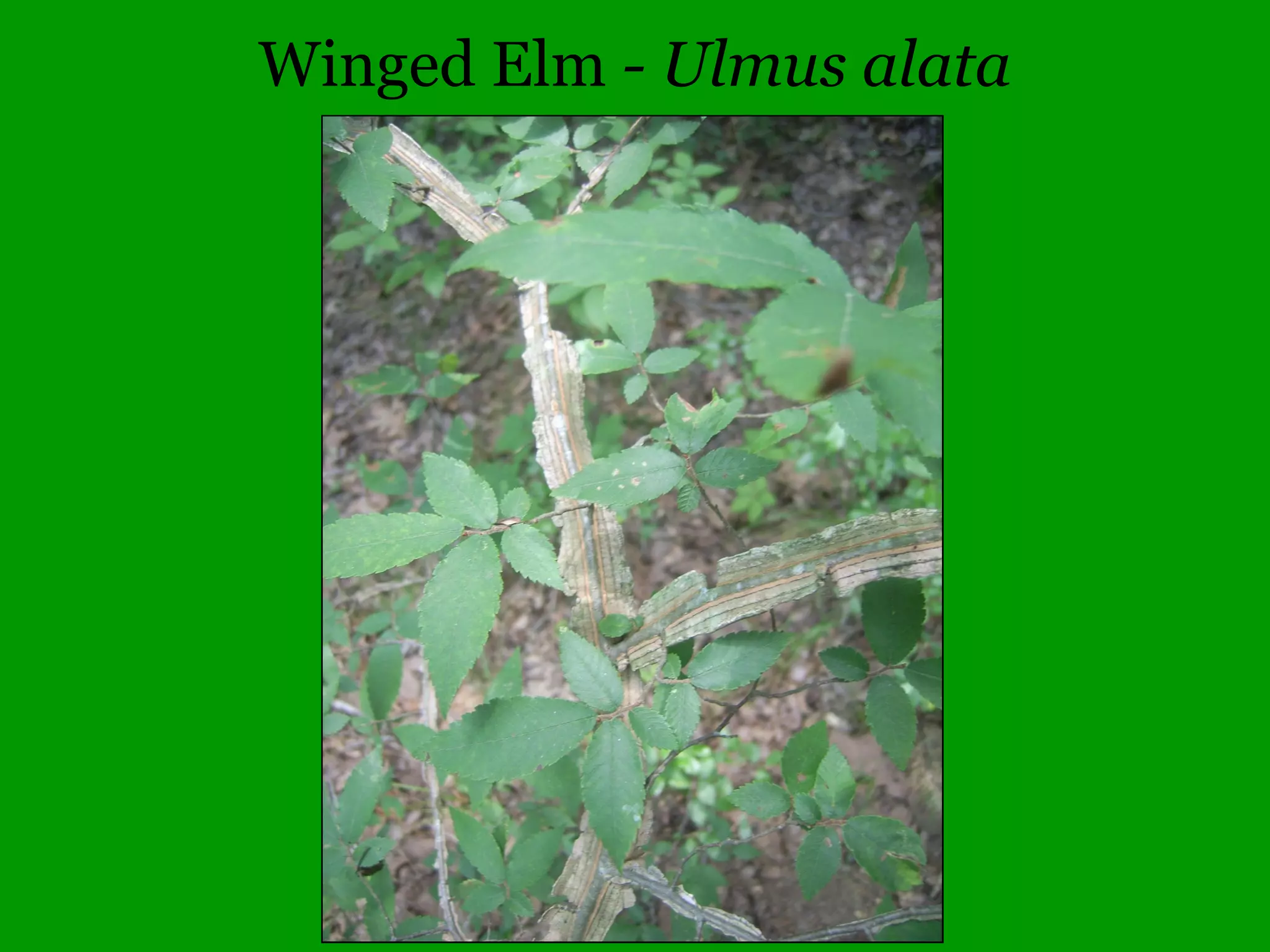
• alata (Winged Elm)
• americana (American Elm)
• pumila* (Siberian Elm)
• rubra (Red Elm)
• thomasii (Rock Elm)
botanizer@gmail.com
www.facebook.com/illinoisbotanizer
www.illinoisbotanizer.blogspot.com
www.illinoisbotanizer.com

Tree ID and Ecology

  • 1.
    Tree Identification andEcology The Morton Arboretum Instructor: Christopher David Benda
  • 2.
    Plant Ecologist Illinois NaturalHistory Survey President Illinois Native Plant Society Instructor, Flora of Southern Illinois Southern Illinois University Instructor, Tree ID and Ecology The Morton Arboretum Technical Expert Consultant Illinois Endangered Species Protection Board CHRISTOPHER DAVID BENDA, M.S.
  • 3.
  • 4.
  • 5.
    Illinois Natural AreasInventory Category I – High Quality Natural Communities
  • 6.
    0.07% in anatural condition
  • 7.
    Natural Community Soil MoistureGradient Xeric Dry Dry-mesic Mesic Wet-mesic Wet Hydric
  • 8.
    Tree Identification andEcology Go over syllabus Icebreaker Exercise
  • 9.
    Simple leaf, magnolia a.Simple versus compound leaves Pinnately compound leaf, black walnut Palmately compound leaf, buckeye b. Arrangement of leaves on stem Opposite leaves, maple Whorled leaves, bedstraw Alternate leaves, American beech Leaf Characteristics
  • 10.
  • 11.
    Palmately compound leaf OhioBuckeye Aesculus glabra petiole
  • 12.
  • 13.
  • 14.
  • 15.
  • 16.
    Exceptions to therule: 1. Bladdernut 2. Euonymous (Wahoo) 3. Wild Hydrangea 4. Catalpa 5. Buttonbush 4. Catalpa 5. Buttonbush
  • 19.
  • 20.
    Basic Flower Anatomy •The male part is termed the Stamen, which consists of the anther and filament. • The female part is the Carpel, which consists of the stigma, style and ovary.
  • 21.
  • 22.
    Perfect Flowers • Flowerscontaining BOTH male (stamen) and female (carpel) sexual parts. • Automatically monoecious
  • 23.
    Imperfect Flowers • Flowerscontaining the reproductive parts of only one sex. • These imperfect flowers may be on the same plant (monoecious), • or on separate plants (dioecious) Sparganium eurycarpum Thalictrum dioicum
  • 24.
  • 25.
  • 26.
    Imperfect, monoecious Imperfect,dioecious Carex grayi Thalictrum dioicum
  • 27.
    Obligate (requires a specifichabitat for survival) Vs. Facultative (requires a general habitat for survival)
  • 28.
    Plant Taxonomy •Non-Vascular •Early Plants(spores) •Archaeplastida (algae) •Bryophyta (mosses) •Marchantiophyta (liverworts) •Anthocerophyta (hornworts) •Vascular •Seedless plants •Pteridophyta (Ferns) •Fern Allies •Equisetaceae (Horsetail) •Isoetaceae (Quillwort) •Lycopodiaceae (Clubmoss) •Marsileaceae (Water-Clover) •Selaginellaceae (Spikemoss) •Seed Plants •Gymnosperms (Conifers/Evergreens) •Juniperus, Pinus, Taxodium •Angiosperms (Flowering Plants) •Monocots (Orchids, Lilies, Irises, Grasses, Sedges, Rushes, aquatic plants) •Dicots (most other flowering plants)
  • 29.
    Binomial Nomenclature “The beginningof wisdom is to call things by their rightful names.” Kingdom Phylum Class Order Family Genus Species Animalia Cordata Reptilia Testudines Emydidae Emydoidea E. blandingii
  • 30.
    The Top Tenreasons for using scientific names Understand the meaning of the names!
  • 31.
    Latin Pronunciation Pronounce everyletter except diphthongs Echinacea, Tradescantia, Opuntia, Ambrosia “ch” is a “k” sound Polystichum, Heuchera, Aristolochia If a word has two syllables, the accent always goes with the next to the last (called the penult); e.g., Àcer. If a word has three or more syllables, the accent always goes either with the next to the last (penult) or the third from the last (called the antepenult). Synandra hispidula, Onoclea sensibilis, Liriodendron tulipifera phyllum – rhizophyllum, Podophyllum, triphyllum ae Pellaea, Arisaema, Chamaecrista au Daucus carota Eu Teucrium, Leucanthemum Oe (phoebe), Platanthera peramoena, Ipomoea Ui Equisetum “oi” is not a diphthong! Pleopeltis polypodioides Pronounce when ending with “e” Silene, canadense, sessile, hyemale Latinized last names (one or two i’s) Dodecatheon frenchii, Emydoidea blandingii Most trees have been feminized! Quercus rubra, Fagus grandifolia, Ulmus americana
  • 32.
    Latin Pronunciation English pronunciationof vowels A – E – I – O - U Latin pronunciation of vowels Ah – Eh – EE – Oh - OO
  • 33.
    Plant Resources forSouthern Illinois Field Guide Books & Websites
  • 34.
    What do younotice about the arrangement of the textbook?
  • 35.
  • 36.
    • plants thatdon’t produce a protective fruit around the seed. • all the conifers - pines, cedar, tamarack, yew, and cypress. Gymnosperms (“naked seed”) Pinus echinata Taxodium distichum Larix laricina
  • 37.
    • flowering plantswhere the seed is encased in a protective fruit. • This is the dominant group of plants on Earth today. Angiosperms (“hidden seeds”)
  • 38.
  • 39.
  • 40.
    Leaf veins forma parallel pattern
  • 41.
    Flower parts inthrees and multiples of three, irregular (nonsymmetrical)
  • 42.
  • 43.
    Leaf veins forma net pattern
  • 44.
    Flower parts infours or fives and their multiples
  • 45.
  • 46.
  • 47.
    Dichotomous key demonstration 1.Needle-likeor scale-like leaves 1. Leaves broad and flat 2. Leaves simple 2. Leaves compound 3. Leaves opposite or whorled 3. Leaves alternate 4. Leaves not toothed or lobed 4. Leaves toothed or lobed 5. Leaves toothed 5. Leaved lobed
  • 48.
    • Reproductive feaureslike flowers, cones, and fruits are less variable • Tree age • Time of season • Flowers available for only a short time early in the season. Why? • Leaves easier to use for ID but not always available • Twigs available all year but hard for most to use for ID
  • 50.
    Coefficient of Conservatism Thenative species most successful in badly damaged habitats were given C values of 0. At the other end of the spectrum, species virtually restricted to natural areas in Illinois received C values of 10. (Taft et al. 1997) Further reading http://www.conservationresearchinstitute.org/assets/illinoisfqa.pdf http://www.fws.gov/verobeach/Home/S1029%20Mortellaro%20mo nograph.pdf
  • 51.
    Erigenia link http://www.ill-inps.org/Erigenia T &E Species Link http://www.dnr.illinois.gov/ESPB/Documents/2015_Ch ecklistFINAL_for_webpage_051915.pdf
  • 52.
    Gee whiz?! information Ifyou can’t tell a joke about it, explain where the name comes from, or tell story about the plant then: WHO CARES!!!
  • 53.
    Plant Humor How canyou ID a dogwood tree? By its bark!
  • 54.
  • 55.
    Illinois Gymnosperms • Cypressaceae– Cypress family – Juniperus – 3 species • communis (Ground Juniper, rare) • horizontalis (Trailing Juniper, rare) • virginiana (Eastern Red Cedar) – Thuja – 1 species • occidentalis (White Cedar, rare)
  • 56.
    Illinois Gymnosperms • Ginkgoaceae– Ginkgo family – Ginkgo – 1 species • biloba (Ginkgo)
  • 57.
    Illinois Gymnosperms • Pinaceae– Pine family – Larix – 2 species • decidua* (European Larch) • laricina (Tamarack, rare) – Picea – 2 species • abies* (Norway Spruce) • mariana* (Black Spruce)
  • 58.
    Illinois Gymnosperms • Pinaceae– Pine family – Pinus – 10 species • banksiana (Jack Pine) • echinata (Short-leaf Pine, rare) • nigra* (Austrian Pine) • resinosa (Red Pine, rare) • rigida* (Pitch Pine) • strobus (White Pine) • sylvestris* (Scots Pine) • taeda (Loblolly Pine) • 2 others
  • 59.
    Illinois Gymnosperms • Taxaceae– Yew family – Taxus – 1 species • canadensis (Canada Yew, rare) • Taxodiaceae – Bald Cypress family – Taxodium – 1 species • distichum (Bald Cypress)
  • 60.
    Cypress Swamp –Little Black Slough
  • 61.
    Common Woody Angiosperms •Aceraceae (Maple family) – Acer - 11 species • barbatum (Southern Sugar Maple) • campestre (Hedge Maple) • ginnala (Amur Maple) • negundo (Box Elder) • nigrum (Black Maple) • palmatum (Japanese Maple) • platanoides (Norway Maple) • pseudoplatanus (Sycamore Maple) • rubrum (Red Maple) • saccharinum (Silver Maple) • saccharum (Sugar Maple)
  • 62.
    Common Woody Angiosperms •Anacardiaceae (Cashew or Sumac family) – Rhus – 4 species • aromatica (Fragrant Sumac) • copallina (Winged Sumac) • glabra (Smooth Sumac) • typhina (Staghorn Sumac) – Toxicodendron – 4 species • radicans (Poison Ivy) • vernix (Poison Sumac)
  • 63.
    Common Woody Angiosperms •Annonaceae (Custard Apple family) – Asimina - 1 species • triloba (paw-paw) • Betulaceae (Birch family) – Alnus – 3 species • glutinosa (Black Alder) • incana (Speckled Alder) • serrulata (Smooth Alder)
  • 64.
    Common Woody Angiosperms •Betulaceae (Birch family) – Betula – 8 species • alleghaniensis (Yellow Birch, rare) • nigra (River Birch) • papyrifera (Paper Birch, rare) • pumila (Dwarf Birch, rare) • 2 other species and 2 hybrids, (rare)
  • 65.
    Common Woody Angiosperms •Caprifoliaceae – Lonicera – 19 species • dioica – (Red Honeysuckle) • flava – (Yellow Honeysuckle, rare) • japonica* (Japanese Honeysuckle) • maackii* (Amur Honeysuckle) • tatarica* (Tartarian Honeysuckle)
  • 66.
    Common Woody Angiosperms •Caprifoliaceae – Sambucus – 2 species • canadensis (Elderberry) • racemosa (Red-berried Elder) – Symphoricarpos – 1 species • albus* (Snowberry) • occidentalis (Wolfberry) • orbiculatus (Coralberry)
  • 67.
    Common Woody Angiosperms •Caprifoliaceae – Viburnum – 13 species • acerifolium (Maple-leaved Arrowwood) • dentatum* (Arrowwood) • lentago (Nannyberry) • prunifolium (Black Haw) • rafinesquianum (Downy Arrowwood) • recognitum (Smooth Arrowwood) • rufidulum (Rusty Black Haw) • trilobum (High-bush Cranberry, rare)
  • 68.
  • 69.
    Common Woody Angiosperms •Corylaceae (Hazelnut family) – Carpinus – 1 species • caroliniana (Musclewood, Blue Beech) – Corylus – 1 species • americana (Hazelnut) – Ostrya – 1 species • virginiana (Ironwood, Eastern Hop Hornbeam)
  • 70.
    Common Woody Angiosperms •Cornaceae (Dogwood family) – Cornus – 12 species • alternifolia (Alternate-leaved Dogwood) • amomum (Swamp Dogwood) • canadensis (Bunchberry, rare) • drummondii (Rough-leaved Dogwood) • florida (Flowering Dogwood) • foemina (Stiff Dogwood) • obliqua (Silky Dogwood • racemosa (Gray Dogwood) • rugosa (Round-leaved Dogwood) • sericea (Red-osier Dogwood) • 2 non-native (alba and mas)
  • 71.
    Flowering Dogwood –Cornus florida
  • 72.
    Common Woody Angiosperms •Ebenaceae (Ebony family) – Diospyros – 1 species • virginiana (Persimmon)
  • 73.
    Common Woody Angiosperms •Ericaceae (Heath family) – Gaylussacia – 1 species • baccata (Black Huckleberry) – Rhododendron – 2 species • prinophyllum – (Wild Azalea) – Vaccinium – 8 species • arboreum (Farkleberry) • pallidum (Blueberry) • stamenium (Deerberry)
  • 74.
    Lowbush Blueberry -Vaccinium pallidum
  • 75.
    Common Woody Angiosperms •Caesalpiniaceae (Caesalpinia family) – Cercis – 1 species • canadensis (Redbud) – Gleditsia – 2 species • aquatica – (Water Locust) • triacanthos (Honey Locust) – Gymnocladus – 1 species • dioicus (Kentucky Coffee Tree)
  • 76.
    Common Woody Angiosperms •Fabaceae (Bean/Pea family) – Amorpha – 3 species • canescens (Leadplant) • fruticosa (False Indigo Bush) • nitens (Smooth False Indigo, rare) – Cladrastis – 1 species • kentukea (Yellowwood, rare) – Robinia – 1 species • pseudoacacia (Black Locust)
  • 77.
    Common Woody Angiosperms •Fagaceae (Beech family) – Castanea – 1 species • dentata (Chestnut) – Fagus – 1 species • grandifolia (American Beech)
  • 78.
    Common Woody Angiosperms •Fagaceae (Beech family) – Quercus – 21 species • acutissima (Sawtooth Oak) • alba (White Oak) • bicolor (Swamp White Oak) • coccinea (Scarlet Oak) • ellipsoidalis (Northern Pin Oak) • falcata (Southern Red Oak) • imbricaria (Shingle Oak) • lyrata (Overcup Oak) • macrocarpa (Bur Oak) • marilandica (Blackjack Oak)
  • 79.
    Common Woody Angiosperms •Fagaceae (Beech family) – Quercus – 21 species • michauxii (Swamp Chestnut Oak) • muhlenbergia (Chinquapin Oak) • pagoda (Cherrybark Oak) • palustris (Pin Oak) • phellos (Willow Oak) • prinus (Rock Chestnut Oak) • rubra (Red Oak) • shumardii (Shumard’s Oak) • stellata (Post Oak) • texana (Nuttall’s Oak) • velutina (Black Oak)
  • 80.
    Blackjack Oak -Quercus marilandica
  • 81.
    Common Woody Angiosperms •Hamamelidaceae (Witch Hazel family) – Hamamelis – 1 species • virginiana (Witch Hazel) – Liquidambar – 1 species • styraciflua (Sweet Gum)
  • 82.
    Common Woody Angiosperms •Hippocastanaceae (Horse Chestnut family) – Aesculus – 4 species • flava (Sweet Buckeye, rare) • glabra (Ohio Buckeye) • hippocastanum (Horse Chestnut) • pavia (Red Buckeye)
  • 83.
    Common Woody Angiosperms •Juglandaceae (Walnut family) – Carya – 10 species • aquatica (Water Hickory, rare) • cordiformis (Bitternut) • glabra (Pignut Hickory) • illinoiensis (Pecan) • laciniosa (Shellbark Hickory) • ovalis (Sweet Pignut Hickory) • ovata (Shagbark Hickory) • pallida (Pale Hickory, rare) • texana (Black Hickory) • tomentosa (Mockernut)
  • 84.
    Common Woody Angiosperms •Juglandaceae (Walnut family) – Juglans – 10 species • cinerea (Butternut) • nigra (Black Walnut)
  • 85.
    Common Woody Angiosperms •Lauraceae (Laurel family) – Lindera – 1 species • Benzoin (Spicebush) – Sassafras – 1 species • albidum (Sassafras) • Magnoliaceae (Magnolia family) – Liriodendron – 1 species • tulipifera (Tulip Tree) – Magnolia – 1 species • acuminata (Cucumber Magnolia)
  • 86.
    Common Woody Angiosperms •Moraceae (Mulberry family) – Maclura – 1 species • pomifera (Osage Orange) – Morus – 2 species • alba (White Mulberry) • rubra (Red Mulberry) • tatarica* (Russian Mulberry)
  • 87.
    Common Woody Angiosperms •Nyssaceae (Nyssa family) – Nyssa – 3 species • aquatica (Tupelo Gum) • biflora (Swamp Gum) • sylvatica (Black Gum)
  • 88.
    Common Woody Angiosperms •Oleaceae (Olive family) – Forestiera – 1 species • acuminata (Swamp Privet) – Forsythia – 1 species • suspensa (Forthysia) – Ligustrum – 2 species • obtusifolium (Blunt-leaved Privet) • vulgare (Common Privet)
  • 89.
    Common Woody Angiosperms •Oleaceae (Olive family) – Fraxinus – 7 species • americana (White Ash) • biltmoreana (Biltmore Ash) • lanceolata (Green Ash) • nigra (Black Ash) • pennsylvanica (Red Ash) • profunda (Pumpkin Ash) • quadrangulata (Blue Ash)
  • 90.
    Common Woody Angiosperms •Platanaceae (Sycamore family) – Platanus – 1 species • occidentalis (Sycamore) • Rhamnaceae (Buckthorn family) – Ceanothus • americanus (New Jersey Tea) • herbaceous (Redroot, rare) – Frangula – 2 species • alnus (Glossy Buckthorn) • caroliniana (Carolina Buckthorn) – Rhamnus – 6 species • cathartica (Common Buckthorn)
  • 91.
    Common Woody Angiosperms •Rosaceae (Rose family) – Amelanchier – 5 species • arborea (Serviceberry) – Aronia – 2 species • melanopcarpa (Black Chokeberry) • prunifolia (Purple Chokeberry)
  • 92.
    Common Woody Angiosperms •Rosaceae (Rose family) – Crataegus – 44 species • mollis (Hawthorn) – Malus – 8 species • ioensis (Iowa Crab Apple) – Prunus – 18 species • americana (Wild Plum) • mexicana (Big Tree Plum) • serotina (Black Cherry) • virginiana (Common Chokecherry)
  • 93.
    Common Woody Angiosperms •Rosaceae (Rose family) – Rosa (many species) – Rubus (many species)
  • 94.
    Common Woody Angiosperms •Rubiaceae (Madder family) – Cephalanthus – 1 species • occidentalis (Buttonbush)
  • 95.
    Common Woody Angiosperms •Rutaceae (Citrus family) – Ptelea – 1 species • trifoliata (Wafer Ash) – Zanthoxylum – 1 species • americanum (Prickly Ash)
  • 96.
    Common Woody Angiosperms •Salicaceae (Willow family) – Populus – 10 species • alba (White Poplar) • deltoides (Cottonwood) • grandidentata (Large-toothed Aspen) • heterophylla (Swamp Cottonwood) • tremuloides (Quaking Aspen)
  • 97.
    Common Woody Angiosperms •Salicaceae (Willow family) – Salix – 29 species • babylonica (Weeping Willow) • discolor (Pussy Willow) • glaucophylloides (Blue-leaf Willow) • humilis (Prairie Willow) • interior (Sandbar Willow) • nigra (Black Willow)
  • 98.
    Common Woody Angiosperms •Tiliaceae (Basswood family) – Tilia – 3 species • americana (American Basswood) • cordata (Heart-leaved Basswood) • heterophylla (White Basswood)
  • 99.
    Common Woody Angiosperms •Ulmaceae (Elm family) – Celtis – 3 species • laevigata (Sugarberry) • occidentalis (Common Hackberry) • tenuifolia (Dwarf Hackberry) – Planera – 1 species • americana (Water Elm) – Ulmus – 5 species • alata (Winged Elm) • americana (American Elm) • pumila* (Siberian Elm) • rubra (Red Elm) • thomasii (Rock Elm)
  • 100.