Adult Immunization
Dr Banu chander pandian. S
DNB FAMILY MEDICINE
KG HOSPITAL
6/23/2017 1
Definition
• Immunization refers to the artificial
induction of immunity. It can be by
Active Immunization: the use of live
attenuated infectious agents or
inactivated toxins, or antigens obtained
by genetic recombination OR
Passive Immunization: temporary
immunity obtained by the administration
of immunoglobulins or antitoxins.
6/23/2017 2
Is it immunisation helpful
• Smallpox eradicated in 1978 from
India
• polio eradication.
• Infant/Childhood immunization –
one of the top public health success
stories of the 20th century
• The prevalence of Diphtheria,
Pertussis, tetanus, measles, mumps,
rubella, poliomyelitis are reduced.
6/23/2017 4
Why Adult Immunization ???
• Build on success of infant/childhood, adolescent
immunization program.
• Not vaccinated earlier, booster.
• New vaccines targeted at adults.
• Ageing : more susceptible.
• Increasing Antimicrobial Resistance.
• Recognition of the burden of adult vaccine-
preventable disease.
• No equivalent “Vaccines for Adults” program.
6/23/2017 5
Adult Immunization recommended in
india
Tdap MMR
Influenza Pneumococcal
Hepatitis B Hepatitis A
Varicella HPV (cervical cancer)
Meningococcal Herpes Zoster
6/23/2017 6
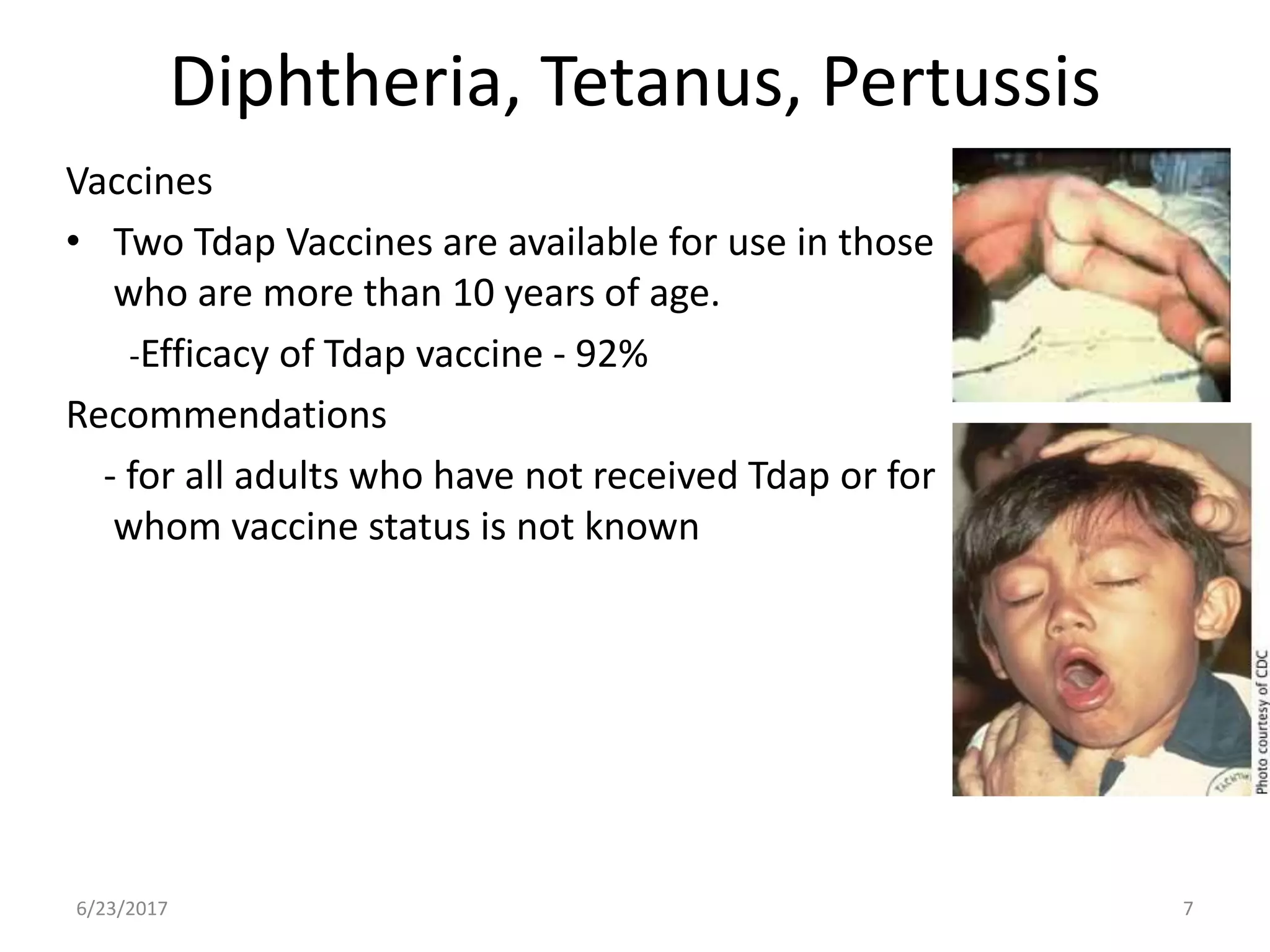
Diphtheria, Tetanus, Pertussis
Vaccines
• Two Tdap Vaccines are available for use in those
who are more than 10 years of age.
-Efficacy of Tdap vaccine - 92%
Recommendations
- for all adults who have not received Tdap or for
whom vaccine status is not known
6/23/2017 7
Measles, Mumps And Rubella
Vaccines
• In India the measles, mumps, rubella (MMR) live
attenuated vaccine is manufactured using the
following strains:
• The measles and the rubella components are
produced using human diploid cells while the
mumps component is produced from chick
embryo.
• The MMR vaccine should be administered
subcutaneously into the upper arm.
6/23/2017 8
Indications
• Adolesents and adults
• Women of childbearing age who is not
pregnant
FREQUENCY
• Two doses at interval of 4 weeks
• Subcutaneously in upper arm
Varicella (Chickenpox)
6/23/2017 10
Vaccines
• Two Live attenuated VZV (Oka strain)
vaccines for varicella virus are
currently available in India.
– Varilrix (GlaxoSmithKline, Belgium) and
– Okavax (Pasteur Mérieux, France).
Schedule
- Interval between 2 doses should be 4–
8wks.
Recommendations
• All susceptible adults and adolescents should
be vaccinated.(18-49yrs)
• It is especially important to susceptible
persons
– Health care workers
– Family contacts of immunocompromised persons
– High risk of exposure (e.g., teachers, day care
employees, military personnel, and international
travelers).
6/23/2017 11
Human Papilloma Virus
• Papilloma virus infection is precursor to cervical
cancer
– Types 16, 18 account for 70% of cervical
cancers
Vaccines
• Two types HPV vaccines are available.
– Gardasil (Merck, USA), a quadrivalent vaccine
containing HPV virus L1 protein like particles of
HPV 6,11,16, and 18
– Cervarix (GlaxoSmithKline, Belgium) is a
bivalent vaccine containing L1 VLPs of HPV
16,18.
6/23/2017 12
Recommendations
• The vaccine has to be delivered prior to
exposure to the HPV virus. Therefore, the
immunization must precede the sexual debut.
• Age for initiation for vaccination to be 10 - 12
years.
• Catch-up vaccination can be advised up to the
age of 26 years for Gardasil vaccine and 45
years for Cervarix vaccine.
6/23/2017 14
• Schedule
– BHPV – 0,1,6 months
– QHPV – 0,2,6 months
For male HPV 4 is recommanded
Hepatitis B
Vaccines
• For immunocompetent adults, 1ml (20 μg) of
recombinant vaccine is administered at 0, 1, and 6
months as an intramuscular.
• Protection (anti-HBs antibody titer of 10mIU/ml or
higher) after recombinant vaccine
– After first dose - 20% to 30%
– After second dose - 75% to 80%
– After third doses - 90% to 95%
Recommendations
• All unvaccinated adult risk for HBV infection and
• All adults seeking protection from HBV infection
including post-exposure prophylaxis.
6/23/2017 16
• Booster doses of HBV vaccine are not
indicated in persons with normal immune
status .
• For CKD patients, the need for booster
doses should be assessed by annual anti-
HBs antibody titre testing.
• A booster dose should be administered
when anti-HBs levels decline to less than 10
mIU/ml & <100 mIU/ml in patients on
dialysis.
.
6/23/2017 17
6/23/2017 18
Hepatitis A
Vaccines
• Inactivated-single antigen (HAV antigen) vaccines,
– Havrix (GlaxoSmithKline) and
– Vaqta (Merck & Co)
– Dose : 1440ELU
Schedule
• Two doses of 1ml at 6 month interval.
• Immune status for hepatitis A should be checked
6/23/2017 19
Pneumococcal Infection
Vaccines
Two types
• The pneumococcal polysaccharide
vaccine (PPV23), contains 25 μg each of
purified capsular polysaccharide from 23
serotypes of Streptococcus pneumoniae.
• Pneumococcal conjugate vaccine (PCV 13)
– This vaccine can be co-administered with
live vaccines such as the influenza
vaccine.
6/23/2017 20
Schedule
–A single standard dose (0.5 ml) is
administered by the intramuscular or
subcutaneous route.
–Revaccination: 0.5ml IM or SC at least
after 5 years of 1st dose in case of High
risk people.
6/23/2017 21
Influenza
Vaccines
– Trivalent inactivated influenza vaccine (TIV) and
– Live attenuated influenza vaccine (LAIV)
• The TIV contains
– A/17/California/2009/38(H1N1),
– A/Brisbane/ 10/2007 (H3N2), and
– B/Brisbane/60/2008 strains.
• Live attenuated influenza vaccine (LAIV) –
Nasovac contains
– A/17/California/2009/38 like strain
• Schedule
– The TIV - annual, single dose of 0.5 ml IM.
– The LAIV – 0.5 ml intranasal (spray 0.25 ml per
nostril)
6/23/2017 22
Meningococcal Meningitis
Vaccines
• Types
– Polysaccharide vaccines
• Bivalent (A&C)
• Quadrivalent (A,C,Y & W135)
– Conjugate vaccines.
• The vaccine does not induce herd immunity
and has no effect on nasopharyngeal
carriage.
• Containing 50 μg of polysaccharide per dose.
• After reconstitution use within 8-12 hours.
6/23/2017 23
Schedule
• A single dose of 0.5 ml SC in deltoid region.
• Used in selected population
• Age 2- 3 yrs
• Congenital deficiencs in complement
components
• Travellers to hajj
• Lab persons
6/23/2017 24
Documentation
• Provide copy of Vaccine
Information Statement (VIS)to
patient
• Documents to be maintained
– Date vaccination & next dose
– Vaccine manufacturer
– Lot number
– Dose & site of vaccine
6/23/2017 25
Vaccine Administration
• Health care personnel should get proper
training before administrating vaccine.
• Always prepare and check the following for
every vaccination you give:
– Right Patient
– Right Drug (vaccine)
– Right Dose
– Right Route (intramuscular, SC,intradermal)
– Right Time (is scheduling correct)
6/23/2017 26
Vaccine / Age group 19-26 yrs 27-49 yrs 50-59 yrs 60-64 yrs > 65 yrs
Tetanus, Diptheria, Pertussis (Tdap)
Substitude one time dose of Tdap with Td,
then booster with Td every 10 years
Td booster
every 10 yrs
Human Papiloma Vaccine 3 doses
Varicella 2 doses
Zoster 1 dose
Measles, Mumps, Rubella 1 or 2 doses 1 dose
Influenza 1 dose annually
Pnemococcal (Polysaccharide) 1 or 2 doses 1 dose
Hepatitis A 2 doses
Hepatitis B 3 doses
Meninngicoccal 1 or more doses
6/23/2017 27
ACIP Adult Immunization Schedule, Age-Based Recommendations, INDIA
Recommended if some risk factor is present
All persons who meet the age criteria
No recommendation
6/23/2017 28
Adult Immunization based on medical and other indications (INDIA)
Indications
Pregnancy
Immunoco
mpromise
d
conditions
(Excluding
HIV)
HIV infection
with CD4
count
Diabetes,
heart
disease,
chronic
lung
disease
Asplenia
(excluding
elective
splenectomy
)
Chronic
liver
disease
Kidney
failure, end
stage renal
disease, on
hemodialysi
s
Health
care
professi
onals
Vaccine <200
cells/ µl
>200
cells/ µl
Tetanus, Diptheria,
Pertussis (Tdap)
Td
Substitute one time dose of Tdap with Td, then booster with Td every 10
years
Human Pappiloma
Vaccine
3 doses for females through age 26 years
Varicella Contraindication 2 doses
Zoster Contraindication 1 dose
Measles, Mumps, Rubella Contraindication 1 or 2 doses
Influenza 1 dose TIV annually 1 dose TIV
or LAIV
Pnemococcal
(Polysaccharide)
1 or 2 doses
Hepatitis A 2 doses
Hepatitis B 3 doses
Meninngicoccal 1 or more doses
Recommended if some risk factor is present
All persons who meet the age criteria
Contraindication
Immunization in adult

Immunization in adult

  • 1.
    Adult Immunization Dr Banuchander pandian. S DNB FAMILY MEDICINE KG HOSPITAL 6/23/2017 1
  • 2.
    Definition • Immunization refersto the artificial induction of immunity. It can be by Active Immunization: the use of live attenuated infectious agents or inactivated toxins, or antigens obtained by genetic recombination OR Passive Immunization: temporary immunity obtained by the administration of immunoglobulins or antitoxins. 6/23/2017 2
  • 3.
  • 4.
    • Smallpox eradicatedin 1978 from India • polio eradication. • Infant/Childhood immunization – one of the top public health success stories of the 20th century • The prevalence of Diphtheria, Pertussis, tetanus, measles, mumps, rubella, poliomyelitis are reduced. 6/23/2017 4
  • 5.
    Why Adult Immunization??? • Build on success of infant/childhood, adolescent immunization program. • Not vaccinated earlier, booster. • New vaccines targeted at adults. • Ageing : more susceptible. • Increasing Antimicrobial Resistance. • Recognition of the burden of adult vaccine- preventable disease. • No equivalent “Vaccines for Adults” program. 6/23/2017 5
  • 6.
    Adult Immunization recommendedin india Tdap MMR Influenza Pneumococcal Hepatitis B Hepatitis A Varicella HPV (cervical cancer) Meningococcal Herpes Zoster 6/23/2017 6
  • 7.
    Diphtheria, Tetanus, Pertussis Vaccines •Two Tdap Vaccines are available for use in those who are more than 10 years of age. -Efficacy of Tdap vaccine - 92% Recommendations - for all adults who have not received Tdap or for whom vaccine status is not known 6/23/2017 7
  • 8.
    Measles, Mumps AndRubella Vaccines • In India the measles, mumps, rubella (MMR) live attenuated vaccine is manufactured using the following strains: • The measles and the rubella components are produced using human diploid cells while the mumps component is produced from chick embryo. • The MMR vaccine should be administered subcutaneously into the upper arm. 6/23/2017 8
  • 9.
    Indications • Adolesents andadults • Women of childbearing age who is not pregnant FREQUENCY • Two doses at interval of 4 weeks • Subcutaneously in upper arm
  • 10.
    Varicella (Chickenpox) 6/23/2017 10 Vaccines •Two Live attenuated VZV (Oka strain) vaccines for varicella virus are currently available in India. – Varilrix (GlaxoSmithKline, Belgium) and – Okavax (Pasteur Mérieux, France). Schedule - Interval between 2 doses should be 4– 8wks.
  • 11.
    Recommendations • All susceptibleadults and adolescents should be vaccinated.(18-49yrs) • It is especially important to susceptible persons – Health care workers – Family contacts of immunocompromised persons – High risk of exposure (e.g., teachers, day care employees, military personnel, and international travelers). 6/23/2017 11
  • 12.
    Human Papilloma Virus •Papilloma virus infection is precursor to cervical cancer – Types 16, 18 account for 70% of cervical cancers Vaccines • Two types HPV vaccines are available. – Gardasil (Merck, USA), a quadrivalent vaccine containing HPV virus L1 protein like particles of HPV 6,11,16, and 18 – Cervarix (GlaxoSmithKline, Belgium) is a bivalent vaccine containing L1 VLPs of HPV 16,18. 6/23/2017 12
  • 14.
    Recommendations • The vaccinehas to be delivered prior to exposure to the HPV virus. Therefore, the immunization must precede the sexual debut. • Age for initiation for vaccination to be 10 - 12 years. • Catch-up vaccination can be advised up to the age of 26 years for Gardasil vaccine and 45 years for Cervarix vaccine. 6/23/2017 14
  • 15.
    • Schedule – BHPV– 0,1,6 months – QHPV – 0,2,6 months For male HPV 4 is recommanded
  • 16.
    Hepatitis B Vaccines • Forimmunocompetent adults, 1ml (20 μg) of recombinant vaccine is administered at 0, 1, and 6 months as an intramuscular. • Protection (anti-HBs antibody titer of 10mIU/ml or higher) after recombinant vaccine – After first dose - 20% to 30% – After second dose - 75% to 80% – After third doses - 90% to 95% Recommendations • All unvaccinated adult risk for HBV infection and • All adults seeking protection from HBV infection including post-exposure prophylaxis. 6/23/2017 16
  • 17.
    • Booster dosesof HBV vaccine are not indicated in persons with normal immune status . • For CKD patients, the need for booster doses should be assessed by annual anti- HBs antibody titre testing. • A booster dose should be administered when anti-HBs levels decline to less than 10 mIU/ml & <100 mIU/ml in patients on dialysis. . 6/23/2017 17
  • 18.
  • 19.
    Hepatitis A Vaccines • Inactivated-singleantigen (HAV antigen) vaccines, – Havrix (GlaxoSmithKline) and – Vaqta (Merck & Co) – Dose : 1440ELU Schedule • Two doses of 1ml at 6 month interval. • Immune status for hepatitis A should be checked 6/23/2017 19
  • 20.
    Pneumococcal Infection Vaccines Two types •The pneumococcal polysaccharide vaccine (PPV23), contains 25 μg each of purified capsular polysaccharide from 23 serotypes of Streptococcus pneumoniae. • Pneumococcal conjugate vaccine (PCV 13) – This vaccine can be co-administered with live vaccines such as the influenza vaccine. 6/23/2017 20
  • 21.
    Schedule –A single standarddose (0.5 ml) is administered by the intramuscular or subcutaneous route. –Revaccination: 0.5ml IM or SC at least after 5 years of 1st dose in case of High risk people. 6/23/2017 21
  • 22.
    Influenza Vaccines – Trivalent inactivatedinfluenza vaccine (TIV) and – Live attenuated influenza vaccine (LAIV) • The TIV contains – A/17/California/2009/38(H1N1), – A/Brisbane/ 10/2007 (H3N2), and – B/Brisbane/60/2008 strains. • Live attenuated influenza vaccine (LAIV) – Nasovac contains – A/17/California/2009/38 like strain • Schedule – The TIV - annual, single dose of 0.5 ml IM. – The LAIV – 0.5 ml intranasal (spray 0.25 ml per nostril) 6/23/2017 22
  • 23.
    Meningococcal Meningitis Vaccines • Types –Polysaccharide vaccines • Bivalent (A&C) • Quadrivalent (A,C,Y & W135) – Conjugate vaccines. • The vaccine does not induce herd immunity and has no effect on nasopharyngeal carriage. • Containing 50 μg of polysaccharide per dose. • After reconstitution use within 8-12 hours. 6/23/2017 23
  • 24.
    Schedule • A singledose of 0.5 ml SC in deltoid region. • Used in selected population • Age 2- 3 yrs • Congenital deficiencs in complement components • Travellers to hajj • Lab persons 6/23/2017 24
  • 25.
    Documentation • Provide copyof Vaccine Information Statement (VIS)to patient • Documents to be maintained – Date vaccination & next dose – Vaccine manufacturer – Lot number – Dose & site of vaccine 6/23/2017 25
  • 26.
    Vaccine Administration • Healthcare personnel should get proper training before administrating vaccine. • Always prepare and check the following for every vaccination you give: – Right Patient – Right Drug (vaccine) – Right Dose – Right Route (intramuscular, SC,intradermal) – Right Time (is scheduling correct) 6/23/2017 26
  • 27.
    Vaccine / Agegroup 19-26 yrs 27-49 yrs 50-59 yrs 60-64 yrs > 65 yrs Tetanus, Diptheria, Pertussis (Tdap) Substitude one time dose of Tdap with Td, then booster with Td every 10 years Td booster every 10 yrs Human Papiloma Vaccine 3 doses Varicella 2 doses Zoster 1 dose Measles, Mumps, Rubella 1 or 2 doses 1 dose Influenza 1 dose annually Pnemococcal (Polysaccharide) 1 or 2 doses 1 dose Hepatitis A 2 doses Hepatitis B 3 doses Meninngicoccal 1 or more doses 6/23/2017 27 ACIP Adult Immunization Schedule, Age-Based Recommendations, INDIA Recommended if some risk factor is present All persons who meet the age criteria No recommendation
  • 28.
    6/23/2017 28 Adult Immunizationbased on medical and other indications (INDIA) Indications Pregnancy Immunoco mpromise d conditions (Excluding HIV) HIV infection with CD4 count Diabetes, heart disease, chronic lung disease Asplenia (excluding elective splenectomy ) Chronic liver disease Kidney failure, end stage renal disease, on hemodialysi s Health care professi onals Vaccine <200 cells/ µl >200 cells/ µl Tetanus, Diptheria, Pertussis (Tdap) Td Substitute one time dose of Tdap with Td, then booster with Td every 10 years Human Pappiloma Vaccine 3 doses for females through age 26 years Varicella Contraindication 2 doses Zoster Contraindication 1 dose Measles, Mumps, Rubella Contraindication 1 or 2 doses Influenza 1 dose TIV annually 1 dose TIV or LAIV Pnemococcal (Polysaccharide) 1 or 2 doses Hepatitis A 2 doses Hepatitis B 3 doses Meninngicoccal 1 or more doses Recommended if some risk factor is present All persons who meet the age criteria Contraindication