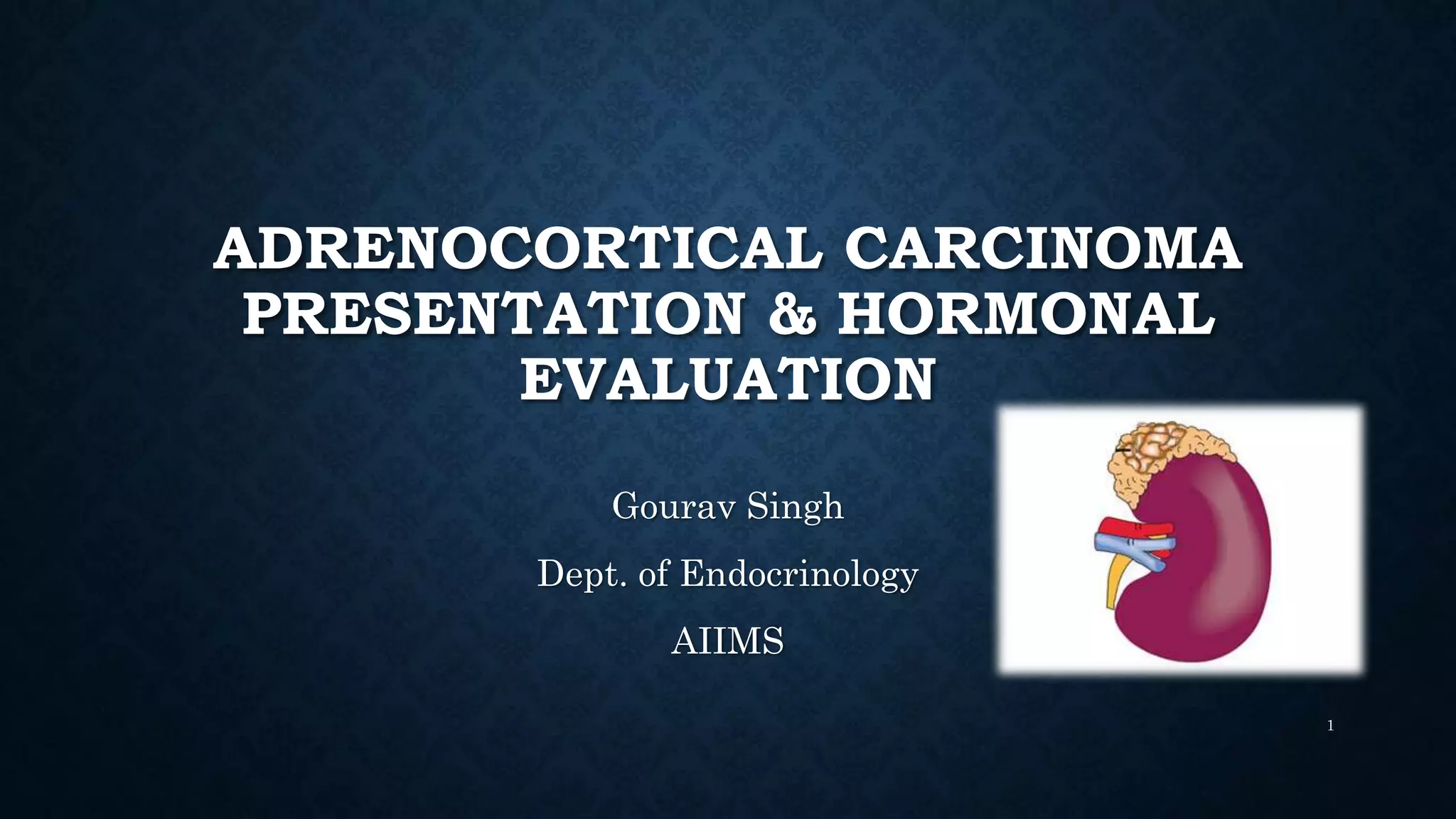
ADRENOCORTICAL CARCINOMA
PRESENTATION & HORMONAL
EVALUATION
Gourav Singh
Dept. of Endocrinology
AIIMS
1
INTRODUCTION & EPIDEMIOLOGY
• ACC is a rare malignancy with an annual
incidence of 1–2 per million population.
• Around 5% of all Adrenal Incidentaloma.
• Highly malignant tumor.
• Bimodal age distribution –
Children – First decade of life
Adults – Fourth to Fifth decades of life
• F > M (55-60% more in females).
2
INTRODUCTION & EPIDEMIOLOGY
• ACC usually present as sporadic tumor.
• But it can present as Hereditary Tumor
• Associated with –
 Germline TP53 mutation (Li-Fraumeni syndrome)
 Alterations in the Wnt/β-catenin pathway (FAP)
 IGF2 overexpression (Beckwith Wiedemann Syndrome)
3
CLINICAL FEATURES
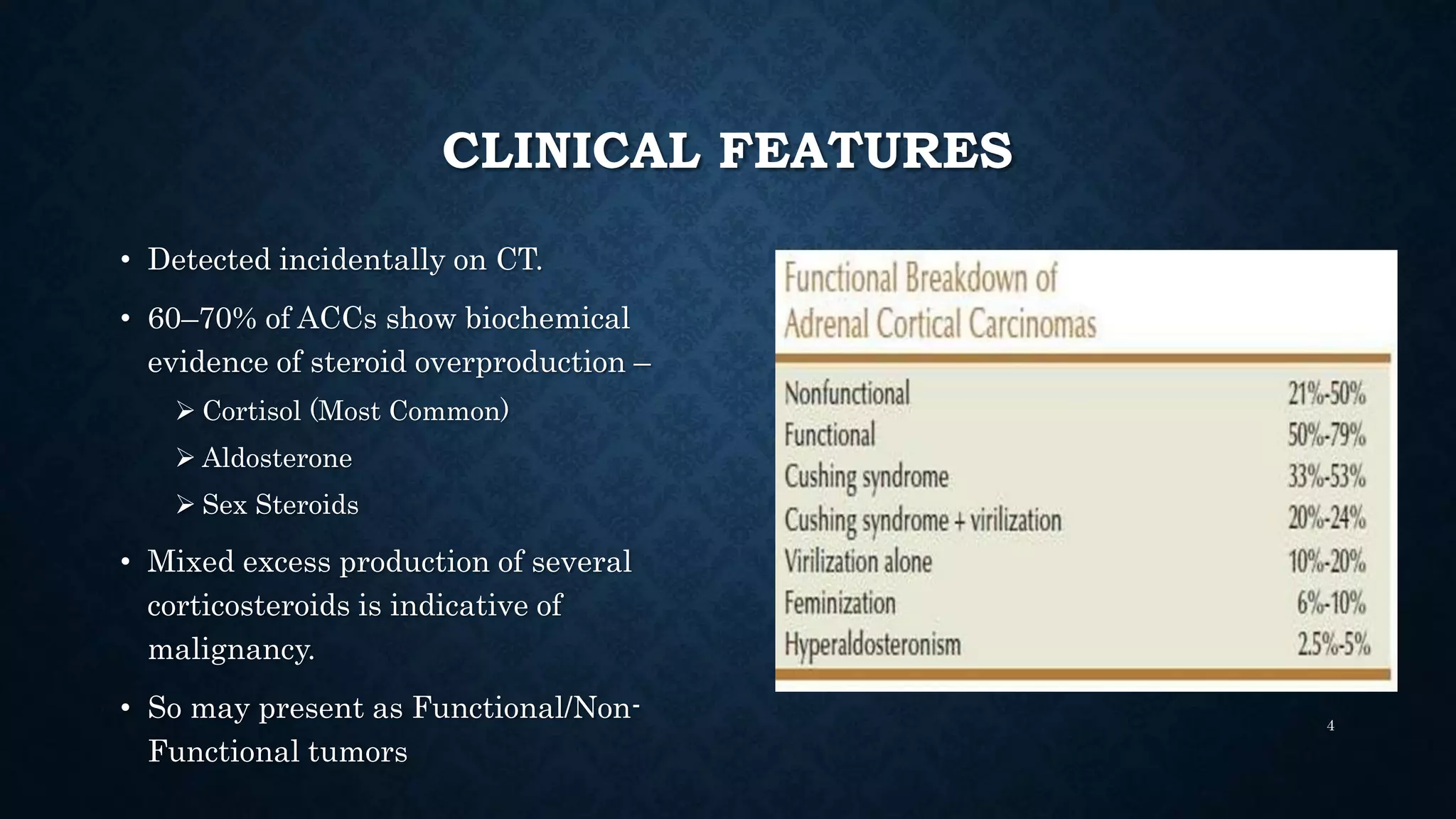
• Detected incidentally on CT.
• 60–70% of ACCs show biochemical
evidence of steroid overproduction –
 Cortisol (Most Common)
 Aldosterone
 Sex Steroids
• Mixed excess production of several
corticosteroids is indicative of
malignancy.
• So may present as Functional/Non-
Functional tumors
4
CLINICAL FEATURES
• Non-Functional tumor symptoms –
 Local symptoms:
 Abdominal fullness, back pain, nausea & vomiting.
 Systemic/Metastatic symptoms:
 Anorexia, anaemia, asthenia and weight loss.
5
CLINICAL FEATURES
• Functional tumor symptoms –
 Symptoms like Cushing Syndrome (Cortisol secreting tumor).
6
CLINICAL FEATURES
7
CLINICAL FEATURES
• Functional tumor symptoms –
 Symptoms like Cushing Syndrome (Cortisol secreting tumor).
 Symptoms like Hyperaldosteronism.
8
CLINICAL FEATURES
9
HORMONAL EVALUATION
10
HORMONAL EVALUATION
• Dexamethasone suppression test
To confirm the diagnosis of Cushing Syndrome.
11
HORMONAL EVALUATION
12
HORMONAL EVALUATION
• Dexamethasone suppression test
To confirm the diagnosis of Cushing Syndrome.
Dexamethasone given in night (11 pm)
Cortisol levels measured on next morning (8 am)
Done in two stages –
 Low dose test
 1mg Dexamethasone given
 To confirm patient actually has
Cushing Syndrome.
 Cortisol > 5gm/dl
 High dose test
 8mg Dexamethasone given
 To know the cause of Cushing
Syndrome.
13
11p.m.
11p.m.
14
REFERENCES AND ILLUSTRATIONS
• Harrison's Principles of Internal Medicine, 20th edition.
• Puglisi S, Perotti P, Cosentini D, Roca E, Basile V, Berruti A, Terzolo M. Decision-
making for adrenocortical carcinoma: surgical, systemic, and endocrine management
options. Expert review of anticancer therapy. 2018 Nov 2;18(11):1125-33.
• Ross NS, Aron DC. Hormonal evaluation of the patient with an incidentally
discovered adrenal mass. New England Journal of Medicine. 1990 Nov
15;323(20):1401-5.
• Ng L, Libertino JM. Adrenocortical carcinoma: diagnosis, evaluation and treatment.
The Journal of urology. 2003 Jan;169(1):5-11.
• Google Image Search.
15

Adrenocortical Carcinoma: Clinical Features & Hormonal Evaluation

  • 1.
    ADRENOCORTICAL CARCINOMA PRESENTATION &HORMONAL EVALUATION Gourav Singh Dept. of Endocrinology AIIMS 1
  • 2.
    INTRODUCTION & EPIDEMIOLOGY •ACC is a rare malignancy with an annual incidence of 1–2 per million population. • Around 5% of all Adrenal Incidentaloma. • Highly malignant tumor. • Bimodal age distribution – Children – First decade of life Adults – Fourth to Fifth decades of life • F > M (55-60% more in females). 2
  • 3.
    INTRODUCTION & EPIDEMIOLOGY •ACC usually present as sporadic tumor. • But it can present as Hereditary Tumor • Associated with –  Germline TP53 mutation (Li-Fraumeni syndrome)  Alterations in the Wnt/β-catenin pathway (FAP)  IGF2 overexpression (Beckwith Wiedemann Syndrome) 3
  • 4.
    CLINICAL FEATURES • Detectedincidentally on CT. • 60–70% of ACCs show biochemical evidence of steroid overproduction –  Cortisol (Most Common)  Aldosterone  Sex Steroids • Mixed excess production of several corticosteroids is indicative of malignancy. • So may present as Functional/Non- Functional tumors 4
  • 5.
    CLINICAL FEATURES • Non-Functionaltumor symptoms –  Local symptoms:  Abdominal fullness, back pain, nausea & vomiting.  Systemic/Metastatic symptoms:  Anorexia, anaemia, asthenia and weight loss. 5
  • 6.
    CLINICAL FEATURES • Functionaltumor symptoms –  Symptoms like Cushing Syndrome (Cortisol secreting tumor). 6
  • 7.
  • 8.
    CLINICAL FEATURES • Functionaltumor symptoms –  Symptoms like Cushing Syndrome (Cortisol secreting tumor).  Symptoms like Hyperaldosteronism. 8
  • 9.
  • 10.
  • 11.
    HORMONAL EVALUATION • Dexamethasonesuppression test To confirm the diagnosis of Cushing Syndrome. 11
  • 12.
  • 13.
    HORMONAL EVALUATION • Dexamethasonesuppression test To confirm the diagnosis of Cushing Syndrome. Dexamethasone given in night (11 pm) Cortisol levels measured on next morning (8 am) Done in two stages –  Low dose test  1mg Dexamethasone given  To confirm patient actually has Cushing Syndrome.  Cortisol > 5gm/dl  High dose test  8mg Dexamethasone given  To know the cause of Cushing Syndrome. 13
  • 14.
  • 15.
    REFERENCES AND ILLUSTRATIONS •Harrison's Principles of Internal Medicine, 20th edition. • Puglisi S, Perotti P, Cosentini D, Roca E, Basile V, Berruti A, Terzolo M. Decision- making for adrenocortical carcinoma: surgical, systemic, and endocrine management options. Expert review of anticancer therapy. 2018 Nov 2;18(11):1125-33. • Ross NS, Aron DC. Hormonal evaluation of the patient with an incidentally discovered adrenal mass. New England Journal of Medicine. 1990 Nov 15;323(20):1401-5. • Ng L, Libertino JM. Adrenocortical carcinoma: diagnosis, evaluation and treatment. The Journal of urology. 2003 Jan;169(1):5-11. • Google Image Search. 15