Getting Work Done
  Better Faster Cheaper:
The Business Case for Agile


        www.MauriceHagar.com
Overview


           Business Realities and Challenges


           The Business Case for Agile


           How We Can Help


                    www.MauriceHagar.com
Business Realities


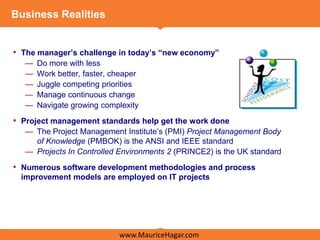
• The manager’s challenge in today’s “new economy”
  —   Do more with less
  —   Work better, faster, cheaper
  —   Juggle competing priorities
  —   Manage continuous change
  —   Navigate growing complexity
• Project management standards help get the work done
  — The Project Management Institute’s (PMI) Project Management Body
    of Knowledge (PMBOK) is the ANSI and IEEE standard
  — Projects In Controlled Environments 2 (PRINCE2) is the UK standard
• Numerous software development methodologies and process
 improvement models are employed on IT projects


                            www.MauriceHagar.com
Business Challenges


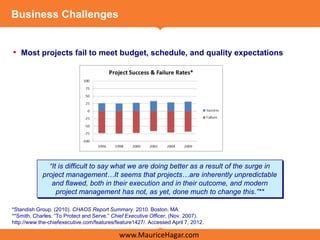
• Most projects fail to meet budget, schedule, and quality expectations


              “It is difficult to say what we are doing better as a result of the surge in
            project management…It seems that projects…are inherently unpredictable
               and flawed, both in their execution and in their outcome, and modern
                 project management has not, as yet, done much to change this.”**

*Standish Group. (2010). CHAOS Report Summary. 2010. Boston, MA.
**Smith, Charles. ―To Protect and Serve.‖ Chief Executive Officer, (Nov. 2007).
http://www.the-chiefexecutive.com/features/feature1427/. Accessed April 7, 2012.

                                            www.MauriceHagar.com
Root Cause Analysis


• The UK’s Engineering and Physical Sciences Research Council
     — Convened thought leaders from around the world
     — Included representatives from PMI, the Association for Project
       Management, and the International Project Management Association
• Landmark report Rethinking Project Management released May 2006
     — Existing standards are simplistic and rooted in early 20th-century practices
     — New approaches needed to manage today’s rapid changes and complexity


                       “The gap between project management theory and real-world
                         practice is growing; we need a fundamental rethink of the
                          discipline…This is not to argue that conventional project
                     management theory should now be abandoned, only that there is
                     a need now to develop this field beyond its current foundations.”*


*Winter, Mark, and Charles Smith. Rethinking Project Management: Final Report, 2006. EPSRC Network, 2004–2006.
www.ronrosenhead.co.uk/wp-content/rethinking-project-management1.pdf. Accessed April 7, 2011.

                                          www.MauriceHagar.com
Overview


           Business Realities and Challenges


           The Business Case for Agile


           How We Can Help


                    www.MauriceHagar.com
Introducing Agile


• Agile has emerged as the most effective approach for successfully
   managing dynamic, complex work
    — Rooted in W. Edwards Deming and lean manufacturing
    — The Agile Manifesto signed by software thought leaders in 2001
    — PMI’s Agile project management credential (PMI-ACP) launched in 2011
• Rapid and widespread adoption
     — The US military uses Agile approaches for mission planning
     — Gartner estimates that 80% of IT shops are using or learning Agile
     — Non-IT managers, entrepreneurs, and MBA students are now learning Agile
                “The use of Agile practices…has become an essential approach for effectively
                     delivering project work in environments where change is the norm.”*

          “There is no question that Agile project management is a leading and emergent
           practice…critical to understand.”—Gregory Balestrero, CEO Emeritus, PMI**

*Project Management Institute. ―PMI Introduces New Agile Certification.‖
Credential Passport: PMI’s Global Credential Holder Newsletter. (March 2011).
www.pmi.org/passport/mar11/pmi-introduces-new-agile-certification.html. Accessed April 7, 2011.
**Balestrero, Gregory. On the Threshold of Agility. March 18, 2009. http://blogs.pmi.org. Accessed April 7, 2011.

                                              www.MauriceHagar.com
What Is Agile?


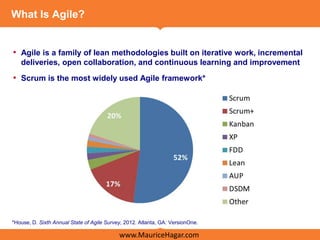
• Agile is a family of lean methodologies built on iterative work, incremental
   deliveries, open collaboration, and continuous learning and improvement
• Scrum is the most widely used Agile framework*


*House, D. Sixth Annual State of Agile Survey, 2012. Atlanta, GA: VersionOne.

                                            www.MauriceHagar.com
When to Use Agile


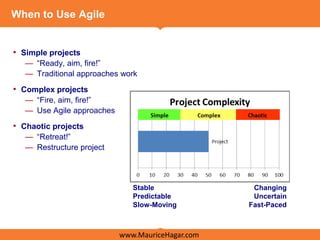
• Simple projects
   — ―Ready, aim, fire!‖
   — Traditional approaches work
• Complex projects
   — ―Fire, aim, fire!‖
   — Use Agile approaches
• Chaotic projects
   — ―Retreat!‖
   — Restructure project


                               Stable               Changing
                               Predictable          Uncertain
                               Slow-Moving         Fast-Paced


                            www.MauriceHagar.com
Agile Benefits


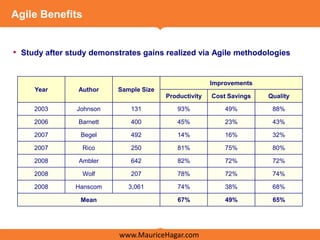
• Study after study demonstrates gains realized via Agile methodologies


                                                       Improvements
     Year       Author    Sample Size
                                        Productivity   Cost Savings   Quality

     2003       Johnson       131          93%             49%         88%

     2006       Barnett       400          45%             23%         43%

     2007        Begel        492          14%             16%         32%

     2007        Rico         250          81%             75%         80%

     2008       Ambler        642          82%             72%         72%

     2008        Wolf         207          78%             72%         74%

     2008       Hanscom      3,061         74%             38%         68%

                 Mean                      67%             49%         65%


                           www.MauriceHagar.com
A Closer Look


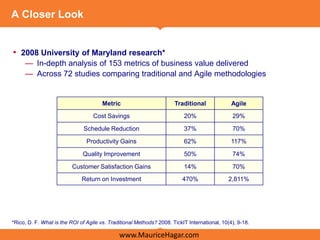
• 2008 University of Maryland research*
     — In-depth analysis of 153 metrics of business value delivered
     — Across 72 studies comparing traditional and Agile methodologies


                                       Metric                         Traditional              Agile

                                   Cost Savings                           20%                  29%

                               Schedule Reduction                         37%                  70%

                                Productivity Gains                        62%                  117%

                              Quality Improvement                         50%                  74%

                          Customer Satisfaction Gains                     14%                  70%
                              Return on Investment                       470%                2,811%


*Rico, D. F. What is the ROI of Agile vs. Traditional Methods? 2008. TickIT International, 10(4), 9-18.

                                              www.MauriceHagar.com
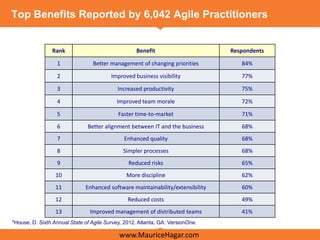
Top Benefits Reported by 6,042 Agile Practitioners


                Rank                               Benefit                      Respondents

                  1              Better management of changing priorities          84%

                  2                      Improved business visibility              77%

                  3                         Increased productivity                 75%

                  4                        Improved team morale                    72%

                  5                         Faster time-to-market                  71%
                  6            Better alignment between IT and the business        68%
                  7                           Enhanced quality                     68%
                  8                           Simpler processes                    68%
                  9                             Reduced risks                      65%
                  10                           More discipline                     62%
                  11          Enhanced software maintainability/extensibility      60%
                  12                            Reduced costs                      49%
                  13            Improved management of distributed teams           41%
*House, D. Sixth Annual State of Agile Survey, 2012. Atlanta, GA: VersionOne.

                                            www.MauriceHagar.com
Overview


           Business Realities and Challenges


           The Business Case for Agile


           How We Can Help


                    www.MauriceHagar.com
Introducing Maurice Hagar & Associates


                      Maurice Hagar holds a graduate degree and multiple certifications in project
                      management with additional certifications in business analysis and change
                      management. Maurice brings 25 years proven experience delivering quantifiable
                      business results for both start-ups and Fortune 500 companies such as Boeing,
                      Citigroup, Coca-Cola, General Motors, GlaxoSmithKline, Northwestern University,
                      and the US Military. Maurice has served in a variety of roles from software
                      development manager to global program manager to CIO, and has offered
                      project management consulting and training since 2005.

Maurice’s broad experience, along with his expertise across a wide spectrum of project management
methodologies and his capabilities as both a practitioner and a strong communicator, make him unique
in the field of project management. Maurice has won a number of industry awards, he was featured in
an Information Week article, and he is a sought-after speaker, trainer, and consultant around the world.

―& Associates‖ refers to Maurice’s strategic partnerships:

    — Gear Stream is a global company with 10 years experience offering Agile management solutions
      that radically improve performance around product innovation and development.
    — Learning Tree International is a world leader in hands-on training for management, project
      management, and technology professionals with over 2 million students since 1974.


                                        www.MauriceHagar.com
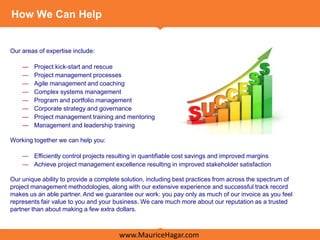
How We Can Help


Our areas of expertise include:

    —   Project kick-start and rescue
    —   Project management processes
    —   Agile management and coaching
    —   Complex systems management
    —   Program and portfolio management
    —   Corporate strategy and governance
    —   Project management training and mentoring
    —   Management and leadership training

Working together we can help you:

    — Efficiently control projects resulting in quantifiable cost savings and improved margins
    — Achieve project management excellence resulting in improved stakeholder satisfaction

Our unique ability to provide a complete solution, including best practices from across the spectrum of
project management methodologies, along with our extensive experience and successful track record
makes us an able partner. And we guarantee our work: you pay only as much of our invoice as you feel
represents fair value to you and your business. We care much more about our reputation as a trusted
partner than about making a few extra dollars.


                                       www.MauriceHagar.com

The Business Case for Agile

  • 1.
    Getting Work Done Better Faster Cheaper: The Business Case for Agile www.MauriceHagar.com
  • 2.
    Overview Business Realities and Challenges The Business Case for Agile How We Can Help www.MauriceHagar.com
  • 3.
    Business Realities • Themanager’s challenge in today’s “new economy” — Do more with less — Work better, faster, cheaper — Juggle competing priorities — Manage continuous change — Navigate growing complexity • Project management standards help get the work done — The Project Management Institute’s (PMI) Project Management Body of Knowledge (PMBOK) is the ANSI and IEEE standard — Projects In Controlled Environments 2 (PRINCE2) is the UK standard • Numerous software development methodologies and process improvement models are employed on IT projects www.MauriceHagar.com
  • 4.
    Business Challenges • Mostprojects fail to meet budget, schedule, and quality expectations “It is difficult to say what we are doing better as a result of the surge in project management…It seems that projects…are inherently unpredictable and flawed, both in their execution and in their outcome, and modern project management has not, as yet, done much to change this.”** *Standish Group. (2010). CHAOS Report Summary. 2010. Boston, MA. **Smith, Charles. ―To Protect and Serve.‖ Chief Executive Officer, (Nov. 2007). http://www.the-chiefexecutive.com/features/feature1427/. Accessed April 7, 2012. www.MauriceHagar.com
  • 5.
    Root Cause Analysis •The UK’s Engineering and Physical Sciences Research Council — Convened thought leaders from around the world — Included representatives from PMI, the Association for Project Management, and the International Project Management Association • Landmark report Rethinking Project Management released May 2006 — Existing standards are simplistic and rooted in early 20th-century practices — New approaches needed to manage today’s rapid changes and complexity “The gap between project management theory and real-world practice is growing; we need a fundamental rethink of the discipline…This is not to argue that conventional project management theory should now be abandoned, only that there is a need now to develop this field beyond its current foundations.”* *Winter, Mark, and Charles Smith. Rethinking Project Management: Final Report, 2006. EPSRC Network, 2004–2006. www.ronrosenhead.co.uk/wp-content/rethinking-project-management1.pdf. Accessed April 7, 2011. www.MauriceHagar.com
  • 6.
    Overview Business Realities and Challenges The Business Case for Agile How We Can Help www.MauriceHagar.com
  • 7.
    Introducing Agile • Agilehas emerged as the most effective approach for successfully managing dynamic, complex work — Rooted in W. Edwards Deming and lean manufacturing — The Agile Manifesto signed by software thought leaders in 2001 — PMI’s Agile project management credential (PMI-ACP) launched in 2011 • Rapid and widespread adoption — The US military uses Agile approaches for mission planning — Gartner estimates that 80% of IT shops are using or learning Agile — Non-IT managers, entrepreneurs, and MBA students are now learning Agile “The use of Agile practices…has become an essential approach for effectively delivering project work in environments where change is the norm.”* “There is no question that Agile project management is a leading and emergent practice…critical to understand.”—Gregory Balestrero, CEO Emeritus, PMI** *Project Management Institute. ―PMI Introduces New Agile Certification.‖ Credential Passport: PMI’s Global Credential Holder Newsletter. (March 2011). www.pmi.org/passport/mar11/pmi-introduces-new-agile-certification.html. Accessed April 7, 2011. **Balestrero, Gregory. On the Threshold of Agility. March 18, 2009. http://blogs.pmi.org. Accessed April 7, 2011. www.MauriceHagar.com
  • 8.
    What Is Agile? •Agile is a family of lean methodologies built on iterative work, incremental deliveries, open collaboration, and continuous learning and improvement • Scrum is the most widely used Agile framework* *House, D. Sixth Annual State of Agile Survey, 2012. Atlanta, GA: VersionOne. www.MauriceHagar.com
  • 9.
    When to UseAgile • Simple projects — ―Ready, aim, fire!‖ — Traditional approaches work • Complex projects — ―Fire, aim, fire!‖ — Use Agile approaches • Chaotic projects — ―Retreat!‖ — Restructure project Stable Changing Predictable Uncertain Slow-Moving Fast-Paced www.MauriceHagar.com
  • 10.
    Agile Benefits • Studyafter study demonstrates gains realized via Agile methodologies Improvements Year Author Sample Size Productivity Cost Savings Quality 2003 Johnson 131 93% 49% 88% 2006 Barnett 400 45% 23% 43% 2007 Begel 492 14% 16% 32% 2007 Rico 250 81% 75% 80% 2008 Ambler 642 82% 72% 72% 2008 Wolf 207 78% 72% 74% 2008 Hanscom 3,061 74% 38% 68% Mean 67% 49% 65% www.MauriceHagar.com
  • 11.
    A Closer Look •2008 University of Maryland research* — In-depth analysis of 153 metrics of business value delivered — Across 72 studies comparing traditional and Agile methodologies Metric Traditional Agile Cost Savings 20% 29% Schedule Reduction 37% 70% Productivity Gains 62% 117% Quality Improvement 50% 74% Customer Satisfaction Gains 14% 70% Return on Investment 470% 2,811% *Rico, D. F. What is the ROI of Agile vs. Traditional Methods? 2008. TickIT International, 10(4), 9-18. www.MauriceHagar.com
  • 12.
    Top Benefits Reportedby 6,042 Agile Practitioners Rank Benefit Respondents 1 Better management of changing priorities 84% 2 Improved business visibility 77% 3 Increased productivity 75% 4 Improved team morale 72% 5 Faster time-to-market 71% 6 Better alignment between IT and the business 68% 7 Enhanced quality 68% 8 Simpler processes 68% 9 Reduced risks 65% 10 More discipline 62% 11 Enhanced software maintainability/extensibility 60% 12 Reduced costs 49% 13 Improved management of distributed teams 41% *House, D. Sixth Annual State of Agile Survey, 2012. Atlanta, GA: VersionOne. www.MauriceHagar.com
  • 13.
    Overview Business Realities and Challenges The Business Case for Agile How We Can Help www.MauriceHagar.com
  • 14.
    Introducing Maurice Hagar& Associates Maurice Hagar holds a graduate degree and multiple certifications in project management with additional certifications in business analysis and change management. Maurice brings 25 years proven experience delivering quantifiable business results for both start-ups and Fortune 500 companies such as Boeing, Citigroup, Coca-Cola, General Motors, GlaxoSmithKline, Northwestern University, and the US Military. Maurice has served in a variety of roles from software development manager to global program manager to CIO, and has offered project management consulting and training since 2005. Maurice’s broad experience, along with his expertise across a wide spectrum of project management methodologies and his capabilities as both a practitioner and a strong communicator, make him unique in the field of project management. Maurice has won a number of industry awards, he was featured in an Information Week article, and he is a sought-after speaker, trainer, and consultant around the world. ―& Associates‖ refers to Maurice’s strategic partnerships: — Gear Stream is a global company with 10 years experience offering Agile management solutions that radically improve performance around product innovation and development. — Learning Tree International is a world leader in hands-on training for management, project management, and technology professionals with over 2 million students since 1974. www.MauriceHagar.com
  • 15.
    How We CanHelp Our areas of expertise include: — Project kick-start and rescue — Project management processes — Agile management and coaching — Complex systems management — Program and portfolio management — Corporate strategy and governance — Project management training and mentoring — Management and leadership training Working together we can help you: — Efficiently control projects resulting in quantifiable cost savings and improved margins — Achieve project management excellence resulting in improved stakeholder satisfaction Our unique ability to provide a complete solution, including best practices from across the spectrum of project management methodologies, along with our extensive experience and successful track record makes us an able partner. And we guarantee our work: you pay only as much of our invoice as you feel represents fair value to you and your business. We care much more about our reputation as a trusted partner than about making a few extra dollars. www.MauriceHagar.com