Antonacci & O’Callaghan
Need
 Struggle to read required textbooks
 74% of 8th graders performed at the basic level
 8 million students struggle to read
 Learning to read is different from reading to learn –
  basic skills learned in 3rd grade are not sufficient to
  assist these students with complex texts
 Many graduates are not ready for college; rising
  literacy demands
Literacy Demands
 Students must be able to gather information from
  multiple texts and have technological literacy
 Content teachers must be able to develop content
  literacy for their students- this requires assisting
  students to interact with the text, not just read the
  words
   Connections to previous learning
   Understanding how this fits in with the bigger picture
   Pulling forward background knowledge; assimilation
    and accomodation
Literacy Demands - continued
 Metacognitive strategies that good readers use without
  thinking – must be taught explicitly
 Vocabulary is content specific – must be explicitly
  taught – not just assigned as looking words up in the
  dictionary
 There is no intervention powerful enough to make up
  for an ineffective Gen. Ed program – the heart of
  improving student achievement is to improve Gen. Ed.
  Instruction – Dr. Kevin Feldman –
 Content teachers must be part of the solution!
Strategies Affecting Literacy and
Learning
 Metacognitive strategies:
   Predictions – using
    headings, subheadings, titles, illustrations, tables and
    graphs, skimming/scanning
   Setting a purpose for reading
   Activating prior knowledge/making connections
   Previewing texts
   Asking questions – Before, during, and after
   Figuring out unknown words
   Text structure
   Self-talk
   Reviewing and recalling
  We will be learning strategies in each of these areas you can
    implement in your own classrooms with regard to your own
    content!
Social Dimensions of Literacy
 Some cultures openly ask for childrens’ opinions and
  value them when heard, whereas in other
  cultures, children are taught to obey and listen, rarely
  voicing their opinion.
 Can influence the way in which they comprehend the
  text based upon the social values talked about or
  taught at home
 Can affect student participation
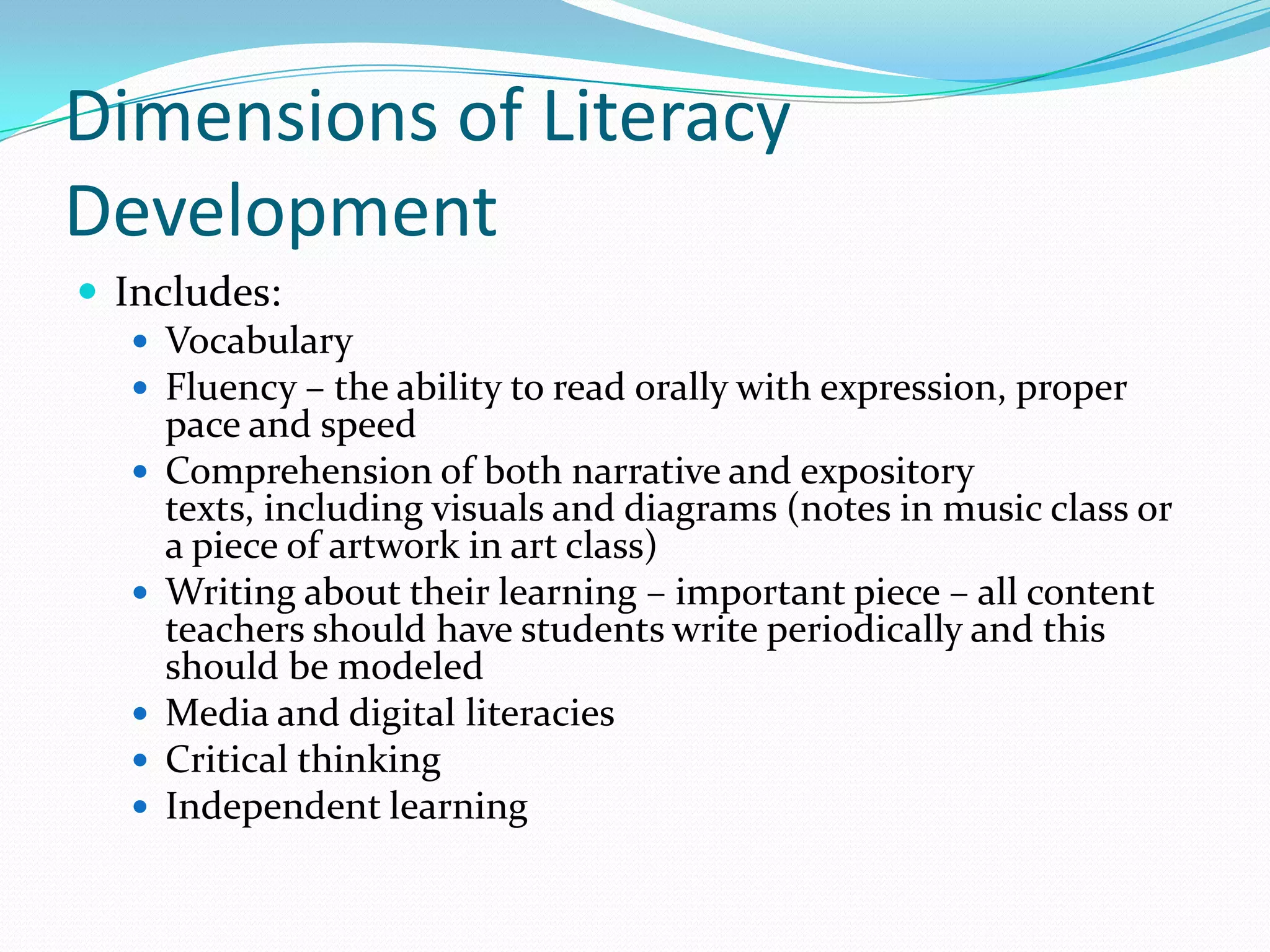
Dimensions of Literacy
Development
 Includes:
    Vocabulary
    Fluency – the ability to read orally with expression, proper
     pace and speed
    Comprehension of both narrative and expository
     texts, including visuals and diagrams (notes in music class or
     a piece of artwork in art class)
    Writing about their learning – important piece – all content
     teachers should have students write periodically and this
     should be modeled
    Media and digital literacies
    Critical thinking
    Independent learning

Adolescent literacy 2012

  • 1.
  • 2.
    Need  Struggle toread required textbooks  74% of 8th graders performed at the basic level  8 million students struggle to read  Learning to read is different from reading to learn – basic skills learned in 3rd grade are not sufficient to assist these students with complex texts  Many graduates are not ready for college; rising literacy demands
  • 3.
    Literacy Demands  Studentsmust be able to gather information from multiple texts and have technological literacy  Content teachers must be able to develop content literacy for their students- this requires assisting students to interact with the text, not just read the words  Connections to previous learning  Understanding how this fits in with the bigger picture  Pulling forward background knowledge; assimilation and accomodation
  • 4.
    Literacy Demands -continued  Metacognitive strategies that good readers use without thinking – must be taught explicitly  Vocabulary is content specific – must be explicitly taught – not just assigned as looking words up in the dictionary  There is no intervention powerful enough to make up for an ineffective Gen. Ed program – the heart of improving student achievement is to improve Gen. Ed. Instruction – Dr. Kevin Feldman –  Content teachers must be part of the solution!
  • 5.
    Strategies Affecting Literacyand Learning  Metacognitive strategies:  Predictions – using headings, subheadings, titles, illustrations, tables and graphs, skimming/scanning  Setting a purpose for reading  Activating prior knowledge/making connections  Previewing texts  Asking questions – Before, during, and after  Figuring out unknown words  Text structure  Self-talk  Reviewing and recalling We will be learning strategies in each of these areas you can implement in your own classrooms with regard to your own content!
  • 6.
    Social Dimensions ofLiteracy  Some cultures openly ask for childrens’ opinions and value them when heard, whereas in other cultures, children are taught to obey and listen, rarely voicing their opinion.  Can influence the way in which they comprehend the text based upon the social values talked about or taught at home  Can affect student participation
  • 7.
    Dimensions of Literacy Development Includes:  Vocabulary  Fluency – the ability to read orally with expression, proper pace and speed  Comprehension of both narrative and expository texts, including visuals and diagrams (notes in music class or a piece of artwork in art class)  Writing about their learning – important piece – all content teachers should have students write periodically and this should be modeled  Media and digital literacies  Critical thinking  Independent learning