unit 1: Introduction to management
1
Learning objectives
At the end of the chapter the students will be able to:
๏ƒ˜Define health and health related terms and management
๏ƒ˜Describe the importance of management
๏ƒ˜Explain principles and concepts of management
๏ƒ˜Perform environmental analysis to develop health sector
plan
2
Activities 5 minute
โ€ข Health?
โ€ข Health care?
โ€ข Health service?
โ€ข Health system?
โ€ข Organization?
โ€ข Health service organization?
โ€ข Goal?
3
Definitions of terms
๏ƒ˜ What is health?
๏ƒ˜ Health care:
๏ถ It is the total societal effort, undertaken in the private and
public sectors, focuses on pursuing health.
๏ƒ˜ Health services โ€“ are specific activities undertaken to
maintain or improve health or to prevent decrements
of health.
โ€ข Can be preventive, promotive, acute, chronic,
restorative or palliative in nature
โ€ข Can be public or personal
4
5
Definitions of terms contโ€™dโ€ฆ
๏ƒ˜ Health systems
โ€ข All health service organization, people and actions
whose primary purpose is to improve health. WHO,
2000
Health service organizations
โ€ข Entities that provide the organizational structure
within which the delivery of health services is
directed to consumers.
6
Definitions of terms contโ€™dโ€ฆ
What is organization mean?
๏ถ work together in a structured way to achieve a specific
goal or set of goals.
๏ถ Believing there is a benefit working together to achieve
a common goal
What does goal mean ?
๏ถ Goals :The purpose that organization strives to achieve.
๏ถ Goal is the fundamental element of an organization.
7
Definitions of terms contโ€™dโ€ฆ
๏ƒผ Organizational goals are important for at least four
reasons:
1. Goals Provide A Sense Of Direction.
2. Goals Focus Our Efforts.
3. Goals Guide Our Plans And Decisions.
4. Goals Help Us Evaluate Our Progress.
What do all organizations need
to achieve goals?
To achieve goals all organizations should
๏ถHave a method and
๏ถHave to acquire and allocate resources
Thus the need for management.
8
Brain storming
โ€ข What is management?
9
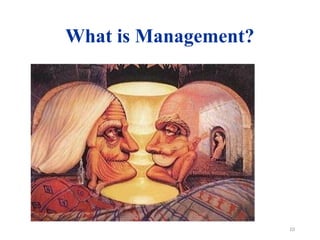
What is Management?
10
11
What is Management?
โ€ข It is impossible to provide a single, comprehensive ,
universally accepted definition of management.
โ€ข Has been defined in ways that appear different but with a
strong underlying similarity .
Management is:
It is the process of accomplishing predetermined
objectives through the effective use of human,
financial, and technical resources (Longest Jr.,
Rakich , & Darr, 2000).
12
What is Management? Contโ€™dโ€ฆ
WHO โ€œOn Being in Chargeโ€
โ€ข Getting things done
โ€ข Getting things done through people.
โ€ข The efficient use of resources.
โ€ข Getting people to work harmoniously together and to
make efficient use of resources in order to achieve
objectives.
13
What is Management? Contโ€™dโ€ฆ
โ€ข Samuel C. Certo: โ€œModern Managementโ€
โ€ข It is the process of reaching organizational goals by working
with and through people and other organizational resources.
๏ƒ˜ The process of planning, organizing, staffing, leading, and
controlling the work of organization members and using all
available organizational resources to reach stated
organizational goals.
14
What is manager?
โ€ข What is manager?
๏ƒ˜ A manager is a person who plans, organizes, leads and controls
human, financial, and other resources to meet organizational
goals.
๏ƒ˜ In the healthcare system organizational goals can include:
๏‚ง treating patients safely and cost-effectively
๏‚ง preventing the spread of disease through programmes such as health
education or vaccination campaigns
๏‚ง promoting the health and well-being of a population through
legislation and policymaking
15
Importance of Management
โ€ข Management is essential for all kinds of organization
and It is necessary function for;
๏ƒผTo making of decisions,
๏ƒผthe coordinating of activities,
๏ƒผthe handling of people and,
๏ƒผEvaluating the performances directed towards its
objective
16
Characteristics of Management
๏ƒ˜ Universal : It applies every where
๏ƒ˜ Continuous process: Carried out through out the budget year.
๏ƒ˜ Dynamic: Changes from one form to another
๏ƒ˜ Pervasive: practiced in every organization
Management and Administration
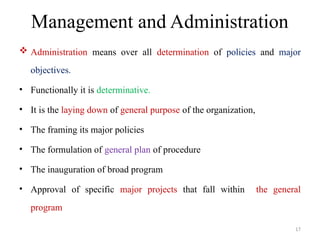
๏ถ Administration means over all determination of policies and major
objectives.
โ€ข Functionally it is determinative.
โ€ข It is the laying down of general purpose of the organization,
โ€ข The framing its major policies
โ€ข The formulation of general plan of procedure
โ€ข The inauguration of broad program
โ€ข Approval of specific major projects that fall within the general
program
17
Management and Administration..
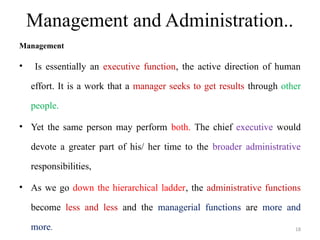
Management
โ€ข Is essentially an executive function, the active direction of human
effort. It is a work that a manager seeks to get results through other
people.
โ€ข Yet the same person may perform both. The chief executive would
devote a greater part of his/ her time to the broader administrative
responsibilities,
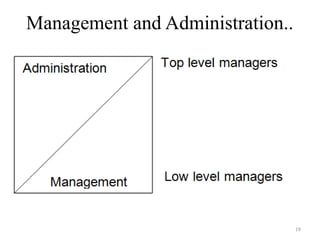
โ€ข As we go down the hierarchical ladder, the administrative functions
become less and less and the managerial functions are more and
more. 18
Management and Administration..
19
20
Concepts and Principles in Management
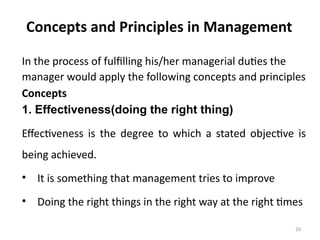
In the process of fulfilling his/her managerial duties the
manager would apply the following concepts and principles
Concepts
1. Effectiveness(doing the right thing)
Effectiveness is the degree to which a stated objective is
being achieved.
โ€ข It is something that management tries to improve
โ€ข Doing the right things in the right way at the right times
21
Conceptsโ€ฆโ€ฆโ€ฆ.
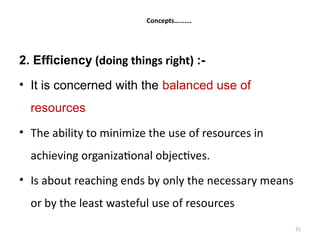
2. Efficiency (doing things right) :-
โ€ข It is concerned with the balanced use of
resources
โ€ข The ability to minimize the use of resources in
achieving organizational objectives.
โ€ข Is about reaching ends by only the necessary means
or by the least wasteful use of resources
22
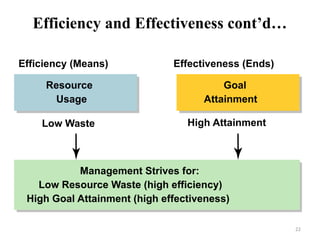
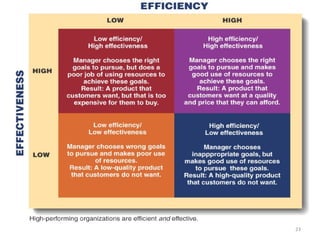
Efficiency and Effectiveness contโ€™dโ€ฆ
Goal
Attainment
Effectiveness (Ends)
Resource
Usage
Management Strives for:
Low Resource Waste (high efficiency)
High Goal Attainment (high effectiveness)
Efficiency (Means)
Low Waste High Attainment
23
24
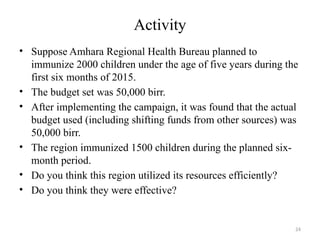
Activity
โ€ข Suppose Amhara Regional Health Bureau planned to
immunize 2000 children under the age of five years during the
first six months of 2015.
โ€ข The budget set was 50,000 birr.
โ€ข After implementing the campaign, it was found that the actual
budget used (including shifting funds from other sources) was
50,000 birr.
โ€ข The region immunized 1500 children during the planned six-
month period.
โ€ข Do you think this region utilized its resources efficiently?
โ€ข Do you think they were effective?
25
Conceptsโ€ฆโ€ฆโ€ฆ.
3. Economy of Scarce Resources :
Often many, resources are scarce and costly thus we have to economize &use
based on priority need.
4 Work Relations :-Work activities should be designed and structured
so as to support each other towards the achievement of objectives
5 Information
โ€ข Management needs information to make the right decision for action.
At the same time, information can easily handicap Management, if it
is not
the right kind, at the right time and& in the right hands.
Principles of management
1. Management by Objective
Management sees that objectives are specified then that they are
achieved.
The objectives should state:
๏ƒ˜What is to be accomplished?
๏ƒ˜How much of it?
๏ƒ˜Where it is to be done.
๏ƒ˜When it is be completed.
26
Principles of management contโ€™dโ€ฆ
2. Learning from Experience
โ€ข Analysis of the results between the objectives and
achievement made.
โ€ข For better performance there should be feedback to
learn from experience.
3. Division of Labour
โ€ข Management attempts to bring about balance of
work among the different work and among the
different people concerned
27
Principles of management contโ€™dโ€ฆ
4. Substitution of Resources
โ€ข Often when the resources that are normally used to
provide service became scarce or too expensive,
different resources may be used to provide the
intended results.
5. Convergence of Work
โ€ข Working relations should contribute to the success of
each activity and so to general effectiveness
28
Principles of management contโ€™dโ€ฆ
6.Functions Determine Structure
โ€ข When the work is defined i.e. the function and duties of the
individual members of the team are clearly defined and known to all,
the working relations (structure) follow.
โ€ข The exact nature of authority will be clearly delineated on the
structure.
7.Delegation
โ€ข Delegation is the downward transfer of formal authority
from superior to subordinate.
29
Principles of management contโ€™dโ€ฆ
8.Management by Exception
โ€ข Do not be overloaded with the routine and unnecessary
information, be selective and making big decision first.
In short management by exception means:
๏ƒผSelectivity in information and priority in decision
9. Shortest Decision-path
This principle deals with issues like:
๏ƒ˜Who should make which decision?
๏ƒ˜When and where?
๏ƒ˜Decision must be made as closely as possible in time and
place to the object of decision and to those affected by it.
30
Management and Environment:
โ€ข Health service organizations exist in the larger environment
they are not isolated. They are affected by the external
environment and vice versa.
โ€ข Relationship between managerial functions and the
environment occur because organizations are open systems
โ€ข They acquire their inputs from the environment in the form of:-
โ€“ Human Resource
โ€“ Information
โ€“ Materials
โ€“ Technology
โ€“ Finances
โ€“ Time
31
Management and environmentโ€ฆ.
External environment:
โ€ข All elements outside an organization that are
relevant to its operation
Internal environment
โ€ข All elements inside an organization that are
relevant to its operation
32
Thank you very much!!!

L1 Introduction to HSM_033642.pppppppppppppptx

  • 1.
    unit 1: Introductionto management 1
  • 2.
    Learning objectives At theend of the chapter the students will be able to: ๏ƒ˜Define health and health related terms and management ๏ƒ˜Describe the importance of management ๏ƒ˜Explain principles and concepts of management ๏ƒ˜Perform environmental analysis to develop health sector plan 2
  • 3.
    Activities 5 minute โ€ขHealth? โ€ข Health care? โ€ข Health service? โ€ข Health system? โ€ข Organization? โ€ข Health service organization? โ€ข Goal? 3
  • 4.
    Definitions of terms ๏ƒ˜What is health? ๏ƒ˜ Health care: ๏ถ It is the total societal effort, undertaken in the private and public sectors, focuses on pursuing health. ๏ƒ˜ Health services โ€“ are specific activities undertaken to maintain or improve health or to prevent decrements of health. โ€ข Can be preventive, promotive, acute, chronic, restorative or palliative in nature โ€ข Can be public or personal 4
  • 5.
    5 Definitions of termscontโ€™dโ€ฆ ๏ƒ˜ Health systems โ€ข All health service organization, people and actions whose primary purpose is to improve health. WHO, 2000 Health service organizations โ€ข Entities that provide the organizational structure within which the delivery of health services is directed to consumers.
  • 6.
    6 Definitions of termscontโ€™dโ€ฆ What is organization mean? ๏ถ work together in a structured way to achieve a specific goal or set of goals. ๏ถ Believing there is a benefit working together to achieve a common goal What does goal mean ? ๏ถ Goals :The purpose that organization strives to achieve. ๏ถ Goal is the fundamental element of an organization.
  • 7.
    7 Definitions of termscontโ€™dโ€ฆ ๏ƒผ Organizational goals are important for at least four reasons: 1. Goals Provide A Sense Of Direction. 2. Goals Focus Our Efforts. 3. Goals Guide Our Plans And Decisions. 4. Goals Help Us Evaluate Our Progress.
  • 8.
    What do allorganizations need to achieve goals? To achieve goals all organizations should ๏ถHave a method and ๏ถHave to acquire and allocate resources Thus the need for management. 8
  • 9.
  • 10.
  • 11.
    11 What is Management? โ€ขIt is impossible to provide a single, comprehensive , universally accepted definition of management. โ€ข Has been defined in ways that appear different but with a strong underlying similarity . Management is: It is the process of accomplishing predetermined objectives through the effective use of human, financial, and technical resources (Longest Jr., Rakich , & Darr, 2000).
  • 12.
    12 What is Management?Contโ€™dโ€ฆ WHO โ€œOn Being in Chargeโ€ โ€ข Getting things done โ€ข Getting things done through people. โ€ข The efficient use of resources. โ€ข Getting people to work harmoniously together and to make efficient use of resources in order to achieve objectives.
  • 13.
    13 What is Management?Contโ€™dโ€ฆ โ€ข Samuel C. Certo: โ€œModern Managementโ€ โ€ข It is the process of reaching organizational goals by working with and through people and other organizational resources. ๏ƒ˜ The process of planning, organizing, staffing, leading, and controlling the work of organization members and using all available organizational resources to reach stated organizational goals.
  • 14.
    14 What is manager? โ€ขWhat is manager? ๏ƒ˜ A manager is a person who plans, organizes, leads and controls human, financial, and other resources to meet organizational goals. ๏ƒ˜ In the healthcare system organizational goals can include: ๏‚ง treating patients safely and cost-effectively ๏‚ง preventing the spread of disease through programmes such as health education or vaccination campaigns ๏‚ง promoting the health and well-being of a population through legislation and policymaking
  • 15.
    15 Importance of Management โ€ขManagement is essential for all kinds of organization and It is necessary function for; ๏ƒผTo making of decisions, ๏ƒผthe coordinating of activities, ๏ƒผthe handling of people and, ๏ƒผEvaluating the performances directed towards its objective
  • 16.
    16 Characteristics of Management ๏ƒ˜Universal : It applies every where ๏ƒ˜ Continuous process: Carried out through out the budget year. ๏ƒ˜ Dynamic: Changes from one form to another ๏ƒ˜ Pervasive: practiced in every organization
  • 17.
    Management and Administration ๏ถAdministration means over all determination of policies and major objectives. โ€ข Functionally it is determinative. โ€ข It is the laying down of general purpose of the organization, โ€ข The framing its major policies โ€ข The formulation of general plan of procedure โ€ข The inauguration of broad program โ€ข Approval of specific major projects that fall within the general program 17
  • 18.
    Management and Administration.. Management โ€ขIs essentially an executive function, the active direction of human effort. It is a work that a manager seeks to get results through other people. โ€ข Yet the same person may perform both. The chief executive would devote a greater part of his/ her time to the broader administrative responsibilities, โ€ข As we go down the hierarchical ladder, the administrative functions become less and less and the managerial functions are more and more. 18
  • 19.
  • 20.
    20 Concepts and Principlesin Management In the process of fulfilling his/her managerial duties the manager would apply the following concepts and principles Concepts 1. Effectiveness(doing the right thing) Effectiveness is the degree to which a stated objective is being achieved. โ€ข It is something that management tries to improve โ€ข Doing the right things in the right way at the right times
  • 21.
    21 Conceptsโ€ฆโ€ฆโ€ฆ. 2. Efficiency (doingthings right) :- โ€ข It is concerned with the balanced use of resources โ€ข The ability to minimize the use of resources in achieving organizational objectives. โ€ข Is about reaching ends by only the necessary means or by the least wasteful use of resources
  • 22.
    22 Efficiency and Effectivenesscontโ€™dโ€ฆ Goal Attainment Effectiveness (Ends) Resource Usage Management Strives for: Low Resource Waste (high efficiency) High Goal Attainment (high effectiveness) Efficiency (Means) Low Waste High Attainment
  • 23.
  • 24.
    24 Activity โ€ข Suppose AmharaRegional Health Bureau planned to immunize 2000 children under the age of five years during the first six months of 2015. โ€ข The budget set was 50,000 birr. โ€ข After implementing the campaign, it was found that the actual budget used (including shifting funds from other sources) was 50,000 birr. โ€ข The region immunized 1500 children during the planned six- month period. โ€ข Do you think this region utilized its resources efficiently? โ€ข Do you think they were effective?
  • 25.
    25 Conceptsโ€ฆโ€ฆโ€ฆ. 3. Economy ofScarce Resources : Often many, resources are scarce and costly thus we have to economize &use based on priority need. 4 Work Relations :-Work activities should be designed and structured so as to support each other towards the achievement of objectives 5 Information โ€ข Management needs information to make the right decision for action. At the same time, information can easily handicap Management, if it is not the right kind, at the right time and& in the right hands.
  • 26.
    Principles of management 1.Management by Objective Management sees that objectives are specified then that they are achieved. The objectives should state: ๏ƒ˜What is to be accomplished? ๏ƒ˜How much of it? ๏ƒ˜Where it is to be done. ๏ƒ˜When it is be completed. 26
  • 27.
    Principles of managementcontโ€™dโ€ฆ 2. Learning from Experience โ€ข Analysis of the results between the objectives and achievement made. โ€ข For better performance there should be feedback to learn from experience. 3. Division of Labour โ€ข Management attempts to bring about balance of work among the different work and among the different people concerned 27
  • 28.
    Principles of managementcontโ€™dโ€ฆ 4. Substitution of Resources โ€ข Often when the resources that are normally used to provide service became scarce or too expensive, different resources may be used to provide the intended results. 5. Convergence of Work โ€ข Working relations should contribute to the success of each activity and so to general effectiveness 28
  • 29.
    Principles of managementcontโ€™dโ€ฆ 6.Functions Determine Structure โ€ข When the work is defined i.e. the function and duties of the individual members of the team are clearly defined and known to all, the working relations (structure) follow. โ€ข The exact nature of authority will be clearly delineated on the structure. 7.Delegation โ€ข Delegation is the downward transfer of formal authority from superior to subordinate. 29
  • 30.
    Principles of managementcontโ€™dโ€ฆ 8.Management by Exception โ€ข Do not be overloaded with the routine and unnecessary information, be selective and making big decision first. In short management by exception means: ๏ƒผSelectivity in information and priority in decision 9. Shortest Decision-path This principle deals with issues like: ๏ƒ˜Who should make which decision? ๏ƒ˜When and where? ๏ƒ˜Decision must be made as closely as possible in time and place to the object of decision and to those affected by it. 30
  • 31.
    Management and Environment: โ€ขHealth service organizations exist in the larger environment they are not isolated. They are affected by the external environment and vice versa. โ€ข Relationship between managerial functions and the environment occur because organizations are open systems โ€ข They acquire their inputs from the environment in the form of:- โ€“ Human Resource โ€“ Information โ€“ Materials โ€“ Technology โ€“ Finances โ€“ Time 31
  • 32.
    Management and environmentโ€ฆ. Externalenvironment: โ€ข All elements outside an organization that are relevant to its operation Internal environment โ€ข All elements inside an organization that are relevant to its operation 32
  • 33.