What is Ethnography

Introduction to Ethnographic
Research
Jean J. Schensul, Ph.D.
Institute for Community Research
www.incommunityresearch.org
Prepared for CIRA M & B Core, July, 2005
Goals for Today

 Introduction to main components of
 ethnographic research
 Developing research questions
 Developing a research model
 Outlining an ethnographic “proposal”
 Self-assessment
Outline

I.      What is Ethnography?
II.     Ethnographic research questions
III.    Research modeling
IV.     Building blocks of ethnographic research
V.      Developing a research design
VI.     Proposal outline
VII.    Analytic Aids
VIII.   Organizational Supports
IX.     Who should do ethnographic research
I. What is Ethnography

 Inquiry (asking questions)
 Discovery (discovering new things)
 Exploration and description/
 confirmation or discovery of
 relationships among variables
 (developing and testing hypotheses)
Ethnography is about
Communities ….

 Geographically situated
 Problem or topic oriented
 Involves participation in the life of the
 “community”
 May contribute to issue clarification or to
 pointing to directions for targeted social
 change
 Ethnography involves……………
research in a natural setting
  Intimate face to face interaction with participants;
  accurate reflection of participants' perspectives
and behaviors;
  utilizes multiple data sources qualitative and
qualtitative
  inductive, interactive and recursive data collection
  analytic strategies to build local cultural theories;
  frames behavior and action in socio-political and
historical context;
   uses concept of culture as a lens through which
to interpret results.
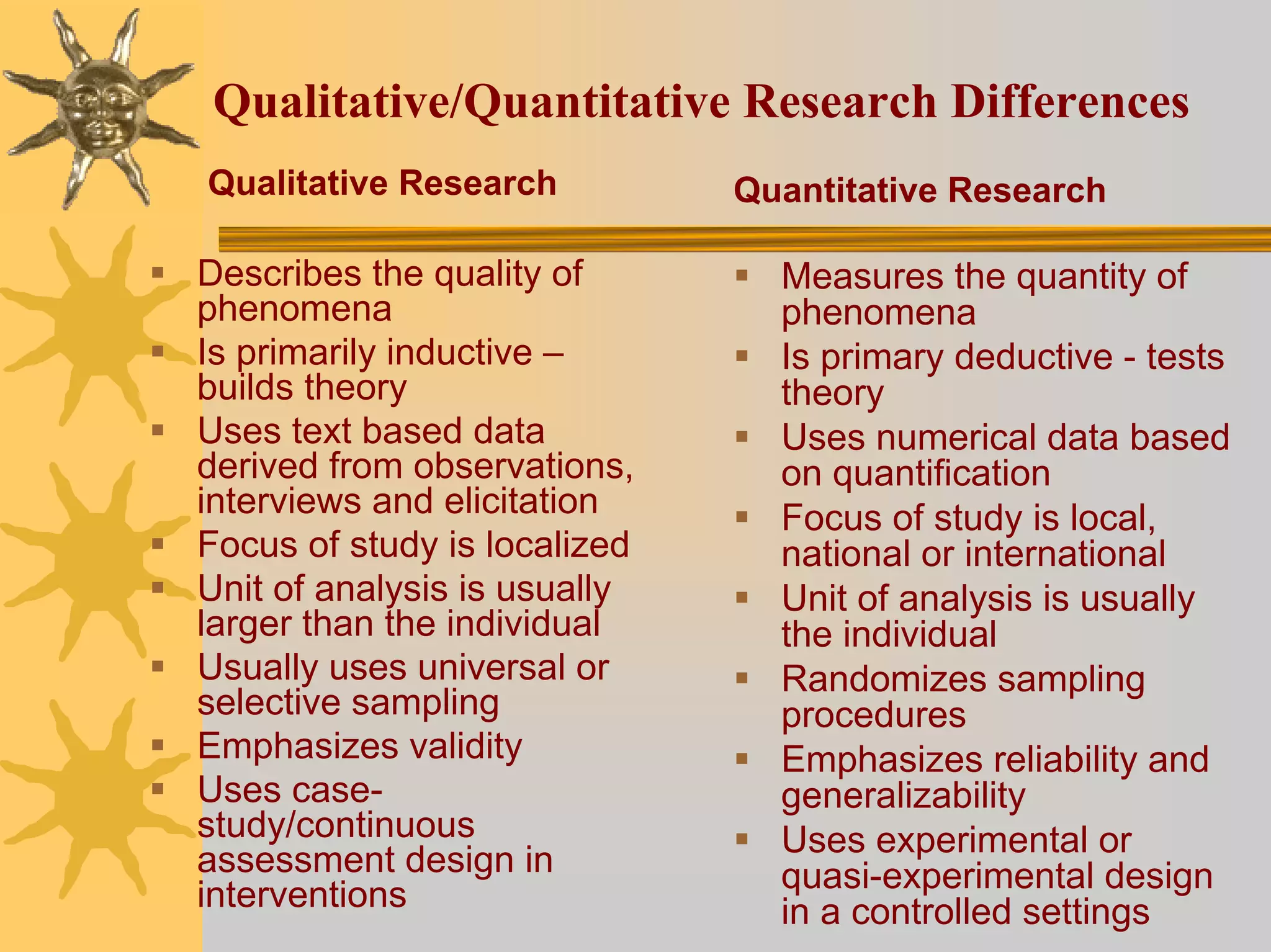
Qualitative/Quantitative Research Differences
Qualitative Research          Quantitative Research

Describes the quality of        Measures the quantity of
phenomena                       phenomena
Is primarily inductive –        Is primary deductive - tests
builds theory                   theory
Uses text based data            Uses numerical data based
derived from observations,      on quantification
interviews and elicitation      Focus of study is local,
Focus of study is localized     national or international
Unit of analysis is usually     Unit of analysis is usually
larger than the individual      the individual
Usually uses universal or       Randomizes sampling
selective sampling              procedures
Emphasizes validity             Emphasizes reliability and
Uses case-                      generalizability
study/continuous                Uses experimental or
assessment design in            quasi-experimental design
interventions                   in a controlled settings
What surveys do

 Surveys can test hypotheses that predict change in
 a population over time.

 Surveys are useful in demonstrating national and
 local trends
When to Call Upon Qualitative/Ethnographic
and Case Study Approaches
When the problem is not clear (new public health problem).
When we don’t know why something happens
When the domain is not well understood
When the target population is not identified.
When random sampling does not capture range of variation.
When there is a disjuncture between what people know and what
they do
When respondents (or researchers) don’t trust surveys
When new approaches to intervention are required.
When an intervention has unexpected processes or outcomes
When the research design is not a good fit
When new trends emerge that are not included in existing surveys
When people want their story told
When a perspective is not represented
When lifestyles vary
When traditional measures do not address causes and
II. Ethnographic Research
Questions
 Differences among people (ethnicity, age,
 residential situation, etc.) (predictors)
 Different behaviors, cultural beliefs, attitudes,
 norms, risks (outcomes)
 Relationships (processes)
 Processes (community, organizational, problem
 solving, decision making etc.)
 Structures (policies, norms, rules, etc.)
 Historical factors (background variables)
 Statuses (health, educational, economic,
 political
How Do We Generate Questions?
    Reading
    Invention
    Observation
    Discrepancy and conflict
    Change over time (trends)
    Others’ questions or observations
    Interdisciplinary or cross situation
    comparisons
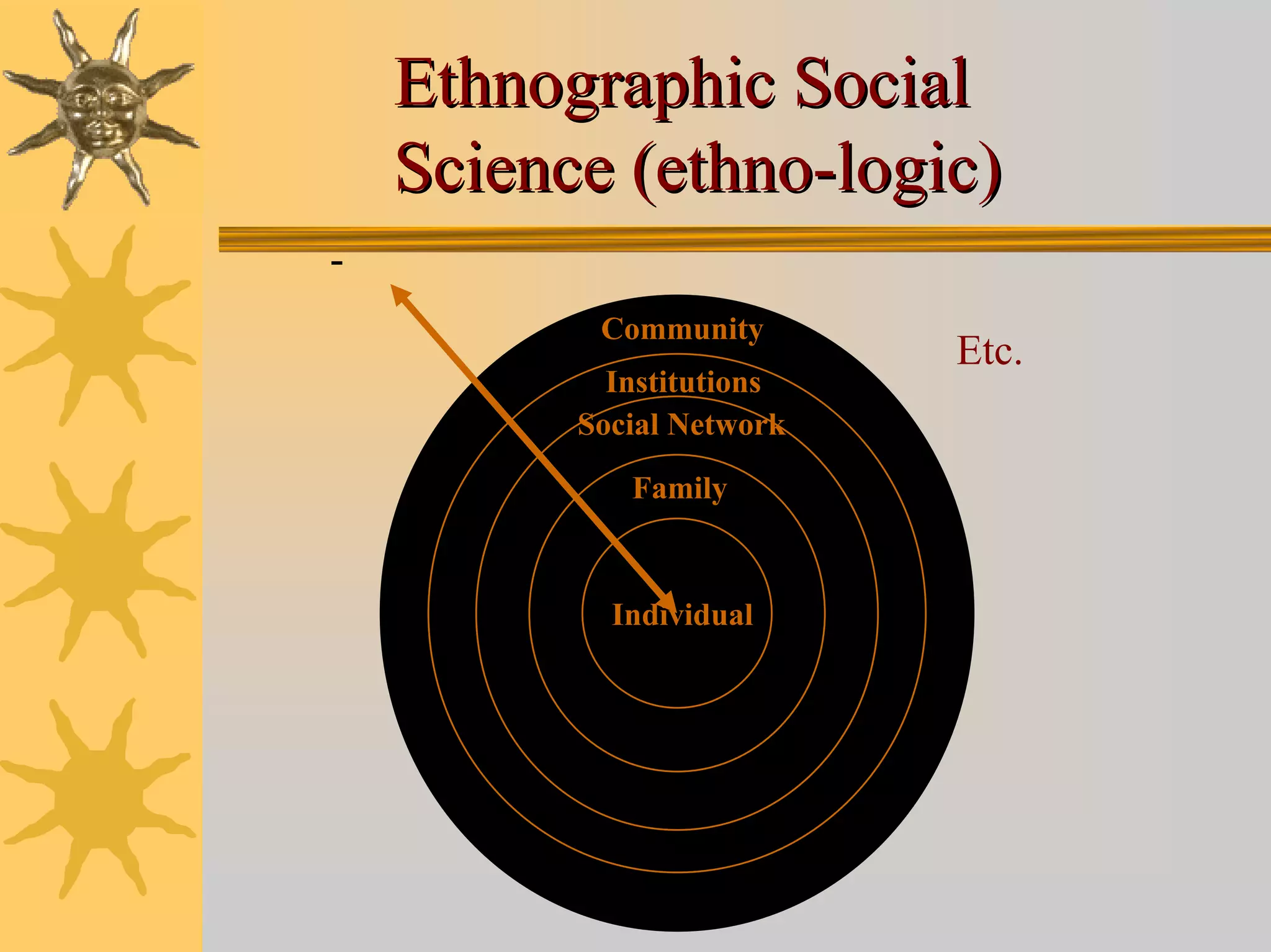
III. Research Modeling

 Core domain and related domains
 Dependent domain and Predictor
 domains
 Systems variables and individual level
 predictors
 Ecological Modeling as a useful tool
Ethnographic Social
    Science (ethno-logic)
-
           Community
                           Etc.
            Institutions
          Social Network

             Family


             Family
            Individual
Generating an Initial Model
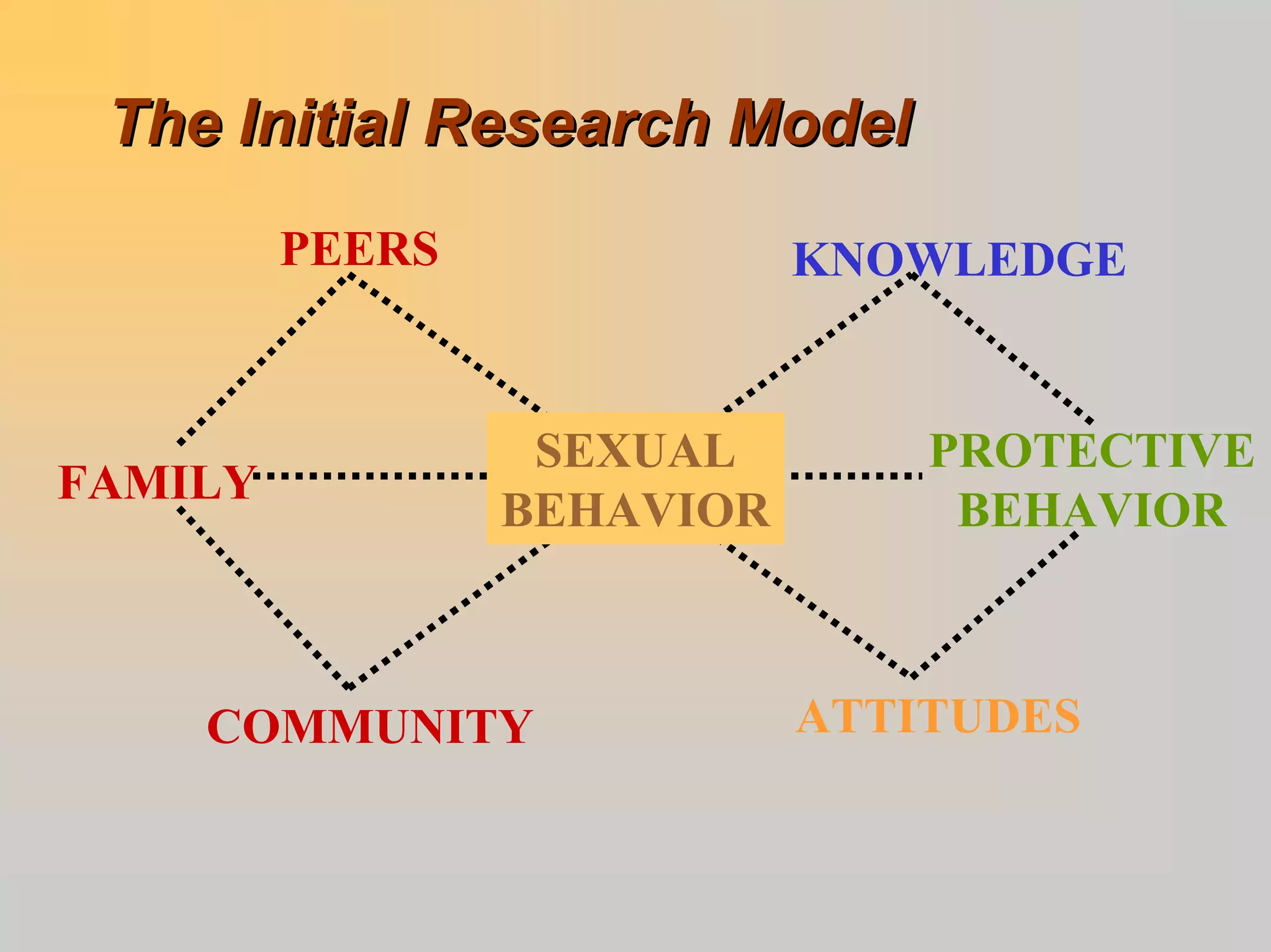
The Initial Research Model
         PEERS              KNOWLEDGE


                  SEXUAL        PROTECTIVE
FAMILY
                 BEHAVIOR        BEHAVIOR


    COMMUNITY               ATTITUDES
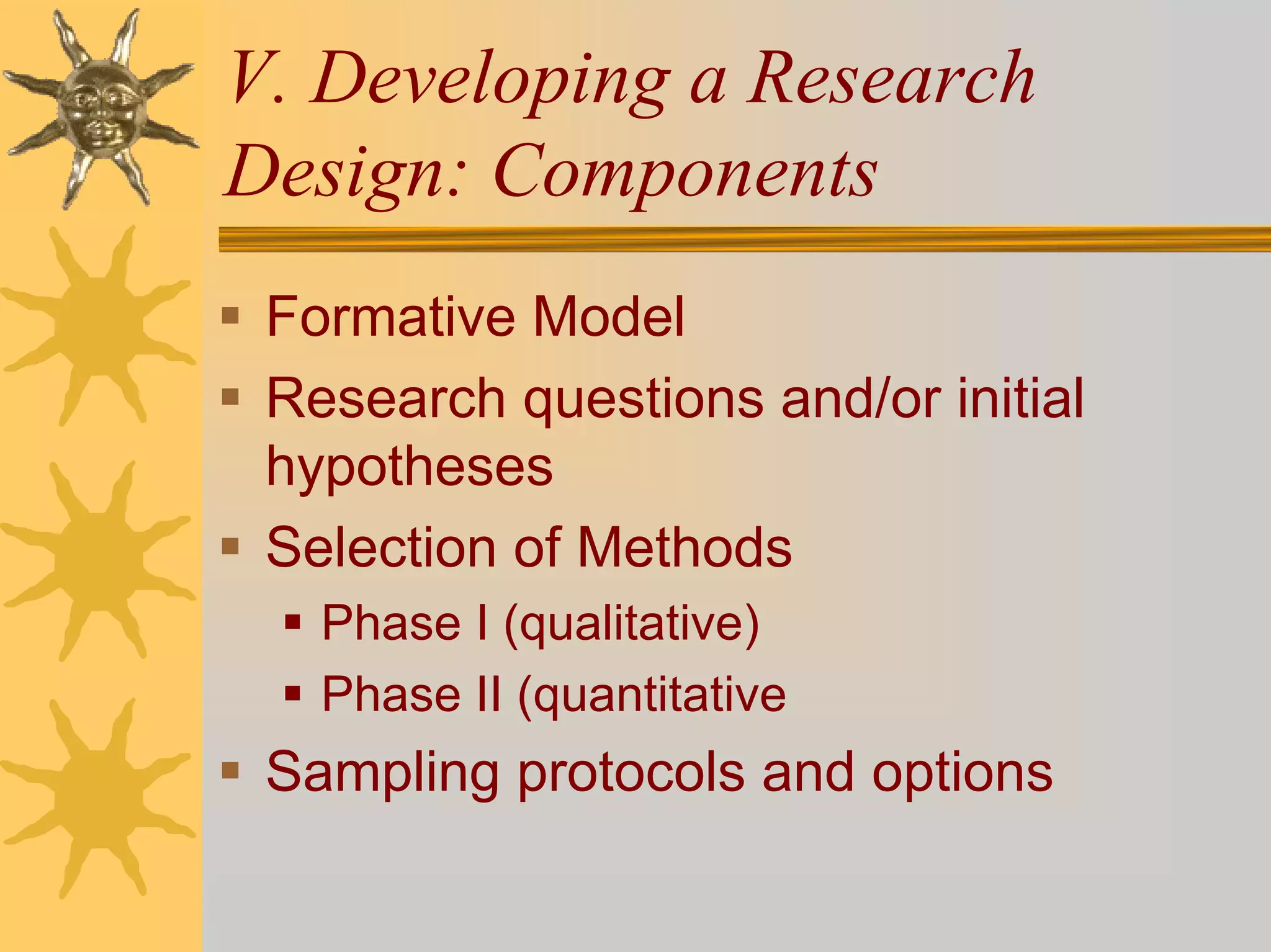
V. Developing a Research
Design: Components
 Formative Model
 Research questions and/or initial
 hypotheses
 Selection of Methods
   Phase I (qualitative)
   Phase II (quantitative
 Sampling protocols and options
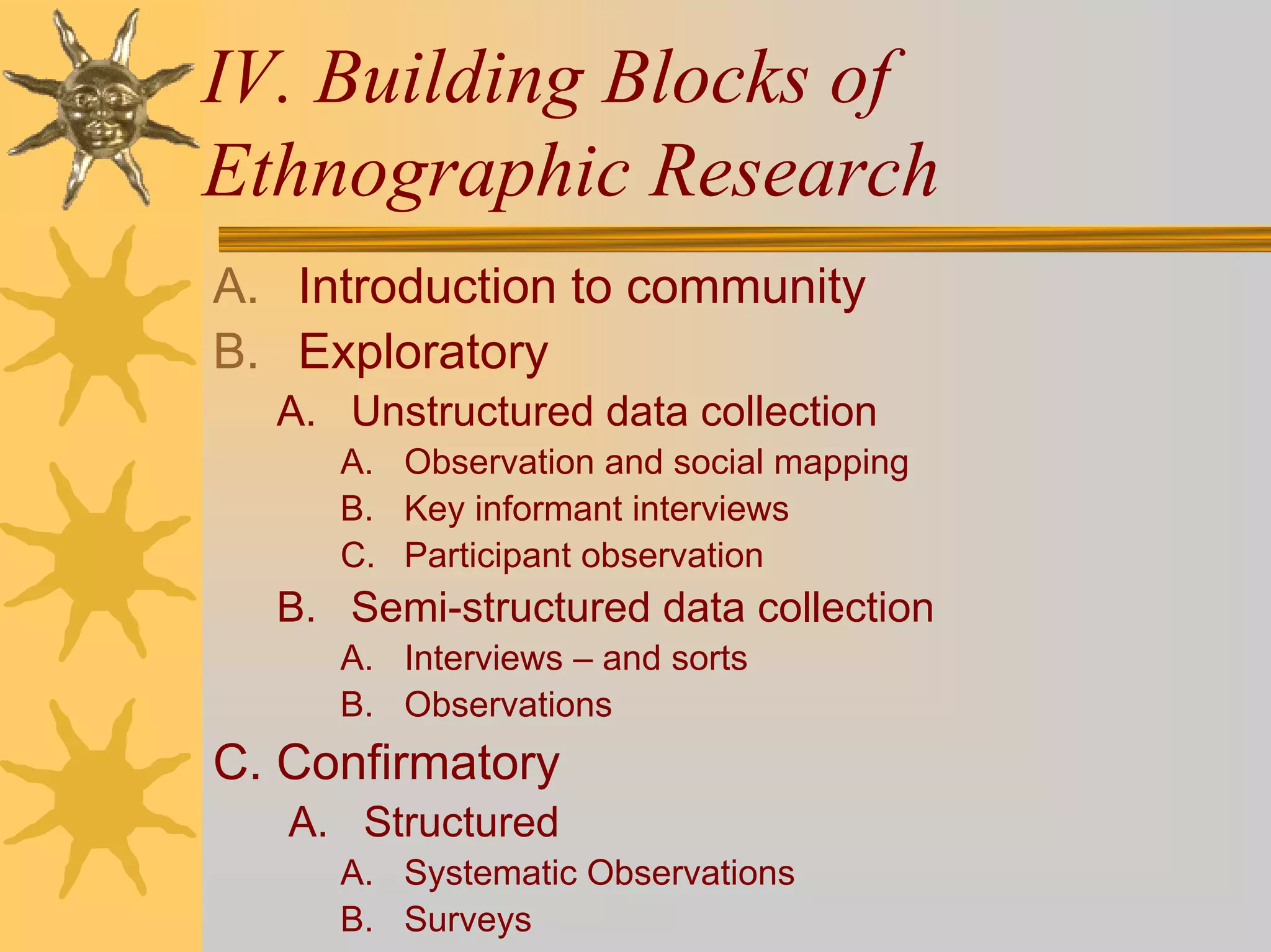
IV. Building Blocks of
Ethnographic Research
A. Introduction to community
B. Exploratory
  A. Unstructured data collection
     A. Observation and social mapping
     B. Key informant interviews
     C. Participant observation
  B. Semi-structured data collection
     A. Interviews – and sorts
     B. Observations
C. Confirmatory
   A. Structured
     A. Systematic Observations
     B. Surveys
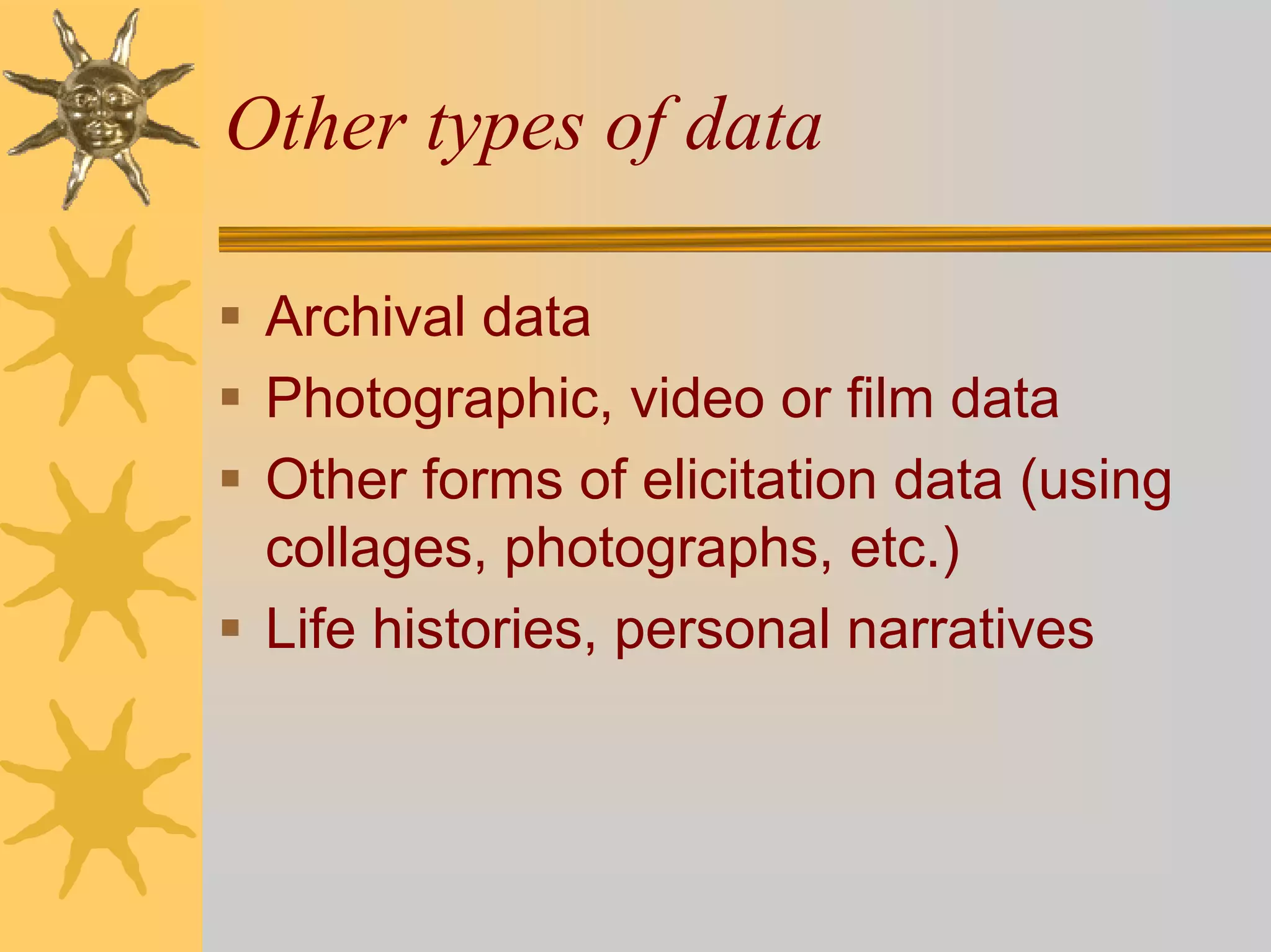
Other types of data

 Archival data
 Photographic, video or film data
 Other forms of elicitation data (using
 collages, photographs, etc.)
 Life histories, personal narratives
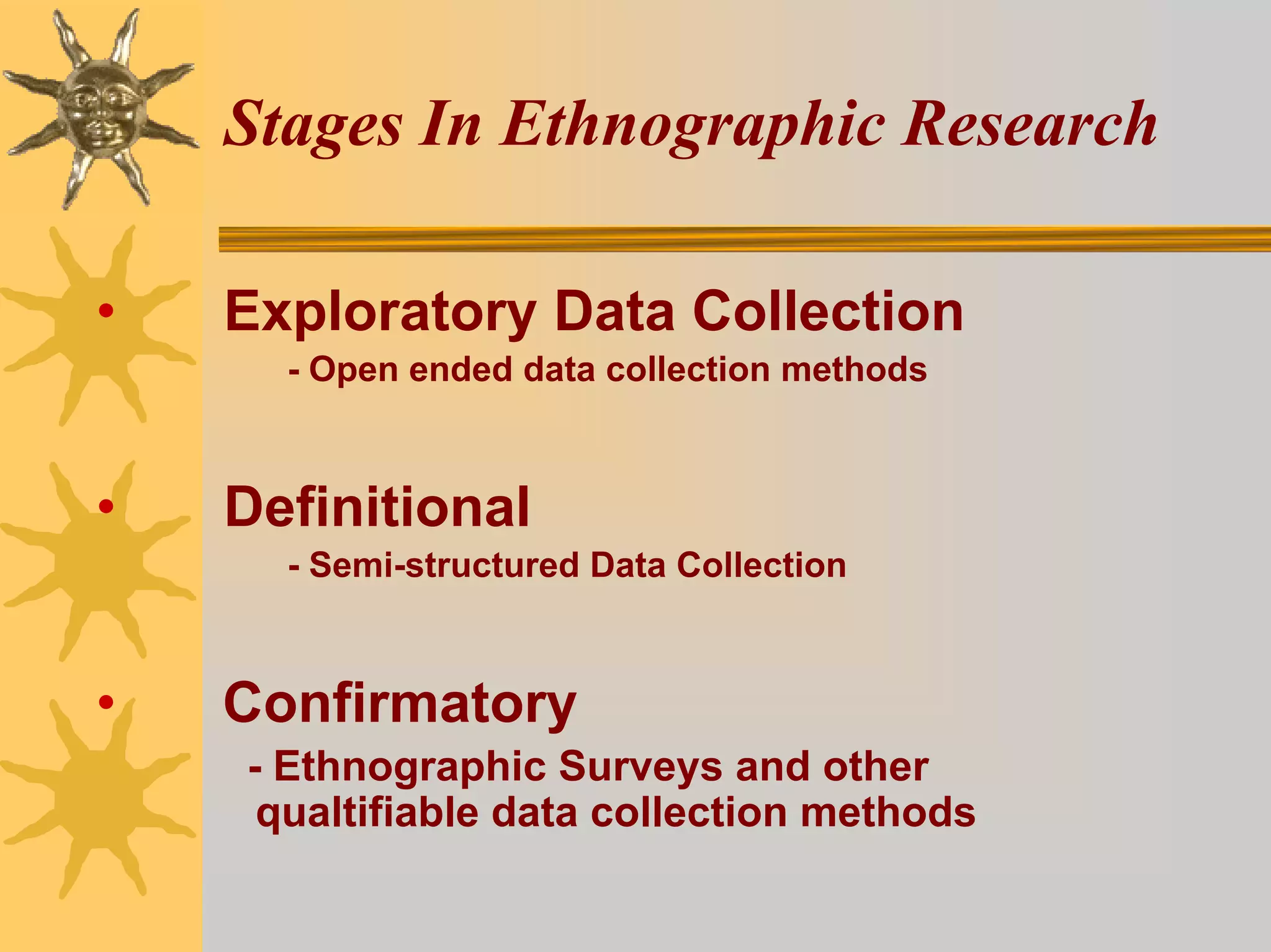
Stages In Ethnographic Research

•   Exploratory Data Collection
      - Open ended data collection methods


•   Definitional
      - Semi-structured Data Collection


•   Confirmatory
    - Ethnographic Surveys and other
     qualtifiable data collection methods
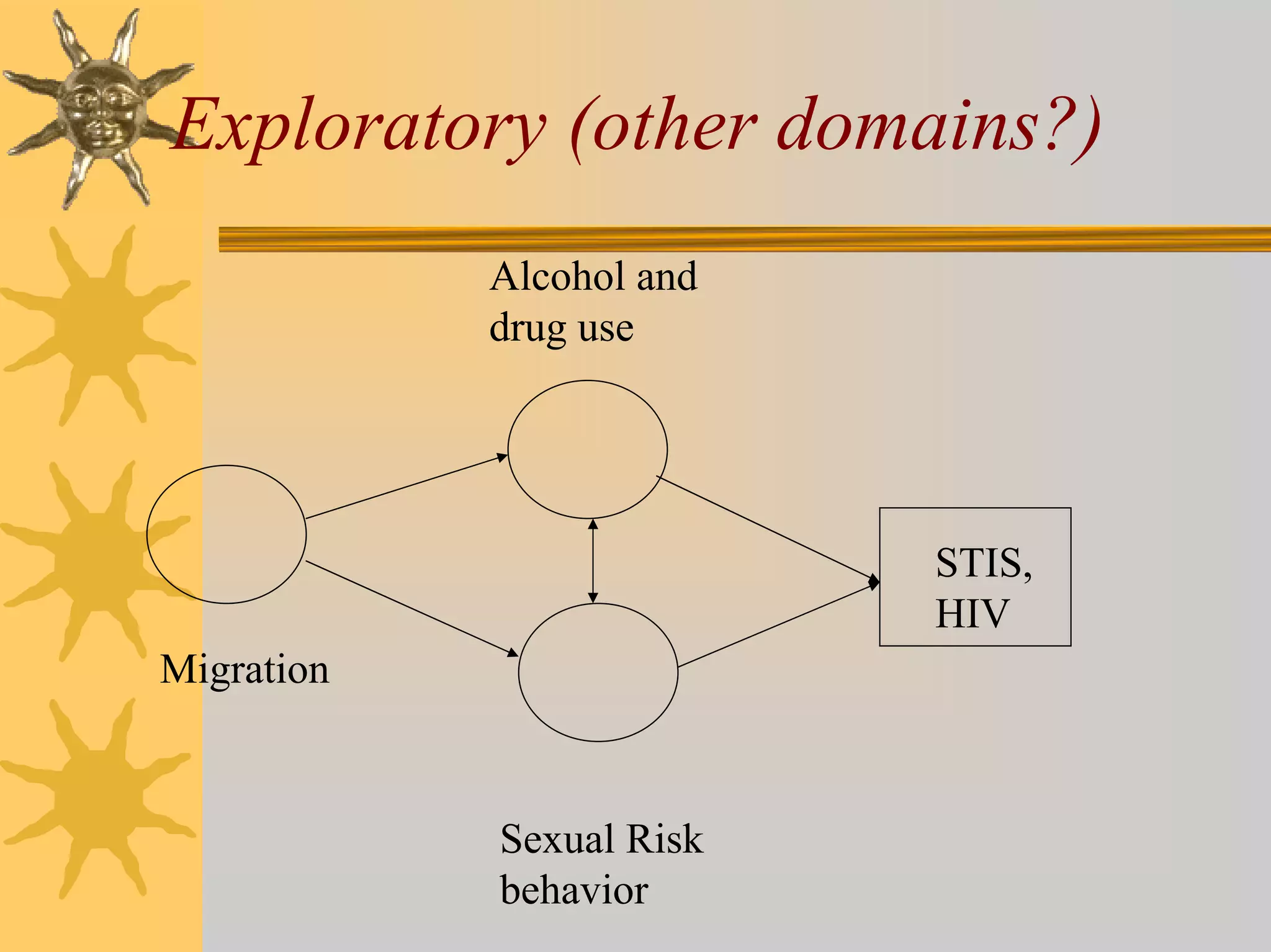
Exploratory (other domains?)
            Alcohol and
            drug use


                          STIS,
                          HIV
Migration


            Sexual Risk
            behavior
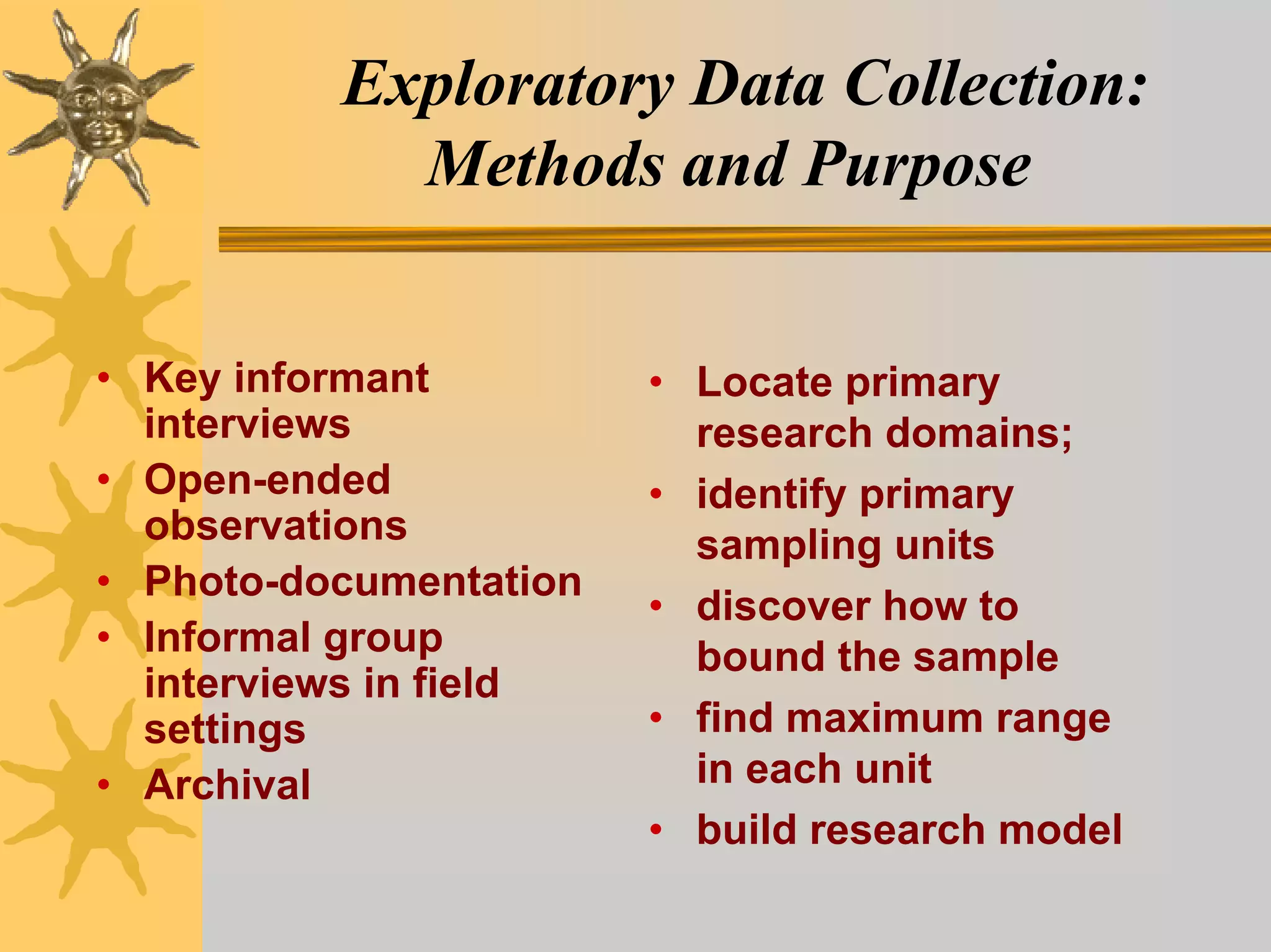
Exploratory Data Collection:
            Methods and Purpose


• Key informant         • Locate primary
  interviews              research domains;
• Open-ended            • identify primary
  observations            sampling units
• Photo-documentation
                        • discover how to
• Informal group          bound the sample
  interviews in field
  settings              • find maximum range
• Archival                in each unit
                        • build research model
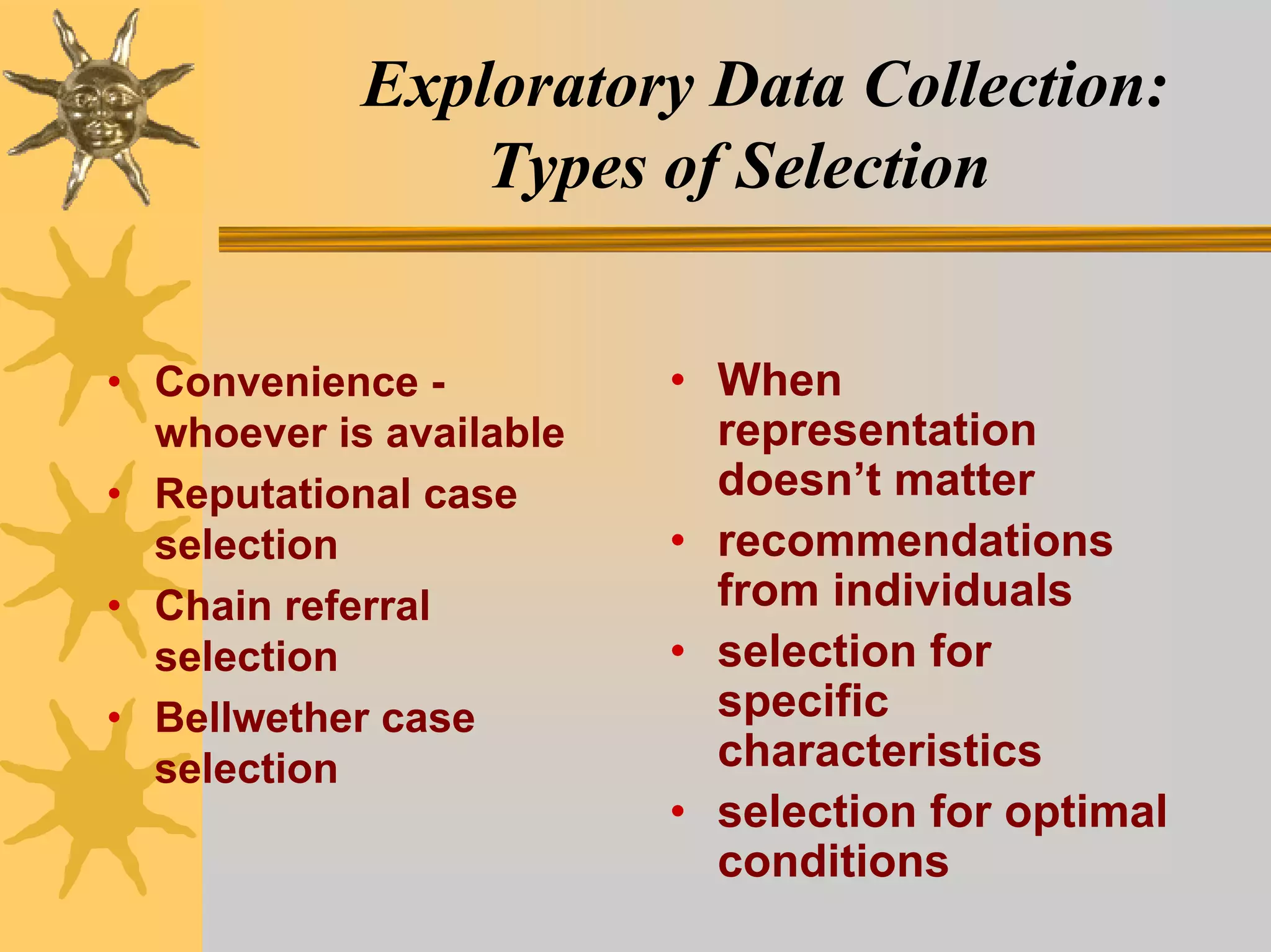
Exploratory Data Collection:
                Types of Selection


• Convenience -          • When
  whoever is available     representation
• Reputational case        doesn’t matter
  selection              • recommendations
• Chain referral           from individuals
  selection              • selection for
• Bellwether case          specific
  selection                characteristics
                         • selection for optimal
                           conditions
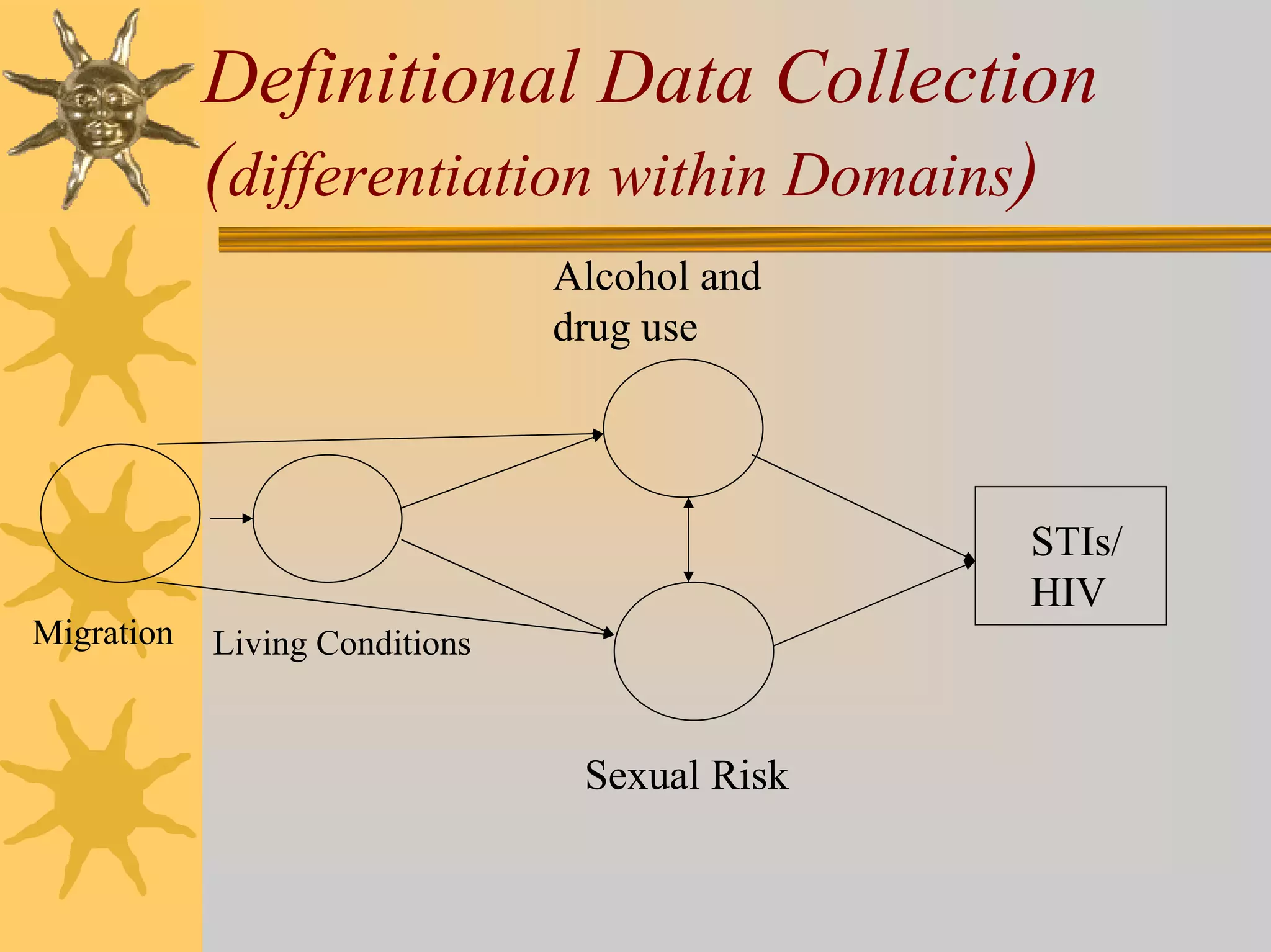
Definitional Data Collection
            (differentiation within Domains)
                                Alcohol and
                                drug use


                                               STIs/
                                               HIV
Migration   Living Conditions


                                 Sexual Risk
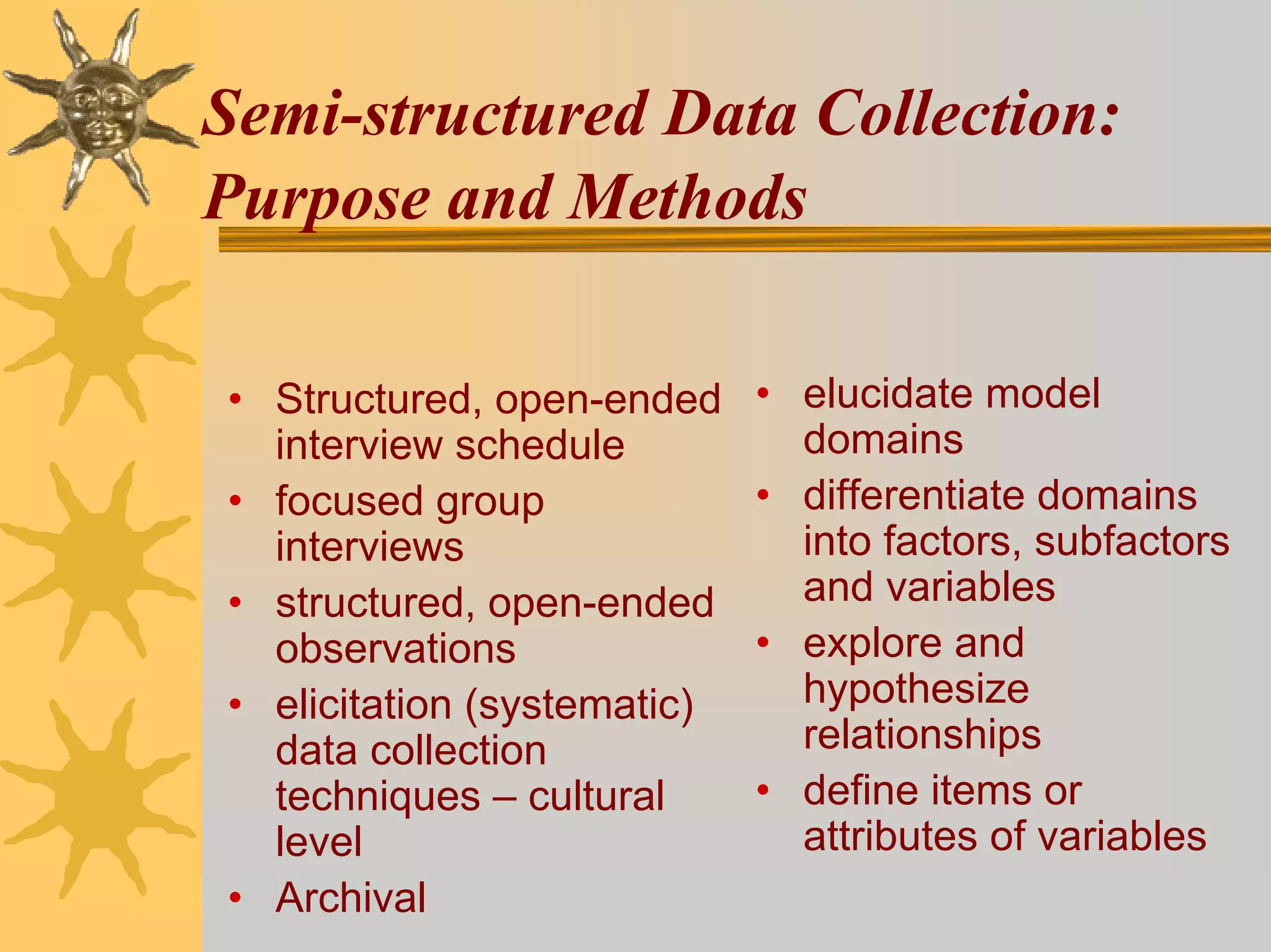
Semi-structured Data Collection:
Purpose and Methods

• Structured, open-ended     • elucidate model
  interview schedule           domains
• focused group              • differentiate domains
  interviews                   into factors, subfactors
• structured, open-ended       and variables
  observations               • explore and
• elicitation (systematic)     hypothesize
  data collection              relationships
  techniques – cultural      • define items or
  level                        attributes of variables
• Archival
Semi-Structured Data Collection:
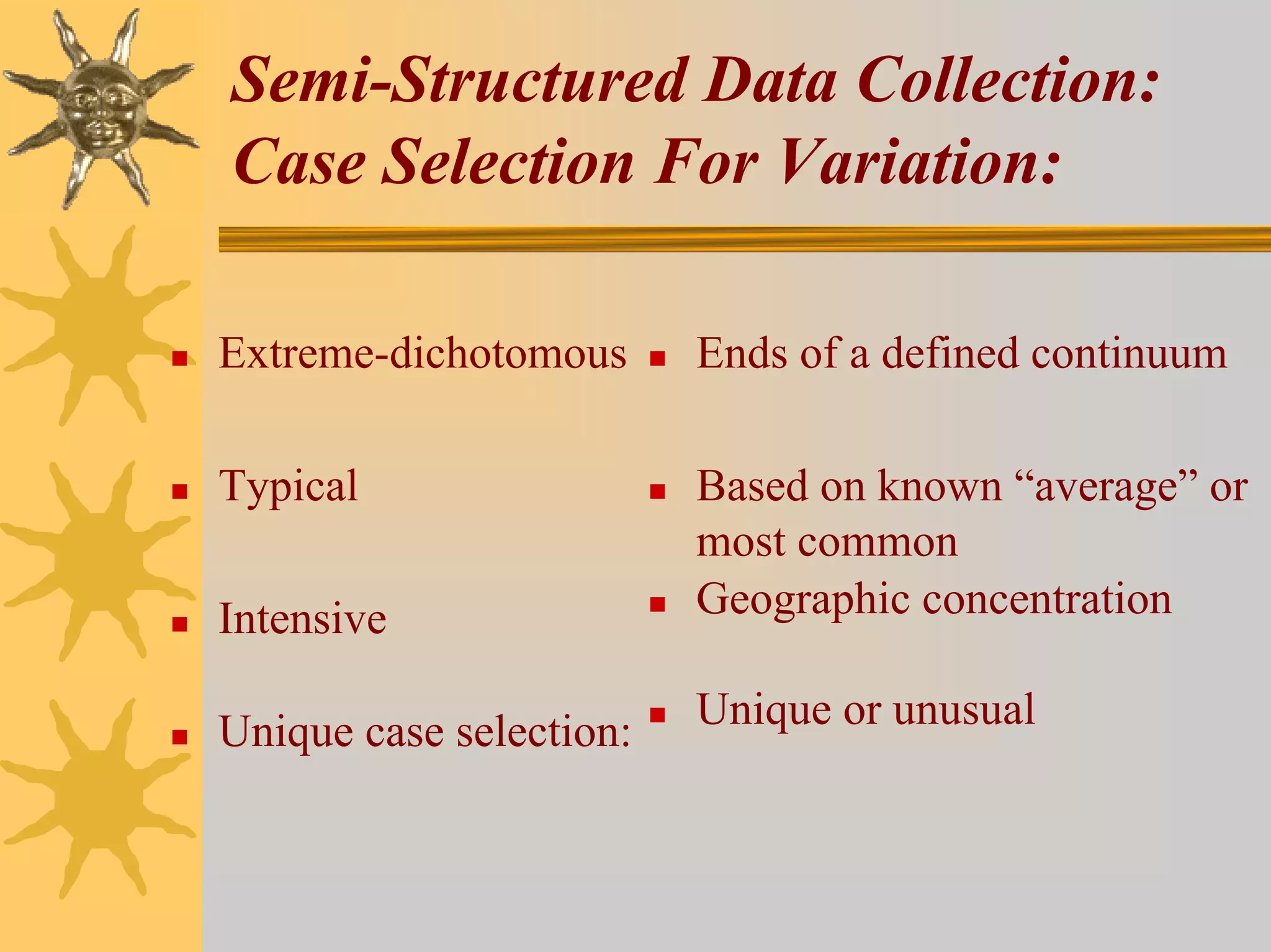
Case Selection For Variation:

Extreme-dichotomous      Ends of a defined continuum

Typical                  Based on known “average” or
                         most common
Intensive                Geographic concentration

Unique case selection:   Unique or unusual
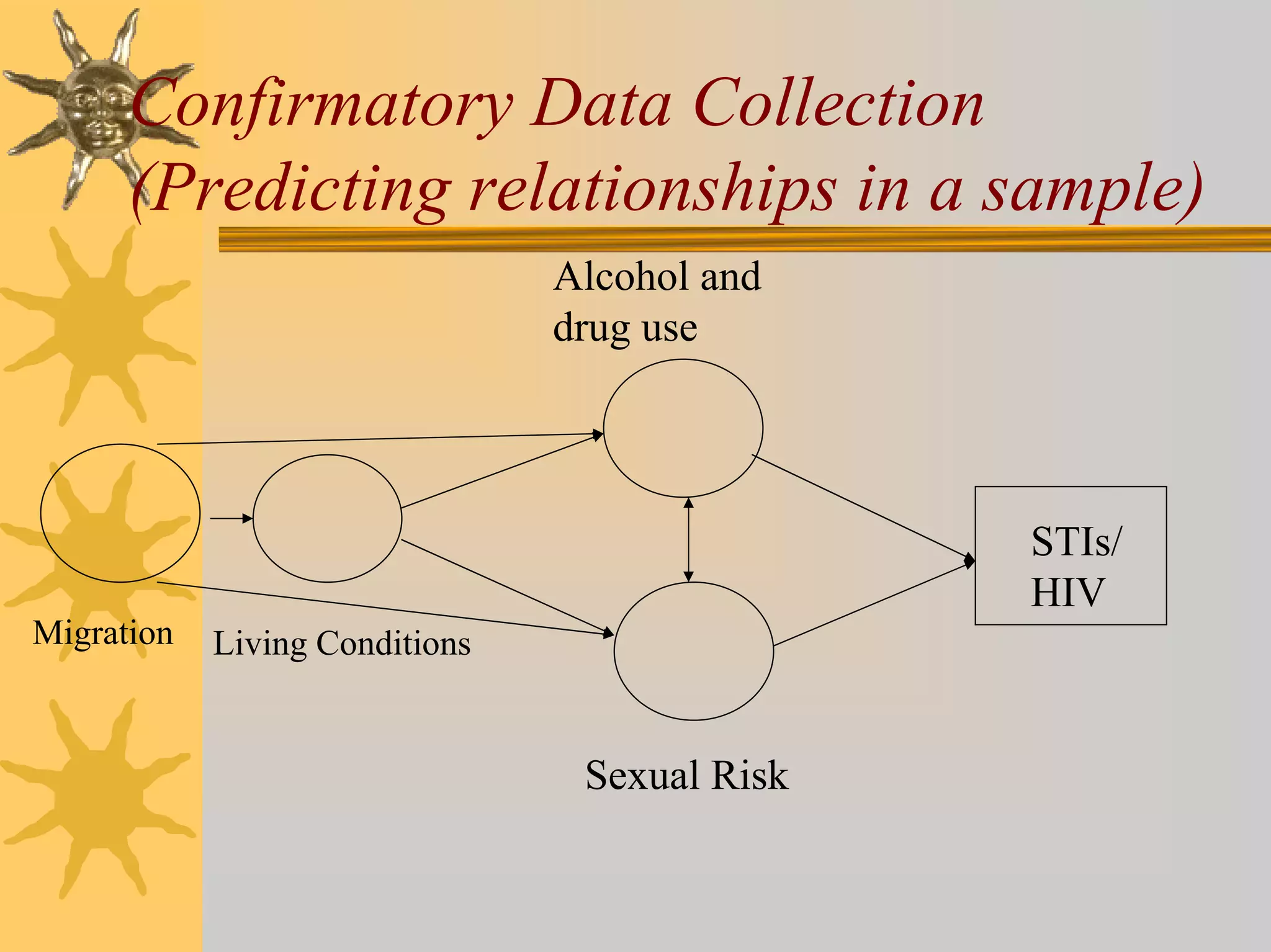
Confirmatory Data Collection
      (Predicting relationships in a sample)
                                Alcohol and
                                drug use


                                               STIs/
                                               HIV
Migration   Living Conditions


                                 Sexual Risk
Structured Data Collection:
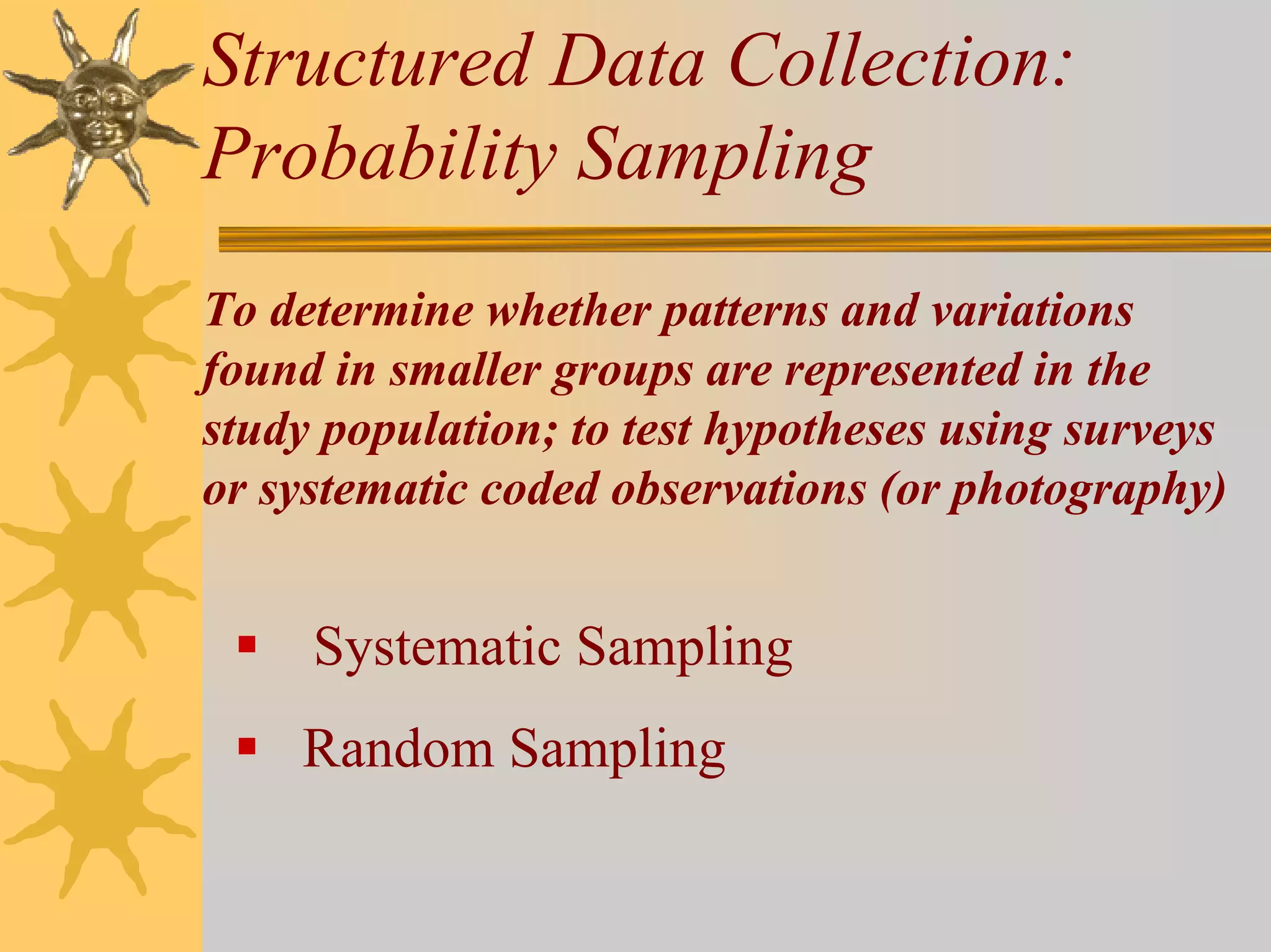
Probability Sampling
To determine whether patterns and variations
found in smaller groups are represented in the
study population; to test hypotheses using surveys
or systematic coded observations (or photography)


     Systematic Sampling
    Random Sampling
Structured Data Collection:
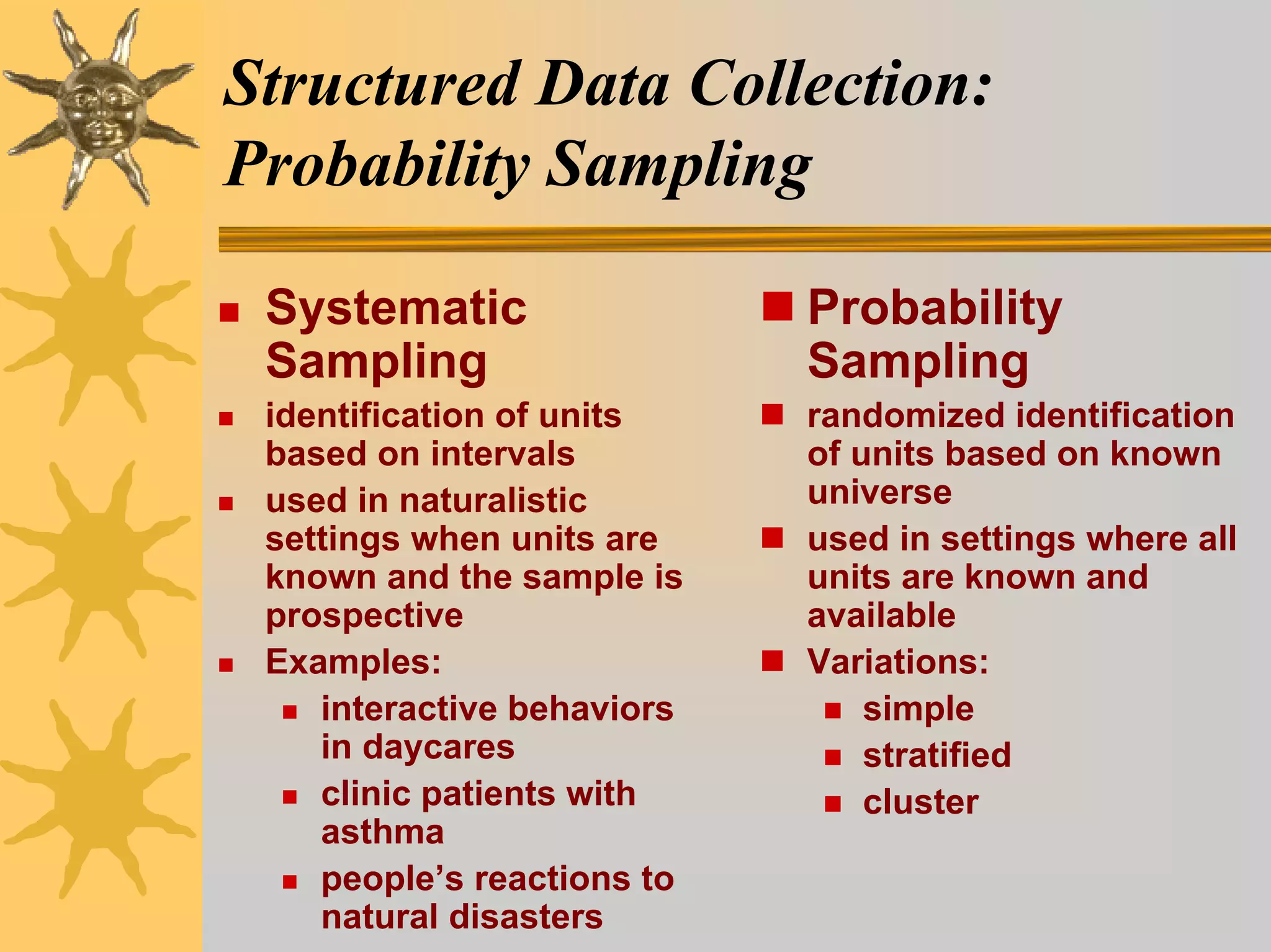
Probability Sampling

 Systematic                 Probability
 Sampling                   Sampling
 identification of units    randomized identification
 based on intervals         of units based on known
 used in naturalistic       universe
 settings when units are    used in settings where all
 known and the sample is    units are known and
 prospective                available
 Examples:                  Variations:
    interactive behaviors       simple
    in daycares                 stratified
    clinic patients with        cluster
    asthma
    people’s reactions to
    natural disasters
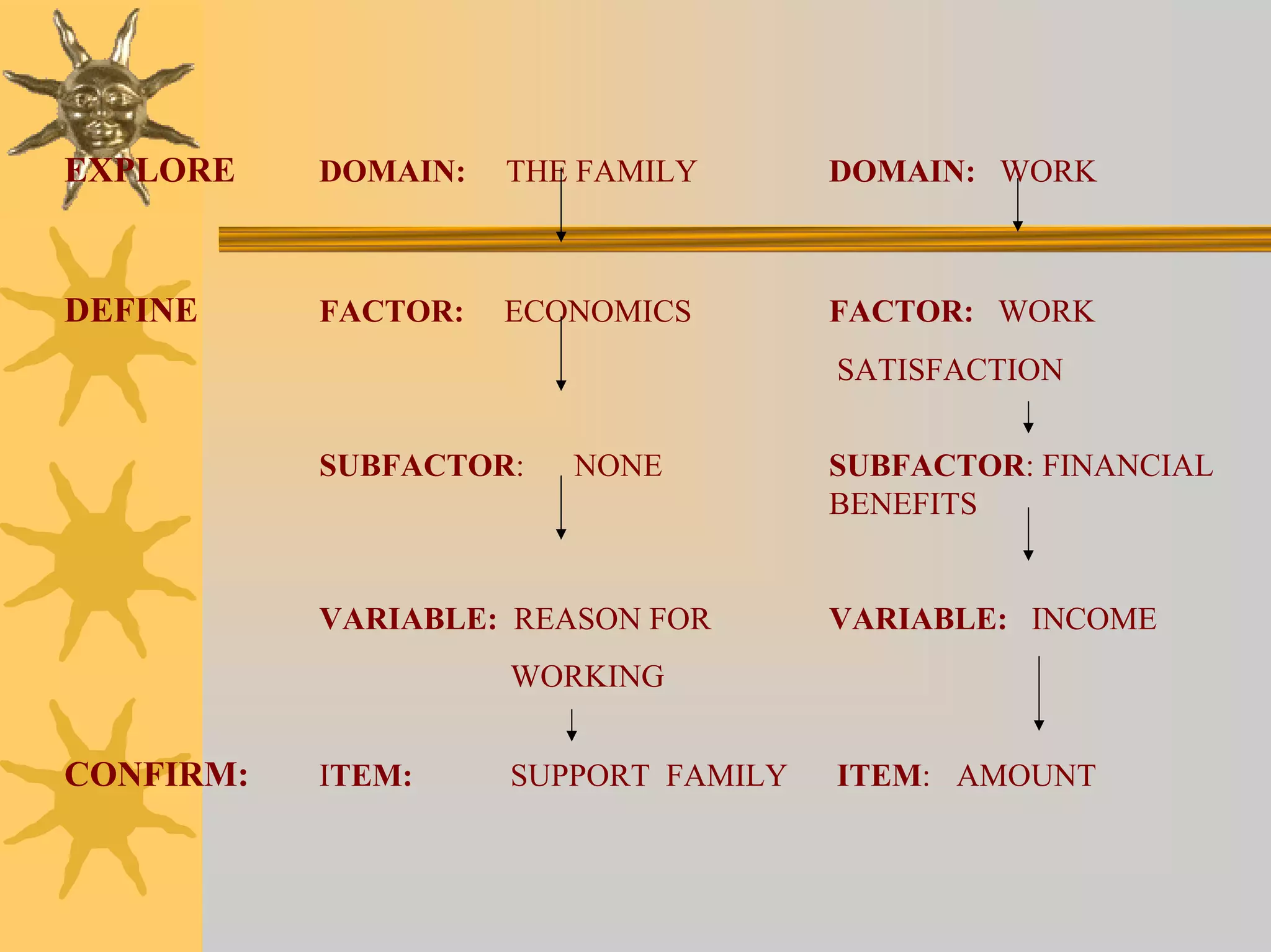
EXPLORE    DOMAIN:   THE FAMILY       DOMAIN: WORK


DEFINE     FACTOR:   ECONOMICS        FACTOR: WORK
                                      SATISFACTION


           SUBFACTOR:   NONE          SUBFACTOR: FINANCIAL
                                      BENEFITS


           VARIABLE: REASON FOR       VARIABLE: INCOME
                     WORKING


CONFIRM:   ITEM:     SUPPORT FAMILY   ITEM: AMOUNT
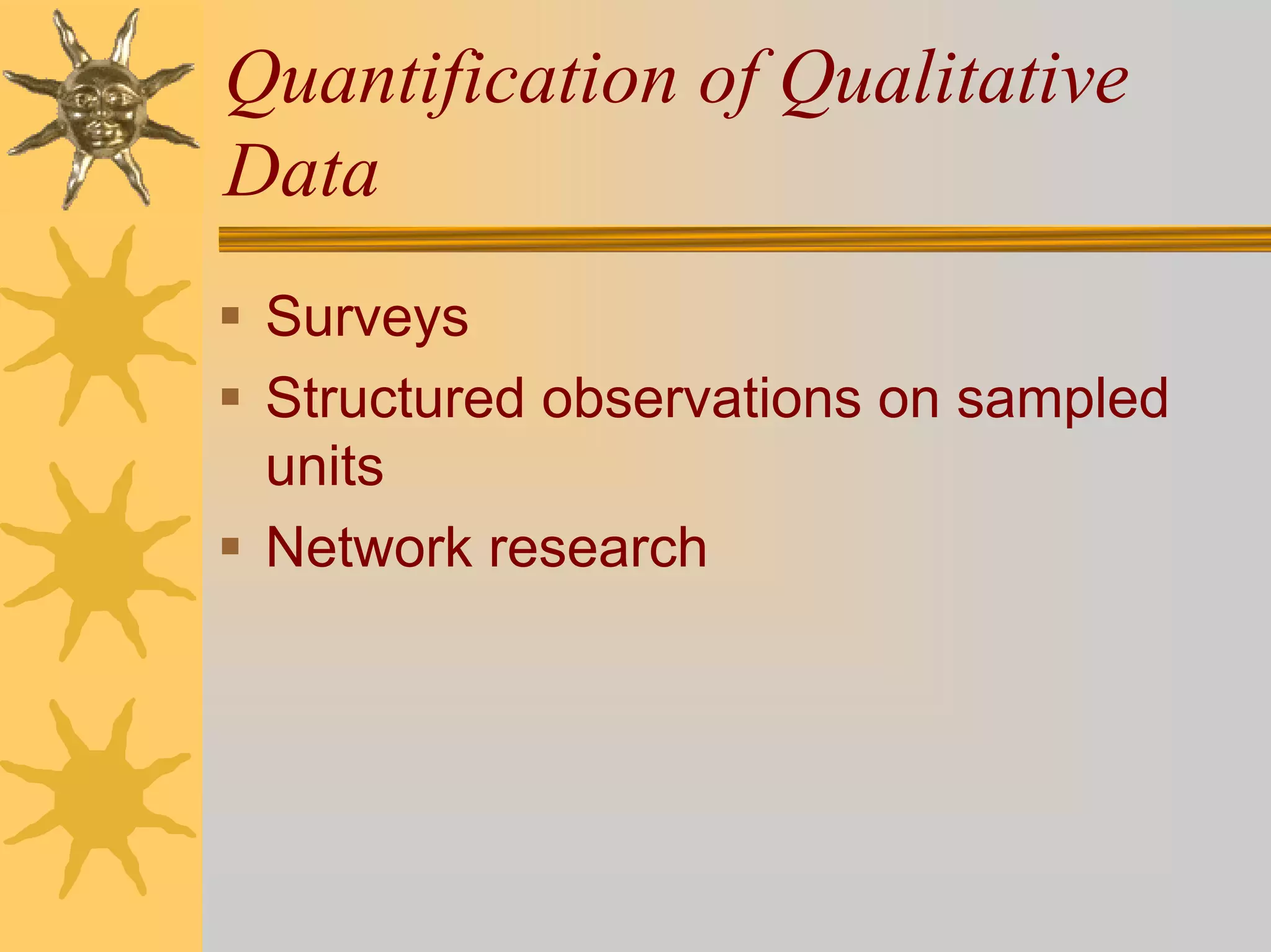
Quantification of Qualitative
Data
 Surveys
 Structured observations on sampled
 units
 Network research
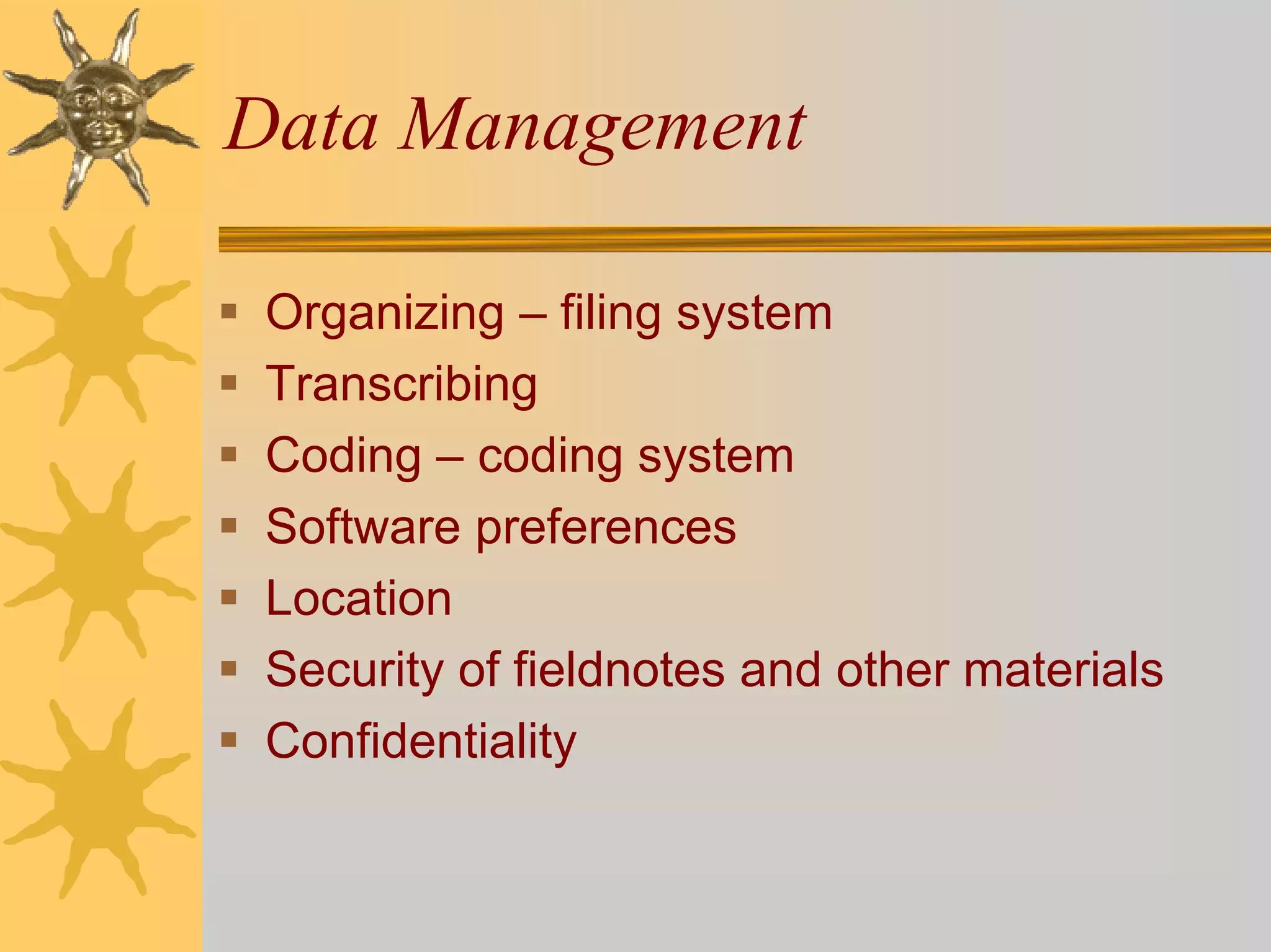
Data Management

 Organizing – filing system
 Transcribing
 Coding – coding system
 Software preferences
 Location
 Security of fieldnotes and other materials
 Confidentiality
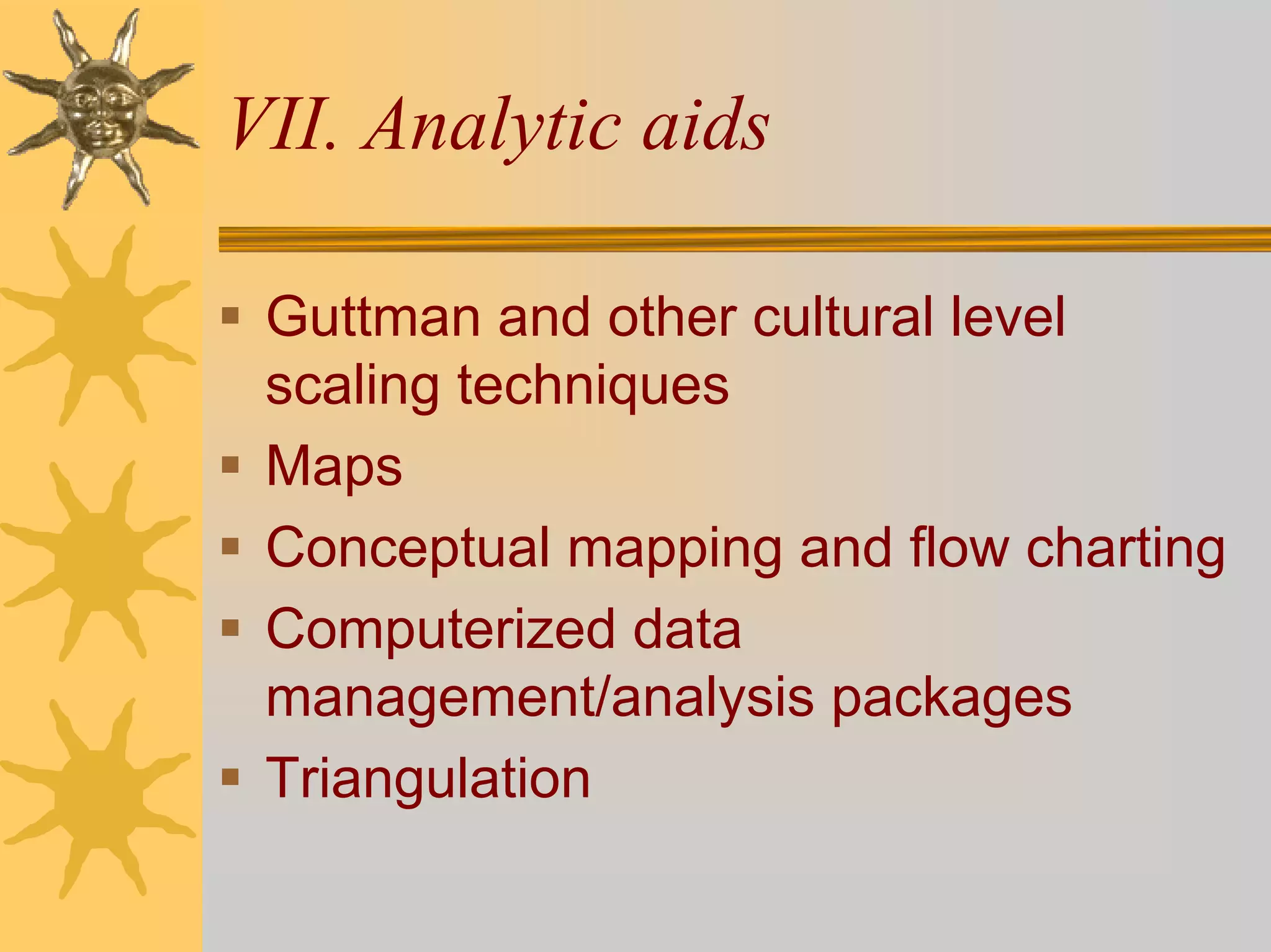
VII. Analytic aids

 Guttman and other cultural level
 scaling techniques
 Maps
 Conceptual mapping and flow charting
 Computerized data
 management/analysis packages
 Triangulation
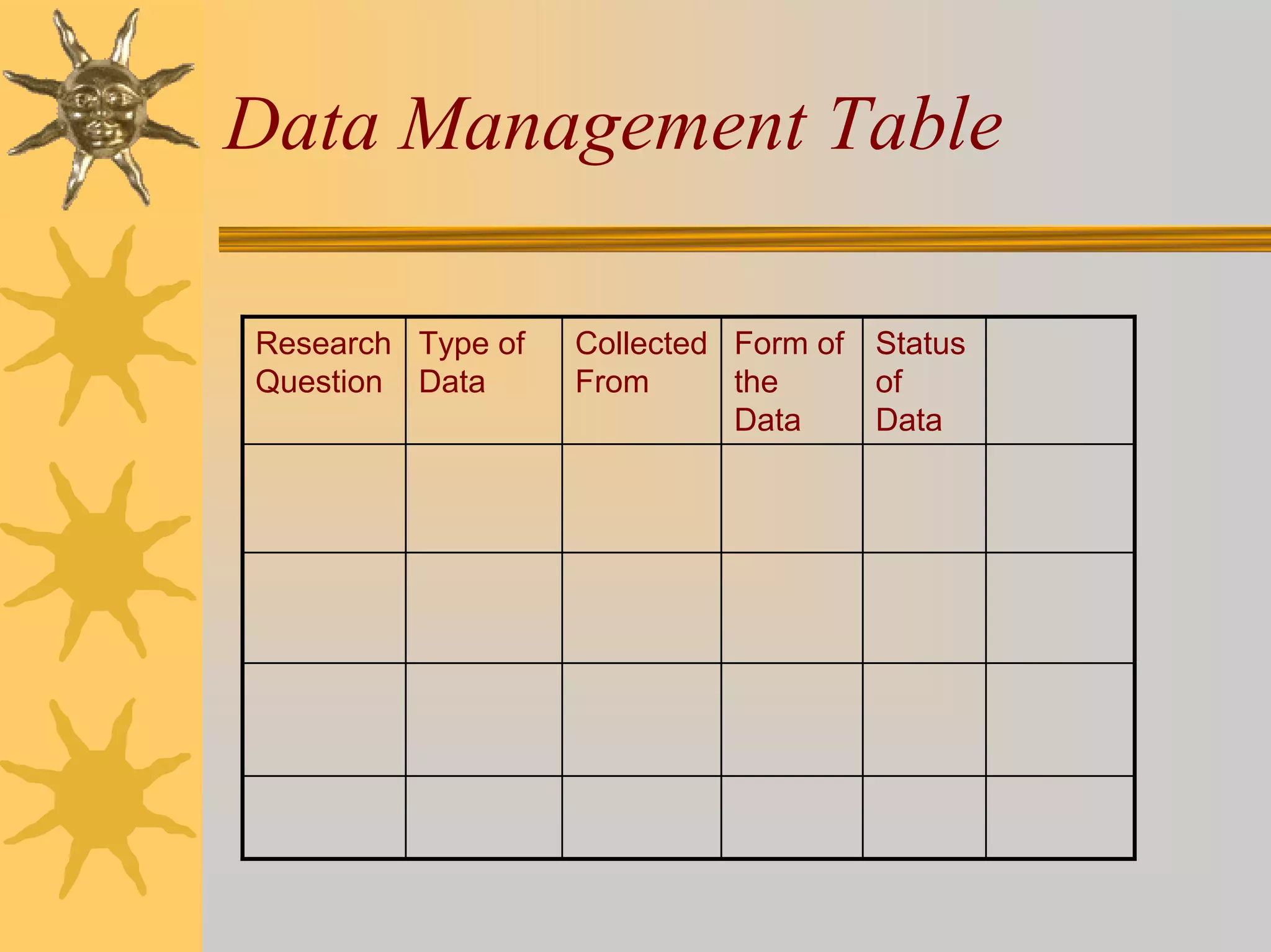
Data Management Table

Research Type of   Collected Form of Status
Question Data      From      the     of
                             Data    Data
VIII. Organizational support

 Staffing
 Training
 Timeline
 Ethical considerations
 Budget
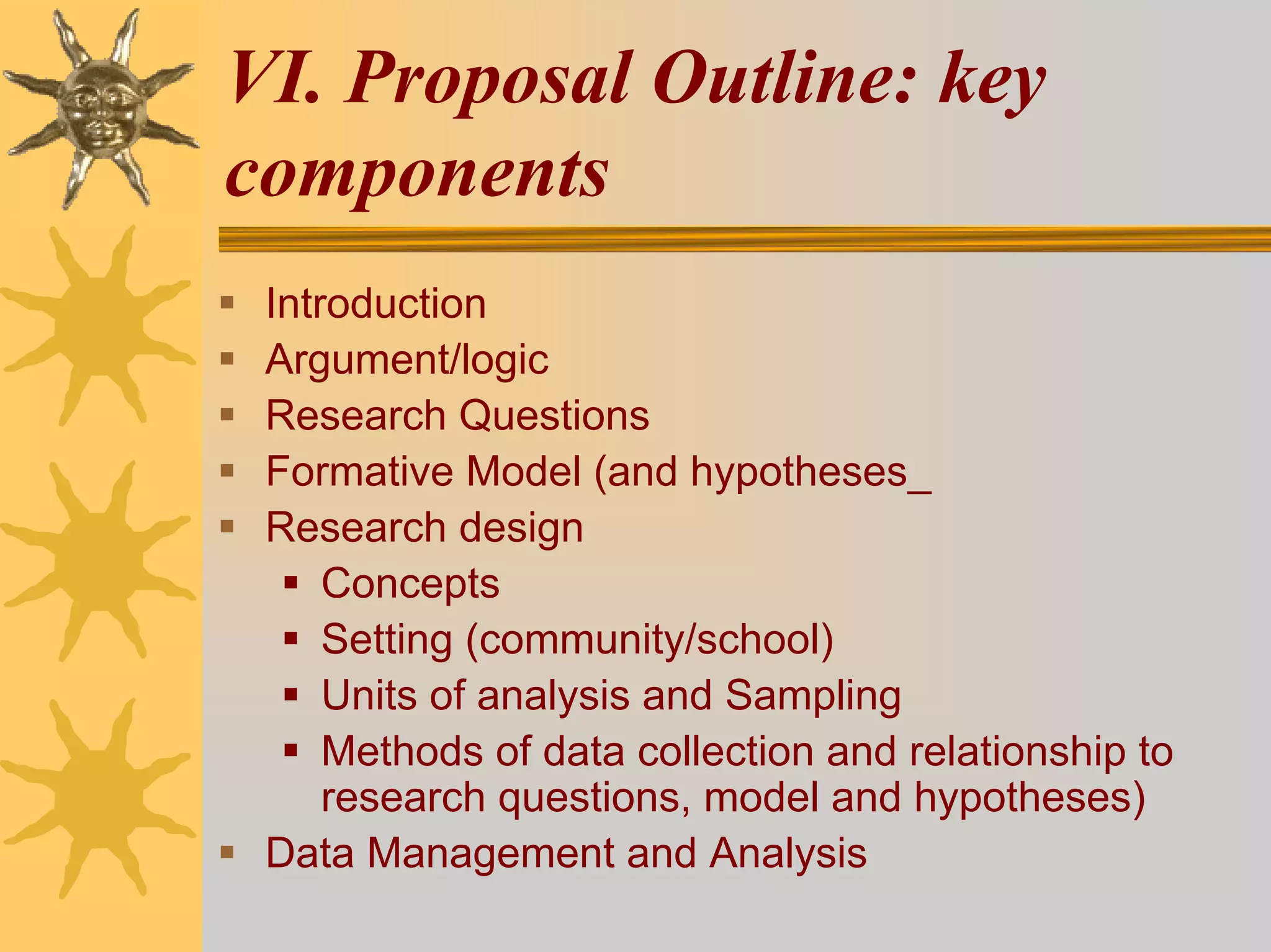
VI. Proposal Outline: key
components
 Introduction
 Argument/logic
 Research Questions
 Formative Model (and hypotheses_
 Research design
     Concepts
     Setting (community/school)
     Units of analysis and Sampling
     Methods of data collection and relationship to
     research questions, model and hypotheses)
 Data Management and Analysis
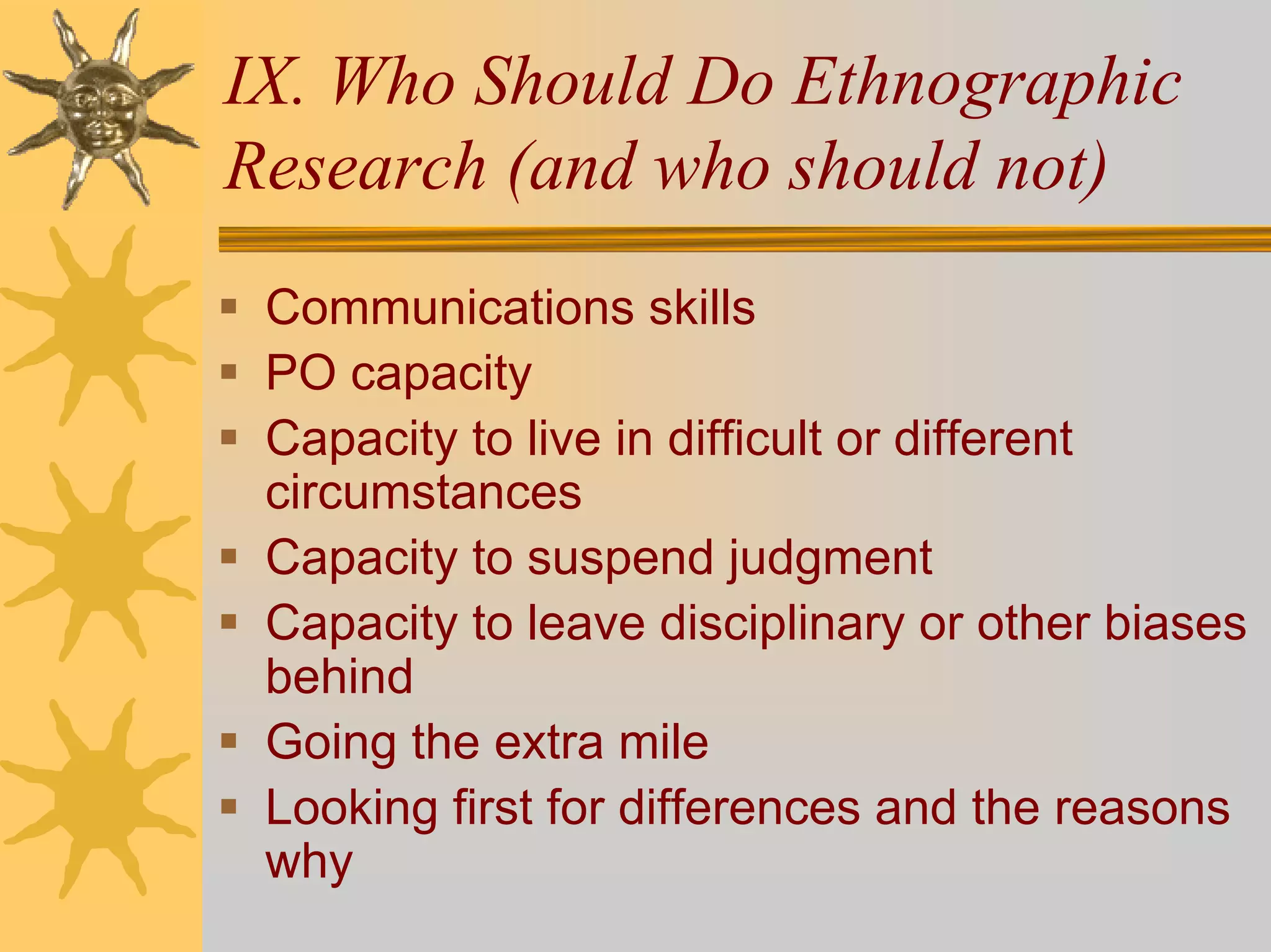
IX. Who Should Do Ethnographic
Research (and who should not)
 Communications skills
 PO capacity
 Capacity to live in difficult or different
 circumstances
 Capacity to suspend judgment
 Capacity to leave disciplinary or other biases
 behind
 Going the extra mile
 Looking first for differences and the reasons
 why

Brief view about type of research design

  • 1.
    What is Ethnography Introductionto Ethnographic Research Jean J. Schensul, Ph.D. Institute for Community Research www.incommunityresearch.org Prepared for CIRA M & B Core, July, 2005
  • 2.
    Goals for Today Introduction to main components of ethnographic research Developing research questions Developing a research model Outlining an ethnographic “proposal” Self-assessment
  • 3.
    Outline I. What is Ethnography? II. Ethnographic research questions III. Research modeling IV. Building blocks of ethnographic research V. Developing a research design VI. Proposal outline VII. Analytic Aids VIII. Organizational Supports IX. Who should do ethnographic research
  • 4.
    I. What isEthnography Inquiry (asking questions) Discovery (discovering new things) Exploration and description/ confirmation or discovery of relationships among variables (developing and testing hypotheses)
  • 5.
    Ethnography is about Communities…. Geographically situated Problem or topic oriented Involves participation in the life of the “community” May contribute to issue clarification or to pointing to directions for targeted social change Ethnography involves……………
  • 6.
    research in anatural setting Intimate face to face interaction with participants; accurate reflection of participants' perspectives and behaviors; utilizes multiple data sources qualitative and qualtitative inductive, interactive and recursive data collection analytic strategies to build local cultural theories; frames behavior and action in socio-political and historical context; uses concept of culture as a lens through which to interpret results.
  • 7.
    Qualitative/Quantitative Research Differences QualitativeResearch Quantitative Research Describes the quality of Measures the quantity of phenomena phenomena Is primarily inductive – Is primary deductive - tests builds theory theory Uses text based data Uses numerical data based derived from observations, on quantification interviews and elicitation Focus of study is local, Focus of study is localized national or international Unit of analysis is usually Unit of analysis is usually larger than the individual the individual Usually uses universal or Randomizes sampling selective sampling procedures Emphasizes validity Emphasizes reliability and Uses case- generalizability study/continuous Uses experimental or assessment design in quasi-experimental design interventions in a controlled settings
  • 8.
    What surveys do Surveys can test hypotheses that predict change in a population over time. Surveys are useful in demonstrating national and local trends
  • 9.
    When to CallUpon Qualitative/Ethnographic and Case Study Approaches When the problem is not clear (new public health problem). When we don’t know why something happens When the domain is not well understood When the target population is not identified. When random sampling does not capture range of variation. When there is a disjuncture between what people know and what they do When respondents (or researchers) don’t trust surveys When new approaches to intervention are required. When an intervention has unexpected processes or outcomes When the research design is not a good fit When new trends emerge that are not included in existing surveys When people want their story told When a perspective is not represented When lifestyles vary When traditional measures do not address causes and
  • 10.
    II. Ethnographic Research Questions Differences among people (ethnicity, age, residential situation, etc.) (predictors) Different behaviors, cultural beliefs, attitudes, norms, risks (outcomes) Relationships (processes) Processes (community, organizational, problem solving, decision making etc.) Structures (policies, norms, rules, etc.) Historical factors (background variables) Statuses (health, educational, economic, political
  • 11.
    How Do WeGenerate Questions? Reading Invention Observation Discrepancy and conflict Change over time (trends) Others’ questions or observations Interdisciplinary or cross situation comparisons
  • 12.
    III. Research Modeling Core domain and related domains Dependent domain and Predictor domains Systems variables and individual level predictors Ecological Modeling as a useful tool
  • 13.
    Ethnographic Social Science (ethno-logic) - Community Etc. Institutions Social Network Family Family Individual
  • 14.
  • 15.
    The Initial ResearchModel PEERS KNOWLEDGE SEXUAL PROTECTIVE FAMILY BEHAVIOR BEHAVIOR COMMUNITY ATTITUDES
  • 16.
    V. Developing aResearch Design: Components Formative Model Research questions and/or initial hypotheses Selection of Methods Phase I (qualitative) Phase II (quantitative Sampling protocols and options
  • 17.
    IV. Building Blocksof Ethnographic Research A. Introduction to community B. Exploratory A. Unstructured data collection A. Observation and social mapping B. Key informant interviews C. Participant observation B. Semi-structured data collection A. Interviews – and sorts B. Observations C. Confirmatory A. Structured A. Systematic Observations B. Surveys
  • 18.
    Other types ofdata Archival data Photographic, video or film data Other forms of elicitation data (using collages, photographs, etc.) Life histories, personal narratives
  • 19.
    Stages In EthnographicResearch • Exploratory Data Collection - Open ended data collection methods • Definitional - Semi-structured Data Collection • Confirmatory - Ethnographic Surveys and other qualtifiable data collection methods
  • 20.
    Exploratory (other domains?) Alcohol and drug use STIS, HIV Migration Sexual Risk behavior
  • 21.
    Exploratory Data Collection: Methods and Purpose • Key informant • Locate primary interviews research domains; • Open-ended • identify primary observations sampling units • Photo-documentation • discover how to • Informal group bound the sample interviews in field settings • find maximum range • Archival in each unit • build research model
  • 22.
    Exploratory Data Collection: Types of Selection • Convenience - • When whoever is available representation • Reputational case doesn’t matter selection • recommendations • Chain referral from individuals selection • selection for • Bellwether case specific selection characteristics • selection for optimal conditions
  • 23.
    Definitional Data Collection (differentiation within Domains) Alcohol and drug use STIs/ HIV Migration Living Conditions Sexual Risk
  • 24.
    Semi-structured Data Collection: Purposeand Methods • Structured, open-ended • elucidate model interview schedule domains • focused group • differentiate domains interviews into factors, subfactors • structured, open-ended and variables observations • explore and • elicitation (systematic) hypothesize data collection relationships techniques – cultural • define items or level attributes of variables • Archival
  • 25.
    Semi-Structured Data Collection: CaseSelection For Variation: Extreme-dichotomous Ends of a defined continuum Typical Based on known “average” or most common Intensive Geographic concentration Unique case selection: Unique or unusual
  • 26.
    Confirmatory Data Collection (Predicting relationships in a sample) Alcohol and drug use STIs/ HIV Migration Living Conditions Sexual Risk
  • 27.
    Structured Data Collection: ProbabilitySampling To determine whether patterns and variations found in smaller groups are represented in the study population; to test hypotheses using surveys or systematic coded observations (or photography) Systematic Sampling Random Sampling
  • 28.
    Structured Data Collection: ProbabilitySampling Systematic Probability Sampling Sampling identification of units randomized identification based on intervals of units based on known used in naturalistic universe settings when units are used in settings where all known and the sample is units are known and prospective available Examples: Variations: interactive behaviors simple in daycares stratified clinic patients with cluster asthma people’s reactions to natural disasters
  • 29.
    EXPLORE DOMAIN: THE FAMILY DOMAIN: WORK DEFINE FACTOR: ECONOMICS FACTOR: WORK SATISFACTION SUBFACTOR: NONE SUBFACTOR: FINANCIAL BENEFITS VARIABLE: REASON FOR VARIABLE: INCOME WORKING CONFIRM: ITEM: SUPPORT FAMILY ITEM: AMOUNT
  • 30.
    Quantification of Qualitative Data Surveys Structured observations on sampled units Network research
  • 31.
    Data Management Organizing– filing system Transcribing Coding – coding system Software preferences Location Security of fieldnotes and other materials Confidentiality
  • 32.
    VII. Analytic aids Guttman and other cultural level scaling techniques Maps Conceptual mapping and flow charting Computerized data management/analysis packages Triangulation
  • 33.
    Data Management Table ResearchType of Collected Form of Status Question Data From the of Data Data
  • 34.
    VIII. Organizational support Staffing Training Timeline Ethical considerations Budget
  • 35.
    VI. Proposal Outline:key components Introduction Argument/logic Research Questions Formative Model (and hypotheses_ Research design Concepts Setting (community/school) Units of analysis and Sampling Methods of data collection and relationship to research questions, model and hypotheses) Data Management and Analysis
  • 36.
    IX. Who ShouldDo Ethnographic Research (and who should not) Communications skills PO capacity Capacity to live in difficult or different circumstances Capacity to suspend judgment Capacity to leave disciplinary or other biases behind Going the extra mile Looking first for differences and the reasons why