Adhesion Prevention In
Peritoneal Surgery
Dr. Mamdouh Sabry
MD. Ain Shams Un. Egypt, Ph.D. France, Paris V. Un.
Consultant Ob. & Gyn.
EL Mataria Teaching Hospital, Nasser Institute
Cairo, Egypt
Peritoneal adhesions continue to be the
bogey of reproductive & non reproductive
surgeons.
 Infection
 Endometriosis
 Surgical Trauma
Etiology:
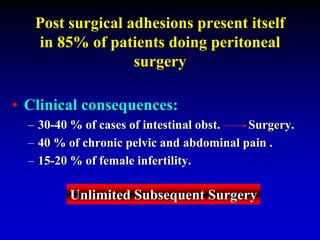
Post surgical adhesions present itself
in 85% of patients doing peritoneal
surgery
• Clinical consequences:
– 30-40 % of cases of intestinal obst. Surgery.
– 40 % of chronic pelvic and abdominal pain .
– 15-20 % of female infertility.
Unlimited Subsequent Surgery
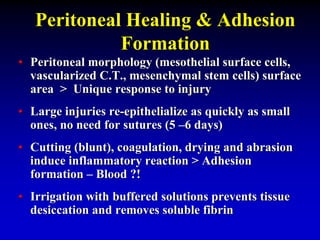
Peritoneal Healing & Adhesion
Formation
• Peritoneal morphology (mesothelial surface cells,
vascularized C.T., mesenchymal stem cells) surface
area > Unique response to injury
• Large injuries re-epithelialize as quickly as small
ones, no need for sutures (5 –6 days)
• Cutting (blunt), coagulation, drying and abrasion
induce inflammatory reaction > Adhesion
formation – Blood ?!
• Irrigation with buffered solutions prevents tissue
desiccation and removes soluble fibrin
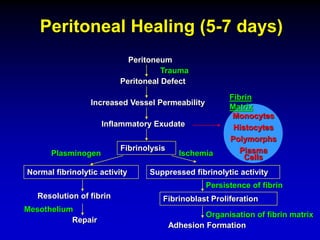
Peritoneum
Peritoneal Defect
Increased Vessel Permeability
Inflammatory Exudate
Trauma
Monocytes
Histocytes
Polymorphs
Plasma
Cells
Fibrin
Matrix
Fibrinolysis
Normal fibrinolytic activity Suppressed fibrinolytic activity
Plasminogen Ischemia
Resolution of fibrin
Repair
Mesothelium
Fibrinoblast Proliferation
Adhesion Formation
Persistence of fibrin
Organisation of fibrin matrix
Peritoneal Healing (5-7 days)
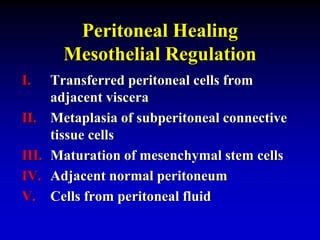
Peritoneal Healing
Mesothelial Regulation
I. Transferred peritoneal cells from
adjacent viscera
II. Metaplasia of subperitoneal connective
tissue cells
III. Maturation of mesenchymal stem cells
IV. Adjacent normal peritoneum
V. Cells from peritoneal fluid
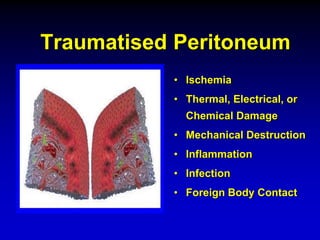
Traumatised Peritoneum
• Ischemia
• Thermal, Electrical, or
Chemical Damage
• Mechanical Destruction
• Inflammation
• Infection
• Foreign Body Contact
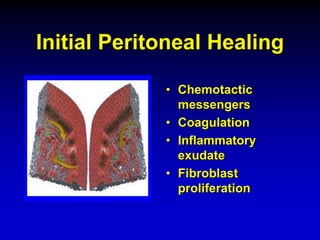
Initial Peritoneal Healing
• Chemotactic
messengers
• Coagulation
• Inflammatory
exudate
• Fibroblast
proliferation
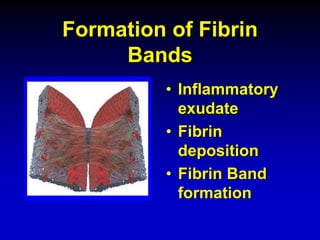
Formation of Fibrin
Bands
• Inflammatory
exudate
• Fibrin
deposition
• Fibrin Band
formation
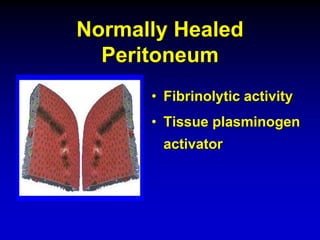
Normally Healed
Peritoneum
• Fibrinolytic activity
• Tissue plasminogen
activator
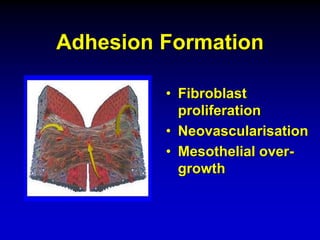
Adhesion Formation
• Fibroblast
proliferation
• Neovascularisation
• Mesothelial over-
growth
Laparotomy – Laparoscopy
& Adhesions
• Differences
• Abdominal wall adhesions
• Techniques
• Adhesion scoring
Correlation between skin incision, prior surgery, and
subsequent adhesion formation
0
20
40
60
80
100
120
M. Sabry & Di Zerega GSD
IncidenceofAdhesion
Incision type Pfannenstiel Pfannenstiel Midline Midline Midline Midline
Incision number Multiple Single Multiple Single Multiple
Umbilicus Below Below Above Above
Number 180 78 55 32 30 9
Laparotomy - Laparoscopy
• The extent and severity of adhesions after
laparoscopy are less than laparotomy with absence
of de novo adhesions ( Diamond et al 1987, 2000 ,
Di Zerega 2007 and M. Sabry 2009)
• Laparoscopy is less likely to cause adhesions in
untouched patient
• Despite introduction of laparoscopy and application
of meticulous surgical technique, still the rate of
adhesion reformation after adhesiolysis is not low.
• So other efforts are needed
Insufflation & Peritoneum
• Filtered, heated, hydrated gas
must be used for laparoscopy
The Prevention of Adhesions
• Good Surgical Technique, dissection,
sutures, cauterisation, instruments .........
• Reduction of the inflammatory reaction,
towelling .....
• Prevention of fibrin formation
• Mechanical separation of raw surfaces
• Other adjunctive therapies. (Barriers)
Barriers
• Barriers are the only proven method of
reducing the incidence of adhesions
without causing any adverse reactions
• Characteristics of the ideal barrier:
• Safe and effective
• Absorbable
• Promotes remesothelialisation
• Non-inflammatory
• Easy to use
• Cost effective
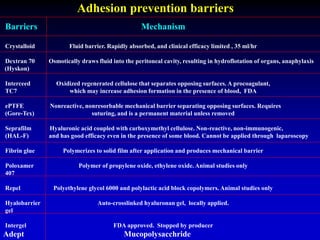
Adhesion prevention barriers
Barriers Mechanism
Crystalloid Fluid barrier. Rapidly absorbed, and clinical efficacy limited , 35 ml/hr
Dextran 70 Osmotically draws fluid into the peritoneal cavity, resulting in hydroflotation of organs, anaphylaxis
(Hyskon)
Interceed Oxidized regenerated cellulose that separates opposing surfaces. A procoagulant,
TC7 which may increase adhesion formation in the presence of blood, FDA
ePTFE Nonreactive, nonresorbable mechanical barrier separating opposing surfaces. Requires
(Gore-Tex) suturing, and is a permanent material unless removed
Seprafilm Hyaluronic acid coupled with carboxymethyl cellulose. Non-reactive, non-immunogenic,
(HAL-F) and has good efficacy even in the presence of some blood. Cannot be applied through laparoscopy
Fibrin glue Polymerizes to solid film after application and produces mechanical barrier
Poloxamer Polymer of propylene oxide, ethylene oxide. Animal studies only
407
Repel Polyethylene glycol 6000 and polylactic acid block copolymers. Animal studies only
Hyalobarrier Auto-crosslinked hyaluronan gel, locally applied.
gel
Intergel FDA approved. Stopped by producer
Adept Mucopolysacchride
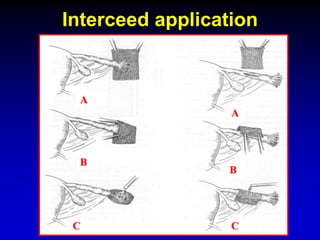
Interceed application
A
A
B
B
CC
Intergel
• Hyaluronic acid is a naturally occurring
component of peritoneal fluid
• Peritoneal mesothelial cells synthesize
HA in vitro
• It plays a role (HA) in cellular lubrication
and maintenance of structural integrity
of tissue as well as regulation of fluid
retention
Conclusion
Ideal Barrier
• Safe
• Absorbable gel or fluid
• Clinically proven to reduce the incidence,
extent and severity of post surgical
adhesions
• Effective at the surgical site as well as
throughout the peritoneal cavity
• Easy to use
• Compatible with laparoscopy
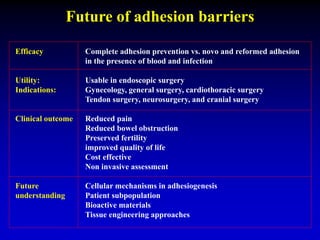
Future of adhesion barriers
Efficacy Complete adhesion prevention vs. novo and reformed adhesion
in the presence of blood and infection
Utility: Usable in endoscopic surgery
Indications: Gynecology, general surgery, cardiothoracic surgery
Tendon surgery, neurosurgery, and cranial surgery
Clinical outcome Reduced pain
Reduced bowel obstruction
Preserved fertility
improved quality of life
Cost effective
Non invasive assessment
Future Cellular mechanisms in adhesiogenesis
understanding Patient subpopulation
Bioactive materials
Tissue engineering approaches
Thank you

Adhesion prevention in peritoneal surgery

  • 1.
    Adhesion Prevention In PeritonealSurgery Dr. Mamdouh Sabry MD. Ain Shams Un. Egypt, Ph.D. France, Paris V. Un. Consultant Ob. & Gyn. EL Mataria Teaching Hospital, Nasser Institute Cairo, Egypt
  • 2.
    Peritoneal adhesions continueto be the bogey of reproductive & non reproductive surgeons.  Infection  Endometriosis  Surgical Trauma Etiology:
  • 3.
    Post surgical adhesionspresent itself in 85% of patients doing peritoneal surgery • Clinical consequences: – 30-40 % of cases of intestinal obst. Surgery. – 40 % of chronic pelvic and abdominal pain . – 15-20 % of female infertility. Unlimited Subsequent Surgery
  • 4.
    Peritoneal Healing &Adhesion Formation • Peritoneal morphology (mesothelial surface cells, vascularized C.T., mesenchymal stem cells) surface area > Unique response to injury • Large injuries re-epithelialize as quickly as small ones, no need for sutures (5 –6 days) • Cutting (blunt), coagulation, drying and abrasion induce inflammatory reaction > Adhesion formation – Blood ?! • Irrigation with buffered solutions prevents tissue desiccation and removes soluble fibrin
  • 5.
    Peritoneum Peritoneal Defect Increased VesselPermeability Inflammatory Exudate Trauma Monocytes Histocytes Polymorphs Plasma Cells Fibrin Matrix Fibrinolysis Normal fibrinolytic activity Suppressed fibrinolytic activity Plasminogen Ischemia Resolution of fibrin Repair Mesothelium Fibrinoblast Proliferation Adhesion Formation Persistence of fibrin Organisation of fibrin matrix Peritoneal Healing (5-7 days)
  • 6.
    Peritoneal Healing Mesothelial Regulation I.Transferred peritoneal cells from adjacent viscera II. Metaplasia of subperitoneal connective tissue cells III. Maturation of mesenchymal stem cells IV. Adjacent normal peritoneum V. Cells from peritoneal fluid
  • 7.
    Traumatised Peritoneum • Ischemia •Thermal, Electrical, or Chemical Damage • Mechanical Destruction • Inflammation • Infection • Foreign Body Contact
  • 8.
    Initial Peritoneal Healing •Chemotactic messengers • Coagulation • Inflammatory exudate • Fibroblast proliferation
  • 9.
    Formation of Fibrin Bands •Inflammatory exudate • Fibrin deposition • Fibrin Band formation
  • 10.
    Normally Healed Peritoneum • Fibrinolyticactivity • Tissue plasminogen activator
  • 11.
    Adhesion Formation • Fibroblast proliferation •Neovascularisation • Mesothelial over- growth
  • 12.
    Laparotomy – Laparoscopy &Adhesions • Differences • Abdominal wall adhesions • Techniques • Adhesion scoring
  • 13.
    Correlation between skinincision, prior surgery, and subsequent adhesion formation 0 20 40 60 80 100 120 M. Sabry & Di Zerega GSD IncidenceofAdhesion Incision type Pfannenstiel Pfannenstiel Midline Midline Midline Midline Incision number Multiple Single Multiple Single Multiple Umbilicus Below Below Above Above Number 180 78 55 32 30 9
  • 14.
    Laparotomy - Laparoscopy •The extent and severity of adhesions after laparoscopy are less than laparotomy with absence of de novo adhesions ( Diamond et al 1987, 2000 , Di Zerega 2007 and M. Sabry 2009) • Laparoscopy is less likely to cause adhesions in untouched patient • Despite introduction of laparoscopy and application of meticulous surgical technique, still the rate of adhesion reformation after adhesiolysis is not low. • So other efforts are needed
  • 15.
    Insufflation & Peritoneum •Filtered, heated, hydrated gas must be used for laparoscopy
  • 16.
    The Prevention ofAdhesions • Good Surgical Technique, dissection, sutures, cauterisation, instruments ......... • Reduction of the inflammatory reaction, towelling ..... • Prevention of fibrin formation • Mechanical separation of raw surfaces • Other adjunctive therapies. (Barriers)
  • 17.
    Barriers • Barriers arethe only proven method of reducing the incidence of adhesions without causing any adverse reactions • Characteristics of the ideal barrier: • Safe and effective • Absorbable • Promotes remesothelialisation • Non-inflammatory • Easy to use • Cost effective
  • 18.
    Adhesion prevention barriers BarriersMechanism Crystalloid Fluid barrier. Rapidly absorbed, and clinical efficacy limited , 35 ml/hr Dextran 70 Osmotically draws fluid into the peritoneal cavity, resulting in hydroflotation of organs, anaphylaxis (Hyskon) Interceed Oxidized regenerated cellulose that separates opposing surfaces. A procoagulant, TC7 which may increase adhesion formation in the presence of blood, FDA ePTFE Nonreactive, nonresorbable mechanical barrier separating opposing surfaces. Requires (Gore-Tex) suturing, and is a permanent material unless removed Seprafilm Hyaluronic acid coupled with carboxymethyl cellulose. Non-reactive, non-immunogenic, (HAL-F) and has good efficacy even in the presence of some blood. Cannot be applied through laparoscopy Fibrin glue Polymerizes to solid film after application and produces mechanical barrier Poloxamer Polymer of propylene oxide, ethylene oxide. Animal studies only 407 Repel Polyethylene glycol 6000 and polylactic acid block copolymers. Animal studies only Hyalobarrier Auto-crosslinked hyaluronan gel, locally applied. gel Intergel FDA approved. Stopped by producer Adept Mucopolysacchride
  • 19.
  • 20.
    Intergel • Hyaluronic acidis a naturally occurring component of peritoneal fluid • Peritoneal mesothelial cells synthesize HA in vitro • It plays a role (HA) in cellular lubrication and maintenance of structural integrity of tissue as well as regulation of fluid retention
  • 21.
    Conclusion Ideal Barrier • Safe •Absorbable gel or fluid • Clinically proven to reduce the incidence, extent and severity of post surgical adhesions • Effective at the surgical site as well as throughout the peritoneal cavity • Easy to use • Compatible with laparoscopy
  • 22.
    Future of adhesionbarriers Efficacy Complete adhesion prevention vs. novo and reformed adhesion in the presence of blood and infection Utility: Usable in endoscopic surgery Indications: Gynecology, general surgery, cardiothoracic surgery Tendon surgery, neurosurgery, and cranial surgery Clinical outcome Reduced pain Reduced bowel obstruction Preserved fertility improved quality of life Cost effective Non invasive assessment Future Cellular mechanisms in adhesiogenesis understanding Patient subpopulation Bioactive materials Tissue engineering approaches
  • 23.