National Institutes of Health 


                                     Attention Deficit Hyperactivity Disorder
Fact Sheet
                                                     (ADHD)

Attention deficit/hyperactivity disorder (ADHD) is one of the most common childhood disorders and can continue into
adolescence and adulthood. Symptoms include difficulty staying focused and paying attention, difficulty controlling
behavior, and very high levels of activity. Studies show that the number of children being diagnosed with ADHD is
increasing.

Yesterday
•	 ADHD was once considered a transient disorder of                fidgety symptoms common among those with
   childhood that children would outgrow upon                      ADHD.
   entering their teen years.
                                                               •	 Findings from the Preschoolers with ADHD
•	 ADHD was seen as a behavioral disturbance caused               Treatment Study (PATS) indicate that using low
   by environmental factors, such as inconsistent                 dose methylphenidate (for example, Ritalin) to treat
   parenting.                                                     children age 3–5 years diagnosed with severe
•	 Brain development in people with ADHD could not                ADHD can be effective.
   be studied directly, but only estimated by observing        •	 A preschooler’s response to medications for ADHD
   behavior or using other indirect methods.                      has been found to be associated with the number of
 •	 ADHD was treated with immediate release                       coexisting mental disorders the child has. Children
    stimulant medications such as methylphenidate (for            with fewer coexisting disorders were most likely to
    example, Ritalin), which worked well but whose                respond to methylphenidate treatment, whereas
    effect lasted only a few hours. Children needed               those with three or more coexisting disorders did
    multiple doses during the day, disrupting their               not respond to the treatment.
    school schedules and daily activities.                     •	 For some children, early behavioral interventions
                                                                  designed to reduce symptoms of ADHD in
Today                                                             preschoolers may be effective alternatives or
                                                                  additions to medication treatment.
•	 Using brain imaging, scientists observed that in
   some young people with ADHD the development of              •	 One study comparing a parent education (PE)
   the brain, while still showing a normal pattern, is            program with a multi-component intervention
   delayed in some regions by an average of three                 (MCI) found that problem behavior decreased
   years compared to children without the disorder.               among the children in both programs and their
                                                                  social skills improved after one year.
•	 The delay was most marked in the brain area that
   supports the ability to suppress inappropriate              •	 The PE program focused on teaching parenting
   actions and thoughts, focus attention, remember                skills in a group setting. The MCI included parent
   things moment to moment, work for reward, and                  education classes as well as individualized
   plan (the frontal cortex). By contrast, the area that          interventions in the home and at preschool or day
   controls movement (the motor cortex) tends to                  care.
   mature faster than normal, an exception to the
                                                               •	 The ongoing Multimodal Treatment Study of
   pattern of delay. This mismatch in brain
                                                                  Children with ADHD (MTA study) is helping to
   development may account for the restlessness and
                                                                  inform long-term treatment decisions. For example,
National Institutes of Health                                                           Attention Deficit Hyperactivity Disorder – 1
January 2009
MTA researchers found that medication works best           substance abuse, a smaller proportion receive
      when treatment is regularly monitored by the               treatment for their ADHD symptoms.
      prescribing doctor and the dose is adjusted based on
                                                             •	 More studies are needed to assess the effects of
      the child’s needs. Two years after the study ended,
                                                                ADHD over the lifespan and to find better ways to
      most children treated in a variety of ways for
                                                                diagnose and treat ADHD in adults, with a special
      ADHD showed sustained improvement.
                                                                focus on promoting competence and improving
                                                                functioning.
Tomorrow                                                     •	 New research linking genetics, brain development,
                                                                and functioning are providing scientists with a new
•	 Research continues on the search for innovative
                                                                understanding of how ADHD develops.
   methods to treat ADHD and may someday offer
   more options for children who cannot take ADHD            •	 One such study showed that brain areas controlling
   medications or do not respond to them. These                 attention were thinnest in children with ADHD who
   methods include using neurofeedback and novel                carried a particular version of the gene for one type
   psychosocial treatments.                                     of neuro-chemical receptor in the brain. However,
                                                                these areas normalized in thickness during the teen
•	 During neurofeedback, a person uses information
                                                                years in these children, coinciding with clinical
   (feedback) about his or her brain waves to try to
                                                                improvement. Although this particular gene version
   bring those waves into a range associated with
                                                                increased risk for ADHD, it also predicted better
   healthy brain function. NIH-funded researchers are
                                                                clinical outcomes and higher IQ than two other
   testing whether children with ADHD could learn to
                                                                versions of the same gene in youth with ADHD.
   respond to neurofeedback and change their brain
   wave patterns in a way that would improve
   behavior. The research uses a new technology to
   provide neurofeedback in which a child’s brain
   waves control a video game. In the test group,
   changes in brain waves will change the action
   occurring in the video game, while in the control
   group, pre-programmed changes will occur,
   independent of changes in the child’s brain waves.
•	 Another study is focusing on treating children with
   ADHD and impaired mood (AIM), which bears
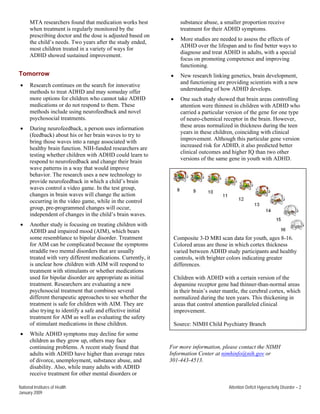
   some resemblance to bipolar disorder. Treatment            Composite 3-D MRI scan data for youth, ages 8-16.
   for AIM can be complicated because the symptoms            Colored areas are those in which cortex thickness
   straddle two mental disorders that are usually             varied between ADHD study participants and healthy
   treated with very different medications. Currently, it     controls, with brighter colors indicating greater
   is unclear how children with AIM will respond to           differences.
   treatment with stimulants or whether medications
   used for bipolar disorder are appropriate as initial       Children with ADHD with a certain version of the
   treatment. Researchers are evaluating a new                dopamine receptor gene had thinner-than-normal areas
   psychosocial treatment that combines several               in their brain’s outer mantle, the cerebral cortex, which
   different therapeutic approaches to see whether the        normalized during the teen years. This thickening in
   treatment is safe for children with AIM. They are          areas that control attention paralleled clinical
   also trying to identify a safe and effective initial       improvement.
   treatment for AIM as well as evaluating the safety
   of stimulant medications in these children.                Source: NIMH Child Psychiatry Branch
•	 While ADHD symptoms may decline for some
   children as they grow up, others may face
   continuing problems. A recent study found that            For more information, please contact the NIMH
   adults with ADHD have higher than average rates           Information Center at nimhinfo@nih.gov or
   of divorce, unemployment, substance abuse, and            301-443-4513.
   disability. Also, while many adults with ADHD
   receive treatment for other mental disorders or

National Institutes of Health                                                         Attention Deficit Hyperactivity Disorder – 2
January 2009

Adhd

  • 1.
    National Institutes ofHealth Attention Deficit Hyperactivity Disorder Fact Sheet (ADHD) Attention deficit/hyperactivity disorder (ADHD) is one of the most common childhood disorders and can continue into adolescence and adulthood. Symptoms include difficulty staying focused and paying attention, difficulty controlling behavior, and very high levels of activity. Studies show that the number of children being diagnosed with ADHD is increasing. Yesterday • ADHD was once considered a transient disorder of fidgety symptoms common among those with childhood that children would outgrow upon ADHD. entering their teen years. • Findings from the Preschoolers with ADHD • ADHD was seen as a behavioral disturbance caused Treatment Study (PATS) indicate that using low by environmental factors, such as inconsistent dose methylphenidate (for example, Ritalin) to treat parenting. children age 3–5 years diagnosed with severe • Brain development in people with ADHD could not ADHD can be effective. be studied directly, but only estimated by observing • A preschooler’s response to medications for ADHD behavior or using other indirect methods. has been found to be associated with the number of • ADHD was treated with immediate release coexisting mental disorders the child has. Children stimulant medications such as methylphenidate (for with fewer coexisting disorders were most likely to example, Ritalin), which worked well but whose respond to methylphenidate treatment, whereas effect lasted only a few hours. Children needed those with three or more coexisting disorders did multiple doses during the day, disrupting their not respond to the treatment. school schedules and daily activities. • For some children, early behavioral interventions designed to reduce symptoms of ADHD in Today preschoolers may be effective alternatives or additions to medication treatment. • Using brain imaging, scientists observed that in some young people with ADHD the development of • One study comparing a parent education (PE) the brain, while still showing a normal pattern, is program with a multi-component intervention delayed in some regions by an average of three (MCI) found that problem behavior decreased years compared to children without the disorder. among the children in both programs and their social skills improved after one year. • The delay was most marked in the brain area that supports the ability to suppress inappropriate • The PE program focused on teaching parenting actions and thoughts, focus attention, remember skills in a group setting. The MCI included parent things moment to moment, work for reward, and education classes as well as individualized plan (the frontal cortex). By contrast, the area that interventions in the home and at preschool or day controls movement (the motor cortex) tends to care. mature faster than normal, an exception to the • The ongoing Multimodal Treatment Study of pattern of delay. This mismatch in brain Children with ADHD (MTA study) is helping to development may account for the restlessness and inform long-term treatment decisions. For example, National Institutes of Health Attention Deficit Hyperactivity Disorder – 1 January 2009
  • 2.
    MTA researchers foundthat medication works best substance abuse, a smaller proportion receive when treatment is regularly monitored by the treatment for their ADHD symptoms. prescribing doctor and the dose is adjusted based on • More studies are needed to assess the effects of the child’s needs. Two years after the study ended, ADHD over the lifespan and to find better ways to most children treated in a variety of ways for diagnose and treat ADHD in adults, with a special ADHD showed sustained improvement. focus on promoting competence and improving functioning. Tomorrow • New research linking genetics, brain development, and functioning are providing scientists with a new • Research continues on the search for innovative understanding of how ADHD develops. methods to treat ADHD and may someday offer more options for children who cannot take ADHD • One such study showed that brain areas controlling medications or do not respond to them. These attention were thinnest in children with ADHD who methods include using neurofeedback and novel carried a particular version of the gene for one type psychosocial treatments. of neuro-chemical receptor in the brain. However, these areas normalized in thickness during the teen • During neurofeedback, a person uses information years in these children, coinciding with clinical (feedback) about his or her brain waves to try to improvement. Although this particular gene version bring those waves into a range associated with increased risk for ADHD, it also predicted better healthy brain function. NIH-funded researchers are clinical outcomes and higher IQ than two other testing whether children with ADHD could learn to versions of the same gene in youth with ADHD. respond to neurofeedback and change their brain wave patterns in a way that would improve behavior. The research uses a new technology to provide neurofeedback in which a child’s brain waves control a video game. In the test group, changes in brain waves will change the action occurring in the video game, while in the control group, pre-programmed changes will occur, independent of changes in the child’s brain waves. • Another study is focusing on treating children with ADHD and impaired mood (AIM), which bears some resemblance to bipolar disorder. Treatment Composite 3-D MRI scan data for youth, ages 8-16. for AIM can be complicated because the symptoms Colored areas are those in which cortex thickness straddle two mental disorders that are usually varied between ADHD study participants and healthy treated with very different medications. Currently, it controls, with brighter colors indicating greater is unclear how children with AIM will respond to differences. treatment with stimulants or whether medications used for bipolar disorder are appropriate as initial Children with ADHD with a certain version of the treatment. Researchers are evaluating a new dopamine receptor gene had thinner-than-normal areas psychosocial treatment that combines several in their brain’s outer mantle, the cerebral cortex, which different therapeutic approaches to see whether the normalized during the teen years. This thickening in treatment is safe for children with AIM. They are areas that control attention paralleled clinical also trying to identify a safe and effective initial improvement. treatment for AIM as well as evaluating the safety of stimulant medications in these children. Source: NIMH Child Psychiatry Branch • While ADHD symptoms may decline for some children as they grow up, others may face continuing problems. A recent study found that For more information, please contact the NIMH adults with ADHD have higher than average rates Information Center at nimhinfo@nih.gov or of divorce, unemployment, substance abuse, and 301-443-4513. disability. Also, while many adults with ADHD receive treatment for other mental disorders or National Institutes of Health Attention Deficit Hyperactivity Disorder – 2 January 2009