The Effect of Medication On The Social and Emotional Development Of Children Diagnosed with ADHD
Daniele Klebern & Dr. Laurie Jordan
Loyola University Chicago
Introduction Background and Methods Results and Conclusion
References
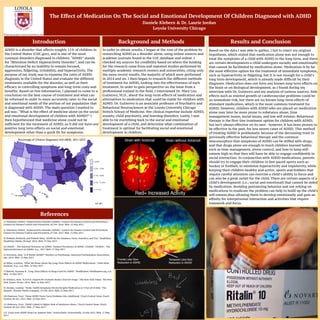
ADHD is a disorder that affects roughly 11% of children in
the United States (CDC.gov), and is one of the most
common disorders diagnosed in children. “ADHD” stands
for “Attention Deficit Hyperactivity Disorder”, and can be
characterized by an inability to remain focused,
aggression, fidgeting, irritability, and hyperactivity. The
purpose of my study was to examine the rates of ADHD
diagnosis in the United States and evaluate the different
treatments available for the disorder, as well as their
efficacy in controlling symptoms and long-term costs and
benefits. Based on this information, I planned to come to a
conclusion on the best course of treatment and what can
be reformed in order to more accurately cater to the social
and emotional needs of the portion of our population that
is diagnosed with ADHD. The main question I wanted to
ask was: “What is the effect of medicine alone on the social
and emotional development of children with ADHD?” I
then hypothesized that medicine alone could not be
sufficient for the treatment of ADHD, as it did not have any
positive long term effects on social and emotional
development other than a quick fix for symptoms.
In order to obtain results, I began at the root of the problem by
researching ADHD as a disorder alone, using online sources and
academic journals found in the LUC database and online. I
checked my sources for credibility based on where the funding
for the research came from and repeated studies performed by
multiple academic research centers and universities, citing only
the more recent results, the majority of which were performed
in 2014 and on. I then began to research the different methods
of treatment for ADHD, looking into the effectiveness of each
treatment. In order to gain perspective on the issue from a
professional trained in the field, I interviewed Dr. Mary Lou
Gutierrez, M.D., about the long-term effects of medication and
alternatives to medication that could be viable for children with
ADHD. Dr. Gutierrez is an associate professor of Psychiatry and
Behavioral Neurosciences at the Loyola University Chicago
Stritch School of Medicine. Her clinical expertise include ADHD,
anxiety, child psychiatry, and learning disorders. Lastly, I was
able to tie everything back to the social and emotional
development of a child, and determine what combination of
treatment is optimal for facilitating social and emotional
development in children.
Based on the data I was able to gather, I fail to reject my original
hypothesis, which stated that medication alone was not enough to
treat the symptoms of a child with ADHD in the long term, and there
are certain developments a child undergoes socially and emotionally
that cannot be facilitated by medication alone. Medication is by far
the most effective option for the treatment of immediate symptoms,
such as hyperactivity or fidgeting, but it is not enough for a child’s
long term development, which is already made difficult by their
diagnosis. Medication does not have any known long term effects on
the brain or on biological development, as I found during my
interview with Dr. Gutierrez and my analysis of various sources. Side
effects such as stunted growth or cardiovascular problems could be
an immediate risk, but there are no known long-term effects of
stimulant medication, which is the most common treatment for
ADHD. However, children with ADHD who are placed on medication
alone may later be more prone to substance abuse, time
management issues, social issues, and low self-esteem. Behavioral
therapy is the first-line treatment option for children with ADHD,
but isn’t always effective on its own - however, it has been proven to
be effective in the past, for less severe cases of ADHD. This method
of treating ADHD is problematic because of the decreasing trust in
previously effective behavioral therapy and the common
misconception that symptoms of ADHD can be stifled with drugs,
and that drugs alone are enough to teach children learned habits
such as time management, stress control, and how to keep self-
esteem high so that they will have be able to engage confidently in
social interaction. In conjunction with ADHD medications, parents
should try to engage their children in fast-paced sports such as
hockey or football, to minimize hyperactivity and impulsivity, while
keeping their children healthy and active; sports and hobbies that
require careful attention can exercise a child’s ability to focus and
can also be a great outlet for the child. There are certain aspects of a
child’s development (i.e., social and emotional) that cannot be aided
by medication. Avoiding patronizing behavior and not relying on
medications to eradicate the problem can help to build up the child's
self esteem,thus allowing them to develop emotionally and gain an
affinity for interpersonal interaction and activities that require
teamwork and focus.
1) "Attention-Deficit / Hyperactivity Disorder (ADHD)." Centers for Disease Control and Prevention.
Centers for Disease Control and Prevention, 05 Oct. 2016. Web. 15 May 2017.
2) "Attention-Deficit / Hyperactivity Disorder (ADHD)." Centers for Disease Control and Prevention.
Centers for Disease Control and Prevention, 07 Feb. 2017. Web. 15 May 2017.
3) Holland, Kimberly, and Elsbeth Riley. "ADHD by the Numbers: Facts, Statistics, and You." Healthline.
Healthline Media, 04 Sept. 2014. Web. 15 May 2017.
4) CHADD – The National Resource on ADHD. "General Prevalence of ADHD | CHADD." CHADD – The
National Resource on ADHD. N.p., 2017. Web. 15 May 2017.
5) Novotney, Amy. "Is It Really ADHD?" Monitor on Psychology. American Psychological Association,
Apr. 2014. Web. 15 May 2017.
6) Miller, Caroline. "What We Know About the Long-Term Effects of ADHD Medications." Child Mind
Institute. N.p., n.d. Web. 16 May 2017.
7) Robotti, Suzanne B. "Long-Term Effects of Drugs Used for ADHD." MedShadow. MedShadow.org, n.d.
Web. 16 May 2017.
8) Schwarz, Alan. "A.D.H.D. Experts Re-evaluate Study’s Zeal for Drugs." The New York Times. The New
York Times, 29 Dec. 2013. Web. 16 May 2017.
9) Abrams, Lindsay. "Study: ADHD Symptoms Persist Despite Medication in 9 Out of 10 Kids." The
Atlantic. Atlantic Media Company, 13 Feb. 2013. Web. 16 May 2017.
10) Pedersen, Traci. "Many ADHD Teens Carry Problems Into Adulthood." Psych Central News. Psych
Central, 06 Oct. 2015. Web. 16 May 2017.
11) Pedersen, Traci. "ADHD Linked to Higher Risk of Substance Abuse." Psych Central News. Psych
Central, 06 Oct. 2015. Web. 17 May 2017.
12) "Long-term ADHD Drug Use Appears Safe." ScienceDaily. ScienceDaily, 18 July 2012. Web. 17 May
2017.
Percentage of Children Diagnosed with ADHD, 2011/2012
cdc.gov

Fyre poster:display

  • 1.
    The Effect ofMedication On The Social and Emotional Development Of Children Diagnosed with ADHD Daniele Klebern & Dr. Laurie Jordan Loyola University Chicago Introduction Background and Methods Results and Conclusion References ADHD is a disorder that affects roughly 11% of children in the United States (CDC.gov), and is one of the most common disorders diagnosed in children. “ADHD” stands for “Attention Deficit Hyperactivity Disorder”, and can be characterized by an inability to remain focused, aggression, fidgeting, irritability, and hyperactivity. The purpose of my study was to examine the rates of ADHD diagnosis in the United States and evaluate the different treatments available for the disorder, as well as their efficacy in controlling symptoms and long-term costs and benefits. Based on this information, I planned to come to a conclusion on the best course of treatment and what can be reformed in order to more accurately cater to the social and emotional needs of the portion of our population that is diagnosed with ADHD. The main question I wanted to ask was: “What is the effect of medicine alone on the social and emotional development of children with ADHD?” I then hypothesized that medicine alone could not be sufficient for the treatment of ADHD, as it did not have any positive long term effects on social and emotional development other than a quick fix for symptoms. In order to obtain results, I began at the root of the problem by researching ADHD as a disorder alone, using online sources and academic journals found in the LUC database and online. I checked my sources for credibility based on where the funding for the research came from and repeated studies performed by multiple academic research centers and universities, citing only the more recent results, the majority of which were performed in 2014 and on. I then began to research the different methods of treatment for ADHD, looking into the effectiveness of each treatment. In order to gain perspective on the issue from a professional trained in the field, I interviewed Dr. Mary Lou Gutierrez, M.D., about the long-term effects of medication and alternatives to medication that could be viable for children with ADHD. Dr. Gutierrez is an associate professor of Psychiatry and Behavioral Neurosciences at the Loyola University Chicago Stritch School of Medicine. Her clinical expertise include ADHD, anxiety, child psychiatry, and learning disorders. Lastly, I was able to tie everything back to the social and emotional development of a child, and determine what combination of treatment is optimal for facilitating social and emotional development in children. Based on the data I was able to gather, I fail to reject my original hypothesis, which stated that medication alone was not enough to treat the symptoms of a child with ADHD in the long term, and there are certain developments a child undergoes socially and emotionally that cannot be facilitated by medication alone. Medication is by far the most effective option for the treatment of immediate symptoms, such as hyperactivity or fidgeting, but it is not enough for a child’s long term development, which is already made difficult by their diagnosis. Medication does not have any known long term effects on the brain or on biological development, as I found during my interview with Dr. Gutierrez and my analysis of various sources. Side effects such as stunted growth or cardiovascular problems could be an immediate risk, but there are no known long-term effects of stimulant medication, which is the most common treatment for ADHD. However, children with ADHD who are placed on medication alone may later be more prone to substance abuse, time management issues, social issues, and low self-esteem. Behavioral therapy is the first-line treatment option for children with ADHD, but isn’t always effective on its own - however, it has been proven to be effective in the past, for less severe cases of ADHD. This method of treating ADHD is problematic because of the decreasing trust in previously effective behavioral therapy and the common misconception that symptoms of ADHD can be stifled with drugs, and that drugs alone are enough to teach children learned habits such as time management, stress control, and how to keep self- esteem high so that they will have be able to engage confidently in social interaction. In conjunction with ADHD medications, parents should try to engage their children in fast-paced sports such as hockey or football, to minimize hyperactivity and impulsivity, while keeping their children healthy and active; sports and hobbies that require careful attention can exercise a child’s ability to focus and can also be a great outlet for the child. There are certain aspects of a child’s development (i.e., social and emotional) that cannot be aided by medication. Avoiding patronizing behavior and not relying on medications to eradicate the problem can help to build up the child's self esteem,thus allowing them to develop emotionally and gain an affinity for interpersonal interaction and activities that require teamwork and focus. 1) "Attention-Deficit / Hyperactivity Disorder (ADHD)." Centers for Disease Control and Prevention. Centers for Disease Control and Prevention, 05 Oct. 2016. Web. 15 May 2017. 2) "Attention-Deficit / Hyperactivity Disorder (ADHD)." Centers for Disease Control and Prevention. Centers for Disease Control and Prevention, 07 Feb. 2017. Web. 15 May 2017. 3) Holland, Kimberly, and Elsbeth Riley. "ADHD by the Numbers: Facts, Statistics, and You." Healthline. Healthline Media, 04 Sept. 2014. Web. 15 May 2017. 4) CHADD – The National Resource on ADHD. "General Prevalence of ADHD | CHADD." CHADD – The National Resource on ADHD. N.p., 2017. Web. 15 May 2017. 5) Novotney, Amy. "Is It Really ADHD?" Monitor on Psychology. American Psychological Association, Apr. 2014. Web. 15 May 2017. 6) Miller, Caroline. "What We Know About the Long-Term Effects of ADHD Medications." Child Mind Institute. N.p., n.d. Web. 16 May 2017. 7) Robotti, Suzanne B. "Long-Term Effects of Drugs Used for ADHD." MedShadow. MedShadow.org, n.d. Web. 16 May 2017. 8) Schwarz, Alan. "A.D.H.D. Experts Re-evaluate Study’s Zeal for Drugs." The New York Times. The New York Times, 29 Dec. 2013. Web. 16 May 2017. 9) Abrams, Lindsay. "Study: ADHD Symptoms Persist Despite Medication in 9 Out of 10 Kids." The Atlantic. Atlantic Media Company, 13 Feb. 2013. Web. 16 May 2017. 10) Pedersen, Traci. "Many ADHD Teens Carry Problems Into Adulthood." Psych Central News. Psych Central, 06 Oct. 2015. Web. 16 May 2017. 11) Pedersen, Traci. "ADHD Linked to Higher Risk of Substance Abuse." Psych Central News. Psych Central, 06 Oct. 2015. Web. 17 May 2017. 12) "Long-term ADHD Drug Use Appears Safe." ScienceDaily. ScienceDaily, 18 July 2012. Web. 17 May 2017. Percentage of Children Diagnosed with ADHD, 2011/2012 cdc.gov