Consumer
Decision
Process
• Adeline Moore
• MRK.2100
• Professor Brar
• 28 July 2020
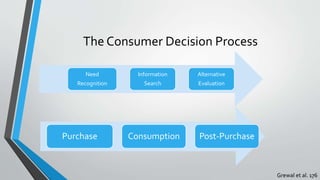
The Consumer Decision Process
Need
Recognition
Information
Search
Alternative
Evaluation
Purchase Consumption Post-Purchase
Grewal et al. 176
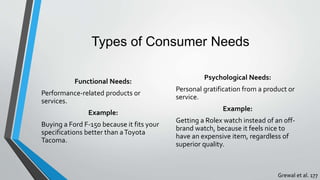
Types of Consumer Needs
Functional Needs:
Performance-related products or
services.
Example:
Buying a Ford F-150 because it fits your
specifications better than aToyota
Tacoma.
Psychological Needs:
Personal gratification from a product or
service.
Example:
Getting a Rolex watch instead of an off-
brand watch, because it feels nice to
have an expensive item, regardless of
superior quality.
Grewal et al. 177
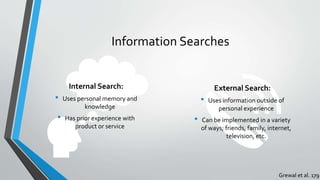
Information Searches
External Search:
• Uses information outside of
personal experience
• Can be implemented in a variety
of ways; friends, family, internet,
television, etc.
Internal Search:
• Uses personal memory and
knowledge
• Has prior experience with
product or service
Grewal et al. 179
Factors Affecting
Information
Searches
 Perceived Benefits vs. Costs
 Locus of Control
 Internal (people have control over their actions)
 External (fate controls all outcomes)
 Actual or Perceived Risk
 Performance risk (Product/service does not
perform as expected)
 Financial risk (Initial and continued costs of
product)
 Social risk (Others might regard purchase
negatively)
 Physiological/safety risk (Harm inflicted if
product fails)
 Psychological risk (Emotions felt if product does
not convey the right image)
Grewal et al. 181-182
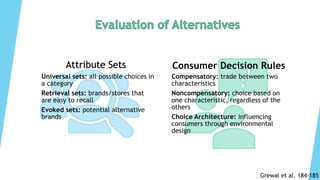
Attribute Sets
Universal sets: all possible choices in
a category
Retrieval sets: brands/stores that
are easy to recall
Evoked sets: potential alternative
brands
Consumer Decision Rules
Compensatory: trade between two
characteristics
Noncompensatory: choice based on
one characteristic, regardless of the
others
Choice Architecture: influencing
consumers through environmental
design
Grewal et al. 184-185
PURCHASE
Purchase: decision to buy a
product/service after evaluating
alternatives.
Conversion rate: success rate in
converting purchase intentions into
actual purchases.
 Purchase is based on the
consumer’s needs/wants, so a
business needs to be identified
by performing better in a specific
area than its competitors
Grewal et al.
CONSUMPT
ION
Consumption is simply the act of using
something that you purchased or received
(m-w.com). In the business sense of the
term, not just products are consumed.
Services can also be consumed.
Consumption is also the basis for the
entire economy. Without consumption,
there would be no point to have
advertising or businesses
(myaccountingcourse.com).
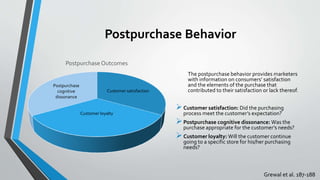
Postpurchase Behavior
Postpurchase Outcomes
Postpurchase
cognitive
dissonance
Customer satisfaction
Customer loyalty
The postpurchase behavior provides marketers
with information on consumers’ satisfaction
and the elements of the purchase that
contributed to their satisfaction or lack thereof.
Customer satisfaction: Did the purchasing
process meet the customer’s expectation?
Postpurchase cognitive dissonance: Was the
purchase appropriate for the customer’s needs?
Customer loyalty: Will the customer continue
going to a specific store for his/her purchasing
needs?
Grewal et al. 187-188
RECAP OF CONSUMER DECISION PROCESS
There are five stages (and one
substage):
• Need Recognition
• Information search
• Alternative evaluation
• Purchase (and
consumption)
• Postpurchase
• Marketers must create strategies to
cater to consumers through each of
these stages. All of them are
important to consider, and there
are many different aspects to
consider within each stage.
Businesses who take all of these
stages into consideration will
attract more customers and the
customers will be more likely to feel
satisfied after buying a product or
service because all of their needs
and concerns were met.
Grewal et al.
Works Cited:
Grewal, Dhruv, and Michael Levy. Marketing. McGraw-Hill
Education, 2020.
“Consume.” Merriam-Webster, Merriam-Webster,
www.merriam-webster.com/dictionary/consume.
Accessed 28 July 2020.
“What Is Consumption?” My Accounting Course,
myaccountingcourse.com/accounting-
dictionary/consumption.Accessed 28 July 2020.

Adeline Moore, MRK.2100 Consumer Behavior Final Project

  • 1.
    Consumer Decision Process • Adeline Moore •MRK.2100 • Professor Brar • 28 July 2020
  • 2.
    The Consumer DecisionProcess Need Recognition Information Search Alternative Evaluation Purchase Consumption Post-Purchase Grewal et al. 176
  • 3.
    Types of ConsumerNeeds Functional Needs: Performance-related products or services. Example: Buying a Ford F-150 because it fits your specifications better than aToyota Tacoma. Psychological Needs: Personal gratification from a product or service. Example: Getting a Rolex watch instead of an off- brand watch, because it feels nice to have an expensive item, regardless of superior quality. Grewal et al. 177
  • 4.
    Information Searches External Search: •Uses information outside of personal experience • Can be implemented in a variety of ways; friends, family, internet, television, etc. Internal Search: • Uses personal memory and knowledge • Has prior experience with product or service Grewal et al. 179
  • 5.
    Factors Affecting Information Searches  PerceivedBenefits vs. Costs  Locus of Control  Internal (people have control over their actions)  External (fate controls all outcomes)  Actual or Perceived Risk  Performance risk (Product/service does not perform as expected)  Financial risk (Initial and continued costs of product)  Social risk (Others might regard purchase negatively)  Physiological/safety risk (Harm inflicted if product fails)  Psychological risk (Emotions felt if product does not convey the right image) Grewal et al. 181-182
  • 6.
    Attribute Sets Universal sets:all possible choices in a category Retrieval sets: brands/stores that are easy to recall Evoked sets: potential alternative brands Consumer Decision Rules Compensatory: trade between two characteristics Noncompensatory: choice based on one characteristic, regardless of the others Choice Architecture: influencing consumers through environmental design Grewal et al. 184-185
  • 7.
    PURCHASE Purchase: decision tobuy a product/service after evaluating alternatives. Conversion rate: success rate in converting purchase intentions into actual purchases.  Purchase is based on the consumer’s needs/wants, so a business needs to be identified by performing better in a specific area than its competitors Grewal et al.
  • 8.
    CONSUMPT ION Consumption is simplythe act of using something that you purchased or received (m-w.com). In the business sense of the term, not just products are consumed. Services can also be consumed. Consumption is also the basis for the entire economy. Without consumption, there would be no point to have advertising or businesses (myaccountingcourse.com).
  • 9.
    Postpurchase Behavior Postpurchase Outcomes Postpurchase cognitive dissonance Customersatisfaction Customer loyalty The postpurchase behavior provides marketers with information on consumers’ satisfaction and the elements of the purchase that contributed to their satisfaction or lack thereof. Customer satisfaction: Did the purchasing process meet the customer’s expectation? Postpurchase cognitive dissonance: Was the purchase appropriate for the customer’s needs? Customer loyalty: Will the customer continue going to a specific store for his/her purchasing needs? Grewal et al. 187-188
  • 10.
    RECAP OF CONSUMERDECISION PROCESS There are five stages (and one substage): • Need Recognition • Information search • Alternative evaluation • Purchase (and consumption) • Postpurchase • Marketers must create strategies to cater to consumers through each of these stages. All of them are important to consider, and there are many different aspects to consider within each stage. Businesses who take all of these stages into consideration will attract more customers and the customers will be more likely to feel satisfied after buying a product or service because all of their needs and concerns were met. Grewal et al.
  • 11.
    Works Cited: Grewal, Dhruv,and Michael Levy. Marketing. McGraw-Hill Education, 2020. “Consume.” Merriam-Webster, Merriam-Webster, www.merriam-webster.com/dictionary/consume. Accessed 28 July 2020. “What Is Consumption?” My Accounting Course, myaccountingcourse.com/accounting- dictionary/consumption.Accessed 28 July 2020.