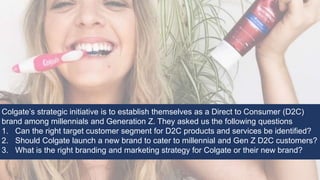
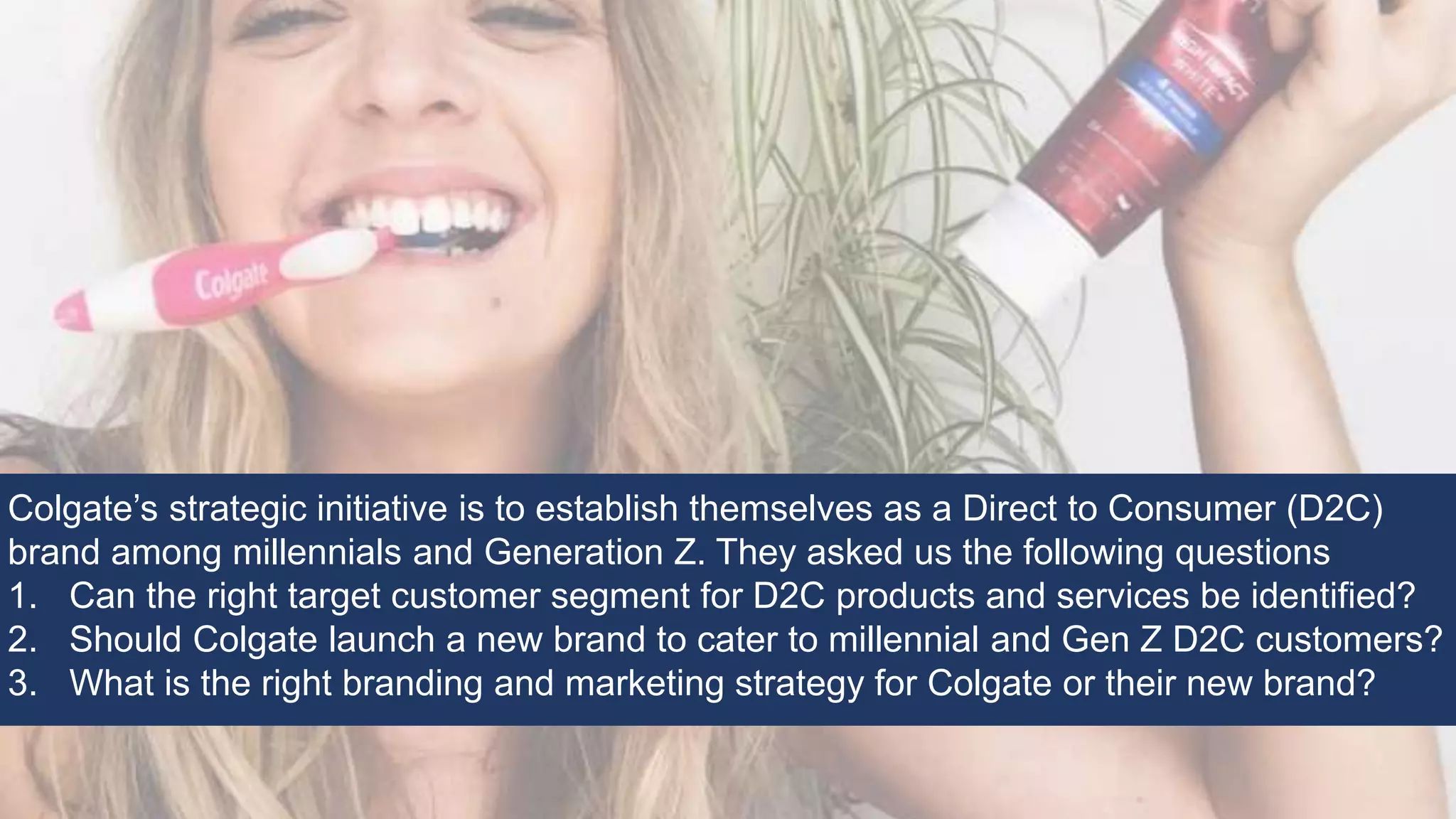
Colgate’s strategic initiative is to establish themselves as a Direct to Consumer (D2C)
brand among millennials and Generation Z. They asked us the following questions
1. Can the right target customer segment for D2C products and services be identified?
2. Should Colgate launch a new brand to cater to millennial and Gen Z D2C customers?
3. What is the right branding and marketing strategy for Colgate or their new brand?
2
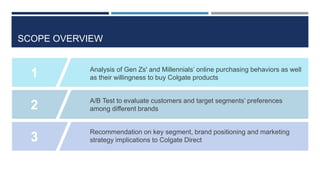
SCOPE OVERVIEW
Analysis of Gen Zs' and Millennials’ online purchasing behaviors as well
as their willingness to buy Colgate products
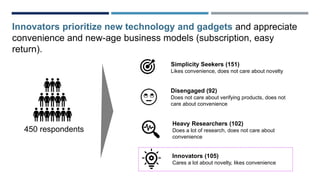
A/B Test to evaluate customers and target segments’ preferences
among different brands
Recommendation on key segment, brand positioning and marketing
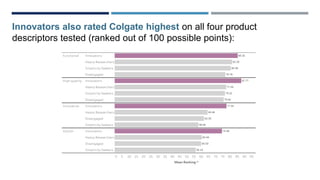
strategy implications to Colgate Direct
1
3
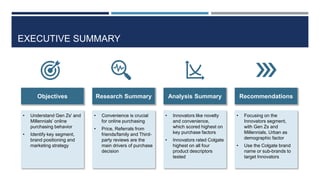
EXECUTIVE SUMMARY
Objectives
• Understand Gen Zs' and
Millennials’ online
purchasing behavior
• Identify key segment,
brand positioning and
marketing strategy
Research Summary
• Convenience is crucial
for online purchasing
• Price, Referrals from
friends/family and Third-
party reviews are the
main drivers of purchase
decision
Analysis Summary
• Innovators like novelty
and convenience,
which scored highest on
key purchase factors
• Innovators rated Colgate
highest on all four
product descriptors
tested
Recommendations
• Focusing on the
Innovators segment,
with Gen Zs and
Millennials, Urban as
demographic factor
• Use the Colgate brand
name or sub-brands to
target Innovators
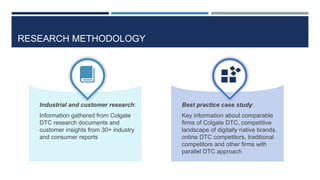
RESEARCH METHODOLOGY
Industrial and customer research:
Information gathered from Colgate
DTC research documents and
customer insights from 30+ industry
and consumer reports
Best practice case study:
Key information about comparable
firms of Colgate DTC, competitive
landscape of digitally native brands,
online DTC competitors, traditional
competitors and other firms with
parallel DTC approach
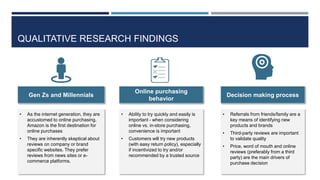
QUALITATIVE RESEARCH FINDINGS
Gen Zs and Millennials
• As the internet generation, they are
accustomed to online purchasing.
Amazon is the first destination for
online purchases
• They are inherently skeptical about
reviews on company or brand
specific websites. They prefer
reviews from news sites or e-
commerce platforms.
Online purchasing
behavior
• Ability to try quickly and easily is
important - when considering
online vs. in-store purchasing,
convenience is important
• Customers will try new products
(with easy return policy), especially
if incentivized to try and/or
recommended by a trusted source
Decision making process
• Referrals from friends/family are a
key means of identifying new
products and brands
• Third-party reviews are important
to validate quality
• Price, word of mouth and online
reviews (preferably from a third
party) are the main drivers of
purchase decision
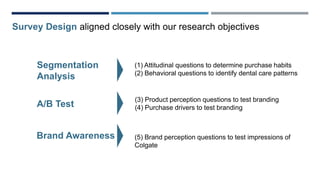
Survey Design aligned closely with our research objectives
Segmentation
Analysis
A/B Test
Brand Awareness
(1) Attitudinal questions to determine purchase habits
(2) Behavioral questions to identify dental care patterns
(5) Brand perception questions to test impressions of
Colgate
(3) Product perception questions to test branding​
(4) Purchase drivers to test branding
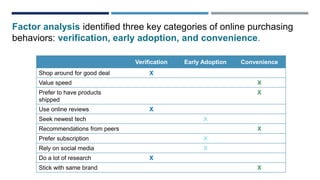
Verification Early Adoption Convenience
Shop around for good deal X
Value speed X
Prefer to have products
shipped
X
Use online reviews X
Seek newest tech X
Recommendations from peers X
Prefer subscription X
Rely on social media X
Do a lot of research X
Stick with same brand X
Factor analysis identified three key categories of online purchasing
behaviors: verification, early adoption, and convenience.
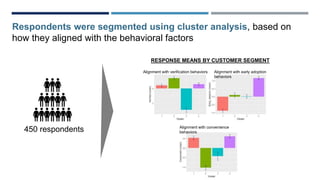
Respondents were segmented using cluster analysis, based on
how they aligned with the behavioral factors
450 respondents
Alignment with verification behaviors Alignment with early adoption
behaviors
Alignment with convenience
behaviors
RESPONSE MEANS BY CUSTOMER SEGMENT
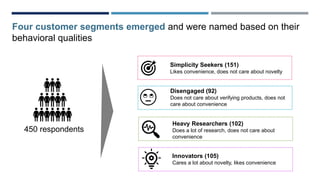
Four customer segments emerged and were named based on their
behavioral qualities
Simplicity Seekers (151)
Likes convenience, does not care about novelty
Disengaged (92)
Does not care about verifying products, does not
care about convenience
Heavy Researchers (102)
Does a lot of research, does not care about
convenience
Innovators (105)
Cares a lot about novelty, likes convenience
450 respondents
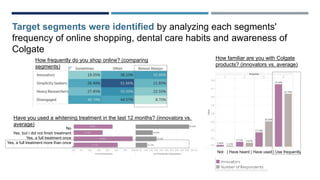
Target segments were identified by analyzing each segments'
frequency of online shopping, dental care habits and awareness of
Colgate
No
Yes, but I did not finish treatment
Yes, a full treatment once
Yes, a full treatment more than once
How frequently do you shop online? (comparing
segments)
Have you used a whitening treatment in the last 12 months? (innovators vs.
average)
How familiar are you with Colgate
products? (innovators vs. average)
Not | Have heard | Have used | Use frequently
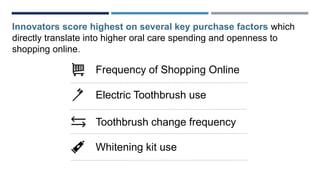
Innovators score highest on several key purchase factors which
directly translate into higher oral care spending and openness to
shopping online.
Frequency of Shopping Online
Whitening kit use
Toothbrush change frequency
Electric Toothbrush use
Innovators also rated Colgate highest on all four product
descriptors tested (ranked out of 100 possible points):
Innovators prioritize new technology and gadgets and appreciate
convenience and new-age business models (subscription, easy
return).
450 respondents
Simplicity Seekers (151)
Likes convenience, does not care about novelty
Disengaged (92)
Does not care about verifying products, does not
care about convenience
Heavy Researchers (102)
Does a lot of research, does not care about
convenience
Innovators (105)
Cares a lot about novelty, likes convenience
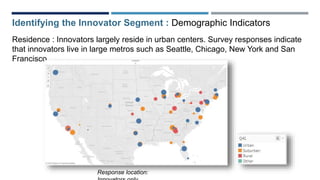
Residence : Innovators largely reside in urban centers. Survey responses indicate
that innovators live in large metros such as Seattle, Chicago, New York and San
Francisco
Response location:
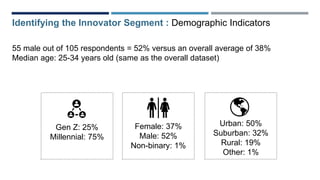
Identifying the Innovator Segment : Demographic Indicators
55 male out of 105 respondents = 52% versus an overall average of 38%
Median age: 25-34 years old (same as the overall dataset)
Gen Z: 25%
Millennial: 75%
Female: 37%
Male: 52%
Non-binary: 1%
Urban: 50%
Suburban: 32%
Rural: 19%
Other: 1%
Identifying the Innovator Segment : Demographic Indicators
A/B TEST SUMMARY
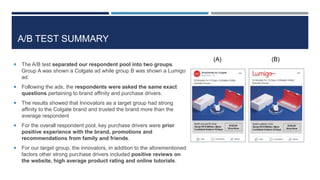
 The A/B test separated our respondent pool into two groups.
Group A was shown a Colgate ad while group B was shown a Lumigo
ad.
 Following the ads, the respondents were asked the same exact
questions pertaining to brand affinity and purchase drivers.
 The results showed that Innovators as a target group had strong
affinity to the Colgate brand and trusted the brand more than the
average respondent
 For the overall respondent pool, key purchase drivers were prior
positive experience with the brand, promotions and
recommendations from family and friends.
 For our target group, the innovators, in addition to the aforementioned
factors other strong purchase drivers included positive reviews on
the website, high average product rating and online tutorials.
(A) (B)
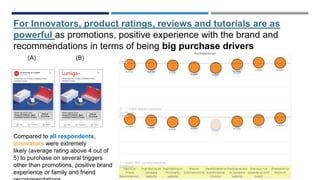
Compared to all respondents,
Innovators were extremely
likely (average rating above 4 out of
5) to purchase on several triggers
other than promotions, positive brand
experience or family and friend
5 = would increase purchase
likelihood
1 = would NOT increase purchase
likelihood
For Innovators, product ratings, reviews and tutorials are as
powerful as promotions, positive experience with the brand and
recommendations in terms of being big purchase drivers
(A) (B)
GOING FORWARD: BRAND AND MARKETING STRATEGY FOR
COLGATE DIRECT
Segment
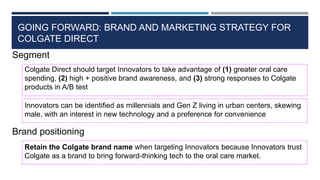
Colgate Direct should target Innovators to take advantage of (1) greater oral care
spending, (2) high + positive brand awareness, and (3) strong responses to Colgate
products in A/B test
Innovators can be identified as millennials and Gen Z living in urban centers, skewing
male, with an interest in new technology and a preference for convenience
Brand positioning
Retain the Colgate brand name when targeting Innovators because Innovators trust
Colgate as a brand to bring forward-thinking tech to the oral care market.
OUR TEAMCHRIS MAYOR ARIA JELINEK
ASHWATH KRISHNAN JOAO ARAUJO

Colgate DTC branding strategy

  • 1.
    Colgate’s strategic initiativeis to establish themselves as a Direct to Consumer (D2C) brand among millennials and Generation Z. They asked us the following questions 1. Can the right target customer segment for D2C products and services be identified? 2. Should Colgate launch a new brand to cater to millennial and Gen Z D2C customers? 3. What is the right branding and marketing strategy for Colgate or their new brand?
  • 2.
    2 SCOPE OVERVIEW Analysis ofGen Zs' and Millennials’ online purchasing behaviors as well as their willingness to buy Colgate products A/B Test to evaluate customers and target segments’ preferences among different brands Recommendation on key segment, brand positioning and marketing strategy implications to Colgate Direct 1 3
  • 3.
    EXECUTIVE SUMMARY Objectives • UnderstandGen Zs' and Millennials’ online purchasing behavior • Identify key segment, brand positioning and marketing strategy Research Summary • Convenience is crucial for online purchasing • Price, Referrals from friends/family and Third- party reviews are the main drivers of purchase decision Analysis Summary • Innovators like novelty and convenience, which scored highest on key purchase factors • Innovators rated Colgate highest on all four product descriptors tested Recommendations • Focusing on the Innovators segment, with Gen Zs and Millennials, Urban as demographic factor • Use the Colgate brand name or sub-brands to target Innovators
  • 4.
    RESEARCH METHODOLOGY Industrial andcustomer research: Information gathered from Colgate DTC research documents and customer insights from 30+ industry and consumer reports Best practice case study: Key information about comparable firms of Colgate DTC, competitive landscape of digitally native brands, online DTC competitors, traditional competitors and other firms with parallel DTC approach
  • 5.
    QUALITATIVE RESEARCH FINDINGS GenZs and Millennials • As the internet generation, they are accustomed to online purchasing. Amazon is the first destination for online purchases • They are inherently skeptical about reviews on company or brand specific websites. They prefer reviews from news sites or e- commerce platforms. Online purchasing behavior • Ability to try quickly and easily is important - when considering online vs. in-store purchasing, convenience is important • Customers will try new products (with easy return policy), especially if incentivized to try and/or recommended by a trusted source Decision making process • Referrals from friends/family are a key means of identifying new products and brands • Third-party reviews are important to validate quality • Price, word of mouth and online reviews (preferably from a third party) are the main drivers of purchase decision
  • 6.
    Survey Design alignedclosely with our research objectives Segmentation Analysis A/B Test Brand Awareness (1) Attitudinal questions to determine purchase habits (2) Behavioral questions to identify dental care patterns (5) Brand perception questions to test impressions of Colgate (3) Product perception questions to test branding​ (4) Purchase drivers to test branding
  • 7.
    Verification Early AdoptionConvenience Shop around for good deal X Value speed X Prefer to have products shipped X Use online reviews X Seek newest tech X Recommendations from peers X Prefer subscription X Rely on social media X Do a lot of research X Stick with same brand X Factor analysis identified three key categories of online purchasing behaviors: verification, early adoption, and convenience.
  • 8.
    Respondents were segmentedusing cluster analysis, based on how they aligned with the behavioral factors 450 respondents Alignment with verification behaviors Alignment with early adoption behaviors Alignment with convenience behaviors RESPONSE MEANS BY CUSTOMER SEGMENT
  • 9.
    Four customer segmentsemerged and were named based on their behavioral qualities Simplicity Seekers (151) Likes convenience, does not care about novelty Disengaged (92) Does not care about verifying products, does not care about convenience Heavy Researchers (102) Does a lot of research, does not care about convenience Innovators (105) Cares a lot about novelty, likes convenience 450 respondents
  • 10.
    Target segments wereidentified by analyzing each segments' frequency of online shopping, dental care habits and awareness of Colgate No Yes, but I did not finish treatment Yes, a full treatment once Yes, a full treatment more than once How frequently do you shop online? (comparing segments) Have you used a whitening treatment in the last 12 months? (innovators vs. average) How familiar are you with Colgate products? (innovators vs. average) Not | Have heard | Have used | Use frequently
  • 11.
    Innovators score higheston several key purchase factors which directly translate into higher oral care spending and openness to shopping online. Frequency of Shopping Online Whitening kit use Toothbrush change frequency Electric Toothbrush use
  • 12.
    Innovators also ratedColgate highest on all four product descriptors tested (ranked out of 100 possible points):
  • 13.
    Innovators prioritize newtechnology and gadgets and appreciate convenience and new-age business models (subscription, easy return). 450 respondents Simplicity Seekers (151) Likes convenience, does not care about novelty Disengaged (92) Does not care about verifying products, does not care about convenience Heavy Researchers (102) Does a lot of research, does not care about convenience Innovators (105) Cares a lot about novelty, likes convenience
  • 14.
    Residence : Innovatorslargely reside in urban centers. Survey responses indicate that innovators live in large metros such as Seattle, Chicago, New York and San Francisco Response location: Identifying the Innovator Segment : Demographic Indicators
  • 15.
    55 male outof 105 respondents = 52% versus an overall average of 38% Median age: 25-34 years old (same as the overall dataset) Gen Z: 25% Millennial: 75% Female: 37% Male: 52% Non-binary: 1% Urban: 50% Suburban: 32% Rural: 19% Other: 1% Identifying the Innovator Segment : Demographic Indicators
  • 16.
    A/B TEST SUMMARY The A/B test separated our respondent pool into two groups. Group A was shown a Colgate ad while group B was shown a Lumigo ad.  Following the ads, the respondents were asked the same exact questions pertaining to brand affinity and purchase drivers.  The results showed that Innovators as a target group had strong affinity to the Colgate brand and trusted the brand more than the average respondent  For the overall respondent pool, key purchase drivers were prior positive experience with the brand, promotions and recommendations from family and friends.  For our target group, the innovators, in addition to the aforementioned factors other strong purchase drivers included positive reviews on the website, high average product rating and online tutorials. (A) (B)
  • 17.
    Compared to allrespondents, Innovators were extremely likely (average rating above 4 out of 5) to purchase on several triggers other than promotions, positive brand experience or family and friend 5 = would increase purchase likelihood 1 = would NOT increase purchase likelihood For Innovators, product ratings, reviews and tutorials are as powerful as promotions, positive experience with the brand and recommendations in terms of being big purchase drivers (A) (B)
  • 18.
    GOING FORWARD: BRANDAND MARKETING STRATEGY FOR COLGATE DIRECT Segment Colgate Direct should target Innovators to take advantage of (1) greater oral care spending, (2) high + positive brand awareness, and (3) strong responses to Colgate products in A/B test Innovators can be identified as millennials and Gen Z living in urban centers, skewing male, with an interest in new technology and a preference for convenience Brand positioning Retain the Colgate brand name when targeting Innovators because Innovators trust Colgate as a brand to bring forward-thinking tech to the oral care market.
  • 19.
    OUR TEAMCHRIS MAYORARIA JELINEK ASHWATH KRISHNAN JOAO ARAUJO