CONSUMER BEHAVIOR
Foundations of Marketing
Danielle Smith
WHAT IS CONSUMER
BEHAVIOR?
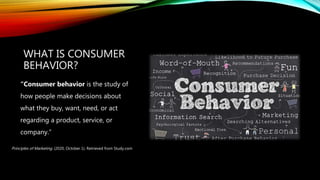
“Consumer behavior is the study of
how people make decisions about
what they buy, want, need, or act
regarding a product, service, or
company.”
Principles of Marketing. (2020, October 1). Retrieved from Study.com
WHAT IS THE CONSUMER DECISION MAKING PROCESS?
Many factors influence how a consumer makes a purchase. Their desire, trends,
consumer needs and wants, social status and cost are to name a few.
To understand a consumer, marketers must understand why a consumer buys
products or services. They must recognize the needs and wants of their current and
potential consumers. They need to connect successfully with their consumers and
deliver products and services efficiently.
THE CONSUMER DECISION PROCESS
The consumer decision process has five steps a consumer must go through before, during,
and after making a purchase.
These steps offer guidance and precise understanding of how consumers make their
purchasing decisions. The consumer decision process steps contribute in determining how to
communicate more effectively with consumers.
Need
Recognition
Information
Search
Alternative
Evaluation
Purchase and
Consumption
Postpurchase
Need
Recognition
“The beginning of the consumer decision
process when consumers recognize they
have an unsatisfied need and want from
their actual, needy state to different,
desired state.”
Grewal, Dhruv, and Michael Levy. Marketing. McGraw-Hill, 2020.
During this step, the following needs are addressed:
Functional Needs – performance of the product or service
Psychological Needs – personal gratification with product or service
Information
Search
“The second step of the consumer
decision process, is to search for
information about the various options
that exist to satisfy that need.”
Grewal, Dhruv, and Michael Levy. Marketing. McGraw-Hill, 2020.
During this step, two key searches of information are done:
Internal Search– what the consumer already knows about the product or service
External Search– what the consumer seeks out to find about the product of service
INFORMATION SEARCH
Internal Search
- Own Memories
- Prior Knowledge
- Past Experiences
External Search
- Seek outside information
- Consumer Reports
- Sponsored Media such as magazines,
TV or radio
- Internet searches; Google, Bing, etc.
Alternative
Evaluation
“Alternative evaluation often occurs while
the consumer is engaged in the process
of information search. He or she must
now go through the choices that are
available and evaluate the alternatives.”
Grewal, Dhruv, and Michael Levy. Marketing. McGraw-Hill, 2020.
During this step, the consumer decision rules are conscious or subconsciously set:
Compensatory– trades off one characteristic against another
Noncompensatory– chooses one characteristic or one subset of characteristic
Purchase and
Consumption
At this step in the decision process, the
consumer has decided to make their purchase.
Their purchase is based on the knowledge they
gathered during the previous steps. They have
reviewed, assessed, and based their decisions
on facts and experiences.
During this step, "retailers turn to conversion rate to measure how well they have converted
purchase intentions into purchases.”
Grewal, Dhruv, and Michael Levy. Marketing. McGraw-Hill, 2020.
Postpurchase
“The final and most important step in the
consumer decision process. Marketers are
particularly interested in this stage because
they learn vital information about the
actual consumer rather than potential
ones.”
Grewal, Dhruv, and Michael Levy. Marketing. McGraw-Hill, 2020.
Possible Postpurchase Outcomes:
Customer Satisfaction– consumer expectations
Postpurchase Cognitive Dissonance– internal conflict
Customer Loyalty– loyal relationships with their customers
POSTPURCHASE
Customer Satisfaction
- Realistic expectations
- Correct product use
- Customer Feedback
- Money-back guarantees
- Warranties
- Customer care and support
Postpurchase
Cognitive Dissonance
- Product returns
- Attention to positive information,
such as ads and articles about
designers
- Seek more feedback from friends
- Seek negative information about
products or outfits made by
companies or designers not selected
Customer Loyalty
- Satisfied with purchases
- Customer buys from the same
company again
- Customer only buys certain brands
- Customer will only shop are certain
stores and companies
- Customer relationship management
(CRM)
Point of view - Consumer Behavior

Point of view - Consumer Behavior

  • 1.
    CONSUMER BEHAVIOR Foundations ofMarketing Danielle Smith
  • 2.
    WHAT IS CONSUMER BEHAVIOR? “Consumerbehavior is the study of how people make decisions about what they buy, want, need, or act regarding a product, service, or company.” Principles of Marketing. (2020, October 1). Retrieved from Study.com
  • 3.
    WHAT IS THECONSUMER DECISION MAKING PROCESS? Many factors influence how a consumer makes a purchase. Their desire, trends, consumer needs and wants, social status and cost are to name a few. To understand a consumer, marketers must understand why a consumer buys products or services. They must recognize the needs and wants of their current and potential consumers. They need to connect successfully with their consumers and deliver products and services efficiently.
  • 4.
    THE CONSUMER DECISIONPROCESS The consumer decision process has five steps a consumer must go through before, during, and after making a purchase. These steps offer guidance and precise understanding of how consumers make their purchasing decisions. The consumer decision process steps contribute in determining how to communicate more effectively with consumers. Need Recognition Information Search Alternative Evaluation Purchase and Consumption Postpurchase
  • 5.
    Need Recognition “The beginning ofthe consumer decision process when consumers recognize they have an unsatisfied need and want from their actual, needy state to different, desired state.” Grewal, Dhruv, and Michael Levy. Marketing. McGraw-Hill, 2020. During this step, the following needs are addressed: Functional Needs – performance of the product or service Psychological Needs – personal gratification with product or service
  • 6.
    Information Search “The second stepof the consumer decision process, is to search for information about the various options that exist to satisfy that need.” Grewal, Dhruv, and Michael Levy. Marketing. McGraw-Hill, 2020. During this step, two key searches of information are done: Internal Search– what the consumer already knows about the product or service External Search– what the consumer seeks out to find about the product of service
  • 7.
    INFORMATION SEARCH Internal Search -Own Memories - Prior Knowledge - Past Experiences External Search - Seek outside information - Consumer Reports - Sponsored Media such as magazines, TV or radio - Internet searches; Google, Bing, etc.
  • 8.
    Alternative Evaluation “Alternative evaluation oftenoccurs while the consumer is engaged in the process of information search. He or she must now go through the choices that are available and evaluate the alternatives.” Grewal, Dhruv, and Michael Levy. Marketing. McGraw-Hill, 2020. During this step, the consumer decision rules are conscious or subconsciously set: Compensatory– trades off one characteristic against another Noncompensatory– chooses one characteristic or one subset of characteristic
  • 9.
    Purchase and Consumption At thisstep in the decision process, the consumer has decided to make their purchase. Their purchase is based on the knowledge they gathered during the previous steps. They have reviewed, assessed, and based their decisions on facts and experiences. During this step, "retailers turn to conversion rate to measure how well they have converted purchase intentions into purchases.” Grewal, Dhruv, and Michael Levy. Marketing. McGraw-Hill, 2020.
  • 10.
    Postpurchase “The final andmost important step in the consumer decision process. Marketers are particularly interested in this stage because they learn vital information about the actual consumer rather than potential ones.” Grewal, Dhruv, and Michael Levy. Marketing. McGraw-Hill, 2020. Possible Postpurchase Outcomes: Customer Satisfaction– consumer expectations Postpurchase Cognitive Dissonance– internal conflict Customer Loyalty– loyal relationships with their customers
  • 11.
    POSTPURCHASE Customer Satisfaction - Realisticexpectations - Correct product use - Customer Feedback - Money-back guarantees - Warranties - Customer care and support Postpurchase Cognitive Dissonance - Product returns - Attention to positive information, such as ads and articles about designers - Seek more feedback from friends - Seek negative information about products or outfits made by companies or designers not selected Customer Loyalty - Satisfied with purchases - Customer buys from the same company again - Customer only buys certain brands - Customer will only shop are certain stores and companies - Customer relationship management (CRM)