SPECIAL AND INCLUSIVE
EDUCATION
By:
ASUNCION, MIZEL RAVEN A.
MANAGUELOD, KAREN C.
ADDRESSING DIVERSITY
THROUGH THE YEARS:
CHAPTER 2
I. MODELS OF DISABILITY
- concept of disability has been existent for ages.
 Bible chronicles the presence of persons who are
blind and crippled who needed to be healed.
 Philippine history has records of disability through
the Apolinario Mabini.
**Disablity cuts across countries, cultures, and
timelines.
I. MODELS OF DISABILITY
How PWDs were once treated is not
something any nation would be proud
of.
As soon as the “deviants” were
“identified”, segregation, exclusion,
isolation and other forms of violence
and cruelty followed.
PWDs were seen as social threats
capable of contaminating an otherwise
pure human species.
PWDs also had to be protected from
society.
They were killed or treated as sub-
humans devoid of any rights (Kisanji 1999,
Wolfensberger 1972)
Sociology reminds us that human behavior must
always be studied in relation to cultural, historical,
and sociostructural contexts.
The best way to understand why people think or
act the way they doi is by looking at what was
happening to their community
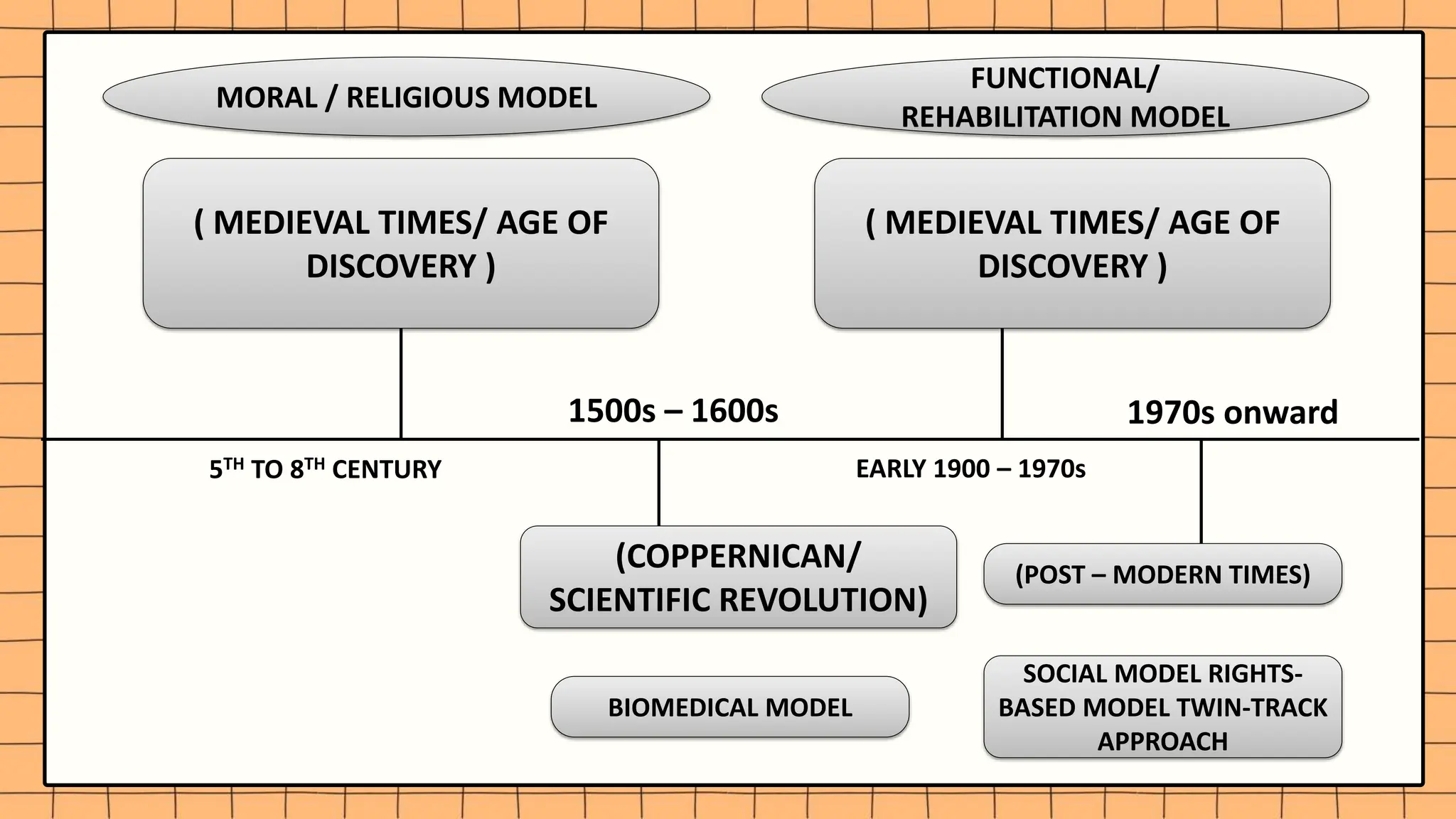
MORAL / RELIGIOUS MODEL
FUNCTIONAL/
REHABILITATION MODEL
( MEDIEVAL TIMES/ AGE OF
DISCOVERY )
( MEDIEVAL TIMES/ AGE OF
DISCOVERY )
1500s – 1600s 1970s onward
(POST – MODERN TIMES)
(COPPERNICAN/
SCIENTIFIC REVOLUTION)
BIOMEDICAL MODEL
SOCIAL MODEL RIGHTS-
BASED MODEL TWIN-TRACK
APPROACH
5TH TO 8TH CENTURY EARLY 1900 – 1970s
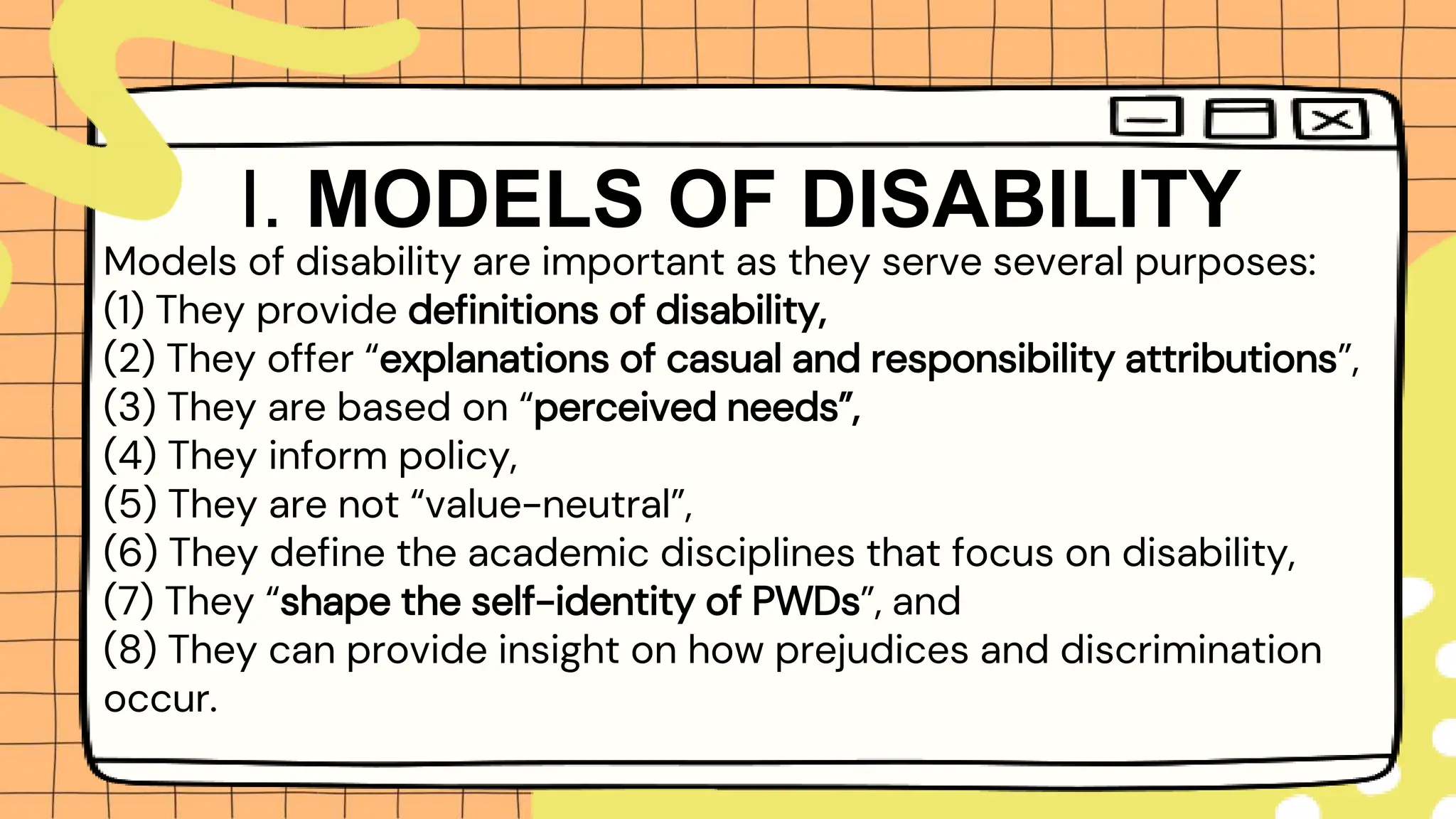
Models of disability are important as they serve several purposes:
(1) They provide definitions of disability,
(2) They offer “explanations of casual and responsibility attributions”,
(3) They are based on “perceived needs”,
(4) They inform policy,
(5) They are not “value-neutral”,
(6) They define the academic disciplines that focus on disability,
(7) They “shape the self-identity of PWDs”, and
(8) They can provide insight on how prejudices and discrimination
occur.
I. MODELS OF DISABILITY
A. THE MORAL/ RELIGIOUS
MODEL
 Church is one of the most influential figures in Europe during
the Medieval Age started from 476 towards early 1800’s.
 The idea of God as an all powerful being was so strong in
man’s consciousness that it affected the way society treated
PWDs at the time.
 The middle ground was to see disability as a test of faith and
an opportunity to redeem oneself through endurance,
resilience, and piety (Niemann 2005 as cited in Retief and
Letsosa 2018).
A. THE MORAL/ RELIGIOUS MODEL
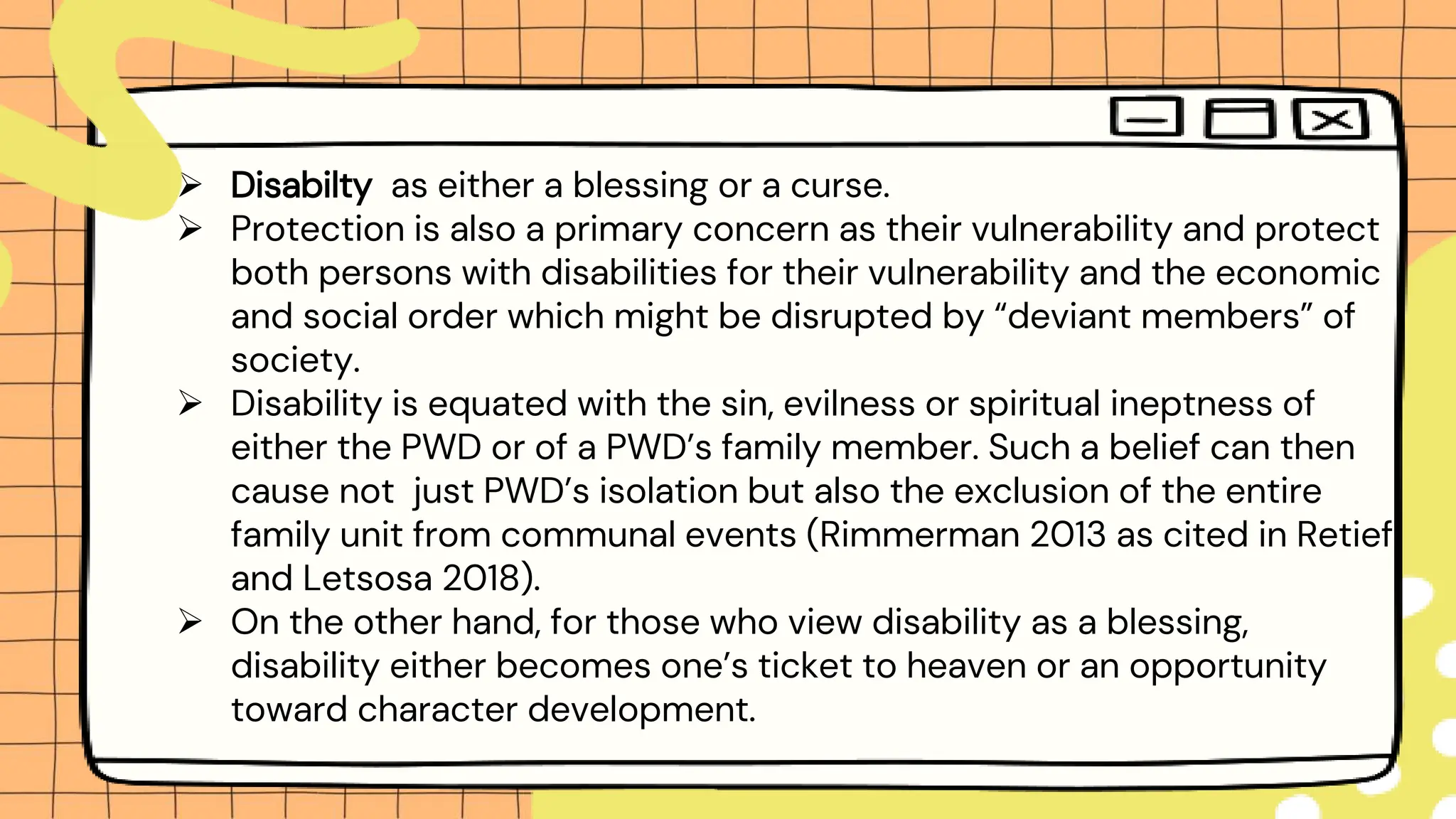
 Disabilty as either a blessing or a curse.
 Protection is also a primary concern as their vulnerability and protect
both persons with disabilities for their vulnerability and the economic
and social order which might be disrupted by “deviant members” of
society.
 Disability is equated with the sin, evilness or spiritual ineptness of
either the PWD or of a PWD’s family member. Such a belief can then
cause not just PWD’s isolation but also the exclusion of the entire
family unit from communal events (Rimmerman 2013 as cited in Retief
and Letsosa 2018).
 On the other hand, for those who view disability as a blessing,
disability either becomes one’s ticket to heaven or an opportunity
toward character development.
B. BIOMEDICAL/ INDIVIDUAL
MODEL
THE BIOMEDICAL/INDIVIDUAL MODEL
PWD’s are see as persons who
are ill and meant to be treated
or “made more normal.”
“Disability is seen as a medical
problem that resides in the
individual. It is a defect in or
failure of a bodily system and
as such, is inherently abnormal
and pathological.
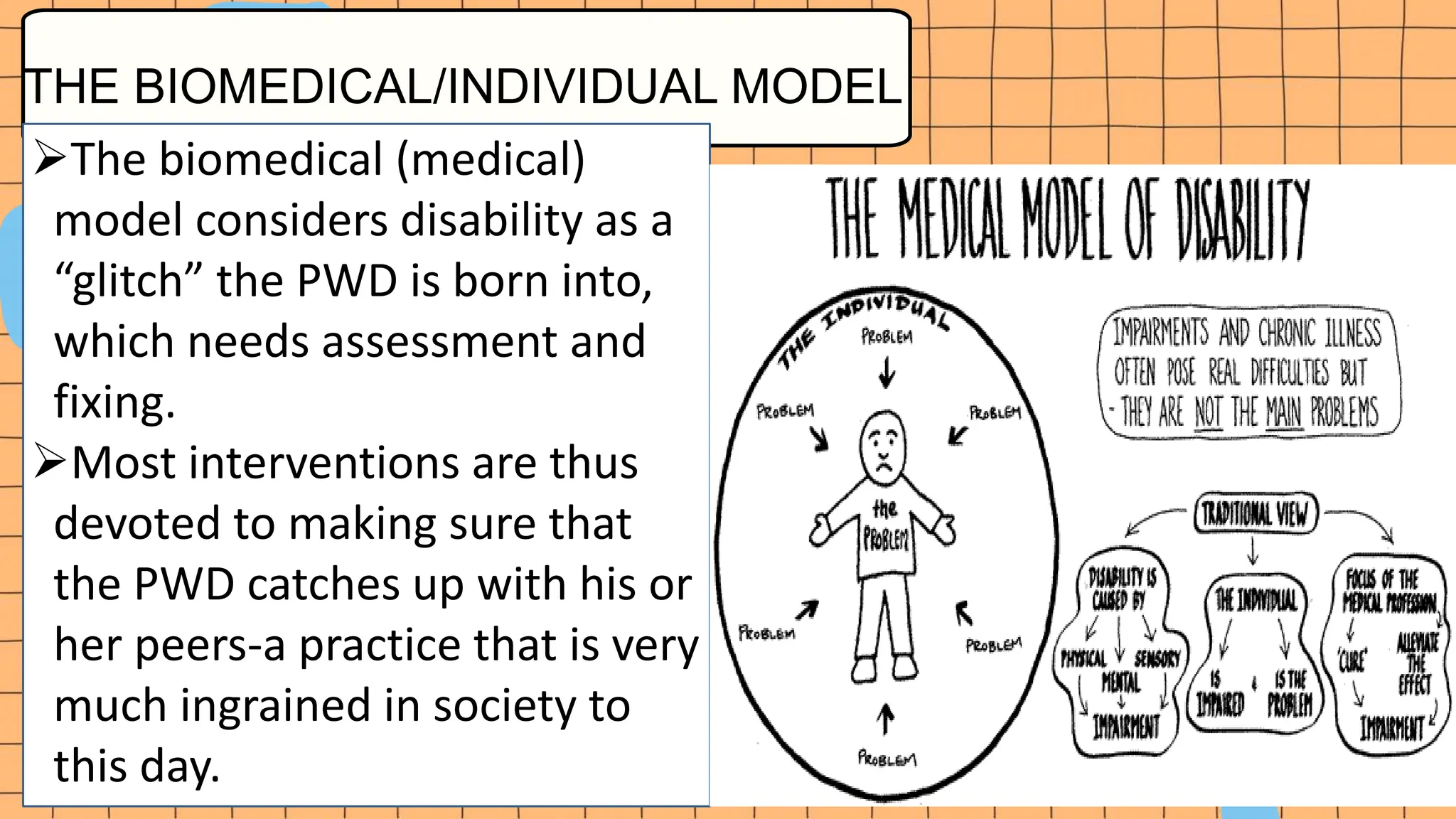
THE BIOMEDICAL/INDIVIDUAL MODEL
The biomedical (medical)
model considers disability as a
“glitch” the PWD is born into,
which needs assessment and
fixing.
Most interventions are thus
devoted to making sure that
the PWD catches up with his or
her peers-a practice that is very
much ingrained in society to
this day.
THE BIOMEDICAL/INDIVIDUAL MODEL
• Biological Focus
 a result of an individual’s
physical or mental impairments,
illnesses, or conditions. It places
the emphasis on diagnosing and
treating these impairments.
• Pathological Perspective
 Disabilities are often viewed as
pathological or abnormal
conditions that need to be
cured, treated or rehabilitated.
THE BIOMEDICAL/INDIVIDUAL MODEL
• Professional Control
 In the medical model,
healthcare professionals play a
central role in defining disability
and determining appropriate
interventions. The decisions and
treatment plans are typically made
by healthcare experts.
• Segregation and Specialization
 The medical model can lead to the
segregation of individuals with
disabilities into specialized facilities
or services, such as hospitals or
rehabilitation
THE BIOMEDICAL/INDIVIDUAL MODEL
• Limited Social and Environmental Considerations
 It tends to downplay the role of social and
environmental factors in contributing to disability.
Instead, the focus is primarily on the individual’s
impairment.
• “Fixing” Disability:
 The ultimate goal of the medical model is often to “fix”
or “cure” the disability, enabling the person to function
as closely to the norm as possible.
C. THE
FUNCTIONAL/REHABILITATION
MODEL
When World War I happened, communities
witnessed perfectly healthy people leave to serve
the country only to come back disabled physically,
neurologically, or mentally.
Physical and Occupational Therapies soon became
prevalent modes of rehabilitation for much of the
service-related injuries the soldiers sustained
The biomedical model often suggests
habilitation, which refers to help given to
those whose disabilities are congenital or
manifested very early in life in order to
maximize function.
The functional/rehabilitation model refers to
the assistance given by professionals to
those who have an acquired disability in the
hope of gaining.
The biomedical and rehabilitative models,
together with the dawn of clinic-based
assessments in the 1950s and its
proliferation during the 1960s onward, show
how much society has placed value on
convention, performance and achievement.
In living spaces, such persons were shunned by
society.
In educational settings, such students were advised
to transfer schools for a more specialized type of
education
In workplaces, they were segregated or refused
opportunities.
Either way, both models constantly put the PWD at a
disadvantage.
C. THE SOCIAL
MODEL
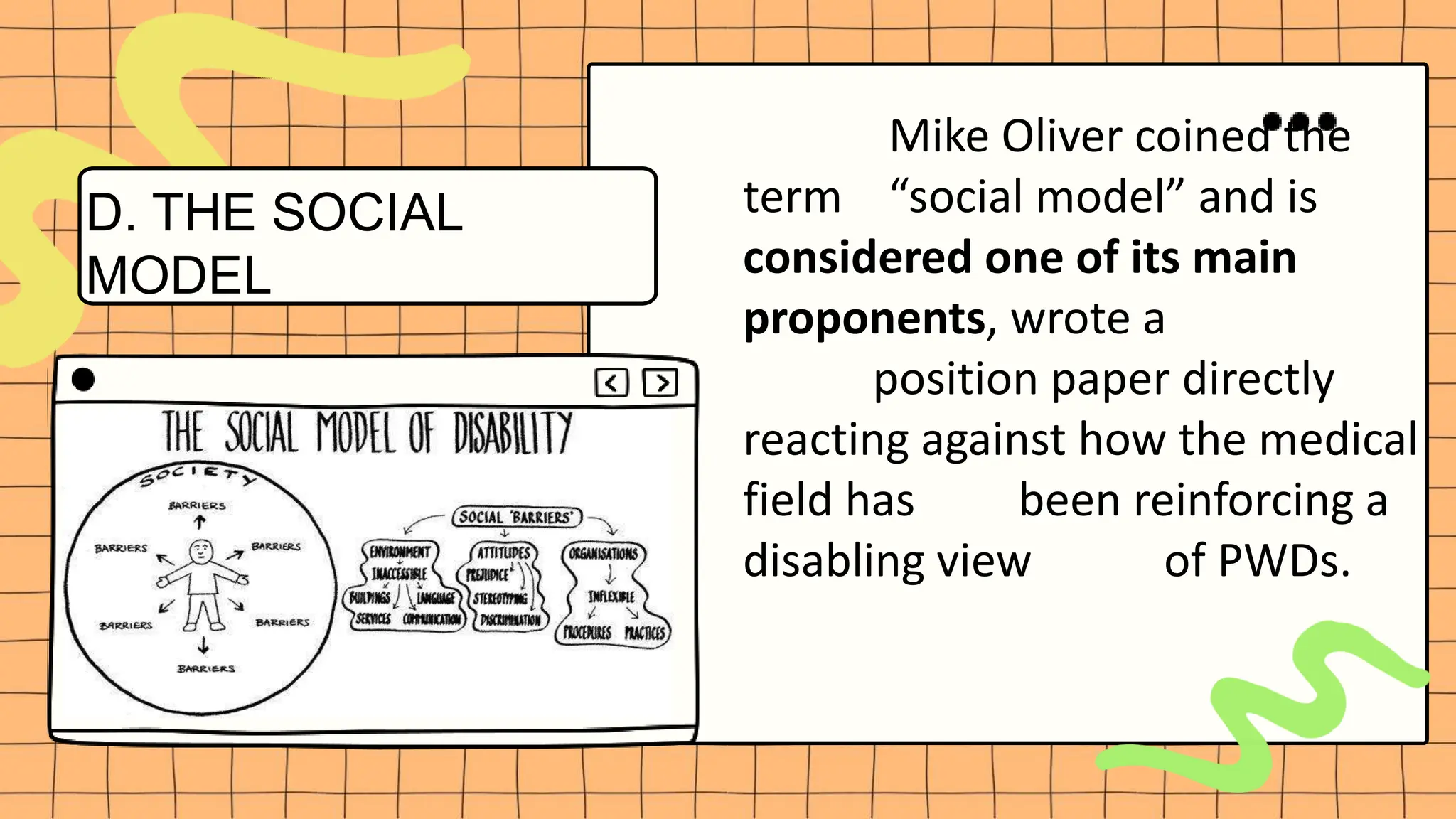
Mike Oliver coined the
term “social model” and is
considered one of its main
proponents, wrote a
position paper directly
reacting against how the medical
field has been reinforcing a
disabling view of PWDs.
D. THE SOCIAL
MODEL
D. THE SOCIAL
MODEL
• According to the sociological
response, disability occurs as
a result of society’s lack of
understanding of individual
differences.
• PWDs are seen as disabled
not because they are
deficient but because they
are deficient but because
society “insists” they are
deficient and
disadvantaged.
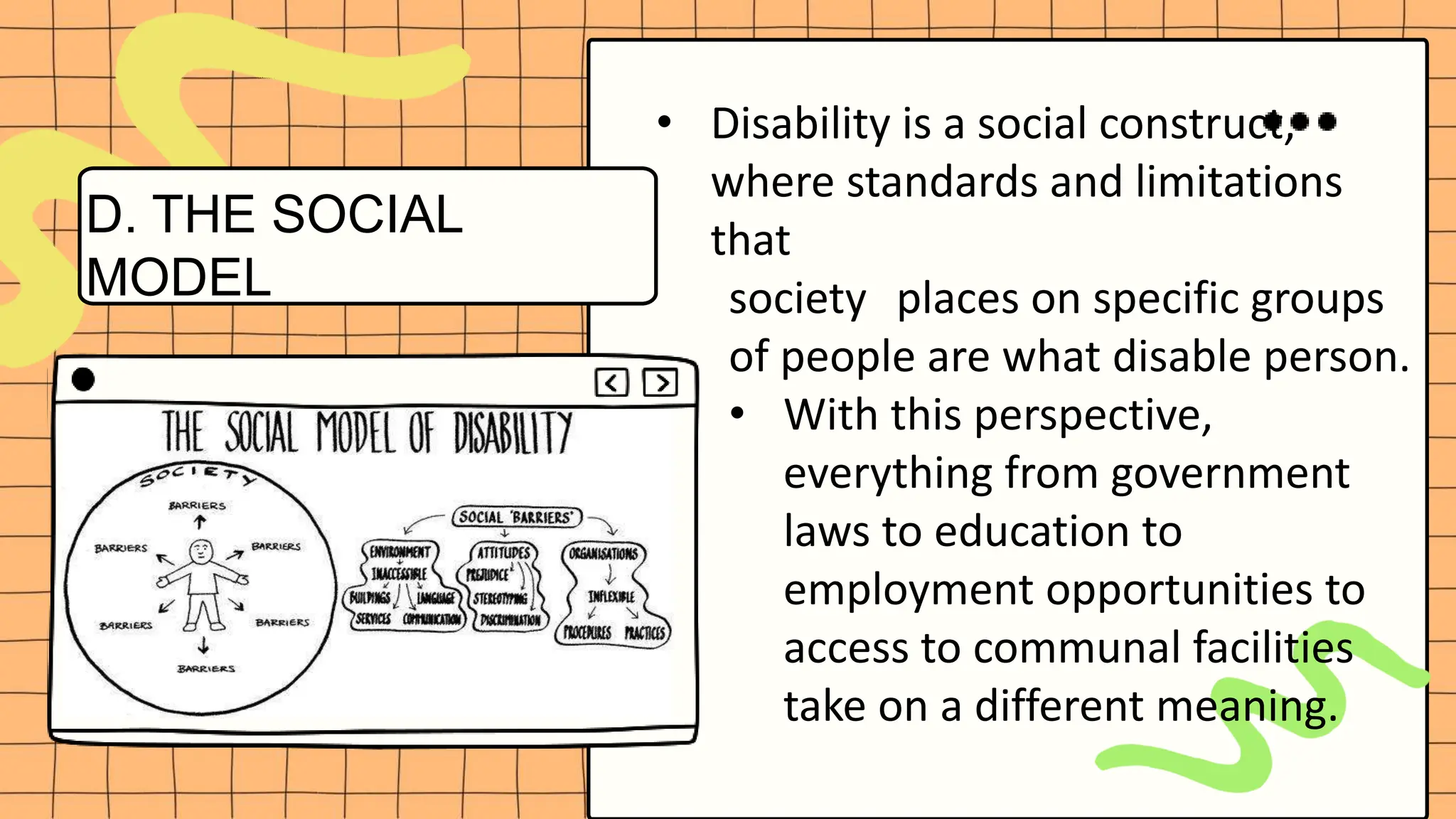
• Disability is a social construct,
where standards and limitations
that
society places on specific groups
of people are what disable person.
• With this perspective,
everything from government
laws to education to
employment opportunities to
access to communal facilities
take on a different meaning.
D. THE SOCIAL
MODEL
• The World Health Organization (1980)
differentiates between disability
and impairment.
• Impairment is seen as “any loss or
abnormality of psychological or
anatomical structure or function”.
• Disability refers to “any
restriction or lack (resulting from
an impairment) of ability to
perform an activity in the manner
or within the range considered
normal for a human being”.
D. THE SOCIAL
MODEL
• The social model, reiterates that
impairment should
be seen as a normal aspect of life
and when it happens, it should
not cause a stir.
• Kaplan (2000) agrees that if
disability were to be seen as
something natural and
expected, it could change the
way we design our systems
and our environments.
D. THE SOCIAL
MODEL
• Wendell (1996 as cited in
Kaplan 2000: 356) relates:
“The cultural habit of
regarding the condition of the
person, not the built
environment or the social
organization of activities,
as the source of the
problem, runs deep.
D. THE SOCIAL
MODEL
E. RIGHTS-BASED MODEL AND
TWIN TRACK APPROACH
• The rights-based model of disability is a framework that
bears similarities with the social model.
• The rights-based model “moves beyond explanation,
offering a theoretical framework for disability policy
that emphasizes the human dignity of PWDs”
• Tries to address his upholding and safeguarding their
identities and rights as human beings.
• A rights-based approach to education
ensures that all energies are devoted to the
realization of each learner’s right to education.
• It is built on the principle that education is a
basic human right and therefore all must have
access to it.
• Four key factors directly involved in such a model:
(1) The government as duty-bearers.
(2)The child as the right-holder,
(3)The parents as representatives of the child, and
(4)The teachers, both as rights-holders and duty-
bearers
• Practitioners now promote a twin track approach,
which combines the social model and the rights-based
model. A marrying of the two perspectives allows for
holistic changes to occur, with the opinion of
promoting individual needs whenever necessary. For
instance, in education, this would mean allowing a PWD
to join the mainstream yet be given opportunities for
disability-specific programs in case programs in case
additional support is needed
II. WHAT IS SPECIAL NEEDS
EDUCATION?
II.WHAT IS SPECIAL NEED EDUCATION?
“The action or process of teaching someone
especially in a school, college or university”. –
Merriam Webster
II.WHAT IS SPECIAL NEED EDUCATION?
Special Needs Education is education for
students with disabilities, in consideration of
their individual educational needs, which aims at
full development of their capabilities and at
their independence and social participation.
II.WHAT IS SPECIAL NEED EDUCATION?
According to Frensky (2014), “the real goal of education is
becoming- becoming a ‘good person’ and becoming a more
capable person that when you started.”
II.WHAT IS SPECIAL NEED EDUCATION?
Not everyone reacts to learner diversity the same
way.
The key to nation-building is quality education
accessible to all types of learners. This accessibility
is the essence of inclusive education.
III. WHY INCLUSION?
III. WHY INCLUSION?
- is an educational practice that places students
with disabilities in the general education
classroom along with typically developing
children under the supervision and guidance of
a general education teacher (Del Corro-Tiangco
2014)
III. WHY INCLUSION?
1948,- there have already been worldwide declarations
on children and their (Universal Declaration of Human
Rights 1948; United right to be educated Nations
Convention on the Rights of the Child 1989).
1990 - many countries banded together for the world
declaration of Education for All (EFA), which stated that
all children must have access to complete, free, and
compulsory primary education.
III. WHY INCLUSION?
Guidelines for Inclusion (2005) published by UNESCO
enumerates four key elements:
(1) That inclusion is a process, that is, “a never ending
search to find better ways to respond to diversity”,
(2) That inclusion involves a preventive dimension,
specifically in identifying and removing potential barriers to
this process through “collecting, collating, and evaluating
information” for improving policy and practice.
III. WHY INCLUSION?
(3) That inclusion is all about the “presence,
participation, and achievement” or learning outcomes of
all types of students; and
(4) That inclusion puts “particular emphasis on
learners who may be at risk of marginalization, exclusion,
or underachievement,” and therefore, they must be
consistently monitored and represented in the inclusive
process.
III. WHY INCLUSION?
Inclusion in Education Involves:
A. Valuing all students and staff equally
B. Increasing the participation of students in; and
reducing their exclusion from; the cultures,
curricula, and communities of local schools
III. WHY INCLUSION?
C. Reducing barriers to learning and participation for
all students, not only those with impairments or
those who are categorized as ‘having special
educational needs’
D. Viewing the difference between students as
resources to support learning.
E. Acknowledging the right of students to an
education in their locality
III. WHY INCLUSION?
F. Improving schools for staff as well as for students.
G. Emphasizing the role of schools in building
community and developing values, as well as in
increasing achievement.
H. Fostering mutually sustaining relationships
between schools and community.
I. Recognizing that inclusion in education is one
aspect of inclusion in society.
IV. THE 2030 AGENDA
GOAL of inclusion is for every fabric of
society to embrace diversity. It is for this
reason that all
these treatises state the need for a
paradigm shift to address the issues of
inclusion in education.
Inclusive education is not merely a call
toward educational reform for those
with additional needs. It is simply a call
to improve the quality of education for
all learners, because “every learner
matters and matter equally
(UNESCO 2017:12,2005).
THE 2030 AGENDA
• RA 7277 (1992)- Magna Carta for Disabled Persons
• Equal rights and privileges of PWDs on
employment, education, health,
telecommunications, auxiliary social services,
accessibility, political and civil rights.
• Administrative Order 35 (2002)- National
Disability
• Penalties for violations law
• Prevention and Rehabilitation (NPDR Week)
every 3rd week of July)
• Guidelines in the Admission of Students with
disabilities in Higher Education and Post-
Secondary Institutions in the Philippines
“PHILIPPINE
LAWS FOR
PWDS”
PANGALANGAN
& LITONG, 2014
• RA 9442 (2007) – Amendment
of RA 7277 (Privileges to PWDs)
• 20% discount privileges to
PWDs
• Change name for “Magna Carta
for Disabled Persons” to Magna
Carta for PWDs”
“PHILIPPINE
LAWS FOR
PWDS”
PANGALANGAN
& LITONG, 2014
• NCDA Administrative Order No. 001,
s. 2008- Guidelines on the Issuance
of PWD ID Cards relative to RA 9442
• RA 10070 (2010)- Amendment of
RA 7277 (Implementation of
Programs and Services for PWDs in
every province, city and
municipality- PDAO Law)
• RA 10366 (2013)- Accessible
Polling Places for PWDs and Senior
Citizens
“PHILIPPINE
LAWS FOR
PWDS”
PANGALANGAN
& LITONG, 2014
• RA 10754 (2016) – An
Act Expanding the
Benefits and Privileges
of PWDs
• Exemption of VAT on
the following sale of
goods and services
“PHILIPPINE
LAWS FOR
PWDS”
PANGALANGAN
& LITONG, 2014
• Civil Service Commission MC No. 20, s.
2017- express lanes for PWDs in all
commercial and government
establishments
• RA 11228 (2019)- Amendment of RA
7277
All PWDs shall be automatically
covered by the National Health Insurance
Program (NHIP) of the Philhealth and that
the Philhealth shall develop exclusive
packages for PWDs that will address their
specific health and development needs.
“PHILIPPINE
LAWS FOR
PWDS”
PANGALANGAN
& LITONG, 2014
Thank you
#gereahteful

Addressing-Diversity-through-the-years-Special-and-Inclusive-Education-1.pptx

  • 1.
    SPECIAL AND INCLUSIVE EDUCATION By: ASUNCION,MIZEL RAVEN A. MANAGUELOD, KAREN C. ADDRESSING DIVERSITY THROUGH THE YEARS: CHAPTER 2
  • 2.
    I. MODELS OFDISABILITY
  • 3.
    - concept ofdisability has been existent for ages.  Bible chronicles the presence of persons who are blind and crippled who needed to be healed.  Philippine history has records of disability through the Apolinario Mabini. **Disablity cuts across countries, cultures, and timelines. I. MODELS OF DISABILITY
  • 5.
    How PWDs wereonce treated is not something any nation would be proud of. As soon as the “deviants” were “identified”, segregation, exclusion, isolation and other forms of violence and cruelty followed.
  • 6.
    PWDs were seenas social threats capable of contaminating an otherwise pure human species. PWDs also had to be protected from society. They were killed or treated as sub- humans devoid of any rights (Kisanji 1999, Wolfensberger 1972)
  • 7.
    Sociology reminds usthat human behavior must always be studied in relation to cultural, historical, and sociostructural contexts. The best way to understand why people think or act the way they doi is by looking at what was happening to their community
  • 8.
    MORAL / RELIGIOUSMODEL FUNCTIONAL/ REHABILITATION MODEL ( MEDIEVAL TIMES/ AGE OF DISCOVERY ) ( MEDIEVAL TIMES/ AGE OF DISCOVERY ) 1500s – 1600s 1970s onward (POST – MODERN TIMES) (COPPERNICAN/ SCIENTIFIC REVOLUTION) BIOMEDICAL MODEL SOCIAL MODEL RIGHTS- BASED MODEL TWIN-TRACK APPROACH 5TH TO 8TH CENTURY EARLY 1900 – 1970s
  • 9.
    Models of disabilityare important as they serve several purposes: (1) They provide definitions of disability, (2) They offer “explanations of casual and responsibility attributions”, (3) They are based on “perceived needs”, (4) They inform policy, (5) They are not “value-neutral”, (6) They define the academic disciplines that focus on disability, (7) They “shape the self-identity of PWDs”, and (8) They can provide insight on how prejudices and discrimination occur. I. MODELS OF DISABILITY
  • 10.
    A. THE MORAL/RELIGIOUS MODEL
  • 11.
     Church isone of the most influential figures in Europe during the Medieval Age started from 476 towards early 1800’s.  The idea of God as an all powerful being was so strong in man’s consciousness that it affected the way society treated PWDs at the time.  The middle ground was to see disability as a test of faith and an opportunity to redeem oneself through endurance, resilience, and piety (Niemann 2005 as cited in Retief and Letsosa 2018). A. THE MORAL/ RELIGIOUS MODEL
  • 12.
     Disabilty aseither a blessing or a curse.  Protection is also a primary concern as their vulnerability and protect both persons with disabilities for their vulnerability and the economic and social order which might be disrupted by “deviant members” of society.  Disability is equated with the sin, evilness or spiritual ineptness of either the PWD or of a PWD’s family member. Such a belief can then cause not just PWD’s isolation but also the exclusion of the entire family unit from communal events (Rimmerman 2013 as cited in Retief and Letsosa 2018).  On the other hand, for those who view disability as a blessing, disability either becomes one’s ticket to heaven or an opportunity toward character development.
  • 13.
  • 14.
    THE BIOMEDICAL/INDIVIDUAL MODEL PWD’sare see as persons who are ill and meant to be treated or “made more normal.” “Disability is seen as a medical problem that resides in the individual. It is a defect in or failure of a bodily system and as such, is inherently abnormal and pathological.
  • 15.
    THE BIOMEDICAL/INDIVIDUAL MODEL Thebiomedical (medical) model considers disability as a “glitch” the PWD is born into, which needs assessment and fixing. Most interventions are thus devoted to making sure that the PWD catches up with his or her peers-a practice that is very much ingrained in society to this day.
  • 16.
    THE BIOMEDICAL/INDIVIDUAL MODEL •Biological Focus  a result of an individual’s physical or mental impairments, illnesses, or conditions. It places the emphasis on diagnosing and treating these impairments. • Pathological Perspective  Disabilities are often viewed as pathological or abnormal conditions that need to be cured, treated or rehabilitated.
  • 17.
    THE BIOMEDICAL/INDIVIDUAL MODEL •Professional Control  In the medical model, healthcare professionals play a central role in defining disability and determining appropriate interventions. The decisions and treatment plans are typically made by healthcare experts. • Segregation and Specialization  The medical model can lead to the segregation of individuals with disabilities into specialized facilities or services, such as hospitals or rehabilitation
  • 18.
    THE BIOMEDICAL/INDIVIDUAL MODEL •Limited Social and Environmental Considerations  It tends to downplay the role of social and environmental factors in contributing to disability. Instead, the focus is primarily on the individual’s impairment. • “Fixing” Disability:  The ultimate goal of the medical model is often to “fix” or “cure” the disability, enabling the person to function as closely to the norm as possible.
  • 19.
  • 20.
    When World WarI happened, communities witnessed perfectly healthy people leave to serve the country only to come back disabled physically, neurologically, or mentally. Physical and Occupational Therapies soon became prevalent modes of rehabilitation for much of the service-related injuries the soldiers sustained
  • 21.
    The biomedical modeloften suggests habilitation, which refers to help given to those whose disabilities are congenital or manifested very early in life in order to maximize function. The functional/rehabilitation model refers to the assistance given by professionals to those who have an acquired disability in the hope of gaining.
  • 22.
    The biomedical andrehabilitative models, together with the dawn of clinic-based assessments in the 1950s and its proliferation during the 1960s onward, show how much society has placed value on convention, performance and achievement.
  • 23.
    In living spaces,such persons were shunned by society. In educational settings, such students were advised to transfer schools for a more specialized type of education In workplaces, they were segregated or refused opportunities. Either way, both models constantly put the PWD at a disadvantage.
  • 24.
  • 25.
    Mike Oliver coinedthe term “social model” and is considered one of its main proponents, wrote a position paper directly reacting against how the medical field has been reinforcing a disabling view of PWDs. D. THE SOCIAL MODEL
  • 26.
    D. THE SOCIAL MODEL •According to the sociological response, disability occurs as a result of society’s lack of understanding of individual differences. • PWDs are seen as disabled not because they are deficient but because they are deficient but because society “insists” they are deficient and disadvantaged.
  • 27.
    • Disability isa social construct, where standards and limitations that society places on specific groups of people are what disable person. • With this perspective, everything from government laws to education to employment opportunities to access to communal facilities take on a different meaning. D. THE SOCIAL MODEL
  • 28.
    • The WorldHealth Organization (1980) differentiates between disability and impairment. • Impairment is seen as “any loss or abnormality of psychological or anatomical structure or function”. • Disability refers to “any restriction or lack (resulting from an impairment) of ability to perform an activity in the manner or within the range considered normal for a human being”. D. THE SOCIAL MODEL
  • 29.
    • The socialmodel, reiterates that impairment should be seen as a normal aspect of life and when it happens, it should not cause a stir. • Kaplan (2000) agrees that if disability were to be seen as something natural and expected, it could change the way we design our systems and our environments. D. THE SOCIAL MODEL
  • 30.
    • Wendell (1996as cited in Kaplan 2000: 356) relates: “The cultural habit of regarding the condition of the person, not the built environment or the social organization of activities, as the source of the problem, runs deep. D. THE SOCIAL MODEL
  • 31.
    E. RIGHTS-BASED MODELAND TWIN TRACK APPROACH
  • 32.
    • The rights-basedmodel of disability is a framework that bears similarities with the social model. • The rights-based model “moves beyond explanation, offering a theoretical framework for disability policy that emphasizes the human dignity of PWDs” • Tries to address his upholding and safeguarding their identities and rights as human beings.
  • 33.
    • A rights-basedapproach to education ensures that all energies are devoted to the realization of each learner’s right to education. • It is built on the principle that education is a basic human right and therefore all must have access to it.
  • 34.
    • Four keyfactors directly involved in such a model: (1) The government as duty-bearers. (2)The child as the right-holder, (3)The parents as representatives of the child, and (4)The teachers, both as rights-holders and duty- bearers
  • 35.
    • Practitioners nowpromote a twin track approach, which combines the social model and the rights-based model. A marrying of the two perspectives allows for holistic changes to occur, with the opinion of promoting individual needs whenever necessary. For instance, in education, this would mean allowing a PWD to join the mainstream yet be given opportunities for disability-specific programs in case programs in case additional support is needed
  • 36.
    II. WHAT ISSPECIAL NEEDS EDUCATION?
  • 37.
    II.WHAT IS SPECIALNEED EDUCATION? “The action or process of teaching someone especially in a school, college or university”. – Merriam Webster
  • 38.
    II.WHAT IS SPECIALNEED EDUCATION? Special Needs Education is education for students with disabilities, in consideration of their individual educational needs, which aims at full development of their capabilities and at their independence and social participation.
  • 39.
    II.WHAT IS SPECIALNEED EDUCATION? According to Frensky (2014), “the real goal of education is becoming- becoming a ‘good person’ and becoming a more capable person that when you started.”
  • 40.
    II.WHAT IS SPECIALNEED EDUCATION? Not everyone reacts to learner diversity the same way. The key to nation-building is quality education accessible to all types of learners. This accessibility is the essence of inclusive education.
  • 41.
  • 42.
    III. WHY INCLUSION? -is an educational practice that places students with disabilities in the general education classroom along with typically developing children under the supervision and guidance of a general education teacher (Del Corro-Tiangco 2014)
  • 43.
    III. WHY INCLUSION? 1948,-there have already been worldwide declarations on children and their (Universal Declaration of Human Rights 1948; United right to be educated Nations Convention on the Rights of the Child 1989). 1990 - many countries banded together for the world declaration of Education for All (EFA), which stated that all children must have access to complete, free, and compulsory primary education.
  • 44.
    III. WHY INCLUSION? Guidelinesfor Inclusion (2005) published by UNESCO enumerates four key elements: (1) That inclusion is a process, that is, “a never ending search to find better ways to respond to diversity”, (2) That inclusion involves a preventive dimension, specifically in identifying and removing potential barriers to this process through “collecting, collating, and evaluating information” for improving policy and practice.
  • 45.
    III. WHY INCLUSION? (3)That inclusion is all about the “presence, participation, and achievement” or learning outcomes of all types of students; and (4) That inclusion puts “particular emphasis on learners who may be at risk of marginalization, exclusion, or underachievement,” and therefore, they must be consistently monitored and represented in the inclusive process.
  • 46.
    III. WHY INCLUSION? Inclusionin Education Involves: A. Valuing all students and staff equally B. Increasing the participation of students in; and reducing their exclusion from; the cultures, curricula, and communities of local schools
  • 47.
    III. WHY INCLUSION? C.Reducing barriers to learning and participation for all students, not only those with impairments or those who are categorized as ‘having special educational needs’ D. Viewing the difference between students as resources to support learning. E. Acknowledging the right of students to an education in their locality
  • 48.
    III. WHY INCLUSION? F.Improving schools for staff as well as for students. G. Emphasizing the role of schools in building community and developing values, as well as in increasing achievement. H. Fostering mutually sustaining relationships between schools and community. I. Recognizing that inclusion in education is one aspect of inclusion in society.
  • 49.
  • 50.
    GOAL of inclusionis for every fabric of society to embrace diversity. It is for this reason that all these treatises state the need for a paradigm shift to address the issues of inclusion in education. Inclusive education is not merely a call toward educational reform for those with additional needs. It is simply a call to improve the quality of education for all learners, because “every learner matters and matter equally (UNESCO 2017:12,2005). THE 2030 AGENDA
  • 52.
    • RA 7277(1992)- Magna Carta for Disabled Persons • Equal rights and privileges of PWDs on employment, education, health, telecommunications, auxiliary social services, accessibility, political and civil rights. • Administrative Order 35 (2002)- National Disability • Penalties for violations law • Prevention and Rehabilitation (NPDR Week) every 3rd week of July) • Guidelines in the Admission of Students with disabilities in Higher Education and Post- Secondary Institutions in the Philippines “PHILIPPINE LAWS FOR PWDS” PANGALANGAN & LITONG, 2014
  • 53.
    • RA 9442(2007) – Amendment of RA 7277 (Privileges to PWDs) • 20% discount privileges to PWDs • Change name for “Magna Carta for Disabled Persons” to Magna Carta for PWDs” “PHILIPPINE LAWS FOR PWDS” PANGALANGAN & LITONG, 2014
  • 54.
    • NCDA AdministrativeOrder No. 001, s. 2008- Guidelines on the Issuance of PWD ID Cards relative to RA 9442 • RA 10070 (2010)- Amendment of RA 7277 (Implementation of Programs and Services for PWDs in every province, city and municipality- PDAO Law) • RA 10366 (2013)- Accessible Polling Places for PWDs and Senior Citizens “PHILIPPINE LAWS FOR PWDS” PANGALANGAN & LITONG, 2014
  • 55.
    • RA 10754(2016) – An Act Expanding the Benefits and Privileges of PWDs • Exemption of VAT on the following sale of goods and services “PHILIPPINE LAWS FOR PWDS” PANGALANGAN & LITONG, 2014
  • 56.
    • Civil ServiceCommission MC No. 20, s. 2017- express lanes for PWDs in all commercial and government establishments • RA 11228 (2019)- Amendment of RA 7277 All PWDs shall be automatically covered by the National Health Insurance Program (NHIP) of the Philhealth and that the Philhealth shall develop exclusive packages for PWDs that will address their specific health and development needs. “PHILIPPINE LAWS FOR PWDS” PANGALANGAN & LITONG, 2014
  • 57.