PREPARED BY:
JOHN KENNETH M. CUARE LPT, RSW
FACULTY/ PART-TIME LECTURER
Diversity is from the Latin Word divertere,
which means to turn away, separate,
oppose.
(Latin Dictionary n.d.)
The Collins dictionary defines diversity as
“The state or quality of being different or varied; a variety or
assortment; a point of difference; the inclusion of people of
different races, genders, religions, etc. in a group; the relation
that holds between two entities when and only when they are
not identical; the property of being numerically distinct.”
In the United Nation’s Educational, Scientific and Cultural Organization’s (UNESCO) Guide on ensuring
Inclusion and Equity in Education (2017), diversity is defined as
“people’s differences which may relate to their
race, ethnicity, gender, sexual orientation,
language, culture, religion, mental physical
ability, class, immigration status.” (UNESCO 2017)
It is important that we understand
our differences and master how
these could be used to harness
tolerance, cooperation, and unity
will lead to productivity.
How?
In what way?
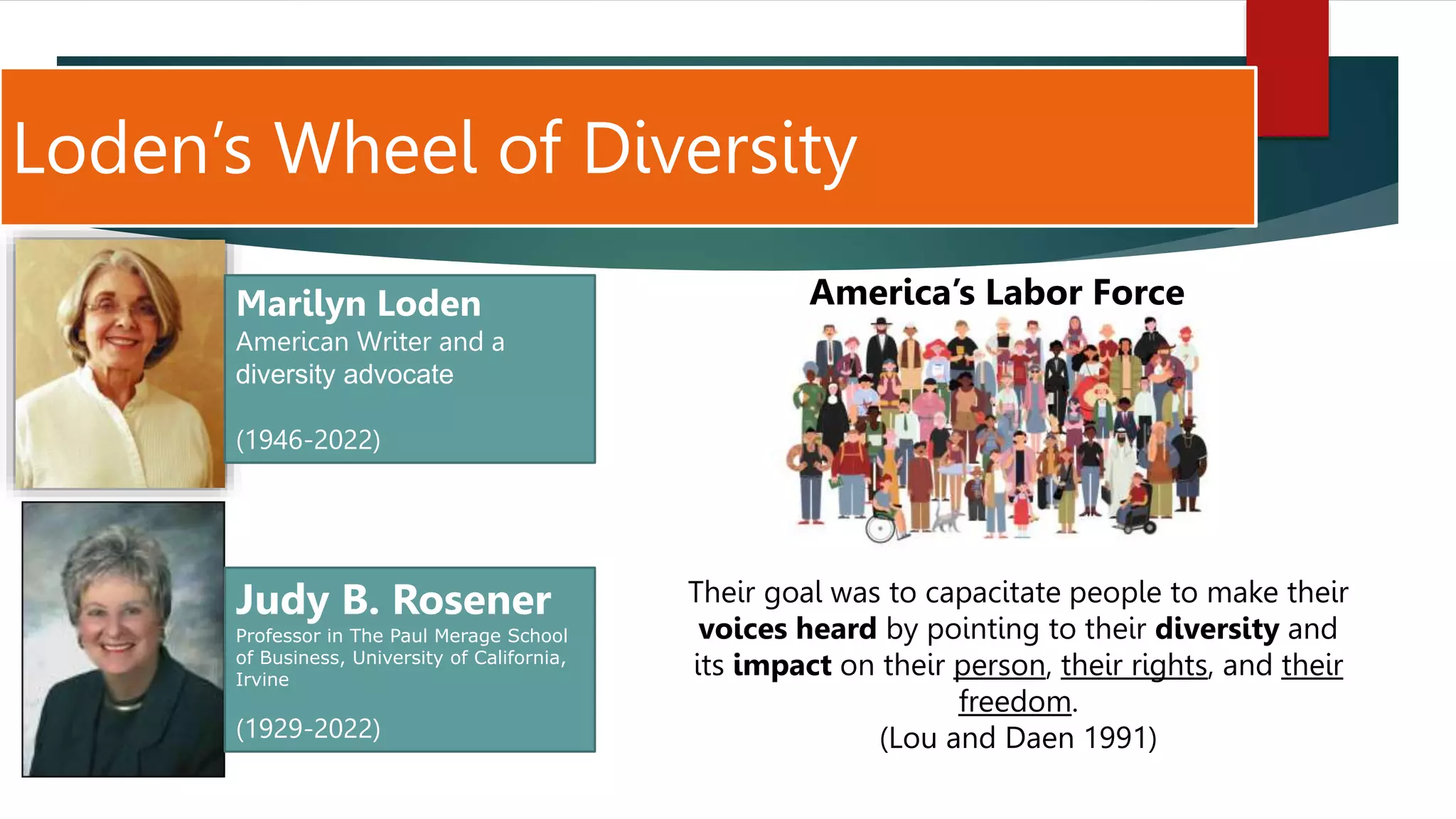
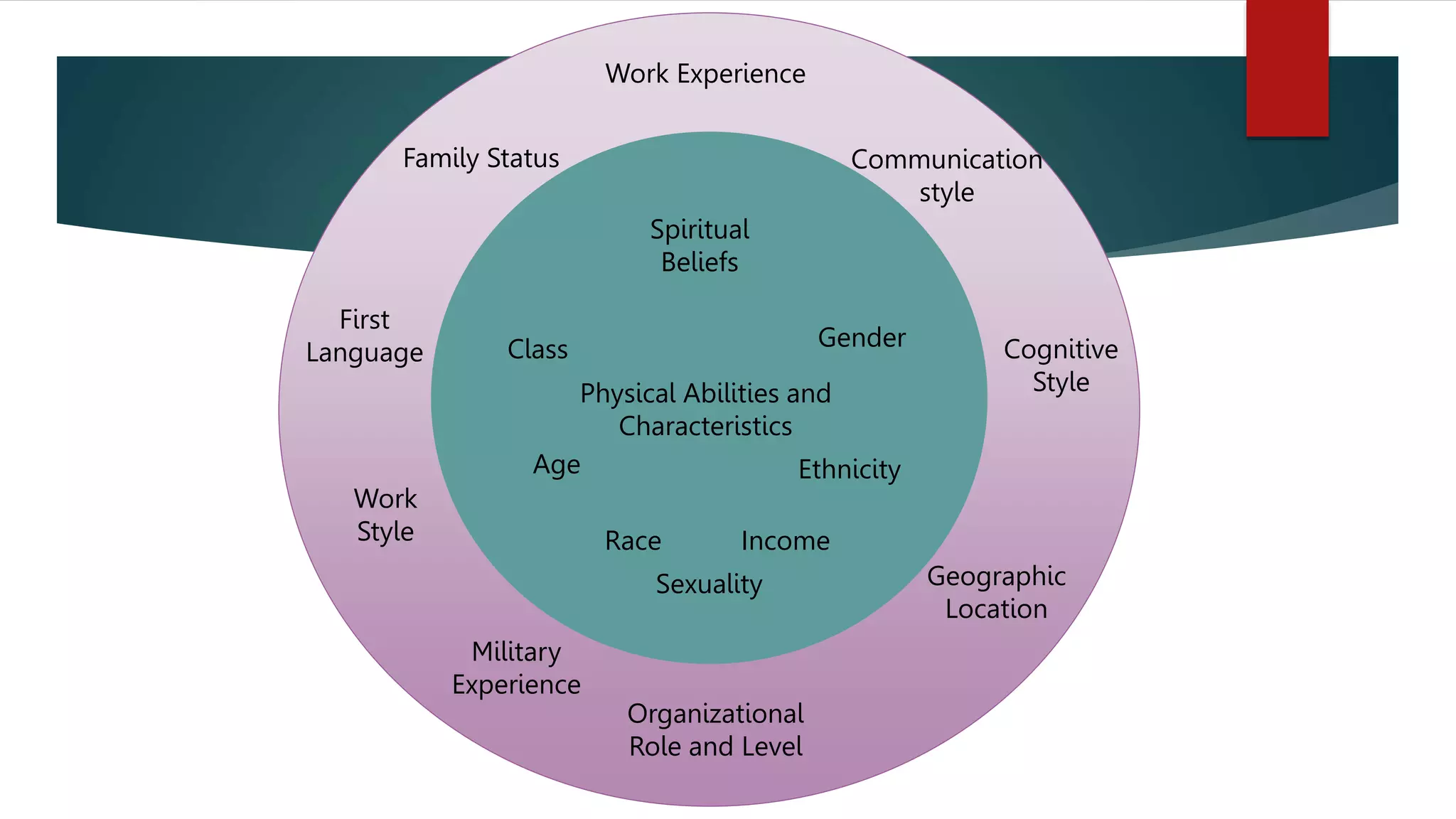
Loden’s Wheel of Diversity
Their goal was to capacitate people to make their
voices heard by pointing to their diversity and
its impact on their person, their rights, and their
freedom.
(Lou and Daen 1991)
Marilyn Loden
American Writer and a
diversity advocate
(1946-2022)
Judy B. Rosener
Professor in The Paul Merage School
of Business, University of California,
Irvine
(1929-2022)
America’s Labor Force
Work Experience
Communication
style
Family Status
First
Language Cognitive
Style
Work
Style
Military
Experience
Organizational
Role and Level
Geographic
Location
Spiritual
Beliefs
Gender
Class
Physical Abilities and
Characteristics
Age Ethnicity
Race Income
Sexuality
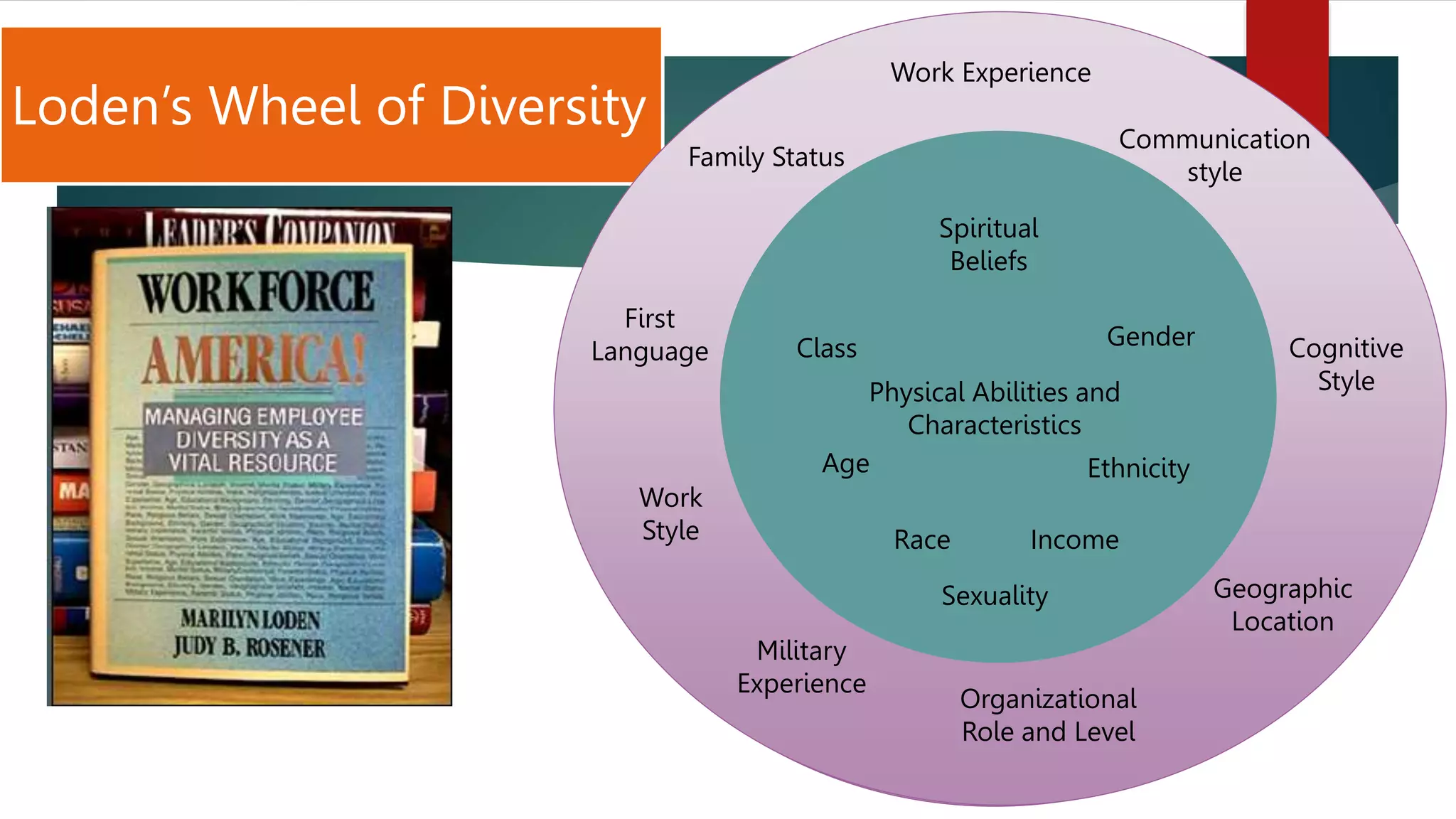
Loden’s Wheel of Diversity
Work Experience
Communication
style
Family Status
First
Language Cognitive
Style
Work
Style
Military
Experience
Organizational
Role and Level
Geographic
Location
Spiritual
Beliefs
Gender
Class
Physical Abilities and
Characteristics
Age Ethnicity
Race Income
Sexuality
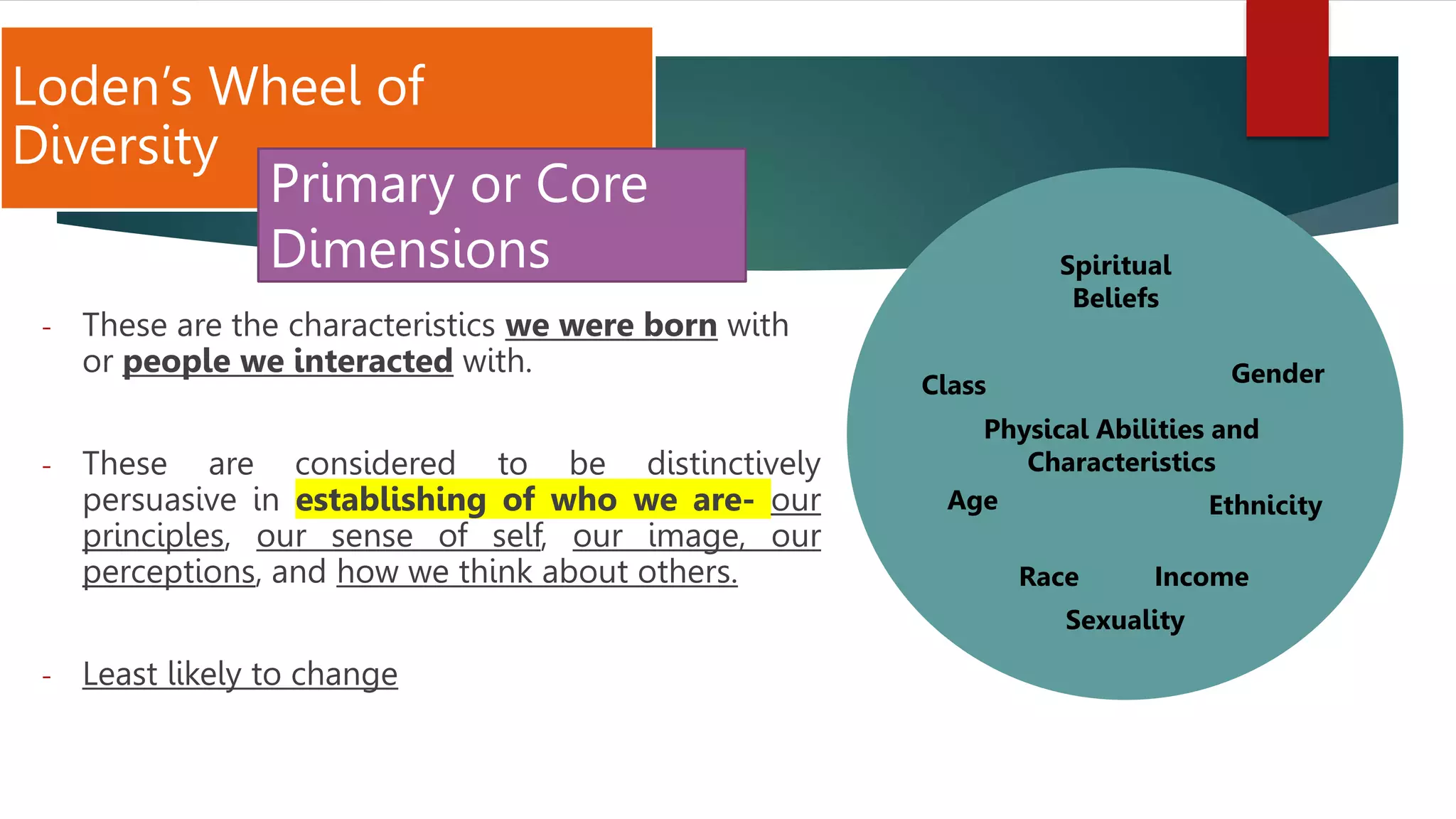
- These are the characteristics we were born with
or people we interacted with.
- These are considered to be distinctively
persuasive in establishing of who we are- our
principles, our sense of self, our image, our
perceptions, and how we think about others.
- Least likely to change
Spiritual
Beliefs
Gender
Class
Physical Abilities and
Characteristics
Age Ethnicity
Race Income
Sexuality
Loden’s Wheel of
Diversity
Primary or Core
Dimensions
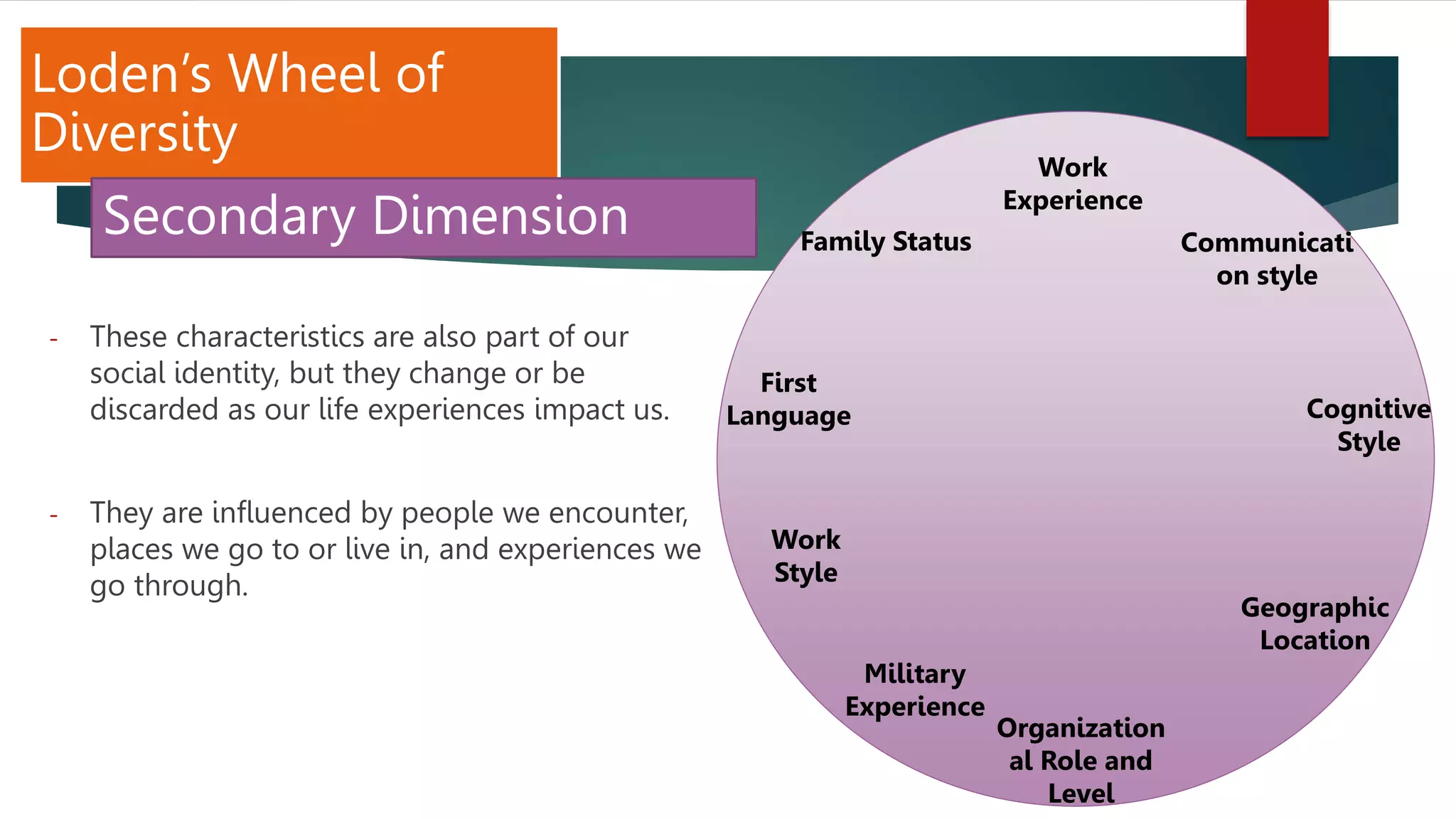
- These characteristics are also part of our
social identity, but they change or be
discarded as our life experiences impact us.
- They are influenced by people we encounter,
places we go to or live in, and experiences we
go through.
Work
Experience
Communicati
on style
Family Status
First
Language Cognitive
Style
Work
Style
Military
Experience
Organization
al Role and
Level
Geographic
Location
Loden’s Wheel of
Diversity
Secondary Dimension
How diverse is your group?
Work Experience
Communication
style
Family Status
First
Language Cognitive
Style
Work
Style
Military
Experience
Organizational
Role and Level
Geographic
Location
Spiritual
Beliefs
Gender
Class
Physical Abilities and
Characteristics
Age Ethnicity
Race Income
Sexuality
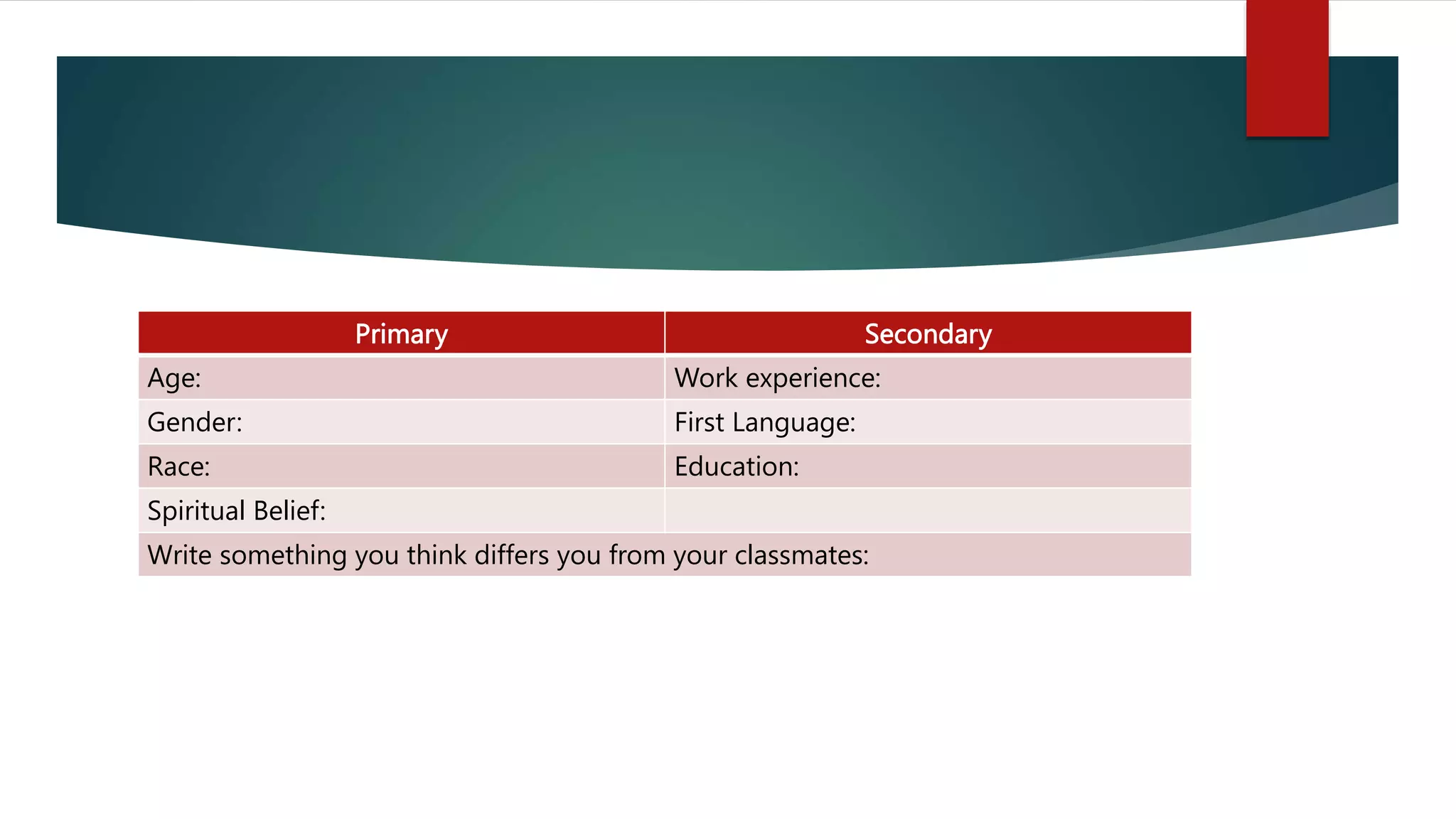
Primary Secondary
Age: Work experience:
Gender: First Language:
Race: Education:
Spiritual Belief:
Write something you think differs you from your classmates:
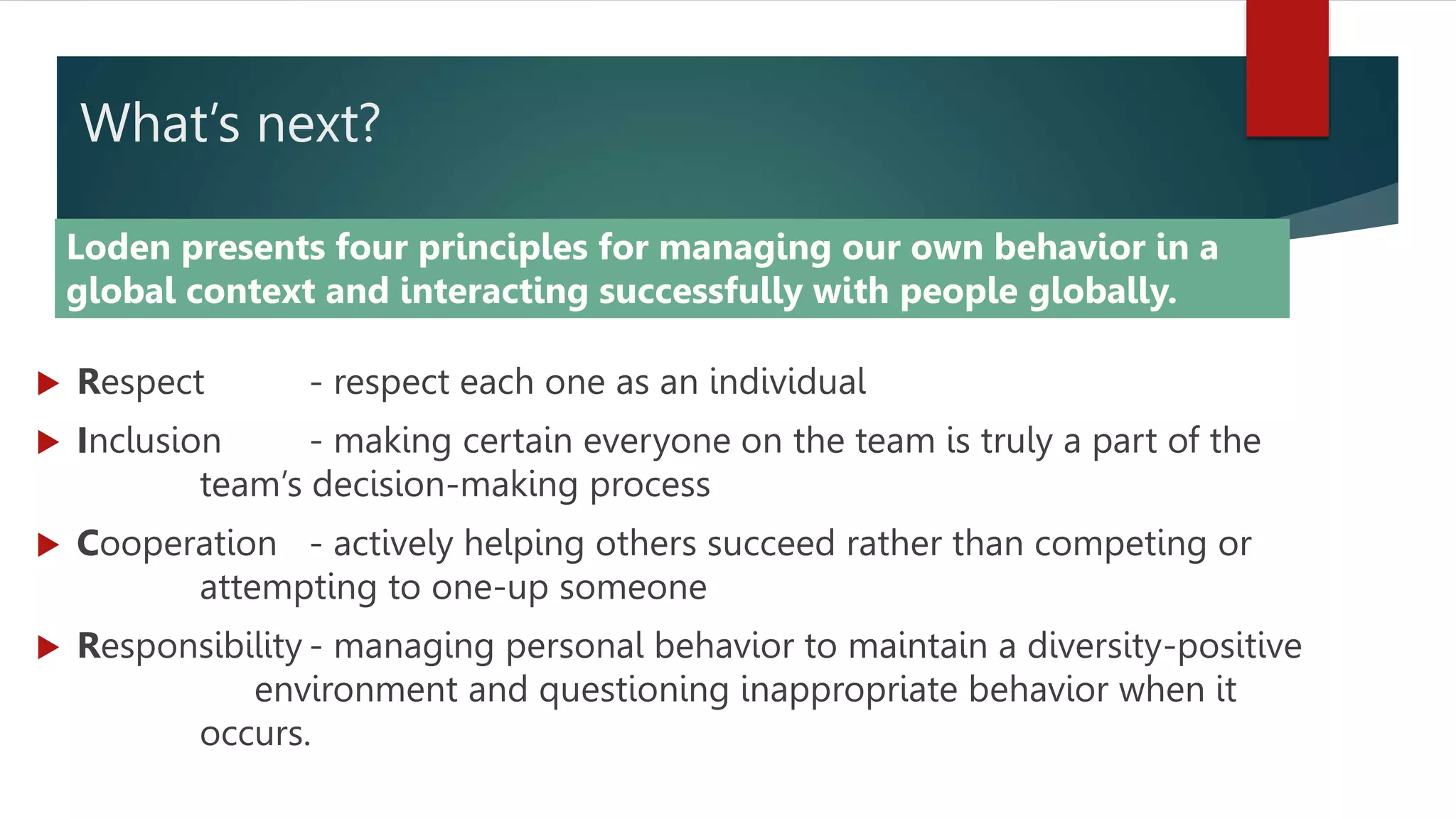
What’s next?
 Respect - respect each one as an individual
 Inclusion - making certain everyone on the team is truly a part of the
team’s decision-making process
 Cooperation - actively helping others succeed rather than competing or
attempting to one-up someone
 Responsibility - managing personal behavior to maintain a diversity-positive
environment and questioning inappropriate behavior when it
occurs.
Loden presents four principles for managing our own behavior in a
global context and interacting successfully with people globally.
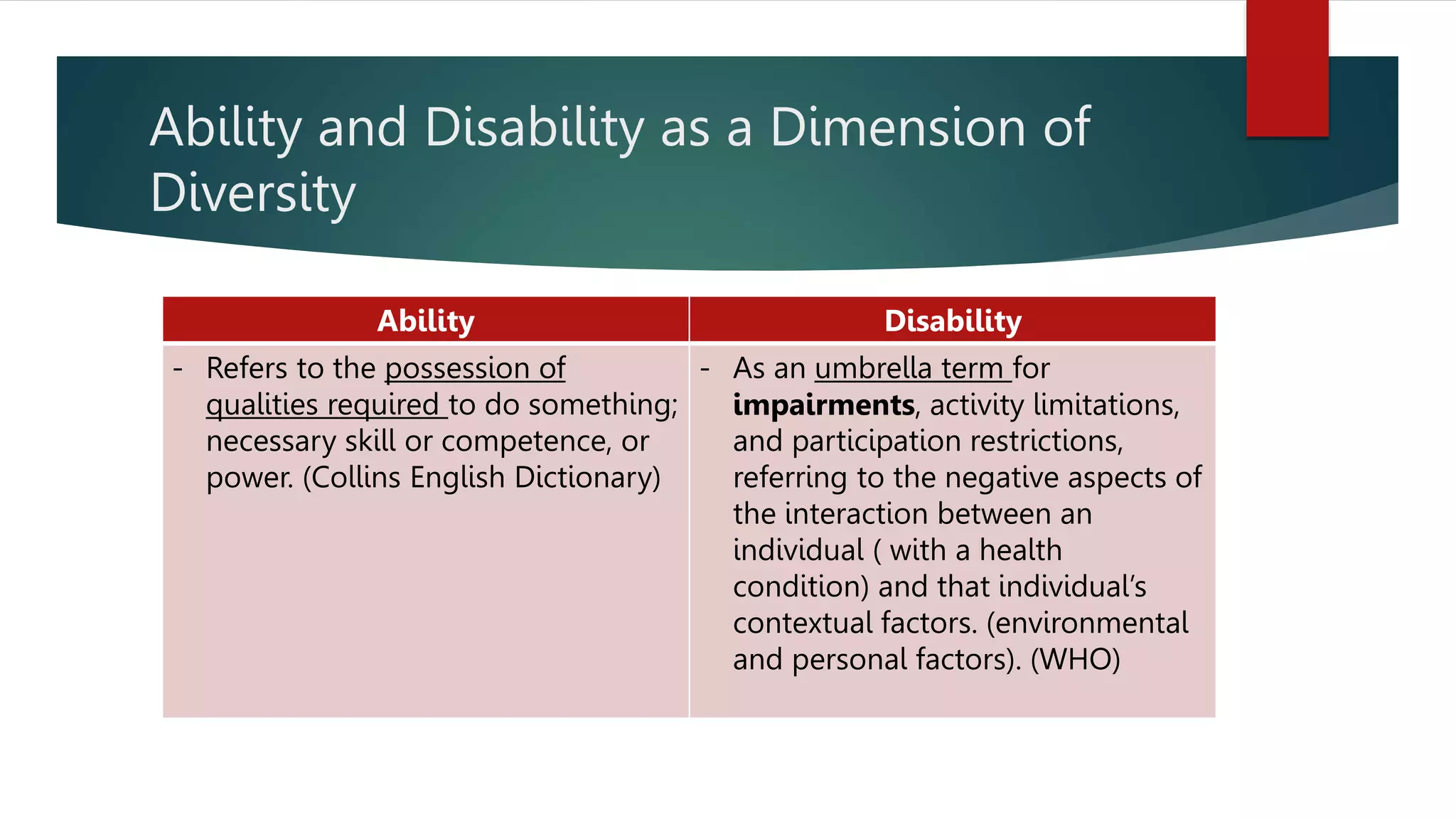
Ability and Disability as a Dimension of
Diversity
Ability Disability
- Refers to the possession of
qualities required to do something;
necessary skill or competence, or
power. (Collins English Dictionary)
- As an umbrella term for
impairments, activity limitations,
and participation restrictions,
referring to the negative aspects of
the interaction between an
individual ( with a health
condition) and that individual’s
contextual factors. (environmental
and personal factors). (WHO)
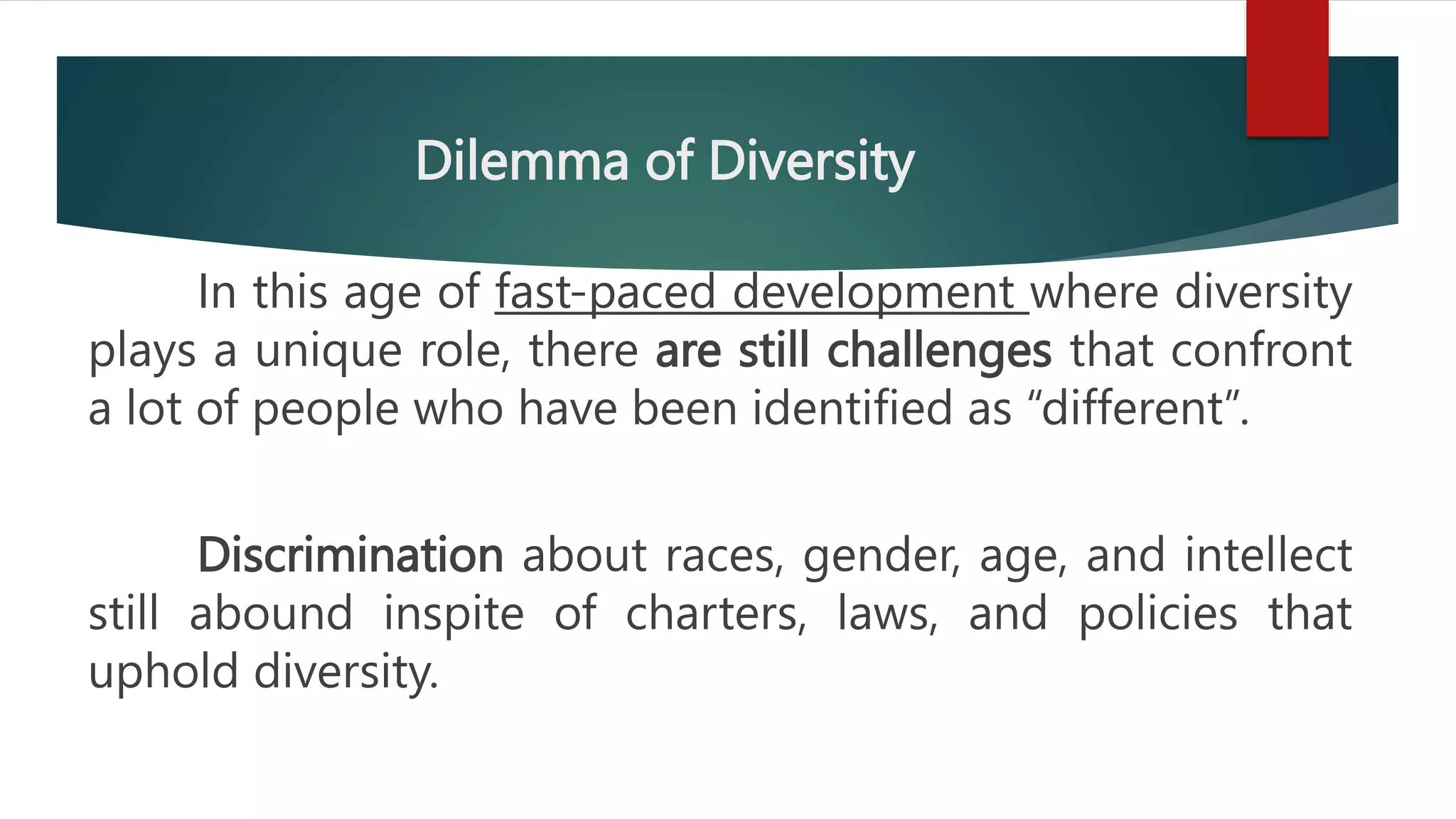
Dilemma of Diversity
In this age of fast-paced development where diversity
plays a unique role, there are still challenges that confront
a lot of people who have been identified as “different”.
Discrimination about races, gender, age, and intellect
still abound inspite of charters, laws, and policies that
uphold diversity.
Activity
Get 1 piece of a short bond paper and create a poster
that demonstrates the impact and importance of
acknowledging and respecting diversity.
Get 1 piece of yellow paper and put your explanation
about the poster you created.
Submit it to me on
Jan. 20, 2023
Friday 11am in the SCO office
Chapter 1.pptx

Chapter 1.pptx

  • 1.
    PREPARED BY: JOHN KENNETHM. CUARE LPT, RSW FACULTY/ PART-TIME LECTURER
  • 2.
    Diversity is fromthe Latin Word divertere, which means to turn away, separate, oppose. (Latin Dictionary n.d.)
  • 3.
    The Collins dictionarydefines diversity as “The state or quality of being different or varied; a variety or assortment; a point of difference; the inclusion of people of different races, genders, religions, etc. in a group; the relation that holds between two entities when and only when they are not identical; the property of being numerically distinct.”
  • 4.
    In the UnitedNation’s Educational, Scientific and Cultural Organization’s (UNESCO) Guide on ensuring Inclusion and Equity in Education (2017), diversity is defined as “people’s differences which may relate to their race, ethnicity, gender, sexual orientation, language, culture, religion, mental physical ability, class, immigration status.” (UNESCO 2017)
  • 5.
    It is importantthat we understand our differences and master how these could be used to harness tolerance, cooperation, and unity will lead to productivity.
  • 6.
  • 7.
    Loden’s Wheel ofDiversity Their goal was to capacitate people to make their voices heard by pointing to their diversity and its impact on their person, their rights, and their freedom. (Lou and Daen 1991) Marilyn Loden American Writer and a diversity advocate (1946-2022) Judy B. Rosener Professor in The Paul Merage School of Business, University of California, Irvine (1929-2022) America’s Labor Force
  • 8.
    Work Experience Communication style Family Status First LanguageCognitive Style Work Style Military Experience Organizational Role and Level Geographic Location Spiritual Beliefs Gender Class Physical Abilities and Characteristics Age Ethnicity Race Income Sexuality Loden’s Wheel of Diversity Work Experience Communication style Family Status First Language Cognitive Style Work Style Military Experience Organizational Role and Level Geographic Location Spiritual Beliefs Gender Class Physical Abilities and Characteristics Age Ethnicity Race Income Sexuality
  • 9.
    - These arethe characteristics we were born with or people we interacted with. - These are considered to be distinctively persuasive in establishing of who we are- our principles, our sense of self, our image, our perceptions, and how we think about others. - Least likely to change Spiritual Beliefs Gender Class Physical Abilities and Characteristics Age Ethnicity Race Income Sexuality Loden’s Wheel of Diversity Primary or Core Dimensions
  • 10.
    - These characteristicsare also part of our social identity, but they change or be discarded as our life experiences impact us. - They are influenced by people we encounter, places we go to or live in, and experiences we go through. Work Experience Communicati on style Family Status First Language Cognitive Style Work Style Military Experience Organization al Role and Level Geographic Location Loden’s Wheel of Diversity Secondary Dimension
  • 11.
    How diverse isyour group?
  • 12.
    Work Experience Communication style Family Status First LanguageCognitive Style Work Style Military Experience Organizational Role and Level Geographic Location Spiritual Beliefs Gender Class Physical Abilities and Characteristics Age Ethnicity Race Income Sexuality
  • 13.
    Primary Secondary Age: Workexperience: Gender: First Language: Race: Education: Spiritual Belief: Write something you think differs you from your classmates:
  • 14.
    What’s next?  Respect- respect each one as an individual  Inclusion - making certain everyone on the team is truly a part of the team’s decision-making process  Cooperation - actively helping others succeed rather than competing or attempting to one-up someone  Responsibility - managing personal behavior to maintain a diversity-positive environment and questioning inappropriate behavior when it occurs. Loden presents four principles for managing our own behavior in a global context and interacting successfully with people globally.
  • 15.
    Ability and Disabilityas a Dimension of Diversity Ability Disability - Refers to the possession of qualities required to do something; necessary skill or competence, or power. (Collins English Dictionary) - As an umbrella term for impairments, activity limitations, and participation restrictions, referring to the negative aspects of the interaction between an individual ( with a health condition) and that individual’s contextual factors. (environmental and personal factors). (WHO)
  • 16.
    Dilemma of Diversity Inthis age of fast-paced development where diversity plays a unique role, there are still challenges that confront a lot of people who have been identified as “different”. Discrimination about races, gender, age, and intellect still abound inspite of charters, laws, and policies that uphold diversity.
  • 17.
    Activity Get 1 pieceof a short bond paper and create a poster that demonstrates the impact and importance of acknowledging and respecting diversity. Get 1 piece of yellow paper and put your explanation about the poster you created.
  • 18.
    Submit it tome on Jan. 20, 2023 Friday 11am in the SCO office