CHAPTER TWO
DISABILITY MODELS
Asa wheelchair user who had polio when I was young, I have experienced well-meaning
individuals tell me that if I just pray and live my life as God wishes me to, I will be cured,
the implication being that I must not be living a “Godly” life since I still need a wheel
chair for mobility. These beliefs are a good example that the moral model continues to
guide people’s thinking.
—Nancy, faculty member
Most disability models are closer to paradigms than they are to theories
in that they present a certain way of viewing disability based on people’s
perceptions, beliefs, and experiences rather than research data. Definitions
and conceptualizations of disability presented in models reflect the worldview
of specific time periods and cultures (Drum, 2009). As such, disability is a
social construction, the meaning of which shifts over time and place and is
influenced by political ideology, economic conditions, and cultural values
(Meade & Serlin, 2006; Olkin, 1999). Olkin (1999) explained that “each
[model] has a perspective on what ‘the problem’ of disability is, who holds
the problem, and avenues that best address the problem” (p. 24). How U.S.
society has perceived disability over the course of the country’s existence has
provided the foundation for how individuals with disabilities have been viewed
and treated, as well as the expectations and assumptions held by individuals
with disabilities themselves.
Interactions between individuals with disabilities and various societal insti
tutions, including the family, community, workplace, and educational system,
are dictated largely by the meaning that society attaches to disability during
54
2.
55
Disability Models
a specificperiod in history. Different assumptions about disability—that is,
disability models—have influenced whether individuals with various disabil
ities were able to attend college at specific times during the history of the
United States and their experiences after they enrolled. Scholars have also
based research on specific models to verify the ideas they include.
In this chapter, we first review the moral, medical, functional limitations,
social, and minority models as major disability perspectives that have guided
thinking and action over time. We discuss them in the order in which they
became important in society, noting factors that were influential in their devel
opment. We then outline critical disability theory and critical realism as two
models that have influenced our thinking and have potential to contribute to
the understanding and practice of disability scholarship and disability support.
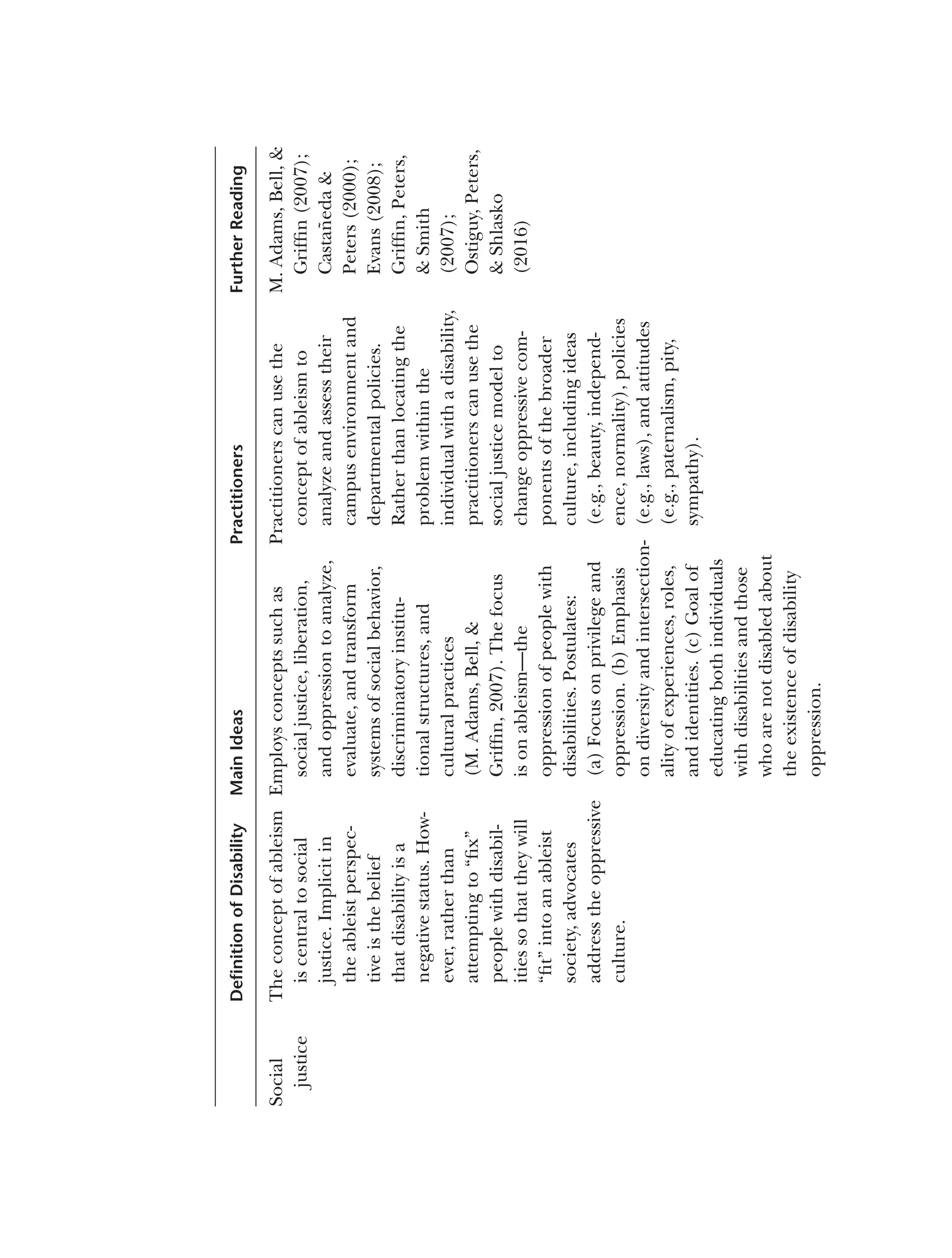
We next highlight the social justice model, which we believe has particular util
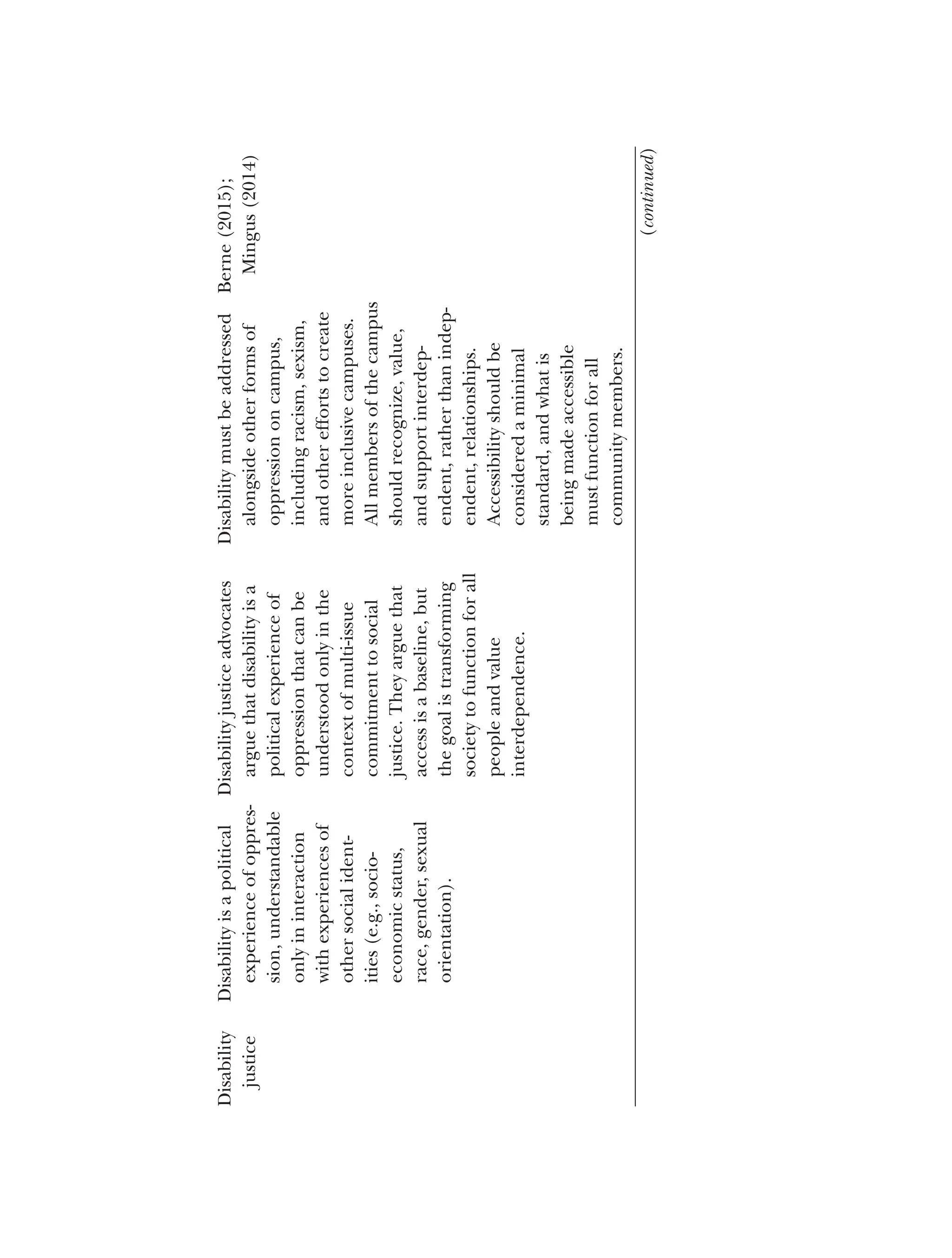
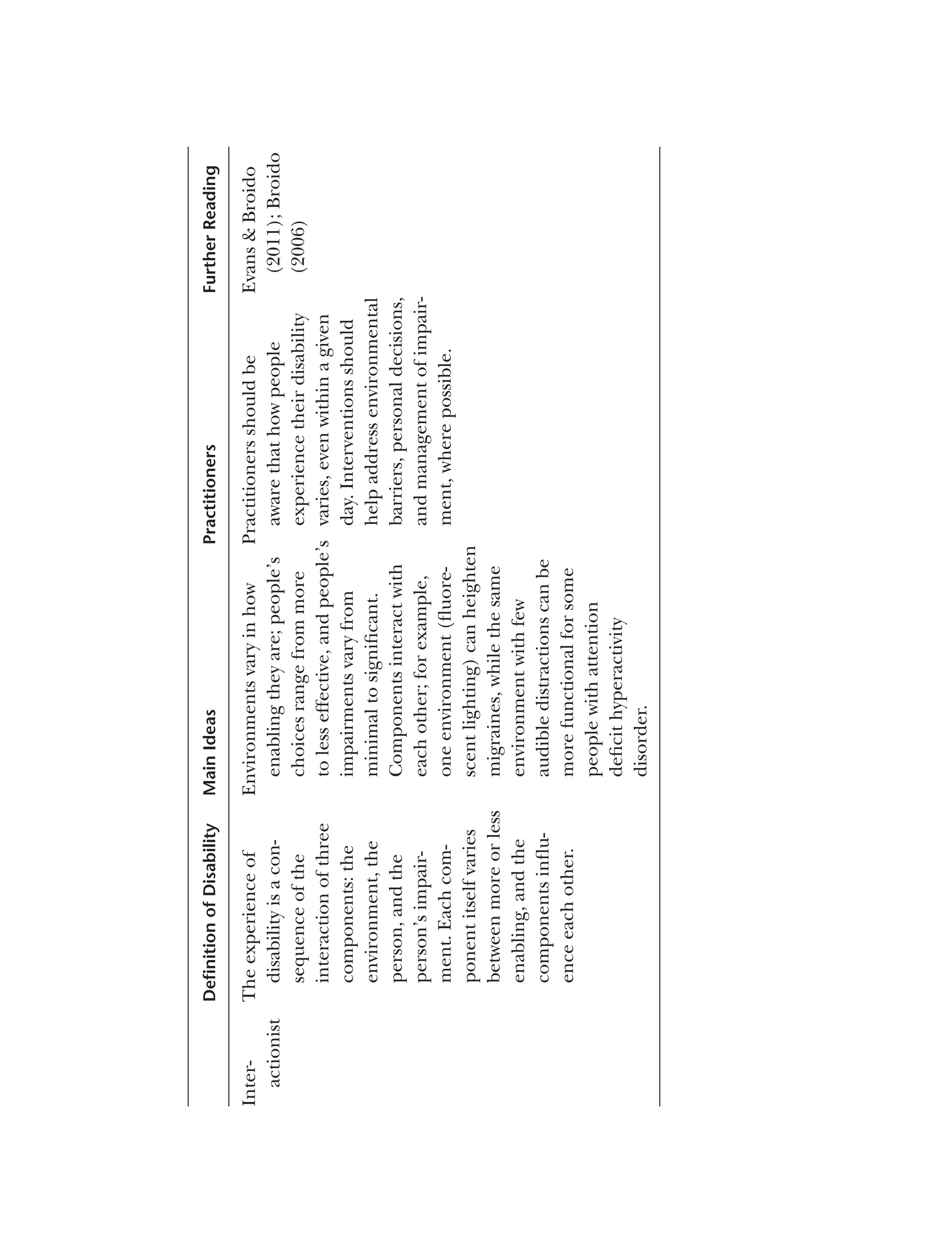
ity in higher education settings. Then we briefly discuss two emerging models,
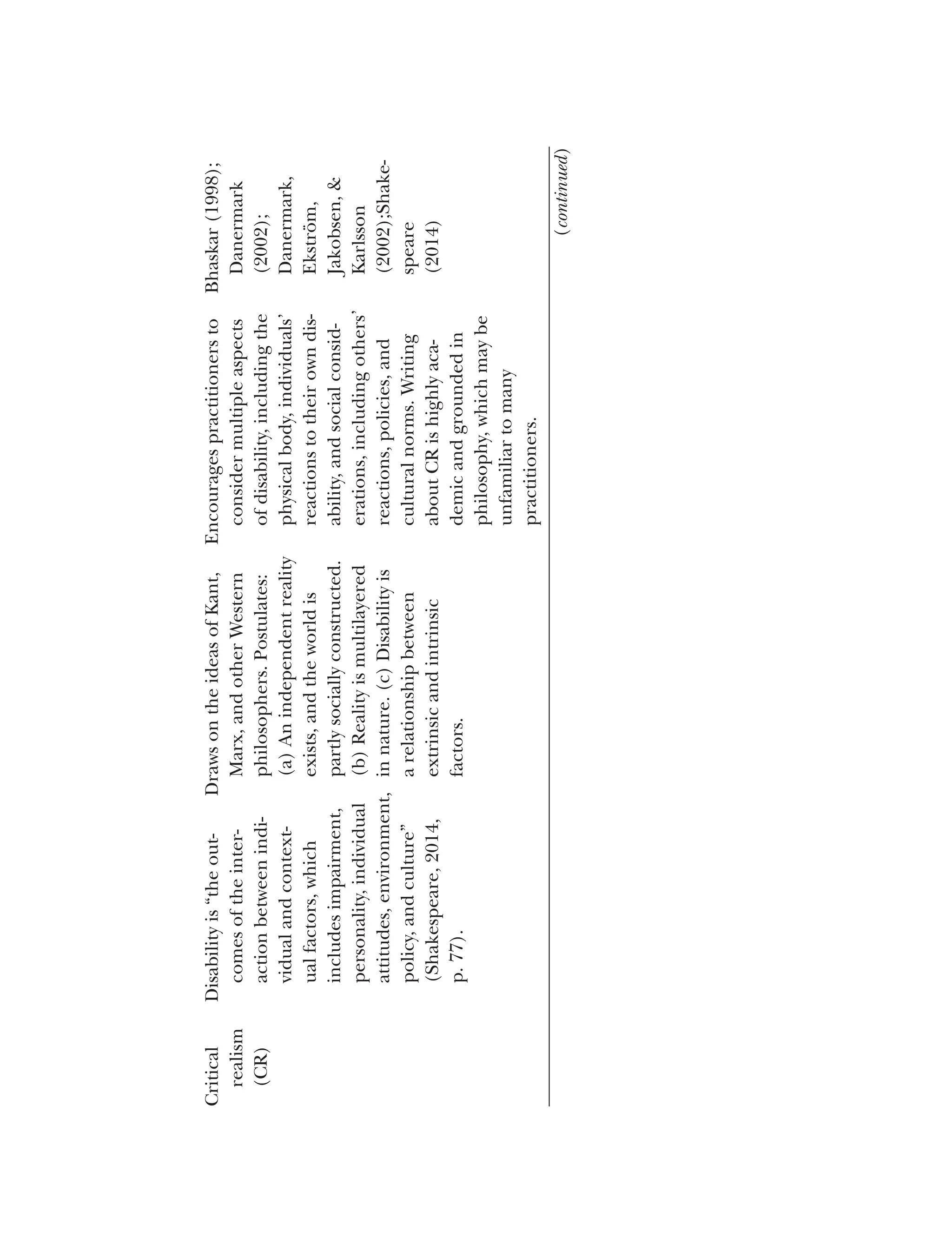
the disability justice model and the interactionist model, that introduce useful
ideas not found in other models. The appendix at the end of this chapter sum
marizes key points of the models we describe. Older models do not disappear
when new models arise. Many of these models coexist in society currently, and
there are still vestiges of the earlier models, as Nancy’s experience discussed at
the start of the chapter demonstrates.
While disability models vary greatly in how they conceptualize disability,
Scambler and Scambler (2010) posited that a theme connecting diverse per
spectives is the idea of chronic illnesses and disabilities as “assaults on the
lifeworld” (p. 1). This broad understanding of disability allows for a variety
of disability models, each of which interprets the contributions of biological,
psychological, and social factors in its own way. Disagreement over disability
policy, legislation, and practice can be attributed to differences in how dis
ability is defined and conceptualized by individuals using different disability
models (Scotch, 2009). Understanding the principles associated with each of
the major models is therefore necessary prior to exploring how disability is
understood and addressed in higher education.
Established Models
We begin by providing overviews of established models of disability that have
guided understanding of disability since the start of the Common Era (moral
model), the 19th century (medical model), the beginning of the 20th century
(functional limitations model), and the 1960s and 1970s (social model and
minority group model).
3.
56 Disability inHigher Education
Moral Model
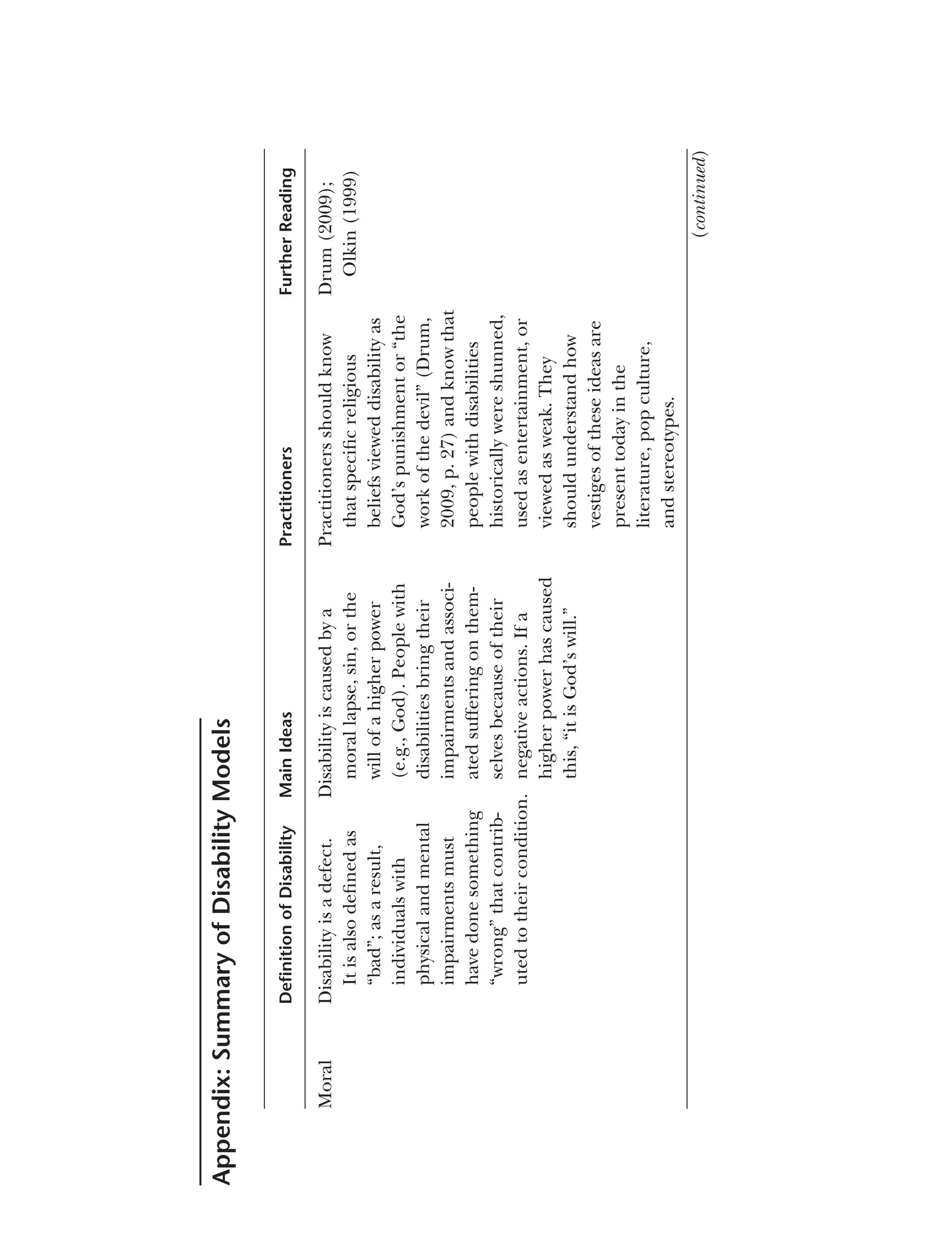
Proponents of the moral model view “disability [as] a defect caused by moral
lapse or sins” (Olkin, 1999, p. 25). As early as the beginning of the Common
Era, the Jewish culture linked physical defects to the “sins” committed by indi
viduals and believed that it was up to individuals to cure themselves since their
actions had caused the defects (Stiker, 1999). During medieval times when
religious beliefs and practices dominated the thinking and actions of West
ern civilization, people believed that disability was God’s punishment for “sin,
failure of faith, moral lapse, or evil” (Olkin, 1999, p. 25) committed by individ
uals themselves or members of their families. Physical impairments could also
be “the work of the devil” (Drum, 2009, p. 27). Because they were viewed as
the result of the individual’s moral misbehavior, defects brought shame on the
individual and the family (Olkin, 1999). As a result, during the Middle Ages,
people who were viewed as defective were “shunned, condemned, or used for
entertainment purposes, e.g, as court jesters” (Drum, 2009, p. 27).
During the late 1800s, disability and its related effects, such as poverty,
unemployment, and dependence on others, continued to be viewed as a result
of fate, God’s punishment, or individual moral weaknesses (K. W. Hickel, 2001).
Because disabled people were viewed as weak, flawed, and having brought their
conditions on themselves, government agencies as well as private charities
refused to provide aid to adults disabled in later life, although they did assist
children with disabilities and veterans of military service (K. W. Hickel, 2001).
While the moral model is not the most prevalent view of disability today,
vestiges of it remain in today’s language, culture, and beliefs (Olkin, 1999).
For instance, one often hears the phrase, “It is God’s will,” when a child is born
with an incurable illness or a person becomes paralyzed as a result of an auto
mobile accident. Western culture is permeated with the belief that disability is
“bad” and, as a result, individuals with physical and mental impairments must
have done something “wrong” that contributed to their condition. This atti
tude is especially evident when individuals are viewed as having played a direct
role in their impairment, such as those with AIDS, Type 2 diabetes, obesity, or
addictions. In such cases, it is viewed as acceptable to blame these individu
als for their disabilities and even to exclude them from protection under the
Americans With Disabilities Act Amendments Act (ADAAA; e.g., those with
drug addiction who have not stopped using drugs). In addition, pop culture
(e.g., television programs, movies, and popular books) often portrays disabled
characters as villains or evil persons (Longmore, 2003). Arguments against pro
viding government assistance to people with disabilities are frequently based
on similar thinking (Shapiro, 1993).
4.
57
Disability Models
Olkin (1999)provided another viewpoint originating from the moral
model: “the myth of disability as mysticism” (p. 25). This belief suggests that
when individuals lose one of their senses, other senses are heightened, such as
the blind seer in the ancient Greek play Oedipus who provided the king with a
prophecy regarding the future. Similarly, some people believe that as a result
of surviving the adversity of living with a physical impairment, individuals will
develop special spiritual, emotional, or reflective powers (Olkin, 1999).
Medical Model
Many factors converged during the mid-1800s that led to the development
of the medical model. Most important was the beginning of the scientific
and medical fields during the late 1700s and their refinement throughout
the 1800s (Castañeda, Hopkins, & Peters, 2013). A second factor was the
emergence of the concept of the “average man” whose characteristics and
qualities were assumed to be “correct” or “normal” (L. J. Davis, 2006, p. 6).
Any deviation from the average was viewed as deviant, abnormal, and in need
of correction in order for a person to be acceptable in society. In addition,
scientific advances during the 1800s led to a better understanding of diseases
and their causes (Drum, 2009). Thus, by the late 1800s, disability was consid
ered a public health issue, and people came to believe that it could be treated
by physicians in institutions designed for that purpose (Drum, 2009). By the
early 20th century, social service agencies, educational institutions, health
care personnel, and policymakers formalized the medical model of disability
and placed disability under the authority of medical and quasi-medical
professionals (Nielsen, 2012). From these beginnings, the medical model
evolved and remains a major paradigm for understanding, treating, and
working with people with disabilities. A number of variations of the medical
model exist (see Altman, 2001; Masala & Petretto, 2008); our overview focuses
on principles associated with the majority of these approaches.
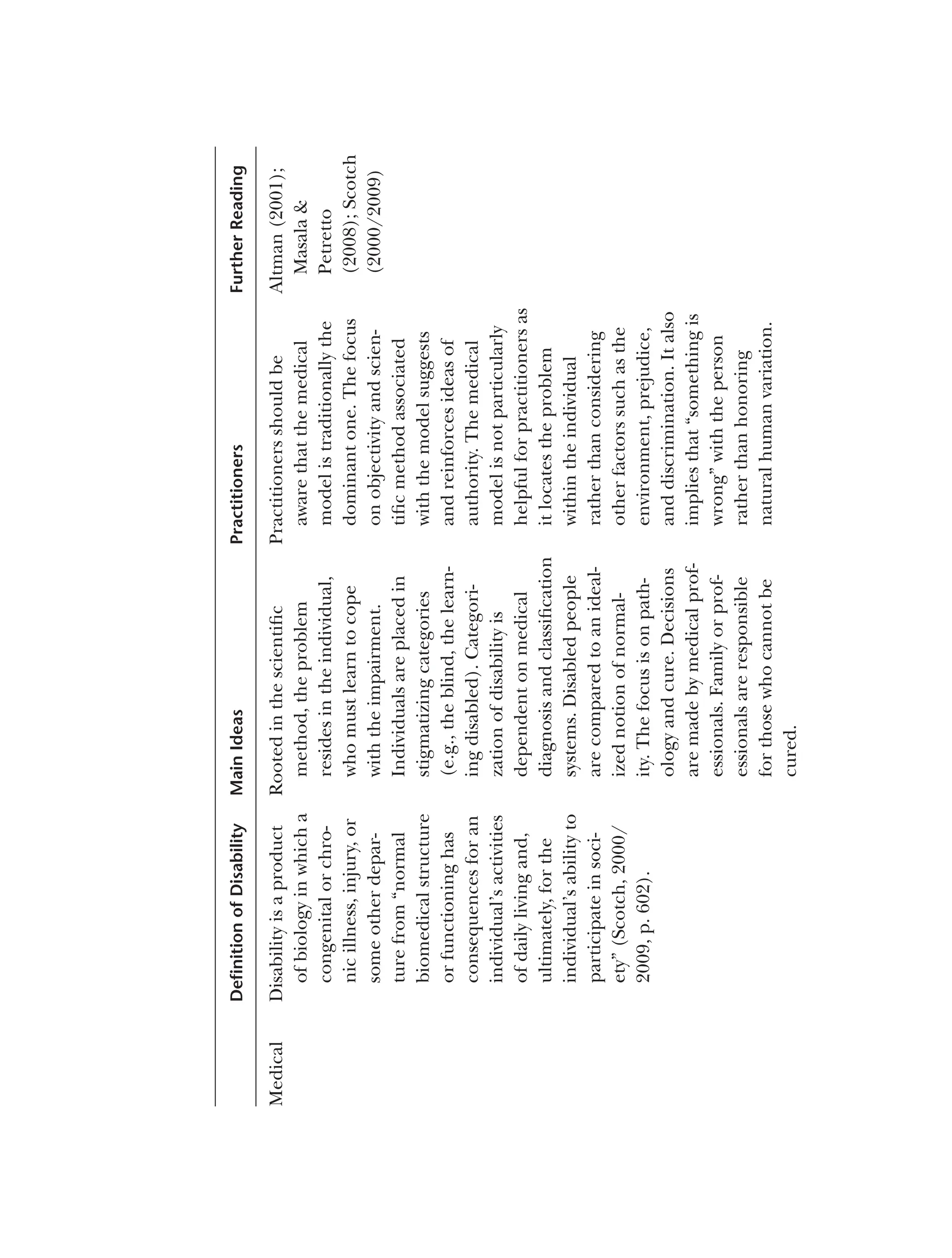
Adherents of the medical model view disability as “a medical problem that
resides in the individual … a defect in or failure of a bodily system and as such
is inherently abnormal and pathological” (Olkin, 1999, p. 26). If the person
is to fully function as a human being, this defect must be “cured or elimi
nated” (Siebers, 2008, p. 3). Fine and Asch (1988/2000) listed the following
assumptions of the medical model: (a) disability is located only in the body,
(b) a person’s problems are caused by the person’s impairment, (c) disabled
persons are “victims” who must learn to handle the circumstances they face,
(d) how disabled persons view themselves and compare themselves to others
5.
58 Disability inHigher Education
centers around their disabilities, and (e) people who have disabilities need
help and support.
The medical model is linear (Minaire, 1992). Disabilities are caused by
diseases, illnesses, traumas, or internal biological conditions (Drum, 2009)
that create pathologies defined as physiological or cognitive impairments that
make persons different from those who are considered “normal” (Meade &
Serlin, 2006). The resulting symptomologies are the limitations people expe
rience in their ability to perform everyday activities people of a similar age can
complete, such as personal self-care, attending school, managing a household,
or maintaining employment (Longmore & Umansky, 2001). Thus, users of the
model focus “on the disease process itself, with the goal of curing the disease
and returning the patient to normal functioning” (Lutz & Bowers, 2003/2007,
p. 13). Therefore, a university’s disability resource office staff using a medical
perspective would focus on students’ access to appropriate health care.
Rather than viewing individuals with disabilities as people, adherents of
the medical model see them as “social embodiments of their physical disabil
ity: they are dysfunctional or quasi-functional or nonfunctional bodies to be
repaired or, if not, then managed with bureaucratic and economic efficiency”
(Meade & Serlin, 2006, p. 3). It is up to the medical professional to decide
how to cure the disabled person’s problem and the disabled person must do
exactly what is prescribed in order to “get well” (Pfeiffer, 2000/2007, p. 7), tak
ing on what Parsons (1951) labeled the “sick role” (p. 23). By taking on the
sick role, individuals do not have the same social obligations as others in soci
ety, such as employment or household management, because they are “sick,”
but they also give up their rights to those who are caring for them (Pfeiffer,
2000/2007). If they do not obey the regimen prescribed by their physician or
are not “cured” of their illness, they must accept the blame for their failure “to
respond to treatment” (Drum, 2009, p. 28). Scambler and Scambler (2010)
observed that under the medical model, the lives of individuals with disabili
ties can be affected as much by fears of stigmatization as by the direct effects of
the exclusion from society they experience as a result of being excused from
their social responsibilities.
A number of critiques of the medical model can be found in the literature.
Imrie (1997) noted that focusing exclusively on the biological aspects of dis
ability ignores factors such as culture, environment, and politics that play an
important role in disability and its effects on individuals directly and by way of
the attitudes and prejudice that result from these aspects of society. Lutz and
Bowers (2003/2007) also suggested that while the medical model can be useful
in the diagnosis and initial treatment of diseases, it does not take into consid
eration other factors that affect individuals with disabilities over the course
6.
59
Disability Models
of theirlife span. Psychologists have also expressed concern that the medical
model does not take into consideration that psychological distress from prej
udice and discrimination can contribute to how individuals experience and
respond to disability (Marks, 1997). Disability activists reject the idea of equat
ing disability with illness or abnormality. Many find the views and resulting
treatment disabled people receive from members of the medical community
as oppressive and marginalizing (Bricher, 2000).
Strict adherents of the medical model, who are concerned only with cur
ing the illnesses or physiological abnormalities exhibited by individuals with
impairments, are most likely to view disabled individuals as unfit to attend col
lege or work in any capacity. One of the reviewers of a draft of this book (M.
Peña, personal communication, August 5, 2016) shared an experience that she
had with this type of thinking when she began working at a college in 1989:
“I had to go before the college board, introduce myself, and talk about my
college degrees, [and] then proceeded to tell them about my learning disabil
ity. One of the board members said, ‘Having a learning disability and going to
college are mutually exclusive.’” Since they are viewed as being sick, disabled
people are considered unfit to take part in the normal activities expected of a
college student or employee.
Within the medical model, there is no expectation that society will make
adjustments to change people’s attitudes or improve the environment so
that people with disabilities can participate fully. People with disabilities are
expected to rely on medical intervention, such as medication, therapy, or
other forms of treatment, to address the symptoms and problems associated
with their impairment. Another experience that our reviewer, M. Peña
(personal communication, August 5, 2016), recalled was an employer who,
upon learning that she had a learning disability, asked her if she took a pill
for that. Those who adhere to the medical model also believe that if there is
no current intervention to treat the impairments of disabled individuals, they
must adjust to being outsiders and wait for a cure for their ailment.
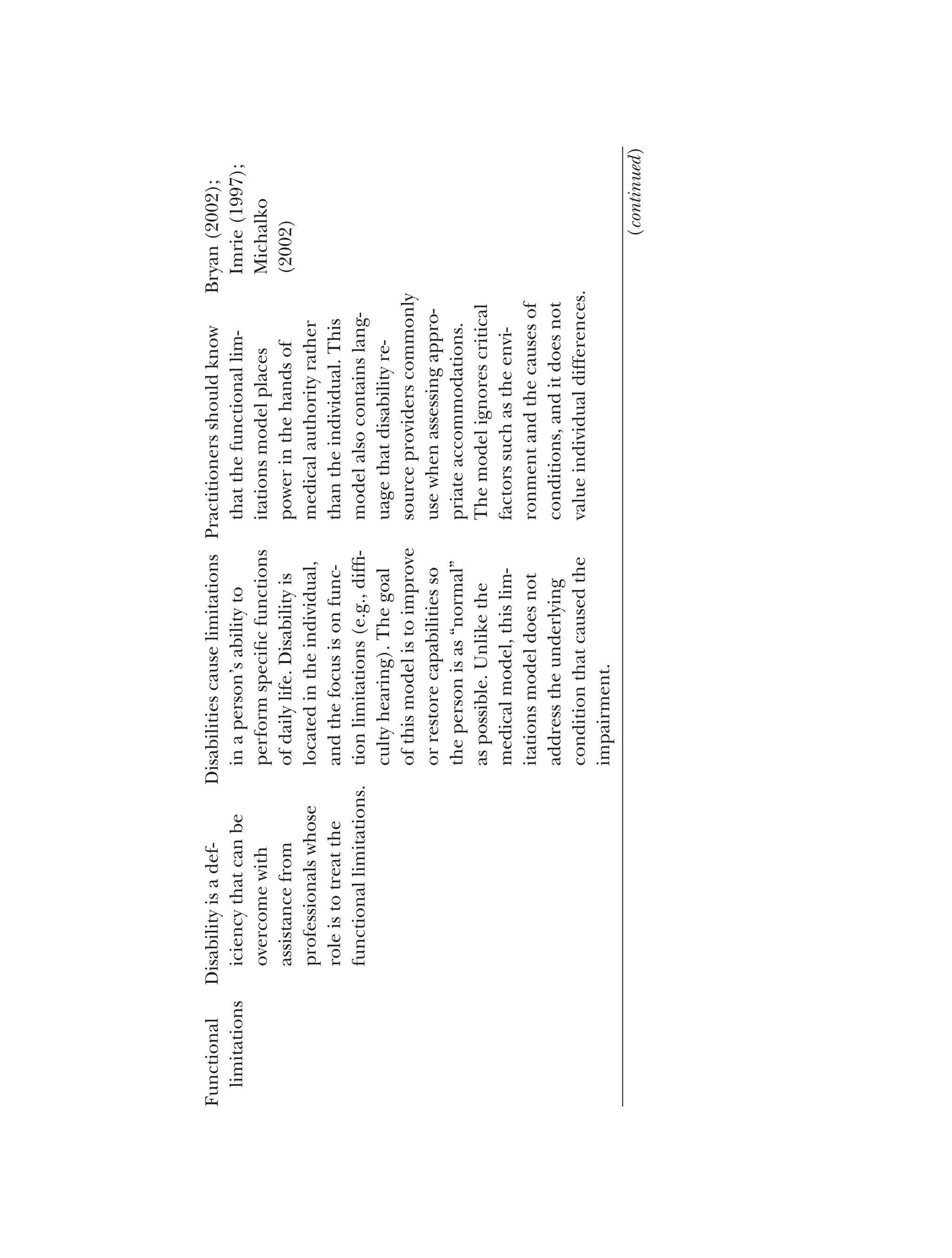
Functional Limitations (Rehabilitation) Model
The concept of rehabilitation first appeared around 1880 with the develop
ment of hospital-schools to prepare crippled children to function in society
(Byrom, 2001). Adherents of this approach viewed disability as a deficiency that
could be overcome with assistance from professionals whose role was to treat
the social and medical problems these children faced (Burch & Sutherland,
2006). The rehabilitation approach was expanded to address the increasing
number of disabled veterans after World War I (Strauss, 1965).
7.
60 Disability inHigher Education
Stiker (1999) pointed out that “the notion of ‘rehabilitation’ [implied]
returning to a point, to a prior situation” (p. 122), suggesting that disability was
a deviation from the norm of nondisabled existence and that the goal of reha
bilitation was returning the disabled individual to this state. During the early
20th century, the focus shifted from its original emphasis on social rehabilita
tion, providing education and training so that disabled individuals could find
a place to fit in society, to medical rehabilitation, which consisted of surgical
and technological intervention to correct the impairments of disabled persons
(Byrom, 2001).
In the functional limitations (or rehabilitation) model, the main argu
ment is that disabilities cause limitations in a person’s ability to perform
specific functions of daily life (Bryan, 2002). Like the medical model, the
functional limitations model of disability is exclusively focused on the person;
the individual, rather than society, is rehabilitated (Imrie, 1997). But as Nagi
(1965) explained, unlike the medical model, which focuses on pathology
and cure, the rehabilitation model focuses on functional limitations and
disabilities. Functional limitations may include difficulties moving, breath
ing, working, or caring for oneself independently (Bickenbach, Chatterji,
Badley, & Üstün, 1999). The functional limitations model is essentialist in
nature; it does not acknowledge that the culture, situation, or environment
can influence the extent to which functional limitations affect people’s ability
to do things (Imrie, 1997). Adherents of the model also see disability as
dichotomous; that is, there are only two kinds of people in the world—those
who have functional limitations and those who do not (Drum, 2009). Only
those who do not have functional limitations—the able-bodied—can be
successful (Imrie, 1997).
The goal of this model is to improve disabled people’s functional capabil
ities so that they are “restored to their previous condition,” that is, the usual
human condition of “ordinariness” (Michalko, 2002, p. 152). Unlike the med
ical model, the functional limitations model does not address the underlying
condition that caused the impairment; rather, the emphasis is on improving
the individual’s functional capacity (Drum, 2009). To do so, rehabilitation
personnel assess functional limitations and develop rehabilitation plans that
focus as much as possible on restoring individuals to their former level of func
tioning and assisting them in adapting to their environments (Bryan, 2002).
As Michalko (2002) pointed out, in today’s society, people tend to be judged
by how well they are able to carry out activities, “make a living,” and contribute
to society. There appears to be a hierarchy of disability, with physical and occu
pational functioning being the most important to address in rehabilitation
(Imrie, 1997). As such, “the problem of disability … becomes the problem of
8.
61
Disability Models
inability” (Michalko,2002, p. 156). Disability resource office staff working from
a functional limitations model would focus on providing accommodations,
adaptive equipment, and individual coaching to enable students with disabili
ties to “overcome” their functional limitations and accomplish their academic
goals, succeed in college, and enter the workplace.
There are a number of criticisms of the functional limitations model.
From a social justice perspective, the functional limitations model, as with the
medical model, places power and control in the hands of medical personnel
who determine what tests and treatments should be administered to address
the individual’s functional limitations and when the individual’s functional
capacity has improved enough to consider the rehabilitation a success (Lutz &
Bowers, 2003/2007). The reliance on testing by disability resource staff to
verify learning disabilities and allow students to secure accommodations is
based on the functional limitations model. In addition, the individual must
be a “good patient” and comply with the instructions the rehabilitation
professional provides. Disabled persons who cannot successfully regain full
function remain dependent on others for care and are left “in a chronic role
of dependency” (Lutz & Bowers, 2003/2007, p. 12). They are socialized into
accepting the idea that they are “inferior” to those who are not disabled and
behave in ways that conform to the stereotypes and behaviors that others
expect (Imrie, 1997). In addition, the rehabilitation model does not value
individual difference. Individuals with disabilities that make them unique
must be rehabilitated so they are similar to everyone else and can assimilate
in society (Stiker, 1999).
Others point out that the functional limitations model ignores the effects
of aspects of the environment by focusing only on internal bodily limitations
(Bickenbach et al., 1999; H. Hahn, 1991). It also fails to consider ways to
change the environment to suit disabled persons by expecting the disabled
person to adjust to the environment (Bryan, 2002). For instance, vocational
rehabilitation services, which many disabled individuals rely on for assistance
in attending college or securing employment, assisted Nancy when she
determined that she could not negotiate the amount of walking required in
her position at Penn State. They provided her with a motorized scooter to use
on campus. Rather than recommending that the university adjust her work
environment by moving her classes to the building in which her office was
located, they considered only ways to adjust her personal mobility.
Medical personnel working from a rehabilitation perspective have also
been criticized for focusing so much on the causes of conditions affecting
disabled individuals that they tend to segregate them into disease categories
and separate them from other people with different disabilities rather than
9.
62 Disability inHigher Education
bringing them together to address common issues, such as discrimination and
environmental barriers (Bryan, 2002). In addition, reducing a person to a con
dition ignores other aspects of the whole person (Bryan, 2002).
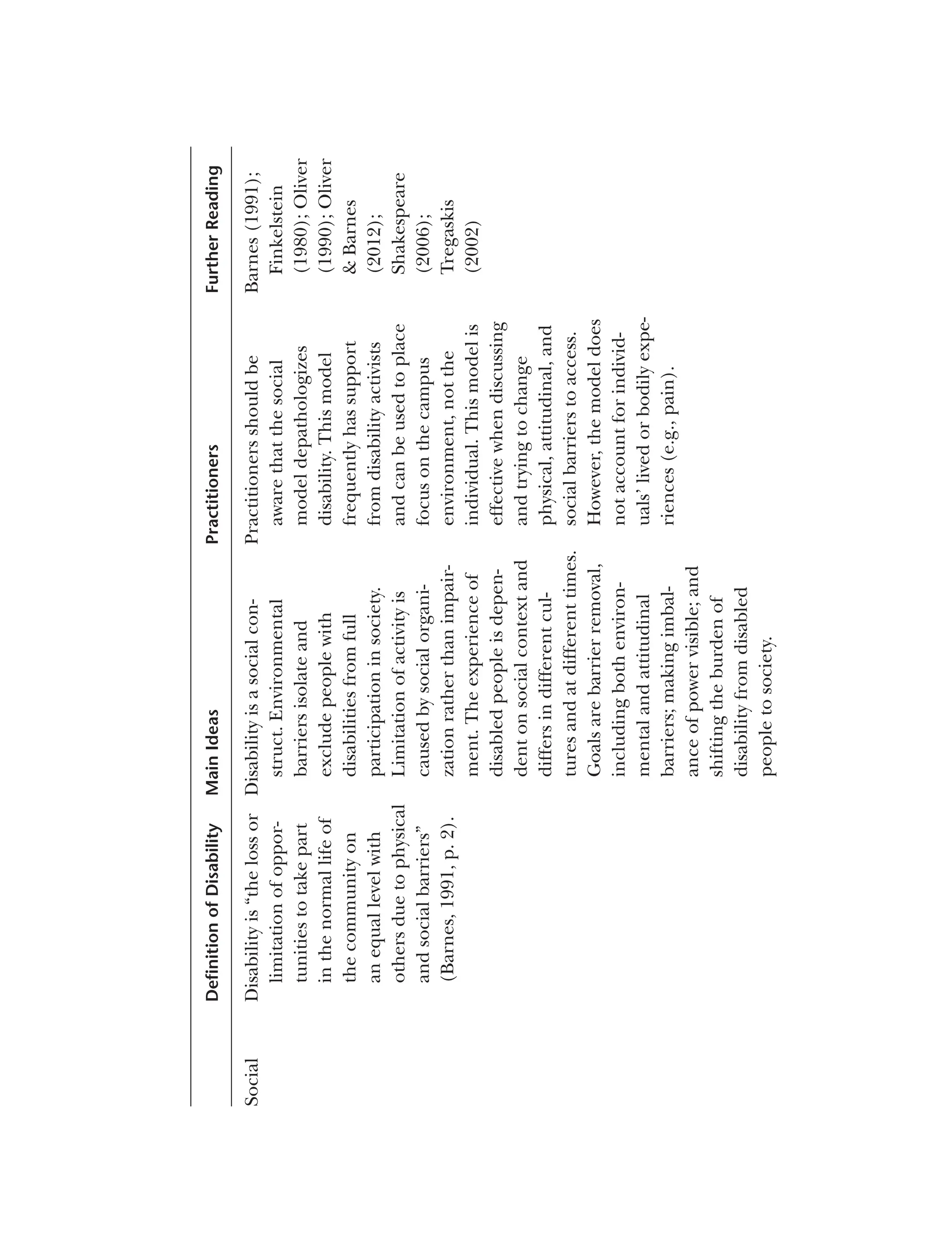
Social Model
The social model of disability originated in the United Kingdom and was based
on Fundamental Principles of Disability (1976), a document written and pub
lished by a disability activist group, the Union of the Physically Impaired against
Segregation. Academics in the United Kingdom, especially Michael Oliver,
Colin Barnes, and Vic Finkelstein, formalized the ideas set out in the doc
ument to create the social model of disability, the most often cited version
of which was written by Oliver (1990). The social model was developed as
an alternative to the medical and functional limitations approaches to which
many disability activists objected (Drum, 2009). Many variations of the social
model have evolved since the 1980s, including materialist (Finkelstein, 1980),
cultural (Barnes, 1991; Shakespeare, 1994), and feminist (C. Thomas, 1999)
versions (Tregaskis, 2002). The social model was introduced primarily for use
by disability professionals and activists. As a result, Oliver (2004) stressed that
it was not a disability theory. Often referred to as the “big idea” of the disability
movement in the United Kingdom, the social model had a major influence
on building the collective disability consciousness of its members by getting
disabled people to think about their commonalities and the barriers they all
faced (Oliver, 2004).
Barnes (1991) defined disability as “the loss or limitation of opportunities
to take part in the normal life of the community on an equal level with others
due to physical and social barriers” (p. 2). Thus, disability is a socially con
structed concept, its meaning based on the perceptions of those making up
society (Llewellyn & Hogan, 2000; Olkin, 2011b). Proponents of the social
model argue that disability is located in the social environment, which they
view as exclusionary and oppressive, rather than in the body (Marks, 1999).
Social modelists define the environment broadly as including physical, eco
nomic, and political factors, as well as social dimensions (Tregaskis, 2002).
They understand disability as the barriers that individuals with impairments
have to address in all aspects of their lives, including work settings, housing
options, education opportunities, civil rights, transportation, and access to the
architectural environment (C. Thomas, 2004).
Initially impairment was not important to social modelists in that they saw
disability as “wholly and exclusively social … [and] disablement [as having]
nothing to do with the body” (Oliver, 1996, pp. 41–42). Later writers modified
10.
63
Disability Models
this position,defining impairment as “limitation in a person’s physical, men
tal or sensory functioning [that] … only become[s] salient and disabling in
specific settings” (Marks, 1999, p. 80). Social modelists, however, continue
to believe that “disability is the overriding priority for … the disabled people’s
movement” (C. Thomas, 2004, p. 24). Disability resource office staff working
within the social model would be interested only in environmental barriers
such as inaccessible buildings, lack of captioning on videos, or inaccessible
technology rather than any factors related to students themselves.
The main goal of adherents of the social model is to make sense of
and change “disabling socio-political and cultural practices” (Goodley, 2004,
p. 123). Social modelists also argue against segregated, special, or adapted
facilities for disabled people since such facilities send a message that disabled
individuals are different from other members of the community and cannot
fit in the “normal” world (Marks, 1999). Instead, they advocate using universal
design (see Chapters 10 and 12) to modify the mainstream environment so
that it is accessible to all individuals, with or without disabilities (Marks, 1999).
The strengths of the social model are that it introduced a new way
for professional disability workers and researchers to think about disability
and raised new research questions amenable to different methodological
approaches to better understand the concept of disability (Llewellen &
Hogan, 2000). The social model depathologized disability by focusing on the
social environment rather than internal ailments or injuries while addressing
what they believed to be the true cause of disability: prejudice and discrimina
tion (Fougeyrollas & Beauregard, 2001). The model also secured some basic
changes in society to allow access and inclusion for people with disabilities
(Oliver, 2013; Olkin, 2011b).
There are a number of concerns about the social model as well. Critics
have focused on the role of impairment and personal stories within the
social model, with some arguing that their inclusion would lessen the model’s
effectiveness and others suggesting they are critical to a fuller understanding
of disability (Shakespeare & Watson, 1997). Abberley (1987) critiqued the
minimization of impairment, arguing that like disability, it too was socially
produced. Others, particularly feminists, posited that the body should be
considered since it has an effect on a person’s experiences (C. Thomas, 2004).
Shakespeare (2006a) explained that individuals with degenerative conditions
or conditions that cause pain and discomfort would certainly be well aware of
the negative aspects of impairments. For instance, Ellen has noted that even
when she is working at a camp for children with diabetes, designed to remove
all social barriers, she still experiences fluctuations in blood sugar that limit
her functioning.
11.
64 Disability inHigher Education
C. Thomas (2004) viewed the type of social barriers addressed in the
social model as too limited, in that only material barriers found in the exter
nal social world were considered. Marks (1999), as well as C. Thomas (2004),
argued that there are also psychoemotional aspects of disability, specifically
the effects of social interactions between the “powerless impaired” and the
“powerful nonimpaired,” such as families, communities, health services, and
educational services, when they make impaired people feel helpless, worthless,
unattractive, and so forth. Abberley (1987), as well as Marks (1999) and Vernon
(1998), pointed out that the social model ignores individual differences in race,
gender, and other social identities, as well as historical time, when considering
the effects of the environment on those with disabilities. Finally, Shakespeare
(2006a) suggested that the idea that removing all social barriers would erase
disability was unrealistic. Anastasiou and Kauffman (2011) explained that
removing all barriers for persons with one type of impairment, not a partic
ularly realistic idea itself, could create barriers for persons with another type
of impairment. For instance, creating curb cuts for wheelchair users makes
following sidewalks with a cane difficult for people who are blind, and allowing
emotional support animals into residence halls for students with psychological
disabilities presents challenges for students with pet allergies.
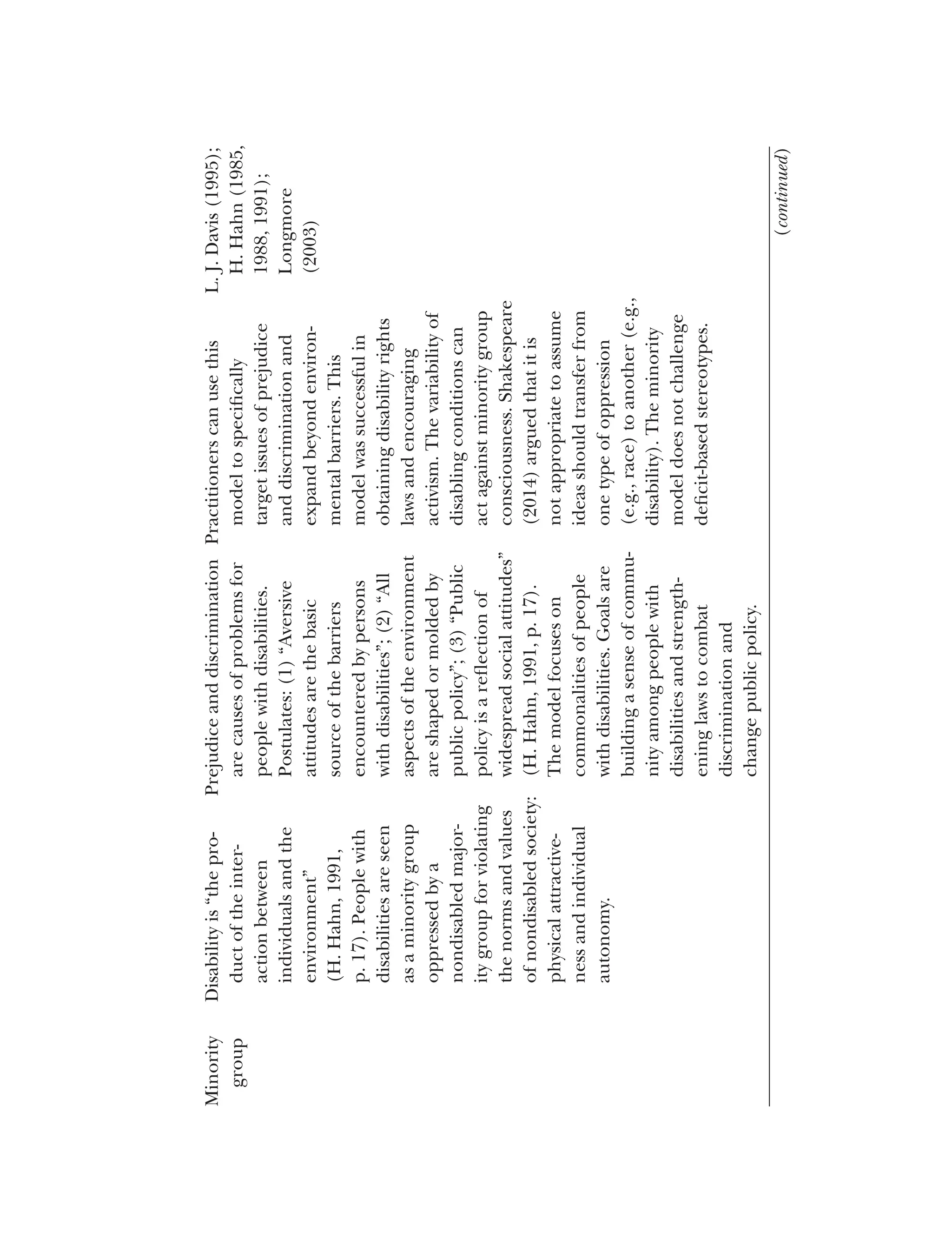
Minority Group (Sociopolitical) Model
Also referred to as the sociopolitical model, the minority group model is an
expansion of the social model, which proponents in the United States believed
used too narrow a view of the environment (Drum, 2009). The minority group
model grew out of the disability rights movement in the United States in the
1970s (H. Hahn, 1988; Smart & Smart, 2006). Those associated with this move
ment distrusted the medical model and medical professionals who controlled
all decisions regarding the treatment of disabled persons, leaving disabled
individuals with no voice in decisions that affected their lives (Lutz & Bowers,
2003/2007). Disability rights activists also argued that nondisabled academics
who had no knowledge of the issues facing people with impairments were
often biased and that disabled researchers should take the lead in conducting
research about disability since they understood the issues (Longmore, 2003).
As a result, disabled academics in the United States, especially Harlan Hahn
and Paul Longmore, promoted the new “minority group” approach, which
led to its predominance in the 1970s and 1980s as a basis for research and the
development of the field of disability studies in the United States (H. Hahn,
1985, 1988; Longmore, 2003).
12.
65
Disability Models
The goalof this movement was to transfer the “burden of disability”
(Lutz & Bowers, 2003/2007, p. 14) from people with impairments to society
by creating a sense of community among people with disabilities and strength
ening laws to combat discrimination and change public policy (H. Hahn,
1985). Similar to members of other minority groups based on race, gender, or
sexual orientation, proponents of the minority group model argued that peo
ple with disabilities experience commonalities such as oppression, alienation,
and discrimination (H. Hahn, 1991; Longmore, 2003; Scotch, 2000/2009).
H. Hahn (1988) argued that nondisabled people oppress disabled people for
violating two critical values of Western society in the 20th century: physical
attractiveness (in the case of physical disabilities) and individual autonomy.
H. Hahn added that “the social stigma of a disability fundamentally derives
from the fact that the resulting functional impairments may interfere with
important life activities” (p. 43). Disability resource staff working within
the context of the minority group model are likely to stress the importance
of building awareness among students with disabilities of the oppression
and discrimination they face on campus and within society. They would
be likely to create consciousness-raising groups and encourage an activist
orientation among students for obtaining rights and policies to create a more
just environment.
Impairment and disability are considered to be different concepts within
the minority group model (Nielsen, 2012). While not explicitly defined in the
model, impairment is used to refer to a mental or physical disease, injury, or
ailment affecting the person’s body or mind; disability is defined as “the prod
uct of the interaction between individuals and the environment” (H. Hahn,
1991, p. 17). People’s surroundings, rather than their bodies, are the sources
of the limitations they face (H. Hahn, 1988), and social context greatly influ
ences how disability is viewed and treated (Nielsen, 2012). H. Hahn (1991)
went on to explain that “disability is not a personal defect or deficiency [but
rather it is] primarily the product of a disabling environment” (p. 17). As such,
it is the environment that must be adjusted to meet the person’s requirements
rather than the person adapting to the environment (Bryan, 2002). H. Hahn
(1988, 1991) saw societal attitudes as the most powerful environmental factor
affecting people with disabilities. He offered three postulates to this proposi
tion: (a) negative attitudes are the major cause of the barriers that people with
disabilities face, (b) public policy drives all aspects of the environment, and
(c) social attitudes are influential in the creation of public policy.
The minority group model is particularly important in the history of dis
ability since it was instrumental in the passage and enactment of disability
rights laws and the development of disability activism in the United States
13.
66 Disability inHigher Education
(Drum, 2009; Longmore, 2003). It also does a better job than the medical
and functional limitations models of explaining the daily experiences of dis
abled people, since in most cases, prejudice and discrimination have more of
an impact on lives than do functional limitations (Scotch, 2000/2009; Smart &
Smart, 2006). H. Hahn (1985) also pointed out that the minority group model
is more complex than either the medical or social models since it considers
the interaction of the person and the environment rather than only one of
these factors.
The minority group model nevertheless also has some weaknesses. Batavia
and Schriner (2001) viewed it as “over simplified,” suggesting that it leaves out
consideration of important factors including individual, family, and cultural
variables that influence a person’s ability “to live independently and produc
tively” (p. 692). Lack of attention to the role of the individual’s body is also a
point of contention (Drum, 2009; Imrie, 1997), as is the narrow focus on pub
lic policy approaches to reduce discrimination toward disability (Imrie, 1997).
Many critics have argued that the variability of impairments and the difficul
ties of coming together as a group act against the development of a minority
group consciousness (S. R. Jones, 1996). Perhaps the most salient criticism
of the minority group model in the view of social justice educators is its con
struction as a deficit model that supports the stereotype of individuals with
disabilities as being victims in need of support (S. R. Jones, 1996).
Critical Approaches to Disability
Two more recent models have strong potential for shaping the work of dis
ability professionals and scholars: critical disability theory and critical realism.
Both fit under the umbrella of critical theory.
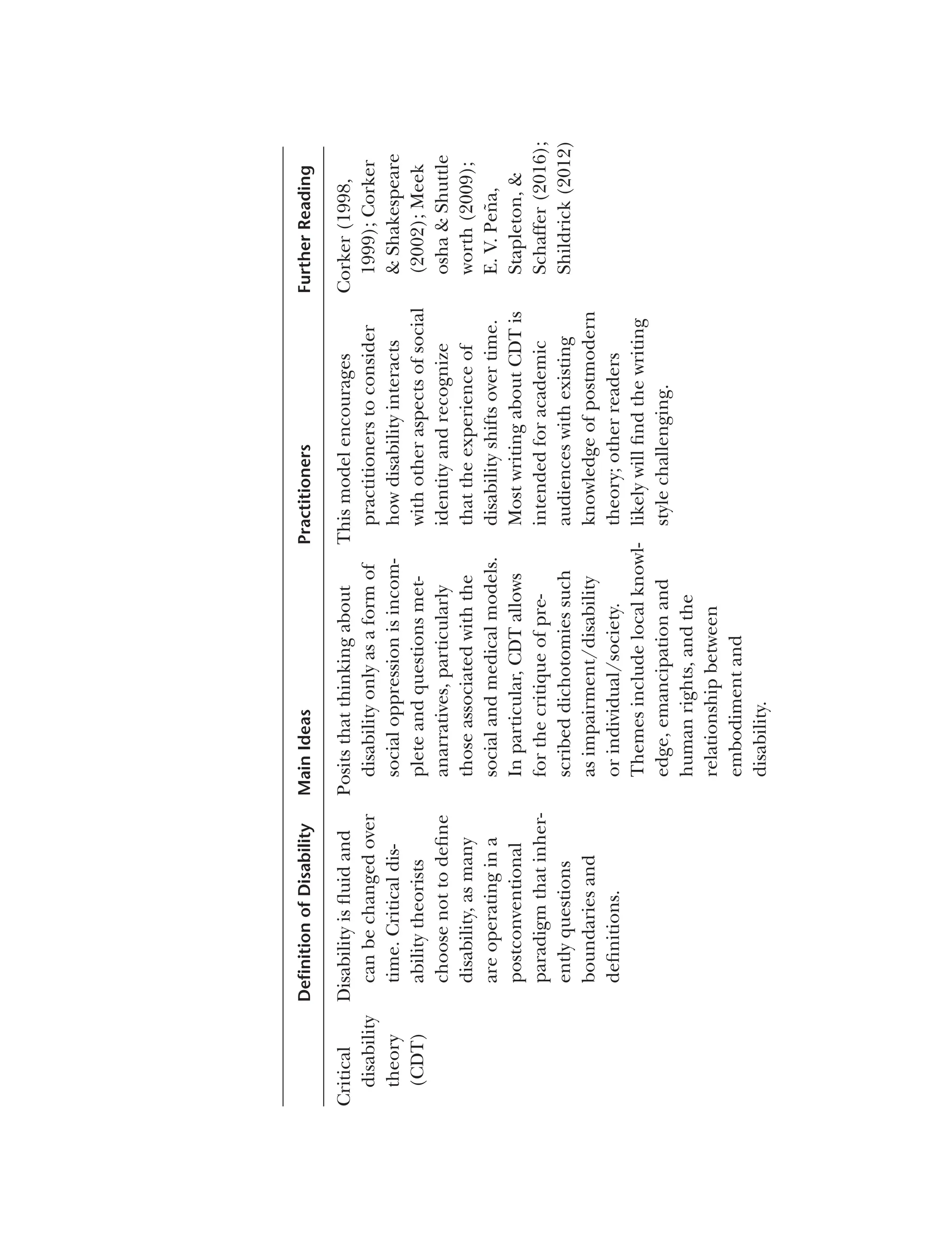
Critical Disability Theory
Critical disability theory (CDT) is a framework that emerged from postmodern
and postconventional critiques of existing disability theories (Corker, 1998;
Corker & Shakespeare, 2002; L. Davis, 2002; Meekosha, 2006; Meekosha &
Shuttleworth, 2009; Shildrick, 2009, 2012). Foucault (1977, 1980) championed
critical perspectives, yet disability studies theorists did not adopt his ideas until
the 1990s (Corker, 1998, 1999; Corker & Shakespeare, 2002) and only very
recently has CDT entered the higher education and student affairs literature
(Meekosha & Shuttleworth, 2009; Peña, Stapleton, & Schaffer, 2016; Vaccaro,
Kimball, Wells, & Ostiguy, 2015).
14.
67
Disability Models
Although criticalof the medical and functional limitation models, CDT
arose primarily as a challenge to the perceived hegemony of the social model
(L. Davis, 2002). Specifically, Corker (1999) argued that thinking about dis
ability only as a form of social oppression was incomplete, explaining, “In its
efforts to produce a collective notion of disability, disability studies has inad
vertently reproduced the kind of representations and theoretical structures
that it has historically claimed to challenge” (p. 629). CDT scholars questioned
metanarratives (L. Davis, 2002), particularly those within the social model that
prescribe dichotomies such as individual/society or impairment/disability
(Corker & Shakespeare, 2002; Meekosha & Shuttleworth, 2009; Shildrick,
2012). Scholars working within a CDT framework also critiqued ideas associ
ated with the minority model, noting that a “conundrum in disability research
is the assumption that all participants in a particular study will form part of a
collective ‘disabled identity’” (Smith-Chandler & Swart, 2014, p. 424).
As a model, CDT is complex and multifaceted; here we focus on four core
components. First, in CDT, disability is defined as “slippery, fluid, [and] het
erogeneous” (Shildrick, 2009, p. 4). This definition allows disability to change
over time and be intersectional; that is, it is shaped by other aspects of social
identity, meaning, for example, that a particular form of disability experienced
by an Asian American may differ from how that disability is experienced by
an African American (Shildrick, 2009). As Smith-Chandler and Swart (2014)
stated, “We contend that there is no single, universal, fixed, stable disabled
identity and that experiences differ in terms of both individual and contextual
factors” (p. 424). A definition of disability that is fluid and temporal can be
useful in higher education settings, in that it allows that disability might
be recently acquired, or recently diagnosed, or might change in impact
over the collegiate experience. Furthermore, it encourages practitioners to
take an intersectional approach and understand why some students may
not identify as disabled even though they may have an impairment. For
instance, rather than assuming a student who refused to accept accommo
dations for a learning disability was being stubborn and unrealistic about
his ability to succeed with the disability, a disability resource professional
using a critical disability theory approach might probe to understand why the
student felt this way and how learning disabilities were viewed in his family
and culture.
Second, CDT includes local knowledge as a method of understanding the
lived experiences of people with disabilities (Meekosha & Shuttleworth, 2009).
Given the importance of campus climate, locally situated knowledge is impera
tive for anyone working with disabled people in higher education settings. For
example, knowing that snow removal along accessible paths is prioritized by
15.
68 Disability inHigher Education
facilities staff is valuable, and not to be assumed when coming from a campus
where these paths either were not prioritized or there was no snowfall.
Third, CDT educators value emancipation and spotlight issues of human
rights and social justice (Meekosha & Shuttleworth, 2009). Practitioners may
assume that important social justice topics for disabled people primarily relate
to employment, education, and physical access. CDT goes beyond the politi
cal focus of other theoretical frameworks by bringing social justice into areas
that are meaningful for disabled people, such as culture and sex (Meekosha
& Shuttleworth, 2009). For instance, individuals with many types of disabili
ties are frequently and falsely assumed to be asexual; thus, health and edu
cation providers should have critical discussions with all clients about healthy
sex practices. Those working within a CDT framework encourage campus sex
education programmers to include diversity in relation to how people with
impaired bodies have sex and foster a disability culture by inviting speakers
and promoting disability pride events.
Finally, scholars using a CDT framework posit that both impairment and
environment are important and that a relational discourse occurs between
embodiment and disability (Meekosha & Shuttleworth, 2009). Unlike other
theoretical frameworks that isolate impairment, CDT allows for a “causal
relationship between impairment and disability” (Corker, 1999, p. 632). For
example, the social model would posit that Kirsten’s spelling impairment is
caused by the environment, and practitioners using that model would focus
on changing the environment by creating access to spell-checking or other
adaptive software. CDT allows a more complex and fluid understanding of a
relationship between the inability to spell and the environment. Practitioners
employing CDT would recognize that in some environments, the impairment
will dominate and environmental alterations, such as spell-checkers or writing
on a dry erase board during a meeting, are not useful. Furthermore, by having
an embodied component, CDT honors the frustration Kirsten feels when she
spells a word so poorly that a spell-checking program cannot even guess what
she wants. Hence, using CDT, a professional working in higher education
might gain a better understanding of why there are times when impairment
matters more, why there are times when environment matters more, and why
there are times when the interactions between impairment and society make
functional limitations more or less difficult to manage.
CDT offers professionals in higher education settings a unique set of tools
to understand disability experiences in a more complex and intersectional
manner. Notably, CDT provides a framework that allows faculty, staff, and
others in higher education settings to consider identity, intersectionality,
campus environments, impairment, and visible and nonvisible representations;
16.
69
Disability Models
it offerspowerful tools to break down hierarchies and include underrepre
sented voices. Within CDT, students, scholars, and researchers prefer and
frequently use disability-first terminology (e.g., “disabled student”), although
some also purposefully employ person-first language (e.g., “student with a
disability”) in specific situations (Meekosha & Shuttleworth, 2009; Shildrick,
2009). For example, person-first language can be used to show pride or
reclaim disability, “move away from the preoccupation with binary under
standings” (Meekosha & Shuttleworth, 2009, p. 50), or deconstruct hierarchies
of knowledge via discourse analysis (Shildrick, 2009). The use of disability-first
language may be uncomfortable, especially in student affairs, which remains
a field where the dominant norm emphasizes using person-first language.
Another challenge in using CDT is that fluid or temporal definitions of
disability may be challenging to employ within identity-based centers or in
developing identity politics. In addition, the tendency of postmodern schol
ars to use complex and inaccessible language might make CDT inaccessible
to individuals without an advanced understanding of philosophical thought
(K. Brown, Broido, Stapleton, Evans, & Peña, 2016).
CDT offers unique social justice opportunities but also may pose diffi
culties for engaging undergraduate students, staff, and community members.
Higher education professionals and scholars wishing to integrate CDT in their
practice and research should engage with the theoretical lens beyond the lim
ited overview provided in this book. In particular, we direct interested readers
to consider Gillies and Dupuis (2013) as an example of how to use CDT
to frame a participatory action research study, Meekosha and Shuttleworth
(2009) as a resource to better understand social justice implications, and
E. V. Peña et al. (2016) as a framework for exploring intersectionality.
Critical Realism
Unlike the other models reviewed in this chapter, critical realism is not a
model of disability but a philosophy of science. We include it here because, as
applied to the study of disability, it requires that we reintegrate consideration
of the physical realities of the body and mind with the constructivist focus
on structural and social systems (Shakespeare, 2014). Critical realism arose
as an explicit philosophy of science during the 1970s (Bhaskar, 1998) but
is grounded in the work of multiple Western philosophers writing across
the 20th century (Danermark, Ekström, Jakobsen, & Karlsson, 2002). It was
developed to address the limitations of both essentialist perspectives and those
of constructivist perspectives in ways that would “serve progressive politics”
(Moya, 2000, p. 3).
17.
70 Disability inHigher Education
Applied to disability studies to address shortcomings of the social model
(Shakespeare, 2014), critical realism is a paradigm that holds that reality exists
in ways that allow us to make causal truth claims. Both physical and social
phenomena are thought to exist independent of observers’ and participants’
perceptions of them. However, understandings of truth and reality are shaped
by individuals’ identities and experiences such that “the conditions and social
relations of the production of knowledge influence its content” (Easton, 2010,
p. 120). Thus, “critical realists propose … there exists a reality ‘out there’ inde
pendent of observers … [and that] the world is socially constructed but not
entirely so” (p. 120).
A second key concept in critical realism is the multilayered nature of real
ity. Phenomena such as disability have multiple, mutually influencing layers:
the molecular, the physiological, the psychological, the social, and the struc
tural/cultural (S. J. Williams, 1999). These layers influence each other, but in
nondeterministic ways. Danermark (2002), who has to date made the great
est use of critical realism in writing about disability, gave the example of two
people who have a hearing impairment with the same physiological origin.
Depending on their linguistic memory, the quality of their sight and light lev
els in their environment, and their coping skills, they will have varying degrees
of functional impairment. Their families and friends will react in multiple ways
to their impairment, some in ways facilitative of communication and others in
ways less so. The two people may live in different countries, one of which pro
vides extensive support to those with limited hearing and another without such
resources. These mechanisms are independent of one another but do influ
ence each other. Understanding hearing impairment requires recognition of
the multiple, mutually shaping but independent layers of reality. Disability
within a critical realistic perspective, then, is “a relationship between intrinsic
factors (impairment, personality, motivation, etc.) and extrinsic factors (envi
ronments, support systems, oppression, etc.)” (Shakespeare, 2014, p. 76).
Writers using a critical realism framework (e.g., Shakespeare, 2014) to
discuss disability have argued it is important to consider both the body/mind
and the social/cultural experience when trying to understand disability and
respond to it, as well as to consider the influence of context, knowing that no
context-free claims about reality can be sustained (Danermark & Gellerstadt,
2004; Pilgrim, 2014). Shakespeare (2014) made clear that disability cannot be
solely understood as a social construction, writing that “even with the removal
of barriers and the provision of support, impairment will remain problematic
for many disabled people” (p. 85). For instance, a critical realist in student
affairs encouraging a student with a chronic disability to become involved
on campus would want to ensure that the student took under consideration
18.
71
Disability Models
not onlyher specific interests and the accessibility of the organizations
she was considering but also factors associated with her physical condition,
such as fatigue.
The critical realist approach has two primary limitations. The first is the
inaccessibility of the model. Most books and articles about critical realism are
written using language inaccessible to those without training in metaphysics
and the philosophy of science. The second is that critical realism appears to
have made little inroad into the practice of social science. While it is easy
to find writing about critical realism, it is more challenging to find research
that employs a critical realist approach, especially disability research. Very little
writing provides guidance on how to conduct a study from the perspective of
critical realism. Articles published in the Journal for the Theory of Social Behavior,
the primary outlet for critical realist writing, are overwhelmingly theoretical,
with very few empirical pieces.
Social Justice (Ableist or Disability Oppression) Model
The social justice (or ableist, or disability oppression) model of disability is
based on concepts associated with the overall social justice movement in the
United States, which borrowed ideas from the separate civil rights, women’s,
and New Left movements of the 1960s and 1970s (L. A. Bell, 2013). In this
model, concepts such as social justice, liberation, and oppression are used
to analyze, evaluate, and transform systems of social behavior, discriminatory
institutional structures, and cultural practices (M. Adams, Bell, & Griffin,
2007). The University of Massachusetts Social Justice Education Program has
been particularly influential in developing and promoting this model. With
the exception of conceptual work introduced by writers associated with the
University of Massachusetts program and some research conducted in the
United Kingdom, little writing and almost no research in the field of social
justice has focused on ableism (Nocella, 2009).
Rather than focusing on disablism, which F. K. Campbell (2009) defined as
“a set of assumptions (conscious and unconscious) and practices that promote
the differential or unequal treatment of people because of actual or presumed
disabilities” (p. 4), social justice model adherents “prefer the term ableism to
define the oppression of people with disabilities” (Griffin, Peters, & Smith,
2007, p. 335). Rauscher and McClintock (1997) explained that throughout
history, ableism has functioned to “create an environment that is often
hostile to those whose physical, emotional, cognitive, or sensory abilities fall
outside the scope of what is currently defined as socially acceptable” (p. 198).
19.
72 Disability inHigher Education
F. K. Campbell (2009) added that ableism equates able-bodiedness with
normalcy; by contrast, disability is viewed as abnormal, dependent, and
deficient. As such, disabled individuals often cannot fulfill the social and
economic roles that society expects, and their talents are not acknowledged
(Castañeda et al., 2013; S. R. Smith, 2009). Implicit in the ableist perspective
is the belief that disability is a negative status and should be eliminated or
rehabilitated if possible (F. K. Campbell, 2009).
Another label for this approach, disability oppression theory, is used to
describe the dynamics associated with the discrimination and injustice that
are directed toward people with disabilities in an ableist society (Castañeda
& Peters, 2000). Rather than attempting to “fix” people with disabilities so
that they will “fit” into an ableist society, advocates of disability oppression
theory promote addressing the oppressive culture so that all individuals are
accepted as they are (Castañeda & Peters, 2000; Nocella, 2009). Hutcheon
and Wolbring (2012) posited that the concept of ableism is helpful in two
ways: it helps to explain the experiences of “ability-diverse” (p. 47) individuals
and allows for more effective examination of policy and its effects.
Similar to other forms of oppression, ableism works on cultural, insti
tutional, and individual levels (Castañeda et al., 2013; Griffin et al., 2007;
Rauscher & McClintock, 1997). Cultural beliefs, including those regarding
beauty, independence, and normality, affect how individuals with disabil
ities are viewed and treated in society. The policies, practices, and norms
established in institutions such as the family, religion, law, housing, health
care, and government create barriers for people with disabilities. Individual
attitudes such as paternalism, pity, sympathy, disgust, and others expressed
toward disabled individuals contribute to feelings of discomfort and distrust
that people with disabilities experience in an ableist society (Griffin et al.,
2007). The social justice model outlines how people with disabilities overcome
these forms of oppression as they move toward empowerment as a result of
the establishment of equitable access and accommodation within society and
the creation of social structures where all people are able to take on equally
important tasks and meaningful roles while connecting with other people
interdependently (Castañeda & Peters, 2000).
Three major components unique to the social justice model of disability
are its focus on privilege and oppression as major influences in shaping how
disability is viewed and experienced in U.S. society; its emphasis on diversity
and intersectionality of the disabled individual’s experiences, roles, and iden
tities; and its intentionally educational mission. Social justice advocates point
out that throughout time, nondisabled individuals have held the privilege and
power to decide how disabled people, as the oppressed group, will be viewed
20.
73
Disability Models
and treated(Evans, 2008). L. A. Bell (2013) explained that oppression of indi
viduals with disabilities has four qualities. It is pervasive in that inequality is
“woven throughout social institutions as well as embedded within individual
consciousness” (p. 22). It is restrictive in that lives of individuals with disabilities
are constricted by structural and material barriers. It is hierarchical as mem
bers of the dominant nondisabled group are advantaged by disempowering
the oppressed disabled group. Finally, it is internalized by disabled individuals
as well as nondisabled dominant group members.
Oppression has three dimensions: context, application, and consciousness
(Hardiman, Jackson, & Griffin, 2013). As already noted, oppression in the
form of ableism can occur at the individual level, through the attitudes and
behaviors of individuals; it can take place in institutional settings, including
family, government, education, religion, and the legal system; and it is also
located at the social/cultural level when expressed as values, beliefs, and
norms. Oppression is applied in these same locations—individually through
attitudes and behaviors; institutionally through laws, policies, and practices;
and societally through values, beliefs, and customs. Finally, the dimension of
consciousness indicates that oppression can be intentional or unintentional.
Similarly, social justice educators and advocates can address oppression in
each of these contexts and locations. For instance, diversity courses should
include units on disability to dispel students’ negative attitudes, misinforma
tion, and stereotypes about people with disabilities; social justice advocates
can review policies and practices in areas such as admissions, residence life,
and student activities to ensure that they are equitable for all students (see
Chapters 14 and 15); and advocates can point out underlying values and
beliefs that may appear in campus media, such as newspapers, handbooks,
and websites.
The second aspect of the social justice model addressed much more exten-
sively than in other models is diversity and the intersectionality of experiences,
roles, and identities. As S. R. Smith (2009) pointed out, in addition to structural
injustice, discrimination against disabled individuals is also caused by “identity
exclusion” (p. 25), when nondisabled individuals assume what the experience
of disabled people is rather than considering the variation in experiences that
disabled individuals actually have. Proponents of the social justice model stress
the diversity of people with disabilities, including their broad range of physical,
emotional, and mental capabilities; their other social identities; and their vari
ous personality characteristics, as well as the different social contexts in which
they live (Castañeda et al., 2013; Evans, Assadi, & Herriott, 2005).
All of these variables influence people’s worldviews, self-perceptions, and
how others perceive and treat them. Taking into consideration individuals’
21.
74 Disability inHigher Education
various social identities, including gender, race, religion, age, sexual orienta
tion, and social class, in relation to their impairments is especially important
for understanding the meaning that the individual, other people, and society
will attach to their disabilities (Castañeda & Peters, 2004; Griffin et al., 2007).
For instance, because the norms of behavior for young African American chil
dren are different from those for White children, African American children
are much more often diagnosed as having attention deficit disorder than are
White children (see Chapter 5 for further discussion of identity). As Hardi
man et al. (2013) stated, “Our various social identities interrelate to negate
the possibility of a unitary or universal experience of any one manifestation of
oppression” (p. 30).
The social justice model is intentionally educational, unlike other models
we have addressed. MacKinnon, Broido, and Wilson (2004) listed three impor
tant dimensions of social justice advocacy in education. Applied to disability,
they are (a) providing support to students with disabilities; (b) educating both
students with disabilities and those who are not disabled about the existence
of disability oppression, working with them to create an environment that
values differences, and teaching them to advocate for their own and others’
liberation; and (c) working to change institutional structures and policies that
support oppression of those with disabilities.
Four goals are associated with the social justice model: elimination of
ableism, redefinition of normal, respect and equity, and development of a
positive disability identity. Eliminating ableism involves changing the physical
and social environment so that disabled individuals can function effectively
(Griffin et al., 2007). Implementing universal design principles both in
and out of the classroom is one strategy for accomplishing this goal at
the institutional level (see Chapters 10 and 12). Legislation to eliminate
discrimination and environmental barriers is another means that the gov
ernment has used to address ableism (Rauscher & McClintock, 1997; see
Chapter 3 for a discussion of legal aspects of disability.) In recent years, social
justice education has been used to raise individual awareness of ableism and
promote equity, access, and transformation of societal systems to create just
institutions and cultural values of respect and equal treatment for all people
(Hackman, 2008).
Redefining normalcy “so that physical, mental, and sensory differences are
no longer viewed as abnormal” (Griffin et al., 2007) is another goal of the social
justice model. Within the ableist system, certain characteristics of the human
mind and body, constructed as “normal,” are privileged; others, associated
with disability, are viewed as deficient and inadequate (F. K. Campbell, 2009).
Individuals with minds and bodies that are not “normal” are excluded by the
22.
75
Disability Models
dominant nondisabledgroup from many aspects of economic and social life
(Nocella, 2009). To reintegrate individuals with disabilities into society, the nar
row definition of what is considered normal needs to be expanded so that their
differences are accepted and valued (Rauscher & McClintock, 1997). Social
justice educators stress that concepts such as normalcy, average, standardiza
tion, and equality are socially constructed and there is no such thing as an
objective “norm” or “average” (Nocella, 2009). Rather, all people are different
mentally and physically, leading social justice educators to promote “respect of
differences not of equality” (Nocella, 2009, p. 155). An example of a narrow
definition of what is normal is the assumption that all people should be able to
navigate by walking. A social justice approach would suggest that any form of
navigation, including using motorized scooters or wheelchairs, is appropriate.
Given this assumption, all entrances to buildings would be wide and have auto
matic door openers; entrances would be approached using sidewalks that were
flat or slightly inclined rather than stairs.
The goal of promoting respect and equity, then, is intertwined with
respecting difference. Respect entails self-respect as well as respect from
others and for others. As L. A. Bell (2013) stated, “Social justice involves social
actors who have a sense of their own agency as well as a sense of social responsi
bility toward and with others, their society, and the broader world in which we
live” (p. 21). This vision of society can best be achieved when “the distribution
of resources is equitable and all members are physically and psychologically
secure” (L. A. Bell, 2013, p. 21). S. R. Smith (2009) argued for a “productive
tension” (p. 27) in the creation of “socially just human relations” (p. 27)
that would enable nondisabled individuals to identify with and appreciate
disabled individuals by engaging with them and sharing positive experiences
but also recognize that people with disabilities have a right to expect structural
changes in the social and political environment to enable them to successfully
negotiate their surroundings. In the postsecondary setting, advocates of
the social justice model of disability stress the right of every person to have
a fulfilling and successful academic and cocurricular experience in which
each person’s complete identity and specific experiences are taken into
account (Evans & Herriott, 2009). Social justice educators also “seek to create
awareness on the campus regarding disability as another expression of human
diversity similar to race, social class, gender, and sexual orientation” (Evans &
Herriott, 2009, p. 36). Diversity classes and programs that include information
regarding disability are effective ways of accomplishing this goal.
Similar to the minority group model, the social justice model is invested in
achieving a positive identity among disabled people. Understanding that dis
ability is caused by social, economic, and environmental barriers rather than
23.
76 Disability inHigher Education
“conditions” that are psychological or physical in nature allows persons with
disabilities to redefine themselves as strong and capable individuals (Rauscher
& McClintock, 1997). Within this model, disabled individuals are proud of
their differences and work to make others aware of their accomplishments
and talents (Rauscher & McClintock, 1997). For example, disabled individuals
may develop particular insights as a result of their experiences as “outsiders”
that can be of benefit to other people (S. R. Smith, 2009). In the college or
university setting, ensuring that students with disabilities are provided with
opportunities to engage in cocurricular activities and take on leadership posi
tions enables them to use their skills and talents in positive ways that con
vey to others that they are capable and encourages development of a positive
disability identity.
The social justice model is more complex than earlier models in its under-
standing of how systems of privilege and oppression affect how individuals with
disabilities view themselves and how others view them. It also is much more
attentive than other models to the intersectionality of social identities and the
unique aspects of each person’s life as a disabled person. However, like other
models, it does not account for the role played by impairments in the everyday
life of many people with disabilities, particularly those who experience chronic
illness and pain on an ongoing basis. To begin to address this concern, we next
turn to two promising approaches that consider bodily experiences as well as
broader disability communities.
Emerging Models
Disability justice and the interactionist model of disability are two emerging
models that offer political and multifaceted approaches to understanding dis
ability. In particular, the interactionist model is useful in that it is based on two
studies of disabled college students.
Disability Justice
Disability justice is a new framework for disability advocacy, originally concep
tualized in 2005 by a group of queer women of color who are also disabled
activists (Berne, 2015). Mingus (as cited in Taormina-Weiss, 2013) argued,
“Disability justice is a multi-issue political understanding of disability and
ableism, moving away from a rights based equality model and beyond just
access, to a framework that centers justice and wholeness for all disabled
people and communities” (para. 5).
24.
77
Disability Models
Disability justiceactivists looked to create a movement that addressed the
shortcomings of the disability rights movement, which they saw as focused
on White, economically privileged, heteronormative people and approaches
(Berne, 2015). The disability justice movement exists primarily online, created
by activists rather than scholars; this origin is congruent with the movement’s
focus on creating change rather than theorizing.
Mingus (2014) captured a core principle of disability justice, writing:
We recognize that ableism is connected, tied up with and mutually dependent on other sys
tems of oppression and that we cannot end ableism without also ending white supremacy,
economic exploitation, colonization, and gender oppression. Disability justice requires that
we no longer build single-issue analysis, but instead build frameworks that can hold the com
plexities of our lives. (p. 110)
Another key idea in disability justice is that of interdependence, a direct
challenge to the disability rights argument that people with disabilities want to
be independent. Copley (2011) wrote, “Ableism depends on maintaining the
myth that we can be self-sufficient if we are strong enough—the myth of inde
pendence” (para. 6). In a disability justice perspective, there is recognition
of and value in “interdependence, in which other people are necessary for
physical, emotional and community health and well-being. Interdependency
values our connection to others and communities” (Copley, 2011, para. 6).
This emerging model offers new voices and perspectives to understanding
disability, particularly as experienced by those with multiple marginalized
identities. Disability resource office staff proponents of this model would
focus on disabled students as people with many different yet intertwined
social identities and stress the importance of working together for change.
Interactionist Model of Disability
Two studies of college students with disabilities served as the basis for an inter
actionist model of disability developed by Evans and Broido (2011). The first
study was a phenomenological exploration of how students with disabilities
perceived their involvement in social activities, organizations, and leadership
positions, as well as the effects of their experiences on identity development.
The second study was a phenomenological exploration of the collegiate expe
riences of students who had Type 1 diabetes.
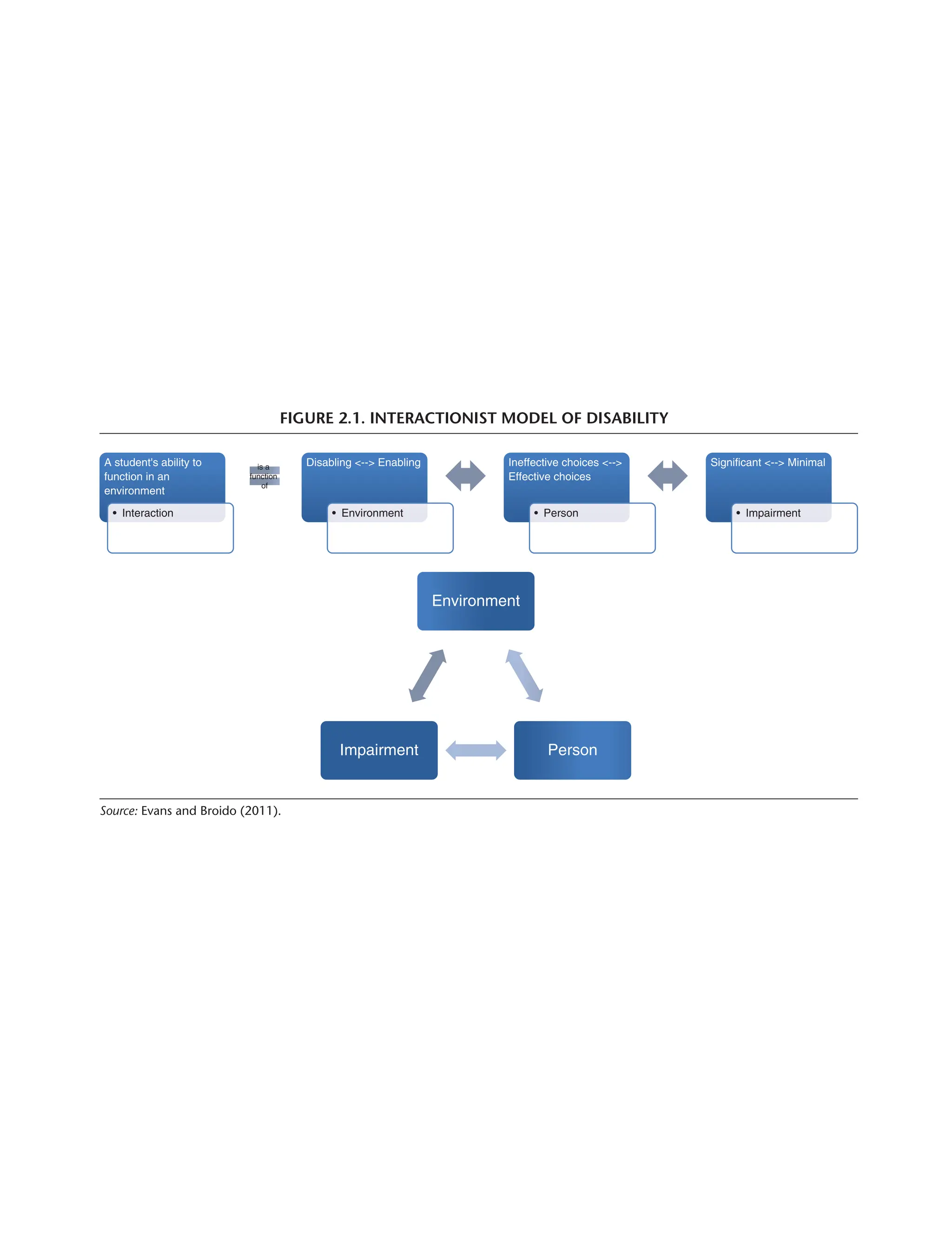
Building on Lewin’s (1936) interactionist model, Evans and Broido (2011)
argued that students’ ability to function in an environment is an interaction of
the environment, the person, and the person’s impairment. Each of these areas
25.
78 Disability inHigher Education
is dynamic: environments can range from enabling to disabling, people can
make more and less effective choices, and impairments can vary from minimal
to significant. The three elements influence each other as well. Environments
can support individuals’ ability to make effective choices, and individuals can
influence their environments; the extent of impairment can influence people’s
ability to make effective choices, and the choices they make may (depending
on the type of impairment) influence the impact of the impairment. The envi
ronment can influence the impact of the impairment and to a small degree;
the extent of impairment might influence the environment (see Figure 2.1).
A student affairs professional using an interactionist perspective would exam
ine the degree to which specific aspects of the campus environment were dis
abling, the effectiveness of the individual student’s choices, and the type and
severity of the student’s impairment, as well as how these factors all intersect
and contribute to the specific situation the student was experiencing. The
student affairs educator could help the student to understand that her experi
ences are fluid and can be changed by altering one or more of these variables.
Conclusion
Returning to Nancy’s story that started this chapter, multiple models of disabil
ity shape the experiences of students, faculty, and staff with disabilities. Vestiges
of the moral model shape the thinking of many individuals, as Nancy learned.
Other older models, such as the medical model and the functional limitations
model, continue to guide the work of disability resource offices on many col
lege campuses, as well as vocational rehabilitation services that many students
use. Therefore, an understanding of all of the models discussed in this chapter
is imperative.
L. A. Bell (2013) posited, “Practice is always shaped by theory, whether
formal or informal, tacit or expressed” (p. 22). How individuals approach dis
ability, how they identify problems that need to be addressed, how they choose
to address them, and the solutions they determine to be appropriate are all
influenced by theory (L. A. Bell, 2013), specifically by the models they choose
to frame their understanding. We recommend using concepts drawn from
more than one model as each can provide helpful insight that another one
may not (Bryan, 2002). We do believe, however, that a social justice approach
provides the strongest foundation from which to understand the impact of
disability and how to address ableism in society since its principles are well
developed and the model is based on inclusiveness and respect for all peo
ple. Once this foundation has been established, concepts from the critical
26.
FIGURE 2.1. INTERACTIONISTMODEL OF DISABILITY
A student's ability to
function in an
environment
• Interaction
is a
function
of
Disabling <--> Enabling
• Environment
Ineffective choices <-->
Effective choices
• Person
Significant <--> Minimal
• Impairment
Environment
Person
Impairment
Source: Evans and Broido (2011).
27.
80 Disability inHigher Education
and interactionist models, as well as disability justice, can add to the manner
in which disability is understood and ableism is addressed, since they are more
fluid and include more complex and dynamic understandings of intersection
ality. Throughout this book, we ground our thinking in the social justice per-
spective, while also using ideas and concepts from various models and theories
to explore the wide range of issues that must be addressed when working with
disabled students in higher education settings.
Discussion Questions
1. Which models of disability most closely align with or inform current prac
tices on your campus?
2. How might using one of the emerging models of disability inform policies
and practices on campus differently than the established models?
3. How do you see the various models of disability being informed by and
informing societal expectations of disability?
![CHAPTER TWO
DISABILITY MODELS
As a wheelchair user who had polio when I was young, I have experienced well-meaning
individuals tell me that if I just pray and live my life as God wishes me to, I will be cured,
the implication being that I must not be living a “Godly” life since I still need a wheel
chair for mobility. These beliefs are a good example that the moral model continues to
guide people’s thinking.
—Nancy, faculty member
Most disability models are closer to paradigms than they are to theories
in that they present a certain way of viewing disability based on people’s
perceptions, beliefs, and experiences rather than research data. Definitions
and conceptualizations of disability presented in models reflect the worldview
of specific time periods and cultures (Drum, 2009). As such, disability is a
social construction, the meaning of which shifts over time and place and is
influenced by political ideology, economic conditions, and cultural values
(Meade & Serlin, 2006; Olkin, 1999). Olkin (1999) explained that “each
[model] has a perspective on what ‘the problem’ of disability is, who holds
the problem, and avenues that best address the problem” (p. 24). How U.S.
society has perceived disability over the course of the country’s existence has
provided the foundation for how individuals with disabilities have been viewed
and treated, as well as the expectations and assumptions held by individuals
with disabilities themselves.
Interactions between individuals with disabilities and various societal insti
tutions, including the family, community, workplace, and educational system,
are dictated largely by the meaning that society attaches to disability during
54](https://image.slidesharecdn.com/disability-models-article-copy-250414121734-98b488f6/75/Disability-Models-Article-copy-pdxczxczxczxczxcf-1-2048.jpg)
![56 Disability in Higher Education
Moral Model
Proponents of the moral model view “disability [as] a defect caused by moral
lapse or sins” (Olkin, 1999, p. 25). As early as the beginning of the Common
Era, the Jewish culture linked physical defects to the “sins” committed by indi
viduals and believed that it was up to individuals to cure themselves since their
actions had caused the defects (Stiker, 1999). During medieval times when
religious beliefs and practices dominated the thinking and actions of West
ern civilization, people believed that disability was God’s punishment for “sin,
failure of faith, moral lapse, or evil” (Olkin, 1999, p. 25) committed by individ
uals themselves or members of their families. Physical impairments could also
be “the work of the devil” (Drum, 2009, p. 27). Because they were viewed as
the result of the individual’s moral misbehavior, defects brought shame on the
individual and the family (Olkin, 1999). As a result, during the Middle Ages,
people who were viewed as defective were “shunned, condemned, or used for
entertainment purposes, e.g, as court jesters” (Drum, 2009, p. 27).
During the late 1800s, disability and its related effects, such as poverty,
unemployment, and dependence on others, continued to be viewed as a result
of fate, God’s punishment, or individual moral weaknesses (K. W. Hickel, 2001).
Because disabled people were viewed as weak, flawed, and having brought their
conditions on themselves, government agencies as well as private charities
refused to provide aid to adults disabled in later life, although they did assist
children with disabilities and veterans of military service (K. W. Hickel, 2001).
While the moral model is not the most prevalent view of disability today,
vestiges of it remain in today’s language, culture, and beliefs (Olkin, 1999).
For instance, one often hears the phrase, “It is God’s will,” when a child is born
with an incurable illness or a person becomes paralyzed as a result of an auto
mobile accident. Western culture is permeated with the belief that disability is
“bad” and, as a result, individuals with physical and mental impairments must
have done something “wrong” that contributed to their condition. This atti
tude is especially evident when individuals are viewed as having played a direct
role in their impairment, such as those with AIDS, Type 2 diabetes, obesity, or
addictions. In such cases, it is viewed as acceptable to blame these individu
als for their disabilities and even to exclude them from protection under the
Americans With Disabilities Act Amendments Act (ADAAA; e.g., those with
drug addiction who have not stopped using drugs). In addition, pop culture
(e.g., television programs, movies, and popular books) often portrays disabled
characters as villains or evil persons (Longmore, 2003). Arguments against pro
viding government assistance to people with disabilities are frequently based
on similar thinking (Shapiro, 1993).](https://image.slidesharecdn.com/disability-models-article-copy-250414121734-98b488f6/75/Disability-Models-Article-copy-pdxczxczxczxczxcf-3-2048.jpg)
![59
Disability Models
of their life span. Psychologists have also expressed concern that the medical
model does not take into consideration that psychological distress from prej
udice and discrimination can contribute to how individuals experience and
respond to disability (Marks, 1997). Disability activists reject the idea of equat
ing disability with illness or abnormality. Many find the views and resulting
treatment disabled people receive from members of the medical community
as oppressive and marginalizing (Bricher, 2000).
Strict adherents of the medical model, who are concerned only with cur
ing the illnesses or physiological abnormalities exhibited by individuals with
impairments, are most likely to view disabled individuals as unfit to attend col
lege or work in any capacity. One of the reviewers of a draft of this book (M.
Peña, personal communication, August 5, 2016) shared an experience that she
had with this type of thinking when she began working at a college in 1989:
“I had to go before the college board, introduce myself, and talk about my
college degrees, [and] then proceeded to tell them about my learning disabil
ity. One of the board members said, ‘Having a learning disability and going to
college are mutually exclusive.’” Since they are viewed as being sick, disabled
people are considered unfit to take part in the normal activities expected of a
college student or employee.
Within the medical model, there is no expectation that society will make
adjustments to change people’s attitudes or improve the environment so
that people with disabilities can participate fully. People with disabilities are
expected to rely on medical intervention, such as medication, therapy, or
other forms of treatment, to address the symptoms and problems associated
with their impairment. Another experience that our reviewer, M. Peña
(personal communication, August 5, 2016), recalled was an employer who,
upon learning that she had a learning disability, asked her if she took a pill
for that. Those who adhere to the medical model also believe that if there is
no current intervention to treat the impairments of disabled individuals, they
must adjust to being outsiders and wait for a cure for their ailment.
Functional Limitations (Rehabilitation) Model
The concept of rehabilitation first appeared around 1880 with the develop
ment of hospital-schools to prepare crippled children to function in society
(Byrom, 2001). Adherents of this approach viewed disability as a deficiency that
could be overcome with assistance from professionals whose role was to treat
the social and medical problems these children faced (Burch & Sutherland,
2006). The rehabilitation approach was expanded to address the increasing
number of disabled veterans after World War I (Strauss, 1965).](https://image.slidesharecdn.com/disability-models-article-copy-250414121734-98b488f6/75/Disability-Models-Article-copy-pdxczxczxczxczxcf-6-2048.jpg)
![60 Disability in Higher Education
Stiker (1999) pointed out that “the notion of ‘rehabilitation’ [implied]
returning to a point, to a prior situation” (p. 122), suggesting that disability was
a deviation from the norm of nondisabled existence and that the goal of reha
bilitation was returning the disabled individual to this state. During the early
20th century, the focus shifted from its original emphasis on social rehabilita
tion, providing education and training so that disabled individuals could find
a place to fit in society, to medical rehabilitation, which consisted of surgical
and technological intervention to correct the impairments of disabled persons
(Byrom, 2001).
In the functional limitations (or rehabilitation) model, the main argu
ment is that disabilities cause limitations in a person’s ability to perform
specific functions of daily life (Bryan, 2002). Like the medical model, the
functional limitations model of disability is exclusively focused on the person;
the individual, rather than society, is rehabilitated (Imrie, 1997). But as Nagi
(1965) explained, unlike the medical model, which focuses on pathology
and cure, the rehabilitation model focuses on functional limitations and
disabilities. Functional limitations may include difficulties moving, breath
ing, working, or caring for oneself independently (Bickenbach, Chatterji,
Badley, & Üstün, 1999). The functional limitations model is essentialist in
nature; it does not acknowledge that the culture, situation, or environment
can influence the extent to which functional limitations affect people’s ability
to do things (Imrie, 1997). Adherents of the model also see disability as
dichotomous; that is, there are only two kinds of people in the world—those
who have functional limitations and those who do not (Drum, 2009). Only
those who do not have functional limitations—the able-bodied—can be
successful (Imrie, 1997).
The goal of this model is to improve disabled people’s functional capabil
ities so that they are “restored to their previous condition,” that is, the usual
human condition of “ordinariness” (Michalko, 2002, p. 152). Unlike the med
ical model, the functional limitations model does not address the underlying
condition that caused the impairment; rather, the emphasis is on improving
the individual’s functional capacity (Drum, 2009). To do so, rehabilitation
personnel assess functional limitations and develop rehabilitation plans that
focus as much as possible on restoring individuals to their former level of func
tioning and assisting them in adapting to their environments (Bryan, 2002).
As Michalko (2002) pointed out, in today’s society, people tend to be judged
by how well they are able to carry out activities, “make a living,” and contribute
to society. There appears to be a hierarchy of disability, with physical and occu
pational functioning being the most important to address in rehabilitation
(Imrie, 1997). As such, “the problem of disability … becomes the problem of](https://image.slidesharecdn.com/disability-models-article-copy-250414121734-98b488f6/75/Disability-Models-Article-copy-pdxczxczxczxczxcf-7-2048.jpg)
![62 Disability in Higher Education
bringing them together to address common issues, such as discrimination and
environmental barriers (Bryan, 2002). In addition, reducing a person to a con
dition ignores other aspects of the whole person (Bryan, 2002).
Social Model
The social model of disability originated in the United Kingdom and was based
on Fundamental Principles of Disability (1976), a document written and pub
lished by a disability activist group, the Union of the Physically Impaired against
Segregation. Academics in the United Kingdom, especially Michael Oliver,
Colin Barnes, and Vic Finkelstein, formalized the ideas set out in the doc
ument to create the social model of disability, the most often cited version
of which was written by Oliver (1990). The social model was developed as
an alternative to the medical and functional limitations approaches to which
many disability activists objected (Drum, 2009). Many variations of the social
model have evolved since the 1980s, including materialist (Finkelstein, 1980),
cultural (Barnes, 1991; Shakespeare, 1994), and feminist (C. Thomas, 1999)
versions (Tregaskis, 2002). The social model was introduced primarily for use
by disability professionals and activists. As a result, Oliver (2004) stressed that
it was not a disability theory. Often referred to as the “big idea” of the disability
movement in the United Kingdom, the social model had a major influence
on building the collective disability consciousness of its members by getting
disabled people to think about their commonalities and the barriers they all
faced (Oliver, 2004).
Barnes (1991) defined disability as “the loss or limitation of opportunities
to take part in the normal life of the community on an equal level with others
due to physical and social barriers” (p. 2). Thus, disability is a socially con
structed concept, its meaning based on the perceptions of those making up
society (Llewellyn & Hogan, 2000; Olkin, 2011b). Proponents of the social
model argue that disability is located in the social environment, which they
view as exclusionary and oppressive, rather than in the body (Marks, 1999).
Social modelists define the environment broadly as including physical, eco
nomic, and political factors, as well as social dimensions (Tregaskis, 2002).
They understand disability as the barriers that individuals with impairments
have to address in all aspects of their lives, including work settings, housing
options, education opportunities, civil rights, transportation, and access to the
architectural environment (C. Thomas, 2004).
Initially impairment was not important to social modelists in that they saw
disability as “wholly and exclusively social … [and] disablement [as having]
nothing to do with the body” (Oliver, 1996, pp. 41–42). Later writers modified](https://image.slidesharecdn.com/disability-models-article-copy-250414121734-98b488f6/75/Disability-Models-Article-copy-pdxczxczxczxczxcf-9-2048.jpg)
![63
Disability Models
this position, defining impairment as “limitation in a person’s physical, men
tal or sensory functioning [that] … only become[s] salient and disabling in
specific settings” (Marks, 1999, p. 80). Social modelists, however, continue
to believe that “disability is the overriding priority for … the disabled people’s
movement” (C. Thomas, 2004, p. 24). Disability resource office staff working
within the social model would be interested only in environmental barriers
such as inaccessible buildings, lack of captioning on videos, or inaccessible
technology rather than any factors related to students themselves.
The main goal of adherents of the social model is to make sense of
and change “disabling socio-political and cultural practices” (Goodley, 2004,
p. 123). Social modelists also argue against segregated, special, or adapted
facilities for disabled people since such facilities send a message that disabled
individuals are different from other members of the community and cannot
fit in the “normal” world (Marks, 1999). Instead, they advocate using universal
design (see Chapters 10 and 12) to modify the mainstream environment so
that it is accessible to all individuals, with or without disabilities (Marks, 1999).
The strengths of the social model are that it introduced a new way
for professional disability workers and researchers to think about disability
and raised new research questions amenable to different methodological
approaches to better understand the concept of disability (Llewellen &
Hogan, 2000). The social model depathologized disability by focusing on the
social environment rather than internal ailments or injuries while addressing
what they believed to be the true cause of disability: prejudice and discrimina
tion (Fougeyrollas & Beauregard, 2001). The model also secured some basic
changes in society to allow access and inclusion for people with disabilities
(Oliver, 2013; Olkin, 2011b).
There are a number of concerns about the social model as well. Critics
have focused on the role of impairment and personal stories within the
social model, with some arguing that their inclusion would lessen the model’s
effectiveness and others suggesting they are critical to a fuller understanding
of disability (Shakespeare & Watson, 1997). Abberley (1987) critiqued the
minimization of impairment, arguing that like disability, it too was socially
produced. Others, particularly feminists, posited that the body should be
considered since it has an effect on a person’s experiences (C. Thomas, 2004).
Shakespeare (2006a) explained that individuals with degenerative conditions
or conditions that cause pain and discomfort would certainly be well aware of
the negative aspects of impairments. For instance, Ellen has noted that even
when she is working at a camp for children with diabetes, designed to remove
all social barriers, she still experiences fluctuations in blood sugar that limit
her functioning.](https://image.slidesharecdn.com/disability-models-article-copy-250414121734-98b488f6/75/Disability-Models-Article-copy-pdxczxczxczxczxcf-10-2048.jpg)
![65
Disability Models
The goal of this movement was to transfer the “burden of disability”
(Lutz & Bowers, 2003/2007, p. 14) from people with impairments to society
by creating a sense of community among people with disabilities and strength
ening laws to combat discrimination and change public policy (H. Hahn,
1985). Similar to members of other minority groups based on race, gender, or
sexual orientation, proponents of the minority group model argued that peo
ple with disabilities experience commonalities such as oppression, alienation,
and discrimination (H. Hahn, 1991; Longmore, 2003; Scotch, 2000/2009).
H. Hahn (1988) argued that nondisabled people oppress disabled people for
violating two critical values of Western society in the 20th century: physical
attractiveness (in the case of physical disabilities) and individual autonomy.
H. Hahn added that “the social stigma of a disability fundamentally derives
from the fact that the resulting functional impairments may interfere with
important life activities” (p. 43). Disability resource staff working within
the context of the minority group model are likely to stress the importance
of building awareness among students with disabilities of the oppression
and discrimination they face on campus and within society. They would
be likely to create consciousness-raising groups and encourage an activist
orientation among students for obtaining rights and policies to create a more
just environment.
Impairment and disability are considered to be different concepts within
the minority group model (Nielsen, 2012). While not explicitly defined in the
model, impairment is used to refer to a mental or physical disease, injury, or
ailment affecting the person’s body or mind; disability is defined as “the prod
uct of the interaction between individuals and the environment” (H. Hahn,
1991, p. 17). People’s surroundings, rather than their bodies, are the sources
of the limitations they face (H. Hahn, 1988), and social context greatly influ
ences how disability is viewed and treated (Nielsen, 2012). H. Hahn (1991)
went on to explain that “disability is not a personal defect or deficiency [but
rather it is] primarily the product of a disabling environment” (p. 17). As such,
it is the environment that must be adjusted to meet the person’s requirements
rather than the person adapting to the environment (Bryan, 2002). H. Hahn
(1988, 1991) saw societal attitudes as the most powerful environmental factor
affecting people with disabilities. He offered three postulates to this proposi
tion: (a) negative attitudes are the major cause of the barriers that people with
disabilities face, (b) public policy drives all aspects of the environment, and
(c) social attitudes are influential in the creation of public policy.
The minority group model is particularly important in the history of dis
ability since it was instrumental in the passage and enactment of disability
rights laws and the development of disability activism in the United States](https://image.slidesharecdn.com/disability-models-article-copy-250414121734-98b488f6/75/Disability-Models-Article-copy-pdxczxczxczxczxcf-12-2048.jpg)
![67
Disability Models
Although critical of the medical and functional limitation models, CDT
arose primarily as a challenge to the perceived hegemony of the social model
(L. Davis, 2002). Specifically, Corker (1999) argued that thinking about dis
ability only as a form of social oppression was incomplete, explaining, “In its
efforts to produce a collective notion of disability, disability studies has inad
vertently reproduced the kind of representations and theoretical structures
that it has historically claimed to challenge” (p. 629). CDT scholars questioned
metanarratives (L. Davis, 2002), particularly those within the social model that
prescribe dichotomies such as individual/society or impairment/disability
(Corker & Shakespeare, 2002; Meekosha & Shuttleworth, 2009; Shildrick,
2012). Scholars working within a CDT framework also critiqued ideas associ
ated with the minority model, noting that a “conundrum in disability research
is the assumption that all participants in a particular study will form part of a
collective ‘disabled identity’” (Smith-Chandler & Swart, 2014, p. 424).
As a model, CDT is complex and multifaceted; here we focus on four core
components. First, in CDT, disability is defined as “slippery, fluid, [and] het
erogeneous” (Shildrick, 2009, p. 4). This definition allows disability to change
over time and be intersectional; that is, it is shaped by other aspects of social
identity, meaning, for example, that a particular form of disability experienced
by an Asian American may differ from how that disability is experienced by
an African American (Shildrick, 2009). As Smith-Chandler and Swart (2014)
stated, “We contend that there is no single, universal, fixed, stable disabled
identity and that experiences differ in terms of both individual and contextual
factors” (p. 424). A definition of disability that is fluid and temporal can be
useful in higher education settings, in that it allows that disability might
be recently acquired, or recently diagnosed, or might change in impact
over the collegiate experience. Furthermore, it encourages practitioners to
take an intersectional approach and understand why some students may
not identify as disabled even though they may have an impairment. For
instance, rather than assuming a student who refused to accept accommo
dations for a learning disability was being stubborn and unrealistic about
his ability to succeed with the disability, a disability resource professional
using a critical disability theory approach might probe to understand why the
student felt this way and how learning disabilities were viewed in his family
and culture.
Second, CDT includes local knowledge as a method of understanding the
lived experiences of people with disabilities (Meekosha & Shuttleworth, 2009).
Given the importance of campus climate, locally situated knowledge is impera
tive for anyone working with disabled people in higher education settings. For
example, knowing that snow removal along accessible paths is prioritized by](https://image.slidesharecdn.com/disability-models-article-copy-250414121734-98b488f6/75/Disability-Models-Article-copy-pdxczxczxczxczxcf-14-2048.jpg)
![70 Disability in Higher Education
Applied to disability studies to address shortcomings of the social model
(Shakespeare, 2014), critical realism is a paradigm that holds that reality exists
in ways that allow us to make causal truth claims. Both physical and social
phenomena are thought to exist independent of observers’ and participants’
perceptions of them. However, understandings of truth and reality are shaped
by individuals’ identities and experiences such that “the conditions and social
relations of the production of knowledge influence its content” (Easton, 2010,
p. 120). Thus, “critical realists propose … there exists a reality ‘out there’ inde
pendent of observers … [and that] the world is socially constructed but not
entirely so” (p. 120).
A second key concept in critical realism is the multilayered nature of real
ity. Phenomena such as disability have multiple, mutually influencing layers:
the molecular, the physiological, the psychological, the social, and the struc
tural/cultural (S. J. Williams, 1999). These layers influence each other, but in
nondeterministic ways. Danermark (2002), who has to date made the great
est use of critical realism in writing about disability, gave the example of two
people who have a hearing impairment with the same physiological origin.
Depending on their linguistic memory, the quality of their sight and light lev
els in their environment, and their coping skills, they will have varying degrees
of functional impairment. Their families and friends will react in multiple ways
to their impairment, some in ways facilitative of communication and others in
ways less so. The two people may live in different countries, one of which pro
vides extensive support to those with limited hearing and another without such
resources. These mechanisms are independent of one another but do influ
ence each other. Understanding hearing impairment requires recognition of
the multiple, mutually shaping but independent layers of reality. Disability
within a critical realistic perspective, then, is “a relationship between intrinsic
factors (impairment, personality, motivation, etc.) and extrinsic factors (envi
ronments, support systems, oppression, etc.)” (Shakespeare, 2014, p. 76).
Writers using a critical realism framework (e.g., Shakespeare, 2014) to
discuss disability have argued it is important to consider both the body/mind
and the social/cultural experience when trying to understand disability and
respond to it, as well as to consider the influence of context, knowing that no
context-free claims about reality can be sustained (Danermark & Gellerstadt,
2004; Pilgrim, 2014). Shakespeare (2014) made clear that disability cannot be
solely understood as a social construction, writing that “even with the removal
of barriers and the provision of support, impairment will remain problematic
for many disabled people” (p. 85). For instance, a critical realist in student
affairs encouraging a student with a chronic disability to become involved
on campus would want to ensure that the student took under consideration](https://image.slidesharecdn.com/disability-models-article-copy-250414121734-98b488f6/75/Disability-Models-Article-copy-pdxczxczxczxczxcf-17-2048.jpg)