CHAPTER II
Objectives
 1. Identify the different models of disability
 2. Discuss the different perspectives and definition
of special needs education;
 3. Explain the importance of special and inclusive
education;
 4. Discuss and demonstrate an understanding of
the philosophy, principles, theories, goals and
policies that pertain to the development of
educational programs for students with special
needs;
 5. Demonstrate reflective thinking and
professional self-direction.
Models of Disability
 tools for defining impairment
provide a basis upon which
government and society can devise
strategies for meeting the needs of
disabled people
useful framework in which to gain an
understanding of disability issues, and
also of the perspective held by those
creating and applying the models.
MODELS OF DISABILTY
 Smart's study in 2004 (as cited in Retief and
Letsosa, 2018) emphasizes that models of
disability are important as they serve several
purposes:
(1) they provide definitions of disability,
 (2) they offer "explanations of causal and
responsibility attributions",
(3) they are based on "perceived needs,"
(4) they inform policy
MODELS OF DISABILTY
 Smart's study in 2004 (as cited in Retief and
Letsosa, 2018) emphasizes that models of disability
are important as they serve several purposes:
 ( (5) they are not "value-neutral,"
 (6) they define the academic disciplines that focus
on disability,
 (7) they "shape the self-identity of PWDs," and
 (8) they can provide insight on how prejudices and
discriminations occur.
The Moral/Religious Model
 sees disability as either a blessing or a curse. It is
characterized by notions of charity and caretaking.
 Jackson (2018) adds that it is a protection which
primary concern is an instinct to protect both the
persons with disabilities for their vulnerability and
the economic and social order which might be
disrupted by "deviant members" of society.
 It is considered the oldest model of disability and is
evident in many religious traditions.
The Moral/Religious Model
disability is equated with the sin, evilness,
or spiritual ineptness of either the PWD
or of a PWD's family member.
This belief can then cause not just the
PWD's isolation but also the exclusion of
the entire family unit from communal
events (Rimmerman 2013 as cited in
Retief and Letsosa 2018).
The Moral/Religious Model
The core response to this model was the
establishing of segregated institutions where
PWDs could be kept.
Example, In the United States, United Kingdom,
and Australia, asylums for the "mentally ill,
retardates, degenerates, and defectives" were
built . Segregated residential schools and
workhouses with dormitories located miles
away from town centers were also erected.
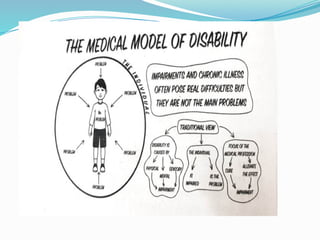
The Biomedical/Individual Model
 PWDs are seen as persons who are ill and meant to be
treated or "made more normal." Olkin (1999 as cited in
Retief & Letsosa 2018)
 Disability is seen as a medical problem that resides in the
individual. It is a defect in or failure of a bodily system and
as such, is inherently abnormal and pathological. The goals
of intervention are cure, amelioration of the physical
condition to the greatest extent possible, and rehabilitation
(i.e., the adjustment of the person with the disability to the
condition and to the environment).
 Persons with disabilities are expected to avail themselves
of the variety of services offered to them
The Biomedical/Individual Model
 considers disability as a "glitch" the PWD is born
into, which needs assessment and fixing.
 It also reinforces the notion that those "without
disabilities" (1.e, the able-bodied or typically
developing) are superior than those with
disabilities, and that they have a primary
responsibility over the welfare of the disabled. Most
interventions are thus devoted to making sure that
the PWD catches up with his or her peers-a practice
that is very much ingrained in society to this day.
The Functional/Rehabilitation Model
The functional/rehabilitation model is
quite similar to the biomedical model in
that it sees the PWD as having deficits.
These deficits then justify the need to
undergo rehabilitative intervention such
as therapies, counseling, and the like in
the aim of reintegrating the disabled into
society.
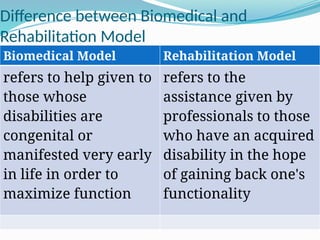
Difference between Biomedical and
Rehabilitation Model
Biomedical Model Rehabilitation Model
refers to help given to
those whose
disabilities are
congenital or
manifested very early
in life in order to
maximize function
refers to the
assistance given by
professionals to those
who have an acquired
disability in the hope
of gaining back one's
functionality
The biomedical and rehabilitative models,
together with the dawn of clinic-based
assessments in the 1950s and its proliferation
during the 1960s onward, show how much
society has placed value on convention,
performance, and achievement. Anyone
whose performance does not fall within the
norm of a population is automatically
deemed different and deficient
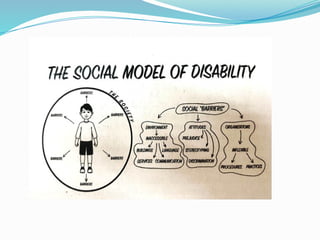
The Social Model
Clough & Corbett 2000) points out that the
social (sociological) model became
society's reaction to how the biomedical
perspective viewed disability.
Disability occurs as a result of society's lack of
understanding of individual differences.
PWDs are seen as disabled not because they
are deficient but because Society "insists" they
are deficient and disadvantaged. Norms, after
all, are determined by society.
The underlying principle of the social model of
disability is that disability is a social construct,
where standards and limitations that society
places on specific groups of people are what
disable a person.
The Social Model
 The World Health Organization (1980) differentiates
between disability and impairment.
 Impairment is seen as "any loss or abnormality of
psychological or anatomical structure or function"
 Disability refers to any restriction or lack (resulting from an
impairment) of ability to perform an activity in the manner
or within the range considered normal for a human being".
The social model
 The social model, reiterates that impairment should be
seen as a normal aspect of life and when it happens, it
should not cause a stir. Instead, society must plan in
anticipation of possible impairment occurrences so as not
to disable anyone. Kaplan (2000) agrees that if disability
were to be seen as something natural and expected, it
could change the way we design our systems and our
environments. Wendell (1996 as cited in Kaplan 2000: 356)
Rights-Based Model and Twin Track Approach
 The rights-based model of disability is a framework that
bears similarities with the social model. Although most
practitioners see the two one and the same
Social Model Rights-Based Model
the social model reiterates social
factors and dynamics that form our
perceptions of disability
the rights-based model "moves
beyond explanation, offering a
theoretical framework for
disability policy that emphasizes
the human dignity of PWDs"
the social model is mostly critical
of public health policies that
advocate the prevention of
impairment
the rights-based model
recognizes the fact that properly
formulated prevention policy may
be regarded as an instance of
human rights protection for PWDs"
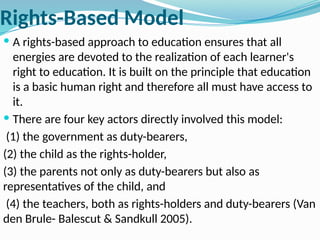
Rights-Based Model
 A rights-based approach to education ensures that all
energies are devoted to the realization of each learner's
right to education. It is built on the principle that education
is a basic human right and therefore all must have access to
it.
 There are four key actors directly involved this model:
(1) the government as duty-bearers,
(2) the child as the rights-holder,
(3) the parents not only as duty-bearers but also as
representatives of the child, and
(4) the teachers, both as rights-holders and duty-bearers (Van
den Brule- Balescut & Sandkull 2005).
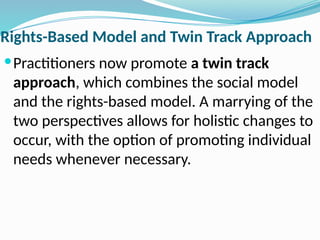
Rights-Based Model and Twin Track Approach
Practitioners now promote a twin track
approach, which combines the social model
and the rights-based model. A marrying of the
two perspectives allows for holistic changes to
occur, with the option of promoting individual
needs whenever necessary.
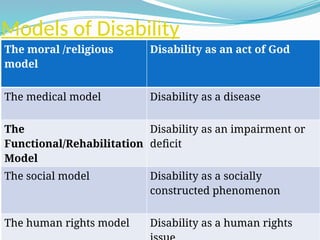
Models of Disability
The moral /religious
model
Disability as an act of God
The medical model Disability as a disease
The
Functional/Rehabilitation
Model
Disability as an impairment or
deficit
The social model Disability as a socially
constructed phenomenon
The human rights model Disability as a human rights
EDUC2 Chapter-2-Addressing-Diversity.pptx

EDUC2 Chapter-2-Addressing-Diversity.pptx

  • 1.
  • 2.
    Objectives  1. Identifythe different models of disability  2. Discuss the different perspectives and definition of special needs education;  3. Explain the importance of special and inclusive education;  4. Discuss and demonstrate an understanding of the philosophy, principles, theories, goals and policies that pertain to the development of educational programs for students with special needs;  5. Demonstrate reflective thinking and professional self-direction.
  • 3.
    Models of Disability tools for defining impairment provide a basis upon which government and society can devise strategies for meeting the needs of disabled people useful framework in which to gain an understanding of disability issues, and also of the perspective held by those creating and applying the models.
  • 4.
    MODELS OF DISABILTY Smart's study in 2004 (as cited in Retief and Letsosa, 2018) emphasizes that models of disability are important as they serve several purposes: (1) they provide definitions of disability,  (2) they offer "explanations of causal and responsibility attributions", (3) they are based on "perceived needs," (4) they inform policy
  • 5.
    MODELS OF DISABILTY Smart's study in 2004 (as cited in Retief and Letsosa, 2018) emphasizes that models of disability are important as they serve several purposes:  ( (5) they are not "value-neutral,"  (6) they define the academic disciplines that focus on disability,  (7) they "shape the self-identity of PWDs," and  (8) they can provide insight on how prejudices and discriminations occur.
  • 6.
    The Moral/Religious Model sees disability as either a blessing or a curse. It is characterized by notions of charity and caretaking.  Jackson (2018) adds that it is a protection which primary concern is an instinct to protect both the persons with disabilities for their vulnerability and the economic and social order which might be disrupted by "deviant members" of society.  It is considered the oldest model of disability and is evident in many religious traditions.
  • 7.
    The Moral/Religious Model disabilityis equated with the sin, evilness, or spiritual ineptness of either the PWD or of a PWD's family member. This belief can then cause not just the PWD's isolation but also the exclusion of the entire family unit from communal events (Rimmerman 2013 as cited in Retief and Letsosa 2018).
  • 8.
    The Moral/Religious Model Thecore response to this model was the establishing of segregated institutions where PWDs could be kept. Example, In the United States, United Kingdom, and Australia, asylums for the "mentally ill, retardates, degenerates, and defectives" were built . Segregated residential schools and workhouses with dormitories located miles away from town centers were also erected.
  • 9.
    The Biomedical/Individual Model PWDs are seen as persons who are ill and meant to be treated or "made more normal." Olkin (1999 as cited in Retief & Letsosa 2018)  Disability is seen as a medical problem that resides in the individual. It is a defect in or failure of a bodily system and as such, is inherently abnormal and pathological. The goals of intervention are cure, amelioration of the physical condition to the greatest extent possible, and rehabilitation (i.e., the adjustment of the person with the disability to the condition and to the environment).  Persons with disabilities are expected to avail themselves of the variety of services offered to them
  • 10.
    The Biomedical/Individual Model considers disability as a "glitch" the PWD is born into, which needs assessment and fixing.  It also reinforces the notion that those "without disabilities" (1.e, the able-bodied or typically developing) are superior than those with disabilities, and that they have a primary responsibility over the welfare of the disabled. Most interventions are thus devoted to making sure that the PWD catches up with his or her peers-a practice that is very much ingrained in society to this day.
  • 12.
    The Functional/Rehabilitation Model Thefunctional/rehabilitation model is quite similar to the biomedical model in that it sees the PWD as having deficits. These deficits then justify the need to undergo rehabilitative intervention such as therapies, counseling, and the like in the aim of reintegrating the disabled into society.
  • 13.
    Difference between Biomedicaland Rehabilitation Model Biomedical Model Rehabilitation Model refers to help given to those whose disabilities are congenital or manifested very early in life in order to maximize function refers to the assistance given by professionals to those who have an acquired disability in the hope of gaining back one's functionality
  • 14.
    The biomedical andrehabilitative models, together with the dawn of clinic-based assessments in the 1950s and its proliferation during the 1960s onward, show how much society has placed value on convention, performance, and achievement. Anyone whose performance does not fall within the norm of a population is automatically deemed different and deficient
  • 15.
    The Social Model Clough& Corbett 2000) points out that the social (sociological) model became society's reaction to how the biomedical perspective viewed disability.
  • 16.
    Disability occurs asa result of society's lack of understanding of individual differences. PWDs are seen as disabled not because they are deficient but because Society "insists" they are deficient and disadvantaged. Norms, after all, are determined by society. The underlying principle of the social model of disability is that disability is a social construct, where standards and limitations that society places on specific groups of people are what disable a person.
  • 17.
    The Social Model The World Health Organization (1980) differentiates between disability and impairment.  Impairment is seen as "any loss or abnormality of psychological or anatomical structure or function"  Disability refers to any restriction or lack (resulting from an impairment) of ability to perform an activity in the manner or within the range considered normal for a human being".
  • 18.
    The social model The social model, reiterates that impairment should be seen as a normal aspect of life and when it happens, it should not cause a stir. Instead, society must plan in anticipation of possible impairment occurrences so as not to disable anyone. Kaplan (2000) agrees that if disability were to be seen as something natural and expected, it could change the way we design our systems and our environments. Wendell (1996 as cited in Kaplan 2000: 356)
  • 20.
    Rights-Based Model andTwin Track Approach  The rights-based model of disability is a framework that bears similarities with the social model. Although most practitioners see the two one and the same Social Model Rights-Based Model the social model reiterates social factors and dynamics that form our perceptions of disability the rights-based model "moves beyond explanation, offering a theoretical framework for disability policy that emphasizes the human dignity of PWDs" the social model is mostly critical of public health policies that advocate the prevention of impairment the rights-based model recognizes the fact that properly formulated prevention policy may be regarded as an instance of human rights protection for PWDs"
  • 21.
    Rights-Based Model  Arights-based approach to education ensures that all energies are devoted to the realization of each learner's right to education. It is built on the principle that education is a basic human right and therefore all must have access to it.  There are four key actors directly involved this model: (1) the government as duty-bearers, (2) the child as the rights-holder, (3) the parents not only as duty-bearers but also as representatives of the child, and (4) the teachers, both as rights-holders and duty-bearers (Van den Brule- Balescut & Sandkull 2005).
  • 22.
    Rights-Based Model andTwin Track Approach Practitioners now promote a twin track approach, which combines the social model and the rights-based model. A marrying of the two perspectives allows for holistic changes to occur, with the option of promoting individual needs whenever necessary.
  • 23.
    Models of Disability Themoral /religious model Disability as an act of God The medical model Disability as a disease The Functional/Rehabilitation Model Disability as an impairment or deficit The social model Disability as a socially constructed phenomenon The human rights model Disability as a human rights