

Adaptive Data Cleansing with
StreamSets and Cassandra
Pat Patterson
Community Champion
@metadaddy
pat@superpat.com
About Pat
Pat Patterson
Community Champion @ StreamSets
Formerly Developer Evangelist at
Salesforce
Contact
pat@streamsets.com
@metadaddy
Feeding Cassandra with StreamSets Data Collector
User defined aggregate functions in Cassandra
Push statistics back into the data pipeline
Resources
Q & A
Agenda
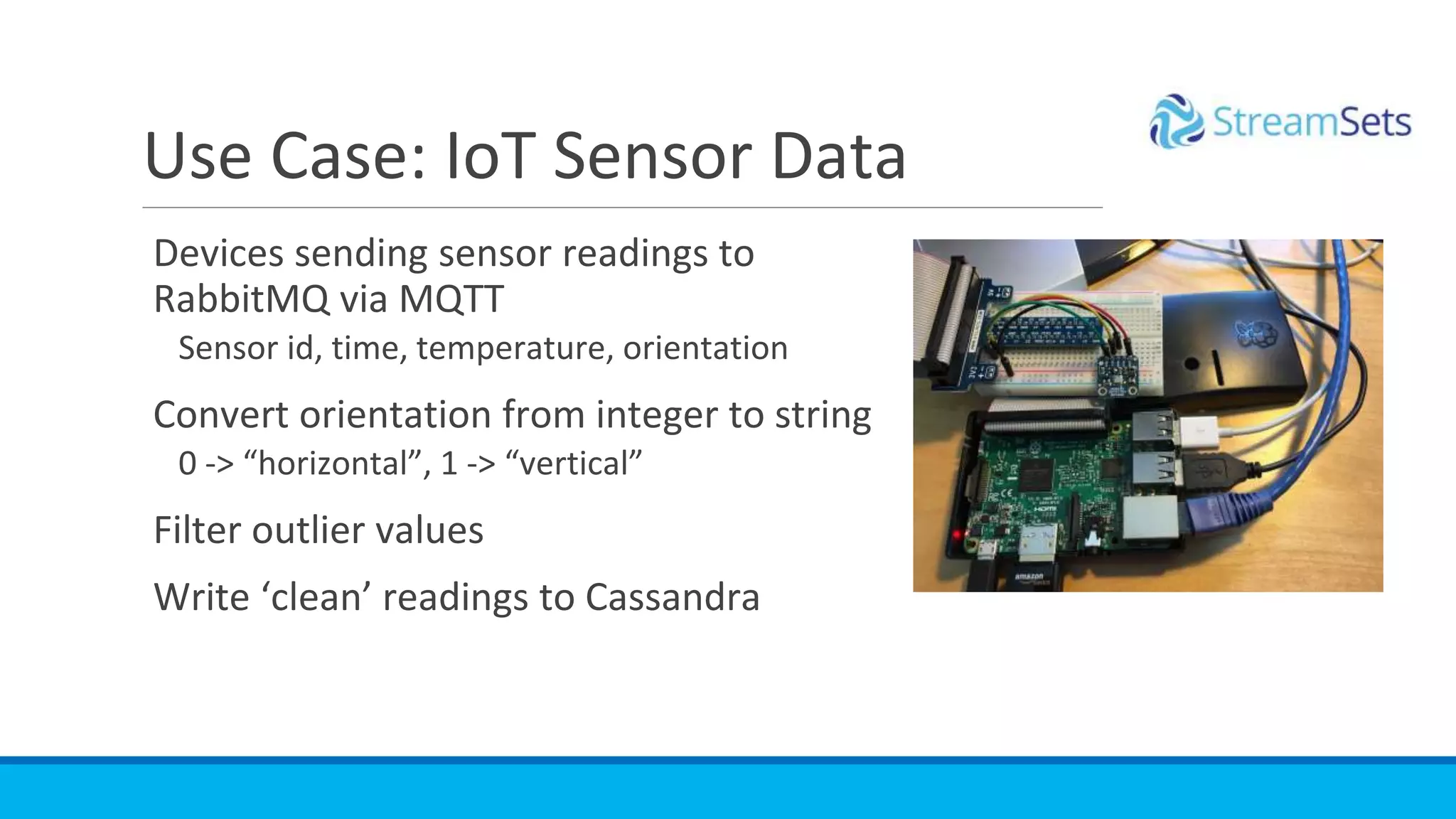
Devices sending sensor readings to
RabbitMQ via MQTT
Sensor id, time, temperature, orientation
Convert orientation from integer to string
0 -> “horizontal”, 1 -> “vertical”
Filter outlier values
Write ‘clean’ readings to Cassandra
Use Case: IoT Sensor Data
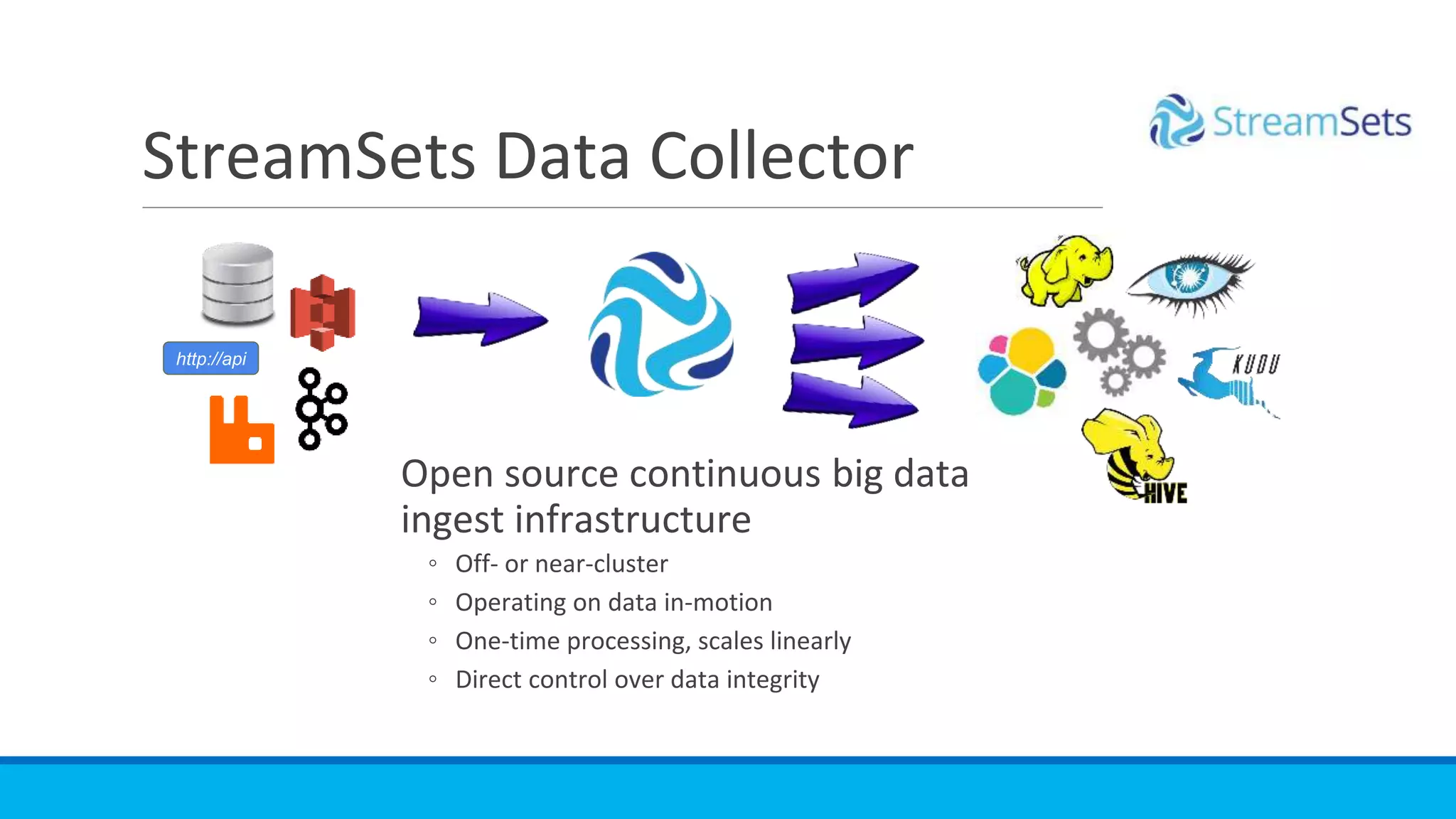
StreamSets Data Collector
http://api
Open source continuous big data
ingest infrastructure
◦ Off- or near-cluster
◦ Operating on data in-motion
◦ One-time processing, scales linearly
◦ Direct control over data integrity
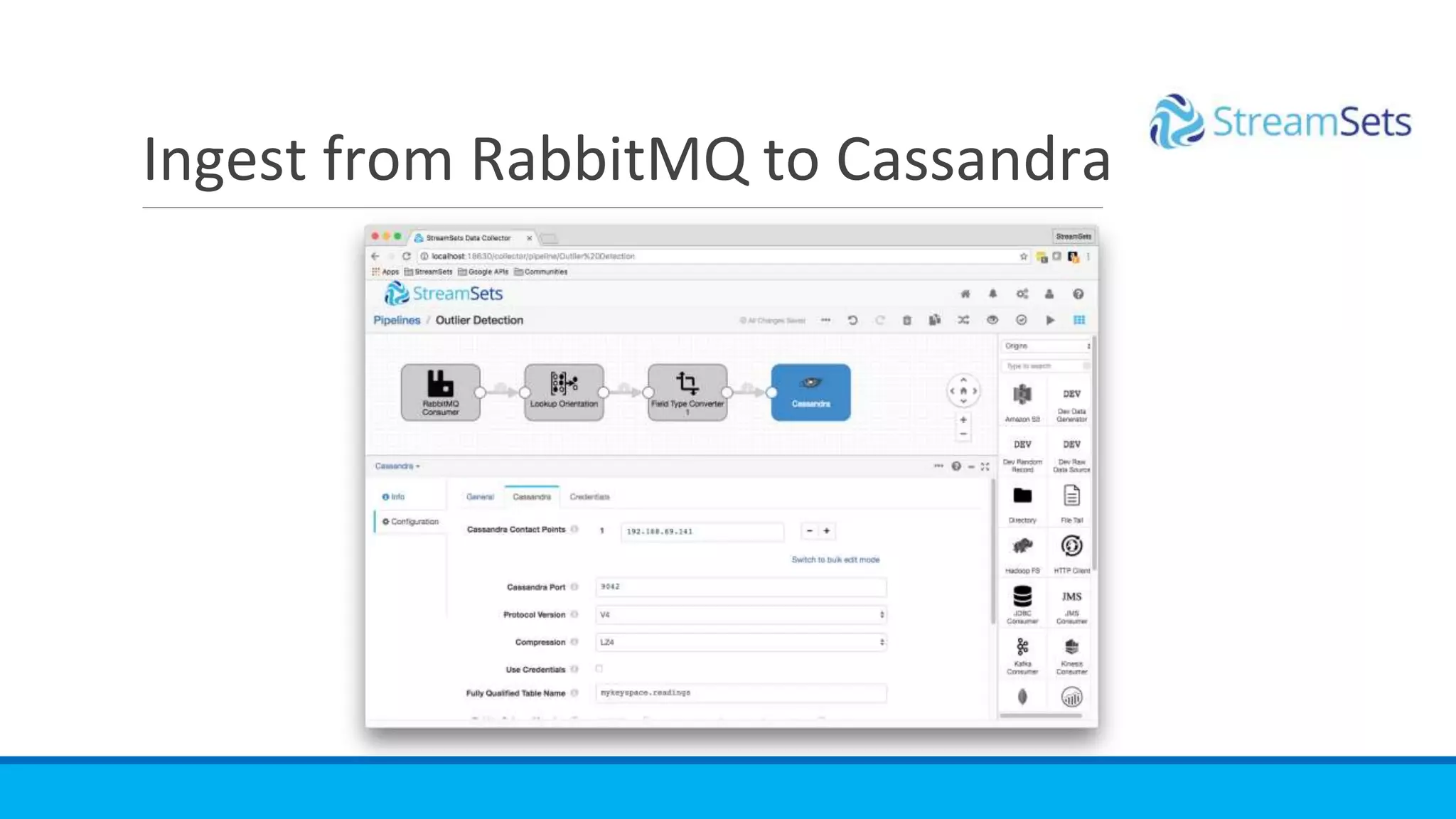
Ingest from RabbitMQ to Cassandra
Could easily filter on some static boundary
But that will only catch ‘obvious’ problems
Can we find outlier values in a more dynamic,
flexible way?
Let’s define an outlier as any temperature value
more than 4 standard deviations from the past
hour’s mean temperature
Cleaning Up The Data
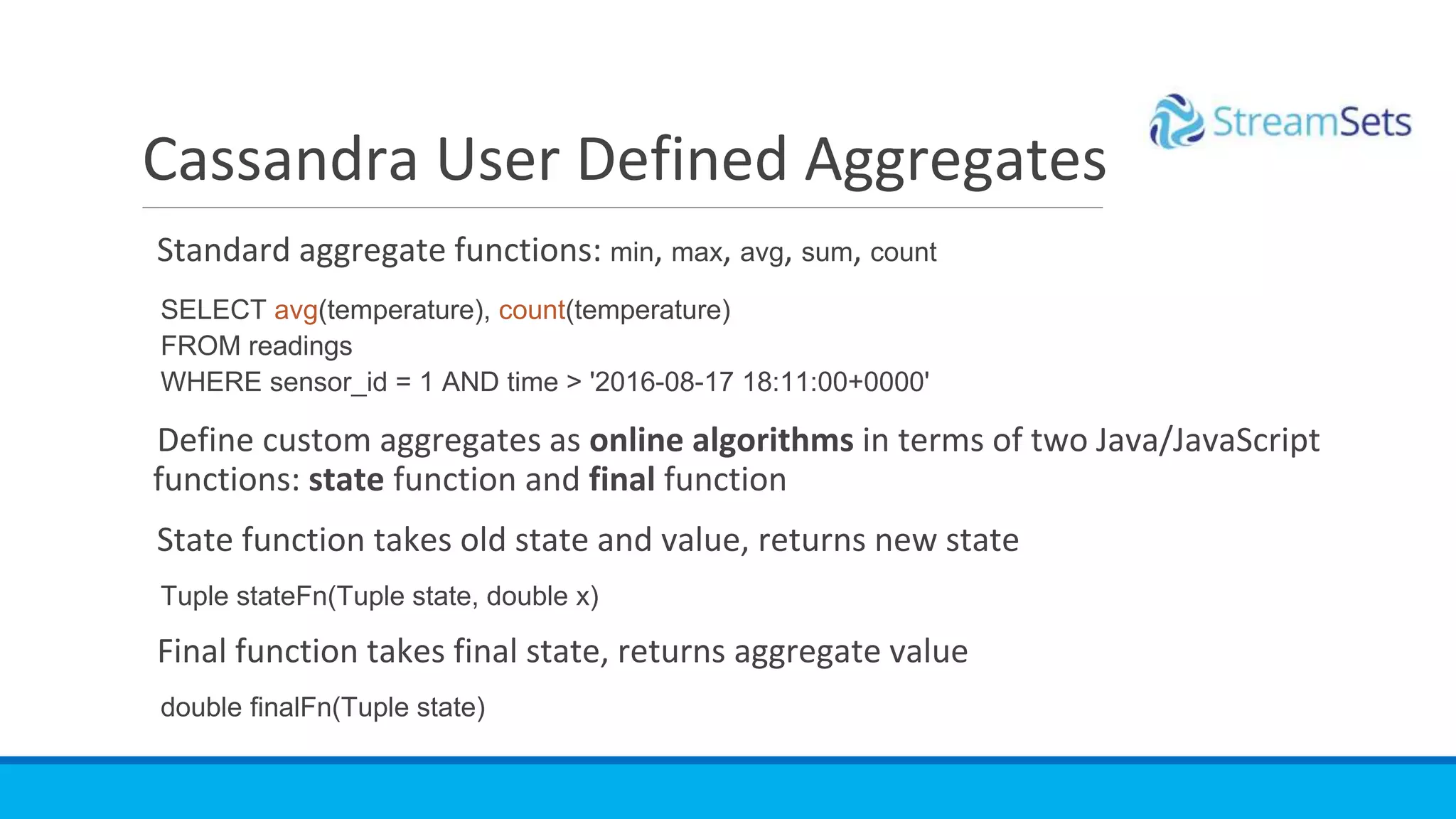
Standard aggregate functions: min, max, avg, sum, count
SELECT avg(temperature), count(temperature)
FROM readings
WHERE sensor_id = 1 AND time > '2016-08-17 18:11:00+0000'
Define custom aggregates as online algorithms in terms of two Java/JavaScript
functions: state function and final function
State function takes old state and value, returns new state
Tuple stateFn(Tuple state, double x)
Final function takes final state, returns aggregate value
double finalFn(Tuple state)
Cassandra User Defined Aggregates
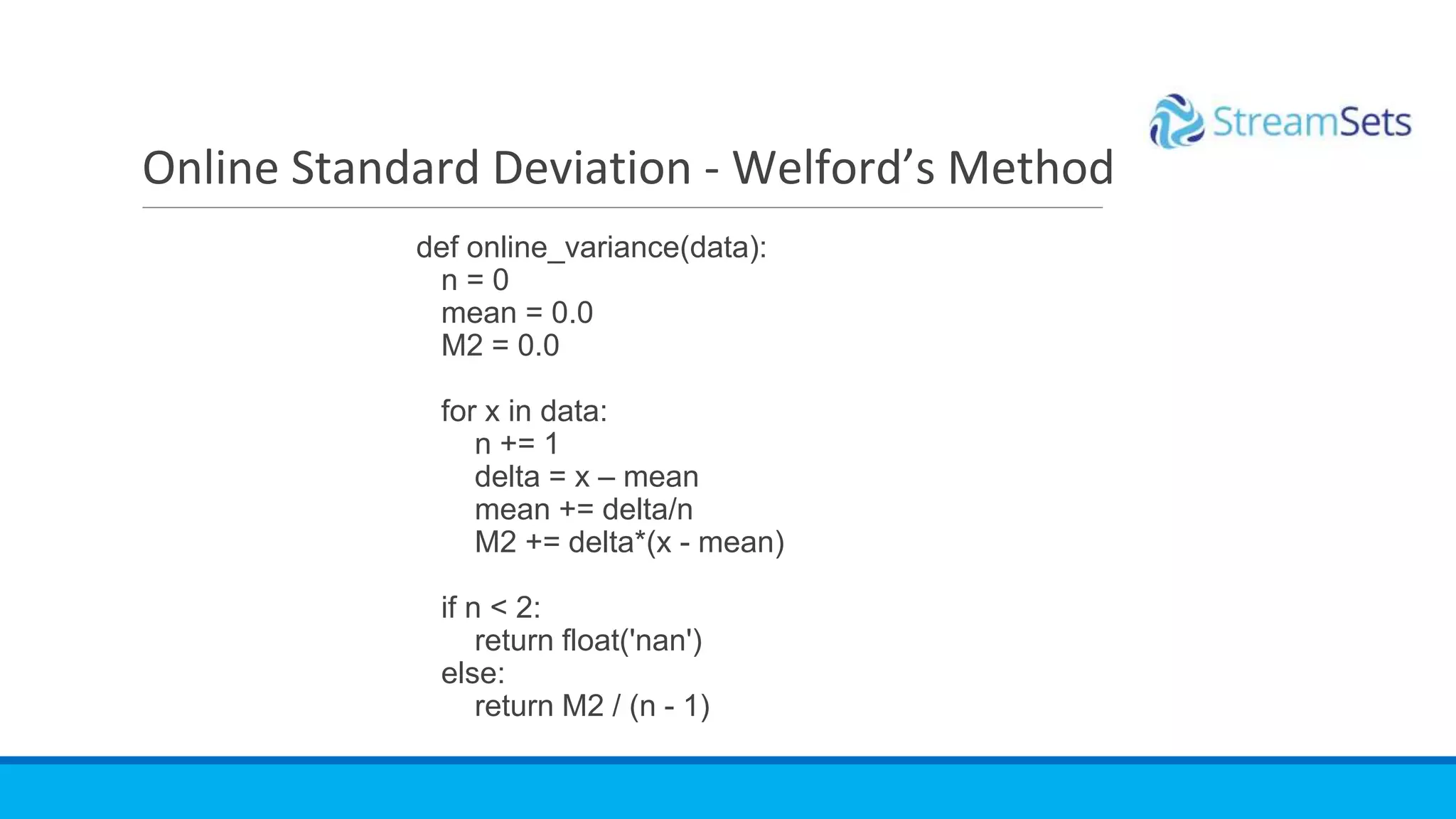
def online_variance(data):
n = 0
mean = 0.0
M2 = 0.0
for x in data:
n += 1
delta = x – mean
mean += delta/n
M2 += delta*(x - mean)
if n < 2:
return float('nan')
else:
return M2 / (n - 1)
Online Standard Deviation - Welford’s Method
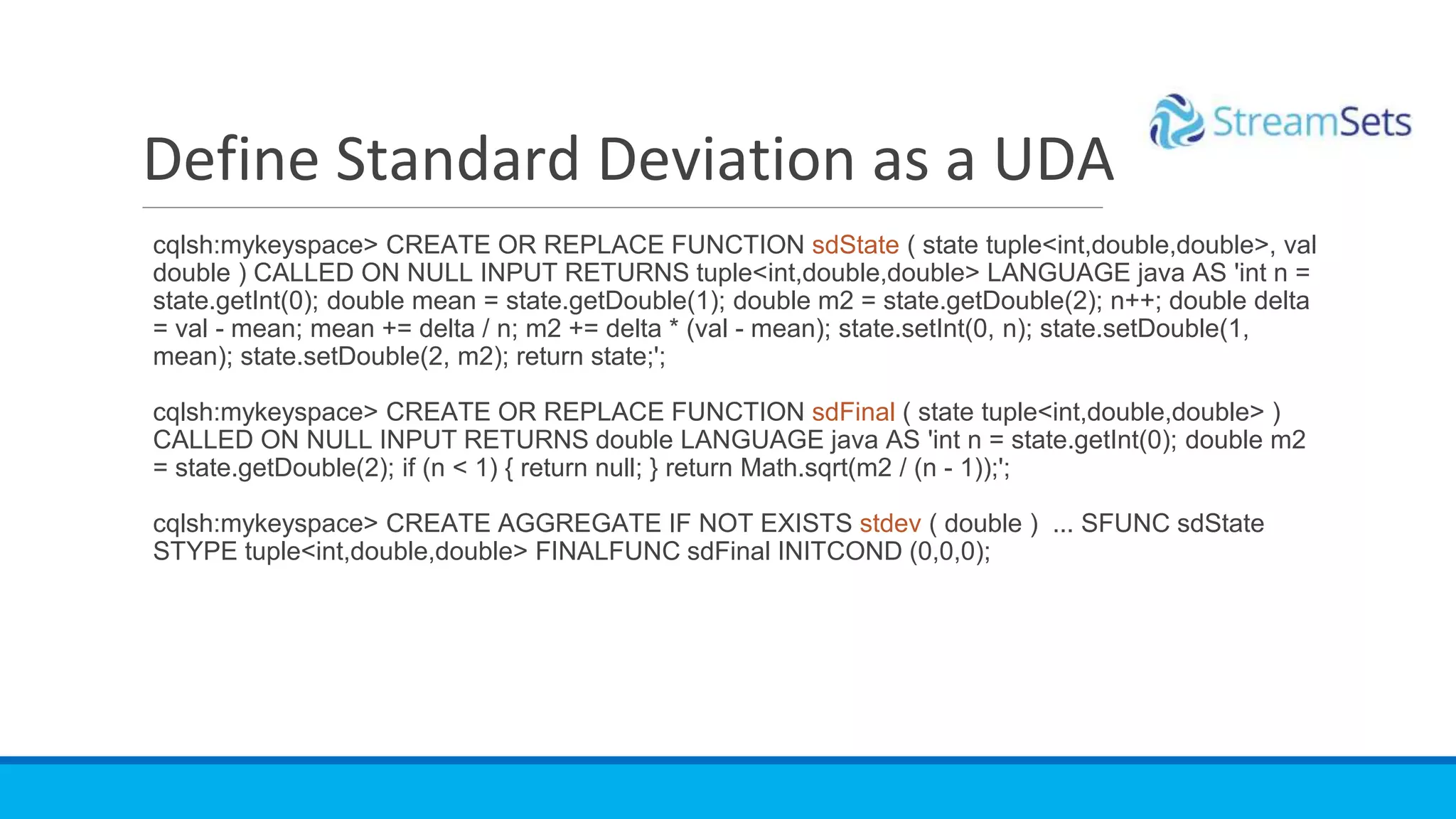
cqlsh:mykeyspace> CREATE OR REPLACE FUNCTION sdState ( state tuple<int,double,double>, val
double ) CALLED ON NULL INPUT RETURNS tuple<int,double,double> LANGUAGE java AS 'int n =
state.getInt(0); double mean = state.getDouble(1); double m2 = state.getDouble(2); n++; double delta
= val - mean; mean += delta / n; m2 += delta * (val - mean); state.setInt(0, n); state.setDouble(1,
mean); state.setDouble(2, m2); return state;';
cqlsh:mykeyspace> CREATE OR REPLACE FUNCTION sdFinal ( state tuple<int,double,double> )
CALLED ON NULL INPUT RETURNS double LANGUAGE java AS 'int n = state.getInt(0); double m2
= state.getDouble(2); if (n < 1) { return null; } return Math.sqrt(m2 / (n - 1));';
cqlsh:mykeyspace> CREATE AGGREGATE IF NOT EXISTS stdev ( double ) ... SFUNC sdState
STYPE tuple<int,double,double> FINALFUNC sdFinal INITCOND (0,0,0);
Define Standard Deviation as a UDA
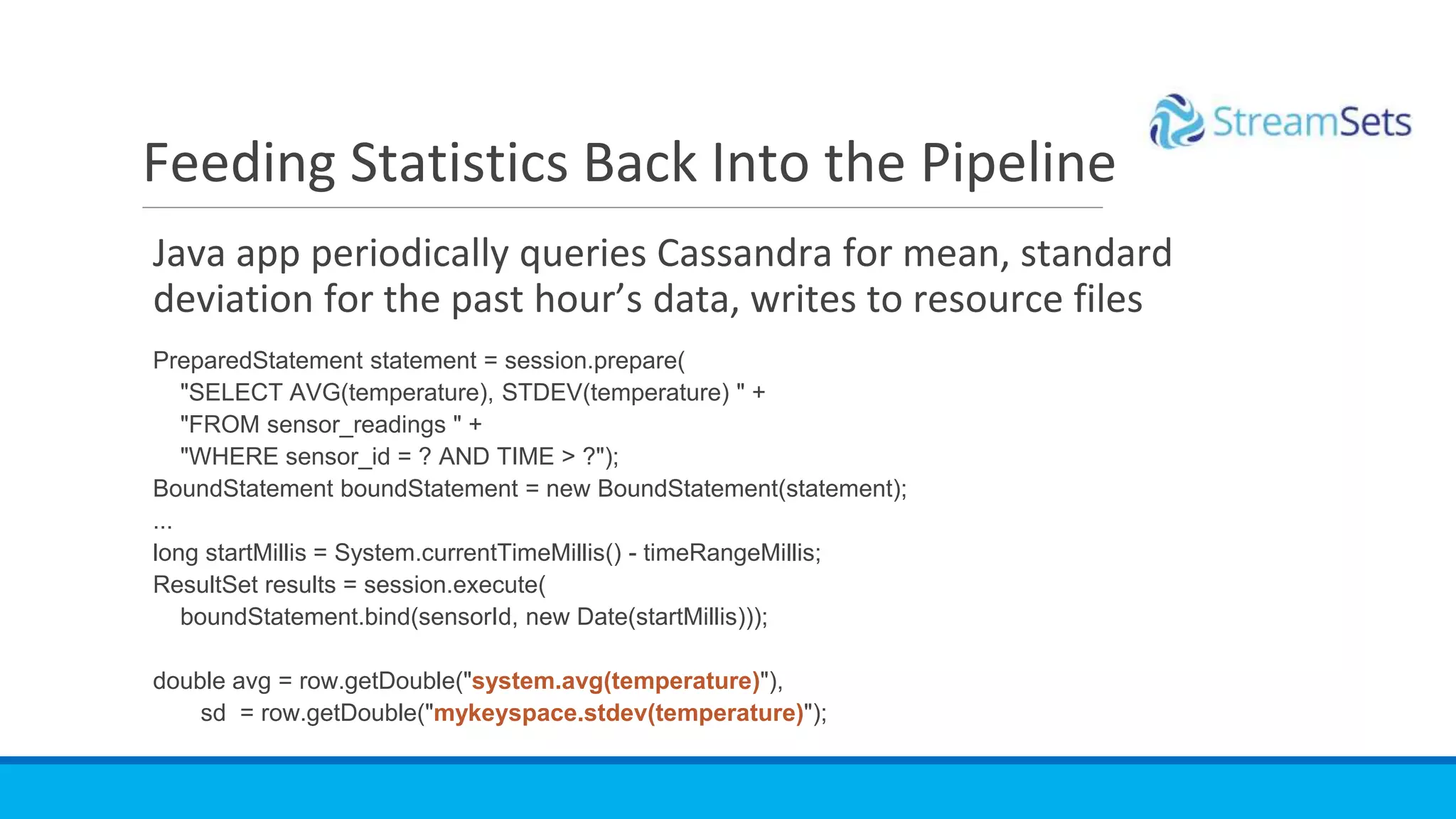
Java app periodically queries Cassandra for mean, standard
deviation for the past hour’s data, writes to resource files
PreparedStatement statement = session.prepare(
"SELECT AVG(temperature), STDEV(temperature) " +
"FROM sensor_readings " +
"WHERE sensor_id = ? AND TIME > ?");
BoundStatement boundStatement = new BoundStatement(statement);
...
long startMillis = System.currentTimeMillis() - timeRangeMillis;
ResultSet results = session.execute(
boundStatement.bind(sensorId, new Date(startMillis)));
double avg = row.getDouble("system.avg(temperature)"),
sd = row.getDouble("mykeyspace.stdev(temperature)");
Feeding Statistics Back Into the Pipeline
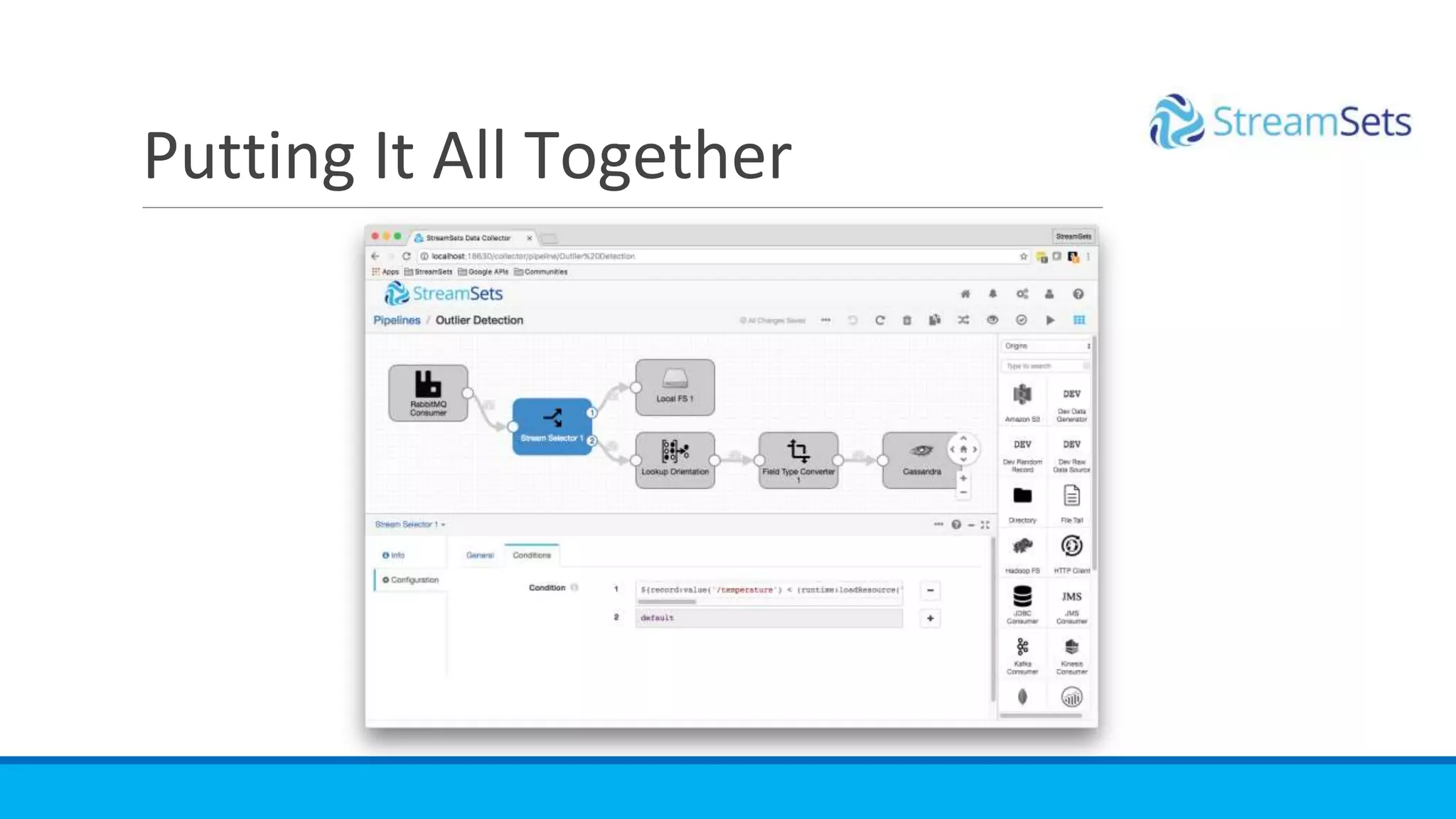
Putting It All Together
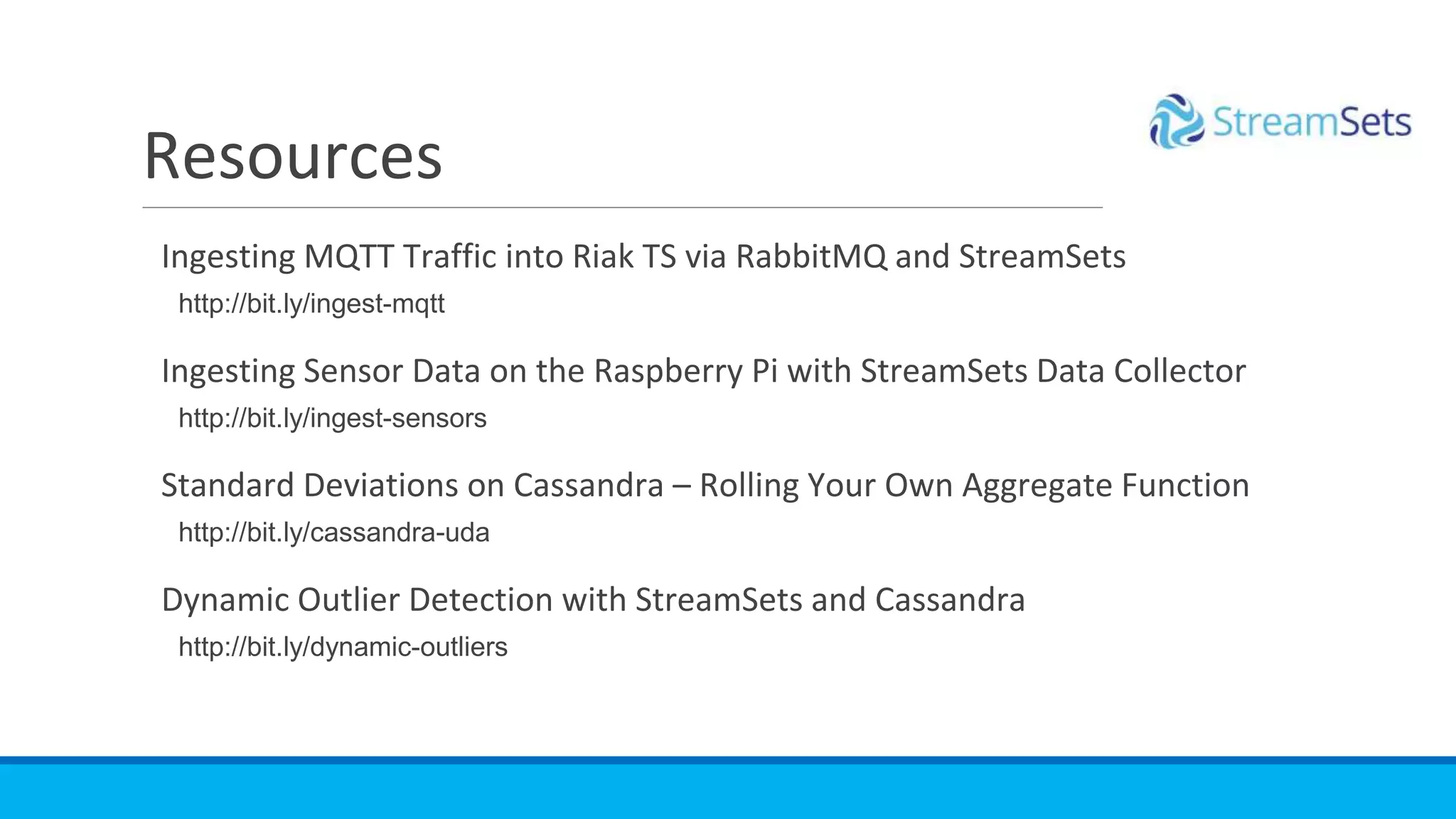
Ingesting MQTT Traffic into Riak TS via RabbitMQ and StreamSets
http://bit.ly/ingest-mqtt
Ingesting Sensor Data on the Raspberry Pi with StreamSets Data Collector
http://bit.ly/ingest-sensors
Standard Deviations on Cassandra – Rolling Your Own Aggregate Function
http://bit.ly/cassandra-uda
Dynamic Outlier Detection with StreamSets and Cassandra
http://bit.ly/dynamic-outliers
Resources
Questions?
Pat Patterson
Community Champion
@metadaddy
pat@superpat.com

Adaptive Data Cleansing with StreamSets and Cassandra (Pat Patterson, StreamSets) | C* Summit 2016

  • 1.
    Adaptive Data Cleansingwith StreamSets and Cassandra Pat Patterson Community Champion @metadaddy pat@superpat.com
  • 2.
    About Pat Pat Patterson CommunityChampion @ StreamSets Formerly Developer Evangelist at Salesforce Contact pat@streamsets.com @metadaddy
  • 3.
    Feeding Cassandra withStreamSets Data Collector User defined aggregate functions in Cassandra Push statistics back into the data pipeline Resources Q & A Agenda
  • 4.
    Devices sending sensorreadings to RabbitMQ via MQTT Sensor id, time, temperature, orientation Convert orientation from integer to string 0 -> “horizontal”, 1 -> “vertical” Filter outlier values Write ‘clean’ readings to Cassandra Use Case: IoT Sensor Data
  • 5.
    StreamSets Data Collector http://api Opensource continuous big data ingest infrastructure ◦ Off- or near-cluster ◦ Operating on data in-motion ◦ One-time processing, scales linearly ◦ Direct control over data integrity
  • 6.
  • 7.
    Could easily filteron some static boundary But that will only catch ‘obvious’ problems Can we find outlier values in a more dynamic, flexible way? Let’s define an outlier as any temperature value more than 4 standard deviations from the past hour’s mean temperature Cleaning Up The Data
  • 8.
    Standard aggregate functions:min, max, avg, sum, count SELECT avg(temperature), count(temperature) FROM readings WHERE sensor_id = 1 AND time > '2016-08-17 18:11:00+0000' Define custom aggregates as online algorithms in terms of two Java/JavaScript functions: state function and final function State function takes old state and value, returns new state Tuple stateFn(Tuple state, double x) Final function takes final state, returns aggregate value double finalFn(Tuple state) Cassandra User Defined Aggregates
  • 9.
    def online_variance(data): n =0 mean = 0.0 M2 = 0.0 for x in data: n += 1 delta = x – mean mean += delta/n M2 += delta*(x - mean) if n < 2: return float('nan') else: return M2 / (n - 1) Online Standard Deviation - Welford’s Method
  • 10.
    cqlsh:mykeyspace> CREATE ORREPLACE FUNCTION sdState ( state tuple<int,double,double>, val double ) CALLED ON NULL INPUT RETURNS tuple<int,double,double> LANGUAGE java AS 'int n = state.getInt(0); double mean = state.getDouble(1); double m2 = state.getDouble(2); n++; double delta = val - mean; mean += delta / n; m2 += delta * (val - mean); state.setInt(0, n); state.setDouble(1, mean); state.setDouble(2, m2); return state;'; cqlsh:mykeyspace> CREATE OR REPLACE FUNCTION sdFinal ( state tuple<int,double,double> ) CALLED ON NULL INPUT RETURNS double LANGUAGE java AS 'int n = state.getInt(0); double m2 = state.getDouble(2); if (n < 1) { return null; } return Math.sqrt(m2 / (n - 1));'; cqlsh:mykeyspace> CREATE AGGREGATE IF NOT EXISTS stdev ( double ) ... SFUNC sdState STYPE tuple<int,double,double> FINALFUNC sdFinal INITCOND (0,0,0); Define Standard Deviation as a UDA
  • 11.
    Java app periodicallyqueries Cassandra for mean, standard deviation for the past hour’s data, writes to resource files PreparedStatement statement = session.prepare( "SELECT AVG(temperature), STDEV(temperature) " + "FROM sensor_readings " + "WHERE sensor_id = ? AND TIME > ?"); BoundStatement boundStatement = new BoundStatement(statement); ... long startMillis = System.currentTimeMillis() - timeRangeMillis; ResultSet results = session.execute( boundStatement.bind(sensorId, new Date(startMillis))); double avg = row.getDouble("system.avg(temperature)"), sd = row.getDouble("mykeyspace.stdev(temperature)"); Feeding Statistics Back Into the Pipeline
  • 12.
  • 13.
    Ingesting MQTT Trafficinto Riak TS via RabbitMQ and StreamSets http://bit.ly/ingest-mqtt Ingesting Sensor Data on the Raspberry Pi with StreamSets Data Collector http://bit.ly/ingest-sensors Standard Deviations on Cassandra – Rolling Your Own Aggregate Function http://bit.ly/cassandra-uda Dynamic Outlier Detection with StreamSets and Cassandra http://bit.ly/dynamic-outliers Resources
  • 14.