CC Adaptation + CDRM
  Sustainable Communities
    Raks Thai Foundation
Capacity Building Workshop on Climate
     Change Negotiation Process
 Friday 17 August 2012, at the Amari
           Watergate Hotel
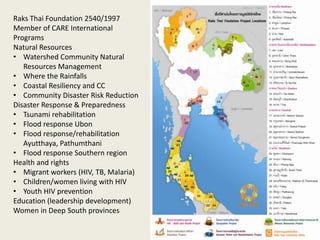
Raks Thai Foundation 2540/1997
Member of CARE International
Programs
Natural Resources
• Watershed Community Natural
   Resources Management
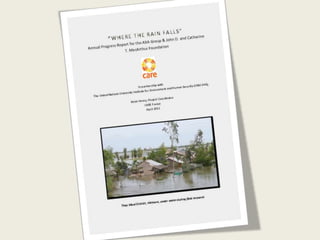
• Where the Rainfalls
• Coastal Resiliency and CC
• Community Disaster Risk Reduction
Disaster Response & Preparedness
• Tsunami rehabilitation
• Flood response Ubon
• Flood response/rehabilitation
   Ayutthaya, Pathumthani
• Flood response Southern region
Health and rights
• Migrant workers (HIV, TB, Malaria)
• Children/women living with HIV
• Youth HIV prevention
Education (leadership development)
Women in Deep South provinces
LEARNING LAB
• Review/analyze
• Tools development
• Process
• Results
• Impact
• Case studies
Community
Agencies, Civil society
National
Regional (Asia)
10 key steps on CBDRM process
Raks Thai & CS Partners
• Raks Thai Foundation
• Red Cross
• Thailand Environment Institution
• Sustainable Development Foundation
• Southeast Asia Regional Center of the Global
  Change System for Analysis, Research, and
  Training (START)
• RECOFT
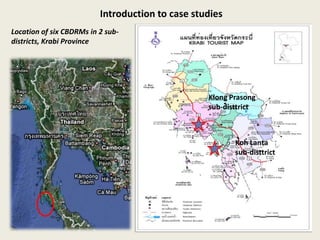
Introduction to case studies
Location of six CBDRMs in 2 sub-
districts, Krabi Province


                                                  Klong Prasong
                                                  sub-disttrict


                                                         Koh Lanta
                                                         sub-disttrict
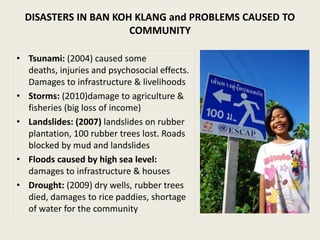
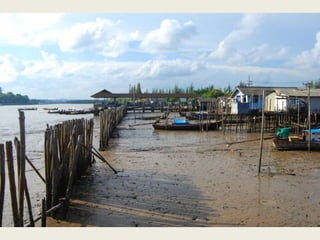
DISASTERS IN BAN KOH KLANG and PROBLEMS CAUSED TO
                      COMMUNITY

• Tsunami: (2004) caused some
  deaths, injuries and psychosocial effects.
  Damages to infrastructure & livelihoods
• Storms: (2010)damage to agriculture &
  fisheries (big loss of income)
• Landslides: (2007) landslides on rubber
  plantation, 100 rubber trees lost. Roads
  blocked by mud and landslides
• Floods caused by high sea level:
  damages to infrastructure & houses
• Drought: (2009) dry wells, rubber trees
  died, damages to rice paddies, shortage
  of water for the community
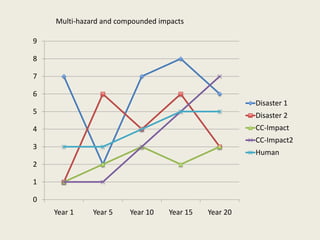
Multi-hazard and compounded impacts

9

8

7

6
                                                      Disaster 1
5                                                     Disaster 2
4                                                     CC-Impact
                                                      CC-Impact2
3
                                                      Human
2

1

0
    Year 1    Year 5    Year 10   Year 15   Year 20
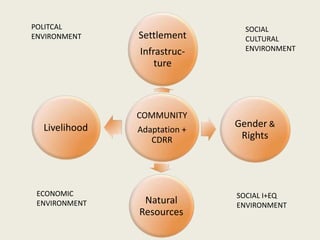
POLITCAL                        SOCIAL
ENVIRONMENT    Settlement       CULTURAL
               Infrastruc-      ENVIRONMENT
                   ture


               COMMUNITY
  Livelihood                  Gender &
               Adaptation +
                  CDRR         Rights


 ECONOMIC                     SOCIAL I+EQ
 ENVIRONMENT    Natural       ENVIRONMENT
               Resources
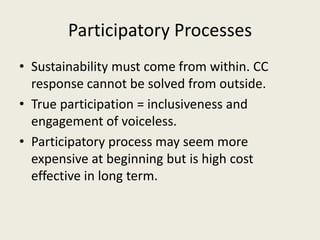
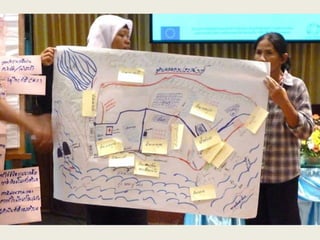
Participatory Processes
• Sustainability must come from within. CC
  response cannot be solved from outside.
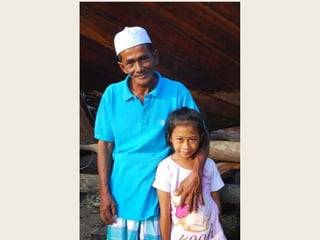
• True participation = inclusiveness and
  engagement of voiceless.
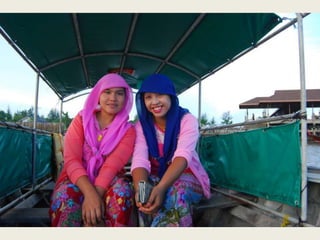
• Participatory process may seem more
  expensive at beginning but is high cost
  effective in long term.
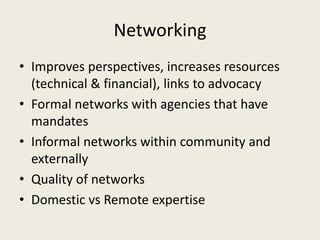
Networking
• Improves perspectives, increases resources
  (technical & financial), links to advocacy
• Formal networks with agencies that have
  mandates
• Informal networks within community and
  externally
• Quality of networks
• Domestic vs Remote expertise
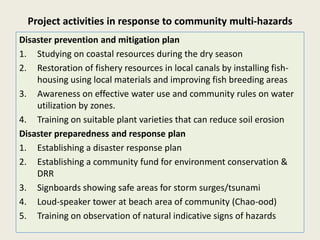
Project activities in response to community multi-hazards
Disaster prevention and mitigation plan
1. Studying on coastal resources during the dry season
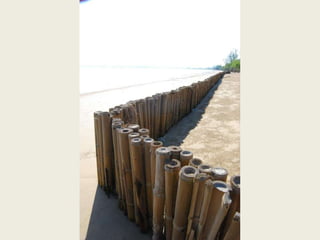
2. Restoration of fishery resources in local canals by installing fish-
    housing using local materials and improving fish breeding areas
3. Awareness on effective water use and community rules on water
    utilization by zones.
4. Training on suitable plant varieties that can reduce soil erosion
Disaster preparedness and response plan
1. Establishing a disaster response plan
2. Establishing a community fund for environment conservation &
    DRR
3. Signboards showing safe areas for storm surges/tsunami
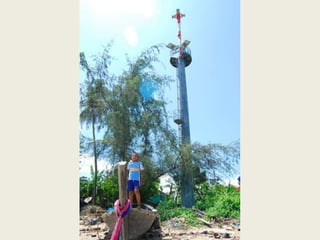
4. Loud-speaker tower at beach area of community (Chao-ood)
5. Training on observation of natural indicative signs of hazards
Funding Community Initiatives
•   Short term – long term
•   Who pays?
•   How to make expenses of highest value.
•   Equity – who get’s what? Who is saved?
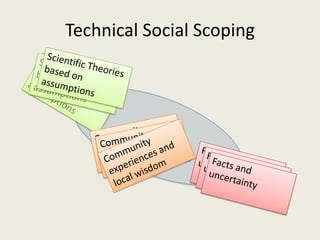
Technical Social Scoping
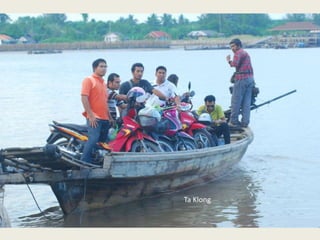
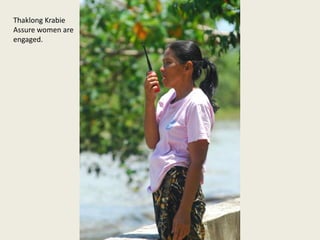
Ta Klong
Thaklong Krabie
Assure women are
engaged.
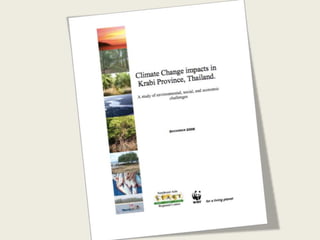
K ledgeN ork(C K ),
               now    etw   DN


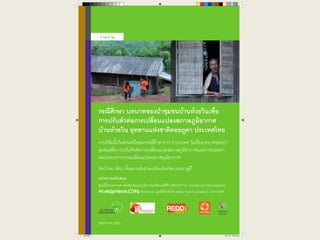
Thai.indd 1                         5/21/12 10:45 AM
http://www.careclimatechange.org/
http://www.greenforall.net/
http://www.raksthai.org/
www.facebook.com/raksthaifoundation
Adaptation Leaning Labs Raks Thai

Adaptation Leaning Labs Raks Thai

  • 1.
    CC Adaptation +CDRM Sustainable Communities Raks Thai Foundation Capacity Building Workshop on Climate Change Negotiation Process Friday 17 August 2012, at the Amari Watergate Hotel
  • 2.
    Raks Thai Foundation2540/1997 Member of CARE International Programs Natural Resources • Watershed Community Natural Resources Management • Where the Rainfalls • Coastal Resiliency and CC • Community Disaster Risk Reduction Disaster Response & Preparedness • Tsunami rehabilitation • Flood response Ubon • Flood response/rehabilitation Ayutthaya, Pathumthani • Flood response Southern region Health and rights • Migrant workers (HIV, TB, Malaria) • Children/women living with HIV • Youth HIV prevention Education (leadership development) Women in Deep South provinces
  • 3.
    LEARNING LAB • Review/analyze •Tools development • Process • Results • Impact • Case studies Community Agencies, Civil society National Regional (Asia)
  • 4.
    10 key stepson CBDRM process
  • 5.
    Raks Thai &CS Partners • Raks Thai Foundation • Red Cross • Thailand Environment Institution • Sustainable Development Foundation • Southeast Asia Regional Center of the Global Change System for Analysis, Research, and Training (START) • RECOFT
  • 6.
    Introduction to casestudies Location of six CBDRMs in 2 sub- districts, Krabi Province Klong Prasong sub-disttrict Koh Lanta sub-disttrict
  • 7.
    DISASTERS IN BANKOH KLANG and PROBLEMS CAUSED TO COMMUNITY • Tsunami: (2004) caused some deaths, injuries and psychosocial effects. Damages to infrastructure & livelihoods • Storms: (2010)damage to agriculture & fisheries (big loss of income) • Landslides: (2007) landslides on rubber plantation, 100 rubber trees lost. Roads blocked by mud and landslides • Floods caused by high sea level: damages to infrastructure & houses • Drought: (2009) dry wells, rubber trees died, damages to rice paddies, shortage of water for the community
  • 8.
    Multi-hazard and compoundedimpacts 9 8 7 6 Disaster 1 5 Disaster 2 4 CC-Impact CC-Impact2 3 Human 2 1 0 Year 1 Year 5 Year 10 Year 15 Year 20
  • 9.
    POLITCAL SOCIAL ENVIRONMENT Settlement CULTURAL Infrastruc- ENVIRONMENT ture COMMUNITY Livelihood Gender & Adaptation + CDRR Rights ECONOMIC SOCIAL I+EQ ENVIRONMENT Natural ENVIRONMENT Resources
  • 10.
    Participatory Processes • Sustainabilitymust come from within. CC response cannot be solved from outside. • True participation = inclusiveness and engagement of voiceless. • Participatory process may seem more expensive at beginning but is high cost effective in long term.
  • 14.
    Networking • Improves perspectives,increases resources (technical & financial), links to advocacy • Formal networks with agencies that have mandates • Informal networks within community and externally • Quality of networks • Domestic vs Remote expertise
  • 18.
    Project activities inresponse to community multi-hazards Disaster prevention and mitigation plan 1. Studying on coastal resources during the dry season 2. Restoration of fishery resources in local canals by installing fish- housing using local materials and improving fish breeding areas 3. Awareness on effective water use and community rules on water utilization by zones. 4. Training on suitable plant varieties that can reduce soil erosion Disaster preparedness and response plan 1. Establishing a disaster response plan 2. Establishing a community fund for environment conservation & DRR 3. Signboards showing safe areas for storm surges/tsunami 4. Loud-speaker tower at beach area of community (Chao-ood) 5. Training on observation of natural indicative signs of hazards
  • 19.
    Funding Community Initiatives • Short term – long term • Who pays? • How to make expenses of highest value. • Equity – who get’s what? Who is saved?
  • 20.
  • 31.
  • 33.
  • 40.
    K ledgeN ork(CK ), now etw DN Thai.indd 1 5/21/12 10:45 AM
  • 44.