Adapt Your Study Technique
with Oonagh Carroll
to suit your Learning Style
www.careertrail.wordpress.com
Benefits of knowing
your learning style?
• Head-start
• Maximises your learning
• Reduces study stress and
frustration
• Boosts self confidence
• Teaches you how to use your
brain best
When learning something new. . .
what do you prefer???
• Listen to someone explain it?
• Read about it?
• Watch a demonstration of it?
Image courtesy of Stuart Miles at
freedigitalphotos.net
Learning Styles
Visual Auditory Kinaesthetic
• Photographic memories
• Good spellers
• Organised and tidy
• Remember what people wear and looked like
• Have trouble following long lectures
• Often need verbal instruction to be repeated
• Don’t remember names easily
Visual Learners
!
Visual Learners
• Use images, diagrams, charts, graphs, mind-maps.
• Write notes using colour and pictures.
• Watch videos.
• Use colourful flashcards

Auditory Learners
• Talkative in class
• Remember who said what in the past
• Like to be read to
• Often talk to themselves
• Remember names
• Reading graphs, charts etc.
• Background noise
• Written directions
• Slow readers
!
Auditory Learners
• Listen in class
• Read out loud
• Explain material to others
• Answer questions orally
• Use melodies and rhythms to learn
• Repeat facts aloud with eyes closed
• Make recordings of notes and listen back

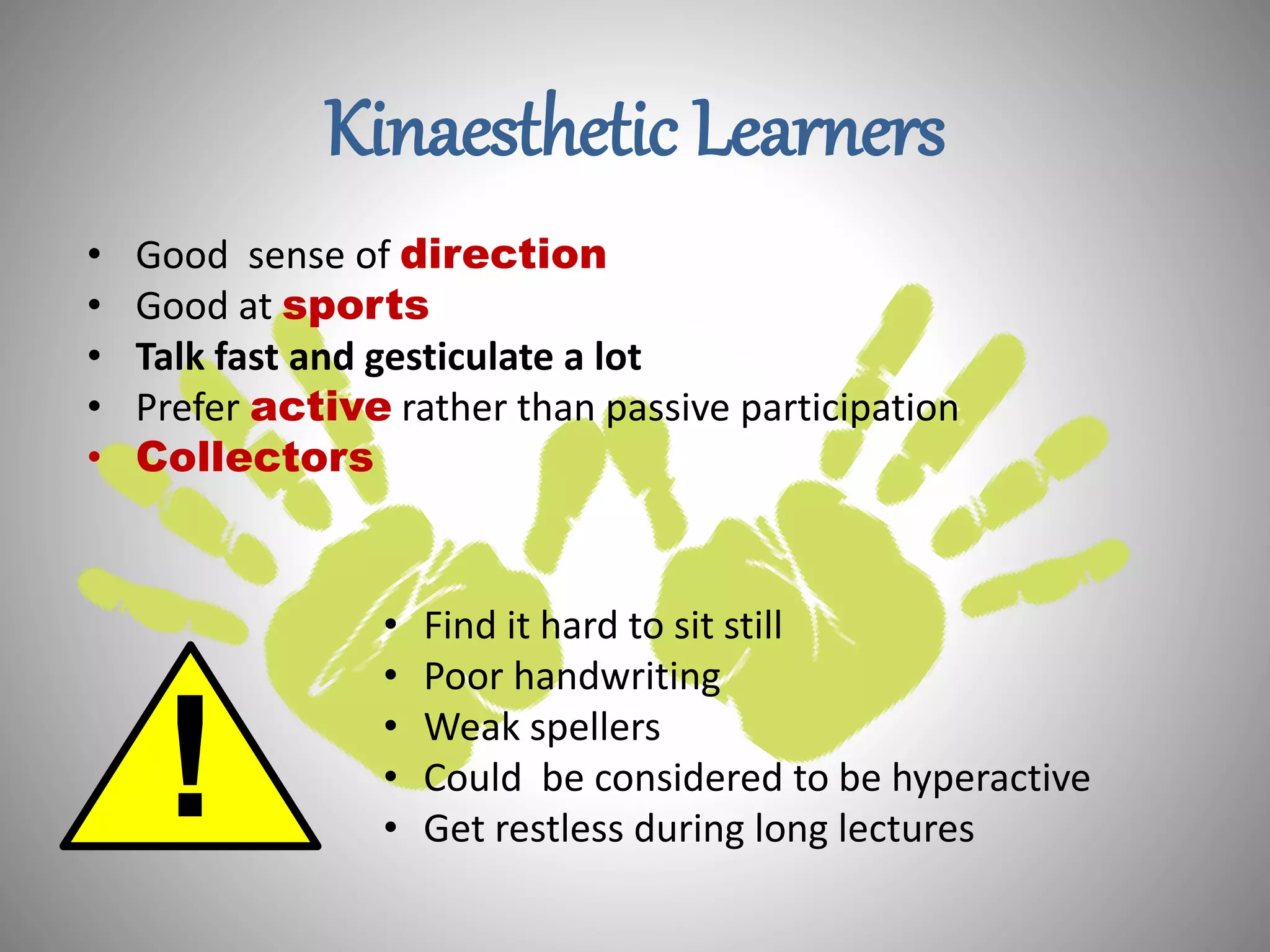
Kinaesthetic Learners
• Good sense of direction
• Good at sports
• Talk fast and gesticulate a lot
• Prefer active rather than passive participation
• Collectors
• Find it hard to sit still
• Poor handwriting
• Weak spellers
• Could be considered to be hyperactive
• Get restless during long lectures
!
Kinaesthetic Learners
• Move around when studying
• Squeeze stress balls when studying
• Role play
• Use a computer
• Use drawing materials
• Use puzzles and games as study aids

For more information
• Leaflet
• www.careertrail.wordpress.com
@thecareertrail
@OonaghCarroll

Adapt your study technique to suit your learning style

  • 1.
    Adapt Your StudyTechnique with Oonagh Carroll to suit your Learning Style www.careertrail.wordpress.com
  • 2.
    Benefits of knowing yourlearning style? • Head-start • Maximises your learning • Reduces study stress and frustration • Boosts self confidence • Teaches you how to use your brain best
  • 3.
    When learning somethingnew. . . what do you prefer??? • Listen to someone explain it? • Read about it? • Watch a demonstration of it? Image courtesy of Stuart Miles at freedigitalphotos.net
  • 4.
  • 5.
    • Photographic memories •Good spellers • Organised and tidy • Remember what people wear and looked like • Have trouble following long lectures • Often need verbal instruction to be repeated • Don’t remember names easily Visual Learners !
  • 6.
    Visual Learners • Useimages, diagrams, charts, graphs, mind-maps. • Write notes using colour and pictures. • Watch videos. • Use colourful flashcards 
  • 7.
    Auditory Learners • Talkativein class • Remember who said what in the past • Like to be read to • Often talk to themselves • Remember names • Reading graphs, charts etc. • Background noise • Written directions • Slow readers !
  • 8.
    Auditory Learners • Listenin class • Read out loud • Explain material to others • Answer questions orally • Use melodies and rhythms to learn • Repeat facts aloud with eyes closed • Make recordings of notes and listen back 
  • 9.
    Kinaesthetic Learners • Goodsense of direction • Good at sports • Talk fast and gesticulate a lot • Prefer active rather than passive participation • Collectors • Find it hard to sit still • Poor handwriting • Weak spellers • Could be considered to be hyperactive • Get restless during long lectures !
  • 10.
    Kinaesthetic Learners • Movearound when studying • Squeeze stress balls when studying • Role play • Use a computer • Use drawing materials • Use puzzles and games as study aids 
  • 11.
    For more information •Leaflet • www.careertrail.wordpress.com @thecareertrail @OonaghCarroll

Editor's Notes

  • #2 In secondary school, especially in 6th year, students get bombarded by the word ‘study’ You must study to do well. You should start studying now. You need a study timetable. Study, study, study. But have you ever stopped to think . . .what is study? How do you do that? For many ppl studying means sitting on front of the book for hours. Taking notes Practicing questions These are all good practices but if you do this for 15 hours a week for 9 months it can get quite tiresome and demotivating. The biggest problem with this approach to study is that it is adapted by the majority of ppl but doesn’t suit most ppl. Just like teaching strategies needs to be diverse to reach every student, learning is also very personal. There is no ‘One Size Fits All’ when it comes to study. In order to get the most out of the hours you put into study you need to need to study in the way that you learn. This avoids the frustration of study. If you have spent hours learning a topic only to find that you can’t recall the information a week later then you need to stop. . . take a step back . . . And look at different ways to study. Each person has a distinct way of learning, known as his or her personal learning style. Ppl vary greatly in the ways that they take in and process information. We use all of our senses to learn, but most of us are strongest in one area. This natural preference or dominant style is known as your learning style.
  • #3 So why do I need to know what my learning style is? How will it benefit me? It will give you a head start – through identifying how you learn and studying in that way you will make good progress quickly. It will help you to make the most of your study sessions. No more wasted time studying without retaining the information. If you study in the way that you learn you will make the most of the hours you put in and your study will be more effective. Most effective study session will boost your confidence and reduce stress and anxiety associated with study. If gives you a life skill of learning how to use your brain more effectively.
  • #4 So how do you work out what your learning style is? There are various free tests available on line. I will be posting a link to these on my blog so you can complete these and they will give you an indication of how you learn. But for the purpose of today’s sessions I’m going to ask you a simple question and your answer may identify your learning style to you. When learning some. . . . .. Listen. . . . Read. . .. Watch a demo . . .
  • #5 No-one uses one of the styles exclusively, and there is usually significant overlap in learning styles. Some people learn by seeing (visual); some people learn by hearing (auditory); some people learn by doing (tactile-kinesthetic) During childhood, each person advances through various stages of each style. Young children are all kinesthetic learners. Visual and auditory preferences emerge later. Each person is born with tendencies toward one main style. The dominant style may not always be the same. It may vary or be combined with others, according to the nature of the activity
  • #6 2/3 pop. See Visual materials Retain information and recall information Clear line of vision with learning stimulus
  • #9 Learn effectively through lectures, audio books, music, verbal instruction Enjoy class discussions and debates
  • #10 Make up only 5% of population Type of person who doesn’t bother reading instructions – just gets stuck in and works out the problem by doing it. Have a ‘hands on’ approach to learning Enjoy demonstrations and practical work Master skills through imitation and practice Prefer to stand, walk around of use their body when learning