}  SAS 31 ‘Evidential Matter’
}  Existence
}  Completeness
}  Valuation
}  Rights and Obligations
}  Presentation and Disclosure
Assets or liabilities exist at a given date and
whether recorded transactions have occurred
during a given period.
Begin: Books and Ledger
Other sources:
Evidence of tangible or intangible asset or liability
Confirmation with outside third party
Examples:
Confirmation of receivables
Confirmation of cash account balances
Whether all transactions and accounts that should
be presented in the financial statements are so
included.
Materiality considerations.
Origination: Externally generated documentation.
Ex. Tangible assets (internal) with vendor invoice (external)
and warehouse receiving report (internal). Document à JE à
Ledger à Balance
Use of analytical procedures (industry benchmarks)
Ex. Cost of goods sold to sales
Ex. Existence and Completeness: Inventory -
Inspect subsidiary ledger entries. Vouch to tangible inventory
Physical inventory count. Trace back to inventory ledger
support.
Whether asset, liability, revenue, and expense
components have been included in the
financial statements at appropriate amounts.
GAAP guidance
Ex. Accounts Receivables
Confirmation is Existence
Is payment assured?
Age current accounts receivable
Whether assets are the rights of the entity and
liabilities are the obligations of the entity at a
given date.
Off statement financing – Asset use. No risk.
Special purpose entities
Ex. Build-to-order lease transaction. Lessor has title.
Lessee has risk.
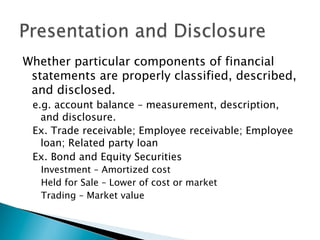
Whether particular components of financial
statements are properly classified, described,
and disclosed.
e.g. account balance – measurement, description,
and disclosure.
Ex. Trade receivable; Employee receivable; Employee
loan; Related party loan
Ex. Bond and Equity Securities
Investment – Amortized cost
Held for Sale – Lower of cost or market
Trading – Market value
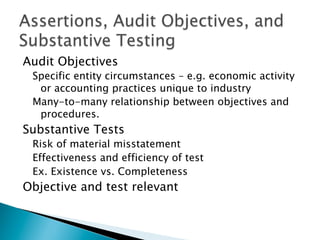
Audit Objectives
Specific entity circumstances – e.g. economic activity
or accounting practices unique to industry
Many-to-many relationship between objectives and
procedures.
Substantive Tests
Risk of material misstatement
Effectiveness and efficiency of test
Ex. Existence vs. Completeness
Objective and test relevant
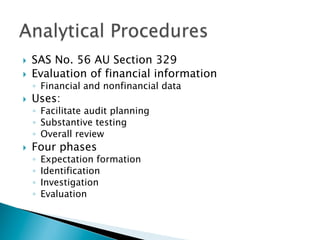
}  SAS No. 56 AU Section 329
}  Evaluation of financial information
◦  Financial and nonfinancial data
}  Uses:
◦  Facilitate audit planning
◦  Substantive testing
◦  Overall review
}  Four phases
◦  Expectation formation
◦  Identification
◦  Investigation
◦  Evaluation
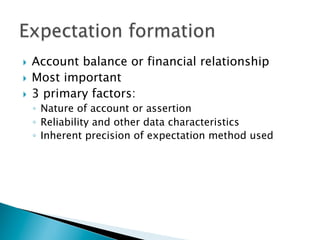
}  Account balance or financial relationship
}  Most important
}  3 primary factors:
◦  Nature of account or assertion
◦  Reliability and other data characteristics
◦  Inherent precision of expectation method used
}  Determine if unusual fluctuation exists
between expected and recorded amounts.
}  Expected value vs. recorded amount
◦  Unexpected difference vs. threshold
}  Cause of unexpected differences
◦  Consider cause. Most probable cause.
}  Large difference: Misstatement
}  Small different: nonmisstatement
}  Factors:
◦  Understanding of matters
◦  Management and board reports
◦  Board minutes
◦  Prior year unusual event details
}  Likelihood of material misstatement
}  Additional audit procedures
}  Aggregate to determine if material
}  Underpins reports, evaluations and financial
audits
}  Sufficiency, competence, and relevance of
evidence
}  Competence
◦  Validity and reliability
–  Reliability: Completeness and accuracy
}  Goal: Can data be used for its intended
purpose
}  Accuracy
◦  Consistency
}  Completeness
}  Validity
}  Input and Output (results)
}  Requires technical specialists:
◦  Data analysts, Statisticians, IT
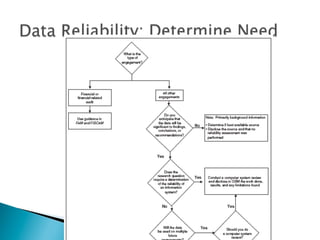
}  When needed and when not needed?
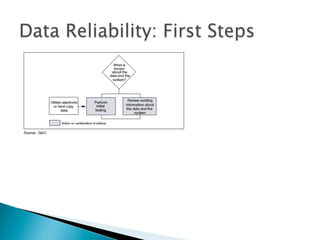
}  Data to support engagement findings,
conclusions, or recommendations
}  Data used as background information
}  Data used in documents w/out findings,
conclusions, or recommendations
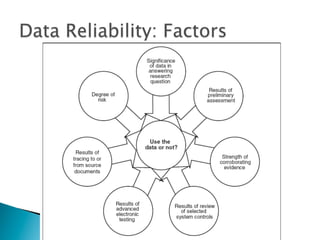
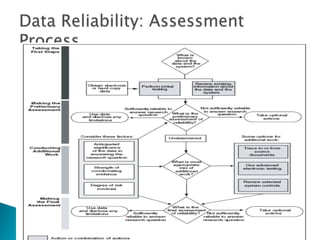
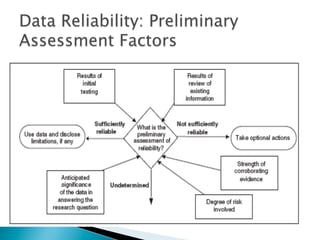
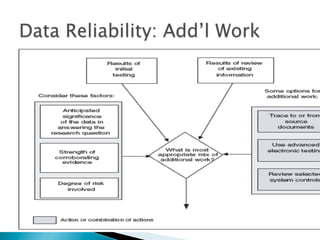
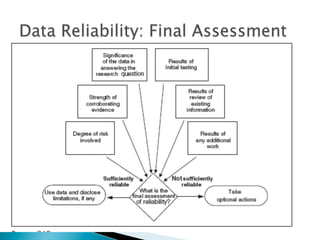
}  Expected significance of data in final report
}  Corroborating evidence
}  Level of risk
}  Results of initial assessment work
}  Significance of data
◦  Data alone to answer question
◦  Aggregation
◦  Disaggregation
◦  Precise nature of data
}  Corroborating evidence
◦  Exists and independently supports
◦  Sufficient, competent, and relevant
◦  Provides crucial support
}  Level of Risk
◦  Influence on decision making
◦  Significant decision making
◦  Public consumption
◦  Controversial subject
◦  Overall audit risk
◦  Unique risk factors
}  Initial Assessment
◦  Strong corroborating evidence, low risk: reliable
◦  Weak corroborating evidence, high risk: not reliable
}  Reliable
◦  Review of related information and initial testing
–  Significant errors or incompleteness is minimal
–  Data will not result in unintentional message
–  There might be questions remaining
}  Not Reliable
◦  Review of related information and initial testing
–  Significant errors or incompleteness exists in data
elements
–  Use of data may lead to incorrect message
}  Tracing source documents
}  Advanced electronic testing
}  Review of selected system controls
}  Completeness of data
◦  Trace from source
}  Accuracy and completeness
◦  Trace to source
}  Sampling
}  Example1: According to a random sample,
10% of the data records have incorrect dates.
However, the dates may be off by an average
of only 3 days. This may not be significant
}  Example 2: The value of a data element was
incorrectly entered as $100,000 rather than
$1,000,000. The documentation of the database
shows that the acceptable range for this data
element is between $100 and $5,000,000.
Electronic testing done in the initial testing phase
would have confirmed that the value of $100,000
fell within that range. The error could be caught
in this case, but only be tracing the data to
source documents. Electronic testing would not
have caught this.
}  Test for specific conditions
◦  Ex. Extremely high values associated with a certain
geographic location – found in initial testing or
while analyzing the data
}  Testing relationships – cross-tabulation –
between data elements, such as skip patterns
or questionnaires
}  Testing formulas
}  Access Controls
}  Edit checks
}  Program Change
}  Steps:
◦  Gain understanding
◦  Identify and assess application and general controls
that are critical
}  Results:
◦  Manage risk to acceptable level
◦  Risk: Mistake undetected and uncorrected
}  AS2
◦  PCAOB’s Auditing Standard No. 2 (AS2) on Internal
Control over Financial Reporting (ICFR)
◦  Approved in 2004
◦  Widely criticized as being a one-size-fits-all approach,
neither being flexible nor risk based
}  AS5
◦  PCAOB’s AS5 replaced AS2 in May 2007
◦  Effective for audits of financial statements ending on or
after November 15, 2007.
◦  Provides incredible benefits to both the external auditors
and management of public companies by clarifying and
refocusing Sarbanes-Oxley Act (SOX) compliance efforts.
}  Only Key Financial Reporting Controls Should
Be Included.
◦  AS2: All controls tested. Result: operational
controls tested.
–  Example: Controls around collecting old outstanding
balances such as collections calls
–  Example: Controls around calculating the reserve for
bad debts
–  AS5 clearly states that ICFR relates to the process of
“providing reasonable assurance regarding the
reliability of financial reporting and the preparation of
financial statements for external purposes.
}  Opinion on Management’s Assessment Not
Required
◦  External auditors are no longer required to issue an
opinion on management’s assessment process
◦  Gives management more latitude to determine the
approach to SOX compliance that fits their company
}  Audit Approach Scalable Based on Company
Size/Complexity
◦  The audit testing approach should be tailored to the
unique characteristics of each company (i.e. the less
complex the company, the less risk, which should
result in a modified audit approach
}  Risk-Based Approach Used for Scoping/
Testing
◦  Scope, Nature, Timing, and Extent
◦  The requirement to “test a large percentage of a
companies operations” using mostly monetary
factors has been removed and qualitative factors
are now emphasized
◦  Factors: Materiality, fraud, industry, etc.
}  Greater Reliance on Management’s Work
Allowed
◦  The “principal evidence” provision has been
removed allowing for greater opportunities for
external auditors to rely on management’s work
◦  PCAOB Auditing Standard AU sec. 322, “The
Auditor’s Consideration of the Internal Audit
Function in an Audit of Financial Statements
◦  For management: Objectivity, Competence, and Re-
Performance
}  Entity Level Testing Can Reduce Transaction
Level Testing
◦  Greater emphasis on entity level controls (e.g.
controls over management override and controls to
monitor results of operations)
◦  Can reduce transaction level testing
–  Link to risks mitigated by transaction level controls
–  Tone at top good = reduce risk
}  Prior Year Testing Can be Relied Upon
◦  Removal of wording “each year must stand on its
own.”
◦  Factors
–  Nature and results of prior year testing
–  Changes in controls in the current year
}  Walkthroughs Not Required To Determine
Testing
◦  Substance over form
◦  Process level versus transaction level
◦  External auditors are not required to perform their
own walkthroughs
}  Integrated External Audit Approach Should be
Utilized
◦  Combine financial statement audit with ICFR audit
◦  Same materiality
}  Redefined Material Weakness & Significant
Deficiency Definitions
◦  “More than remote” changed to “reasonable possibility”
◦  Significant deficiency: “A deficiency or combination of
deficiencies, in internal control over financial reporting
that is less severe than a material weakness yet merits
the attention of those responsible for the oversight of
the company’s financial reporting.”
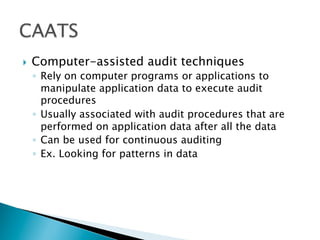
}  Computer-assisted audit techniques
◦  Rely on computer programs or applications to
manipulate application data to execute audit
procedures
◦  Usually associated with audit procedures that are
performed on application data after all the data
◦  Can be used for continuous auditing
◦  Ex. Looking for patterns in data
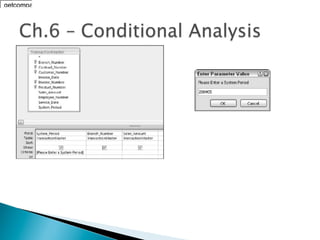
}  Parameter Queries
◦  Prompts for criteria
–  Prompts versus hard coding
◦  Operational characteristics:
–  Field name check
–  Calculated field check
–  Field reference
–  User interaction
◦  Rules
–  Brackets used
–  Can’t use field name
–  Special characters (e.g. !, ., &, or []
getcompagetcompa
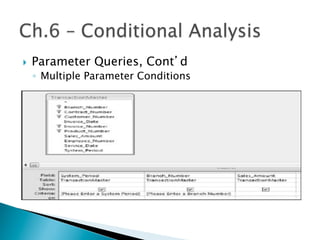
}  Parameter Queries, Cont’d
◦  Multiple Parameter Conditions
}  Parameter Queries & Wildcards
◦  Example:
–  Like [Enter Lastname] & "*"
–  Like "*" & [Enter Lastname] & "*“
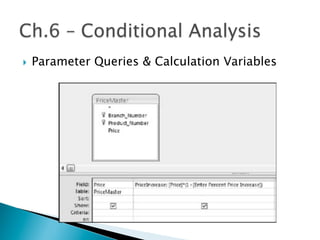
}  Parameter Queries & Calculation Variables
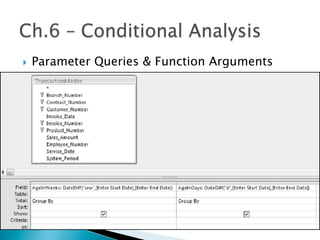
}  Parameter Queries & Function Arguments
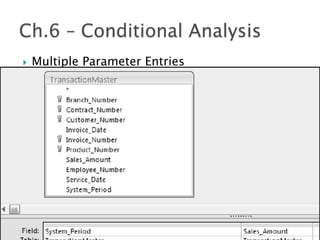
}  Multiple Parameter Entries
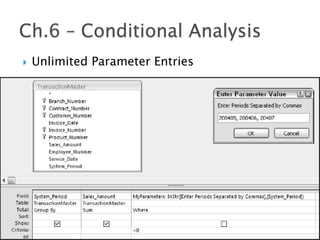
}  Unlimited Parameter Entries
}  Conditional Functions
◦  Built-in functions: Value comparison, data
validation, and conditional evaluation
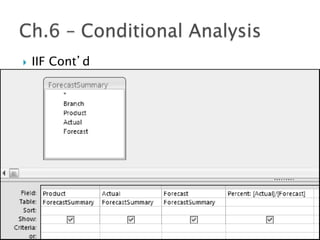
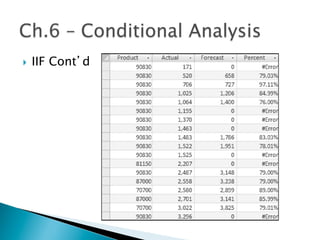
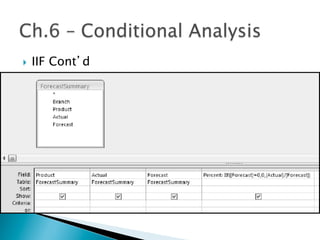
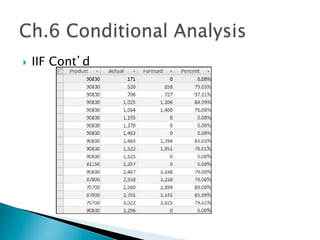
◦  IIF function
–  Evaluation with true or false
–  If Then......Else
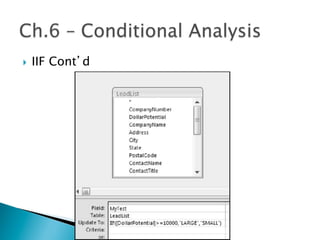
–  IIf(Expression, TrueAnswer, FalseAnswer)
}  IIF Cont’d
}  IIF Cont’d
}  IIF Cont’d
}  IIF Cont’d
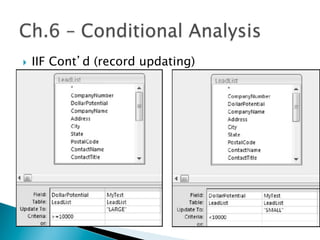
}  IIF Cont’d (record updating)
}  IIF Cont’d
}  IIF w/ Conditional Operators
◦  AND, OR, BETWEEN
–  Ex. IIf([Home_Branch] = '920681' And [Hire_Date] >
#1/1/1985#,"True","False")
}  Nested IIF: Multiple Conditions
◦  Complexity
–  Ex. IIf([VALUE]>100,"A",IIf([VALUE]<100,"C","B"))
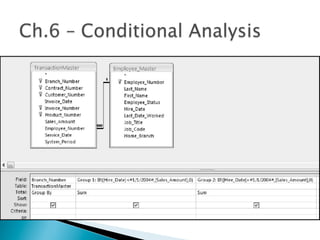
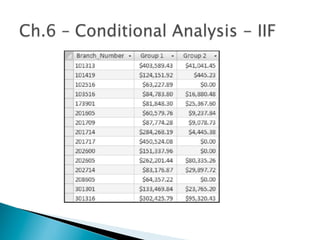
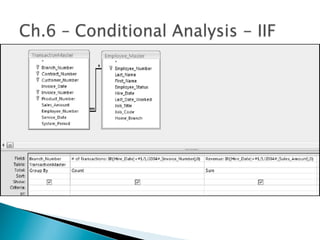
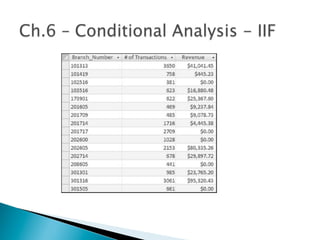
}  IIF Function… Crosstab Analysis
◦  Categorize and group unrelated data items
–  Ex. Returning the sum of sales amount for two groups
of employees: those with a hire date before <some
date> and those with a hire date after <some date>
}  Switch Function
◦  Evaluate a list of expressions and return the value
associated with the expression determined to be
True
–  Switch(Expression1, Value1, Expression2, Value2,
Expression3, Value3)
–  Switch([Count] > 10, "Low", [Count] > 15, "High") may
return null
–  Switch([Count] < 10, "Low", [Count] > 15, "High, True,
"Middle")
–  “Middle” if nothing true
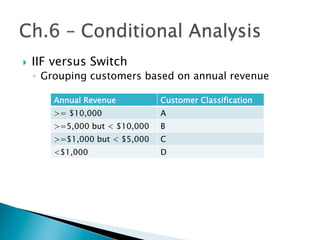
}  IIF versus Switch
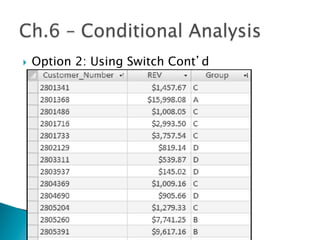
◦  Grouping customers based on annual revenue
Annual Revenue Customer Classification
>= $10,000 A
>=5,000 but < $10,000 B
>=$1,000 but < $5,000 C
<$1,000 D
}  IIF versus Switch Cont’d
◦  Option 1: using Nested IIFs
–  IIf([REV]>=10000,"A",IIf([REV]>=5000 And
[REV]<10000,"B", IIf([REV]>1000 And
[REV]<5000,"C","D")))
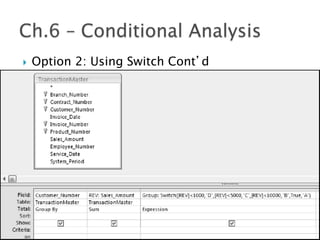
◦  Option 2: using Switch Function
–  Switch([REV]>1000,"D",[REV]<5000,"C",
[REV]<10000,"B",True,"A")
}  Option 2: Using Switch Cont’d
}  Parameter Queries
}  Switch Function
}  IIF Function
}  ???

Adams Georgia State Audit Presentation Series

  • 2.
    }  SAS 31‘Evidential Matter’ }  Existence }  Completeness }  Valuation }  Rights and Obligations }  Presentation and Disclosure
  • 3.
    Assets or liabilitiesexist at a given date and whether recorded transactions have occurred during a given period. Begin: Books and Ledger Other sources: Evidence of tangible or intangible asset or liability Confirmation with outside third party Examples: Confirmation of receivables Confirmation of cash account balances
  • 4.
    Whether all transactionsand accounts that should be presented in the financial statements are so included. Materiality considerations. Origination: Externally generated documentation. Ex. Tangible assets (internal) with vendor invoice (external) and warehouse receiving report (internal). Document à JE à Ledger à Balance Use of analytical procedures (industry benchmarks) Ex. Cost of goods sold to sales Ex. Existence and Completeness: Inventory - Inspect subsidiary ledger entries. Vouch to tangible inventory Physical inventory count. Trace back to inventory ledger support.
  • 5.
    Whether asset, liability,revenue, and expense components have been included in the financial statements at appropriate amounts. GAAP guidance Ex. Accounts Receivables Confirmation is Existence Is payment assured? Age current accounts receivable
  • 6.
    Whether assets arethe rights of the entity and liabilities are the obligations of the entity at a given date. Off statement financing – Asset use. No risk. Special purpose entities Ex. Build-to-order lease transaction. Lessor has title. Lessee has risk.
  • 7.
    Whether particular componentsof financial statements are properly classified, described, and disclosed. e.g. account balance – measurement, description, and disclosure. Ex. Trade receivable; Employee receivable; Employee loan; Related party loan Ex. Bond and Equity Securities Investment – Amortized cost Held for Sale – Lower of cost or market Trading – Market value
  • 8.
    Audit Objectives Specific entitycircumstances – e.g. economic activity or accounting practices unique to industry Many-to-many relationship between objectives and procedures. Substantive Tests Risk of material misstatement Effectiveness and efficiency of test Ex. Existence vs. Completeness Objective and test relevant
  • 9.
    }  SAS No.56 AU Section 329 }  Evaluation of financial information ◦  Financial and nonfinancial data }  Uses: ◦  Facilitate audit planning ◦  Substantive testing ◦  Overall review }  Four phases ◦  Expectation formation ◦  Identification ◦  Investigation ◦  Evaluation
  • 10.
    }  Account balanceor financial relationship }  Most important }  3 primary factors: ◦  Nature of account or assertion ◦  Reliability and other data characteristics ◦  Inherent precision of expectation method used
  • 11.
    }  Determine ifunusual fluctuation exists between expected and recorded amounts. }  Expected value vs. recorded amount ◦  Unexpected difference vs. threshold
  • 12.
    }  Cause ofunexpected differences ◦  Consider cause. Most probable cause. }  Large difference: Misstatement }  Small different: nonmisstatement }  Factors: ◦  Understanding of matters ◦  Management and board reports ◦  Board minutes ◦  Prior year unusual event details
  • 13.
    }  Likelihood ofmaterial misstatement }  Additional audit procedures }  Aggregate to determine if material
  • 14.
    }  Underpins reports,evaluations and financial audits }  Sufficiency, competence, and relevance of evidence }  Competence ◦  Validity and reliability –  Reliability: Completeness and accuracy }  Goal: Can data be used for its intended purpose
  • 16.
    }  Accuracy ◦  Consistency } Completeness }  Validity }  Input and Output (results) }  Requires technical specialists: ◦  Data analysts, Statisticians, IT
  • 18.
    }  When neededand when not needed? }  Data to support engagement findings, conclusions, or recommendations }  Data used as background information }  Data used in documents w/out findings, conclusions, or recommendations
  • 21.
    }  Expected significanceof data in final report }  Corroborating evidence }  Level of risk }  Results of initial assessment work
  • 23.
    }  Significance ofdata ◦  Data alone to answer question ◦  Aggregation ◦  Disaggregation ◦  Precise nature of data }  Corroborating evidence ◦  Exists and independently supports ◦  Sufficient, competent, and relevant ◦  Provides crucial support
  • 24.
    }  Level ofRisk ◦  Influence on decision making ◦  Significant decision making ◦  Public consumption ◦  Controversial subject ◦  Overall audit risk ◦  Unique risk factors }  Initial Assessment ◦  Strong corroborating evidence, low risk: reliable ◦  Weak corroborating evidence, high risk: not reliable
  • 25.
    }  Reliable ◦  Reviewof related information and initial testing –  Significant errors or incompleteness is minimal –  Data will not result in unintentional message –  There might be questions remaining }  Not Reliable ◦  Review of related information and initial testing –  Significant errors or incompleteness exists in data elements –  Use of data may lead to incorrect message
  • 26.
    }  Tracing sourcedocuments }  Advanced electronic testing }  Review of selected system controls
  • 28.
    }  Completeness ofdata ◦  Trace from source }  Accuracy and completeness ◦  Trace to source }  Sampling }  Example1: According to a random sample, 10% of the data records have incorrect dates. However, the dates may be off by an average of only 3 days. This may not be significant
  • 29.
    }  Example 2:The value of a data element was incorrectly entered as $100,000 rather than $1,000,000. The documentation of the database shows that the acceptable range for this data element is between $100 and $5,000,000. Electronic testing done in the initial testing phase would have confirmed that the value of $100,000 fell within that range. The error could be caught in this case, but only be tracing the data to source documents. Electronic testing would not have caught this.
  • 30.
    }  Test forspecific conditions ◦  Ex. Extremely high values associated with a certain geographic location – found in initial testing or while analyzing the data }  Testing relationships – cross-tabulation – between data elements, such as skip patterns or questionnaires }  Testing formulas
  • 31.
    }  Access Controls } Edit checks }  Program Change }  Steps: ◦  Gain understanding ◦  Identify and assess application and general controls that are critical }  Results: ◦  Manage risk to acceptable level ◦  Risk: Mistake undetected and uncorrected
  • 34.
    }  AS2 ◦  PCAOB’sAuditing Standard No. 2 (AS2) on Internal Control over Financial Reporting (ICFR) ◦  Approved in 2004 ◦  Widely criticized as being a one-size-fits-all approach, neither being flexible nor risk based }  AS5 ◦  PCAOB’s AS5 replaced AS2 in May 2007 ◦  Effective for audits of financial statements ending on or after November 15, 2007. ◦  Provides incredible benefits to both the external auditors and management of public companies by clarifying and refocusing Sarbanes-Oxley Act (SOX) compliance efforts.
  • 35.
    }  Only KeyFinancial Reporting Controls Should Be Included. ◦  AS2: All controls tested. Result: operational controls tested. –  Example: Controls around collecting old outstanding balances such as collections calls –  Example: Controls around calculating the reserve for bad debts –  AS5 clearly states that ICFR relates to the process of “providing reasonable assurance regarding the reliability of financial reporting and the preparation of financial statements for external purposes.
  • 36.
    }  Opinion onManagement’s Assessment Not Required ◦  External auditors are no longer required to issue an opinion on management’s assessment process ◦  Gives management more latitude to determine the approach to SOX compliance that fits their company }  Audit Approach Scalable Based on Company Size/Complexity ◦  The audit testing approach should be tailored to the unique characteristics of each company (i.e. the less complex the company, the less risk, which should result in a modified audit approach
  • 37.
    }  Risk-Based ApproachUsed for Scoping/ Testing ◦  Scope, Nature, Timing, and Extent ◦  The requirement to “test a large percentage of a companies operations” using mostly monetary factors has been removed and qualitative factors are now emphasized ◦  Factors: Materiality, fraud, industry, etc.
  • 38.
    }  Greater Relianceon Management’s Work Allowed ◦  The “principal evidence” provision has been removed allowing for greater opportunities for external auditors to rely on management’s work ◦  PCAOB Auditing Standard AU sec. 322, “The Auditor’s Consideration of the Internal Audit Function in an Audit of Financial Statements ◦  For management: Objectivity, Competence, and Re- Performance
  • 39.
    }  Entity LevelTesting Can Reduce Transaction Level Testing ◦  Greater emphasis on entity level controls (e.g. controls over management override and controls to monitor results of operations) ◦  Can reduce transaction level testing –  Link to risks mitigated by transaction level controls –  Tone at top good = reduce risk
  • 40.
    }  Prior YearTesting Can be Relied Upon ◦  Removal of wording “each year must stand on its own.” ◦  Factors –  Nature and results of prior year testing –  Changes in controls in the current year }  Walkthroughs Not Required To Determine Testing ◦  Substance over form ◦  Process level versus transaction level ◦  External auditors are not required to perform their own walkthroughs
  • 41.
    }  Integrated ExternalAudit Approach Should be Utilized ◦  Combine financial statement audit with ICFR audit ◦  Same materiality }  Redefined Material Weakness & Significant Deficiency Definitions ◦  “More than remote” changed to “reasonable possibility” ◦  Significant deficiency: “A deficiency or combination of deficiencies, in internal control over financial reporting that is less severe than a material weakness yet merits the attention of those responsible for the oversight of the company’s financial reporting.”
  • 42.
    }  Computer-assisted audittechniques ◦  Rely on computer programs or applications to manipulate application data to execute audit procedures ◦  Usually associated with audit procedures that are performed on application data after all the data ◦  Can be used for continuous auditing ◦  Ex. Looking for patterns in data
  • 43.
    }  Parameter Queries ◦ Prompts for criteria –  Prompts versus hard coding ◦  Operational characteristics: –  Field name check –  Calculated field check –  Field reference –  User interaction ◦  Rules –  Brackets used –  Can’t use field name –  Special characters (e.g. !, ., &, or []
  • 44.
  • 45.
    }  Parameter Queries,Cont’d ◦  Multiple Parameter Conditions
  • 46.
    }  Parameter Queries& Wildcards ◦  Example: –  Like [Enter Lastname] & "*" –  Like "*" & [Enter Lastname] & "*“
  • 47.
    }  Parameter Queries& Calculation Variables
  • 48.
    }  Parameter Queries& Function Arguments
  • 49.
  • 50.
  • 51.
    }  Conditional Functions ◦ Built-in functions: Value comparison, data validation, and conditional evaluation ◦  IIF function –  Evaluation with true or false –  If Then......Else –  IIf(Expression, TrueAnswer, FalseAnswer)
  • 52.
  • 53.
  • 54.
  • 55.
  • 56.
    }  IIF Cont’d(record updating)
  • 57.
  • 58.
    }  IIF w/Conditional Operators ◦  AND, OR, BETWEEN –  Ex. IIf([Home_Branch] = '920681' And [Hire_Date] > #1/1/1985#,"True","False") }  Nested IIF: Multiple Conditions ◦  Complexity –  Ex. IIf([VALUE]>100,"A",IIf([VALUE]<100,"C","B"))
  • 59.
    }  IIF Function…Crosstab Analysis ◦  Categorize and group unrelated data items –  Ex. Returning the sum of sales amount for two groups of employees: those with a hire date before <some date> and those with a hire date after <some date>
  • 64.
    }  Switch Function ◦ Evaluate a list of expressions and return the value associated with the expression determined to be True –  Switch(Expression1, Value1, Expression2, Value2, Expression3, Value3) –  Switch([Count] > 10, "Low", [Count] > 15, "High") may return null –  Switch([Count] < 10, "Low", [Count] > 15, "High, True, "Middle") –  “Middle” if nothing true
  • 65.
    }  IIF versusSwitch ◦  Grouping customers based on annual revenue Annual Revenue Customer Classification >= $10,000 A >=5,000 but < $10,000 B >=$1,000 but < $5,000 C <$1,000 D
  • 66.
    }  IIF versusSwitch Cont’d ◦  Option 1: using Nested IIFs –  IIf([REV]>=10000,"A",IIf([REV]>=5000 And [REV]<10000,"B", IIf([REV]>1000 And [REV]<5000,"C","D"))) ◦  Option 2: using Switch Function –  Switch([REV]>1000,"D",[REV]<5000,"C", [REV]<10000,"B",True,"A")
  • 67.
    }  Option 2:Using Switch Cont’d
  • 68.
    }  Option 2:Using Switch Cont’d
  • 69.
    }  Parameter Queries } Switch Function }  IIF Function
  • 70.