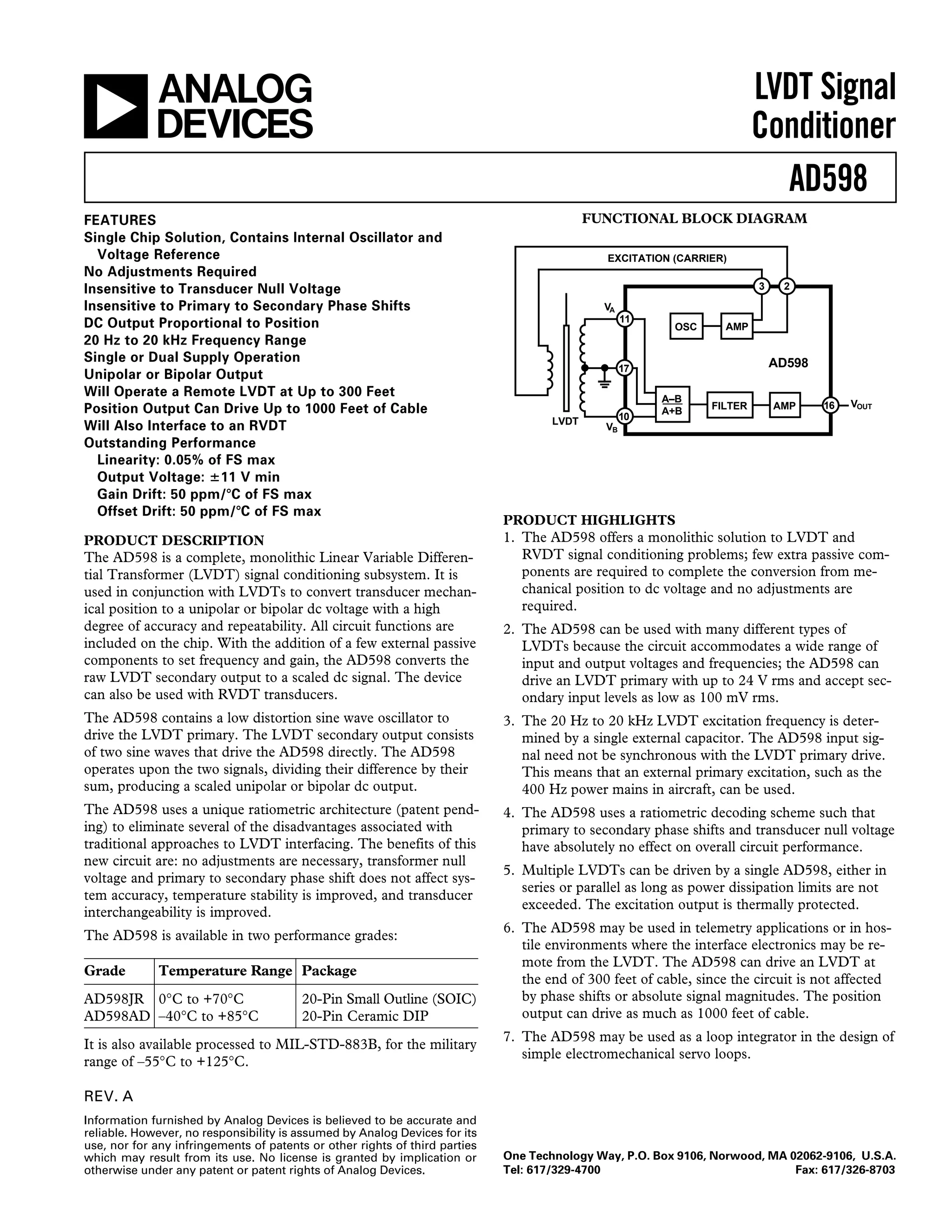
PRODUCT DESCRIPTION
The AD598 is a complete, monolithic Linear Variable Differen-
tial Transformer (LVDT) signal conditioning subsystem. It is
used in conjunction with LVDTs to convert transducer mechan-
ical position to a unipolar or bipolar dc voltage with a high
degree of accuracy and repeatability. All circuit functions are
included on the chip. With the addition of a few external passive
components to set frequency and gain, the AD598 converts the
raw LVDT secondary output to a scaled dc signal. The device
can also be used with RVDT transducers.
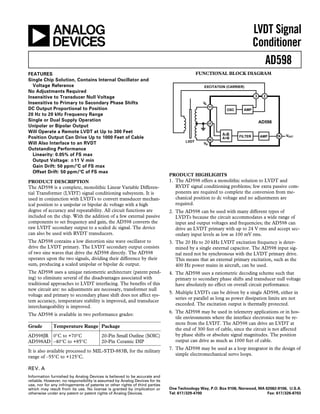
The AD598 contains a low distortion sine wave oscillator to
drive the LVDT primary. The LVDT secondary output consists
of two sine waves that drive the AD598 directly. The AD598
operates upon the two signals, dividing their difference by their
sum, producing a scaled unipolar or bipolar dc output.
The AD598 uses a unique ratiometric architecture (patent pend-
ing) to eliminate several of the disadvantages associated with
traditional approaches to LVDT interfacing. The benefits of this
new circuit are: no adjustments are necessary, transformer null
voltage and primary to secondary phase shift does not affect sys-
tem accuracy, temperature stability is improved, and transducer
interchangeability is improved.
The AD598 is available in two performance grades:
Grade Temperature Range Package
AD598JR 0°C to +70°C 20-Pin Small Outline (SOIC)
AD598AD –40°C to +85°C 20-Pin Ceramic DIP
It is also available processed to MIL-STD-883B, for the military
range of –55°C to +125°C.
FUNCTIONAL BLOCK DIAGRAM
OSC AMP
AMP VOUT
LVDT
EXCITATION (CARRIER)
11
17
10
16
23
FILTER
A–B
A+B
VB
VA
AD598
REV. A
Information furnished by Analog Devices is believed to be accurate and
reliable. However, no responsibility is assumed by Analog Devices for its
use, nor for any infringements of patents or other rights of third parties
which may result from its use. No license is granted by implication or
otherwise under any patent or patent rights of Analog Devices.
a LVDT Signal
Conditioner
AD598
One Technology Way, P.O. Box 9106, Norwood, MA 02062-9106, U.S.A.
Tel: 617/329-4700 Fax: 617/326-8703
PRODUCT HIGHLIGHTS
1. The AD598 offers a monolithic solution to LVDT and
RVDT signal conditioning problems; few extra passive com-
ponents are required to complete the conversion from me-
chanical position to dc voltage and no adjustments are
required.
2. The AD598 can be used with many different types of
LVDTs because the circuit accommodates a wide range of
input and output voltages and frequencies; the AD598 can
drive an LVDT primary with up to 24 V rms and accept sec-
ondary input levels as low as 100 mV rms.
3. The 20 Hz to 20 kHz LVDT excitation frequency is deter-
mined by a single external capacitor. The AD598 input sig-
nal need not be synchronous with the LVDT primary drive.
This means that an external primary excitation, such as the
400 Hz power mains in aircraft, can be used.
4. The AD598 uses a ratiometric decoding scheme such that
primary to secondary phase shifts and transducer null voltage
have absolutely no effect on overall circuit performance.
5. Multiple LVDTs can be driven by a single AD598, either in
series or parallel as long as power dissipation limits are not
exceeded. The excitation output is thermally protected.
6. The AD598 may be used in telemetry applications or in hos-
tile environments where the interface electronics may be re-
mote from the LVDT. The AD598 can drive an LVDT at
the end of 300 feet of cable, since the circuit is not affected
by phase shifts or absolute signal magnitudes. The position
output can drive as much as 1000 feet of cable.
7. The AD598 may be used as a loop integrator in the design of
simple electromechanical servo loops.
FEATURES
Single Chip Solution, Contains Internal Oscillator and
Voltage Reference
No Adjustments Required
Insensitive to Transducer Null Voltage
Insensitive to Primary to Secondary Phase Shifts
DC Output Proportional to Position
20 Hz to 20 kHz Frequency Range
Single or Dual Supply Operation
Unipolar or Bipolar Output
Will Operate a Remote LVDT at Up to 300 Feet
Position Output Can Drive Up to 1000 Feet of Cable
Will Also Interface to an RVDT
Outstanding Performance
Linearity: 0.05% of FS max
Output Voltage: ؎11 V min
Gain Drift: 50 ppm/؇C of FS max
Offset Drift: 50 ppm/؇C of FS max
AD598* PRODUCT PAGE QUICK LINKS
Last Content Update: 02/23/2017
COMPARABLE PARTS
View a parametric search of comparable parts.
DOCUMENTATION
Data Sheet
• AD598: LVDT Signal Conditioner Data Sheet
• AD598: Military Data Sheet
REFERENCE DESIGNS
• CN0288
DESIGN RESOURCES
• AD598 Material Declaration
• PCN-PDN Information
• Quality And Reliability
• Symbols and Footprints
DISCUSSIONS
View all AD598 EngineerZone Discussions.
SAMPLE AND BUY
Visit the product page to see pricing options.
TECHNICAL SUPPORT
Submit a technical question or find your regional support
number.
DOCUMENT FEEDBACK
Submit feedback for this data sheet.
This page is dynamically generated by Analog Devices, Inc., and inserted into this data sheet. A dynamic change to the content on this page will not
trigger a change to either the revision number or the content of the product data sheet. This dynamic page may be frequently modified.
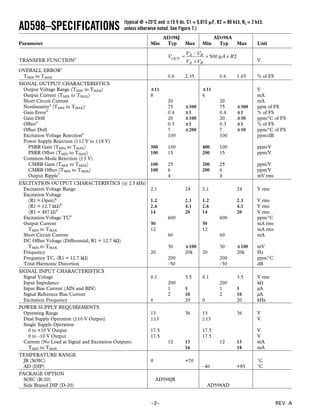
AD598–SPECIFICATIONS (typical @ +25؇C and ؎15 V dc, C1 = 0.015 ␮F, R2 = 80 k⍀, RL = 2 k⍀,
unless otherwise noted. See Figure 7.)
REV. A–2–
AD598J AD598A
Parameter Min Typ Max Min Typ Max Unit
TRANSFER FUNCTION1
VOUT
=
VA –VB
VA +VB
× 500 µA × R2
V
OVERALL ERROR2
TMIN to TMAX 0.6 2.35 0.6 1.65 % of FS
SIGNAL OUTPUT CHARACTERISTICS
Output Voltage Range (TMIN to TMAX) ؎11 ؎11 V
Output Current (TMIN to TMAX) 8 6 mA
Short Circuit Current 20 20 mA
Nonlinearity3
(TMIN to TMAX) 75 ؎500 75 ؎500 ppm of FS
Gain Error4
0.4 ؎1 0.4 ؎1 % of FS
Gain Drift 20 ؎100 20 ؎50 ppm/°C of FS
Offset5
0.3 ؎1 0.3 ؎1 % of FS
Offset Drift 7 ؎200 7 ؎50 ppm/°C of FS
Excitation Voltage Rejection6
100 100 ppm/dB
Power Supply Rejection (±12 V to ±18 V)
PSRR Gain (TMIN to TMAX) 300 100 400 100 ppm/V
PSRR Offset (TMIN to TMAX) 100 15 200 15 ppm/V
Common-Mode Rejection (±3 V)
CMRR Gain (TMIN to TMAX) 100 25 200 25 ppm/V
CMRR Offset (TMIN to TMAX) 100 6 200 6 ppm/V
Output Ripple7
4 4 mV rms
EXCITATION OUTPUT CHARACTERISTICS (@ 2.5 kHz)
Excitation Voltage Range 2.1 24 2.1 24 V rms
Excitation Voltage
(R1 = Open)8
1.2 2.1 1.2 2.1 V rms
(R1 = 12.7 kΩ)8
2.6 4.1 2.6 4.1 V rms
(R1 = 487 Ω)8
14 20 14 20 V rms
Excitation Voltage TC9
600 600 ppm/°C
Output Current 30 30 mA rms
TMIN to TMAX 12 12 mA rms
Short Circuit Current 60 60 mA
DC Offset Voltage (Differential, R1 = 12.7 kΩ)
TMIN to TMAX 30 ؎100 30 ؎100 mV
Frequency 20 20k 20 20k Hz
Frequency TC, (R1 = 12.7 kΩ) 200 200 ppm/°C
Total Harmonic Distortion –50 –50 dB
SIGNAL INPUT CHARACTERISTICS
Signal Voltage 0.1 3.5 0.1 3.5 V rms
Input Impedance 200 200 kΩ
Input Bias Current (AIN and BIN) 1 5 1 5 µA
Signal Reference Bias Current 2 10 2 10 µA
Excitation Frequency 0 20 0 20 kHz
POWER SUPPLY REQUIREMENTS
Operating Range 13 36 13 36 V
Dual Supply Operation (±10 V Output) ±13 ±13 V
Single Supply Operation
0 to +10 V Output 17.5 17.5 V
0 to –10 V Output 17.5 17.5 V
Current (No Load at Signal and Excitation Outputs) 12 15 12 15 mA
TMIN to TMAX 16 18 mA
TEMPERATURE RANGE
JR (SOIC) 0 +70 °C
AD (DIP) –40 +85 °C
PACKAGE OPTION
SOIC (R-20) AD598JR
Side Brazed DIP (D-20) AD598AD
NOTES
1
VA and VB represent the Mean Average Deviation (MAD) of the detected sine waves. Note that for this Transfer Function to linearly represent positive displacement,
the sum of VA and VB of the LVDT must remain constant with stroke length. See “Theory of Operation.” Also see Figures 7 and 12 for R2.
2
From TMIN, to TMAX, the overall error due to the AD598 alone is determined by combining gain error, gain drift and offset drift. For example the worst case overall
error for the AD598AD from TMIN to TMAX is calculated as follows: overall error = gain error at +25°C (±1% full scale) + gain drift from –40°C to +25°C (50 ppm/°C
of FS × +65°C) + offset drift from –40°C to +25°C (50 ppm/°C of FS × +65°C) = ±1.65% of full scale. Note that 1000 ppm of full scale equals 0.1% of full scale.
Full scale is defined as the voltage difference between the maximum positive and maximum negative output.
3
Nonlinearity of the AD598 only, in units of ppm of full scale. Nonlinearity is defined as the maximum measured deviation of the AD598 output voltage from a
straight line. The straight line is determined by connecting the maximum produced full-scale negative voltage with the maximum produced full-scale positive voltage.
4
See Transfer Function.
5
This offset refers to the (VA–VB)/(VA+VB) input spanning a full-scale range of ±1. [For (VA–VB)/(VA+VB) to equal +1, VB must equal zero volts; and correspondingly
for (VA–VB)/(VA+VB) to equal –1, VA must equal zero volts. Note that offset errors do not allow accurate use of zero magnitude inputs, practical inputs are limited to
100 mV rms.] The ±1 span is a convenient reference point to define offset referred to input. For example, with this input span a value of R2 = 20 k Ω would give
VOUT span a value of ±10 volts. Caution, most LVDTs will typically exercise less of the ((VA–VB))/((VA+VB)) input span and thus require a larger value of R2 to
produce the ±10 V output span. In this case the offset is correspondingly magnified when referred to the output voltage. For example, a Schaevitz E100 LVDT
requires 80.2 kΩ for R2 to produce a ±10.69 V output and (VA–VB)/(VA+VB) equals 0.27. This ratio may be determined from the graph shown in Figure 18,
(VA–VB)/(VA+VB) = (1.71 V rms – 0.99 V rms)/(1.71 V rms + 0.99 V rms). The maximum offset value referred to the ±10.69 V output may be determined by
multiplying the maximum value shown in the data sheet (±1% of FS by 1/0.27 which equals ±3.7% maximum. Similarly, to determine the maximum values of offset
drift, offset CMRR and offset PSRR when referred to the ±10.69 V output, these data sheet values should also be multiplied by (1/0.27). For this example for the
AD598AD the maximum values of offset drift, PSRR offset and CMRR offset would be: 185 ppm/°C of FS; 741 ppm/V and 741 ppm/V respectively when referred
to the ±10.69 V output.
6
For example, if the excitation to the primary changes by 1 dB, the gain of the system will change by typically 100 ppm.
7
Output ripple is a function of the AD598 bandwidth determined by C2, C3 and C4. See Figures 16 and 17.
8
R1 is shown in Figures 7 and 12.
9
Excitation voltage drift is not an important specification because of the ratiometric operation of the AD598.
Specifications subject to change without notice.
Specifications shown in boldface are tested on all production units at final electrical test. Results from those tested are used to calculate outgoing quality levels. All
min and max specifications are guaranteed, although only those shown in boldface are tested on all production units.
AD598
THERMAL CHARACTERISTICS
θJC θJA
SOIC Package 22°C/W 80°C/W
Side Brazed Package 25°C/W 85°C/W
ABSOLUTE MAXIMUM RATINGS
Total Supply Voltage +VS to –VS . . . . . . . . . . . . . . . . . +36 V
Storage Temperature Range
R Package . . . . . . . . . . . . . . . . . . . . . . . . .–65°C to +150°C
D Package . . . . . . . . . . . . . . . . . . . . . . . . .–65°C to +150°C
Operating Temperature Range
AD598JR . . . . . . . . . . . . . . . . . . . . . . . . . . . . 0°C to +70°C
AD598AD . . . . . . . . . . . . . . . . . . . . . . . . . .–40°C to +85°C
Lead Temperature Range (Soldering 60 sec) . . . . . . . . +300°C
Power Dissipation Up to +65°C . . . . . . . . . . . . . . . . . . .1.2 W
Derates Above +65°C . . . . . . . . . . . . . . . . . . . . . . . 12 mW/°C
ORDERING GUIDE
Temperature Package Package
Model Range Description Option
AD598JR 0°C to +70°C SOIC R-20
AD598AD –40°C to +85C Ceramic DIP D-20
OFFSET 1
OFFSET 2
SIGNAL REFERENCE
SIGNAL OUTPUT
FEEDBACK
OUTPUT FILTER
A1 FILTER
A2 FILTER
EXC 1
EXC 2
LEVEL 1
LEVEL 2
FREQ 1
FREQ 2
B1 FILTER
B2 FILTER
1
2
3
4
5
6
7
8
9
10 11
12
13
14
16
15
17
18
19
20–VS +VS
AD598
TOP VIEW
(Not to Scale)
VB VA
REV. A –3–
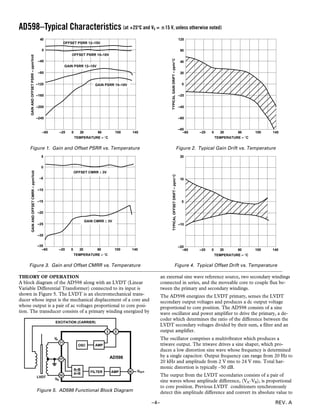
AD598–Typical Characteristics (at +25؇C and VS = ؎15 V, unless otherwise noted)
THEORY OF OPERATION
A block diagram of the AD598 along with an LVDT (Linear
Variable Differential Transformer) connected to its input is
shown in Figure 5. The LVDT is an electromechanical trans-
ducer whose input is the mechanical displacement of a core and
whose output is a pair of ac voltages proportional to core posi-
tion. The transducer consists of a primary winding energized by
OSC AMP
AMP VOUT
LVDT
EXCITATION (CARRIER)
11
17
10
16
23
FILTER
A–B
A+B
VB
VA
AD598
Figure 5. AD598 Functional Block Diagram
an external sine wave reference source, two secondary windings
connected in series, and the moveable core to couple flux be-
tween the primary and secondary windings.
The AD598 energizes the LVDT primary, senses the LVDT
secondary output voltages and produces a dc output voltage
proportional to core position. The AD598 consists of a sine
wave oscillator and power amplifier to drive the primary, a de-
coder which determines the ratio of the difference between the
LVDT secondary voltages divided by their sum, a filter and an
output amplifier.
The oscillator comprises a multivibrator which produces a
triwave output. The triwave drives a sine shaper, which pro-
duces a low distortion sine wave whose frequency is determined
by a single capacitor. Output frequency can range from 20 Hz to
20 kHz and amplitude from 2 V rms to 24 V rms. Total har-
monic distortion is typically –50 dB.
The output from the LVDT secondaries consists of a pair of
sine waves whose amplitude difference, (VA–VB), is proportional
to core position. Previous LVDT conditioners synchronously
detect this amplitude difference and convert its absolute value to
–20 0 20 60 100 140–60
–200
–240
–160
–120
–80
–40
0
40
TEMPERATURE – °C
GAINANDOFFSETPSRR–ppm/Volt
OFFSET PSRR 12–15V
OFFSET PSRR 15–18V
GAIN PSRR 12–15V
GAIN PSRR 15–18V
Figure 1. Gain and Offset PSRR vs. Temperature
–20 0 20 60 100 140–60
–25
–30
–35
–20
–15
–10
–5
0
5
TEMPERATURE – °C
GAINANDOFFSETCMRR–ppm/Volt
OFFSET CMRR ± 3V
GAIN CMRR ± 3V
Figure 3. Gain and Offset CMRR vs. Temperature
–20 0 20 60 100 140–60
–40
–60
–80
–20
0
20
40
80
120
TEMPERATURE – °C
TYPICALGAINDRIFT–ppm/°C
Figure 2. Typical Gain Drift vs. Temperature
–20 0 20 60 100 140–60
–10
–20
0
10
20
TEMPERATURE – °C
TYPICALOFFSETDRIFT–ppm/°C
Figure 4. Typical Offset Drift vs. Temperature
REV. A–4–
AD598
REV. A –5–
a voltage proportional to position. This technique uses the pri-
mary excitation voltage as a phase reference to determine the
polarity of the output voltage. There are a number of problems
associated with this technique such as (1) producing a constant
amplitude, constant frequency excitation signal, (2) compensating
for LVDT primary to secondary phase shifts, and (3) compen-
sating for these shifts as a function of temperature and frequency.
The AD598 eliminates all of these problems. The AD598 does
not require a constant amplitude because it works on the ratio of
the difference and sum of the LVDT output signals. A constant
frequency signal is not necessary because the inputs are rectified
and only the sine wave carrier magnitude is processed. There is
no sensitivity to phase shift between the primary excitation and
the LVDT outputs because synchronous detection is not em-
ployed. The ratiometric principle upon which the AD598 oper-
ates requires that the sum of the LVDT secondary voltages
remains constant with LVDT stroke length. Although LVDT
manufacturers generally do not specify the relationship between
VA+VB and stroke length, it is recognized that some LVDTs do
not meet this requirement. In these cases a nonlinearity will
result. However, the majority of available LVDTs do in fact
meet these requirements.
The AD598 utilizes a special decoder circuit. Referring to the
block diagram and Figure 6 below, an implicit analog comput-
ing loop is employed. After rectification, the A and B signals are
multiplied by complementary duty cycle signals, d and (I–d)
respectively. The difference of these processed signals is inte-
grated and sampled by a comparator. It is the output of this
comparator that defines the original duty cycle, d, which is fed
back to the multipliers.
As shown in Figure 6, the input to the integrator is [(A+B)d]B.
Since the integrator input is forced to 0, the duty cycle d =
B/(A+B).
The output comparator which produces d = B/(A+B) also con-
trols an output amplifier driven by a reference current. Duty
cycle signals d and (1–d) perform separate modulations on the
reference current as shown in Figure 6, which are summed. The
summed current, which is the output current, is IREF × (1–2d).
Since d = B/(A+B), by substitution the output current equals
IREF × (A–B)/(A+B). This output current is then filtered and
converted to a voltage since it is forced to flow through the scal-
ing resistor R2 such that:
VOUT = IREF ×( A – B) / (A + B)× R2
CONNECTING THE AD598
The AD598 can easily be connected for dual or single supply
operation as shown in Figures 7 and 12. The following general
design procedures demonstrate how external component values
are selected and can be used for any LVDT which meets AD598
input/output criteria.
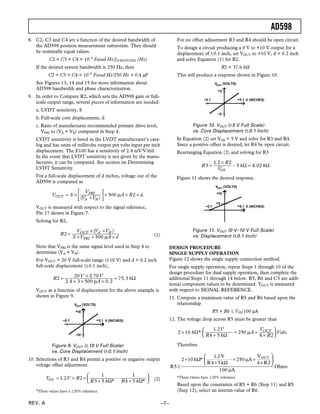
Parameters which are set with external passive components in-
clude: excitation frequency and amplitude, AD598 system
bandwidth, and the scale factor (V/inch). Additionally, there are
optional features, offset null adjustment, filtering, and signal in-
tegration which can be used by adding external components.
COMP
COMP
FILT
FILT
∑ COMP
∑
RTO
OFFSET
FILT ∑ INTEG
V TO I
BANDGAP
REFERENCE
INPUT
INPUT
±1
±1
A
d
B
0<d<1
BINARY SIGNAL
d - DUTY CYCLE
(A+B) d–B
q
B
A+B
1–d
IREF
d
IREF q
A–B
A+B
VOLTS
OUTPUT
VOUT = RSCALE x IREF x A–B
A+B
INTEG
V TO I
1–d
d
V TO I
Figure 6. Block Diagram of Decoder
AD598
REV. A–6–
DESIGN PROCEDURE
DUAL SUPPLY OPERATION
Figure 7 shows the connection method with dual ±15 volt power
supplies and a Schaevitz E100 LVDT. This design procedure
can be used to select component values for other LVDTs as
well. The procedure is outlined in Steps 1 through 10 as follows:
1. Determine the mechanical bandwidth required for LVDT
position measurement subsystem, fSUBSYSTEM. For this
example, assume fSUBSYSTEM = 250 Hz.
2. Select minimum LVDT excitation frequency, approximately
10 × fSUBSYSTEM. Therefore, let excitation frequency = 2.5 kHz.
3. Select a suitable LVDT that will operate with an excitation
frequency of 2.5 kHz. The Schaevitz E100, for instance, will
operate over a range of 50 Hz to 10 kHz and is an eligible
candidate for this example.
4. Determine the sum of LVDT secondary voltages VA and VB.
Energize the LVDT at its typical drive level VPRI as shown in
the manufacturer’s data sheet (3 V rms for the E100). Set the
core displacement to its center position where VA = VB. Mea-
sure these values and compute their sum VA+VB. For the
E100, VA+VB = 2.70 V rms. This calculation will be used
later in determining AD598 output voltage.
5. Determine optimum LVDT excitation voltage, VEXC. With
the LVDT energized at its typical drive level VPRI, set the
core displacement to its mechanical full-scale position and
measure the output VSEC of whichever secondary produces
the largest signal. Compute LVDT voltage transformation
ratio, VTR.
VTR = VPRI/VSEC
For the E100, VSEC = 1.71 V rms for VPRI = 3 V rms.
VTR = 1.75.
The AD598 signal input, VSEC, should be in the range of
1 V rms to 3.5 V rms for maximum AD598 linearity and
minimum noise susceptibility. Select VSEC = 3 V rms. There-
fore, LVDT excitation voltage VEXC should be:
VEXC = VSEC × VTR = 3 × 1.75 = 5.25 V rms
Check the power supply voltages by verifying that the peak
values of VA and VB are at least 2.5 volts less than the volt-
ages at +VS and –VS.
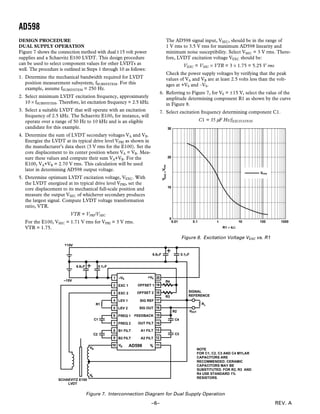
6. Referring to Figure 7, for VS = ±15 V, select the value of the
amplitude determining component R1 as shown by the curve
in Figure 8.
7. Select excitation frequency determining component C1.
C1 = 35 µF Hz/fEXCITATION
30
20
10
0
0.01 0.1 1 10 100 1000
R1 – kΩ
Vrms
VEXC–Vrms
Figure 8. Excitation Voltage VEXC vs. R1
EXC 1
EXC 2
LEV 1
LEV 2
FREQ 1
FREQ 2
B1 FILT
B2 FILT
OFFSET 1
OFFSET 2
SIG REF
SIG OUT
FEEDBACK
OUT FILT
A1 FILT
A2 FILT
R1
C1
C2
AD598
C3
R2
C4
LVDT
SCHAEVITZ E100
R3
R4
6.8µF 0.1µF
0.1µF6.8µF
–15V
SIGNAL
REFERENCE
15V+
–VS
RL
VOUT
+VS1
2
3
4
5
6
7
8
9
10 11
12
13
14
16
15
17
18
19
20
NOTE
FOR C1, C2, C3 AND C4 MYLAR
CAPACITORS ARE
RECOMMENDED. CERAMIC
CAPACITORS MAY BE
SUBSTITUTED. FOR R2, R3 AND
R4 USE STANDARD 1%
RESISTORS.
VA
VB
VB VA
Figure 7. Interconnection Diagram for Dual Supply Operation
AD598
REV. A –7–
8. C2, C3 and C4 are a function of the desired bandwidth of
the AD598 position measurement subsystem. They should
be nominally equal values.
C2 = C3 = C4 = 10–4
Farad Hz/fSUBSYSTEM (Hz)
If the desired system bandwidth is 250 Hz, then
C2 = C3 = C4 = 10–4
Farad Hz/250 Hz = 0.4 µF
See Figures 13, 14 and 15 for more information about
AD598 bandwidth and phase characterization.
9. In order to Compute R2, which sets the AD598 gain or full-
scale output range, several pieces of information are needed:
a. LVDT sensitivity, S
b.Full-scale core displacement, d
c. Ratio of manufacturer recommended primary drive level,
VPRI to (VA + VB) computed in Step 4.
LVDT sensitivity is listed in the LVDT manufacturer’s cata-
log and has units of millivolts output per volts input per inch
displacement. The E100 has a sensitivity of 2.4 mV/V/mil.
In the event that LVDT sensitivity is not given by the manu-
facturer, it can be computed. See section on Determining
LVDT Sensitivity.
For a full-scale displacement of d inches, voltage out of the
AD598 is computed as
VOUT = S ×
VPRI
(VA +VB)



 × 500 µA × R2 × d.
VOUT is measured with respect to the signal reference,
Pin 17 shown in Figure 7.
Solving for R2,
R2 =
VOUT ×(VA +VB )
S ×VPRI × 500 µA × d (1)
Note that VPRI is the same signal level used in Step 4 to
determine (VA + VB).
For VOUT = 20 V full-scale range (±10 V) and d = 0.2 inch
full-scale displacement (±0.1 inch),
R2 =
20V × 2.70V
2.4 × 3 × 500 µA × 0.2
= 75.3 kΩ
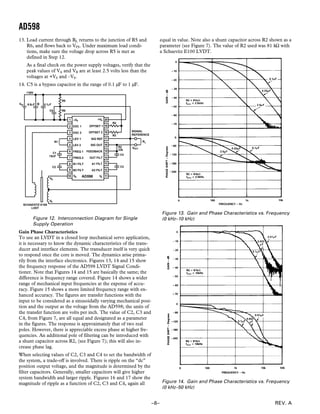
VOUT as a function of displacement for the above example is
shown in Figure 9.
+10
+0.1 d0.1–
10–
VOUT (VOLTS)
(INCHES)
Figure 9. VOUT (±10 V Full Scale)
vs. Core Displacement (±0.1 Inch)
10. Selections of R3 and R4 permit a positive or negative output
voltage offset adjustment.
VOS = 1.2V × R2 ×
1
R3 + 5 kΩ*
–
1
R4 + 5 kΩ*





 (2)
*These values have a ±20% tolerance.
For no offset adjustment R3 and R4 should be open circuit.
To design a circuit producing a 0 V to +10 V output for a
displacement of ±0.1 inch, set VOUT to +10 V, d = 0.2 inch
and solve Equation (1) for R2.
R2 = 37.6 kΩ
This will produce a response shown in Figure 10.
+5
+0.1 d0.1–
5–
(INCHES)
VOUT (VOLTS)
Figure 10. VOUT (±5 V Full Scale)
vs. Core Displacement (±0.1 Inch)
In Equation (2) set VOS = 5 V and solve for R3 and R4.
Since a positive offset is desired, let R4 be open circuit.
Rearranging Equation (2) and solving for R3
R3 =
1.2 × R2
VOS
– 5 kΩ = 4.02 kΩ
Figure 11 shows the desired response.
+10
0.1– +0.1 d
+5
(INCHES)
VOUT (VOLTS)
Figure 11. VOUT (0 V–10 V Full Scale)
vs. Displacement (±0.1 Inch)
DESIGN PROCEDURE
SINGLE SUPPLY OPERATION
Figure 12 shows the single supply connection method.
For single supply operation, repeat Steps 1 through 10 of the
design procedure for dual supply operation, then complete the
additional Steps 11 through 14 below. R5, R6 and C5 are addi-
tional component values to be determined. VOUT is measured
with respect to SIGNAL REFERENCE.
11. Compute a maximum value of R5 and R6 based upon the
relationship
R5 + R6 ≤ VPS/100 µA
12. The voltage drop across R5 must be greater than
2 +10 kΩ*
1.2V
R4 + 5 kΩ
+ 250 µA +
VOUT
4 × R2





 Volts
Therefore
R5≥
2+10 kΩ*
1.2 V
R4+5kΩ
+250 µA +
VOUT
4×R2






100 µA
Ohms
*These values have ±20% tolerance.
Based upon the constraints of R5 + R6 (Step 11) and R5
(Step 12), select an interim value of R6.
AD598
REV. A–8–
13. Load current through RL returns to the junction of R5 and
R6, and flows back to VPS. Under maximum load condi-
tions, make sure the voltage drop across R5 is met as
defined in Step 12.
As a final check on the power supply voltages, verify that the
peak values of VA and VB are at least 2.5 volts less than the
voltages at +VS and –VS.
14. C5 is a bypass capacitor in the range of 0.1 µF to 1 µF.
EXC 1
EXC 2
LEV 1
LEV 2
FREQ 1
FREQ 2
B1 FILT
B2 FILT
OFFSET 1
OFFSET 2
SIG REF
SIG OUT
FEEDBACK
OUT FILT
A1 FILT
A2 FILT
R1
C2
AD598
C3
R2
C4
LVDT
SCHAEVITZ E100
R3
R4
0.1µF6.8µF
SIGNAL
REFERENCE
30V+
–VS
RL
VOUT
+VS1
2
3
4
5
6
7
8
9
10 11
12
13
14
16
15
17
18
19
20
R5
R6C5
C1
15nF
33k
VB
VB
VA
VA
Vps
Figure 12. Interconnection Diagram for Single
Supply Operation
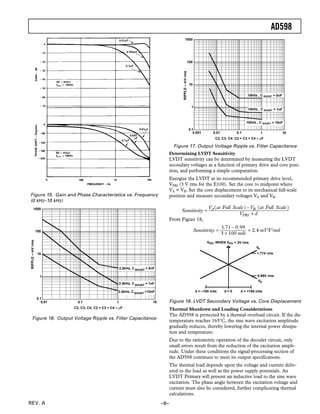
Gain Phase Characteristics
To use an LVDT in a closed loop mechanical servo application,
it is necessary to know the dynamic characteristics of the trans-
ducer and interface elements. The transducer itself is very quick
to respond once the core is moved. The dynamics arise prima-
rily from the interface electronics. Figures 13, 14 and 15 show
the frequency response of the AD598 LVDT Signal Condi-
tioner. Note that Figures 14 and 15 are basically the same; the
difference is frequency range covered. Figure 14 shows a wider
range of mechanical input frequencies at the expense of accu-
racy. Figure 15 shows a more limited frequency range with en-
hanced accuracy. The figures are transfer functions with the
input to be considered as a sinusoidally varying mechanical posi-
tion and the output as the voltage from the AD598; the units of
the transfer function are volts per inch. The value of C2, C3 and
C4, from Figure 7, are all equal and designated as a parameter
in the figures. The response is approximately that of two real
poles. However, there is appreciable excess phase at higher fre-
quencies. An additional pole of filtering can be introduced with
a shunt capacitor across R2, (see Figure 7); this will also in-
crease phase lag.
When selecting values of C2, C3 and C4 to set the bandwidth of
the system, a trade-off is involved. There is ripple on the “dc”
position output voltage, and the magnitude is determined by the
filter capacitors. Generally, smaller capacitors will give higher
system bandwidth and larger ripple. Figures 16 and 17 show the
magnitude of ripple as a function of C2, C3 and C4, again all
equal in value. Note also a shunt capacitor across R2 shown as a
parameter (see Figure 7). The value of R2 used was 81 kΩ with
a Schaevitz E100 LVDT.
Figure 13. Gain and Phase Characteristics vs. Frequency
(0 kHz–10 kHz)
Figure 14. Gain and Phase Characteristics vs. Frequency
(0 kHz–50 kHz)
AD598
REV. A –9–
Figure 15. Gain and Phase Characteristics vs. Frequency
(0 kHz–10 kHz)
1000
100
10
1
0.1
0.01 0.1 1 10
C2, C3, C4; C2 = C3 = C4 – µF
RIPPLE–mVrms
2.5kHz, CSHUNT = 0nF
2.5kHz, CSHUNT = 1nF
2.5kHz, CSHUNT =10nF
Figure 16. Output Voltage Ripple vs. Filter Capacitance
1000
100
10
1
0.1
0.001 0.01 0.1 1 10
C2, C3, C4; C2 = C3 = C4 – µF
RIPPLE–mVrms
10kHz , C SHUNT = 0nF
10kHz , C SHUNT = 1nF
10kHz , C SHUNT = 10nF
Figure 17. Output Voltage Ripple vs. Filter Capacitance
Determining LVDT Sensitivity
LVDT sensitivity can be determined by measuring the LVDT
secondary voltages as a function of primary drive and core posi-
tion, and performing a simple computation.
Energize the LVDT at its recommended primary drive level,
VPRI (3 V rms for the E100). Set the core to midpoint where
VA = VB. Set the core displacement to its mechanical full-scale
position and measure secondary voltages VA and VB.
Sensitivity =
VA(at Full Scale ) –VB (at Full Scale )
VPRI × d
From Figure 18,
Sensitivity =
1.71– 0.99
3 × 100 mils
= 2.4 mV/V/mil
d = –100 mils d = 0
AV
VB
1.71V rms
0.99V rms
100 mils+d =
VSEC WHEN VPRI = 3V rms
Figure 18. LVDT Secondary Voltage vs. Core Displacement
Thermal Shutdown and Loading Considerations
The AD598 is protected by a thermal overload circuit. If the die
temperature reaches 165°C, the sine wave excitation amplitude
gradually reduces, thereby lowering the internal power dissipa-
tion and temperature.
Due to the ratiometric operation of the decoder circuit, only
small errors result from the reduction of the excitation ampli-
tude. Under these conditions the signal-processing section of
the AD598 continues to meet its output specifications.
The thermal load depends upon the voltage and current deliv-
ered to the load as well as the power supply potentials. An
LVDT Primary will present an inductive load to the sine wave
excitation. The phase angle between the excitation voltage and
current must also be considered, further complicating thermal
calculations.
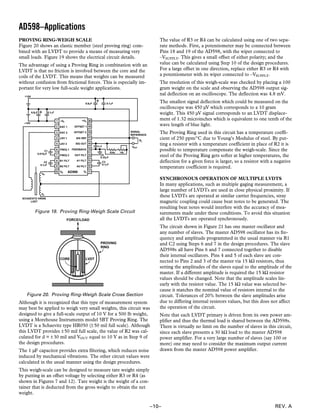
PROVING RING-WEIGH SCALE
Figure 20 shows an elastic member (steel proving ring) com-
bined with an LVDT to provide a means of measuring very
small loads. Figure 19 shows the electrical circuit details.
The advantage of using a Proving Ring in combination with an
LVDT is that no friction is involved between the core and the
coils of the LVDT. This means that weights can be measured
without confusion from frictional forces. This is especially im-
portant for very low full-scale weight applications.
EXC 1
EXC 2
LEV 1
LEV 2
FREQ 1
FREQ 2
B1 FILT
B2 FILT
OFFSET 1
OFFSET 2
SIG REF
SIG OUT
FEEDBACK
OUT FILT
A1 FILT
A2 FILT
AD598
C3
C4
SCHAEVITZ HR050
LVDT
6.8µF 0.1µF
0.1µF6.8µF
–15V
SIGNAL
REFERENCE
15V+
–VS
RL
VOUT
+VS1
2
3
4
5
6
7
8
9
10 11
12
13
14
16
15
17
18
19
20
1µF
634k 10k
0.33µF
0.1µF
C2
0.1µF
C1
0.015µF
VA
VA
VB
VB
Figure 19. Proving Ring-Weigh Scale Circuit
FORCE/LOAD
PROVING
RING
LVDTCORE
Figure 20. Proving Ring-Weigh Scale Cross Section
Although it is recognized that this type of measurement system
may best be applied to weigh very small weights, this circuit was
designed to give a full-scale output of 10 V for a 500 lb weight,
using a Morehouse Instruments model 5BT Proving Ring. The
LVDT is a Schaevitz type HR050 (±50 mil full scale). Although
this LVDT provides ±50 mil full scale, the value of R2 was cal-
culated for d = ±30 mil and VOUT equal to 10 V as in Step 9 of
the design procedures.
The 1 µF capacitor provides extra filtering, which reduces noise
induced by mechanical vibrations. The other circuit values were
calculated in the usual manner using the design procedures.
This weigh-scale can be designed to measure tare weight simply
by putting in an offset voltage by selecting either R3 or R4 (as
shown in Figures 7 and 12). Tare weight is the weight of a con-
tainer that is deducted from the gross weight to obtain the net
weight.
The value of R3 or R4 can be calculated using one of two sepa-
rate methods. First, a potentiometer may be connected between
Pins 18 and 19 of the AD598, with the wiper connected to
–VSUPPLY. This gives a small offset of either polarity; and the
value can be calculated using Step 10 of the design procedures.
For a large offset in one direction, replace either R3 or R4 with
a potentiometer with its wiper connected to –VSUPPLY.
The resolution of this weigh-scale was checked by placing a 100
gram weight on the scale and observing the AD598 output sig-
nal deflection on an oscilloscope. The deflection was 4.8 mV.
The smallest signal deflection which could be measured on the
oscilloscope was 450 µV which corresponds to a 10 gram
weight. This 450 µV signal corresponds to an LVDT displace-
ment of 1.32 microinches which is equivalent to one tenth of the
wave length of blue light.
The Proving Ring used in this circuit has a temperature coeffi-
cient of 250 ppm/°C due to Young’s Modulus of steel. By put-
ting a resistor with a temperature coefficient in place of R2 it is
possible to temperature compensate the weigh-scale. Since the
steel of the Proving Ring gets softer at higher temperatures, the
deflection for a given force is larger, so a resistor with a negative
temperature coefficient is required.
SYNCHRONOUS OPERATION OF MULTIPLE LVDTS
In many applications, such as multiple gaging measurement, a
large number of LVDTs are used in close physical proximity. If
these LVDTs are operated at similar carrier frequencies, stray
magnetic coupling could cause beat notes to be generated. The
resulting beat notes would interfere with the accuracy of mea-
surements made under these conditions. To avoid this situation
all the LVDTs are operated synchronously.
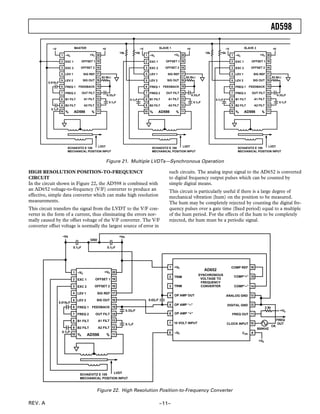
The circuit shown in Figure 21 has one master oscillator and
any number of slaves. The master AD598 oscillator has its fre-
quency and amplitude programmed in the usual manner via R1
and C2 using Steps 6 and 7 in the design procedures. The slave
AD598s all have Pins 6 and 7 connected together to disable
their internal oscillators. Pins 4 and 5 of each slave are con-
nected to Pins 2 and 3 of the master via 15 kΩ resistors, thus
setting the amplitudes of the slaves equal to the amplitude of the
master. If a different amplitude is required the 15 kΩ resistor
values should be changed. Note that the amplitude scales lin-
early with the resistor value. The 15 kΩ value was selected be-
cause it matches the nominal value of resistors internal to the
circuit. Tolerances of 20% between the slave amplitudes arise
due to differing internal resistors values, but this does not affect
the operation of the circuit.
Note that each LVDT primary is driven from its own power am-
plifier and thus the thermal load is shared between the AD598s.
There is virtually no limit on the number of slaves in this circuit,
since each slave presents a 30 kΩ load to the master AD598
power amplifier. For a very large number of slaves (say 100 or
more) one may need to consider the maximum output current
drawn from the master AD598 power amplifier.
REV. A–10–
AD598–Applications
AD598
REV. A –11–
EXC 1
EXC 2
LEV 1
LEV 2
FREQ 1
FREQ 2
B1 FILT
B2 FILT
OFFSET 1
OFFSET 2
SIG REF
SIG OUT
FEEDBACK
OUT FILT
A1 FILT
A2 FILT
AD598
–VS +VS1
2
3
4
5
6
7
8
9
10 11
12
13
14
16
15
17
18
19
20
VB VA
–V +V
0.015µF
0.1µF
15k 15k
82.5kΩ
0.33µF
0.1µF
SCHAEVITZ E 100
MECHANICAL POSITION INPUT
EXC 1
EXC 2
LEV 1
LEV 2
FREQ 1
FREQ 2
B1 FILT
B2 FILT
OFFSET 1
OFFSET 2
SIG REF
SIG OUT
FEEDBACK
OUT FILT
A1 FILT
A2 FILT
AD598
–VS +VS1
2
3
4
5
6
7
8
9
10 11
12
13
14
16
15
17
18
19
20
VB VA
–V +V
SCHAEVITZ E 100
MECHANICAL POSITION INPUT
0.1µF
82.5kΩ
0.33µF
0.1µF
15k 15k
EXC 1
EXC 2
LEV 1
LEV 2
FREQ 1
FREQ 2
B1 FILT
B2 FILT
OFFSET 1
OFFSET 2
SIG REF
SIG OUT
FEEDBACK
OUT FILT
A1 FILT
A2 FILT
AD598
–VS +VS1
2
3
4
5
6
7
8
9
10 11
12
13
14
16
15
17
18
19
20
VB VA
–V +V
SCHAEVITZ E 100
MECHANICAL POSITION INPUT
0.1µF
82.5kΩ
0.33µF
0.1µF
MASTER SLAVE 1 SLAVE 2
LVDT LVDT LVDT
Figure 21. Multiple LVDTs—Synchronous Operation
HIGH RESOLUTION POSITION-TO-FREQUENCY
CIRCUIT
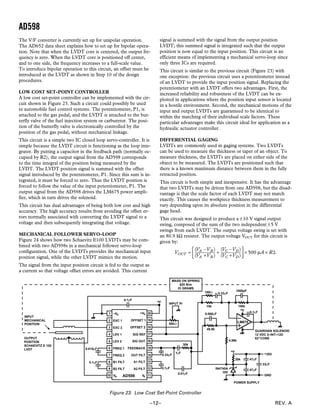
In the circuit shown in Figure 22, the AD598 is combined with
an AD652 voltage-to-frequency (V/F) converter to produce an
effective, simple data converter which can make high resolution
measurements.
This circuit transfers the signal from the LVDT to the V/F con-
verter in the form of a current, thus eliminating the errors nor-
mally caused by the offset voltage of the V/F converter. The V/F
converter offset voltage is normally the largest source of error in
such circuits. The analog input signal to the AD652 is converted
to digital frequency output pulses which can be counted by
simple digital means.
This circuit is particularly useful if there is a large degree of
mechanical vibration (hum) on the position to be measured.
The hum may be completely rejected by counting the digital fre-
quency pulses over a gate time (fixed period) equal to a multiple
of the hum period. For the effects of the hum to be completely
rejected, the hum must be a periodic signal.
EXC 1
EXC 2
LEV 1
LEV 2
FREQ 1
FREQ 2
B1 FILT
B2 FILT
OFFSET 1
OFFSET 2
SIG REF
SIG OUT
FEEDBACK
OUT FILT
A1 FILT
A2 FILT
AD598
–VS +VS1
2
3
4
5
6
7
8
9
10 11
12
13
14
16
15
17
18
19
20
VB VA
0.015µF
0.1µF
0.33µF
0.1µF
SCHAEVITZ E 100
MECHANICAL POSITION INPUT
–Vs
0.1µF
GND
0.1µF
+Vs
1
2
3
4
5
6
7
8
15
14
13
12
11
9
10
16
+VS
2.5k
+VS
FREQ
OUT
500KHZ
CK
0.02µF
AD652
SYNCHRONOUS
VOLTAGE TO
FREQUENCY
CONVERTER
+VS
TRIM
TRIM
OP AMP OUT
OP AMP “–”
OP AMP “+”
10 VOLT INPUT
–VS COS
CLOCK INPUT
FREQ OUT
DIGITAL GND
ANALOG GND
COMP“–”
COMP“+”
COMP REF
LVDT
Figure 22. High Resolution Position-to-Frequency Converter
AD598
REV. A–12–
signal is summed with the signal from the output position
LVDT; this summed signal is integrated such that the output
position is now equal to the input position. This circuit is an
efficient means of implementing a mechanical servo-loop since
only three ICs are required.
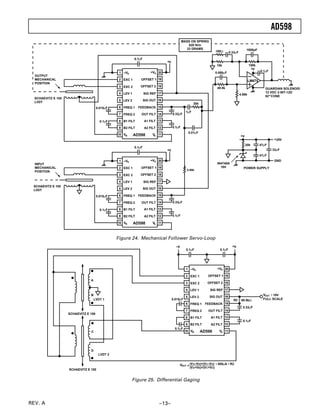
This circuit is similar to the previous circuit (Figure 23) with
one exception: the previous circuit uses a potentiometer instead
of an LVDT to provide the input position signal. Replacing the
potentiometer with an LVDT offers two advantages. First, the
increased reliability and robustness of the LVDT can be ex-
ploited in applications where the position input sensor is located
in a hostile environment. Second, the mechanical motions of the
input and output LVDTs are guaranteed to be identical to
within the matching of their individual scale factors. These
particular advantages make this circuit ideal for application as a
hydraulic actuator controller.
DIFFERENTIAL GAGING
LVDTs are commonly used in gaging systems. Two LVDTs
can be used to measure the thickness or taper of an object. To
measure thickness, the LVDTs are placed on either side of the
object to be measured. The LVDTs are positioned such that
there is a known maximum distance between them in the fully
retracted position.
This circuit is both simple and inexpensive. It has the advantage
that two LVDTs may be driven from one AD598, but the disad-
vantage is that the scale factor of each LVDT may not match
exactly. This causes the workpiece thickness measurement to
vary depending upon its absolute position in the differential
gage head.
This circuit was designed to produce a ±10 V signal output
swing, composed of the sum of the two independent ±5 V
swings from each LVDT. The output voltage swing is set with
an 80.9 kΩ resistor. The output voltage VOUT for this circuit is
given by:
VOUT =
(VA –VB)
(VA +VB)
+
(VC –VD)
(VC +VD)



 × 500 µA × R2.
The V/F converter is currently set up for unipolar operation.
The AD652 data sheet explains how to set up for bipolar opera-
tion. Note that when the LVDT core is centered, the output fre-
quency is zero. When the LVDT core is positioned off center,
and to one side, the frequency increases to a full-scale value.
To introduce bipolar operation to this circuit, an offset must be
introduced at the LVDT as shown in Step 10 of the design
procedures.
LOW COST SET-POINT CONTROLLER
A low cost set-point controller can be implemented with the cir-
cuit shown in Figure 23. Such a circuit could possibly be used
in automobile fuel control systems. The potentiometer, P1, is
attached to the gas pedal, and the LVDT is attached to the but-
terfly valve of the fuel injection system or carburetor. The posi-
tion of the butterfly valve is electronically controlled by the
position of the gas pedal, without mechanical linkage.
This circuit is a simple two IC closed loop servo-controller. It is
simple because the LVDT circuit is functioning as the loop inte-
grator. By putting a capacitor in the feedback path (normally oc-
cupied by R2), the output signal from the AD598 corresponds
to the time integral of the position being measured by the
LVDT. The LVDT position signal is summed with the offset
signal introduced by the potentiometer, P1. Since this sum is in-
tegrated, it must be forced to zero. Thus the LVDT position is
forced to follow the value of the input potentiometer, P1. The
output signal from the AD598 drives the LM675 power ampli-
fier, which in turn drives the solenoid.
This circuit has dual advantages of being both low cost and high
accuracy. The high accuracy results from avoiding the offset er-
rors normally associated with converting the LVDT signal to a
voltage and then subsequently integrating that voltage.
MECHANICAL FOLLOWER SERVO-LOOP
Figure 24 shows how two Schaevitz E100 LVDTs may be com-
bined with two AD598s in a mechanical follower servo-loop
configuration. One of the LVDTs provides the mechanical input
position signal, while the other LVDT mimics the motion.
The signal from the input position circuit is fed to the output as
a current so that voltage offset errors are avoided. This current
EXC 1
EXC 2
LEV 1
LEV 2
FREQ 1
FREQ 2
B1 FILT
B2 FILT
OFFSET 1
OFFSET 2
SIG REF
SIG OUT
FEEDBACK
OUT FILT
A1 FILT
A2 FILT
AD598
0.1µF
–VS +VS1
2
3
4
5
6
7
8
9
10 11
12
13
14
16
15
17
18
19
20
VB VA
+V
0.015µF
0.1µF
0.1µF
0.33µF
0.01µF
1µF
30k
50kΩ
INPUT PI
INPUT
MECHANICAL
POSITION
OUTPUT
POSITION
SCHAEVITZ E 100
LVDT
100Ω
10k
0.33µF
1000pF
150k
0.1µF
+V
MASS ON SPRING
620 N/m
33 GRAMS
0.068µF
49.9k
4.99k
20k 47µF
47µF
33µF
+25V
GND
POWER SUPPLY
+V
LM675
IN4740A
10V
GUARDIAN SOLENOID
12 VDC 2–INT–12D
62 CONE
Figure 23. Low Cost Set-Point Controller
AD598
REV. A –13–
EXC 1
EXC 2
LEV 1
LEV 2
FREQ 1
FREQ 2
B1 FILT
B2 FILT
OFFSET 1
OFFSET 2
SIG REF
SIG OUT
FEEDBACK
OUT FILT
A1 FILT
A2 FILT
AD598
0.1µF
–VS +VS1
2
3
4
5
6
7
8
9
10 11
12
13
14
16
15
17
18
19
20
VB VA
+V
0.015µF
0.1µF
0.1µF
0.33µF
0.01µF
1µF
30k
OUTPUT
MECHANICAL
POSITION
SCHAEVITZ E 100
LVDT
100Ω
10k
0.33µF
1000pF
150k
0.1µF
+V
MASS ON SPRING
620 N/m
33 GRAMS
0.068µF
49.9k
4.99k
20k 47µF
47µF
33µF
+25V
GND
POWER SUPPLY
+V
LM675
EXC 1
EXC 2
LEV 1
LEV 2
FREQ 1
FREQ 2
B1 FILT
B2 FILT
OFFSET 1
OFFSET 2
SIG REF
SIG OUT
FEEDBACK
OUT FILT
A1 FILT
A2 FILT
AD598
0.1µF
–VS +VS1
2
3
4
5
6
7
8
9
10 11
12
13
14
16
15
17
18
19
20
VB VA
+V
0.015µF
0.1µF
0.1µF
0.33µF
INPUT
MECHANICAL
POSITION
SCHAEVITZ E 100
LVDT
4.99k
IN4740A
10V
GUARDIAN SOLENOID
12 VDC 2-INT-12D
62 CONE
Figure 24. Mechanical Follower Servo-Loop
EXC 1
EXC 2
LEV 1
LEV 2
FREQ 1
FREQ 2
B1 FILT
B2 FILT
OFFSET 1
OFFSET 2
SIG REF
SIG OUT
FEEDBACK
OUT FILT
A1 FILT
A2 FILT
AD598
–VS +VS1
2
3
4
5
6
7
8
9
10 11
12
13
14
16
15
17
18
19
20
VB VA
0.015µF
0.1µF
0.33µF
0.1µF
–V
0.1µF 0.1µF
+V
R2 80.9kΩ
A
B
LVDT 1
C
D
LVDT 2
SCHAEVITZ E 100
VOUT =
(VA–VB)+(VC–VD)
(VA+VB)+(VC+VD)
• 500µA • R2
SCHAEVITZ E 100
VOUT ± 10V
FULL SCALE
Figure 25. Differential Gaging
AD598
REV. A–14–
PRECISION DIFFERENTIAL GAGING
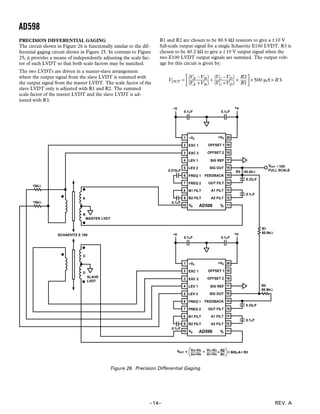
The circuit shown in Figure 26 is functionally similar to the dif-
ferential gaging circuit shown in Figure 25. In contrast to Figure
25, it provides a means of independently adjusting the scale fac-
tor of each LVDT so that both scale factors may be matched.
The two LVDTs are driven in a master-slave arrangement
where the output signal from the slave LVDT is summed with
the output signal from the master LVDT. The scale factor of the
slave LVDT only is adjusted with R1 and R2. The summed
scale factor of the master LVDT and the slave LVDT is ad-
justed with R3.
R1 and R2 are chosen to be 80.9 kΩ resistors to give a ±10 V
full-scale output signal for a single Schaevitz E100 LVDT. R3 is
chosen to be 40.2 kΩ to give a ±10 V output signal when the
two E100 LVDT output signals are summed. The output volt-
age for this circuit is given by:
VOUT =
(VA –VB)
(VA +VB)
+
(VC –VD)
(VC +VD)
×
R2
R1



 × 500 µA × R3.
EXC 1
EXC 2
LEV 1
LEV 2
FREQ 1
FREQ 2
B1 FILT
B2 FILT
OFFSET 1
OFFSET 2
SIG REF
SIG OUT
FEEDBACK
OUT FILT
A1 FILT
A2 FILT
AD598
–VS +VS1
2
3
4
5
6
7
8
9
10 11
12
13
14
16
15
17
18
19
20
VB VA
0.1µF
0.33µF
0.1µF
–V
0.1µF 0.1µF
+V
A
B
C
D
SCHAEVITZ E 100
EXC 1
EXC 2
LEV 1
LEV 2
FREQ 1
FREQ 2
B1 FILT
B2 FILT
OFFSET 1
OFFSET 2
SIG REF
SIG OUT
FEEDBACK
OUT FILT
A1 FILT
A2 FILT
AD598
–VS +VS1
2
3
4
5
6
7
8
9
10 11
12
13
14
16
15
17
18
19
20
VB VA
0.015µF
0.1µF
0.33µF
0.1µF
–V
0.1µF 0.1µF
+V
R3 40.2kΩ
SLAVE
LVDT
MASTER LVDT
15kΩ
15kΩ
R2
80.9kΩ
R1
80.9kΩ
VOUT = VA–VB
VA+VB
+ VC–VD
VC+VD
•• R2
R1
500µA• R3
VOUT ±10V
FULL SCALE
Figure 26. Precision Differential Gaging
AD598
REV. A –15–
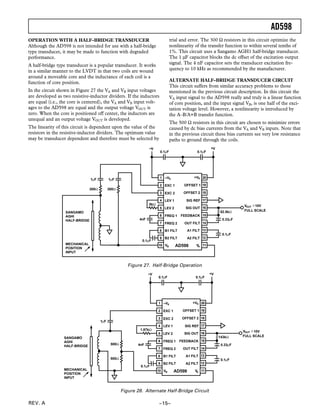
OPERATION WITH A HALF-BRIDGE TRANSDUCER
Although the AD598 is not intended for use with a half-bridge
type transducer, it may be made to function with degraded
performance.
A half-bridge type transducer is a popular transducer. It works
in a similar manner to the LVDT in that two coils are wound
around a moveable core and the inductance of each coil is a
function of core position.
In the circuit shown in Figure 27 the VA and VB input voltages
are developed as two resistive-inductor dividers. If the inductors
are equal (i.e., the core is centered), the VA and VB input volt-
ages to the AD598 are equal and the output voltage VOUT is
zero. When the core is positioned off center, the inductors are
unequal and an output voltage VOUT is developed.
The linearity of this circuit is dependent upon the value of the
resistors in the resistive-inductor dividers. The optimum value
may be transducer dependent and therefore must be selected by
trial and error. The 300 Ω resistors in this circuit optimize the
nonlinearity of the transfer function to within several tenths of
1%. This circuit uses a Sangamo AGH1 half-bridge transducer.
The 1 µF capacitor blocks the dc offset of the excitation output
signal. The 4 nF capacitor sets the transducer excitation fre-
quency to 10 kHz as recommended by the manufacturer.
ALTERNATE HALF-BRIDGE TRANSDUCER CIRCUIT
This circuit suffers from similar accuracy problems to those
mentioned in the previous circuit description. In this circuit the
VA input signal to the AD598 really and truly is a linear function
of core position, and the input signal VB, is one half of the exci-
tation voltage level. However, a nonlinearity is introduced by
the A–B/A+B transfer function.
The 500 Ω resistors in this circuit are chosen to minimize errors
caused by dc bias currents from the VA and VB inputs. Note that
in the previous circuit these bias currents see very low resistance
paths to ground through the coils.
EXC 1
EXC 2
LEV 1
LEV 2
FREQ 1
FREQ 2
B1 FILT
B2 FILT
OFFSET 1
OFFSET 2
SIG REF
SIG OUT
FEEDBACK
OUT FILT
A1 FILT
A2 FILT
AD598
–VS +VS1
2
3
4
5
6
7
8
9
10 11
12
13
14
16
15
17
18
19
20
VB VA
0.1µF
0.33µF
0.1µF
–V
0.1µF 0.1µF
+V
82.5kΩ
5kΩ
4nF
SANGAMO
AGHI
HALF-BRIDGE
1µF 1µF
300Ω 300Ω
MECHANICAL
POSITION
INPUT
VOUT ±10V
FULL SCALE
Figure 27. Half-Bridge Operation
EXC 1
EXC 2
LEV 1
LEV 2
FREQ 1
FREQ 2
B1 FILT
B2 FILT
OFFSET 1
OFFSET 2
SIG REF
SIG OUT
FEEDBACK
OUT FILT
A1 FILT
A2 FILT
AD598
–VS +VS1
2
3
4
5
6
7
8
9
10 11
12
13
14
16
15
17
18
19
20
VB VA
0.1µF
0.33µF
0.1µF
–V
0.1µF 0.1µF
+V
143kΩ
1.87kΩ
4nF
SANGAMO
AGHI
HALF-BRIDGE
1µF
500Ω
500Ω
MECHANICAL
POSITION
INPUT
VOUT ±10V
FULL SCALE
Figure 28. Alternate Half-Bridge Circuit
AD598
REV. A–16–
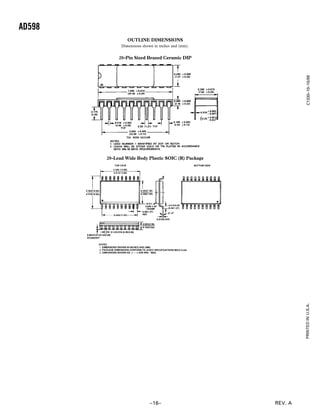
OUTLINE DIMENSIONS
Dimensions shown in inches and (mm).
20-Pin Sized Brazed Ceramic DIP
20-Lead Wide Body Plastic SOIC (R) Package
PRINTEDINU.S.A.C1330–10–10/89

Ad598

  • 1.
    PRODUCT DESCRIPTION The AD598is a complete, monolithic Linear Variable Differen- tial Transformer (LVDT) signal conditioning subsystem. It is used in conjunction with LVDTs to convert transducer mechan- ical position to a unipolar or bipolar dc voltage with a high degree of accuracy and repeatability. All circuit functions are included on the chip. With the addition of a few external passive components to set frequency and gain, the AD598 converts the raw LVDT secondary output to a scaled dc signal. The device can also be used with RVDT transducers. The AD598 contains a low distortion sine wave oscillator to drive the LVDT primary. The LVDT secondary output consists of two sine waves that drive the AD598 directly. The AD598 operates upon the two signals, dividing their difference by their sum, producing a scaled unipolar or bipolar dc output. The AD598 uses a unique ratiometric architecture (patent pend- ing) to eliminate several of the disadvantages associated with traditional approaches to LVDT interfacing. The benefits of this new circuit are: no adjustments are necessary, transformer null voltage and primary to secondary phase shift does not affect sys- tem accuracy, temperature stability is improved, and transducer interchangeability is improved. The AD598 is available in two performance grades: Grade Temperature Range Package AD598JR 0°C to +70°C 20-Pin Small Outline (SOIC) AD598AD –40°C to +85°C 20-Pin Ceramic DIP It is also available processed to MIL-STD-883B, for the military range of –55°C to +125°C. FUNCTIONAL BLOCK DIAGRAM OSC AMP AMP VOUT LVDT EXCITATION (CARRIER) 11 17 10 16 23 FILTER A–B A+B VB VA AD598 REV. A Information furnished by Analog Devices is believed to be accurate and reliable. However, no responsibility is assumed by Analog Devices for its use, nor for any infringements of patents or other rights of third parties which may result from its use. No license is granted by implication or otherwise under any patent or patent rights of Analog Devices. a LVDT Signal Conditioner AD598 One Technology Way, P.O. Box 9106, Norwood, MA 02062-9106, U.S.A. Tel: 617/329-4700 Fax: 617/326-8703 PRODUCT HIGHLIGHTS 1. The AD598 offers a monolithic solution to LVDT and RVDT signal conditioning problems; few extra passive com- ponents are required to complete the conversion from me- chanical position to dc voltage and no adjustments are required. 2. The AD598 can be used with many different types of LVDTs because the circuit accommodates a wide range of input and output voltages and frequencies; the AD598 can drive an LVDT primary with up to 24 V rms and accept sec- ondary input levels as low as 100 mV rms. 3. The 20 Hz to 20 kHz LVDT excitation frequency is deter- mined by a single external capacitor. The AD598 input sig- nal need not be synchronous with the LVDT primary drive. This means that an external primary excitation, such as the 400 Hz power mains in aircraft, can be used. 4. The AD598 uses a ratiometric decoding scheme such that primary to secondary phase shifts and transducer null voltage have absolutely no effect on overall circuit performance. 5. Multiple LVDTs can be driven by a single AD598, either in series or parallel as long as power dissipation limits are not exceeded. The excitation output is thermally protected. 6. The AD598 may be used in telemetry applications or in hos- tile environments where the interface electronics may be re- mote from the LVDT. The AD598 can drive an LVDT at the end of 300 feet of cable, since the circuit is not affected by phase shifts or absolute signal magnitudes. The position output can drive as much as 1000 feet of cable. 7. The AD598 may be used as a loop integrator in the design of simple electromechanical servo loops. FEATURES Single Chip Solution, Contains Internal Oscillator and Voltage Reference No Adjustments Required Insensitive to Transducer Null Voltage Insensitive to Primary to Secondary Phase Shifts DC Output Proportional to Position 20 Hz to 20 kHz Frequency Range Single or Dual Supply Operation Unipolar or Bipolar Output Will Operate a Remote LVDT at Up to 300 Feet Position Output Can Drive Up to 1000 Feet of Cable Will Also Interface to an RVDT Outstanding Performance Linearity: 0.05% of FS max Output Voltage: ؎11 V min Gain Drift: 50 ppm/؇C of FS max Offset Drift: 50 ppm/؇C of FS max
  • 2.
    AD598* PRODUCT PAGEQUICK LINKS Last Content Update: 02/23/2017 COMPARABLE PARTS View a parametric search of comparable parts. DOCUMENTATION Data Sheet • AD598: LVDT Signal Conditioner Data Sheet • AD598: Military Data Sheet REFERENCE DESIGNS • CN0288 DESIGN RESOURCES • AD598 Material Declaration • PCN-PDN Information • Quality And Reliability • Symbols and Footprints DISCUSSIONS View all AD598 EngineerZone Discussions. SAMPLE AND BUY Visit the product page to see pricing options. TECHNICAL SUPPORT Submit a technical question or find your regional support number. DOCUMENT FEEDBACK Submit feedback for this data sheet. This page is dynamically generated by Analog Devices, Inc., and inserted into this data sheet. A dynamic change to the content on this page will not trigger a change to either the revision number or the content of the product data sheet. This dynamic page may be frequently modified.
  • 3.
    AD598–SPECIFICATIONS (typical @+25؇C and ؎15 V dc, C1 = 0.015 ␮F, R2 = 80 k⍀, RL = 2 k⍀, unless otherwise noted. See Figure 7.) REV. A–2– AD598J AD598A Parameter Min Typ Max Min Typ Max Unit TRANSFER FUNCTION1 VOUT = VA –VB VA +VB × 500 µA × R2 V OVERALL ERROR2 TMIN to TMAX 0.6 2.35 0.6 1.65 % of FS SIGNAL OUTPUT CHARACTERISTICS Output Voltage Range (TMIN to TMAX) ؎11 ؎11 V Output Current (TMIN to TMAX) 8 6 mA Short Circuit Current 20 20 mA Nonlinearity3 (TMIN to TMAX) 75 ؎500 75 ؎500 ppm of FS Gain Error4 0.4 ؎1 0.4 ؎1 % of FS Gain Drift 20 ؎100 20 ؎50 ppm/°C of FS Offset5 0.3 ؎1 0.3 ؎1 % of FS Offset Drift 7 ؎200 7 ؎50 ppm/°C of FS Excitation Voltage Rejection6 100 100 ppm/dB Power Supply Rejection (±12 V to ±18 V) PSRR Gain (TMIN to TMAX) 300 100 400 100 ppm/V PSRR Offset (TMIN to TMAX) 100 15 200 15 ppm/V Common-Mode Rejection (±3 V) CMRR Gain (TMIN to TMAX) 100 25 200 25 ppm/V CMRR Offset (TMIN to TMAX) 100 6 200 6 ppm/V Output Ripple7 4 4 mV rms EXCITATION OUTPUT CHARACTERISTICS (@ 2.5 kHz) Excitation Voltage Range 2.1 24 2.1 24 V rms Excitation Voltage (R1 = Open)8 1.2 2.1 1.2 2.1 V rms (R1 = 12.7 kΩ)8 2.6 4.1 2.6 4.1 V rms (R1 = 487 Ω)8 14 20 14 20 V rms Excitation Voltage TC9 600 600 ppm/°C Output Current 30 30 mA rms TMIN to TMAX 12 12 mA rms Short Circuit Current 60 60 mA DC Offset Voltage (Differential, R1 = 12.7 kΩ) TMIN to TMAX 30 ؎100 30 ؎100 mV Frequency 20 20k 20 20k Hz Frequency TC, (R1 = 12.7 kΩ) 200 200 ppm/°C Total Harmonic Distortion –50 –50 dB SIGNAL INPUT CHARACTERISTICS Signal Voltage 0.1 3.5 0.1 3.5 V rms Input Impedance 200 200 kΩ Input Bias Current (AIN and BIN) 1 5 1 5 µA Signal Reference Bias Current 2 10 2 10 µA Excitation Frequency 0 20 0 20 kHz POWER SUPPLY REQUIREMENTS Operating Range 13 36 13 36 V Dual Supply Operation (±10 V Output) ±13 ±13 V Single Supply Operation 0 to +10 V Output 17.5 17.5 V 0 to –10 V Output 17.5 17.5 V Current (No Load at Signal and Excitation Outputs) 12 15 12 15 mA TMIN to TMAX 16 18 mA TEMPERATURE RANGE JR (SOIC) 0 +70 °C AD (DIP) –40 +85 °C PACKAGE OPTION SOIC (R-20) AD598JR Side Brazed DIP (D-20) AD598AD
  • 4.
    NOTES 1 VA and VBrepresent the Mean Average Deviation (MAD) of the detected sine waves. Note that for this Transfer Function to linearly represent positive displacement, the sum of VA and VB of the LVDT must remain constant with stroke length. See “Theory of Operation.” Also see Figures 7 and 12 for R2. 2 From TMIN, to TMAX, the overall error due to the AD598 alone is determined by combining gain error, gain drift and offset drift. For example the worst case overall error for the AD598AD from TMIN to TMAX is calculated as follows: overall error = gain error at +25°C (±1% full scale) + gain drift from –40°C to +25°C (50 ppm/°C of FS × +65°C) + offset drift from –40°C to +25°C (50 ppm/°C of FS × +65°C) = ±1.65% of full scale. Note that 1000 ppm of full scale equals 0.1% of full scale. Full scale is defined as the voltage difference between the maximum positive and maximum negative output. 3 Nonlinearity of the AD598 only, in units of ppm of full scale. Nonlinearity is defined as the maximum measured deviation of the AD598 output voltage from a straight line. The straight line is determined by connecting the maximum produced full-scale negative voltage with the maximum produced full-scale positive voltage. 4 See Transfer Function. 5 This offset refers to the (VA–VB)/(VA+VB) input spanning a full-scale range of ±1. [For (VA–VB)/(VA+VB) to equal +1, VB must equal zero volts; and correspondingly for (VA–VB)/(VA+VB) to equal –1, VA must equal zero volts. Note that offset errors do not allow accurate use of zero magnitude inputs, practical inputs are limited to 100 mV rms.] The ±1 span is a convenient reference point to define offset referred to input. For example, with this input span a value of R2 = 20 k Ω would give VOUT span a value of ±10 volts. Caution, most LVDTs will typically exercise less of the ((VA–VB))/((VA+VB)) input span and thus require a larger value of R2 to produce the ±10 V output span. In this case the offset is correspondingly magnified when referred to the output voltage. For example, a Schaevitz E100 LVDT requires 80.2 kΩ for R2 to produce a ±10.69 V output and (VA–VB)/(VA+VB) equals 0.27. This ratio may be determined from the graph shown in Figure 18, (VA–VB)/(VA+VB) = (1.71 V rms – 0.99 V rms)/(1.71 V rms + 0.99 V rms). The maximum offset value referred to the ±10.69 V output may be determined by multiplying the maximum value shown in the data sheet (±1% of FS by 1/0.27 which equals ±3.7% maximum. Similarly, to determine the maximum values of offset drift, offset CMRR and offset PSRR when referred to the ±10.69 V output, these data sheet values should also be multiplied by (1/0.27). For this example for the AD598AD the maximum values of offset drift, PSRR offset and CMRR offset would be: 185 ppm/°C of FS; 741 ppm/V and 741 ppm/V respectively when referred to the ±10.69 V output. 6 For example, if the excitation to the primary changes by 1 dB, the gain of the system will change by typically 100 ppm. 7 Output ripple is a function of the AD598 bandwidth determined by C2, C3 and C4. See Figures 16 and 17. 8 R1 is shown in Figures 7 and 12. 9 Excitation voltage drift is not an important specification because of the ratiometric operation of the AD598. Specifications subject to change without notice. Specifications shown in boldface are tested on all production units at final electrical test. Results from those tested are used to calculate outgoing quality levels. All min and max specifications are guaranteed, although only those shown in boldface are tested on all production units. AD598 THERMAL CHARACTERISTICS θJC θJA SOIC Package 22°C/W 80°C/W Side Brazed Package 25°C/W 85°C/W ABSOLUTE MAXIMUM RATINGS Total Supply Voltage +VS to –VS . . . . . . . . . . . . . . . . . +36 V Storage Temperature Range R Package . . . . . . . . . . . . . . . . . . . . . . . . .–65°C to +150°C D Package . . . . . . . . . . . . . . . . . . . . . . . . .–65°C to +150°C Operating Temperature Range AD598JR . . . . . . . . . . . . . . . . . . . . . . . . . . . . 0°C to +70°C AD598AD . . . . . . . . . . . . . . . . . . . . . . . . . .–40°C to +85°C Lead Temperature Range (Soldering 60 sec) . . . . . . . . +300°C Power Dissipation Up to +65°C . . . . . . . . . . . . . . . . . . .1.2 W Derates Above +65°C . . . . . . . . . . . . . . . . . . . . . . . 12 mW/°C ORDERING GUIDE Temperature Package Package Model Range Description Option AD598JR 0°C to +70°C SOIC R-20 AD598AD –40°C to +85C Ceramic DIP D-20 OFFSET 1 OFFSET 2 SIGNAL REFERENCE SIGNAL OUTPUT FEEDBACK OUTPUT FILTER A1 FILTER A2 FILTER EXC 1 EXC 2 LEVEL 1 LEVEL 2 FREQ 1 FREQ 2 B1 FILTER B2 FILTER 1 2 3 4 5 6 7 8 9 10 11 12 13 14 16 15 17 18 19 20–VS +VS AD598 TOP VIEW (Not to Scale) VB VA REV. A –3–
  • 5.
    AD598–Typical Characteristics (at+25؇C and VS = ؎15 V, unless otherwise noted) THEORY OF OPERATION A block diagram of the AD598 along with an LVDT (Linear Variable Differential Transformer) connected to its input is shown in Figure 5. The LVDT is an electromechanical trans- ducer whose input is the mechanical displacement of a core and whose output is a pair of ac voltages proportional to core posi- tion. The transducer consists of a primary winding energized by OSC AMP AMP VOUT LVDT EXCITATION (CARRIER) 11 17 10 16 23 FILTER A–B A+B VB VA AD598 Figure 5. AD598 Functional Block Diagram an external sine wave reference source, two secondary windings connected in series, and the moveable core to couple flux be- tween the primary and secondary windings. The AD598 energizes the LVDT primary, senses the LVDT secondary output voltages and produces a dc output voltage proportional to core position. The AD598 consists of a sine wave oscillator and power amplifier to drive the primary, a de- coder which determines the ratio of the difference between the LVDT secondary voltages divided by their sum, a filter and an output amplifier. The oscillator comprises a multivibrator which produces a triwave output. The triwave drives a sine shaper, which pro- duces a low distortion sine wave whose frequency is determined by a single capacitor. Output frequency can range from 20 Hz to 20 kHz and amplitude from 2 V rms to 24 V rms. Total har- monic distortion is typically –50 dB. The output from the LVDT secondaries consists of a pair of sine waves whose amplitude difference, (VA–VB), is proportional to core position. Previous LVDT conditioners synchronously detect this amplitude difference and convert its absolute value to –20 0 20 60 100 140–60 –200 –240 –160 –120 –80 –40 0 40 TEMPERATURE – °C GAINANDOFFSETPSRR–ppm/Volt OFFSET PSRR 12–15V OFFSET PSRR 15–18V GAIN PSRR 12–15V GAIN PSRR 15–18V Figure 1. Gain and Offset PSRR vs. Temperature –20 0 20 60 100 140–60 –25 –30 –35 –20 –15 –10 –5 0 5 TEMPERATURE – °C GAINANDOFFSETCMRR–ppm/Volt OFFSET CMRR ± 3V GAIN CMRR ± 3V Figure 3. Gain and Offset CMRR vs. Temperature –20 0 20 60 100 140–60 –40 –60 –80 –20 0 20 40 80 120 TEMPERATURE – °C TYPICALGAINDRIFT–ppm/°C Figure 2. Typical Gain Drift vs. Temperature –20 0 20 60 100 140–60 –10 –20 0 10 20 TEMPERATURE – °C TYPICALOFFSETDRIFT–ppm/°C Figure 4. Typical Offset Drift vs. Temperature REV. A–4–
  • 6.
    AD598 REV. A –5– avoltage proportional to position. This technique uses the pri- mary excitation voltage as a phase reference to determine the polarity of the output voltage. There are a number of problems associated with this technique such as (1) producing a constant amplitude, constant frequency excitation signal, (2) compensating for LVDT primary to secondary phase shifts, and (3) compen- sating for these shifts as a function of temperature and frequency. The AD598 eliminates all of these problems. The AD598 does not require a constant amplitude because it works on the ratio of the difference and sum of the LVDT output signals. A constant frequency signal is not necessary because the inputs are rectified and only the sine wave carrier magnitude is processed. There is no sensitivity to phase shift between the primary excitation and the LVDT outputs because synchronous detection is not em- ployed. The ratiometric principle upon which the AD598 oper- ates requires that the sum of the LVDT secondary voltages remains constant with LVDT stroke length. Although LVDT manufacturers generally do not specify the relationship between VA+VB and stroke length, it is recognized that some LVDTs do not meet this requirement. In these cases a nonlinearity will result. However, the majority of available LVDTs do in fact meet these requirements. The AD598 utilizes a special decoder circuit. Referring to the block diagram and Figure 6 below, an implicit analog comput- ing loop is employed. After rectification, the A and B signals are multiplied by complementary duty cycle signals, d and (I–d) respectively. The difference of these processed signals is inte- grated and sampled by a comparator. It is the output of this comparator that defines the original duty cycle, d, which is fed back to the multipliers. As shown in Figure 6, the input to the integrator is [(A+B)d]B. Since the integrator input is forced to 0, the duty cycle d = B/(A+B). The output comparator which produces d = B/(A+B) also con- trols an output amplifier driven by a reference current. Duty cycle signals d and (1–d) perform separate modulations on the reference current as shown in Figure 6, which are summed. The summed current, which is the output current, is IREF × (1–2d). Since d = B/(A+B), by substitution the output current equals IREF × (A–B)/(A+B). This output current is then filtered and converted to a voltage since it is forced to flow through the scal- ing resistor R2 such that: VOUT = IREF ×( A – B) / (A + B)× R2 CONNECTING THE AD598 The AD598 can easily be connected for dual or single supply operation as shown in Figures 7 and 12. The following general design procedures demonstrate how external component values are selected and can be used for any LVDT which meets AD598 input/output criteria. Parameters which are set with external passive components in- clude: excitation frequency and amplitude, AD598 system bandwidth, and the scale factor (V/inch). Additionally, there are optional features, offset null adjustment, filtering, and signal in- tegration which can be used by adding external components. COMP COMP FILT FILT ∑ COMP ∑ RTO OFFSET FILT ∑ INTEG V TO I BANDGAP REFERENCE INPUT INPUT ±1 ±1 A d B 0<d<1 BINARY SIGNAL d - DUTY CYCLE (A+B) d–B q B A+B 1–d IREF d IREF q A–B A+B VOLTS OUTPUT VOUT = RSCALE x IREF x A–B A+B INTEG V TO I 1–d d V TO I Figure 6. Block Diagram of Decoder
  • 7.
    AD598 REV. A–6– DESIGN PROCEDURE DUALSUPPLY OPERATION Figure 7 shows the connection method with dual ±15 volt power supplies and a Schaevitz E100 LVDT. This design procedure can be used to select component values for other LVDTs as well. The procedure is outlined in Steps 1 through 10 as follows: 1. Determine the mechanical bandwidth required for LVDT position measurement subsystem, fSUBSYSTEM. For this example, assume fSUBSYSTEM = 250 Hz. 2. Select minimum LVDT excitation frequency, approximately 10 × fSUBSYSTEM. Therefore, let excitation frequency = 2.5 kHz. 3. Select a suitable LVDT that will operate with an excitation frequency of 2.5 kHz. The Schaevitz E100, for instance, will operate over a range of 50 Hz to 10 kHz and is an eligible candidate for this example. 4. Determine the sum of LVDT secondary voltages VA and VB. Energize the LVDT at its typical drive level VPRI as shown in the manufacturer’s data sheet (3 V rms for the E100). Set the core displacement to its center position where VA = VB. Mea- sure these values and compute their sum VA+VB. For the E100, VA+VB = 2.70 V rms. This calculation will be used later in determining AD598 output voltage. 5. Determine optimum LVDT excitation voltage, VEXC. With the LVDT energized at its typical drive level VPRI, set the core displacement to its mechanical full-scale position and measure the output VSEC of whichever secondary produces the largest signal. Compute LVDT voltage transformation ratio, VTR. VTR = VPRI/VSEC For the E100, VSEC = 1.71 V rms for VPRI = 3 V rms. VTR = 1.75. The AD598 signal input, VSEC, should be in the range of 1 V rms to 3.5 V rms for maximum AD598 linearity and minimum noise susceptibility. Select VSEC = 3 V rms. There- fore, LVDT excitation voltage VEXC should be: VEXC = VSEC × VTR = 3 × 1.75 = 5.25 V rms Check the power supply voltages by verifying that the peak values of VA and VB are at least 2.5 volts less than the volt- ages at +VS and –VS. 6. Referring to Figure 7, for VS = ±15 V, select the value of the amplitude determining component R1 as shown by the curve in Figure 8. 7. Select excitation frequency determining component C1. C1 = 35 µF Hz/fEXCITATION 30 20 10 0 0.01 0.1 1 10 100 1000 R1 – kΩ Vrms VEXC–Vrms Figure 8. Excitation Voltage VEXC vs. R1 EXC 1 EXC 2 LEV 1 LEV 2 FREQ 1 FREQ 2 B1 FILT B2 FILT OFFSET 1 OFFSET 2 SIG REF SIG OUT FEEDBACK OUT FILT A1 FILT A2 FILT R1 C1 C2 AD598 C3 R2 C4 LVDT SCHAEVITZ E100 R3 R4 6.8µF 0.1µF 0.1µF6.8µF –15V SIGNAL REFERENCE 15V+ –VS RL VOUT +VS1 2 3 4 5 6 7 8 9 10 11 12 13 14 16 15 17 18 19 20 NOTE FOR C1, C2, C3 AND C4 MYLAR CAPACITORS ARE RECOMMENDED. CERAMIC CAPACITORS MAY BE SUBSTITUTED. FOR R2, R3 AND R4 USE STANDARD 1% RESISTORS. VA VB VB VA Figure 7. Interconnection Diagram for Dual Supply Operation
  • 8.
    AD598 REV. A –7– 8.C2, C3 and C4 are a function of the desired bandwidth of the AD598 position measurement subsystem. They should be nominally equal values. C2 = C3 = C4 = 10–4 Farad Hz/fSUBSYSTEM (Hz) If the desired system bandwidth is 250 Hz, then C2 = C3 = C4 = 10–4 Farad Hz/250 Hz = 0.4 µF See Figures 13, 14 and 15 for more information about AD598 bandwidth and phase characterization. 9. In order to Compute R2, which sets the AD598 gain or full- scale output range, several pieces of information are needed: a. LVDT sensitivity, S b.Full-scale core displacement, d c. Ratio of manufacturer recommended primary drive level, VPRI to (VA + VB) computed in Step 4. LVDT sensitivity is listed in the LVDT manufacturer’s cata- log and has units of millivolts output per volts input per inch displacement. The E100 has a sensitivity of 2.4 mV/V/mil. In the event that LVDT sensitivity is not given by the manu- facturer, it can be computed. See section on Determining LVDT Sensitivity. For a full-scale displacement of d inches, voltage out of the AD598 is computed as VOUT = S × VPRI (VA +VB)     × 500 µA × R2 × d. VOUT is measured with respect to the signal reference, Pin 17 shown in Figure 7. Solving for R2, R2 = VOUT ×(VA +VB ) S ×VPRI × 500 µA × d (1) Note that VPRI is the same signal level used in Step 4 to determine (VA + VB). For VOUT = 20 V full-scale range (±10 V) and d = 0.2 inch full-scale displacement (±0.1 inch), R2 = 20V × 2.70V 2.4 × 3 × 500 µA × 0.2 = 75.3 kΩ VOUT as a function of displacement for the above example is shown in Figure 9. +10 +0.1 d0.1– 10– VOUT (VOLTS) (INCHES) Figure 9. VOUT (±10 V Full Scale) vs. Core Displacement (±0.1 Inch) 10. Selections of R3 and R4 permit a positive or negative output voltage offset adjustment. VOS = 1.2V × R2 × 1 R3 + 5 kΩ* – 1 R4 + 5 kΩ*       (2) *These values have a ±20% tolerance. For no offset adjustment R3 and R4 should be open circuit. To design a circuit producing a 0 V to +10 V output for a displacement of ±0.1 inch, set VOUT to +10 V, d = 0.2 inch and solve Equation (1) for R2. R2 = 37.6 kΩ This will produce a response shown in Figure 10. +5 +0.1 d0.1– 5– (INCHES) VOUT (VOLTS) Figure 10. VOUT (±5 V Full Scale) vs. Core Displacement (±0.1 Inch) In Equation (2) set VOS = 5 V and solve for R3 and R4. Since a positive offset is desired, let R4 be open circuit. Rearranging Equation (2) and solving for R3 R3 = 1.2 × R2 VOS – 5 kΩ = 4.02 kΩ Figure 11 shows the desired response. +10 0.1– +0.1 d +5 (INCHES) VOUT (VOLTS) Figure 11. VOUT (0 V–10 V Full Scale) vs. Displacement (±0.1 Inch) DESIGN PROCEDURE SINGLE SUPPLY OPERATION Figure 12 shows the single supply connection method. For single supply operation, repeat Steps 1 through 10 of the design procedure for dual supply operation, then complete the additional Steps 11 through 14 below. R5, R6 and C5 are addi- tional component values to be determined. VOUT is measured with respect to SIGNAL REFERENCE. 11. Compute a maximum value of R5 and R6 based upon the relationship R5 + R6 ≤ VPS/100 µA 12. The voltage drop across R5 must be greater than 2 +10 kΩ* 1.2V R4 + 5 kΩ + 250 µA + VOUT 4 × R2       Volts Therefore R5≥ 2+10 kΩ* 1.2 V R4+5kΩ +250 µA + VOUT 4×R2       100 µA Ohms *These values have ±20% tolerance. Based upon the constraints of R5 + R6 (Step 11) and R5 (Step 12), select an interim value of R6.
  • 9.
    AD598 REV. A–8– 13. Loadcurrent through RL returns to the junction of R5 and R6, and flows back to VPS. Under maximum load condi- tions, make sure the voltage drop across R5 is met as defined in Step 12. As a final check on the power supply voltages, verify that the peak values of VA and VB are at least 2.5 volts less than the voltages at +VS and –VS. 14. C5 is a bypass capacitor in the range of 0.1 µF to 1 µF. EXC 1 EXC 2 LEV 1 LEV 2 FREQ 1 FREQ 2 B1 FILT B2 FILT OFFSET 1 OFFSET 2 SIG REF SIG OUT FEEDBACK OUT FILT A1 FILT A2 FILT R1 C2 AD598 C3 R2 C4 LVDT SCHAEVITZ E100 R3 R4 0.1µF6.8µF SIGNAL REFERENCE 30V+ –VS RL VOUT +VS1 2 3 4 5 6 7 8 9 10 11 12 13 14 16 15 17 18 19 20 R5 R6C5 C1 15nF 33k VB VB VA VA Vps Figure 12. Interconnection Diagram for Single Supply Operation Gain Phase Characteristics To use an LVDT in a closed loop mechanical servo application, it is necessary to know the dynamic characteristics of the trans- ducer and interface elements. The transducer itself is very quick to respond once the core is moved. The dynamics arise prima- rily from the interface electronics. Figures 13, 14 and 15 show the frequency response of the AD598 LVDT Signal Condi- tioner. Note that Figures 14 and 15 are basically the same; the difference is frequency range covered. Figure 14 shows a wider range of mechanical input frequencies at the expense of accu- racy. Figure 15 shows a more limited frequency range with en- hanced accuracy. The figures are transfer functions with the input to be considered as a sinusoidally varying mechanical posi- tion and the output as the voltage from the AD598; the units of the transfer function are volts per inch. The value of C2, C3 and C4, from Figure 7, are all equal and designated as a parameter in the figures. The response is approximately that of two real poles. However, there is appreciable excess phase at higher fre- quencies. An additional pole of filtering can be introduced with a shunt capacitor across R2, (see Figure 7); this will also in- crease phase lag. When selecting values of C2, C3 and C4 to set the bandwidth of the system, a trade-off is involved. There is ripple on the “dc” position output voltage, and the magnitude is determined by the filter capacitors. Generally, smaller capacitors will give higher system bandwidth and larger ripple. Figures 16 and 17 show the magnitude of ripple as a function of C2, C3 and C4, again all equal in value. Note also a shunt capacitor across R2 shown as a parameter (see Figure 7). The value of R2 used was 81 kΩ with a Schaevitz E100 LVDT. Figure 13. Gain and Phase Characteristics vs. Frequency (0 kHz–10 kHz) Figure 14. Gain and Phase Characteristics vs. Frequency (0 kHz–50 kHz)
  • 10.
    AD598 REV. A –9– Figure15. Gain and Phase Characteristics vs. Frequency (0 kHz–10 kHz) 1000 100 10 1 0.1 0.01 0.1 1 10 C2, C3, C4; C2 = C3 = C4 – µF RIPPLE–mVrms 2.5kHz, CSHUNT = 0nF 2.5kHz, CSHUNT = 1nF 2.5kHz, CSHUNT =10nF Figure 16. Output Voltage Ripple vs. Filter Capacitance 1000 100 10 1 0.1 0.001 0.01 0.1 1 10 C2, C3, C4; C2 = C3 = C4 – µF RIPPLE–mVrms 10kHz , C SHUNT = 0nF 10kHz , C SHUNT = 1nF 10kHz , C SHUNT = 10nF Figure 17. Output Voltage Ripple vs. Filter Capacitance Determining LVDT Sensitivity LVDT sensitivity can be determined by measuring the LVDT secondary voltages as a function of primary drive and core posi- tion, and performing a simple computation. Energize the LVDT at its recommended primary drive level, VPRI (3 V rms for the E100). Set the core to midpoint where VA = VB. Set the core displacement to its mechanical full-scale position and measure secondary voltages VA and VB. Sensitivity = VA(at Full Scale ) –VB (at Full Scale ) VPRI × d From Figure 18, Sensitivity = 1.71– 0.99 3 × 100 mils = 2.4 mV/V/mil d = –100 mils d = 0 AV VB 1.71V rms 0.99V rms 100 mils+d = VSEC WHEN VPRI = 3V rms Figure 18. LVDT Secondary Voltage vs. Core Displacement Thermal Shutdown and Loading Considerations The AD598 is protected by a thermal overload circuit. If the die temperature reaches 165°C, the sine wave excitation amplitude gradually reduces, thereby lowering the internal power dissipa- tion and temperature. Due to the ratiometric operation of the decoder circuit, only small errors result from the reduction of the excitation ampli- tude. Under these conditions the signal-processing section of the AD598 continues to meet its output specifications. The thermal load depends upon the voltage and current deliv- ered to the load as well as the power supply potentials. An LVDT Primary will present an inductive load to the sine wave excitation. The phase angle between the excitation voltage and current must also be considered, further complicating thermal calculations.
  • 11.
    PROVING RING-WEIGH SCALE Figure20 shows an elastic member (steel proving ring) com- bined with an LVDT to provide a means of measuring very small loads. Figure 19 shows the electrical circuit details. The advantage of using a Proving Ring in combination with an LVDT is that no friction is involved between the core and the coils of the LVDT. This means that weights can be measured without confusion from frictional forces. This is especially im- portant for very low full-scale weight applications. EXC 1 EXC 2 LEV 1 LEV 2 FREQ 1 FREQ 2 B1 FILT B2 FILT OFFSET 1 OFFSET 2 SIG REF SIG OUT FEEDBACK OUT FILT A1 FILT A2 FILT AD598 C3 C4 SCHAEVITZ HR050 LVDT 6.8µF 0.1µF 0.1µF6.8µF –15V SIGNAL REFERENCE 15V+ –VS RL VOUT +VS1 2 3 4 5 6 7 8 9 10 11 12 13 14 16 15 17 18 19 20 1µF 634k 10k 0.33µF 0.1µF C2 0.1µF C1 0.015µF VA VA VB VB Figure 19. Proving Ring-Weigh Scale Circuit FORCE/LOAD PROVING RING LVDTCORE Figure 20. Proving Ring-Weigh Scale Cross Section Although it is recognized that this type of measurement system may best be applied to weigh very small weights, this circuit was designed to give a full-scale output of 10 V for a 500 lb weight, using a Morehouse Instruments model 5BT Proving Ring. The LVDT is a Schaevitz type HR050 (±50 mil full scale). Although this LVDT provides ±50 mil full scale, the value of R2 was cal- culated for d = ±30 mil and VOUT equal to 10 V as in Step 9 of the design procedures. The 1 µF capacitor provides extra filtering, which reduces noise induced by mechanical vibrations. The other circuit values were calculated in the usual manner using the design procedures. This weigh-scale can be designed to measure tare weight simply by putting in an offset voltage by selecting either R3 or R4 (as shown in Figures 7 and 12). Tare weight is the weight of a con- tainer that is deducted from the gross weight to obtain the net weight. The value of R3 or R4 can be calculated using one of two sepa- rate methods. First, a potentiometer may be connected between Pins 18 and 19 of the AD598, with the wiper connected to –VSUPPLY. This gives a small offset of either polarity; and the value can be calculated using Step 10 of the design procedures. For a large offset in one direction, replace either R3 or R4 with a potentiometer with its wiper connected to –VSUPPLY. The resolution of this weigh-scale was checked by placing a 100 gram weight on the scale and observing the AD598 output sig- nal deflection on an oscilloscope. The deflection was 4.8 mV. The smallest signal deflection which could be measured on the oscilloscope was 450 µV which corresponds to a 10 gram weight. This 450 µV signal corresponds to an LVDT displace- ment of 1.32 microinches which is equivalent to one tenth of the wave length of blue light. The Proving Ring used in this circuit has a temperature coeffi- cient of 250 ppm/°C due to Young’s Modulus of steel. By put- ting a resistor with a temperature coefficient in place of R2 it is possible to temperature compensate the weigh-scale. Since the steel of the Proving Ring gets softer at higher temperatures, the deflection for a given force is larger, so a resistor with a negative temperature coefficient is required. SYNCHRONOUS OPERATION OF MULTIPLE LVDTS In many applications, such as multiple gaging measurement, a large number of LVDTs are used in close physical proximity. If these LVDTs are operated at similar carrier frequencies, stray magnetic coupling could cause beat notes to be generated. The resulting beat notes would interfere with the accuracy of mea- surements made under these conditions. To avoid this situation all the LVDTs are operated synchronously. The circuit shown in Figure 21 has one master oscillator and any number of slaves. The master AD598 oscillator has its fre- quency and amplitude programmed in the usual manner via R1 and C2 using Steps 6 and 7 in the design procedures. The slave AD598s all have Pins 6 and 7 connected together to disable their internal oscillators. Pins 4 and 5 of each slave are con- nected to Pins 2 and 3 of the master via 15 kΩ resistors, thus setting the amplitudes of the slaves equal to the amplitude of the master. If a different amplitude is required the 15 kΩ resistor values should be changed. Note that the amplitude scales lin- early with the resistor value. The 15 kΩ value was selected be- cause it matches the nominal value of resistors internal to the circuit. Tolerances of 20% between the slave amplitudes arise due to differing internal resistors values, but this does not affect the operation of the circuit. Note that each LVDT primary is driven from its own power am- plifier and thus the thermal load is shared between the AD598s. There is virtually no limit on the number of slaves in this circuit, since each slave presents a 30 kΩ load to the master AD598 power amplifier. For a very large number of slaves (say 100 or more) one may need to consider the maximum output current drawn from the master AD598 power amplifier. REV. A–10– AD598–Applications
  • 12.
    AD598 REV. A –11– EXC1 EXC 2 LEV 1 LEV 2 FREQ 1 FREQ 2 B1 FILT B2 FILT OFFSET 1 OFFSET 2 SIG REF SIG OUT FEEDBACK OUT FILT A1 FILT A2 FILT AD598 –VS +VS1 2 3 4 5 6 7 8 9 10 11 12 13 14 16 15 17 18 19 20 VB VA –V +V 0.015µF 0.1µF 15k 15k 82.5kΩ 0.33µF 0.1µF SCHAEVITZ E 100 MECHANICAL POSITION INPUT EXC 1 EXC 2 LEV 1 LEV 2 FREQ 1 FREQ 2 B1 FILT B2 FILT OFFSET 1 OFFSET 2 SIG REF SIG OUT FEEDBACK OUT FILT A1 FILT A2 FILT AD598 –VS +VS1 2 3 4 5 6 7 8 9 10 11 12 13 14 16 15 17 18 19 20 VB VA –V +V SCHAEVITZ E 100 MECHANICAL POSITION INPUT 0.1µF 82.5kΩ 0.33µF 0.1µF 15k 15k EXC 1 EXC 2 LEV 1 LEV 2 FREQ 1 FREQ 2 B1 FILT B2 FILT OFFSET 1 OFFSET 2 SIG REF SIG OUT FEEDBACK OUT FILT A1 FILT A2 FILT AD598 –VS +VS1 2 3 4 5 6 7 8 9 10 11 12 13 14 16 15 17 18 19 20 VB VA –V +V SCHAEVITZ E 100 MECHANICAL POSITION INPUT 0.1µF 82.5kΩ 0.33µF 0.1µF MASTER SLAVE 1 SLAVE 2 LVDT LVDT LVDT Figure 21. Multiple LVDTs—Synchronous Operation HIGH RESOLUTION POSITION-TO-FREQUENCY CIRCUIT In the circuit shown in Figure 22, the AD598 is combined with an AD652 voltage-to-frequency (V/F) converter to produce an effective, simple data converter which can make high resolution measurements. This circuit transfers the signal from the LVDT to the V/F con- verter in the form of a current, thus eliminating the errors nor- mally caused by the offset voltage of the V/F converter. The V/F converter offset voltage is normally the largest source of error in such circuits. The analog input signal to the AD652 is converted to digital frequency output pulses which can be counted by simple digital means. This circuit is particularly useful if there is a large degree of mechanical vibration (hum) on the position to be measured. The hum may be completely rejected by counting the digital fre- quency pulses over a gate time (fixed period) equal to a multiple of the hum period. For the effects of the hum to be completely rejected, the hum must be a periodic signal. EXC 1 EXC 2 LEV 1 LEV 2 FREQ 1 FREQ 2 B1 FILT B2 FILT OFFSET 1 OFFSET 2 SIG REF SIG OUT FEEDBACK OUT FILT A1 FILT A2 FILT AD598 –VS +VS1 2 3 4 5 6 7 8 9 10 11 12 13 14 16 15 17 18 19 20 VB VA 0.015µF 0.1µF 0.33µF 0.1µF SCHAEVITZ E 100 MECHANICAL POSITION INPUT –Vs 0.1µF GND 0.1µF +Vs 1 2 3 4 5 6 7 8 15 14 13 12 11 9 10 16 +VS 2.5k +VS FREQ OUT 500KHZ CK 0.02µF AD652 SYNCHRONOUS VOLTAGE TO FREQUENCY CONVERTER +VS TRIM TRIM OP AMP OUT OP AMP “–” OP AMP “+” 10 VOLT INPUT –VS COS CLOCK INPUT FREQ OUT DIGITAL GND ANALOG GND COMP“–” COMP“+” COMP REF LVDT Figure 22. High Resolution Position-to-Frequency Converter
  • 13.
    AD598 REV. A–12– signal issummed with the signal from the output position LVDT; this summed signal is integrated such that the output position is now equal to the input position. This circuit is an efficient means of implementing a mechanical servo-loop since only three ICs are required. This circuit is similar to the previous circuit (Figure 23) with one exception: the previous circuit uses a potentiometer instead of an LVDT to provide the input position signal. Replacing the potentiometer with an LVDT offers two advantages. First, the increased reliability and robustness of the LVDT can be ex- ploited in applications where the position input sensor is located in a hostile environment. Second, the mechanical motions of the input and output LVDTs are guaranteed to be identical to within the matching of their individual scale factors. These particular advantages make this circuit ideal for application as a hydraulic actuator controller. DIFFERENTIAL GAGING LVDTs are commonly used in gaging systems. Two LVDTs can be used to measure the thickness or taper of an object. To measure thickness, the LVDTs are placed on either side of the object to be measured. The LVDTs are positioned such that there is a known maximum distance between them in the fully retracted position. This circuit is both simple and inexpensive. It has the advantage that two LVDTs may be driven from one AD598, but the disad- vantage is that the scale factor of each LVDT may not match exactly. This causes the workpiece thickness measurement to vary depending upon its absolute position in the differential gage head. This circuit was designed to produce a ±10 V signal output swing, composed of the sum of the two independent ±5 V swings from each LVDT. The output voltage swing is set with an 80.9 kΩ resistor. The output voltage VOUT for this circuit is given by: VOUT = (VA –VB) (VA +VB) + (VC –VD) (VC +VD)     × 500 µA × R2. The V/F converter is currently set up for unipolar operation. The AD652 data sheet explains how to set up for bipolar opera- tion. Note that when the LVDT core is centered, the output fre- quency is zero. When the LVDT core is positioned off center, and to one side, the frequency increases to a full-scale value. To introduce bipolar operation to this circuit, an offset must be introduced at the LVDT as shown in Step 10 of the design procedures. LOW COST SET-POINT CONTROLLER A low cost set-point controller can be implemented with the cir- cuit shown in Figure 23. Such a circuit could possibly be used in automobile fuel control systems. The potentiometer, P1, is attached to the gas pedal, and the LVDT is attached to the but- terfly valve of the fuel injection system or carburetor. The posi- tion of the butterfly valve is electronically controlled by the position of the gas pedal, without mechanical linkage. This circuit is a simple two IC closed loop servo-controller. It is simple because the LVDT circuit is functioning as the loop inte- grator. By putting a capacitor in the feedback path (normally oc- cupied by R2), the output signal from the AD598 corresponds to the time integral of the position being measured by the LVDT. The LVDT position signal is summed with the offset signal introduced by the potentiometer, P1. Since this sum is in- tegrated, it must be forced to zero. Thus the LVDT position is forced to follow the value of the input potentiometer, P1. The output signal from the AD598 drives the LM675 power ampli- fier, which in turn drives the solenoid. This circuit has dual advantages of being both low cost and high accuracy. The high accuracy results from avoiding the offset er- rors normally associated with converting the LVDT signal to a voltage and then subsequently integrating that voltage. MECHANICAL FOLLOWER SERVO-LOOP Figure 24 shows how two Schaevitz E100 LVDTs may be com- bined with two AD598s in a mechanical follower servo-loop configuration. One of the LVDTs provides the mechanical input position signal, while the other LVDT mimics the motion. The signal from the input position circuit is fed to the output as a current so that voltage offset errors are avoided. This current EXC 1 EXC 2 LEV 1 LEV 2 FREQ 1 FREQ 2 B1 FILT B2 FILT OFFSET 1 OFFSET 2 SIG REF SIG OUT FEEDBACK OUT FILT A1 FILT A2 FILT AD598 0.1µF –VS +VS1 2 3 4 5 6 7 8 9 10 11 12 13 14 16 15 17 18 19 20 VB VA +V 0.015µF 0.1µF 0.1µF 0.33µF 0.01µF 1µF 30k 50kΩ INPUT PI INPUT MECHANICAL POSITION OUTPUT POSITION SCHAEVITZ E 100 LVDT 100Ω 10k 0.33µF 1000pF 150k 0.1µF +V MASS ON SPRING 620 N/m 33 GRAMS 0.068µF 49.9k 4.99k 20k 47µF 47µF 33µF +25V GND POWER SUPPLY +V LM675 IN4740A 10V GUARDIAN SOLENOID 12 VDC 2–INT–12D 62 CONE Figure 23. Low Cost Set-Point Controller
  • 14.
    AD598 REV. A –13– EXC1 EXC 2 LEV 1 LEV 2 FREQ 1 FREQ 2 B1 FILT B2 FILT OFFSET 1 OFFSET 2 SIG REF SIG OUT FEEDBACK OUT FILT A1 FILT A2 FILT AD598 0.1µF –VS +VS1 2 3 4 5 6 7 8 9 10 11 12 13 14 16 15 17 18 19 20 VB VA +V 0.015µF 0.1µF 0.1µF 0.33µF 0.01µF 1µF 30k OUTPUT MECHANICAL POSITION SCHAEVITZ E 100 LVDT 100Ω 10k 0.33µF 1000pF 150k 0.1µF +V MASS ON SPRING 620 N/m 33 GRAMS 0.068µF 49.9k 4.99k 20k 47µF 47µF 33µF +25V GND POWER SUPPLY +V LM675 EXC 1 EXC 2 LEV 1 LEV 2 FREQ 1 FREQ 2 B1 FILT B2 FILT OFFSET 1 OFFSET 2 SIG REF SIG OUT FEEDBACK OUT FILT A1 FILT A2 FILT AD598 0.1µF –VS +VS1 2 3 4 5 6 7 8 9 10 11 12 13 14 16 15 17 18 19 20 VB VA +V 0.015µF 0.1µF 0.1µF 0.33µF INPUT MECHANICAL POSITION SCHAEVITZ E 100 LVDT 4.99k IN4740A 10V GUARDIAN SOLENOID 12 VDC 2-INT-12D 62 CONE Figure 24. Mechanical Follower Servo-Loop EXC 1 EXC 2 LEV 1 LEV 2 FREQ 1 FREQ 2 B1 FILT B2 FILT OFFSET 1 OFFSET 2 SIG REF SIG OUT FEEDBACK OUT FILT A1 FILT A2 FILT AD598 –VS +VS1 2 3 4 5 6 7 8 9 10 11 12 13 14 16 15 17 18 19 20 VB VA 0.015µF 0.1µF 0.33µF 0.1µF –V 0.1µF 0.1µF +V R2 80.9kΩ A B LVDT 1 C D LVDT 2 SCHAEVITZ E 100 VOUT = (VA–VB)+(VC–VD) (VA+VB)+(VC+VD) • 500µA • R2 SCHAEVITZ E 100 VOUT ± 10V FULL SCALE Figure 25. Differential Gaging
  • 15.
    AD598 REV. A–14– PRECISION DIFFERENTIALGAGING The circuit shown in Figure 26 is functionally similar to the dif- ferential gaging circuit shown in Figure 25. In contrast to Figure 25, it provides a means of independently adjusting the scale fac- tor of each LVDT so that both scale factors may be matched. The two LVDTs are driven in a master-slave arrangement where the output signal from the slave LVDT is summed with the output signal from the master LVDT. The scale factor of the slave LVDT only is adjusted with R1 and R2. The summed scale factor of the master LVDT and the slave LVDT is ad- justed with R3. R1 and R2 are chosen to be 80.9 kΩ resistors to give a ±10 V full-scale output signal for a single Schaevitz E100 LVDT. R3 is chosen to be 40.2 kΩ to give a ±10 V output signal when the two E100 LVDT output signals are summed. The output volt- age for this circuit is given by: VOUT = (VA –VB) (VA +VB) + (VC –VD) (VC +VD) × R2 R1     × 500 µA × R3. EXC 1 EXC 2 LEV 1 LEV 2 FREQ 1 FREQ 2 B1 FILT B2 FILT OFFSET 1 OFFSET 2 SIG REF SIG OUT FEEDBACK OUT FILT A1 FILT A2 FILT AD598 –VS +VS1 2 3 4 5 6 7 8 9 10 11 12 13 14 16 15 17 18 19 20 VB VA 0.1µF 0.33µF 0.1µF –V 0.1µF 0.1µF +V A B C D SCHAEVITZ E 100 EXC 1 EXC 2 LEV 1 LEV 2 FREQ 1 FREQ 2 B1 FILT B2 FILT OFFSET 1 OFFSET 2 SIG REF SIG OUT FEEDBACK OUT FILT A1 FILT A2 FILT AD598 –VS +VS1 2 3 4 5 6 7 8 9 10 11 12 13 14 16 15 17 18 19 20 VB VA 0.015µF 0.1µF 0.33µF 0.1µF –V 0.1µF 0.1µF +V R3 40.2kΩ SLAVE LVDT MASTER LVDT 15kΩ 15kΩ R2 80.9kΩ R1 80.9kΩ VOUT = VA–VB VA+VB + VC–VD VC+VD •• R2 R1 500µA• R3 VOUT ±10V FULL SCALE Figure 26. Precision Differential Gaging
  • 16.
    AD598 REV. A –15– OPERATIONWITH A HALF-BRIDGE TRANSDUCER Although the AD598 is not intended for use with a half-bridge type transducer, it may be made to function with degraded performance. A half-bridge type transducer is a popular transducer. It works in a similar manner to the LVDT in that two coils are wound around a moveable core and the inductance of each coil is a function of core position. In the circuit shown in Figure 27 the VA and VB input voltages are developed as two resistive-inductor dividers. If the inductors are equal (i.e., the core is centered), the VA and VB input volt- ages to the AD598 are equal and the output voltage VOUT is zero. When the core is positioned off center, the inductors are unequal and an output voltage VOUT is developed. The linearity of this circuit is dependent upon the value of the resistors in the resistive-inductor dividers. The optimum value may be transducer dependent and therefore must be selected by trial and error. The 300 Ω resistors in this circuit optimize the nonlinearity of the transfer function to within several tenths of 1%. This circuit uses a Sangamo AGH1 half-bridge transducer. The 1 µF capacitor blocks the dc offset of the excitation output signal. The 4 nF capacitor sets the transducer excitation fre- quency to 10 kHz as recommended by the manufacturer. ALTERNATE HALF-BRIDGE TRANSDUCER CIRCUIT This circuit suffers from similar accuracy problems to those mentioned in the previous circuit description. In this circuit the VA input signal to the AD598 really and truly is a linear function of core position, and the input signal VB, is one half of the exci- tation voltage level. However, a nonlinearity is introduced by the A–B/A+B transfer function. The 500 Ω resistors in this circuit are chosen to minimize errors caused by dc bias currents from the VA and VB inputs. Note that in the previous circuit these bias currents see very low resistance paths to ground through the coils. EXC 1 EXC 2 LEV 1 LEV 2 FREQ 1 FREQ 2 B1 FILT B2 FILT OFFSET 1 OFFSET 2 SIG REF SIG OUT FEEDBACK OUT FILT A1 FILT A2 FILT AD598 –VS +VS1 2 3 4 5 6 7 8 9 10 11 12 13 14 16 15 17 18 19 20 VB VA 0.1µF 0.33µF 0.1µF –V 0.1µF 0.1µF +V 82.5kΩ 5kΩ 4nF SANGAMO AGHI HALF-BRIDGE 1µF 1µF 300Ω 300Ω MECHANICAL POSITION INPUT VOUT ±10V FULL SCALE Figure 27. Half-Bridge Operation EXC 1 EXC 2 LEV 1 LEV 2 FREQ 1 FREQ 2 B1 FILT B2 FILT OFFSET 1 OFFSET 2 SIG REF SIG OUT FEEDBACK OUT FILT A1 FILT A2 FILT AD598 –VS +VS1 2 3 4 5 6 7 8 9 10 11 12 13 14 16 15 17 18 19 20 VB VA 0.1µF 0.33µF 0.1µF –V 0.1µF 0.1µF +V 143kΩ 1.87kΩ 4nF SANGAMO AGHI HALF-BRIDGE 1µF 500Ω 500Ω MECHANICAL POSITION INPUT VOUT ±10V FULL SCALE Figure 28. Alternate Half-Bridge Circuit
  • 17.
    AD598 REV. A–16– OUTLINE DIMENSIONS Dimensionsshown in inches and (mm). 20-Pin Sized Brazed Ceramic DIP 20-Lead Wide Body Plastic SOIC (R) Package PRINTEDINU.S.A.C1330–10–10/89