Pelvic Infection
OUTLINE
• DEFINITION
• AETIOLOGIC AGENTS
• RISK FACTORS
• PATHOPHYSIOLOGY
• CLASSIFICATION
• CLINICAL FEATURES
• CLINICAL DIAGNOSIS
• COMPLICATIONS
• TREATMENT
• CONCLUSION
• REFERENCES 2
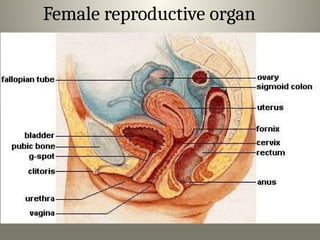
Female reproductive organ
Defence Of the genital tract
Vulval defence
Anatomic: (i) Apposition of the cleft by labia; (ii) Compound
racemose type of Bartholin’s glands.
Physiologic: (i) Fungicidal action of the secretion
(undecylenic acid) of the apocrine glands; (ii) Natural
high resistance to infection of the vulval and perineal skin.
Vaginal defence
Anatomic: (i) Apposition of the anterior and posterior
walls with its transverse rugae; (ii) Strati-fied epithelium
devoid of glands.
Physiologic: This is maintained by the hormone oestrogen
Cervical defence:
• Anatomic—(i) Racemose type of glands, (ii) mucus plug.
• Physiologic—Bactericidal effect of the mucus.
Uterine defence: (i) Cyclic shedding of the endometrium (ii)
Closure of the uterine ostium of the fallopian tube with
slightest inflammatory reaction in the endometrium.
Tubal defence:
• Anatomic—Integrated mucus plicae and epithelial cilia.
• Physiologic—Peristalsis of the tube and also the
movement of the cilia are towards the uterus.
Phases of Life when Defence is lost
i) Following 10 days of birth till puberty is reached.
ii) During reproductive period—in the following
situation:
• During menstruation: The vaginal pH becomes
Increased, The protective cervical mucus disappears and
the endometrium sheds.
• Following abortion and childbirth: The contaminated
lochia increases the pH. The raw placental site,
inevitable tear of the cervix, bruising of the vagina and
presence of blood clots or remnants of decidua favour
nidation of the bacterial growth.
(iii) During menopause.
Organisms
1. Pyogenic (50%):
• Aerobes
 The gram-positive organisms: staphylococcus.
 The gram-negatives: E. coli, pseudomonas,
klebsiella, N. gonorrhoeae
• Anaerobes
 The gram-positives are anaerobic streptococcus,
Clostridium welchii, Cl. tetani, etc.
 The gram-negatives: Bacteroides fragilis is the
commonest
2. Sexually transmitted disease (STD):
N. gonorrhoeae, Chlamydia trachomatis, Treponema
pallidum, Herpes simplex virus type II, Human papilloma
virus, Haemophilus vaginalis, Donovan bodies, HIV I or II,
etc.
3. Parasitic: Trichomonas vaginalis
4. Fungal: Candida albicans
5. Viral: Herpes simplex virus type II, Human papilloma
virus, HIV, Condylomata accuminata,
6. Tubercular: Mycobacterium tuberculosis.
Modes of spread of infections
• The route of infection is most commonly ascending
in nature.
• classic modes of infection of some specific
organisms
 Through continuity and contiguity—gonococcal
infection
 Through lymphatics and pelvic veins—postabortal
and puerperal infection—by pyogenic organisms
other than gonococcus
 Through blood stream—tubercular
 From adjacent infected extra-genital organs
 like intestine.
ACUTE PELVIC INFECTI ON
• Pelvic inflammatory disease (PID).
• Following delivery and abortion.
• Following gynecological procedures.
• Following IUD.
• Secondary to other infections—
appendicitis
PELVIC INFLAMMATORY DISEASE
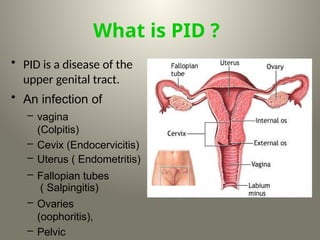
What is PID ?
• PID is a disease of the
upper genital tract.
• An infection of
– vagina
(Colpitis)
– Cevix (Endocervicitis)
– Uterus ( Endometritis)
– Fallopian tubes
( Salpingitis)
– Ovaries
(oophoritis),
– Pelvic
DEFINITION
• It is a spectrum of infection and inflammation of the
upper genital tract organs typically involving the
uterus (endometrium), fallopian tubes, ovaries,
pelvic peritoneum and surrounding structures.(D C
DUTTA)
• Gender-specific (female) ascending infection of the
upper genital tract (uterus, fallopian tubes, and
adjacent pelvic structures) that is neither linked
with surgery nor pregnancy.
3
Incidence
• Varies from 1–2 per cent per year
• About 85 per cent among sexually active
women in reproductive age.
• The remaining 15 per cent follow
procedures,
Risk Factors
• Menstruating teenagers.
• Absence of contraceptive pill use.
• Previous history of acute PID.
• IUD users.
• Area with high prevalence of sexually
transmitted diseases.
• Teenagers with low hormonal defence in
response to genital tract infection.
RISK FACTORS
• young age
• multiple sexual partners
• certain methods of contraception
• previous history of STI
• delayed and decreased access to care
• Vaginal douching
• Recent trans-vaginal instrumentation
• Previous history of PID
Protective factors
Contraceptive practice:
• Barrier methods, specially condom, diaphragm with
spermicides
• Oral steroidal contraceptives: have got two preventive
aspects.
−− Produce thick mucus plug preventing ascent of sperm and
bacterial penetration
−− Decrease in duration of menstruation, creates a shorter
interval of bacterial colonization of the upper tract.
Monogamy or having a partner who had vasectomy.
„Others
• Pregnancy
• Menopause
• Vaccines: hepatitis B, HPV
Mode of affection
• The gonococcus ascends up to affect the tubes through
mucosal continuity and contiguity. This ascent is
facilitated by the sexually transmitted vectors such as
sperm and trichomonads.
• Reflux of menstrual blood along with gonococci into
the fallopian tubes is the other possibility.
• Mycoplasma hominis probably spreads across the
parametrium to affect the tube.
• The secondary organisms probably affect the tube
through lymphatics.
• Rarely, organisms from the gut may affect the tube
directly.
1
9
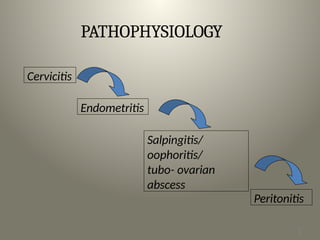
PATHOPHYSIOLOGY
• Contract of infective agent
• Ascension to the upper genital tract
• Inflammation of the genital mucosal lining
• Destruction of the cilia and subsequent
scarring of the tubal lumen.
• Luminal pocketing and partial obstruction
predisposes to ectopic pregnancy
2
0
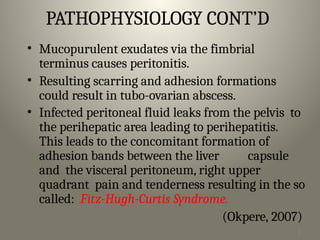
PATHOPHYSIOLOGY CONT’D
• Mucopurulent exudates via the fimbrial
terminus causes peritonitis.
• Resulting scarring and adhesion formations
could result in tubo-ovarian abscess.
• Infected peritoneal fluid leaks from the pelvis to
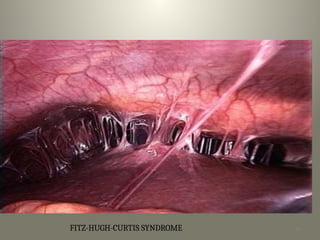
the perihepatic area leading to perihepatitis.
This leads to the concomitant formation of
adhesion bands between the liver capsule
and the visceral peritoneum, right upper
quadrant pain and tenderness resulting in the so
called: Fitz-Hugh-Curtis Syndrome.
(Okpere, 2007)
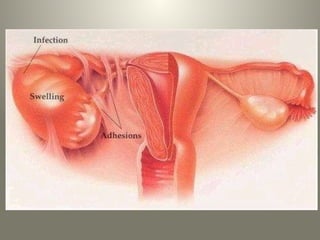
PATHOPHYSIOLOGY
Cervicitis
Endometritis
Salpingitis/
oophoritis/
tubo- ovarian
abscess
Peritonitis
2
1
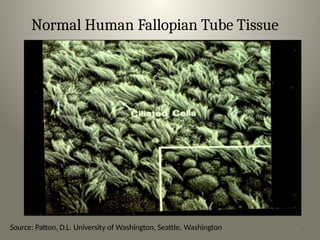
Normal Human Fallopian Tube Tissue
Source: Patton, D.L. University of Washington, Seattle, Washington 22
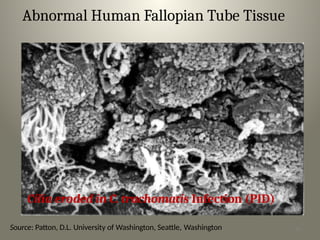
Abnormal Human Fallopian Tube Tissue
Cilia eroded in C. trachomatis Infection (PID)
Source: Patton, D.L. University of Washington, Seattle, Washington 23
CLINICA L FEATURES
Symptoms
• A wide range of non-specific clinical symptoms.
• Appear at the time and immediately after the
menstruation.
• Dull Bilateral lower abdominal and pelvic pain
with radiation to the legs
• Rapid and acute onset of pain in gonococcal
infection (3 days)
• Fever , lassitude and headache.
• Irregular and excessive vaginal bleeding in

endometritis.
Symptoms …Contd
• Purulent and or copious vaginal
discharge 
• Nausea and vomiting.
• Dyspareunia.
• Pain and discomfort in the right
hypochondrium due to concomitant
perihepatitis (Fitz-Hugh- Curtis syndrome).
26
Signs
bilateral lower abdominal tenderness with
radiation to the legs
Adnexal tenderness
• Cervical motion tenderness
• Temperature >38.3°C (101°F)
• Abnormal cervical or vaginal mucopurulent
discharge
• Presence of abundant numbers of WBCs on saline
microscopy of vaginal secretions
• Elevated erythrocyte sedimentation rate (ESR)
• Elevated C-reactive protein (CRP)
• Gonorrhea or chlamydia test positive
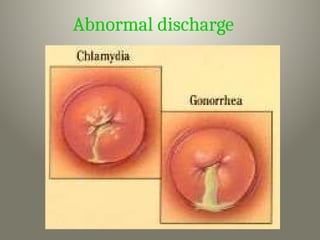
Abnormal discharge
CLINICAL DIAGNOSIS
• Physical Examination: Lower abdominal tenderness, adnexal
tenderness, pain on manipulation of the cervix
• Laboratory Investigations: CBC ESR, PCR, gonorrhea DNA
probes and culture, clamydial DNA probes and culture.
• imaging studies: Transvaginal ultrasonography ,
Abdomino- pelvic USS
• Endometrial Biopsy
• Culdocentesis
• Identification of organisms in
1. Discharge from the urethra or Bartholin’s gland.
2. Cervical canal.
3. Collected pus from the fallopian tubes during
laparoscopy or laparotomy
16
Investigations
• Laparoscopy :the "gold standard
Laparoscopic findings and severity of PID:
 Mild: Tubes: edema, erythema, no purulent
exudates and mobile.
 Mod: Purulent exudates from the fimbrial ends,
tubes not freely movable.
 Severe: Pyosalpinx, inflammatory complex,
abscess.
 ‘Violin string’ like adhesions in the pelvis and
around the liver suggests chlamydial infection.
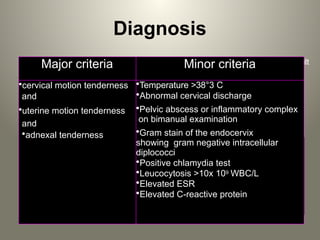
Diagnosis
Symptoms alone are not a good predictor , and clinical diagnosis alone is difficult
Major criteria Minor criteria
•cervical motion tenderness
and
•uterine motion tenderness
and
•adnexal tenderness
•Temperature >38°3 C
•Abnormal cervical discharge
•Pelvic abscess or inflammatory complex
on bimanual examination
•Gram stain of the endocervix
showing gram negative intracellular
diplococci
•Positive chlamydia test
•Leucocytosis >10x 109 WBC/L
•Elevated ESR
•Elevated C-reactive protein
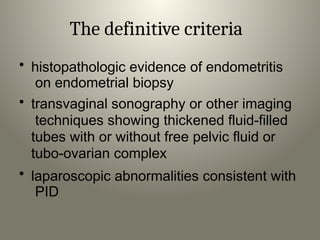
The definitive criteria
• histopathologic evidence of endometritis
on endometrial biopsy
• transvaginal sonography or other imaging
techniques showing thickened fluid-filled
tubes with or without free pelvic fluid or
tubo-ovarian complex
• laparoscopic abnormalities consistent with
PID
Complications
Immediate:
1) Pelvic peritonitis or even generalized peritonitis.
2) Septicemia—producing arthritis or myocarditis.
Late:
(1) Dyspareunia.
(2) Infertility
(3) Chronic pelvic inflammation
(4) Formation of adhesions or hydrosalpinx or
pyosalpinx and tubo-ovarian abscess.
(5)Fitz-hugh-curtis Syndrome: Perihepatic adhesion
6) Chronic pelvic pain and ill health.
7) Increased risk of ectopic pregnancy)
FITZ-HUGH-CURTIS SYNDROME 12
ECTOPIC
INFERTIL- PREGNANCY
ITY
Prevention
Screening
• Community based approach to increase public
health awareness.
• Prevention of sexually transmitted diseases
with the knowledge of healthy and safer sex.
• Liberal use of contraceptives.
• Routine screening of high-risk population.
Management of Sex Partners
• Male sex partners of women with PID
should be examined and treated
• Male partners of women who have PID
caused by C. trachomatis and/or N.
gonorrhoeae frequently are asymptomatic.
Partner Management (continued)
• Sex partners should be treated empirically
with regimens effective against both C.
trachomatis and N. gonorrhoeae,
regardless of the apparent etiology of PID
or pathogens isolated from the infected
woman.
Treatment: Outpatient therapy
• Adequate rest
• Analgesic
• Antibiotics:
 Patient should have oral therapy for 14 days
 Broad spectrum antibiotic coverage
(cefotaxime/ cefoxitin)
 Evaluate after 48 hours and if no response,
hospitalise.
Inpatient therapy
• Bed rest is imposed.
• Oral feeding is restricted.
• Correct Dehydration and acidosis by IV fluid.
• Intravenous antibiotic therapy is recommended
for at least 48 hours but may be extended to 4
days
• Improvement of the patient is evidenced by
 Remission of temperature,
 improvement of pelvic tenderness,
 normal white blood cell count and
 negative report on bacteriological study.
41
TREATMENT...
• Parenteral Regimens:
• CDC-recommended parenteral regimen A
– Cefotetan 2 g IV every 12 hours, OR
– Cefoxitin 2 g IV every 6 hours, PLUS
– Doxycycline 100 mg orally or IV every 12 hours
• CDC-recommended parenteral regimen B
Clindamycin 900 mg IV every 8 hours, PLUS
– Gentamicin loading dose IV or IM (2 mg/kg),
followed by maintenance dose (1.5 mg/kg) every 8
hours. Single daily gentamicin dosing may be
substituted.
Indications of surgery
• Generalized peritonitis.
• Pelvic abscess.
• Tubo-ovarian abscess which does not respond
(48–72 hours) to antimicrobial therapy.
Patient Counseling and
Education
• Educating the patient to avoid reinfection and the
potential hazards of it.
• The patient should be warned against multiple sexual
partners.
• To use condom.
• The sexual partner or partners are to be traced and
properly investigated to find out the organism(s) and
treated effectively
FOLLOW UP
• Repeat smears and cultures from the discharge
are to be done after 7 days following the full
course of treatment.
• The tests are to be repeated following each
menstrual period until it becomes negative for
three consecutive reports when the patient is
declared cured.
• Until she is cured and her sexual partner(s) have
been treated and cured.
• The patient must be prohibited from
intercourse.
Nursing Diagnosis
• Hyperthermia
• Acute pain
• Fatigue
• Activity intolerance
• Deficient fluid volume
• Anxiety
46
CONCLUSION
• Clinical syndrome associated with ascending spread
of microorganisms from the vagina or cervix to the
endometrium, fallopian tubes, ovaries, and
contiguous structures; comprising a spectrum of
inflammatory disorders including any combination
of endometritis, salpingitis, tubo- ovarian abscess,
and pelvic peritonitis.
• It has debilitating sequellae on the reproductive
health of women.
• Regular screening and safe sexual practices
with monogamous partners are key to its
prevention.

PID.pptx pelvic inflammatory diseases obg

  • 1.
  • 2.
    OUTLINE • DEFINITION • AETIOLOGICAGENTS • RISK FACTORS • PATHOPHYSIOLOGY • CLASSIFICATION • CLINICAL FEATURES • CLINICAL DIAGNOSIS • COMPLICATIONS • TREATMENT • CONCLUSION • REFERENCES 2
  • 3.
  • 4.
    Defence Of thegenital tract Vulval defence Anatomic: (i) Apposition of the cleft by labia; (ii) Compound racemose type of Bartholin’s glands. Physiologic: (i) Fungicidal action of the secretion (undecylenic acid) of the apocrine glands; (ii) Natural high resistance to infection of the vulval and perineal skin. Vaginal defence Anatomic: (i) Apposition of the anterior and posterior walls with its transverse rugae; (ii) Strati-fied epithelium devoid of glands. Physiologic: This is maintained by the hormone oestrogen
  • 5.
    Cervical defence: • Anatomic—(i)Racemose type of glands, (ii) mucus plug. • Physiologic—Bactericidal effect of the mucus. Uterine defence: (i) Cyclic shedding of the endometrium (ii) Closure of the uterine ostium of the fallopian tube with slightest inflammatory reaction in the endometrium. Tubal defence: • Anatomic—Integrated mucus plicae and epithelial cilia. • Physiologic—Peristalsis of the tube and also the movement of the cilia are towards the uterus.
  • 6.
    Phases of Lifewhen Defence is lost i) Following 10 days of birth till puberty is reached. ii) During reproductive period—in the following situation: • During menstruation: The vaginal pH becomes Increased, The protective cervical mucus disappears and the endometrium sheds. • Following abortion and childbirth: The contaminated lochia increases the pH. The raw placental site, inevitable tear of the cervix, bruising of the vagina and presence of blood clots or remnants of decidua favour nidation of the bacterial growth. (iii) During menopause.
  • 7.
    Organisms 1. Pyogenic (50%): •Aerobes  The gram-positive organisms: staphylococcus.  The gram-negatives: E. coli, pseudomonas, klebsiella, N. gonorrhoeae • Anaerobes  The gram-positives are anaerobic streptococcus, Clostridium welchii, Cl. tetani, etc.  The gram-negatives: Bacteroides fragilis is the commonest
  • 8.
    2. Sexually transmitteddisease (STD): N. gonorrhoeae, Chlamydia trachomatis, Treponema pallidum, Herpes simplex virus type II, Human papilloma virus, Haemophilus vaginalis, Donovan bodies, HIV I or II, etc. 3. Parasitic: Trichomonas vaginalis 4. Fungal: Candida albicans 5. Viral: Herpes simplex virus type II, Human papilloma virus, HIV, Condylomata accuminata, 6. Tubercular: Mycobacterium tuberculosis.
  • 9.
    Modes of spreadof infections • The route of infection is most commonly ascending in nature. • classic modes of infection of some specific organisms  Through continuity and contiguity—gonococcal infection  Through lymphatics and pelvic veins—postabortal and puerperal infection—by pyogenic organisms other than gonococcus  Through blood stream—tubercular  From adjacent infected extra-genital organs  like intestine.
  • 10.
    ACUTE PELVIC INFECTION • Pelvic inflammatory disease (PID). • Following delivery and abortion. • Following gynecological procedures. • Following IUD. • Secondary to other infections— appendicitis
  • 11.
  • 12.
    What is PID? • PID is a disease of the upper genital tract. • An infection of – vagina (Colpitis) – Cevix (Endocervicitis) – Uterus ( Endometritis) – Fallopian tubes ( Salpingitis) – Ovaries (oophoritis), – Pelvic
  • 13.
    DEFINITION • It isa spectrum of infection and inflammation of the upper genital tract organs typically involving the uterus (endometrium), fallopian tubes, ovaries, pelvic peritoneum and surrounding structures.(D C DUTTA) • Gender-specific (female) ascending infection of the upper genital tract (uterus, fallopian tubes, and adjacent pelvic structures) that is neither linked with surgery nor pregnancy. 3
  • 14.
    Incidence • Varies from1–2 per cent per year • About 85 per cent among sexually active women in reproductive age. • The remaining 15 per cent follow procedures,
  • 15.
    Risk Factors • Menstruatingteenagers. • Absence of contraceptive pill use. • Previous history of acute PID. • IUD users. • Area with high prevalence of sexually transmitted diseases. • Teenagers with low hormonal defence in response to genital tract infection.
  • 16.
    RISK FACTORS • youngage • multiple sexual partners • certain methods of contraception • previous history of STI • delayed and decreased access to care • Vaginal douching • Recent trans-vaginal instrumentation • Previous history of PID
  • 17.
    Protective factors Contraceptive practice: •Barrier methods, specially condom, diaphragm with spermicides • Oral steroidal contraceptives: have got two preventive aspects. −− Produce thick mucus plug preventing ascent of sperm and bacterial penetration −− Decrease in duration of menstruation, creates a shorter interval of bacterial colonization of the upper tract. Monogamy or having a partner who had vasectomy. „Others • Pregnancy • Menopause • Vaccines: hepatitis B, HPV
  • 18.
    Mode of affection •The gonococcus ascends up to affect the tubes through mucosal continuity and contiguity. This ascent is facilitated by the sexually transmitted vectors such as sperm and trichomonads. • Reflux of menstrual blood along with gonococci into the fallopian tubes is the other possibility. • Mycoplasma hominis probably spreads across the parametrium to affect the tube. • The secondary organisms probably affect the tube through lymphatics. • Rarely, organisms from the gut may affect the tube directly.
  • 19.
    1 9 PATHOPHYSIOLOGY • Contract ofinfective agent • Ascension to the upper genital tract • Inflammation of the genital mucosal lining • Destruction of the cilia and subsequent scarring of the tubal lumen. • Luminal pocketing and partial obstruction predisposes to ectopic pregnancy
  • 20.
    2 0 PATHOPHYSIOLOGY CONT’D • Mucopurulentexudates via the fimbrial terminus causes peritonitis. • Resulting scarring and adhesion formations could result in tubo-ovarian abscess. • Infected peritoneal fluid leaks from the pelvis to the perihepatic area leading to perihepatitis. This leads to the concomitant formation of adhesion bands between the liver capsule and the visceral peritoneum, right upper quadrant pain and tenderness resulting in the so called: Fitz-Hugh-Curtis Syndrome. (Okpere, 2007)
  • 21.
  • 22.
    Normal Human FallopianTube Tissue Source: Patton, D.L. University of Washington, Seattle, Washington 22
  • 23.
    Abnormal Human FallopianTube Tissue Cilia eroded in C. trachomatis Infection (PID) Source: Patton, D.L. University of Washington, Seattle, Washington 23
  • 24.
    CLINICA L FEATURES Symptoms •A wide range of non-specific clinical symptoms. • Appear at the time and immediately after the menstruation. • Dull Bilateral lower abdominal and pelvic pain with radiation to the legs • Rapid and acute onset of pain in gonococcal infection (3 days) • Fever , lassitude and headache. • Irregular and excessive vaginal bleeding in  endometritis.
  • 25.
    Symptoms …Contd • Purulentand or copious vaginal discharge  • Nausea and vomiting. • Dyspareunia. • Pain and discomfort in the right hypochondrium due to concomitant perihepatitis (Fitz-Hugh- Curtis syndrome).
  • 26.
    26 Signs bilateral lower abdominaltenderness with radiation to the legs Adnexal tenderness • Cervical motion tenderness • Temperature >38.3°C (101°F) • Abnormal cervical or vaginal mucopurulent discharge • Presence of abundant numbers of WBCs on saline microscopy of vaginal secretions • Elevated erythrocyte sedimentation rate (ESR) • Elevated C-reactive protein (CRP) • Gonorrhea or chlamydia test positive
  • 28.
  • 29.
    CLINICAL DIAGNOSIS • PhysicalExamination: Lower abdominal tenderness, adnexal tenderness, pain on manipulation of the cervix • Laboratory Investigations: CBC ESR, PCR, gonorrhea DNA probes and culture, clamydial DNA probes and culture. • imaging studies: Transvaginal ultrasonography , Abdomino- pelvic USS • Endometrial Biopsy • Culdocentesis • Identification of organisms in 1. Discharge from the urethra or Bartholin’s gland. 2. Cervical canal. 3. Collected pus from the fallopian tubes during laparoscopy or laparotomy 16
  • 30.
    Investigations • Laparoscopy :the"gold standard Laparoscopic findings and severity of PID:  Mild: Tubes: edema, erythema, no purulent exudates and mobile.  Mod: Purulent exudates from the fimbrial ends, tubes not freely movable.  Severe: Pyosalpinx, inflammatory complex, abscess.  ‘Violin string’ like adhesions in the pelvis and around the liver suggests chlamydial infection.
  • 31.
    Diagnosis Symptoms alone arenot a good predictor , and clinical diagnosis alone is difficult Major criteria Minor criteria •cervical motion tenderness and •uterine motion tenderness and •adnexal tenderness •Temperature >38°3 C •Abnormal cervical discharge •Pelvic abscess or inflammatory complex on bimanual examination •Gram stain of the endocervix showing gram negative intracellular diplococci •Positive chlamydia test •Leucocytosis >10x 109 WBC/L •Elevated ESR •Elevated C-reactive protein
  • 32.
    The definitive criteria •histopathologic evidence of endometritis on endometrial biopsy • transvaginal sonography or other imaging techniques showing thickened fluid-filled tubes with or without free pelvic fluid or tubo-ovarian complex • laparoscopic abnormalities consistent with PID
  • 33.
    Complications Immediate: 1) Pelvic peritonitisor even generalized peritonitis. 2) Septicemia—producing arthritis or myocarditis. Late: (1) Dyspareunia. (2) Infertility (3) Chronic pelvic inflammation (4) Formation of adhesions or hydrosalpinx or pyosalpinx and tubo-ovarian abscess. (5)Fitz-hugh-curtis Syndrome: Perihepatic adhesion 6) Chronic pelvic pain and ill health. 7) Increased risk of ectopic pregnancy)
  • 34.
  • 35.
  • 36.
    Screening • Community basedapproach to increase public health awareness. • Prevention of sexually transmitted diseases with the knowledge of healthy and safer sex. • Liberal use of contraceptives. • Routine screening of high-risk population.
  • 37.
    Management of SexPartners • Male sex partners of women with PID should be examined and treated • Male partners of women who have PID caused by C. trachomatis and/or N. gonorrhoeae frequently are asymptomatic.
  • 38.
    Partner Management (continued) •Sex partners should be treated empirically with regimens effective against both C. trachomatis and N. gonorrhoeae, regardless of the apparent etiology of PID or pathogens isolated from the infected woman.
  • 39.
    Treatment: Outpatient therapy •Adequate rest • Analgesic • Antibiotics:  Patient should have oral therapy for 14 days  Broad spectrum antibiotic coverage (cefotaxime/ cefoxitin)  Evaluate after 48 hours and if no response, hospitalise.
  • 40.
    Inpatient therapy • Bedrest is imposed. • Oral feeding is restricted. • Correct Dehydration and acidosis by IV fluid. • Intravenous antibiotic therapy is recommended for at least 48 hours but may be extended to 4 days • Improvement of the patient is evidenced by  Remission of temperature,  improvement of pelvic tenderness,  normal white blood cell count and  negative report on bacteriological study.
  • 41.
    41 TREATMENT... • Parenteral Regimens: •CDC-recommended parenteral regimen A – Cefotetan 2 g IV every 12 hours, OR – Cefoxitin 2 g IV every 6 hours, PLUS – Doxycycline 100 mg orally or IV every 12 hours • CDC-recommended parenteral regimen B Clindamycin 900 mg IV every 8 hours, PLUS – Gentamicin loading dose IV or IM (2 mg/kg), followed by maintenance dose (1.5 mg/kg) every 8 hours. Single daily gentamicin dosing may be substituted.
  • 42.
    Indications of surgery •Generalized peritonitis. • Pelvic abscess. • Tubo-ovarian abscess which does not respond (48–72 hours) to antimicrobial therapy.
  • 43.
    Patient Counseling and Education •Educating the patient to avoid reinfection and the potential hazards of it. • The patient should be warned against multiple sexual partners. • To use condom. • The sexual partner or partners are to be traced and properly investigated to find out the organism(s) and treated effectively
  • 44.
    FOLLOW UP • Repeatsmears and cultures from the discharge are to be done after 7 days following the full course of treatment. • The tests are to be repeated following each menstrual period until it becomes negative for three consecutive reports when the patient is declared cured. • Until she is cured and her sexual partner(s) have been treated and cured. • The patient must be prohibited from intercourse.
  • 45.
    Nursing Diagnosis • Hyperthermia •Acute pain • Fatigue • Activity intolerance • Deficient fluid volume • Anxiety
  • 46.
    46 CONCLUSION • Clinical syndromeassociated with ascending spread of microorganisms from the vagina or cervix to the endometrium, fallopian tubes, ovaries, and contiguous structures; comprising a spectrum of inflammatory disorders including any combination of endometritis, salpingitis, tubo- ovarian abscess, and pelvic peritonitis. • It has debilitating sequellae on the reproductive health of women. • Regular screening and safe sexual practices with monogamous partners are key to its prevention.

Editor's Notes

  • #6 At Birth, under the influence of maternal estrogen circulating into the newborn, the vaginal epithelium becomes multilayered. The desquamated epithelium containing glycogen is converted into lactic acid probably by enzymatic action for the first 48 hours. Subsequently, the Doderlein’s bacilli appear probably from the gut and convert the glycogen into lactic acid. As a result, for about 10-12 days following birth, the vaginal defence is good and infection is unlikely. Thereafter and upto puberty, there is no circulatory estrogen. The vaginal epithelium is reduced to few layers; glycogen is absent and so also the Doderlein’s bacillus. The vaginal pH becomes neutral or alkaline. During the reproductive period with high oestrogen, the vaginal defence is fully restored. But again in postmenopause, after the withdrawal of estrogen, the vaginal defence is lost.