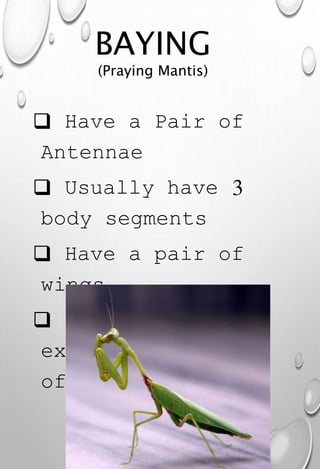
BAYING
(Praying Mantis)
 Have a Pair of
Antennae
 Usually have 3
body segments
 Have a pair of
wings
 Have a hard
exoskeleton, made
of chitin
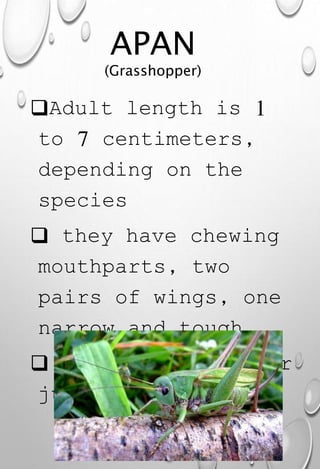
APAN
(Grasshopper)
Adult length is 1
to 7 centimeters,
depending on the
species
 they have chewing
mouthparts, two
pairs of wings, one
narrow and tough
 long hind legs for
jumping.
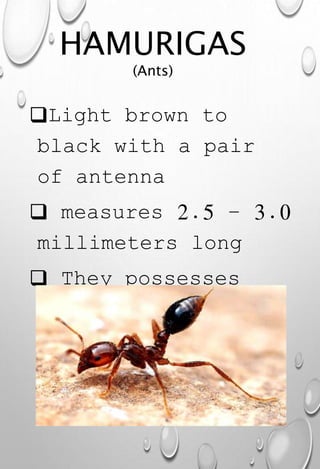
HAMURIGAS
(Ants)
Light brown to
black with a pair
of antenna
 measures 2.5 – 3.0
millimeters long
 They possesses
team work.
PASAYAN
(Shrimps)
Their bodies are
divided into two
parts: the thorax and
the head
 they live in deep
waters
 They can measure
between two and
twenty-five
centimeters long,
 they have small feet
and a sort of antennas
that are the same size
MASAG
(Crabs)
 MOST CRABS HAVE TWO
PAIRS OF ANTENNAE
 COVERED WITH A THICK
EXOSKELETON
 WALKING OR CRAWLING
IS THE USUAL MODE OF
LOCOMOTION
LUKON
(Lobster)
 HAVE TOUGH
EXOSKELETON AND A
HIGHLY FRAGMENTED OR
MULTI-JOINTED BODY
 MARINE CRUSTACEAN
WITH FIVE PAIRS OF
JOINTED LEGS.
 MOVEABLE, MUSCULAR
ABDOMEN
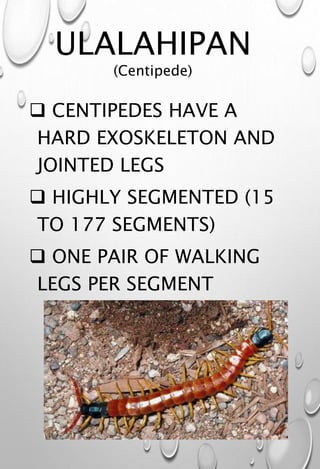
ULALAHIPAN
(Centipede)
 CENTIPEDES HAVE A
HARD EXOSKELETON AND
JOINTED LEGS
 HIGHLY SEGMENTED (15
TO 177 SEGMENTS)
 ONE PAIR OF WALKING
LEGS PER SEGMENT
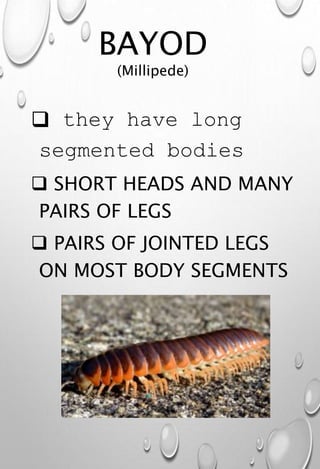
BAYOD
(Millipede)
 they have long
segmented bodies
 SHORT HEADS AND MANY
PAIRS OF LEGS
 PAIRS OF JOINTED LEGS
ON MOST BODY SEGMENTS
ULOD
(Caterpillar)
THEY NEED THIS ENERGY TO
TURN INTO MOTHS OR
BUTTERFLIES
 HEY HAVE SHORT
SEGMENTED ANTENNAE AND
STRONG JAWS
 OST CATERPILLARS HAVE
CYLINDRICAL BODIES
CONSISTING OF MULTIPLE
SEGMENTS
LAWA
(Spider)
 They have two body
parts
 they have
spinnerets at the
bottom of the
abdomen for
spinning webs
 there body range
from 17 to 48 mm
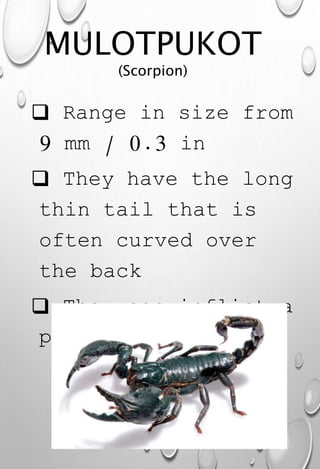
MULOTPUKOT
(Scorpion)
 Range in size from
9 mm / 0.3 in
 They have the long
thin tail that is
often curved over
the back
 They can inflict a
painful sting
GARAPATA
(Ticks)
 have ovoid or
pear-shaped bodies
which become
engorged with blood
when they feed
 All ticks are
parasitic
 Their body shape
color can greatly
change after a
blood meal.

ACTIVITY