Active vs Passive Learning: Which Boosts Success? | Anee's School
1.
Active Learning vs.Passive
Learning
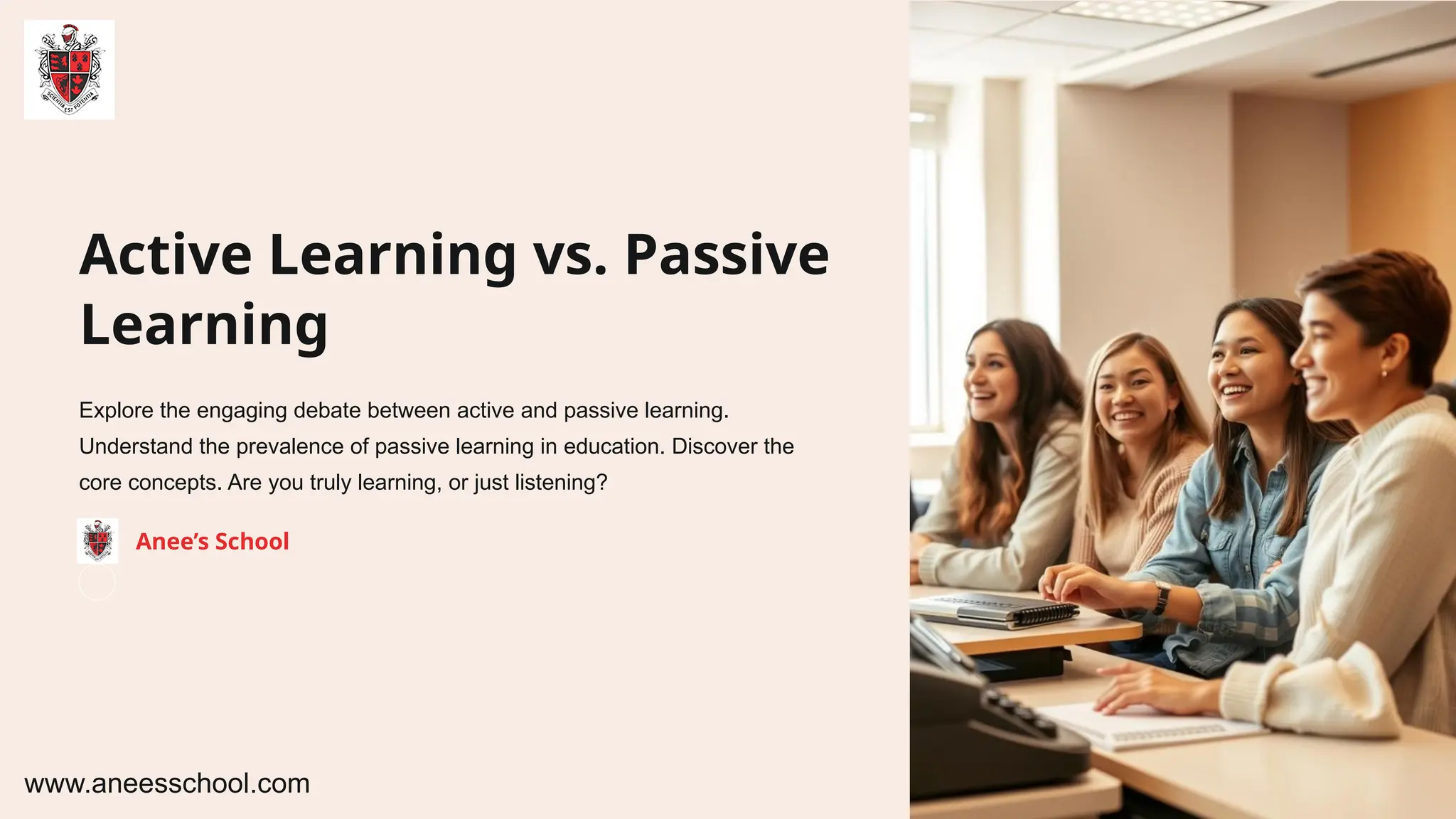
Explore the engaging debate between active and passive learning.
Understand the prevalence of passive learning in education. Discover the
core concepts. Are you truly learning, or just listening?
Anee’s School
www.aneesschool.com
2.
Defining Passive Learning
Passivelearning involves lectures and rote memorization. It
features one-way communication, with the teacher as the
source. Students are recipients.
Examples include listening to lectures and reading textbooks.
Watching videos without interaction is also passive.
Freeman et al. (2014) found higher failure rates in lecture-
based courses. Students are 1.5 times more likely to fail.
3.
Limitations of PassiveLearning
1 Reduced Retention
Limited engagement leads to
reduced retention and
comprehension.
2 Lack of Critical Thinking
It hinders critical thinking and
problem-solving skill development.
3 Superficial
Understanding
It fosters a superficial
understanding of concepts. This
hinders real-world application.
4.
Unveiling Active Learning
Activelearning emphasizes student engagement. It promotes
participation and collaboration.
Students take ownership through activities and discussions.
Problem-solving is key.
Tell me and I forget, teach me and I may remember, involve me and I learn. – Benjamin Franklin
5.
Benefits: Engagement and
Retention
IncreasedInvolvement
Active learning boosts student involvement and motivation.
Deeper Understanding
Students construct knowledge, leading to deeper
understanding.
Improved Retention
This promotes a more stimulating and enjoyable learning
environment.
6.
Cultivating Critical
Thinking
Analyze Information
Activelearning encourages
students to analyze information.
Develop Skills
It develops problem-solving
skills through real-world
application.
Foster Creativity
It fosters creativity, innovation, and independent thinking.
7.
Active Learning inAction
1
Flipped Classrooms
2 Project-Based Learning
3
Team-Based Learning
4 Simulations
A flipped classroom in a STEM course led to a 20% increase in exam scores.
8.
Addressing Common Concerns
Timeconstraints and logistical challenges are often cited. So is
student resistance.
Effective management requires proper planning. Facilitation
and assessment are key.
While active learning requires more preparation, the long-term benefits outweigh the initial investment.
9.
Conclusion: Active LearningTriumphs
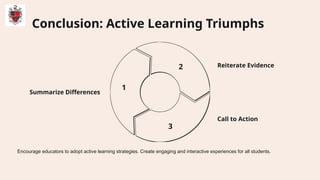
Summarize Differences
1
Reiterate Evidence
2
Call to Action
3
Encourage educators to adopt active learning strategies. Create engaging and interactive experiences for all students.
10.
Q&A and FurtherExploration
1 Questions?
The floor is open for questions and
discussion.
2 Resources
Explore relevant books, articles,
websites, and opportunities.
3 Thank You
Thank you for your participation.