MECX-32
AUTOMOBILE ENGINEERING
ACTIVE SAFETY SYSTEM
BY
 MOHAMED KABEER S A C
170021601107
 MOHAMED SHAKEEL M
180021601049
 MOHAMED SHAKIR S
180021601050
BSACIST
ACTIVE SAFETY SYSTEMS
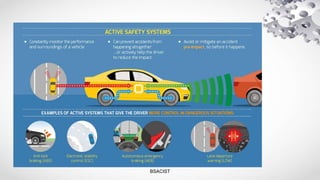
 In the automotive industry, active safety refers to the Advanced Driving
Assistance Systems (ADAS) in a vehicle that help drivers reduce the severity
of accidents or avoid them entirely by managing steering, braking and
propulsion.
 They include traction control, electronic stability control, and braking systems.
These also include advanced driver assist systems that use sensors such as
forward collision warning and lane departure warning, along with adaptive
cruise control.
 As now the industries were foucsing to avoid minor and major accidents using
artificial intellegence.
 Those safety systems plays an vital role at critical conditions to keep the
people inside the vehicle in much safer side.
 There are many systems used to provide better safety.
BSACIST
SYSTEM
 Head-Up Display (HUD)
 Anti-Lock Braking Systems (ABS)
 Electronic Stability Control (ESC)
 Tire Pressure Monitoring System (TPMS)
 Lane Departure Warning System (LDWS)
 Adaptive Cruise Control (ACC)
 Driver Monitoring System (DMS)
 Blind Spot Detection (BSD)
 Night Vision System (NVS)
BSACIST
BSACIST
EXAMPLE
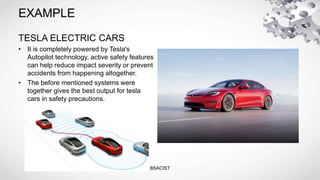
TESLA ELECTRIC CARS
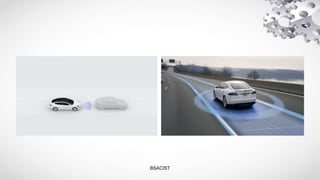
• It is completely powered by Tesla's
Autopilot technology, active safety features
can help reduce impact severity or prevent
accidents from happening altogether.
• The before mentioned systems were
together gives the best output for tesla
cars in safety precautions.
BSACIST
BSACIST
BSACIST
ANTI-LOCK BREAKING SYSTEM(ABS)
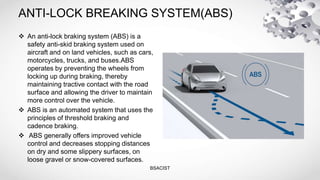
 An anti-lock braking system (ABS) is a
safety anti-skid braking system used on
aircraft and on land vehicles, such as cars,
motorcycles, trucks, and buses.ABS
operates by preventing the wheels from
locking up during braking, thereby
maintaining tractive contact with the road
surface and allowing the driver to maintain
more control over the vehicle.
 ABS is an automated system that uses the
principles of threshold braking and
cadence braking.
 ABS generally offers improved vehicle
control and decreases stopping distances
on dry and some slippery surfaces, on
loose gravel or snow-covered surfaces.
BSACIST
NIGHT VISION SYSTEM(NVS)
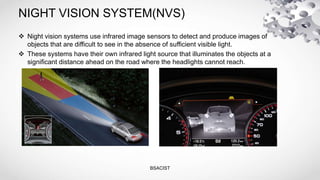
 Night vision systems use infrared image sensors to detect and produce images of
objects that are difficult to see in the absence of sufficient visible light.
 These systems have their own infrared light source that illuminates the objects at a
significant distance ahead on the road where the headlights cannot reach.
BSACIST
LANE DEPARTURE WARNING SYSTEM(LDWS)
 Lane departure warning system (LDWS) is a mechanism
designed to warn the driver when the vehicle begins to
move out of its lane (unless a turn signal is on in that
direction) on freeways and arterial roads. These systems
are designed to minimize accidents by addressing the
main causes of collisions: driver error, distractions and
drowsiness.
 Systems which warn the driver if the vehicle is leaving its
lane with visual, audible, and/or vibration warnings (lane
departure warning, LDW).
 Systems which warn the driver and, with no response,
automatically take steps to ensure the vehicle stays in its
lane (lane keeping assist, LKA/LKS).
 Systems which assist in oversteering, keeping the car
centered in the lane, and asking the driver to take over in
challenging situations.
BSACIST
BLIND SPOT DETECTION(BSD)
 Blind-spot monitoring is a vehicle-based
sensor device that detects other vehicles
located to the driver’s side and rear.
Warnings can be visual, audible, vibrating,
or tactile.
 Blind spot monitors may do more than
monitor the sides and rear of the vehicle.
They may also include "Rear Cross-Traffic
Alert",which alerts drivers backing out of a
parking space when traffic is
approaching from the sides.
BSACIST
THANK YOU
BSACIST

Active safety systems

  • 1.
    MECX-32 AUTOMOBILE ENGINEERING ACTIVE SAFETYSYSTEM BY  MOHAMED KABEER S A C 170021601107  MOHAMED SHAKEEL M 180021601049  MOHAMED SHAKIR S 180021601050 BSACIST
  • 2.
    ACTIVE SAFETY SYSTEMS In the automotive industry, active safety refers to the Advanced Driving Assistance Systems (ADAS) in a vehicle that help drivers reduce the severity of accidents or avoid them entirely by managing steering, braking and propulsion.  They include traction control, electronic stability control, and braking systems. These also include advanced driver assist systems that use sensors such as forward collision warning and lane departure warning, along with adaptive cruise control.  As now the industries were foucsing to avoid minor and major accidents using artificial intellegence.  Those safety systems plays an vital role at critical conditions to keep the people inside the vehicle in much safer side.  There are many systems used to provide better safety. BSACIST
  • 3.
    SYSTEM  Head-Up Display(HUD)  Anti-Lock Braking Systems (ABS)  Electronic Stability Control (ESC)  Tire Pressure Monitoring System (TPMS)  Lane Departure Warning System (LDWS)  Adaptive Cruise Control (ACC)  Driver Monitoring System (DMS)  Blind Spot Detection (BSD)  Night Vision System (NVS) BSACIST
  • 4.
  • 5.
    EXAMPLE TESLA ELECTRIC CARS •It is completely powered by Tesla's Autopilot technology, active safety features can help reduce impact severity or prevent accidents from happening altogether. • The before mentioned systems were together gives the best output for tesla cars in safety precautions. BSACIST
  • 6.
  • 7.
  • 8.
    ANTI-LOCK BREAKING SYSTEM(ABS) An anti-lock braking system (ABS) is a safety anti-skid braking system used on aircraft and on land vehicles, such as cars, motorcycles, trucks, and buses.ABS operates by preventing the wheels from locking up during braking, thereby maintaining tractive contact with the road surface and allowing the driver to maintain more control over the vehicle.  ABS is an automated system that uses the principles of threshold braking and cadence braking.  ABS generally offers improved vehicle control and decreases stopping distances on dry and some slippery surfaces, on loose gravel or snow-covered surfaces. BSACIST
  • 9.
    NIGHT VISION SYSTEM(NVS) Night vision systems use infrared image sensors to detect and produce images of objects that are difficult to see in the absence of sufficient visible light.  These systems have their own infrared light source that illuminates the objects at a significant distance ahead on the road where the headlights cannot reach. BSACIST
  • 10.
    LANE DEPARTURE WARNINGSYSTEM(LDWS)  Lane departure warning system (LDWS) is a mechanism designed to warn the driver when the vehicle begins to move out of its lane (unless a turn signal is on in that direction) on freeways and arterial roads. These systems are designed to minimize accidents by addressing the main causes of collisions: driver error, distractions and drowsiness.  Systems which warn the driver if the vehicle is leaving its lane with visual, audible, and/or vibration warnings (lane departure warning, LDW).  Systems which warn the driver and, with no response, automatically take steps to ensure the vehicle stays in its lane (lane keeping assist, LKA/LKS).  Systems which assist in oversteering, keeping the car centered in the lane, and asking the driver to take over in challenging situations. BSACIST
  • 11.
    BLIND SPOT DETECTION(BSD) Blind-spot monitoring is a vehicle-based sensor device that detects other vehicles located to the driver’s side and rear. Warnings can be visual, audible, vibrating, or tactile.  Blind spot monitors may do more than monitor the sides and rear of the vehicle. They may also include "Rear Cross-Traffic Alert",which alerts drivers backing out of a parking space when traffic is approaching from the sides. BSACIST
  • 12.